
A 4kW solar panel system is the most popular size for average UK households. It produces enough electricity to cover a meaningful share of a typical family’s annual demand, fits comfortably on most 3-bedroom roofs, and hits a sweet spot between upfront cost and long-term return. If you’re a 2-4 person household with annual consumption around 3,000-4,000 kWh, 4kW is almost certainly the size your installer will recommend.
Contents
- 1 Key Takeaways
- 2 What is a 4kW Solar Panel System?
- 3 How Many Panels Does a 4kW System Need?
- 4 How Much Does a 4kW Solar System Cost in the UK?
- 5 How Much Electricity Does a 4kW System Generate?
- 6 How Much Can You Save with a 4kW Solar System?
- 7 Payback Period for a 4kW Solar System
- 8 Should You Add Battery Storage to a 4kW System?
- 9 Is a 4kW System Right for You?
- 10 Case Study: A Family of Four in Leicester With a 4kW System
- 11 Expert Insights From Our Solar Panel Installers About 4kW Systems
- 12 Frequently Asked Questions
- 12.1 How many units of electricity does a 4kW solar system produce per day?
- 12.2 Is a 4kW solar system enough for a family of four?
- 12.3 How much roof space does a 4kW solar system need?
- 12.4 Can a 4kW solar system power an electric vehicle?
- 12.5 Does a 4kW solar system qualify for the Smart Export Guarantee?
- 12.6 How long do 4kW solar panels last?
- 12.7 Should I get 4kW or 5kW solar panels?
- 12.8 Can I expand my 4kW system later?
- 13 Summing Up
Key Takeaways
- A 4kW system uses 9-10 panels and needs approximately 17-21m² of usable roof space.
- Installed cost ranges from £6,500 to £8,500 at 0% VAT (valid until March 2027).
- Annual generation: approximately 3,200-3,600 kWh depending on location and orientation.
- Annual savings: £580-£780 combining self-consumption savings and Smart Export Guarantee income.
- Payback period: 9-13 years, leaving 12+ years of free generation within the 25-year panel warranty.
- Best suited to 2-4 person households in 3-bedroom properties with annual consumption of 3,000-4,500 kWh.
What is a 4kW Solar Panel System?
A 4 kilowatt-peak (4kWp) solar installation is a mid-size residential system capable of generating up to 4,000 watts under peak conditions. In UK climates, actual annual output averages around 3,200-3,600 kWh, which compares well with the average UK household’s electricity consumption of approximately 3,500 kWh per year.
A decade ago, 4kW systems used 16-20 panels rated at 200-250W each. Today’s 400-450W panels bring that count down to just 9-10 panels, requiring significantly less roof space than older installations of the same capacity. This makes 4kW systems accessible to properties with moderate roof sizes, including many Victorian and Edwardian terraced houses that previously had limited solar potential.
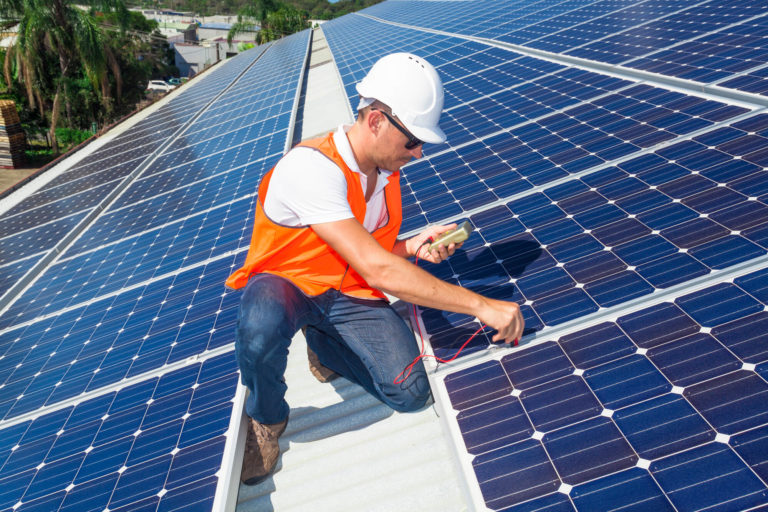
The system includes panels, a 4kW string inverter or microinverters, mounting hardware, DC isolators, AC connection to the consumer unit, a generation meter, and optional monitoring hardware. MCS-accredited installers must register the installation with the MCS database, which is required to access the Smart Export Guarantee (SEG).
How Many Panels Does a 4kW System Need?
With 400W panels, a 4kW system requires exactly 10 panels. With 425W or 450W panels, 9 panels gives you 3.825kW or 4.05kW respectively, so many installers will go for 9 premium-rated panels rather than 10 standard ones. The panel choice depends on your roof size and whether you want to maximise capacity or minimise panel count.
Each panel is approximately 1.7m x 1.0m (1.7m²). Ten panels occupy around 17m² of gross roof space; after accounting for gaps between panels and edge setbacks, you need roughly 19-22m² of total usable roof area. Most south-facing sections of a 3-bedroom semi-detached or detached property will accommodate 10 panels with room to spare.
How Much Does a 4kW Solar System Cost in the UK?
A fully installed 4kW system in 2026 costs between £6,500 and £8,500, including scaffolding, inverter, all wiring, and MCS registration. The 0% VAT rate on residential solar installations saves you around £325-425 compared to the 5% rate that applied before April 2022.
| Component | Budget | Mid-Range | Premium |
|---|---|---|---|
| Panels (9-10 x 400-450W) | Tier 2 brand | Jinko/LONGi/Trina | REC/Panasonic/SunPower |
| Inverter | Growatt/Solis | SolarEdge/Fronius | SolarEdge HD Wave |
| Installed cost | £6,500-7,000 | £7,000-7,800 | £7,800-8,500 |
| Monitoring | Basic app | Full platform | Full platform + optimisers |
| Panel warranty | 10-12 years | 15 years | 25 years |
If your roof is complex (multiple slopes, roof lights, chimney stacks), expect to pay toward the upper end of the range. Scaffolding costs are generally included in installer quotes, but always confirm this before signing. An MCS-certified installer is required to access the SEG, so don’t cut corners on accreditation.
How Much Electricity Does a 4kW System Generate?
On a south-facing roof at 30-40° pitch, a 4kW system produces approximately 3,200-3,600 kWh annually. Regional variation is significant: a system in Cornwall generates around 20% more than an identical system in Aberdeen. East-west splits or north-facing roof sections will reduce output by 15-30%.
| Region | Annual Output (4kW south-facing) | Monthly Average |
|---|---|---|
| South West England | 3,500-3,700 kWh | 292-308 kWh |
| South East England | 3,400-3,600 kWh | 283-300 kWh |
| Midlands | 3,100-3,350 kWh | 258-279 kWh |
| North West England | 2,900-3,100 kWh | 242-258 kWh |
| Scotland | 2,700-3,000 kWh | 225-250 kWh |
Monthly generation varies enormously. In June and July, a Midlands 4kW system produces 450-500 kWh. In December and January, that falls to 80-100 kWh. This seasonal pattern means most solar savings come in the spring and summer months, with solar contribution dropping off significantly in winter.
| Month | Estimated Output (Midlands, 4kW) |
|---|---|
| January | 90 kWh |
| February | 145 kWh |
| March | 265 kWh |
| April | 355 kWh |
| May | 420 kWh |
| June | 465 kWh |
| July | 455 kWh |
| August | 395 kWh |
| September | 290 kWh |
| October | 190 kWh |
| November | 110 kWh |
| December | 80 kWh |
How Much Can You Save with a 4kW Solar System?
Annual savings depend on how much generated electricity you use directly versus export. A typical family home with daytime occupancy self-consumes 45-55% of generation. An all-out household shifts that to 30-35%, exporting most of the midday surplus.
| Scenario | Self-Consumption | Units Used (3,300 kWh gen) | Saved at 27p | SEG Income at 15p | Total Annual Benefit |
|---|---|---|---|---|---|
| Home all day | 60% | 1,980 kWh | £535 | £198 | £733 |
| Typical household | 45% | 1,485 kWh | £401 | £272 | £673 |
| Out all day | 30% | 990 kWh | £267 | £347 | £614 |
| With 5kWh battery | 70% | 2,310 kWh | £624 | £149 | £773 |
SEG rates in 2026: Octopus Energy 15p/kWh, OVO Energy 12p/kWh, E.ON Next 15p/kWh, EDF 12p/kWh. Some time-of-use tariffs like Octopus Flux add further value by allowing export at variable rates that can reach 20p+ during peak grid demand periods.
Payback Period for a 4kW Solar System
At an installed cost of £7,500 and annual savings of £673, payback takes approximately 11 years. That’s well within the 25-year product warranty period, leaving 14 years of effectively free generation after payback. Feed-in Tariff recipients from before 2019 sometimes saw payback in as little as 6-8 years, thanks to the 43.3p/kWh generation tariff; SEG payments are lower, but system costs have fallen dramatically to compensate.
| System Cost | Annual Saving | Payback Period | 25-Year Net Saving |
|---|---|---|---|
| £6,500 | £673 | 9.7 years | £10,325 |
| £7,500 | £673 | 11.1 years | £9,325 |
| £8,000 | £673 | 11.9 years | £8,825 |
| £8,500 | £673 | 12.6 years | £8,325 |
Should You Add Battery Storage to a 4kW System?
A 4kW system paired with a 5-10kWh battery is one of the most popular combinations for UK family homes. The battery captures the midday generation surplus (when most households aren’t home) and makes it available in the evening when demand peaks. For a 4kW system, a 5-7kWh battery is typically well-matched, storing the excess from a good summer day without oversizing for winter output.
Battery costs at 0% VAT range from £3,500 to £7,000 for a 5-10kWh LiFePO4 unit. Popular choices include the Fox ESS H3 (5.12kWh expandable), Solis RHI series, and Tesla Powerwall 3 (13.5kWh). If you’re also considering a smart time-of-use tariff, the combined benefit of cheap overnight grid charging plus solar self-consumption can cut a family electricity bill by 60-70%.
Note: GivEnergy systems are widely installed in the UK but GivEnergy went into administration in early 2025. Existing GivEnergy batteries continue to function, but check current warranty and support status before purchasing new units.
Is a 4kW System Right for You?
A 4kW system suits most 2-4 person households in 3-bedroom properties. It’s the default recommendation from most UK installers because it closely matches average household consumption and fits on most semi-detached or detached roofs without requiring a large south-facing area.
Consider stepping up to 5kW or 6kW if you have an electric vehicle you want to charge from solar, a heat pump, or particularly high electricity consumption (above 4,500 kWh/year). The incremental cost of one or two extra panels at installation time is modest, and it’s easier to add capacity upfront than retrofit later. Step down to 3kW if your roof is small, your budget is tight, or you’re a single-person household with low electricity use.

Case Study: A Family of Four in Leicester With a 4kW System
Background
A family of four in Leicester owned a 1990s detached house with a large south-facing rear roof. Annual electricity consumption was approximately 4,100 kWh. The parents worked from home three days a week and had two school-age children, meaning daytime demand was reasonably high.
Project Overview
Their MCS-accredited installer surveyed the property and recommended a 4kW system, comprising 10 x 400W LONGi panels with a SolarEdge string inverter and individual power optimisers on each panel (to handle minor shading from a rooftop chimney stack). Total installed cost was £7,900 including scaffolding.
Implementation
Installation took one day. The SolarEdge monitoring app showed 3,380 kWh generated in the first year. With both adults working from home during the week, the household self-consumed approximately 57% of generation, using solar electricity directly for laptops, lighting, and cooking during daylight hours.
Results
Year one: £519 saved on electricity (1,927 kWh at 27p) plus £109 in SEG income from Octopus Energy (1,453 kWh exported at 7.5p, as they were on an older rate). Total benefit: £628. After switching to a better SEG tariff the following year at 15p/kWh, their projected annual benefit rose to £783. Payback at that rate: 10.1 years on the £7,900 installation.
Expert Insights From Our Solar Panel Installers About 4kW Systems
One of our senior solar panel installers with 18 years of experience across the UK says the 4kW system is still the standard recommendation for families. “You can’t go wrong with 4kW for a 3-bed house if the roof faces roughly south. Even southeast or southwest gives good results. The clients who stretch to 5kW often say they wish they’d done it sooner, especially once they get an EV. But for a straightforward family home with no EV and moderate electricity use, 4kW does the job well and the payback is predictable.”
Frequently Asked Questions
How many units of electricity does a 4kW solar system produce per day?
On average across the year, a 4kW system in the UK produces around 9 kWh per day. This varies significantly by season: 14-16 kWh on a clear summer day, dropping to 3-4 kWh in mid-winter. The daily average of 9 kWh is a useful planning figure, though actual bills savings depend heavily on when you use electricity relative to when the panels generate it.
Is a 4kW solar system enough for a family of four?
A 4kW system generates around 3,200-3,600 kWh per year, which covers roughly 70-90% of a typical family of four’s annual consumption of 3,500-4,200 kWh. You’ll still need grid electricity for evenings and winter, but a 4kW system can dramatically reduce your grid imports, particularly if you shift high-consumption appliances like dishwashers and washing machines to run during daylight hours.
How much roof space does a 4kW solar system need?
A 4kW system with 9-10 panels requires approximately 17-21m² of usable roof space. Most 3-bedroom semi-detached or detached properties with a south-facing roof slope have well over this amount available. Your installer will survey the roof and confirm how many panels fit after accounting for edge setbacks, chimneys, and roof lights.
Can a 4kW solar system power an electric vehicle?
In summer, yes, a 4kW system can generate enough electricity on a good day to fully charge a small EV (e.g. adding 50-60 miles of range from a midday surplus). In winter, generation is too low to charge an EV meaningfully from solar alone. Most EV owners with 4kW systems use solar to partially offset EV charging costs rather than relying on it exclusively, and combine solar with a smart EV charger that can prioritise solar generation during daylight hours.
Does a 4kW solar system qualify for the Smart Export Guarantee?
Yes. Any system installed by an MCS-accredited installer qualifies for the Smart Export Guarantee (SEG), regardless of size. SEG pays you for every kWh you export to the grid. Rates vary by supplier, from around 12p/kWh (EDF, OVO) to 15p/kWh (Octopus, E.ON Next). You must register for SEG after installation and choose a licensed SEG licensee to pay your export income.
How long do 4kW solar panels last?
Quality solar panels carry a 25-year performance warranty, guaranteeing at least 80-84% of rated output at end of life. Physical product warranties (against defects) are typically 10-25 years depending on the manufacturer. In practice, well-maintained panels often continue performing beyond 30 years, though at reduced efficiency. The inverter, by contrast, typically needs replacing after 10-15 years at a cost of £800-1,500.
Should I get 4kW or 5kW solar panels?
If your roof has space and your budget allows, 5kW is almost always the better long-term investment. The additional 1kW of capacity adds roughly one or two panels, costs around £1,000-1,500 more at installation, and generates an extra 800-1,000 kWh per year. That extra generation pays back at the same rate as the base system, so you’re not paying a premium for the upgrade relative to what you get. 4kW is the right choice if roof space or budget is genuinely constrained.
Can I expand my 4kW system later?
It’s possible but rarely straightforward. Adding panels to an existing system requires checking whether the inverter can handle more capacity, whether the roof structure and mounting can accommodate additional panels, and potentially upgrading the inverter. The cost of a retrofit expansion is significantly higher per kW than installing the larger system upfront. If you think you might want more capacity in the future (especially if you’re considering an EV or heat pump), install the larger system from the start.
Summing Up
A 4kW solar panel system is the UK’s most popular residential solar installation for good reason. At £6,500-£8,500 installed, it generates around 3,200-3,600 kWh per year, saving a typical household £600-£780 annually in electricity costs and SEG income. Payback takes 9-13 years, well within the 25-year panel warranty period. It’s the natural first choice for 2-4 person families in 3-bedroom properties with a south-facing roof, and works well as a standalone installation or paired with a 5-10kWh battery. If your household has an EV or heat pump, consider stepping up to 5kW or 6kW to make the most of your roof’s potential.
Updated