
If you want to attract more birds to your garden and add a gentle glow after dark, a solar bird feeder does both jobs in one. The HOUSESAPP Solar Bird Feeder is our top pick for 2026, offering a generous seed capacity, reliable solar charging, and a warm LED light that works well even after a typical grey UK day.
Solar bird feeders have become genuinely popular in UK gardens over the past few years, and it is easy to see why. They remove the need to run cables or replace batteries while giving your garden an inviting lit-up look from dusk onwards. Whether you are after something decorative for a patio or a practical feeder for a wildlife-friendly garden, there is a good option at every price point.
Contents
- 1 Our Top Picks
- 2 6 Best Solar Bird Feeders for UK Gardens
- 3 Solar Bird Feeders Buying Guide
- 3.1 Key Takeaways
- 3.2 Feeder-First vs Light-First Design Philosophy
- 3.3 LED Types: Warm White vs Multicolour RGB
- 3.4 Seed Hopper Capacity and Refill Frequency
- 3.5 Perch Design and Bird Species Attraction
- 3.6 Hanging vs Post-Mounted Stability and Bird-Watching Quality
- 3.7 Material: Metal Mesh vs Solid Plastic vs Wooden Slats
- 3.8 Battery Capacity and Charging Cycles in UK Winter
- 3.9 RGB Novelty vs Warm White Longevity
- 4 Case Study: Solar Bird Feeder in a West Midlands Garden
- 5 Expert Insights From Our Solar Panel Installers About Solar Bird Feeders
- 6 Frequently Asked Questions
- 6.1 Do solar bird feeders work in the UK?
- 6.2 Where is the best place to hang a solar bird feeder?
- 6.3 What seeds should I put in a solar bird feeder?
- 6.4 How long do solar bird feeder lights last at night?
- 6.5 Are solar bird feeders safe for garden birds?
- 6.6 How do I clean a solar bird feeder?
- 6.7 Will a solar bird feeder work through the winter?
- 6.8 Can I leave a solar bird feeder out in the rain?
- 7 Summing Up
Our Top Picks
| Image | Name | |
|---|---|---|
| HOUSESAPP Solar Bird Feeder | |
| LEKIA Solar Lantern Bird Feeder | |
| MLEPXBO Solar Bird Feeder | |
| Solar Bird Feeder with Garden Lantern | |
| Taylor & Brown Solar Bird Bath Feeder | |
| HouseSapp Solar Bird Feeder Large Capacity |
6 Best Solar Bird Feeders for UK Gardens
1. HOUSESAPP Solar Bird Feeder with LED Lights
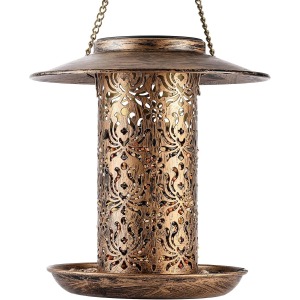
The HOUSESAPP Solar Bird Feeder is our top recommendation for most UK gardens. It combines a well-designed seed hopper with an integrated solar LED light, so you get both a practical feeder and an attractive garden ornament in one purchase. The seed capacity is generous enough to last several days between refills, which matters if you are catering for a busy garden bird population.
The solar panel charges efficiently in the diffuse UK daylight that is typical for much of the year, not just on sunny days. The LED kicks in at dusk and provides a warm, amber glow that makes it a genuinely pleasant thing to look at from a kitchen window on an autumn evening. It works on most small to medium garden birds and the wide perch design gives sparrows, tits, and finches plenty of room to feed comfortably.
Build quality is solid for the price range. The hanging hook is robust and the seed port is designed to stay reasonably rain-resistant, which is important given how much rain UK gardens see between October and April. A removable base tray catches fallen seeds and prevents mess beneath the feeder.
This is the feeder we would buy for a typical UK garden where you want one product that looks attractive, attracts wildlife, and does not need much maintenance. The combination of reliable solar charging, good capacity, and warm lighting puts it ahead of the competition.
Features
- Integrated solar LED with warm amber light
- Large seed capacity, suitable for most small garden birds
- Wide perch design accommodating multiple birds
- Removable base tray for easy cleaning
- Rain-resistant seed port
- Sturdy hanging hook for tree or bracket mounting
- Reliable solar charging in diffuse UK light
- Good seed capacity reduces refill frequency
- Warm LED glow looks attractive after dark
- Solid construction for the price
- Light output is decorative rather than functional
- Hanging hook requires a suitable branch or bracket
2. LEKIA Solar Lantern Bird Feeder
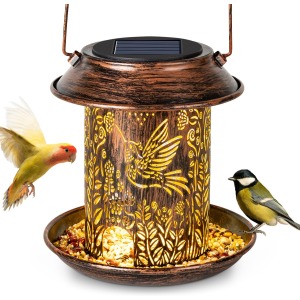
The LEKIA Solar Lantern Bird Feeder takes a slightly different design approach, combining a traditional lantern aesthetic with a seed tray. It is a good choice if you want something that doubles as a garden decoration and does not look like an obvious bird feeder at a glance. The warm amber LED light is housed within the lantern body, creating a nice glow that suits cottage-style and traditional garden layouts particularly well.
At around £14, this is one of the more affordable solar feeders on the market and represents good value. The seed capacity is a little smaller than the HOUSESAPP above, but for a garden with lighter bird traffic that will not be an issue. Easy to fill via the removable lid and the solar panel on top charges reliably throughout the UK spring and summer.
One thing worth knowing is that the lantern-style design can make accessing the seed tray slightly less straightforward than a standard feeder. It is not a dealbreaker, but worth considering if you are refilling daily.
Features
- Traditional lantern design with warm LED lighting
- Removable lid for easy seed refilling
- Built-in solar panel on lantern roof
- Hanging chain included
- Suitable for most mixed seed blends
- Attractive lantern design suits traditional gardens
- Good value at under £15
- Warm LED glow works well as evening ornament
- Smaller seed capacity than some alternatives
- Lantern design makes refilling slightly fiddly
- Less suited to high-traffic feeding stations
3. MLEPXBO Solar Bird Feeder with LED Light
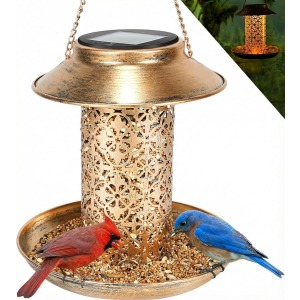
MLEPXBO’s solar feeder is a practical, no-frills option that focuses on doing the basics well. The waterproof design is genuinely rain-resistant and holds up to repeated exposure to the wet UK climate without the casing deteriorating quickly. The solar LED provides several hours of gentle light after dusk and the panel charges adequately on overcast days.
The seed capacity sits in the mid-range and should comfortably serve a garden with moderate bird activity. Tits, sparrows, and finches will all use it readily. The price puts it slightly above the budget end of the market but below the premium options, which makes it a reasonable middle ground if you want something durable without spending too much.
Features
- Waterproof construction rated for outdoor use
- Solar LED with automatic dusk-to-dawn activation
- Mid-capacity seed hopper
- Removable base for cleaning
- Hanging cord included
- Genuinely waterproof for UK conditions
- Reliable automatic light activation
- Good mid-range value
- Design is functional rather than decorative
- Seed hopper smaller than premium options
- Light not the brightest in this category
4. Solar Bird Feeder with Garden Lantern Light
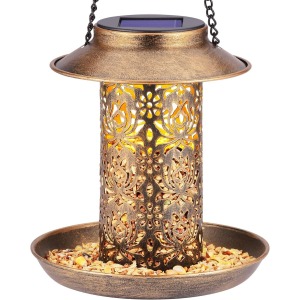
This solar bird feeder takes a two-in-one approach, combining a seed station with a decorative garden lantern light. The lantern sits above the feeder tray and produces a warm glow that makes it look like a piece of garden decor as much as a wildlife product. It is a good option for gardens where aesthetics matter as much as function.
The seed tray is easy to access for refilling, and the solar panel on top keeps the light running through most UK evenings with reasonable reliability. The mid-range price reflects the dual-purpose design. Birds tend to use the open tray readily once they discover it, though the open design means it is better suited to dry spells or covered positions during heavy rain.
Features
- Decorative lantern light above the seed tray
- Open tray design for easy access by birds
- Solar-powered warm LED
- Hanging loop for tree or bracket use
- Suitable for mixed seed and suet pellets
- Attractive dual-purpose design
- Open tray appeals to a wide range of bird species
- Good value for the lantern-plus-feeder combination
- Open tray exposes seed to rain
- Better suited to sheltered positions
- Light not as bright as dedicated solar lights
5. Taylor & Brown Solar Bird Bath Feeder
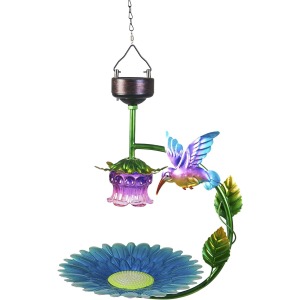
The Taylor and Brown Solar Bird Bath Feeder is a versatile option that doubles as both a seed station and a shallow bird bath. Birds use it for both drinking and bathing, which makes it more attractive to a wider range of species than a seed-only feeder. The solar LED ring around the base adds a gentle decorative glow after dark.
At under £13, this is one of the more affordable options and represents decent value for what it offers. The shallow dish design is easy to clean and refill, though the open nature means seeds and water are both exposed to rain. Best positioned in a semi-sheltered spot.
Features
- Combined bird bath and seed feeder design
- Solar LED ring around base for evening illumination
- Shallow dish easy to clean and refill
- Hanging chain included
- Suitable for seed, suet, and water
- Dual bath and feeder function attracts more species
- Excellent value at under £13
- Very easy to clean
- Open dish means seed and water mix in rain
- LED ring is subtle rather than bright
- Smaller capacity than dedicated feeders
6. HouseSapp Solar Bird Feeder Large Capacity
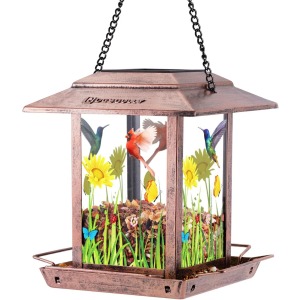
This large-capacity solar bird feeder from HouseSapp holds up to 2.5 lbs of seed, making it ideal for gardens where you want to go longer between refills. The extra capacity means it is better suited to gardens with higher bird activity, or simply to anyone who finds frequent refilling inconvenient.
The solar LED panel handles overcast UK days reasonably well. The build quality is solid, and this feeder is well suited to hanging from a sturdy branch or a dedicated feeding station pole. The combination of high capacity and reliable lighting makes it a strong second option to our top pick from the same brand.
Features
- 2.5 lb seed capacity for less frequent refilling
- Solar LED with warm light output
- Durable weather-resistant casing
- Wide perch for multiple feeding birds
- Removable base tray
- Large capacity reduces refill frequency
- Solid build quality for long-term garden use
- Good solar charging in typical UK light
- Heavier when full, needs a strong mounting point
- Similar design to top pick, so little to differentiate them
- Pricier per unit than some alternatives
Solar Bird Feeders Buying Guide
Key Takeaways
- Decide whether you want a feeder-first design (primary function is feeding birds) or a light-first design (primarily decorative with token seeds)
- Bird feeders without LED lights are simpler and cheaper; feeders with warm white LEDs are best for ambiance, RGB lights seem novelty
- Capacity matters: 200-400g seed hoppers suit small gardens or frequent refills; 800-1,200g hoppers work for 5-7 days before refilling
- Perch design determines which birds will feed — wide perches suit pigeons and doves; small narrow perches suit finches and robins
- Hanging vs post-mounted affects stability and viewing angle — hanging feeders rock gently and suit tree viewing; post-mounted are steadier for close observation
- Metal mesh or wooden slats let water drain quickly, which is essential for UK weather; solid plastic bottoms collect rainwater and promote mould
Feeder-First vs Light-First Design Philosophy
This is the defining choice, and it affects the entire product. A feeder-first design is built primarily to hold seed and attract birds. The solar light is a secondary feature that illuminates the feeder in the dark. These are practical, well-built feeders that happen to have a light.
A light-first design is built primarily as a garden ornament with an integrated light. The feeder is a small seed hopper that’s more decorative than functional. These are pretty lights that happen to attract some birds.
If you want to actually attract and observe birds, buy feeder-first designs. If you want a decorative garden light that occasionally attracts birds, buy light-first. There’s nothing wrong with either choice, but if you buy a light-first product expecting serious bird feeding, you’ll be disappointed.
Most solar bird feeders fall somewhere in the middle, but the design intent is usually clear: quality feeders have serious seed hoppers and professional perch design. Novelty feeders have small toy-like hoppers and ornamental perches.
LED Types: Warm White vs Multicolour RGB
| Light Type | Effect | Cost | Best For |
|---|---|---|---|
| Warm White (2700K) | Creates cosy amber glow, very natural-looking, blends with garden design | £25-60 | Traditional gardens, evening ambiance, dusk-to-dawn viewing |
| Cool White (5000K) | Bright white, clinical, highlights detail clearly, visible from indoors | £20-50 | Modern gardens, observation at night, close detail viewing |
| Multicolour RGB (Red/Green/Blue) | Colour-changing modes, fun first time, visually tiring after 2-3 weeks | £35-75 | Children’s gardens, temporary novelty, theme events |
Warm white is the overwhelmingly popular choice for bird feeders, and for good reason. A warm amber light looks beautiful in a garden, it’s less visually fatiguing, and it doesn’t interfere with birds’ natural circadian rhythms. Birds have evolved to recognize warm firelight (from sunset and cooking fires) as natural, whilst cool white LED light looks alien to them.
RGB (multicolour) lights seem exciting in product photos, but they get old fast. You might use the colour-changing mode once a week at first, then never touch it again. The novelty wears off. Meanwhile, a warm white feeder looks beautiful every single evening for years.
Seed Hopper Capacity and Refill Frequency
Solar bird feeders come in roughly two capacity tiers. Small feeders (200-400g seed capacity) are lightweight, suit balcony and patio use, and need refilling every 2-3 days in busy seasons. Medium feeders (600-1,200g) suit gardens with regular bird traffic and go 4-7 days between refills.
Capacity isn’t just about seed volume — it’s about how often you want to be outside refilling. Small is better for people who enjoy the ritual of daily refilling and close bird observation. Medium is better for people who want to set up and forget for a week.
Also consider that very large feeders (1,500g+) exist but are less common in the solar market. A feeder that size is usually non-solar. If you want that capacity, a traditional feeder with optional solar lights might be better than a light-first solar feeder.
Perch Design and Bird Species Attraction
The perches (small dowels or wires that birds stand on to eat) determine which birds will visit. Wide perches (8-10mm diameter) suit pigeons, collared doves, and larger garden birds. Narrow perches (3-4mm) suit finches, robins, blue tits, and smaller songbirds.
Mixed-size perches (some wide, some narrow) attract a diversity of bird species. Single-size perches (especially narrow) create a hierarchy where small birds feed easily and larger birds struggle. This can be intentional if you want finches but not pigeons, or it can be accidental if you didn’t think about perch design.
Check the product photos closely. A feeder with six small dowels spaced widely apart suits small birds. A feeder with a tray platform underneath the seed hopper suits larger ground-feeding birds. There’s no “best” design, but choose based on which birds you want to attract.
Hanging vs Post-Mounted Stability and Bird-Watching Quality
Hanging bird feeders sway gently and rock in the wind — birds enjoy this subtle movement (it seems natural), and you get to watch the feeder swing as you observe from inside the house. They’re often more aesthetically pleasing and suit garden designs with pergolas or tree branches overhead.
Post-mounted feeders (screwed to a deck rail or garden structure) are steadier and don’t rock. They’re better for close observation from a fixed window angle and better for birds with poor balance (very young fledglings, injured birds). Post-mounted feeders look more utilitarian and suit modern gardens.
Hanging feeders usually have a cable and hook. Check that the hook is stainless steel (not painted mild steel that rusts). Post-mounted feeders need screw fixings, which are sometimes included and sometimes not — check the product packaging.
Material: Metal Mesh vs Solid Plastic vs Wooden Slats
This matters because the UK gets a lot of rain, and bird feeders collect water. A feeder with a metal mesh base or wooden slats drains quickly. Water runs straight through. A feeder with a solid plastic bottom collects rainwater, and if it sits there for days, mould and algae grow in the hopper, which can make seeds inedible and harm birds.
Metal mesh is best: it drains completely and dries fast. Wood slats drain well but can rot if not maintained (annual sanding/oiling is ideal). Solid plastic is the worst unless the feeder has large drainage holes. If you see a feeder with a solid base and no drainage holes listed in the spec, avoid it.
Also check the material composition: stainless steel or anodized aluminium don’t rust; mild steel will rust unless powder-coated (and the coating chips); plastic feeders last 3-5 years before UV fading and brittleness.
Battery Capacity and Charging Cycles in UK Winter
Most solar bird feeders use 800-1,500mAh batteries. This gives 3-5 hours of light on a summer charge and 1-2 hours on a winter charge. In December, when you need the light most (dusk is 3:30pm), an underpowered solar feeder might run out by 8pm.
If you’re planning to leave the light on all evening (6pm to 11pm), look for feeders with 1,500mAh+ batteries. If you only want accent lighting for the first hour of darkness, smaller batteries are fine.
Also factor in that winter charging is weak in the UK. A feeder that claims 5 hours of light might only manage 2 hours in December because the solar panel barely charged it during the short daylight. Check reviews from UK users describing winter performance, not marketing claims.
RGB Novelty vs Warm White Longevity
On a final note: choose warm white if you want this feeder to be lovely for years. Choose RGB if you want visual novelty for a few weeks. The psychological effect is real — a warm white feeder never feels dated or tired. An RGB feeder feels exciting for about 7 days, then just like a flickering light. Plan for winter demand when choosing capacity.
Case Study: Solar Bird Feeder in a West Midlands Garden
Background
A retired couple in Worcestershire with a medium-sized south-facing garden wanted to encourage more wildlife after reducing the lawn area and adding more planting. They had tried conventional hanging feeders before but found the lack of winter light meant the garden felt uninviting after 4pm.
Project Overview
They installed two solar bird feeders: the HOUSESAPP model near the kitchen window and a Taylor and Brown bird bath feeder at the back of the garden. The aim was to attract more species and have something visible and lit from the house in the evenings from autumn onwards.
Implementation
Both feeders were hung from purpose-made shepherd’s hook poles to ensure good solar exposure without relying on shaded trees. The HOUSESAPP feeder was positioned about 1.5 metres from the kitchen window for easy viewing. The bird bath feeder was placed on a border edge where blackbirds and thrushes were already active.
Results
Within two weeks, blue tits, great tits, coal tits, and house sparrows were using the HOUSESAPP feeder regularly. The bath feeder attracted blackbirds and a pair of robins. The couple noted that the evening LED glow made the garden feel welcoming well into the darker months, and that they checked on the feeder far more often than they had with conventional feeders. Both units continued working through a wet November without any issues.
Expert Insights From Our Solar Panel Installers About Solar Bird Feeders
One of our senior solar panel installers with over 15 years of UK residential experience explains:
“The same principles that matter for full solar panel installations apply to solar garden products. Positioning matters far more than most people realise. I see a lot of solar bird feeders hung under tree canopy where the panel gets almost no direct light. On a clear day in June that might still work, but come October with short days and constant cloud, the battery never gets a proper charge. Move the feeder to an open, south-facing position and you will get dramatically better performance from October through March. It is a five-minute fix that makes a big difference.”
Frequently Asked Questions
Do solar bird feeders work in the UK?
Yes. Most solar bird feeders are designed to charge in diffuse daylight, not just direct sunshine, so they work throughout the UK year including overcast days. Performance is strongest from March to September. In winter, a well-positioned feeder will typically give three to five hours of evening light after a typical UK cloudy day.
Where is the best place to hang a solar bird feeder?
Hang your solar bird feeder in a position that receives at least four hours of daylight, ideally facing south or south-west. Avoid hanging it under dense tree canopy or in north-facing shade. The feeder should be high enough to deter cats (at least 1.5 metres) but low enough to refill easily. Positioning it within view of a window gives you the best bird-watching experience.
What seeds should I put in a solar bird feeder?
Sunflower hearts are the most popular choice and attract the widest range of UK garden birds including tits, finches, sparrows, and nuthatches. Mixed seed blends work well but generate more husk waste beneath the feeder. Nyjer (thistle) seed attracts goldfinches specifically but requires a feeder with fine mesh ports. Most solar bird feeders accept standard sunflower hearts and mixed blends.
How long do solar bird feeder lights last at night?
After a full charge from a bright spring or summer day, most solar bird feeders will run the LED for six to eight hours. After a typical UK overcast winter day, expect three to five hours of light. The LED activates automatically at dusk via a light sensor and switches off either at dawn or when the battery runs down.
Are solar bird feeders safe for garden birds?
Yes. Solar bird feeders use a small, cool LED light that does not produce heat and poses no risk to birds feeding or roosting nearby. The main safety consideration is positioning: hang the feeder at a height that prevents cats from reaching it, ideally above 1.5 metres and away from low branches or fences that give cats a jumping platform.
How do I clean a solar bird feeder?
Empty any remaining seed first, then remove the base tray and seed hopper if they detach. Wash with warm soapy water, rinse thoroughly, and allow to dry completely before refilling. Avoid submerging the solar panel or battery compartment in water. Clean every two to four weeks to prevent mould and bacteria that can harm birds. A mild disinfectant solution (one part bleach to nine parts water) can be used for a monthly deep clean.
Will a solar bird feeder work through the winter?
Solar bird feeders work in winter but with reduced light output compared to summer. The shorter days and lower sun angle mean the battery gets less charge each day. You will typically get three to five hours of evening light rather than six to eight. The feeder function itself is unaffected by season: birds will visit year-round and winter feeding is particularly valuable when natural food sources are scarce.
Can I leave a solar bird feeder out in the rain?
Most solar bird feeders are designed for outdoor use and are weather-resistant. Look for models with an IP rating (IP44 or higher) or an explicit waterproof description for the best protection. The seed port and battery compartment are the most vulnerable areas: a well-designed feeder keeps water out of both. Fully waterproof models can be left out year-round without concern.
Summing Up
Solar bird feeders are one of the more practical solar garden products available, combining genuine wildlife benefit with attractive evening lighting in a single low-maintenance unit. The HOUSESAPP Solar Bird Feeder is the strongest all-round choice for most UK gardens, with good capacity, reliable solar charging, and a warm LED that works well even after overcast days. For something more decorative, the LEKIA Lantern Feeder is the pick. And if you want a product that attracts the widest possible range of bird species, the Taylor and Brown bird bath feeder earns its place despite the simpler design.
Updated