
One of the most common questions from homeowners considering solar is how long the whole process takes from first enquiry to a working system. The honest answer is that the installation itself is quicker than most people expect, but the surrounding steps, particularly getting quotes, arranging scaffolding, and waiting for DNO notification, add several weeks to the overall timeline. This guide breaks down every stage so you know exactly what to expect.
For most UK homes, the full journey from initial enquiry to a fully commissioned and grid-connected solar system takes between 4 and 12 weeks. The actual roof installation typically takes just one to two days. The time either side of that is largely admin, logistics, and regulatory processes that you cannot rush.
Contents
- 1 Key Takeaways
- 2 Stage 1: Getting Quotes (1 to 3 Weeks)
- 3 Stage 2: Signing Contracts and Ordering Equipment (1 to 3 Weeks)
- 4 Stage 3: Scaffolding Erection (Half a Day)
- 5 Stage 4: The Installation Itself (1 to 2 Days)
- 6 Stage 5: Commissioning and Electrical Certification (Same Day or Within a Week)
- 7 Stage 6: DNO Notification and G98/G99 Approval
- 8 Stage 7: Registering for the Smart Export Guarantee
- 9 Full Timeline Summary
- 10 What Can Cause Delays?
- 11 How Long Does a Commercial Solar Installation Take?
- 12 Case Study: Surrey Detached House, 5kWp System
- 13 Expert Insights From Our Solar Panel Installers About Installation Timelines
- 14 Frequently Asked Questions
- 14.1 How long does solar panel installation take on the day?
- 14.2 How long does the whole solar installation process take from start to finish?
- 14.3 Do I need to be home during the installation?
- 14.4 How long does DNO approval take for solar panels?
- 14.5 How long after installation can I register for the Smart Export Guarantee?
- 14.6 How long does scaffolding stay up after solar panel installation?
- 14.7 Can solar panels be installed in winter?
- 14.8 How long does a commercial solar installation take?
- 15 Summing Up
Key Takeaways
- The full process from enquiry to working system typically takes 4 to 12 weeks for a residential installation.
- The physical installation itself takes just 1 to 2 days for a standard 4 to 6kWp home system.
- Scaffolding is usually erected the day before installation and removed 2 to 5 days after completion.
- DNO (Distribution Network Operator) notification under G98 takes up to 28 days, but most homeowners can export immediately and wait for formal confirmation.
- Your MCS certificate is typically issued within a few days of completion, which is needed to register for the Smart Export Guarantee.
- Commercial installations and systems requiring G99 grid connection approval take longer, often 3 to 6 months in total.
Stage 1: Getting Quotes (1 to 3 Weeks)
Before any work can begin, you need to obtain and compare quotes from MCS-certified installers. The Microgeneration Certification Scheme (MCS) is the UK quality standard for solar installers, and only MCS-certified installations qualify for the Smart Export Guarantee. You should get at least three quotes before committing.
Most reputable installers will arrange a site survey before providing a quote rather than pricing entirely over the phone. A survey visit takes around 30 to 60 minutes and involves the installer assessing your roof pitch, orientation, shading, roof structure, and consumer unit (fuse box). This is the stage where any complications, such as a roof that needs remedial work or a consumer unit upgrade, are identified. Allow 1 to 2 weeks for surveys to be arranged across multiple installers, and a further few days to receive the written quotes.
You can accelerate this stage by contacting several installers simultaneously rather than sequentially. Using a comparison service or a trusted local referral can also speed things up. Some installers can provide indicative quotes based on satellite imagery and will confirm the exact specification after a survey, which shortens the initial wait.
Stage 2: Signing Contracts and Ordering Equipment (1 to 3 Weeks)
Once you have selected your installer and signed a contract, the installer orders your panels, inverter, mounting hardware, and any battery storage equipment. Lead times on solar panels and inverters vary depending on availability, but most UK installers work with distributors who hold stock and can fulfil orders within 1 to 2 weeks.
During this period, your installer will also notify your DNO of the planned installation. Under G98 (the simplified connection procedure for systems up to 3.68kW per phase), the DNO does not need to give prior approval. For systems above this threshold, G99 applies and explicit DNO approval is required before installation can begin, which can take 4 to 12 weeks and sometimes longer for larger systems. Most residential 4 to 6kWp systems export at below 3.68kW per phase on a three-phase supply, but single-phase connections are common in UK homes and may require G99 for anything above 3.68kWp. Your installer will handle this process and advise whether G99 is needed.
Your installer should also check whether your installation requires planning permission. Most residential installations fall under permitted development and need no planning application. However, if your home is a listed building or in a conservation area, planning permission is required and the approval process can take 8 to 12 weeks. Your installer should identify this during the survey stage.
Stage 3: Scaffolding Erection (Half a Day)
For all roof-mounted systems, scaffolding is required to allow safe access. Most installers arrange scaffolding as a separate contractor and it is typically erected the day before the solar panels are installed. Erecting scaffolding on a standard two-storey house takes a team of two workers around 3 to 4 hours, so it can be scheduled as a morning job the day before installation.
Scaffolding is usually left in place for a few days after installation to allow for any snagging visits, then dismantled. The full scaffolding window is typically 3 to 7 days from erection to removal. This is one of the logistical dependencies that adds time to the process, as scaffolding companies need to be booked in advance alongside the installation date, and rescheduling due to weather can push things back.
Some installers include scaffolding in their quote as a fully managed service. Others quote scaffolding separately or ask you to arrange it. If scaffolding is your responsibility to arrange, get it booked as soon as you sign the contract rather than waiting until closer to the installation date.
Stage 4: The Installation Itself (1 to 2 Days)
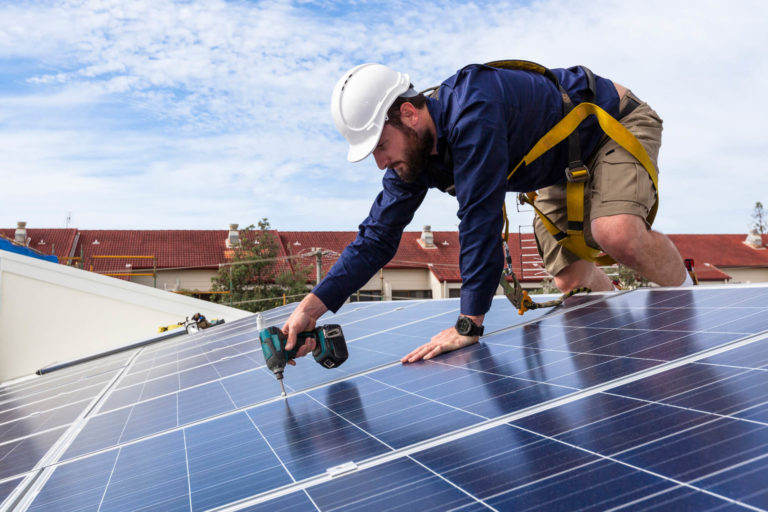
The physical roof installation is the part most homeowners expect to take the longest, but it is usually the quickest stage of the whole process. A standard residential system of 4 to 6kWp (8 to 14 panels) is typically installed in a single day by a team of two to three engineers. Larger systems of 8 to 12kWp may require two days.
Here is what happens on installation day. The team arrives in the morning and begins with the roof mounting system, fixing rails or hooks to the roof structure via the tiles or slates. The solar panels are then lifted up and clipped into the mounting frame. Roof work for a typical installation takes 4 to 6 hours. The team then moves inside to connect the DC cabling from the roof into the inverter, connect the inverter to your consumer unit, install any generation meter, and commission the system. The indoor electrical work takes a further 2 to 4 hours.
By the end of installation day, your system should be generating electricity. The engineers will show you how to read the inverter display and explain how to monitor output. Most modern inverters include an app or web portal for monitoring generation in real time, which your installer will set up before leaving.
For systems that include battery storage, the battery unit is typically wall-mounted in a garage, utility room, or airing cupboard. The battery installation adds an extra 2 to 4 hours to the job, sometimes spreading a one-day installation into a day and a half or two days depending on the complexity of the wiring.
Stage 5: Commissioning and Electrical Certification (Same Day or Within a Week)
Commissioning involves testing the system to confirm it is operating correctly and safely. This is carried out by the installation team on the day of installation. A qualified electrician on the team will conduct electrical tests on the DC and AC circuits, check insulation resistance, verify the earthing, and test the isolators. The results are recorded on an electrical installation certificate.
Under Part P of the Building Regulations, solar panel installations are notifiable electrical work. MCS-certified installers are registered with a Part P competent person scheme, which allows them to self-certify their own work. This means you do not need to notify Building Control separately. Your installer will issue a Building Regulations Compliance Certificate alongside the MCS certificate, usually within a few days of completing the installation.
The MCS certificate is your proof of a certified installation and is required to register for the Smart Export Guarantee. It is also useful for insurance purposes and when selling your home. Keep a copy somewhere safe. The certificate is issued by the installer through the MCS database and should arrive by email within 2 to 5 working days of installation.
Stage 6: DNO Notification and G98/G99 Approval
All grid-connected solar installations must be notified to the DNO. The process differs depending on the system size.
Under G98 (systems up to 3.68kW per phase), the installer notifies the DNO within 28 days of commissioning. You do not need to wait for DNO approval before starting to use and export from your system. The notification is a formality rather than a permission process. The DNO may contact you during the 28-day period if they have concerns about your local grid infrastructure, but in the vast majority of residential installations this never happens.
Under G99 (systems above 3.68kW per phase), prior approval from the DNO is required before commissioning. The DNO has 45 working days to respond to a G99 application, though many respond within 4 to 6 weeks. Your installer should submit the G99 application as soon as possible after contract signing, since this timeline runs in parallel with equipment ordering rather than adding extra time on top. However, if your local grid is constrained, the DNO may request a load flow study or impose export limitations, which can extend the process considerably.
For most standard UK residential installations of 4kWp on a single-phase connection, G99 applies if the single-phase export exceeds 3.68kW. In practice this depends on the inverter configuration. Many 4kWp installations use an inverter with an export limit set at 3.68kW, which allows them to operate under G98. Your installer should advise which procedure applies to your system.

Stage 7: Registering for the Smart Export Guarantee
Once you have your MCS certificate and your system is commissioned, you can apply to your chosen energy supplier for a Smart Export Guarantee (SEG) tariff. The SEG pays you for every unit of electricity your system exports to the grid. Rates currently range from around 10 to 15 pence per kWh depending on the supplier and tariff type.
To register for the SEG, you need a smart meter that records half-hourly export data. Most UK homes already have a SMETS2 smart meter, but if yours is an older meter or not smart-capable, you will need one installed before you can receive SEG payments. Smart meter installation is free and arranged through your energy supplier, but there can be waiting times of several weeks. It is worth checking your meter situation before installation so you can request a smart meter upgrade in advance if needed.
The SEG application itself is straightforward: you apply through your supplier’s website with your MCS certificate number and installation details. Approval typically takes a few days to a couple of weeks. Export payments are usually paid quarterly in arrears.
Full Timeline Summary
Here is a realistic timeline for a typical UK residential solar installation:
| Stage | Duration | Notes |
|---|---|---|
| Getting quotes and site surveys | 1 to 3 weeks | Contact multiple MCS-certified installers simultaneously |
| Reviewing quotes and signing contract | A few days | Allow time to read contracts carefully |
| Equipment ordering | 1 to 2 weeks | Runs in parallel with DNO notification |
| DNO notification (G98) | Notified within 28 days post-install | No waiting period before installation |
| DNO approval (G99 only) | Up to 45 working days | Applies to larger or single-phase systems above 3.68kW |
| Planning permission (if required) | 8 to 12 weeks | Listed buildings and conservation areas only |
| Scaffolding erection | Half a day (day before installation) | Book alongside installation date |
| Installation | 1 to 2 days | Most 4-6kWp systems done in one day |
| Scaffolding removal | 2 to 5 days post-install | Leaves a few days for any snagging |
| MCS certificate issued | 2 to 5 working days post-install | Required for SEG registration |
| SEG registration | A few days to 2 weeks | Smart meter required |
For the majority of residential installations with G98 notification (no prior DNO approval needed), the total time from signing a contract to a fully operational system is typically 3 to 6 weeks. Add 1 to 3 weeks for the quotation stage and you are looking at 4 to 9 weeks from first enquiry to completion. If G99 approval is required, the window extends to 10 to 16 weeks from enquiry.
What Can Cause Delays?
Most residential solar installations proceed smoothly within the timelines above, but a number of factors can cause delays. Panel or inverter stock availability is occasionally an issue, particularly for premium brands with longer lead times. Scaffolding availability can be a constraint in busy periods, especially from spring through to early autumn when demand peaks. Adverse weather, particularly high winds, can prevent both scaffolding erection and roof work, sometimes pushing installation back by several days.
Installer availability itself is a variable. The best MCS-certified installers are often booked several weeks in advance during peak season. Starting your enquiry process early, ideally in late autumn or winter, gives you more flexibility to choose your preferred installer without a long wait for their schedule.
If your installation requires a consumer unit upgrade (sometimes called a fuse box replacement), this is usually carried out on the same day as the solar installation but adds a few hours to the job. Some consumer units in older properties are not compatible with modern solar inverters or do not have space for the required isolators and protective devices. Your installer should identify this during the survey stage and factor it into the quote.
For installations in listed buildings or conservation areas, planning permission is the biggest source of delay. Local planning authorities have 8 weeks to decide on householder applications. In practice, straightforward applications for sympathetically designed systems are usually approved within this window, but complex cases or appeals can take considerably longer. If your property requires planning permission, start that application as early as possible.
How Long Does a Commercial Solar Installation Take?
Commercial installations operate on a different timescale to residential. A 30 to 100kWp system on a business premises typically involves a more detailed design and engineering phase, structural assessments of the roof, and almost certainly a G99 application. The full process from initial enquiry to a commissioned system commonly takes 3 to 6 months for commercial installations, and larger systems or those with complex grid connection requirements can take longer.
Commercial planning permission requirements vary. Systems on commercial buildings below certain size thresholds may fall under permitted development, but larger ground-mounted commercial installations often require full planning permission. Some commercial installations also require an EPC survey of the building, environmental impact assessments, or consultations with local authorities, all of which add time.
Case Study: Surrey Detached House, 5kWp System
Background
A family in Guildford, Surrey, with a detached four-bedroom house decided to install solar panels in early 2026. Their south-facing roof had no shading issues and the property was a standard 1980s construction with no planning constraints.
Project Overview
They contacted four MCS-certified installers and had all four surveys completed within two weeks of making initial contact. Quotes were received within three days of each survey. After reviewing the proposals, they signed a contract with their preferred installer on day 16 of the process.
Timeline
Equipment was ordered on the day the contract was signed. The installer confirmed installation was booked for four weeks later. The system was 5kWp on a single-phase connection, which meant G99 applied. The installer submitted the G99 application to UK Power Networks the same day as the contract signing, and approval came back in 18 working days. This ran comfortably in parallel with equipment ordering and scheduling, so it caused no delay to the installation date.
Scaffolding was erected on a Tuesday morning. Installation took place on Wednesday and was complete by 4pm. On Friday, the scaffolding was removed. The MCS certificate arrived by email the following Tuesday.
The family already had a SMETS2 smart meter, so SEG registration with their supplier was completed online the same day the MCS certificate arrived. Their first SEG payment was received 10 weeks later, covering the first partial quarter of exports.
Results
From first enquiry to a fully operational system took 38 days. From signing the contract to installation day was 26 days. The family were generating and exporting electricity within four weeks of committing to the project, well within their expectations. The entire process required very little involvement from them beyond the survey visit and reading through the contract.
Expert Insights From Our Solar Panel Installers About Installation Timelines
One of our senior solar panel installers with over 17 years of experience in residential and commercial installations shared this perspective: “The thing that surprises homeowners most is how fast the actual installation is. We turn up, put panels on the roof, wire it in, and by end of day the system is live. The weeks either side of that are equipment lead times, scheduling, scaffolding logistics, and paperwork. Customers sometimes delay starting the process thinking they need to research for months, but the sooner you get surveys booked and quotes in, the sooner you’re generating. Spring and summer bookings fill up fast, so the ideal time to start enquiring is autumn or winter so you’re installed and earning before the summer peak arrives.”
Frequently Asked Questions
How long does solar panel installation take on the day?
For a typical residential system of 4 to 6kWp, the installation takes one day. A team of two to three engineers usually completes roof mounting and indoor wiring within 6 to 8 hours. Larger systems of 8 to 12kWp may take two days, and systems with battery storage add a further 2 to 4 hours to the job.
How long does the whole solar installation process take from start to finish?
From first enquiry to a working, grid-connected system typically takes 4 to 12 weeks for a residential installation. The installation itself is just one or two days. The time either side is taken up by surveys, quoting, equipment ordering, DNO notification, scaffolding logistics, and MCS certification.
Do I need to be home during the installation?
Yes, you (or another responsible adult) need to be home during the installation to give access to the loft space, consumer unit, and any internal rooms where the inverter or battery will be mounted. The engineers will also need to briefly turn off your power supply to connect to the consumer unit. You will need to be present when the engineers commission the system so they can walk you through how everything works.
How long does DNO approval take for solar panels?
Under G98 (most systems up to 3.68kW per phase), there is no approval to wait for. Your installer notifies the DNO within 28 days of completing the installation, but you can use and export from your system immediately. Under G99 (larger or single-phase systems above 3.68kW), the DNO has 45 working days to approve the application. Your installer should submit this application as soon as you sign the contract so it runs in parallel with equipment ordering.
How long after installation can I register for the Smart Export Guarantee?
You can apply for the Smart Export Guarantee as soon as you have your MCS certificate, which is typically issued within 2 to 5 working days of installation completion. You also need a SMETS2 smart meter that records half-hourly export data. If you already have one, SEG registration takes a few days to a couple of weeks depending on your supplier. If you need a smart meter installed, request this from your supplier before the installation day to avoid unnecessary delays.
How long does scaffolding stay up after solar panel installation?
Scaffolding is typically removed 2 to 5 days after the installation is complete. It is left in place for a short period to allow engineers to return for any snagging visits or minor adjustments before the scaffolding contractor dismantles it. The full scaffolding window from erection to removal is usually 3 to 7 days.
Can solar panels be installed in winter?
Yes, solar panels can be installed year-round in the UK, including winter. Cold, clear days are actually fine for installation and your system will start generating immediately. The practical constraints are wind speed (high winds prevent safe roof work) and very heavy rain or ice (slippery conditions). Most installers work through winter, though severe weather can cause short delays. Getting installed in winter means your system is fully operational before the high-output summer months arrive.
How long does a commercial solar installation take?
Commercial solar installations typically take 3 to 6 months from enquiry to completion for systems of 30 to 100kWp. Larger systems or those with complex grid connection requirements may take longer. The extended timeline reflects more detailed design and engineering work, structural roof assessments, G99 DNO approval, and in some cases full planning permission applications. The physical installation of a 50kWp commercial system typically takes 3 to 5 days on the roof.
Summing Up
Solar panel installation is genuinely quicker than most homeowners expect once you account for just the installation day itself. The weeks before and after are largely admin and logistics rather than actual work. For a straightforward residential installation under G98, you can realistically go from first enquiry to a generating, exporting system in under six weeks. The key to hitting the faster end of that timeline is acting promptly: get surveys booked simultaneously across multiple installers, sign the contract as soon as you are ready, and check your smart meter situation early. Working with an MCS-certified installer who manages the full process, including DNO notification, scaffolding coordination, and MCS certification, means there is very little for you to do beyond being home on installation day.
For professional solar panel installation with a full managed service from survey to MCS certificate, contact us for a free quote.
Updated