

The best solar panels for UK homes in 2026 are the LONGi Hi-MO X6, a TOPCon panel delivering 440W output at 22.8% efficiency with a 30-year linear performance warranty. It combines the manufacturing reliability of the world’s largest solar panel producer with a price point that makes strong financial sense for most UK homeowners.
Choosing the right solar panels matters more than most installers let on. The technology inside the panel determines how much electricity you generate on overcast British winter days, how quickly the output degrades over time, and how much roof space you need to hit your target system size. This guide covers the eight best solar panels available through UK-certified installers in 2026, what makes each one stand out, and how to decide which technology suits your home.
Key Takeaways
- TOPCon panels (N-type silicon) are now the standard choice for UK residential installations in 2026, replacing older PERC technology as the value leader.
- HJT (heterojunction) panels offer the best performance in low-light and high-temperature conditions but carry a 15–25% price premium over comparable TOPCon panels.
- All panels installed by MCS-certified installers qualify for the Smart Export Guarantee regardless of brand.
- A typical 400–445W panel measures approximately 1.72m × 1.13m and weighs around 21kg — roof structure and rafter spacing affect what fits.
- Look for a minimum 25-year product warranty and a 30-year linear performance guarantee retaining at least 87–88% output at end of life.
- Tier 1 classification (Bloomberg NEF) indicates bankable manufacturers with consistent quality control — all eight panels in this guide are Tier 1.
Solar Panel Efficiency Explained for UK Conditions
Efficiency is the percentage of sunlight hitting the panel surface that gets converted into usable electricity. A 440W panel measuring 1.722m × 1.134m has an active area of roughly 1.95m² — achieving 440W from that area requires around 22.5% efficiency under standard test conditions (STC: 1,000W/m² irradiance, 25°C cell temperature).
In real UK conditions, panels rarely hit STC. The UK’s average irradiance is considerably lower than 1,000W/m², and cell temperatures on warm summer days can exceed 25°C, which reduces output in proportion to the temperature coefficient. A panel with a temperature coefficient of -0.29%/°C loses 0.29% of its rated power for every degree the cell exceeds 25°C. On a warm July day with cell temperatures reaching 50°C, a 440W panel rated at -0.29%/°C produces around 440 × (1 − 0.0029 × 25) = about 408W — HJT panels, with coefficients around -0.24%/°C, perform slightly better in this scenario.
For UK buyers, the difference between 21% and 23% efficiency often comes down to how many panels you can fit on your roof. If your available south-facing roof area is limited, higher efficiency means more kilowatts per square metre — and potentially a larger system without adding extra panels.
The 8 Best Solar Panels for UK Homes
1. LONGi Hi-MO X6 — Best Overall
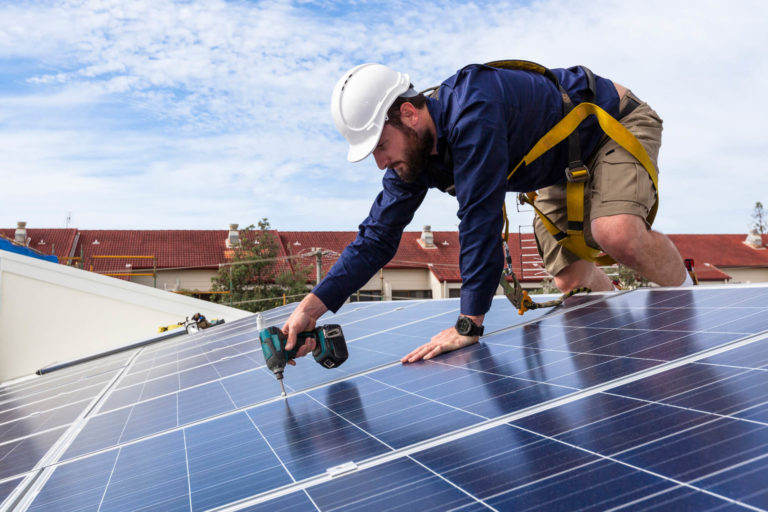
LONGi is the world’s largest solar panel manufacturer and the Hi-MO X6 is their flagship residential product for the UK market in 2026. Using N-type TOPCon cell technology, the 440W variant achieves 22.8% efficiency — enough to generate meaningful output even on the grey winter days that define British solar economics from November through February.
The 30-year linear performance warranty (guaranteeing at least 88.1% of rated output at year 30) gives the Hi-MO X6 the strongest long-term performance guarantee in its price bracket. Most competing panels offer either a shorter guarantee period or a lower floor. Given that a typical UK solar installation is expected to run for 25–35 years, warranty terms at the far end of system life matter more than installers often acknowledge.
The Hi-MO X6 carries a temperature coefficient of -0.29%/°C, which is solid for TOPCon technology. Output in British summer heat remains close to rated power, and the panel’s bifacial design (the LR5-54HTH variant) can capture reflected light from light-coloured roof surfaces, adding a small additional yield benefit.
For most UK homeowners, the combination of price point, performance, warranty terms, and the manufacturing scale to ensure consistent quality batch after batch makes the LONGi Hi-MO X6 the most sensible all-round choice. It’s the panel most likely to be quoted by a well-informed MCS installer operating on volume and reliability rather than brand margin.
Features
- Technology: N-type TOPCon (bifacial option available)
- Power output: 430–445W (Hi-MO X6 series)
- Efficiency: up to 22.8%
- Temperature coefficient: -0.29%/°C (Pmax)
- Product warranty: 25 years
- Performance warranty: 30 years (≥88.1% at year 30)
- Dimensions: 1,722mm × 1,134mm × 30mm
- Weight: 21.3kg
- Industry-leading 30-year performance warranty
- Excellent price-to-efficiency ratio
- Tier 1 manufacturer with consistent quality control
- Strong UK installer network and stock availability
- Bifacial gain is minimal on standard tiled roofs
- Less premium brand recognition than Panasonic or REC
2. Jinko Solar Tiger Neo — Best for Low-Light Performance
Jinko Solar is consistently one of the top two or three largest panel manufacturers globally, and the Tiger Neo range represents their current N-type TOPCon technology. The 440W variant achieves 22.53% efficiency with strong low-light performance that suits the UK’s frequently overcast conditions particularly well.
The Tiger Neo’s dual-glass construction option (available in certain configurations) improves durability against moisture ingress and potential-induced degradation (PID) — a real-world consideration for UK installations exposed to persistent damp. The standard framed version remains the most common choice for residential installations due to its lighter weight and simpler mounting.
Jinko’s performance warranty runs to 30 years with ≥88.0% output retention, matching LONGi at the high end of the market. The first-year degradation rate of ≤1% and subsequent annual degradation of ≤0.4% give the Tiger Neo one of the flatter long-term output curves in its class — meaning more total lifetime energy than panels with steeper early-year degradation.
Features
- Technology: N-type TOPCon
- Power output: 425–445W
- Efficiency: up to 22.53%
- Temperature coefficient: -0.29%/°C
- Performance warranty: 30 years (≥88.0% at year 30)
- Annual degradation: ≤0.4% after year 1
- Excellent low-light performance for UK conditions
- Flat long-term degradation curve
- Strong 30-year performance warranty
- Wide installer availability in the UK
- Marginally lower efficiency ceiling than some HJT competitors
- Less name recognition among UK consumers than European brands
3. Trina Solar Vertex S+ — Best Value TOPCon
Trina Solar has been manufacturing panels since 1997 and the Vertex S+ represents their best residential product in 2026. At 22.5% efficiency with N-type TOPCon cells, the 435–445W range sits in the mainstream sweet spot for UK residential installations — high enough efficiency to matter on constrained roofs, priced competitively against Jinko and LONGi.
What distinguishes the Vertex S+ within the TOPCon category is Trina’s multi-busbar cell interconnection technology, which reduces internal resistance and improves performance under partial shading — relevant for UK homes where chimney stacks, neighbouring trees, or dormers create localised shade at certain times of day. The reduced cell stress also contributes to lower long-term degradation.
Trina offers a 25-year product warranty and a 30-year linear performance guarantee, retaining ≥87.4% at year 30. That’s slightly below the LONGi and Jinko figures but still strong for a mid-price product. UK stock availability through major distributors is generally good.
Features
- Technology: N-type TOPCon
- Power output: 430–445W
- Efficiency: up to 22.5%
- Temperature coefficient: -0.30%/°C
- Performance warranty: 30 years (≥87.4% at year 30)
- Excellent value within the TOPCon category
- Good partial-shade performance from multi-busbar design
- Established UK market presence
- Slightly lower long-term performance floor than LONGi/Jinko
- Not always stocked by smaller regional installers
4. JA Solar DeepBlue 4.0 Pro — Best Warranty Terms
JA Solar’s DeepBlue 4.0 Pro is the Chinese manufacturer’s flagship N-type TOPCon panel and one of the highest-efficiency options in its price range, achieving up to 22.9% cell efficiency. For UK homeowners with limited roof space, the extra percentage point over standard TOPCon alternatives translates to slightly more output from the same number of panels.
JA Solar has invested heavily in UK market distribution over the last two years, and stock availability through UK solar wholesalers is now reliable — an important practical consideration that’s often overlooked when comparing brands on paper. An installer who can’t get your chosen panel within a reasonable lead time will substitute it with something else anyway.
The warranty terms are competitive: 25 years on the product and 30 years on linear performance (≥88.0% at year 30), matching Jinko and close to LONGi. The temperature coefficient of -0.29%/°C is standard for the TOPCon category.
Features
- Technology: N-type TOPCon
- Power output: 430–445W
- Efficiency: up to 22.9%
- Temperature coefficient: -0.29%/°C
- Performance warranty: 30 years (≥88.0% at year 30)
- Among the highest efficiency in the TOPCon category
- Strong 30-year performance warranty
- Improving UK stock and installer availability
- Less established UK brand recognition than LONGi or Jinko
- Regional availability can vary
5. REC Alpha Pure-R — Best HJT Panel for UK Homes
REC is a Norwegian-founded manufacturer (now owned by Reliance Industries) and the Alpha Pure-R is their premium HJT panel for residential use. HJT technology uses a thin amorphous silicon layer on both sides of the crystalline silicon wafer, producing a panel with outstanding temperature performance — the Alpha Pure-R’s temperature coefficient of -0.24%/°C is among the best available in any residential format.
In practical UK terms, HJT’s temperature advantage is most valuable during summer peak generation periods, when conventional silicon cells lose output as cell temperatures climb. The Alpha Pure-R retains proportionally more of its rated power output on warm summer days than equivalent TOPCon or PERC panels — delivering more total energy over the year even if the nameplate wattage difference appears small.
REC’s 25-year product warranty is backed by a 92.0% performance guarantee at year 25 — meaning the panel retains 92% of its rated output rather than the 87–88% typical of TOPCon panels. This is a meaningful difference over the life of the system. The premium price (typically 15–20% above comparable TOPCon options) is partially offset by this superior long-term retention.
Features
- Technology: HJT (heterojunction)
- Power output: 405–430W
- Efficiency: up to 22.3%
- Temperature coefficient: -0.24%/°C (excellent)
- Performance warranty: 25 years (≥92.0% at year 25)
- Dimensions: ~1,730mm × 1,016mm (compact format)
- Industry-leading temperature coefficient for HJT
- Superior long-term performance retention (92% at 25 years)
- Compact format suits UK roof dimensions
- European brand with strong installer reputation
- 15–20% price premium over comparable TOPCon panels
- Lower maximum wattage than top TOPCon options
6. Canadian Solar HiHero — Best HJT for Space-Constrained Roofs
Canadian Solar is one of the world’s largest panel manufacturers and the HiHero is their HJT technology flagship. Achieving up to 22.8% efficiency with a temperature coefficient of -0.26%/°C, the HiHero sits between standard TOPCon and the best HJT panels (like the REC Alpha) in both performance and price.
Where the HiHero stands out is in the combination of high efficiency and relatively compact dimensions. For UK homes where usable south-facing roof area is limited — semi-detached properties with small rear pitches, Victorian terraces with chimneys interrupting the best sections of roof — the HiHero’s ability to pack more watts into a smaller footprint can make the difference between a 3kWp and a 4kWp system on the same roof.
Canadian Solar’s UK market presence and installer relationships are well-established, with reliable supply chains through major UK distributors. The 25-year product warranty and 30-year performance guarantee (≥87.5% at year 30) are solid, if not quite at the REC level on the long-term retention figure.
Features
- Technology: HJT (heterojunction)
- Power output: 425–445W
- Efficiency: up to 22.8%
- Temperature coefficient: -0.26%/°C
- Performance warranty: 30 years (≥87.5% at year 30)
- High efficiency suits constrained roof areas
- Good temperature performance for UK summers
- Strong UK supply chain and installer availability
- HJT price premium over TOPCon alternatives
- Long-term performance floor slightly below REC Alpha
7. Q CELLS Q.PEAK DUO ML-G10+ — Best European Brand
Q CELLS is a South Korean manufacturer with German engineering heritage (Q CELLS was founded in Germany and retains its R&D centre there), and the Q.PEAK DUO ML-G10+ is their mainstream PERC monocrystalline product for the UK market. At 21.4% efficiency and 395–415W output, it sits below the TOPCon and HJT options in raw numbers — but Q CELLS’ reputation for consistent quality and their UK market service infrastructure makes them a reliable choice for risk-averse buyers.
Q CELLS panels consistently feature in Which? recommendations and MCS-installer surveys, not necessarily because they lead on specs but because the manufacturing quality is highly consistent and the UK after-sales support is among the best available. For a system that needs to perform reliably for 25 years with minimal intervention, brand reliability and support quality matter alongside efficiency figures.
The Q.PEAK DUO series uses Q CELLS’ Q.ANTUM DUO technology with multi-busbar cell interconnection, delivering better partial-shade performance than single-busbar PERC alternatives. The product warranty runs 25 years and linear performance warranty runs 25 years at ≥84.8% — slightly shorter and lower than the TOPCon leaders, which is the main trade-off for the European heritage premium.
Features
- Technology: PERC monocrystalline (Q.ANTUM DUO)
- Power output: 395–415W
- Efficiency: up to 21.4%
- Temperature coefficient: -0.34%/°C
- Performance warranty: 25 years (≥84.8%)
- Strong European quality reputation and UK after-sales support
- Consistent manufacturing quality batch to batch
- Well-stocked through UK distributors
- Lower efficiency than TOPCon/HJT alternatives
- PERC technology now behind the curve vs N-type
- Shorter performance warranty than TOPCon leaders
8. Panasonic EverVolt — Best Premium HJT Panel
Panasonic’s EverVolt (formerly branded HIT — Heterojunction with Intrinsic Thin layer) has been the benchmark for premium residential solar panels in the UK for over a decade. The HJT technology achieves a temperature coefficient of -0.26%/°C and a rated efficiency of up to 22.2% — not the absolute highest numbers available, but delivered with Panasonic’s renowned manufacturing consistency and backed by the strongest brand warranty confidence in the market.
What justifies the EverVolt’s price premium is the combination of HJT low-temperature-coefficient performance, Panasonic’s 25-year warranty backed by a company with genuine long-term financial stability, and the panel’s track record of real-world performance data stretching back to original HIT installations in the early 2010s. When you’re choosing panels for a 25-year investment, the manufacturer still being in business at year 20 matters.
The EverVolt is typically priced 20–30% above mainstream TOPCon panels. For most UK homeowners, that premium isn’t necessary — LONGi or Jinko TOPCon panels offer 95% of the performance at significantly lower cost. But for buyers who want the absolute confidence of a premium brand with a multi-decade track record and outstanding technical support, the EverVolt earns its position at the top of the price range.
Features
- Technology: HJT (heterojunction)
- Power output: 410–430W
- Efficiency: up to 22.2%
- Temperature coefficient: -0.26%/°C
- Product warranty: 25 years
- Performance warranty: 25 years (≥92.0% at year 25)
- Outstanding brand reliability and long-term confidence
- Excellent HJT temperature performance for UK summers
- Strong 92% performance retention at 25 years
- Decades of real-world HJT performance data
- 20–30% price premium over mainstream TOPCon panels
- Lower max wattage than leading TOPCon options
Best Solar Panels for Home UK — Rooftop Installation Buying Guide
Key Takeaways
- TOPCon technology (22-24% efficiency) is the 2026 market standard for UK home solar — better than PERC, more available than HJT
- Tier 1 brands (LONGi, Jinko, Trina, Canadian Solar, JA Solar, REC) are MCS-certified and work with all UK installers — don’t compromise on brand
- All-black panels cost 8-12% more than standard silver-frame panels but look significantly better on dark roofs — appearance matters for resale value
- Temperature coefficient of -0.3% per °C is standard; lower is better for UK summer heat management
- System size (3-6kWp) and panel count (9-15 panels) are determined by roof space and consumption — panels themselves don’t vary much by size
- MCS certification is non-negotiable if you want SEG (Smart Export Guarantee) income — non-MCS installations earn nothing from export
TOPCon vs HJT vs PERC: 2026 UK Market Reality
| Technology | Efficiency Range | Temperature Coefficient | Low-Light Performance | Market Share 2026 | Price vs PERC |
|---|---|---|---|---|---|
| PERC (2018-2024 standard) | 20-22% | -0.35% per °C | Good | 30% | Baseline (£0) |
| TOPCon (2024-2026 dominant) | 22-24% | -0.30% per °C | Excellent | 60% | +£400-800 per system |
| HJT (premium cutting-edge) | 24-26% | -0.25% per °C | Outstanding | 5% | +£800-1,500 per system |
| Polycrystalline (obsolete) | 16-18% | -0.40% per °C | Poor | 5% | Slightly cheaper but avoid |
TOPCon (Tunnel Oxide Passivated Contact) is the smart choice for UK home installations in 2026. It offers genuine efficiency gains over PERC (3-4% improvement), better low-light performance on overcast UK days, and a lower temperature coefficient (meaning your panels perform better on hot summer days when efficiency drops). The cost premium is £400-800 for a full system — which is real money, but the extra energy captured pays for itself in 3-4 years.
HJT (Heterojunction) is the premium option with the highest efficiency and lowest temperature coefficient, but it’s only available from a handful of brands (primarily Japanese manufacturers) and costs significantly more. Unless you have space constraints (a small south-facing roof that needs maximum output), HJT is overkill for most UK homes.
PERC is the previous generation (2018-2024 standard). It’s still available from most Tier 1 brands and still a solid choice. The difference between PERC and TOPCon in real-world UK output is about 3-4%, worth roughly £150-250 per year on a 4kWp system. If your budget is tight, PERC is acceptable, but TOPCon is worth stretching for.
Tier 1 Brands and Why They Matter for MCS and SEG
| Brand | Home Market Presence | MCS Certified | Technology | Typical Cost / Panel |
|---|---|---|---|---|
| LONGi (Chinese, global leader) | Very strong | Yes | TOPCon (Hi-MO X6) and HJT | £180-220 |
| Jinko (Chinese) | Very strong | Yes | TOPCon (Tiger Neo) and PERC | £170-210 |
| Trina (Chinese) | Strong | Yes | TOPCon (Vertex S+), PERC | £160-200 |
| Canadian Solar | Strong | Yes | TOPCon (HiHero) and others | £175-215 |
| JA Solar | Growing UK presence | Yes | TOPCon (DeepBlue 4.0), HJT | £180-220 |
| REC (Swedish/Norwegian, premium) | Strong in premium segment | Yes | TOPCon (Alpha Pure-R) | £220-260 |
| Panasonic (premium) | Limited but premium | Yes | HJT (EverVolt) | £280-350 |
| Q CELLS (South Korean) | Moderate | Yes | TOPCon (Q.PEAK DUO) | £165-205 |
Tier 1 brands are those you see recommended by major solar installers, widely available in the UK, and certified by the Microgeneration Certification Scheme (MCS). MCS certification is critical — if your solar panel isn’t from an MCS-certified supplier, you won’t qualify for Smart Export Guarantee payments, and your system won’t get the SEG badge on documents.
All the brands in the table above are Tier 1. They’re proven, available from any MCS-certified installer, and come with standard 25-year power output warranties. You can’t go far wrong with any of them. The choice between them is often determined by which models your specific installer stocks.
Avoid generic no-name Chinese brands (random brands from eBay or AliExpress) because they’re not MCS-certified and you’ll lose SEG income for life.
All-Black vs Silver-Frame Aesthetics and Resale Impact
Solar panels come in two visual styles: all-black (black frame, black junction box, black mounting hardware — completely black appearance) and standard (silver aluminium frame, silver rails). All-black panels cost 8-12% more (maybe £40-50 extra per panel) but look dramatically better on dark roofs.
The reality is that roof aesthetics matter when you sell. A house with black solar panels that look like they’re “meant” to be there sells better than a house with obvious silver-framed panels that look “bolted on.” In property sales surveys, potential buyers comment on panel appearance. If you’re planning to stay in your home 15+ years, this doesn’t matter. If you think you might sell within 10 years, all-black is worth the premium.
On light-coloured roofs or tiles, the aesthetic difference is less noticeable, so you can save the money. On charcoal grey or black roofs, all-black panels are a worthwhile upgrade.
Wattage Per Panel and System Sizing Implications
Modern panels are 400-450W rated power. A few years ago, 300-400W was standard. You’ll rarely see panels smaller than 400W anymore. A 4kWp system uses either 10 panels at 400W each, or 9 panels at 450W each — it depends on what’s in stock.
Panel wattage doesn’t fundamentally change the buying decision. Your installer will recommend a system size (3kWp, 4kWp, 5kWp, etc.) based on your roof space and consumption. The panels to achieve that size are determined by what’s in stock. Most installers offer PERC and TOPCon options at the same system size, and you choose based on budget and technology preference, not specific panel models.
What matters more is the system size decision: 3kWp (small home, £5,000-7,000) vs 4kWp (average family, £6,500-8,500) vs 5kWp+ (large home or EV owner, £8,500-12,000). Your installer will guide this based on your roof and electricity use.
Temperature Coefficient and UK Summer Heat Management
A panel’s temperature coefficient (-0.3% to -0.4% per °C above 25°C STC) measures how much efficiency you lose when the panel heats up. In UK summer, roof-mounted solar panels reach 50-60°C on hot days. That means efficiency drops 7-10% from the rated STC efficiency.
A panel with -0.35% per °C coefficient will lose 12.25% efficiency at 60°C. A panel with -0.30% per °C will lose 10.5% efficiency at the same temperature. The difference is small in absolute terms, but TOPCon’s better temperature coefficient is one reason it outperforms PERC in practice.
You don’t need to hunt for the lowest temperature coefficient — Tier 1 brands are all within a narrow range. Just be aware that on hot summer days (when you’d think panels produce most power), they’re actually losing efficiency due to heat. Early morning and late afternoon output is sometimes better than noon on a 30°C day.
MCS Certification and Smart Export Guarantee (SEG) Eligibility
If your solar system is installed by an MCS-certified installer and uses MCS-approved panels, you qualify for Smart Export Guarantee payments — currently 10-15p per kWh of excess power you export to the grid (varies by supplier). A 4kWp system might export 2-3 kWh per day, earning £50-150 per month.
Non-MCS installations get zero SEG income. Your panels might be identical in quality, but the lack of certification means zero government-supported export payments. This is a £600-1,000+ per year difference over 10 years.
Always verify your installer is MCS-certified BEFORE signing the contract. Check the MCS website (mcscertified.com) for the installer’s registration number. Do not proceed with a non-MCS installer, no matter how cheap they are. You’ll lose SEG income for the life of the system.
What to Ask Your Installer About Panels
When getting a solar quote, your installer will propose specific panel models. Ask these questions:
1. “Are these panels Tier 1 brands?” (If not, why not?)
2. “What’s the technology — PERC, TOPCon, or HJT?” (TOPCon is recommended for UK homes in 2026.)
3. “What’s the temperature coefficient?” (Lower is better, aim for -0.30% per °C.)
4. “Are these panels available in all-black?” (If your roof is dark, worth asking.)
5. “What’s the 25-year performance warranty?” (Should be 80-85% capacity retention.)
6. “Are you MCS-certified?” (Non-negotiable for SEG eligibility.)
Don’t get paralysed choosing between panel models. A well-installed 4.5kWp system using LONGi TOPCon panels and a well-installed 4.5kWp system using Jinko TOPCon panels will produce almost identical results. The differences between Tier 1 brands are minimal. Your installer will stock 1-2 TOPCon options — choose based on aesthetics (all-black or standard) and budget (lowest-cost Tier 1 option if budget-conscious).
Case Study: Surrey Family Chooses LONGi Hi-MO X6 for 4.4kWp System
Background
A family of four in Guildford, Surrey installed solar panels in early 2026. The property is a 1990s detached house with a south-facing rear pitch of approximately 22m². The family’s annual electricity consumption was around 4,200kWh, with above-average daytime usage due to home working.
Project Overview
After receiving three quotes, the family chose an MCS-certified installer who specified 10 × LONGi Hi-MO X6 440W panels on the rear pitch, giving a 4.4kWp system. The quote included a GivEnergy 9.5kWh battery for £13,800 total including 0% VAT. Two alternative quotes specified Trina Vertex S+ panels at a marginally lower cost and Panasonic EverVolt panels at roughly £900 more — the family chose LONGi based on the 30-year performance warranty and the installer’s recommendation.
Implementation
Installation took one day for the panels and a second day for the battery and commissioning. The installer completed the G98 DNO notification (the system is below 3.68kW per phase export limit) and registered the installation with the MCS database. The family registered for the Smart Export Guarantee with Octopus Energy the following week, selecting the Octopus Outgoing fixed 15p/kWh tariff.
Results
In the first year of operation, the system generated approximately 4,150kWh. Self-consumption with the battery accounted for around 80% of generation, with the remaining 20% exported at 15p/kWh, generating around £125 in SEG income. Total electricity bill savings and SEG income combined produced a first-year benefit of approximately £1,480. At that rate, the system is on track to pay back in around 9.3 years before accounting for energy price inflation.
Expert Insights From Our Solar Panel Installers About Choosing the Right Panels
“The most important advice I give to homeowners is not to choose a panel based on the brand name alone,” says one of our senior solar panel installers with over 14 years of experience in UK residential installations. “LONGi and Jinko are manufacturing panels to tolerances that most European brands struggle to match at scale. The reason their warranty terms have improved so dramatically is because they have the quality control data to back them up. I’ve had far more warranty claims on budget panels than I’ve ever had on mainstream Tier 1 products from the major Chinese manufacturers.”
“That said, if someone specifically wants Panasonic or REC because the brand gives them confidence over a 25-year period, that’s a completely valid reason to pay the premium. What I’d push back on is installers who present only one brand because it’s what they stock, rather than matching the panel to the customer’s situation. A roof with a 45-degree south-facing pitch in Devon has different requirements to a flat east-west split in Manchester.”
Frequently Asked Questions
What are the best solar panels for UK homes in 2026?
The best solar panels for most UK homes in 2026 are LONGi Hi-MO X6 or Jinko Tiger Neo TOPCon panels, offering 22–23% efficiency, 30-year performance warranties, and the most competitive price-to-performance ratio in the market. For buyers with budget for a premium product, REC Alpha Pure-R or Panasonic EverVolt HJT panels offer superior temperature performance and 92% output retention at 25 years.
What is the difference between TOPCon and HJT solar panels?
Both are N-type silicon technologies achieving 22–26% efficiency. TOPCon panels are manufactured at much higher volumes, making them more affordable — typically £1,800–£2,500 per kWp installed. HJT panels have better temperature coefficients (around -0.24%/°C vs -0.29%/°C for TOPCon) and often better long-term performance retention, but cost 15–25% more. For most UK homes, TOPCon offers better value.
Do solar panel brands affect the Smart Export Guarantee?
No — your SEG eligibility depends on using an MCS-certified installer and having the installation registered on the MCS database, not on the specific panel brand. All eight panels in this guide are MCS product-listed. Always verify the exact model variant is listed before ordering.
How many solar panels does a typical UK home need?
A typical 3–4 bedroom UK home needs 8–12 panels for a 3–5kWp system. Using 440W panels, 9 panels gives 3.96kWp and 11 panels gives 4.84kWp. The exact number depends on your annual electricity consumption, available roof area, and how much of your usage you want to cover directly from solar generation.
Are Chinese solar panels as good as European ones?
For the major Tier 1 manufacturers — LONGi, Jinko, Trina, JA Solar, Canadian Solar — yes. These companies produce at enormous scale with quality control processes that meet and often exceed European manufacturing standards. Bloomberg NEF Tier 1 classification specifically indicates bankable manufacturers with consistent quality. The panels they produce are used in large-scale commercial and utility projects worldwide, subject to much stricter due diligence than residential purchases.
What solar panel warranty should I look for?
Look for a minimum 25-year product warranty (covering manufacturing defects and physical failure) and a 30-year linear performance warranty retaining at least 87–88% of rated output. The best panels — LONGi, Jinko, JA Solar — now offer 30-year warranties with ≥88% retention. HJT panels from REC and Panasonic offer 92% retention at 25 years, which is superior for long-term output but over a shorter guaranteed period.
How much do solar panels cost in the UK?
A fully installed residential solar panel system in the UK costs approximately £5,000–£8,000 for a 3–4kWp system using quality TOPCon panels, including 0% VAT (until at least March 2027). Premium HJT panels add roughly £500–£1,000 to that cost. Adding a 9.5–10kWh battery storage system typically adds a further £4,500–£7,000.
Can I get solar panels installed for free in the UK?
Most free solar panel offers in the UK are rent-a-roof schemes where a third party owns the panels and takes the SEG income in exchange for the free installation. These deals typically save you less money than owning your own system. Genuinely free installations are available through the ECO4 scheme and Warm Homes Local Grant for qualifying low-income households — but eligibility requires meeting specific income and EPC criteria.
Summing Up
The solar panel market has moved on significantly from the PERC panels that dominated UK installations as recently as 2022. TOPCon technology is now the mainstream choice, delivering 22–23% efficiency and 30-year performance warranties at a price that works for most residential budgets. LONGi Hi-MO X6 and Jinko Tiger Neo stand out as the best overall options, combining market-leading warranty terms with the manufacturing consistency of the world’s largest solar producers.
For buyers with specific requirements — limited roof space, warm regional climate, or priority on long-term output retention — HJT panels from REC, Canadian Solar, or Panasonic deliver meaningful advantages at a premium. And for buyers who place a strong value on European engineering heritage and UK after-sales support, Q CELLS remains a reliable if slightly behind-the-curve choice.
Whatever brand you choose, the installer’s quality, the system design, and the ongoing monitoring setup matter as much as the panel specification. Get quotes from multiple MCS-certified installers and ask each one specifically which panels they recommend and why — the quality of that answer tells you a lot about the quality of the installer.
Updated