
The best solar LED strip lights in the UK right now is the Homeleo 6M Solar LED Strip, it has the most real-world reviews of any solar strip on Amazon.co.uk, a weather-resistant IP65 build, and delivers consistent brightness along a fence or pergola without needing a mains socket. If you want warm white with USB backup charging for UK winters, the echosari range is the one to look at.
Solar LED strip lights have come a long way. They stick to fences, decking rails, greenhouse frames, and garden walls in minutes and run entirely off the sun, no extension leads, no electrician, no fuss. The challenge in the UK is that our weather is unpredictable, our winter days are short, and not every garden has a south-facing surface right where you want the lights. This guide covers the best options available on Amazon.co.uk right now, along with everything you need to know to get them working properly in a British garden.
Our Top Picks
| Image | Name | |
|---|---|---|
| Homeleo 6M Solar LED Strip | |
| echosari 10M Solar LED Strip | |
| echosari 5M Solar LED Strip | |
| CCILAND 10M Solar LED Strip | |
| BlueFire 12M Solar LED Strip | |
| Gaoxun 10M Solar LED Strip |
6 Best Solar LED Strip Lights for UK Gardens
1. Homeleo 6M Solar LED Strip: Best Overall
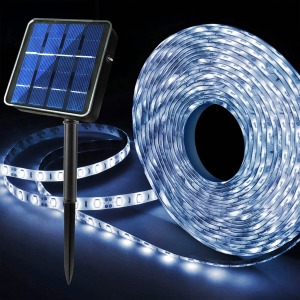
With over 1,300 UK reviews and a solid 4.2-star average, the Homeleo 6M Solar LED Strip has earned its place as the most reliable solar strip light on the UK market. It’s been around long enough to accumulate genuine long-term feedback from British customers, and the consensus is clear: this strip does what it says, doesn’t fall apart after the first winter, and the solar panel charges it adequately through a typical UK summer and autumn.
The cool white output (around 6000K) is brighter and crisper than warm white alternatives, making it particularly suited to security-adjacent lighting, under decking rails, along a workshop wall, or around a shed entrance where you need actual visibility rather than just ambience. The 180 LEDs spread across 6 metres gives a reasonable density of around 30 LEDs per metre, enough for a continuous glow rather than a dotted effect.
What the Homeleo lacks is USB backup charging. It runs on solar only, which works well from April through October but will struggle to run all night during December and January when the UK gets fewer than 8 hours of daylight. If your garden gets good south-facing sun during the day, this isn’t a dealbreaker. But if your fence faces north or sits in shade for much of the day, you’ll want to look at the echosari strips with their USB-C top-up charging instead.
The adhesive backing holds well in UK conditions, the tape uses a 3M-style compound rated for outdoor use. The IP65 rating covers it for rain and splashing but isn’t suitable for submerged or waterlogged positions, so keep it above ground level where standing water could collect.
Features
- 6 metres total length
- 180 LEDs (30 LEDs/metre)
- IP65 weather resistance (splash-proof)
- Cool white light (approx. 6000K)
- 1,200mAh rechargeable battery
- Solar charging only (no USB backup)
- Multiple modes: steady, slow flash, fast flash
- 1,300+ UK reviews: proven track record in British gardens
- Consistent brightness across all 6 metres
- Reliable adhesive holds through UK weather
- Good value for a tried-and-tested product
- Cool white only: not ideal for warm-toned garden aesthetics
- No USB backup charging for short winter days
- IP65 only: not for waterlogged positions
2. echosari 10M Solar LED Strip: Best Premium Long Strip
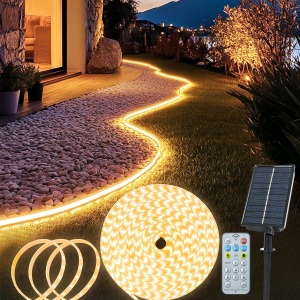
The echosari 10M is the premium choice if you have a longer run to cover, a full perimeter fence, a large pergola, or a stretch of decking that would need two 6M strips otherwise. It packs 640 LEDs into 10 metres, which works out to 64 LEDs per metre, more than double the Homeleo’s density, giving a genuinely continuous, even glow rather than a string-of-points effect.
The dual solar-plus-USB charging setup is the feature that sets this strip apart from cheaper competitors. During the summer months the solar panel keeps it charged effortlessly, but in January and February when a UK garden might see just 6 hours of weak sunlight, you can plug in a USB-C cable and top up the battery in an hour or two. This means you get consistent run-time all year round, not just during the lighter months.
The IP67/68 rating is meaningfully better than the IP65 you get on budget strips. IP67 means it can handle being submerged in up to 1 metre of water for 30 minutes, practical terms, it’ll survive a heavy downpour, a puddle, and a lot of Welsh weather without flinching. For strips mounted low on a fence or along decking edges where water can pool, this is a real advantage.
The warm white output at around 3000K gives a softer, more inviting tone than the cool white options. For a garden seating area or patio the difference is noticeable, warm white makes a space feel welcoming rather than clinical. At £26.99 it’s the priciest strip in this guide, but the LED density, IP rating, and dual charging justify the premium.
Features
- 10 metres total length
- 640 LEDs (64 LEDs/metre)
- IP67/68 waterproof rating
- Warm white light (approx. 3000K)
- 1,200mAh rechargeable battery
- Dual solar + USB-C charging
- Multiple light modes including steady glow
- 640 LEDs: highest density for a continuous even glow
- Dual solar + USB-C charging covers UK winters
- IP67/68: genuinely waterproof, not just splash-proof
- Warm white looks great on garden seating areas
- Premium price at £26.99
- Newer brand with fewer reviews than the Homeleo
- 10M length may be excessive for smaller gardens
3. echosari 5M Solar LED Strip: Best Dense Short Strip
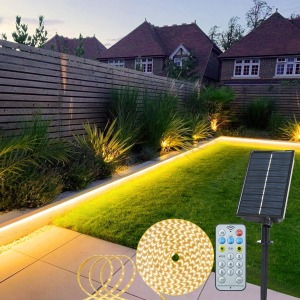
The echosari 5M packs 320 LEDs into just 5 metres, that’s 64 LEDs per metre, the same exceptional density as the 10M version but in a shorter, more affordable format. If you have a compact garden, a single fence panel run, or a balcony railing to light, this gives you all the density and brightness of the premium echosari range without paying for metres you don’t need.
At £17.99 it actually undercuts the Homeleo by a pound whilst offering better LED density, USB-C backup charging, and the superior IP68 rating. The trade-off is purely length, 5M versus 6M, and the fact that echosari is a newer brand with fewer accumulated reviews. But for a short decorative run where you want a genuinely luxurious-looking glow, the 5M punches significantly above its price.
The warm white light at 3000K works particularly well over a short run where colour consistency matters more. A 5M strip along a garden wall at eye level, framed by planting, looks deliberately designed rather than just functional. The USB-C backup means a quick top-up charge before a summer garden party or a plug-in during a grey February week, which gives you far more flexibility than solar-only strips.
One practical note: the solar panel cable on the 5M version is shorter than on the 10M, so placement flexibility is somewhat reduced. Make sure you can position the panel within cable reach of a genuinely south-facing surface before committing.
Features
- 5 metres total length
- 320 LEDs (64 LEDs/metre)
- IP68 waterproof rating
- Warm white light (approx. 3000K)
- 1,200mAh rechargeable battery
- Dual solar + USB-C charging
- Multiple modes including steady and slow flash
- Excellent LED density (64/m) for a continuous glow on a short run
- USB-C backup great for UK winter flexibility
- IP68: best-in-class waterproofing
- Excellent value for the quality
- 5M only: too short for longer fence runs
- Solar panel cable length limits placement options
- Fewer reviews than established brands
4. CCILAND 10M Solar LED Strip: Best Budget 10M Option
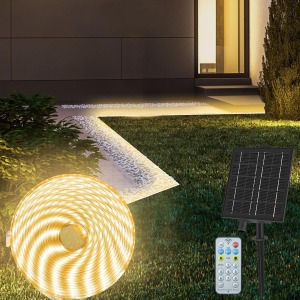
The CCILAND 10M hits a sweet spot: it covers a 10-metre run, includes USB-C backup charging, carries an IP68 waterproof rating, and comes in at £21.83, meaningfully cheaper than the echosari 10M for buyers who don’t need the higher LED density. With 200 LEDs across 10 metres (20 per metre), the glow is more dotted than continuous, but for a fence border or garden perimeter where you want presence rather than wash lighting, it’s perfectly adequate.
The warm white output keeps it in the “garden ambience” category rather than security lighting, and the IP68 rating is reassuring for UK conditions. What you lose relative to the echosari is the LED density, the gap between individual LEDs is noticeable up close, particularly on a decking handrail where you’re looking at the strip from a few feet away. Position it along a fence top or behind a border where the individual LEDs are further from the viewing angle and the effect is much more convincing.
USB-C backup charging is included, which puts the CCILAND ahead of the Homeleo in practical winter usability despite being a newer product with fewer reviews. The 168-review count (at 4.0 stars) is honest feedback from a relatively new listing, the actual quality is solid for the price point.
If you want to cover a long run without breaking the budget and can live with slightly lower LED density, this is the right call.
Features
- 10 metres total length
- 200 LEDs (20 LEDs/metre)
- IP68 waterproof rating
- Warm white light
- 1,200mAh rechargeable battery
- Dual solar + USB-C charging
- Multiple light modes
- 10M length at a budget-friendly price
- USB-C backup charging for UK winters
- IP68 waterproof: handles UK rain without issue
- Low LED density (20/m): dotted effect up close
- Fewer reviews than category leaders
- Not suitable for close-viewing positions (decking handrails etc.)
5. BlueFire 12M Solar LED Strip: Best Long Multicolour Option
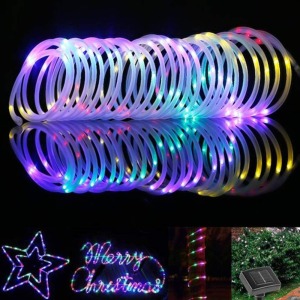
At 12 metres, the BlueFire is the longest strip in this guide, and at £16.99 it’s the best value per metre of any option here. It’s the one to consider when you need to cover a long perimeter fence, run a strip the full length of a patio, or want enough length to snake along multiple surfaces. The 4.3-star rating across 843 reviews is the highest combined score here, which tells you the BlueFire has earned genuine approval from a lot of UK buyers.
What it offers in length and colour versatility it concedes in density: 100 LEDs across 12 metres is just over 8 LEDs per metre, sparse by the standards of the echosari or Homeleo. The multicolour mode cycles through red, green, blue, and combinations, which works well for seasonal decoration or children’s party lighting but isn’t what most buyers want for a year-round garden aesthetic. The steady warm or cool white mode is the realistic day-to-day setting, and at this density it reads more as a series of accent points than a glowing strip.
The IP65 rating and solar-only charging mean the BlueFire is a summer-to-autumn product for most UK gardens. It’ll work fine from April through October when charging times are long enough to run the lights through the evening. Come November, the combination of short days and IP65 (rather than IP67/68) means you’ll start to notice compromises. If your priority is length and colour versatility for the warmer months, this is excellent value. If you want something that performs all year round, go for the echosari with its USB backup.
Features
- 12 metres total length
- 100 LEDs (approx. 8 LEDs/metre)
- IP65 weather resistance
- Multicolour + white light modes
- Solar charging only (no USB backup)
- Multiple flash and colour-cycle modes
- 12M is the longest option in this guide
- Multicolour modes for seasonal and party use
- Excellent value at £16.99: lowest cost per metre
- Highest user rating (4.3★) in this guide
- Very low LED density (8/m): accent points, not a glow strip
- No USB backup charging: winter performance limited
- IP65 only: avoid waterlogged positions
6. Gaoxun 10M Solar LED Strip: Best Battery Capacity
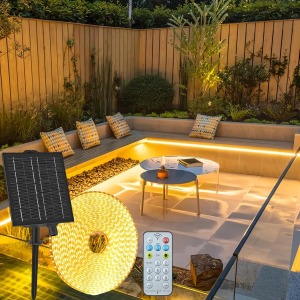
The Gaoxun 10M stands out in one specific way: the 1,800mAh battery is the largest in this round-up, which means longer run-times on a full charge. Combined with 640 LEDs across 10 metres (64 per metre, matching the echosari’s density), it offers on-paper specs that look extremely attractive at £18.57.
In practice, there are some caveats worth knowing before you buy. The 3.8-star rating across 281 reviews is the lowest in this guide, and a pattern in the UK reviews points to two things: the USB-C charging works well but the solar panel is less efficient than competitors at the same price, which means the solar-only charging time is longer. If you’re planning to rely on USB charging as the primary input in winter and use solar as a top-up in summer, the Gaoxun works. If you want the solar panel to be the main driver, the Homeleo or echosari will serve you better.
The IP68 rating is genuinely excellent and the LED density is high, for a strip you’re going to mount on a decking handrail or fence top and charge via USB-C, the Gaoxun gives you a lot of LEDs per pound. The warm white colour temperature is flattering and consistent across the strip. It’s the right choice for buyers who want high density and maximum run-time and are happy to plug in a USB cable regularly rather than relying on the solar panel alone.
Features
- 10 metres total length
- 640 LEDs (64 LEDs/metre)
- IP68 waterproof rating
- Warm white light
- 1,800mAh rechargeable battery (largest in guide)
- USB-C charging (solar + USB)
- Multiple light modes
- 1,800mAh battery: best run-time potential in this guide
- High LED density (64/m) for a dense glowing strip
- IP68 waterproofing
- 3.8★ rating: lowest in this guide; solar panel efficiency queried in reviews
- Best suited to USB-primary charging rather than solar-primary
- Fewer reviews than top picks
Solar LED Strip Lights Buying Guide
Key Takeaways
- USB-C backup charging is not optional for UK year-round use: solar-only strips will struggle in winter
- IP68 beats IP65 for fence and decking positions where rainwater collects at the base
- LED density matters: 30 LEDs/metre gives a dotted effect; 60+ LEDs/metre gives a continuous glow
- The solar panel needs a separate south-facing surface: the strip itself often can’t go where the panel can charge
- Warm white (2700-3000K) flatters plants and wood; cool white (5500-6500K) gives better visibility
- Adhesive backing fails in UK winters from freeze-thaw cycling: use included clips on fence tops and corners
- Never cut a solar LED strip without sealing the cut end with silicone: the waterproofing runs through the coating and cutting breaks it
What Are Solar LED Strip Lights?
Solar LED strip lights are flexible circuit boards with surface-mounted LEDs, powered entirely by a small photovoltaic panel and a rechargeable battery. Unlike mains-powered LED strips, which need to be close to a plug socket and are typically used indoors, solar strips are self-contained outdoor lighting systems. The solar panel charges the battery during daylight hours, and the controller manages when the strip turns on (usually dusk-triggered) and how long it runs.
The key difference from other solar garden lights is flexibility. A solar stake light illuminates one spot. A solar strip lets you define an edge, border, or architectural feature with continuous (or near-continuous) light. This makes strips particularly useful for fences, decking edges, pergola beams, garden walls, greenhouse frames, and steps. The strip follows the shape of the surface rather than sitting on top of it.
The Solar Panel Placement Problem
This is the most common source of disappointment with solar strip lights, and it’s worth understanding before you buy. The solar panel and the light strip are connected by a cable, typically 2 to 5 metres long. This means the panel must be within cable distance of a south-facing surface that gets direct sun for several hours per day.
The strip itself often doesn’t go where the panel needs to be. A north-facing fence might be exactly where you want the lights, but if there’s no south-facing surface within cable reach, the panel won’t charge adequately. In those situations, you have three options: choose a longer cable version, position the panel on a sunny part of the fence with the strip running along the shadier section (the cable connecting them), or accept reduced run-times and compensate with USB backup charging.
Always measure the cable length before mounting the strip. The cable is usually permanently attached and can’t be extended without cutting, which affects the waterproof integrity. Check what direction your fence or target surface faces, and identify where the panel can sit to get maximum daily sun. For most UK gardens, south-south-west is the sweet spot.
Why USB-C Backup Charging Is Essential for UK Winters
A UK winter day in January delivers fewer than 8 hours of daylight, and much of that is at a low angle through clouds. A solar panel rated at 3W in full summer sun might be delivering less than 0.5W on a cloudy January afternoon. The 1,200mAh batteries in most solar strips need several hours of useful charging to run the lights through a 5-hour evening, a demand that solar simply can’t consistently meet from November through February.
USB-C backup charging changes this equation entirely. In winter, a 30-minute USB-C top-up charges the battery to 80%, enough for a full evening. You don’t have to plug it in every day, but having the option means the lights work reliably at Christmas and into February rather than going dim and flickering from November.
If you’re buying solar strip lights purely for summer garden parties and seasonal decoration (April to October), solar-only is fine. If you want them working year-round, USB backup is genuinely essential, not a nice-to-have.
IP Ratings for UK Outdoor Use
IP (Ingress Protection) ratings tell you how well sealed a product is against water and dust. For UK outdoor garden use, here’s what each rating means in practice:
| IP Rating | Water Protection | Best Suited For |
|---|---|---|
| IP44 | Splashing water from any direction | Sheltered porches only |
| IP65 | Low-pressure water jets from any direction | Fences, walls, pergolas (above ground level) |
| IP67 | Submersion up to 1m for 30 minutes | Decking edges, near ponds, lower fence positions |
| IP68 | Continuous submersion beyond 1m | Ground-level runs, waterlogged soil, pond edges |
For most UK garden fence or pergola positions at mid-height, IP65 is adequate. But if you’re running a strip along a decking edge where rainwater drains and pools at the base of the strip, or along the bottom rail of a fence that sits in wet grass or clay soil, IP67 or IP68 is a meaningful step up. The extra waterproofing adds about £5-10 to the price but avoids the scenario where the first wet September finishes off your strip.
Warm White, Cool White, or RGB: Choosing for Your Garden
Colour temperature shapes how a lit garden feels at night:
Warm white (2700-3000K) is the most popular choice for garden seating areas and entertaining spaces. It flatters wood, stone, planting, and skin tones. A pergola or decking edge lit in warm white looks like a designed, intentional space rather than an illuminated storage area. This is what most of the echosari, CCILAND, and Gaoxun strips produce.
Cool white (5500-6500K) is brighter and more clinical. It’s the right choice for workareas, around a workshop door, a garden tap, or steps where you actually need to see where you’re going. The Homeleo 6M produces cool white, which is why it works well as a practical border light but less well as an atmospheric patio light.
RGB multicolour (like the BlueFire) lets you cycle through colours for seasonal decoration, orange and red for Halloween, green for Christmas, white for summer parties. The trade-off is that when you want a steady, single-colour garden light, RGB strips often have a less refined white mode than dedicated warm or cool white strips.
Strip Length and Coverage: Matching Metres to Your Space
Before buying, measure the surface you want to light. A standard UK fence panel is 1.83 metres (6 feet) wide. A typical garden fence run is 5-15 panels long.
| Application | Recommended Length | Best Strip |
|---|---|---|
| Single fence panel or balcony railing | 5M | echosari 5M |
| Decking perimeter or small garden fence run | 5-6M | Homeleo 6M or echosari 5M |
| Full garden perimeter or long pergola run | 10M | echosari 10M or CCILAND 10M |
| Large garden or dual-fence runs | 12M+ | BlueFire 12M or two 6M strips |
If you need more coverage than a single strip provides, you’ll need to buy two strips, they’re not designed to be connected end-to-end. Position two separate solar panels on south-facing surfaces and run the strips along different sections of the fence.
Adhesive vs Clips: What Actually Holds in UK Weather
Most solar strip lights include both adhesive backing (a peel-and-stick tape) and plastic mounting clips. The adhesive is fine for smooth, dry surfaces like painted fence boards, rendered walls, or PVC fascia boards. But UK winters are brutal on outdoor adhesives: the freeze-thaw cycle causes expansion and contraction that progressively weakens the bond, and after a cold December and January, adhesive-only installations frequently start to peel.
The plastic clips are a better long-term solution for any position that will experience frost. They take a few extra minutes to install (you screw them into the surface, then clip the strip in) but they’ll hold through five UK winters without any sign of movement. Use adhesive on the straight runs of a smooth surface, and always use clips at corners, changes of direction, and on any surface that gets direct wind exposure.
Don’t rely on adhesive alone on horizontal surfaces like the top rail of a fence, rain runs along the top of the strip and gets under the adhesive, which accelerates the delamination process. A clip at every 50cm on a top-rail run is the right approach.
Cutting Solar LED Strips Without Killing the Waterproofing
Solar LED strips have cut marks, small scissor symbols at intervals (typically every 50cm or every 10 LEDs) where the circuit can be safely cut without damaging the remaining strip. Cutting at any other point destroys a section of the circuit and may make some LEDs fail.
But cutting even at a marked point exposes the bare circuit board to water ingress. The waterproof coating runs the full length of the strip and covers the cut end in the factory. Once you cut, that protection is gone at the new end. In UK outdoor conditions, moisture will enter the cut end within a season and eventually cause the strip to fail from that point.
The fix is simple: after cutting, seal the cut end with clear silicone sealant or hot glue. Apply a small bead across the cut, covering all the exposed copper pads and the circuit board edges. Allow it to cure fully (24 hours for silicone) before installing or allowing the end to get wet. A properly sealed cut end is as waterproof as the factory finish.
Case Study: Solar LED Strips Along a North-Facing Fence in Surrey
Background
A homeowner in Guildford, Surrey, wanted to add evening lighting to a 9-metre north-facing rear fence. The fence backed onto a neighbour’s garden, meaning no mains power access, and the north-facing aspect gave the fence fewer than 3 hours of direct sun in winter. The homeowner wanted year-round lighting for evening use in the garden.
Project Overview
The initial plan was to run a single 10M strip along the fence top rail. After reading about the solar panel placement problem, the homeowner realised that mounting the panel on the north-facing fence itself would result in poor charging performance from October through March. The solution was to use a strip with a long-enough panel cable to place the panel on the south-facing side of the garage roof, about 3 metres from the fence position, and run the cable discretely along the garage gutter.
Implementation
The echosari 10M was chosen for its long panel cable, USB-C backup charging, and IP67 rating. The strip was mounted along the top rail of the fence using a combination of adhesive on the flat top surface and plastic clips at each fence panel join. The solar panel was fixed to the south-facing garage roof pitch with a self-adhesive bracket, and the cable was routed through a small plastic cable conduit along the gutter line. Total installation time: around 90 minutes.
Results
From April through October, the solar panel charges the strip fully each day without intervention. In November, December, and January, the homeowner plugs in a USB-C cable for 30-40 minutes once or twice a week, enough to maintain full evening operation. The warm white light has transformed what was a dark and uninviting fence line into the main feature of the garden seating area in the evenings.
Expert Insights From Our Solar Panel Installers About Solar LED Strip Lights
One of our senior solar panel installers with over 12 years of experience in domestic solar installations notes: “The biggest mistake we see with solar strip lights is people assuming the panel can go where the strip goes. On a north-facing fence or a shaded garden wall, you end up with a strip that charges for two hours a day and runs for forty minutes in the evening. Always plan the panel position first, and if the panel can’t get to a south-facing surface, make sure your strip has USB backup. That changes everything for UK year-round use.”
Frequently Asked Questions
Can solar LED strip lights work in the UK winter?
Solar-only strips will give reduced run-times in winter due to shorter daylight hours and lower sun angle. Strips with USB-C backup charging work reliably year-round, a short top-up charge compensates for the reduced solar input. If you want your strips working from November through February, choose a model with dual solar and USB charging.
What IP rating do I need for outdoor solar strip lights in the UK?
IP65 is the minimum for most UK outdoor positions (fence mid-height, pergola). Go for IP67 or IP68 if the strip will be mounted at ground level, on decking edges where water pools, or in positions exposed to prolonged rain. The extra cost (typically £5-10) is worth it for anything near ground level.
How many metres of solar strip lights do I need for a garden fence?
A standard UK fence panel is 1.83 metres wide. Measure your fence run before buying. For a single panel, 5M is plenty. For a run of 4-5 panels (7-9 metres), go for a 10M strip. For longer runs, you’ll need two separate strips with two solar panels, as strips can’t be connected end-to-end.
Can I put the solar panel on a different surface to the strip?
Yes, and often you should. The panel needs south-facing sun; the strip goes where you want the light. Most strips have a cable of 2-5 metres between panel and strip, which gives you flexibility to separate them. Just don’t cut or extend the cable, this breaks the waterproofing and may damage the charging circuit.
How do I stop the adhesive from falling off in cold weather?
Use the plastic mounting clips included with most strips, particularly at corners and on any horizontal surfaces. Adhesive backing weakens in freeze-thaw cycles, a single hard frost followed by rain can loosen it within weeks. Clips are the long-term solution for UK outdoor installations. Use adhesive on smooth vertical surfaces as a secondary hold.
Is warm white or cool white better for a garden?
Warm white (2700-3000K) is better for seating areas, patios, and anywhere you spend time in the evening. It flatters wood, stone, and planting. Cool white (5500-6500K) is better for functional areas, workshops, steps, garden taps, where visibility matters more than atmosphere.
Can I cut a solar LED strip to fit my space?
Yes, but only at the marked cut points (usually indicated by a scissor symbol every 50cm or every 10 LEDs). After cutting, seal the exposed end with clear silicone sealant before installation. Unsealed cut ends let moisture into the circuit and will eventually cause the strip to fail from that point.
How long do solar LED strip lights last?
The LEDs themselves typically last 25,000-50,000 hours, effectively the life of the product. The limiting factor is usually the rechargeable battery, which degrades over 2-4 years of regular charge cycles. Some strips allow battery replacement; others don’t. The waterproof coating also degrades over time in UV exposure, so strips in full sun may need replacing after 5-7 years in UK conditions.
Summing Up
Solar LED strip lights are one of the most versatile tools in UK garden lighting, flexible, wireless, and genuinely effective when installed correctly. The key decisions are simple: choose a strip long enough for your space, pick IP67 or IP68 if the strip will be anywhere near ground level, and for year-round use in the UK, make sure USB-C backup charging is included.
The Homeleo 6M remains the most trusted overall pick with over 1,300 UK reviews behind it. For warm white light and USB charging, the echosari range is the one to beat. And if you’re covering a long fence run on a tight budget, the BlueFire 12M gives you excellent value per metre, just accept that it’s a summer strip rather than a year-round solution.
Updated