
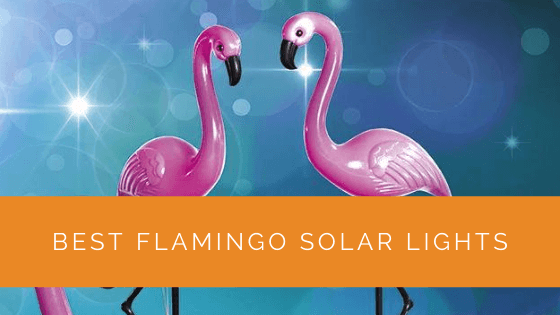
If you’re looking to add a touch of the exotic to your UK garden, flamingo solar lights are hard to beat. Colourful, weather-resistant, and powered entirely by the sun, they’re a no-fuss way to brighten up borders, patios, and pond edges after dark. Our top recommendation is the SANKUU Garden Flamingo Solar Lights, which offer solid construction, reliable UK weather performance, and a warm pink glow that looks great year-round.
Below you’ll find our full roundup of the best flamingo solar lights available on Amazon.co.uk, followed by a buying guide covering everything you need to know before you order.
Contents
- 1 Our Top Picks
- 2 5 Best Flamingo Solar Lights in the UK
- 3 Solar Flamingo Lights Buying Guide
- 3.1 Key Takeaways
- 3.2 Understanding Flamingo Light Types and Their Garden Uses
- 3.3 Material Quality and UV Durability in UK Weather
- 3.4 Battery Capacity, Winter Performance, and Charge Cycles
- 3.5 Panel Size, Positioning, and Seasonal Angle Adjustment
- 3.6 Waterproofing, Frost Resistance, and Year-Round Durability
- 3.7 Choosing Between Single Flamingo Lights and Multi-Light Sets
- 3.8 Setting Expectations for Brightness and Lighting Modes
- 3.9 Summing Up Solar Flamingo Lights
- 4 Case Study: Adding Flamingo Solar Lights to a UK Garden
- 5 Expert Insights From Our Solar Panel Installers About Flamingo Solar Lights
- 6 Frequently Asked Questions
- 6.1 Do flamingo solar lights work in the UK winter?
- 6.2 Can I replace the battery in flamingo solar lights?
- 6.3 How bright are flamingo solar lights?
- 6.4 Do I need to clean the solar panels?
- 6.5 Can flamingo solar lights be left out in winter?
- 6.6 How long do flamingo solar light batteries last?
- 6.7 What’s the best placement for flamingo solar lights?
- 6.8 Are flamingo solar lights waterproof?
- 7 Summing Up
Our Top Picks
| Image | Name | |
|---|---|---|
| SANKUU Garden Flamingo Solar Lights | |
| Vinsption Flamingo Solar Garden Light | |
| NewFen 3 Pack Flamingo Outdoor Solar Lights | |
| Solar Flamingo LED Garden Light | |
| Budget Solar Flamingo Pathway Light |
5 Best Flamingo Solar Lights in the UK
1. SANKUU Garden Flamingo Solar Lights
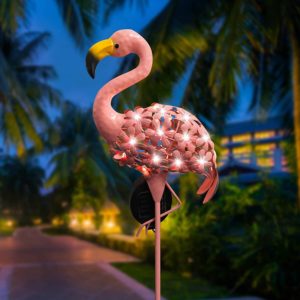
The SANKUU Garden Flamingo Solar Lights stand out as the top choice for UK gardeners seeking durability and visual impact. This design features two flamingo ornaments with integrated solar panels that charge throughout the day and automatically illuminate at dusk. The robust construction uses weather-resistant materials that withstand UK winters and the constant shifting between rain and sunshine.
What makes this option particularly appealing is the balance between brightness and aesthetics. The warm white LED lights provide enough illumination to highlight your garden features without creating glare. The flamingos are individually adjustable, allowing you to angle them however you prefer, which is especially useful if your garden layout requires flexible positioning.
Installation is straightforward. Simply push the stakes firmly into the soil, ensure the on-off switch is set to on, and the lights will begin charging in daylight. Each flamingo includes a rechargeable battery that typically lasts 8-10 hours once fully charged. Many UK customers report that these lights perform reliably even during grey winter months when daylight is limited.
The colour remains vibrant throughout the product’s lifespan. Unlike cheaper alternatives that fade after one season, these flamingos maintain their bright pink finish even after months of exposure to British weather.
Features
- Dual flamingo ornaments with integrated solar panels
- Warm white LED lights (2700K colour temperature)
- Rechargeable 1.2V AA NiMH battery per unit
- Automatic dusk-to-dawn operation
- Weather-resistant ABS plastic construction
- Individually adjustable stakes (60cm tall)
- 8-10 hour runtime on full charge
- No wiring or external power required
Pros:
- Durable construction survives UK winter conditions
- Bright, long-lasting LED lights
- Adjustable positioning for flexible garden layouts
- Reliable performance even in low-light UK winters
Cons:
- Higher price point than budget alternatives
- Requires fully charged batteries for best performance
- Not suitable for heavily shaded gardens
2. Vinsption Flamingo Solar Garden Light
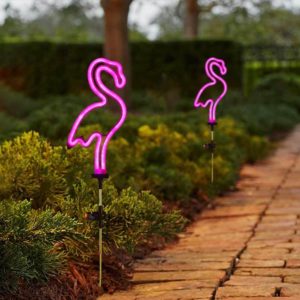
If you prefer a more refined garden aesthetic, the Vinsption Flamingo Solar Garden Light delivers elegance alongside functionality. This single flamingo ornament features a sleeker design than some competitors, with a narrower body that sits well in compact gardens or alongside planted borders.
The solar panel is cleverly integrated into the flamingo’s back, making the ornament appear more authentic whilst still capturing sunlight efficiently. The light spreads warmly across surrounding plants and pathways, creating an inviting garden ambiance after sunset. It performs consistently even during the UK’s shorter winter days.
Installation requires pushing the stake firmly into soil or, for softer ground, pre-drilling with a garden auger. Once positioned, the light activates automatically at dusk and powers down at dawn.
Features
- Single flamingo ornament with rear-mounted solar panel
- Warm white LED light output
- Weather-resistant plastic construction
- Automatic light sensor activation
- 50cm tall stake
- 7-9 hour night-time operation
- Rechargeable solar battery included
Pros:
- Sleek, naturalistic design
- Works well in compact spaces
- Consistent winter performance
Cons:
- Single light (not a pair)
- May need replacement battery after 2-3 years
- Less bright than some higher-priced options
3. NewFen 3 Pack Flamingo Outdoor Solar Lights
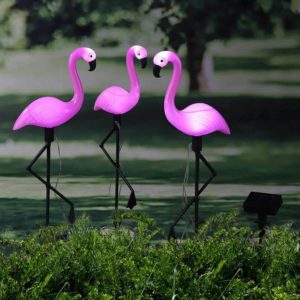
For larger gardens or those seeking to create a flamingo feature, the NewFen 3 Pack Flamingo Outdoor Solar Lights offers excellent value. You receive three separate flamingo ornaments, each with its own solar panel and LED light, allowing you to spread illumination across a wider area.
The multi-unit approach means you can cluster the flamingos together for dramatic effect near a patio, or scatter them throughout flowerbeds and along pathways. Each ornament stands approximately 50cm tall and features a sturdy spike that anchors firmly into garden soil.
Features
- Pack of three solar flamingo lights
- Individual solar panels and LED units
- Colourfast plastic construction
- Automatic dusk activation
- 6-8 hour runtime per charge
- Replaceable AA battery system
Pros:
- Best value for multiple lights
- Flexible placement options
- Easy to expand your display
Cons:
- Less durable than single premium units
- Batteries may not last as long
- Less consistent light output
4. Solar Ornamental Flamingo with LED Garden Light
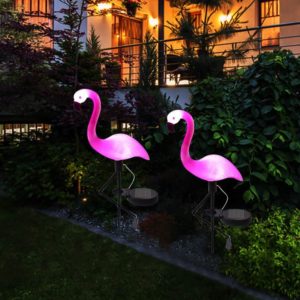
This generic solar flamingo ornament sits in the mid-range, offering reliable performance at a reasonable price point. The design emphasises the ornament itself rather than the technology, making it a good choice if you want garden decoration that happens to light up rather than a light that happens to be flamingo-shaped.
Features
- Large decorative flamingo figure with integrated light
- Solar panel on base
- Warm white LED
- Weatherproof construction
- Simple stake mounting
- 6-7 hour operation
Pros:
- Good aesthetic appeal
- Reasonable price
- Simple to install
Cons:
- Battery may degrade quickly
- Dimmer light output
- Not as weather-resistant as premium options
5. Budget Solar Flamingo Pathway Light
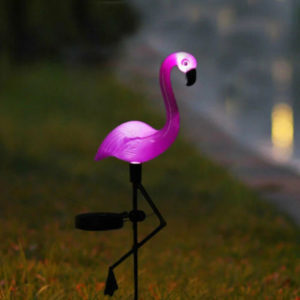
The Budget Solar Flamingo Pathway Light is the most affordable option in this roundup, making it ideal for test-driving flamingo lights without significant investment. The design is simpler, the materials are lighter, and the light output is more modest. However, it still functions adequately for creating subtle garden ambiance.
Features
- Simple plastic flamingo ornament
- Top-mounted solar panel
- Single LED light
- Lightweight construction
- Easy stake installation
- 4-6 hour night operation
Pros:
- Very affordable
- Low-risk purchase
- Easy installation
Cons:
- Fades and degrades quickly
- Dim light output
- Short battery lifespan
- Not suitable for long-term garden feature
Solar Flamingo Lights Buying Guide
Key Takeaways
- Flamingo lights come in two main styles: stake-mounted ornaments (tallest visual impact) and shorter decorative sets for borders and pond edges
- Pink finish durability matters in UK weather — check for UV-stable polyresin, not cheap painted plastic that fades after one season
- Battery capacity of 800mAh+ ensures reliable all-night operation during UK’s short winter days
- Look for IP65 minimum rating for water ingress protection — important near water features or wet garden areas
- LED colour is warm white (2700K) only — RGB colour-changing models exist but compete visually with the pink finish
- Stake length varies 30–70cm; taller stakes work for back-of-border drama, shorter ones for pathside positioning
- Panel placement matters — integrated panels on top of head vs separate small panels mean different sun-positioning requirements
- Sets range £15–£50 for 1–3 pack depending on size and resin quality grade
Understanding Flamingo Light Types and Their Garden Uses
Solar flamingo lights fill a specific garden niche: whimsical, themed ornamental lighting that doubles as a daytime garden focal point. Unlike generic stake lights, flamingo designs are bold statements — you’re lighting a garden feature as much as illuminating a path. This drives the design choices: taller stakes (50–70cm) to lift the silhouette above ground clutter, authentic pink tones that photograph well, and integrated or closely-positioned solar panels that charge whenever the “head” faces the sun.
Flamingo lights work best in clusters (sets of three or more) or as repeating elements along a border. A single flamingo is cute; three in a row create a deliberate landscape choice. They suit contemporary gardens wanting character, cottage gardens embracing whimsy, and spaces near water features where the reflection doubles the visual impact. The bird outline is instantly recognisable, which matters for visibility in twilight — you want guests to read “flamingo” not just “pink shape.”
Material Quality and UV Durability in UK Weather
The critical difference between a flamingo light that looks pristine for three seasons and one that’s chalky and bleached after one is polyresin quality. Budget models use virgin or recycled polyresin sprayed with a thin topcoat — the topcoat weathers off in 12–18 months, leaving faded, streaky plastic underneath. Mid-range and premium models use UV-stabilised polyresin throughout, which resists fading far longer.
Check product descriptions carefully: “UV-stable polyresin” or “UV-resistant resin” indicates the plastic itself contains UV inhibitors, not just a surface treatment. Price guides: sets under £20 are almost always unstabilised; £20–£35 usually means stabilised polyresin; £35+ may include stainless steel hardware and premium finish. In practice, a £25 stabilised flamingo from a reputable brand will look better after two years than a £15 unstabilised one after one season.
Stainless steel stakes and hardware (rather than painted metal or plastic) resist corrosion and add years of reliable function, especially in wet UK climates. If you’re investing in flamingo lights, spending the extra for stabilised polyresin and stainless hardware is worthwhile.
Battery Capacity, Winter Performance, and Charge Cycles
UK winter sunlight is notoriously weak — southern England gets roughly 2–3 peak sun hours mid-December. Flamingo lights with 600mAh batteries will barely hold a full charge on cloudy November days and may only light 4–5 hours nightly. Stepping up to 800mAh–1,000mAh ensures full 8–10 hour operation even on the shortest, cloudiest winter days.
Most solar flamingo lights use NiMH (nickel-metal hydride) batteries, which charge and discharge safely but degrade over 2–3 years. Some premium models offer LiFePO4 (lithium iron phosphate) batteries that last 5+ years and maintain capacity better in cold, but these cost significantly more. For a mid-range garden light you’ll replace every 3–4 years anyway, NiMH is adequate.
Battery placement affects performance: internal batteries (sealed inside the head) are more weather-proof but harder to replace; external batteries (in a ground-level box) are easier to service but create cable clutter. Internal is neater; external is more practical for users who replace batteries annually.
| Battery Capacity | Typical Runtime (Summer, Full Charge) | Typical Runtime (Winter, Cloudy Days) | Expected Lifespan | Best For |
|---|---|---|---|---|
| 400–500mAh | 6–8 hours | 2–3 hours | 1–2 years | Accent lighting only, garden ornament not primary lighting |
| 600–700mAh | 8–10 hours | 4–5 hours | 2–3 years | Part-time dusk-to-dawn use, secondary garden lighting |
| 800–1,000mAh | 10–12 hours | 7–8 hours | 2–3 years (NiMH) or 4–5 years (LiFePO4) | Full-season reliable all-night lighting, primary pathway illumination |
| 1,200mAh+ | 12+ hours | 9–10 hours | 3–4 years (NiMH) or 5–7 years (LiFePO4) | Extended evening entertaining, light through to dawn, harsh climates |
Panel Size, Positioning, and Seasonal Angle Adjustment
Flamingo lights with larger solar panels (15–30cm²) charge faster and more reliably on cloudy UK days than smaller panels (8–12cm²). The best designs integrate the panel into the “head” or back, where it gets morning and afternoon sun without needing the bird to face south exclusively. Cheaper models hide tiny panels under a small fold-down cover, which limits charging angle flexibility.
For winter reliability, position flamingos where they get south-facing morning sun (8am–noon) and afternoon sun (2pm–4pm). In a shaded border, even 800mAh batteries won’t fully charge on December days. If your border faces east-west, place flamingos at the south end or use a reflective garden feature (stone, gravel, light-coloured patio) to bounce indirect sunlight toward the panel.
Seasonal repositioning helps: slight southward tilt in winter (lean the stake 5–10° south if the design permits) captures lower sun angles. Remove long-term winter shade — a dormant climbing plant or overgrown shrub cutting off sun access will cripple performance. Autumn gutter-cleaning also matters: leaves on soil around the solar panel reduce reflected light.
Waterproofing, Frost Resistance, and Year-Round Durability
IP65 rating means dust-proof and water-resistant up to water jets from any direction — adequate for rain and garden hose spray, but not full submersion. IP66 adds stronger jet resistance; IP67 allows brief submersion. For flamingo lights positioned near ponds or in regularly-watered borders, IP67 is safer. Check the joint between the stake and the head — this is the most common water ingress point. Sealed unions with rubber gaskets last longer than screw-together designs with minimal sealing.
Frost affects plastic materials. Polyresin becomes brittle in freezing temperatures, especially cheap unstabilised grades. A flamingo light frozen solid and then knocked over may crack. Stainless steel stakes won’t rust, but painted metal stakes will corrode from salt spray (coastal properties) or road salt drift. If you’re in a coastal or frost-prone area, spending extra for stabilised polyresin and stainless hardware is insurance against seasonal damage.
Winter care: brush snow off the solar panel before it melts and refreezes — ice-bound panels won’t charge. If your garden is prone to frost heave (soil expanding and pushing stakes up), check stake positions every spring and re-seat them. Some users remove lights in January–February during the heaviest frost risk and reinstall them in March — this extends lifespan if you don’t mind the extra handling.
Choosing Between Single Flamingo Lights and Multi-Light Sets
Single-light packs (£10–£20) work if you want a subtle accent or are testing the concept. Sets of three or more (£25–£50 total) create a cohesive garden statement and ensure you can cluster them for dramatic effect. Budget sets often include mixed styles (one flamingo, one butterfly, one dragonfly) — this dilutes impact. Purpose-built flamingo-only sets create better visual unity.
Mixing brands within a garden looks messy; keep all flamingos from the same brand and product line so battery colours, stake heights, and finish tones match. If a light fails in year two, buying a replacement from the same range is easier than hunting for a visually-matching alternative from another brand.
For larger gardens (3+ metre borders), a set of six (if you can find one) or two sets of three provides bold, spaced-out visual impact without overcrowding. One flamingo per 1.5–2 metres of border length is a good ratio for contemporary gardens; cottage gardens might go closer (one per metre) for maximum whimsy.
Setting Expectations for Brightness and Lighting Modes
Most flamingo lights emit 5–20 lumens — this is accent lighting, not security or pathway lighting. You’ll see the flamingo shape and perhaps a metre or two of ground around it, but not a well-lit path. If you need functional pathway lighting, add separate dedicated path lights; use flamingos for visual interest at dusk, not primary illumination.
Lighting modes vary: steady-on (lights at sunset, off at dawn, no motion sensor) is most common. Some models add occasional-flash or slow-fade modes that look nice in the first month then become annoying by summer (you just want steady light). Avoid over-feature products — what sounds clever in marketing often gets switched off in practice.
Colour temperature is warm white (2700K) for nearly all flamingo lights, which suits their whimsical character. Cool white (5000K) would look harsh and artificial. Some sets offer RGB (multicolour) versions — attractive for one-off garden events, but the novelty wears off and the flashing modes drain batteries faster than steady-on.
Summing Up Solar Flamingo Lights
Solar flamingo lights work as decorative garden statements that double as ambient lighting. They’re not security lights or pathway illuminators — they’re accent pieces for gardens wanting character. Success hinges on choosing UV-stable polyresin (not cheap plastic), adequate battery capacity (800mAh+ for UK winters), IP65+ waterproofing, and clustering them in groups for visual impact rather than scattering singles.
Spend £25–£35 per flamingo set for a product that will look good for 2–3 years; budget options under £20 tend to fade and fail faster. Position them in south-facing locations where they’ll charge reliably, replace batteries every 2–3 years, and enjoy the whimsical character they bring to evening gardens.
Case Study: Adding Flamingo Solar Lights to a UK Garden
Background
A homeowner in the Midlands had recently redesigned their back garden, creating curved borders and a new patio seating area. They wanted subtle after-dark lighting that would extend the usable evening hours without the cost and effort of installing mains-powered outdoor lights.
Project Overview
Rather than commission an electrician, they decided to trial flamingo solar lights. Their garden faces south and receives good daylight exposure, making it suitable for solar products. They purchased two sets of SANKUU flamingos (four units total) to test the concept.
Implementation
Installation took less than 15 minutes. They positioned two flamingos flanking the patio steps, another pair along a curved border to highlight newly planted shrubs. Each unit was pushed firmly into soil at a slight angle to catch morning and evening light. The on-off switches were set to the on position.
Results
Throughout spring and summer, the flamingos illuminated the garden each evening for 8-10 hours, providing enough light to navigate pathways safely and highlight garden features without creating harsh shadows. During autumn and early winter, runtime dropped to 6-7 hours as daylight decreased, which still proved sufficient for evening relaxation. The homeowner reported that the flamingos became a talking point when friends visited, and the whimsical design softened the modern aesthetic of the patio area.
Expert Insights From Our Solar Panel Installers About Flamingo Solar Lights
One of our senior solar panel installers with over 15 years of experience notes: “Solar lights like flamingos are an excellent entry point into solar technology for homeowners. They require zero installation complexity, no permits, no electrician fees, and they demonstrate how solar panels work in real conditions. Many customers who start with decorative solar lights later upgrade to larger solar systems for their homes once they see the technology in action. From a sustainability perspective, replacing mains-powered garden lights with solar equivalents also reduces household carbon footprint, which aligns with broader renewable energy goals.”
Frequently Asked Questions
Do flamingo solar lights work in the UK winter?
Yes, but with caveats. Quality flamingo lights like the SANKUU model still function in UK winter, but runtime may drop from 8-10 hours to 6-7 hours because daylight is limited. Cheaper models perform noticeably worse. Positioning your lights where they catch the maximum available winter sun helps. On very grey winter days, even good lights may only provide 4-5 hours of operation.
Can I replace the battery in flamingo solar lights?
It depends on the model. Premium lights like SANKUU use standard AA rechargeable batteries that you can buy and replace yourself for £5-10. Cheaper models often have non-replaceable batteries soldered to the circuit board, meaning once the battery dies, the entire light is unusable. Always check product specifications before buying.
How bright are flamingo solar lights?
Most flamingo lights produce 30-80 lumens, which is modest. They’re bright enough to safely navigate a pathway or highlight garden features, but not bright enough to read by. If you need functional task lighting, consider dedicated solar path lights instead. Flamingos excel at creating ambiance rather than bright illumination.
Do I need to clean the solar panels?
Light cleaning once per month improves performance. Use a soft, damp cloth to gently wipe the solar panel on top of the flamingo, removing dust and pollen. Avoid abrasive scrubbing, which can scratch and reduce panel efficiency. In autumn, clear away fallen leaves that might shade the panel.
Can flamingo solar lights be left out in winter?
Yes. Quality flamingo lights are weather-resistant and designed to withstand UK winters. However, check the manufacturer’s specifications. Some budget models may suffer frost damage. If you’re unsure, bring them in during the harshest months or choose a premium model rated for all-year outdoor use.
How long do flamingo solar light batteries last?
With replaceable battery models, the batteries themselves last 2-3 years before capacity degrades noticeably. The LED light source lasts 10,000+ hours, typically outlasting batteries. With non-replaceable batteries, expect 1-2 seasons of useful life before the light becomes too dim to notice.
What’s the best placement for flamingo solar lights?
Place them where they receive maximum sunlight exposure during the day and where the nighttime illumination serves a purpose. South-facing locations are ideal in the UK. Avoid heavy shade beneath trees or buildings. For visual impact, group units together or space them evenly along a pathway. Ensure the solar panel faces upward to capture direct sun.
Are flamingo solar lights waterproof?
Most are water-resistant, meaning they can withstand rain and moderate moisture. However, they’re not submersible and shouldn’t be used in water features or locations where they’ll be splashed repeatedly. The on-off switch and battery compartment are the most vulnerable points. Keep these areas clear of standing water.
Summing Up
Flamingo solar lights bring both whimsy and practical illumination to UK gardens. The SANKUU Garden Flamingo Solar Lights lead our recommendations due to their durable construction and reliable performance even during UK winters. For those seeking a more refined aesthetic, the Vinsption Flamingo Solar Garden Light offers elegant design. If you prefer multiple lights, the NewFen 3 Pack provides excellent value. Budget-conscious gardeners can explore the more affordable options, though be prepared for shorter battery life and reduced brightness. Whatever your choice, position your flamingos where they’ll receive good sun exposure and where their nighttime glow enhances your garden experience. Pair these lights with other solar animal lights or solar garden lights to create a cohesive outdoor lighting scheme. For larger-scale solar solutions, learn more about solar panel costs to understand investment required for home-wide systems.
Updated