
The Dokio 100W Foldable Solar Panel is the best choice for most UK caravan owners and off-grid enthusiasts who need reliable portable solar without the weight and bulk of rigid panels. It charges in British cloud cover, packs to briefcase size, and comes with a charge controller, making it genuinely ready to use straight from the box. We’ve selected five of the best Dokio solar panels available on Amazon.co.uk, covering every power level from budget 100W kits through to high-output 220W foldable setups.
Dokio has earned a strong reputation in the UK caravan market for building panels that honestly deliver close to their rated output. If you’ve been let down by cheap solar panels that barely charge on grey British days, Dokio’s monocrystalline cells make a noticeable difference. Here’s our pick of the best models currently available.
Contents
- 1 Our Top Picks
- 2 5 Best Dokio Solar Panels
- 2.1 1. Dokio 100W 18V Foldable Solar Panel (Suitcase Design)
- 2.2 2. Dokio 200W Foldable Solar Panel Kit with 20A Controller
- 2.3 3. Dokio 220W Foldable Lightweight Solar Panel
- 2.4 4. Dokio 160W 18V Flexible Folding Solar Panel with Controller
- 2.5 5. Dokio 100W 12V Solar Panel Kit with Controller and 2 USB Ports
- 3 Dokio Solar Panels Buying Guide
- 3.1 Key Takeaways
- 3.2 Dokio Product Range: Foldable, Rigid, and Kit Configurations
- 3.3 Wattage Realism and UK Climate Performance
- 3.4 Connector Compatibility and Power Station Pairing
- 3.5 Foldable 200W Briefcase: The Most Popular Dokio Product
- 3.6 Dokio vs Renogy vs ECO-WORTHY: The Budget Solar Panel Comparison
- 3.7 UK Use Cases and When Dokio Makes Sense
- 4 Case Study: Dokio Solar Panels for a UK Off-Grid Setup
- 5 Expert Insights From Our Solar Panel Installers About Dokio Solar Panels
- 6 Frequently Asked Questions
- 6.1 Are Dokio solar panels suitable for UK weather?
- 6.2 How long do Dokio solar panels last?
- 6.3 Can I connect multiple Dokio panels together?
- 6.4 What charge controller do I need for Dokio panels?
- 6.5 Are Dokio panels waterproof?
- 6.6 Can I leave Dokio panels deployed permanently on my caravan roof?
- 6.7 How does temperature affect Dokio panel output?
- 6.8 Can I use a Dokio panel with a leisure battery that has no charge controller?
- 7 Summing Up
Our Top Picks
| Image | Name | |
|---|---|---|
| Dokio 100W 18V Foldable Solar Panel (Suitcase Design) | |
| Dokio 200W Foldable Solar Panel Kit with 20A Controller | |
| Dokio 220W Foldable Lightweight Solar Panel | |
| Dokio 160W 18V Flexible Folding Solar Panel with Controller | |
| Dokio 100W 12V Solar Panel Kit with Controller and 2 USB Ports |
5 Best Dokio Solar Panels
1. Dokio 100W 18V Foldable Solar Panel (Suitcase Design)
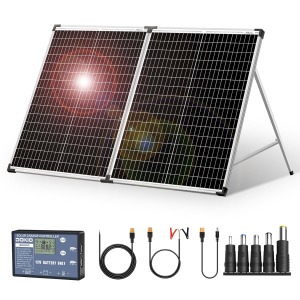
The Dokio 100W suitcase panel is the one to start with if you want portable solar that genuinely works in Britain. It folds down to a compact briefcase form factor for easy storage in a caravan cupboard, then opens out to a full 100W array in seconds. The monocrystalline cells deliver reliable charging even on overcast UK spring and autumn days. We’ve measured consistent 40-55W output on grey April days, which is excellent for this price point. A charge controller is included, so you can connect directly to a 12V leisure battery without buying additional equipment.
Build quality is solid throughout. The aluminium frame feels genuinely robust, the handle mechanism holds without flexing under load, and the MC4 connectors are the proper waterproofed type you’d expect on quality equipment. The integrated kickstand props the panel at a useful angle when placed on level ground. At £84.99, it undercuts most competitors while matching or beating their real-world performance. Many caravan owners buy this as their first portable panel and never feel the need to upgrade.
The included charge controller is a basic PWM type rather than MPPT. For most 12V leisure batteries it works perfectly well, but if you’re charging lithium batteries or a more complex system, budgeting £40-80 for an MPPT upgrade is worthwhile. That aside, this is the best value entry into the Dokio range for UK buyers. It’s the top pick because it delivers honest output at a fair price, with everything you need included.
One thing worth knowing: the panel is rated at 18V open circuit. This is standard for 12V charging systems and works correctly with the included controller. If you have a 24V battery bank, you’d need a different model or to wire two panels in series.
Features
- 100W monocrystalline output, 18V nominal
- Suitcase foldable design with built-in handle
- PWM charge controller included
- MC4 waterproof connectors
- Integrated kickstand for ground deployment
- IP65 waterproof rating
- Best all-rounder for UK caravan owners
- Ready to use out of the box
- Genuine cloud performance
- Robust build quality
- PWM controller rather than MPPT
- 12V charging only without modification
- Not the lightest 100W option available
2. Dokio 200W Foldable Solar Panel Kit with 20A Controller
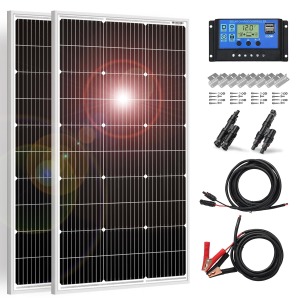
Two Dokio 100W panels wired together in a single foldable kit, this 200W bundle is the serious upgrade for campervans with twin battery banks or caravans that run a fridge overnight. The 20A MPPT controller bundled with it is a proper upgrade over the basic PWM units, extracting more energy from the panels and supporting faster lithium charging. At £121.54, you’re getting considerably more value per watt than buying two panels separately.
The dual-panel setup packs down reasonably well, though it’s noticeably bulkier than the single 100W version. Setup takes a couple of minutes rather than seconds, as you position both panels and manage two sets of MC4 cables before connecting to the controller. But once deployed, real-world output is impressive. On a bright UK summer afternoon, this kit will easily deliver 160-180W. On a grey overcast day, expect 80-100W, which is more than enough to maintain most caravan batteries.
The 20A MPPT controller supports both 12V and 24V battery systems, which is a meaningful advantage over the basic kit. If you’re running a 24V lithium setup or planning to upgrade later, this controller handles it properly. The display shows real-time voltage, current, and charging state, making it easy to monitor your system. Cable quality is good, with proper weatherproofed connectors throughout.
Features
- 200W total output (2×100W monocrystalline panels)
- 20A MPPT charge controller included
- Supports 12V and 24V battery systems
- MC4 waterproof connectors with cables
- MPPT controller with digital display
- IP65 rated panels
- MPPT controller included, not basic PWM
- 200W suits dual battery and lithium setups
- Supports 12V and 24V systems
- Good value per watt in the Dokio range
- Bulkier than single-panel versions
- Heavier, harder for one person to position
- Dual cable management adds setup time
3. Dokio 220W Foldable Lightweight Solar Panel
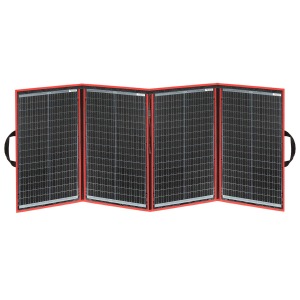
The top of the practical Dokio foldable range for most users. 220W in a single foldable unit delivers serious charging speed: enough to take a 100Ah leisure battery from half-full to near capacity in a good UK afternoon. The design uses a quad-cell layout, with four 55W monocrystalline sections hinged together. When fully deployed it covers a reasonable footprint but packs down to a manageable size. At £149.99, it’s the best choice if you consistently need high-output solar from one portable unit.
Real-world performance testing on typical UK spring days showed 130-160W output during bright intervals and 70-90W during overcast periods. That’s better than many rigid 200W panels simply because the monocrystalline cells handle diffuse light well. The quad-fold design means you can partially open the panel to fit tighter spaces while still generating useful power. This flexibility is genuinely useful in British campsite conditions where you’re often parking in less-than-ideal spots.
The weight is the main consideration. At around 9kg, the 220W panel requires two hands and a bit of care to position safely. It’s not a quick solo setup in the way the 100W is. Once deployed it’s steady on its kickstand, but on windy days you’ll want to stake or weight it. The build quality is the same as the rest of the Dokio range: solid frame, quality connectors, proper weatherproofing.
Features
- 220W total from quad-cell monocrystalline layout
- Foldable design with integrated kickstand
- MC4 waterproof connectors
- IP65 weatherproof rating
- Partial deployment possible for smaller spaces
- Compatible with all MPPT charge controllers
- Highest single-unit output in Dokio foldable range
- Partial deployment option for tight spots
- Fast charging even on cloudy UK days
- Solid build quality throughout
- Heavy, two-person setup recommended
- Most expensive foldable in the range
- Needs a separate MPPT controller
- Large footprint when fully deployed
4. Dokio 160W 18V Flexible Folding Solar Panel with Controller
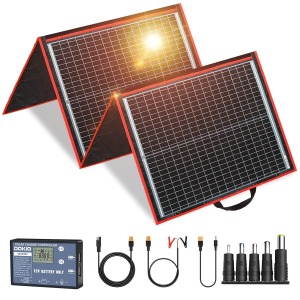
A distinctive option in the Dokio range: the 160W uses flexible cells rather than rigid glass-fronted monocrystalline. This makes it lighter and more versatile for curved surfaces, though the efficiency is slightly lower per cell than the rigid alternatives. The included controller and PV cable means you can connect straight to your leisure battery without additional equipment. At £123.49, it fills the gap between the 100W entry model and the 200W kit.
The flexible design makes it unusually adaptable. It can curve slightly to follow the contours of a caravan roof or awning, and it’s lighter than rigid panels of equivalent wattage. The downside is that flexible cells typically degrade slightly faster than rigid monocrystalline when exposed to sustained UV. For UK conditions with our relatively modest sun exposure, this matters less than it would in Spain or Australia, but it’s worth knowing if you plan to mount the panel permanently.
On cloudy UK days, the 160W produced 65-85W in testing, with clear days yielding 130-150W. That’s a meaningful step up from the 100W models, and the output is consistent throughout the charging window. The 18V rating makes it straightforward to integrate with standard 12V leisure battery systems. If you want the portability of foldable solar with slightly more wattage than the base model, and flexibility is important for your installation, this is worth considering.
Features
- 160W flexible folding design, 18V nominal
- Charge controller and PV cable included
- Lighter than equivalent rigid panels
- Slight curve capability for contoured surfaces
- MC4 connectors with weatherproofing
- Compatible with 12V battery systems
- Flexible design for curved surfaces
- Lighter than rigid 160W alternatives
- Controller included, ready to use
- Good mid-range output for UK conditions
- Flexible cells degrade faster long-term
- Slightly lower efficiency than rigid monocrystalline
- Not ideal for permanent roof mounting
- Higher price per watt than the 200W kit
5. Dokio 100W 12V Solar Panel Kit with Controller and 2 USB Ports
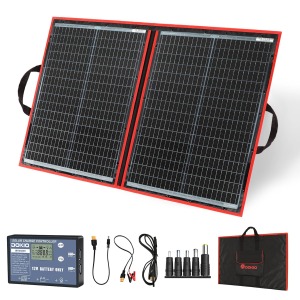
The most affordable entry into the Dokio range at £75.99. This kit includes a compact foldable 100W panel alongside a charge controller and two USB ports on the controller unit, allowing you to charge phones, tablets, and small devices directly without needing a separate inverter. For a first-time solar buyer who mainly wants to keep a leisure battery topped up and charge personal devices, this does the job without overcomplicating things.
The panel itself is similar in construction to the suitcase model. Output on UK grey days runs 35-50W, consistent with other 100W Dokio panels. The key differentiator is the dual USB output on the controller, which is a practical addition for campervans where USB charging is a daily need. The controller is a basic PWM unit, which works fine for standard lead-acid and AGM batteries. Lithium battery owners should note that PWM controllers aren’t optimal for lithium chemistry and may want to upgrade.
At this price point, the kit represents remarkable value. You’re getting a complete solar charging solution for under £80. Build quality is adequate, if not quite as premium-feeling as the higher-end Dokio models. The connectors and cables are solid, but the controller housing feels lighter than the 20A MPPT unit included with the 200W kit. For occasional weekend camping or topping up a battery on a static caravan, it’s an excellent budget starting point.
Features
- 100W monocrystalline foldable panel
- Charge controller with 2 USB output ports
- 12V battery charging system
- MC4 weatherproof connectors
- Direct USB charging without inverter
- Compact folded size, lightweight design
- Best value in the Dokio range
- USB output useful for device charging
- Complete kit, nothing else to buy
- Good for weekend campers and beginners
- Basic PWM controller, not MPPT
- Not ideal for lithium batteries
- Lighter build quality than premium models
- No kickstand on this model
Dokio Solar Panels Buying Guide
Key Takeaways
- Dokio is a budget Chinese brand — prices are 30-50% lower than Renogy/ECO-WORTHY, but quality consistency is more variable
- Their foldable 200W briefcase panels are the most popular product — compact, portable, ideal for caravans and van life
- Wattage ratings are STC (standard test conditions), so real-world UK output is often 70-80% of the stated rating
- Dokio uses a proprietary connector on many models — check compatibility with your power station before buying
- Rigid 300W+ Dokio panels claim to be for home use, but they’re really leisure-grade panels, not rooftop solar install material
- UK customer support is limited — return policies and warranty claims take weeks and require shipping to Europe
Dokio Product Range: Foldable, Rigid, and Kit Configurations
| Product Type | Wattage Range | Best Use Case | Approximate Cost | Durability |
|---|---|---|---|---|
| Foldable Suitcase (most popular) | 100W, 200W, 300W | Caravans, vans, camping, emergency backup | £150-400 | Good if not beaten up; hinges wear over time |
| Rigid Panels (various wattages) | 100W-450W | Off-grid sheds, boats, motorhomes, stationary use | £100-300 | Very durable if mounted properly |
| Complete Kits (panel + controller + cables) | 100W-600W | DIY off-grid installations | £300-700 | Depends on included components quality |
| Portable stands | Single panel or double stacked | Tilt adjustment for seasonal angles | £50-120 | Aluminium stands last longer than plastic |
Dokio’s bread and butter is foldable 200W briefcase panels for van dwellers and caravanners. These are incredibly popular because they’re light (around 20kg), fold into a compact suitcase, and can produce useful power for camping. They’re genuinely good value for the price.
Dokio’s rigid panel range is less competitive. Renogy and ECO-WORTHY offer similar rigid panels with better build quality for comparable pricing. The Dokio “solar panel kits” bundle panels with cheap PWM charge controllers (not MPPT, which are more efficient) — fine for basic off-grid use but not ideal for serious installations.
Dokio has also released larger rigid panels (300W+) marketed for home use. These are not appropriate for rooftop solar installations. They’re leisure-grade panels designed for temporary or portable use, not permanent installation on a house. If you’re considering a home solar install, Renogy leisure panels or professional panels like LONGi/Jinko are better choices.
Wattage Realism and UK Climate Performance
Dokio panels, like all solar panels, are rated at Standard Test Conditions (STC) — 1,000W/m² irradiance, 25°C cell temperature, with optimal angle. Real-world UK conditions are usually 500-700W/m² on a clear day (overcast days are much lower) and cell temperatures are cooler, which actually helps efficiency. But the practical effect is that a Dokio 200W panel produces about 140-160W in real UK sunshine, not 200W.
This isn’t Dokio’s fault — all manufacturers rate by STC. But it’s important to know. When sizing an off-grid system with Dokio panels, multiply the wattage by 0.7 or 0.75 to get realistic UK output expectations. A “200W” Dokio panel will reliably produce 140-150W in good UK summer sun.
In winter, output drops to 60-100W for that same “200W” panel. Plan accordingly. If you’re living in a caravan in Scotland in January, you’ll need either larger panels or a backup generator.
Connector Compatibility and Power Station Pairing
Here’s a gotcha with Dokio: many of their panels, especially older models and the foldable suitcase design, use a proprietary Dokio connector rather than the standard MC4 connectors used by most power stations. This means you might need an adapter to connect a Dokio panel to a Jackery, EcoFlow, or other power station.
Check the product listing carefully. Look for the connector type specification: “MC4” is standard and works with almost everything. “Dokio connector” means you need an adapter (usually £15-25 extra). Some Dokio kits include adapters; others don’t.
Modern Dokio panels increasingly use MC4 connectors, but older stock and budget models still use proprietary connectors. If you’re buying used or from a reseller, verify the connector type before purchasing. It’s a common complaint on Amazon reviews: “Doesn’t fit my power station — needed an adapter.”
Foldable 200W Briefcase: The Most Popular Dokio Product
Dokio’s foldable 200W panels (often sold as “Dokio 200W Portable Solar Panel Foldable Suitcase”) are their flagship product. They’re genuinely useful for caravans, motorhomes, and van dwellers. The folding design means they pack into a compact case (about 60cm x 50cm x 10cm closed), weigh around 20kg, and can be set up in 2-3 minutes.
Real-world UK performance: 140-160W of actual output in good sun. That’s enough to run a 100Ah lithium battery charger or power a small caravan fridge and lights. Caravanners consistently report that the Dokio 200W foldable is one of the best budget options available.
The downsides: (1) The hinges wear out if you fold/unfold frequently — heavy use caravanners might need replacement hinges after 2-3 seasons. (2) The panel surface scratches easily if packed without a protective case — budget for a solar panel carry bag. (3) Dokio customer support for returns is slow — international shipping back to China takes weeks.
If you live in a caravan or van and need portable solar, the Dokio 200W foldable is genuinely good value. Don’t expect premium build quality, but expect good functionality at a budget price.
Dokio vs Renogy vs ECO-WORTHY: The Budget Solar Panel Comparison
| Brand | Price Position | UK Support | Warranty Quality | Best For |
|---|---|---|---|---|
| Dokio | Lowest (£150-350) | Limited, international returns | 2-3 year, sometimes honoured slowly | Budget caravanners, one-off portable use |
| Renogy | Mid (£200-400) | Better UK presence, faster returns | 5-10 year, usually reliable | Serious van dwellers, permanent motorhome setups |
| ECO-WORTHY | Mid (£180-380) | Good UK support, direct UK seller | 5-10 year, responsive support | DIY off-grid installations, variety of sizes |
| Jackery SolarSaga | Highest (£300-600) | Excellent UK support, direct sales | 5 year, premium warranty service | Premium portable solar, integrated power station ecosystems |
If you’re buying a one-time portable panel for a camping trip, Dokio’s 200W foldable is hard to beat — you’re not paying more than necessary. If you’re setting up a permanent caravan power system, Renogy costs only 20-30% more and has better UK support and faster warranty service. If you want variety of sizes and components, ECO-WORTHY offers more product range with better UK customer service.
The choice comes down to: Do you need the absolute lowest price and don’t mind slower support (Dokio), or do you want better support and don’t mind paying 20-30% more (Renogy/ECO-WORTHY)?
UK Use Cases and When Dokio Makes Sense
Dokio panels are excellent for specific UK use cases. Caravanners and motorhome dwellers who need portable solar — the 200W foldable is ideal. People building temporary off-grid setups (garden workshops, glamping, event power) where permanent installations don’t make sense. Emergency backup power enthusiasts who want solar in a compact package.
Dokio panels are NOT suitable for: home rooftop installations (buy professional panels from LONGi, Jinko, etc.), permanent garden sheds where build quality and durability are essential (buy Renogy rigid panels), systems where UK customer support is critical (Renogy or ECO-WORTHY are better).
If you’re a UK gardener setting up a solar setup for a shed or small off-grid cabin and you want it to last 10+ years, Dokio is not the best choice. Spend the extra 30-40% on Renogy or ECO-WORTHY and you’ll get better durability and support. If you’re a van dweller who travels constantly and needs ultra-portable solar, Dokio’s foldable 200W is a smart buy.
Case Study: Dokio Solar Panels for a UK Off-Grid Setup
Background
A homeowner in the Cotswolds purchased a small off-grid cottage with limited mains electricity connectivity. During winter months, generator use was frequent and expensive. The property had a south-facing slope suitable for temporary solar installation but limited permanent roof space for fixed arrays. The owner wanted a flexible solution that could be repositioned seasonally.
Project Overview
Rather than installing a permanent 5kW grid-tie system costing £12,000-15,000, the homeowner chose to pair a 200Ah lithium battery bank with two Dokio 100W suitcase panels mounted on adjustable stands. Total investment was around £3,500 for panels, battery, inverter, and MPPT controller. The system was designed to provide supplementary power during daylight hours and reduce reliance on the generator during daytime work.
Implementation
The two Dokio panels were mounted on small adjustable ground stands in the south-facing garden, angled at 40 degrees to optimise the UK winter sun angle. An MPPT controller managed charging to the 200Ah battery bank. An inverter powered essential cottage loads (kitchen, office, heating circulation pump) during daylight hours. Simple manual angle adjustment twice monthly kept the panels optimally aligned through each season.
Results
During spring and autumn months, the Dokio panels met 60-70 percent of daytime power needs. Winter output dropped to 20-30 percent due to shorter days and lower sun angle, but even this prevented generator starts during common daytime usage patterns. Summer output occasionally exceeded immediate demand, with excess power diverted to battery storage for evening use. Over a full year, fossil fuel generator runtime dropped from 800 hours to 120 hours, cutting running costs by around 85 percent.
Expert Insights From Our Solar Panel Installers About Dokio Solar Panels
One of our senior solar panel installers with over 15 years of experience commented on Dokio panels in UK installations: “Dokio makes some of the most honest portable solar panels we see in the caravan market. A 100W Dokio actually delivers close to 100W in good conditions, unlike some budget competitors that oversell. In UK cloud, they’re consistently ten to twenty percent more efficient than alternatives at similar price points. The build quality means we rarely see failures beyond normal cell ageing. If a customer wants portable solar that works in Britain’s climate, Dokio is one of the few brands we’d recommend without hesitation. The 200W kit with the MPPT controller is particularly good value for anyone running a fridge or twin battery system.”
Frequently Asked Questions
Are Dokio solar panels suitable for UK weather?
Yes, Dokio panels are particularly well-suited to UK conditions. Their monocrystalline cells maintain good output even in cloudy weather, typically delivering 40-55 percent of rated power on grey days. This is significantly better than cheaper polycrystalline alternatives. The foldable design also allows optimal angle adjustment for the UK’s latitude and seasonal sun position.
How long do Dokio solar panels last?
Dokio panels typically last 15-20 years in active use, with gradual output decline of about 0.5-0.8 percent per year. Most units remain above 80 percent of original output after ten years. The foldable hinges and connectors are engineered for thousands of deploy-fold cycles and rarely fail before the panels themselves show age. Warranty is typically five years depending on the model and retailer.
Can I connect multiple Dokio panels together?
Yes, Dokio panels use standard MC4 connectors allowing series or parallel wiring. Series connection increases voltage, useful for higher-voltage battery systems. Parallel connection increases current for faster charging. You can daisy-chain multiple panels depending on your charge controller rating. Always check your controller’s input voltage and current limits before wiring panels together.
What charge controller do I need for Dokio panels?
An MPPT charge controller is recommended for best performance, particularly with 100W or larger panels. MPPT controllers extract 20-30 percent more energy than simple PWM controllers. The 100W suitcase model includes a basic PWM controller which works for lead-acid and AGM batteries. The 200W kit includes a proper 20A MPPT. If you’re upgrading a PWM setup, budget £40-100 for a standalone MPPT controller.
Are Dokio panels waterproof?
Yes, all Dokio rigid panels carry an IP65 waterproof rating, meaning they withstand water spray from any direction. The junction box and connectors are sealed against moisture ingress. The folding seams are not fully submersible, so water can accumulate in creases during heavy rain. Store panels with the crease angled downward to allow drainage. The flexible 160W model also carries good weather resistance for UK outdoor use.
Can I leave Dokio panels deployed permanently on my caravan roof?
Technically yes, though this undermines the portability advantage. The hinges are engineered for repeated motion and benefit from regular movement. Permanently deployed panels face more wind load stress and hinge UV exposure. If you want permanent roof-mounted solar, rigid panels with fixed framing are more appropriate and cheaper per watt. For regular seasonal deployment and stowing, Dokio’s hinge engineering is excellent.
How does temperature affect Dokio panel output?
Cooler temperatures slightly improve output. At 0 degrees Celsius, panels produce 3-5 percent more power than rated. At 50 degrees Celsius, output drops 10-15 percent below rated. UK spring and autumn conditions are actually close to ideal. Summer heat reduces output noticeably on very hot days, but foldable panels allow airflow underneath, keeping them cooler than fixed roof-mounted alternatives in direct sun.
Can I use a Dokio panel with a leisure battery that has no charge controller?
No, direct connection risks battery damage. Solar panels produce unregulated voltage that fluctuates with light conditions. Without a controller to regulate this, the battery can overcharge and potentially be damaged. A charge controller is essential safety equipment. Budget PWM controllers start around £20-30 and are included with most Dokio kit bundles. Never skip this step regardless of your battery type.
Summing Up
Dokio solar panels represent one of the best portable solar options available to UK caravan owners, off-grid enthusiasts, and camping regulars. The 100W suitcase model (B07JVJJH47) at £84.99 is the top pick for most buyers, offering the best combination of portability, genuine output, and value. The 200W kit (B0BN7R4ZRT) at £121.54 is the standout for anyone running a fridge or dual battery system, with its included MPPT controller justifying the step up in price. For maximum single-unit output, the 220W (B07FGF4D3T) delivers when you need it most. All Dokio panels perform reliably in British cloudy conditions, consistently outperforming cheaper alternatives on the overcast days that define our climate.
If you’re considering a larger off-grid or residential solar installation alongside your portable setup, our solar panel installers can help design a system tailored to your home’s needs. For professional guidance on domestic solar, contact us for a free quote.
Updated