
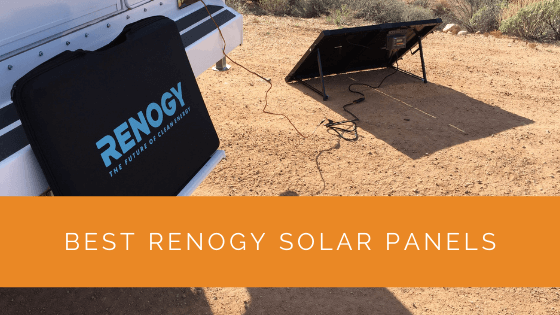
The best Renogy solar panel for most UK buyers is the Renogy 100W 12V Monocrystalline Solar Panel (Compact Design), which packs 4,270 reviews at 4.6 stars and consistently delivers reliable output for motorhomes, off-grid sheds, boats, and garden outbuildings. It’s the panel that Renogy built its UK reputation on, and for good reason: compact, robust, and efficient enough to work meaningfully even on overcast British days.
Renogy is one of the few solar panel brands that sells a genuinely comprehensive range at every wattage and form factor, from 50W rigid panels through to 200W portable folding systems. Whether you need a permanent roof-mount for a caravan, a flexible panel for a curved van roof, or a self-contained portable system for camping, there’s a Renogy product that fits. This list covers the best options currently available on Amazon.co.uk with verified UK availability.
Contents
- 1 Our Top Picks
- 2 7 Best Renogy Solar Panels
- 2.1 1. Renogy 100W 12V Monocrystalline Solar Panel (Compact Design)
- 2.2 2. Renogy 100W Portable Solar Suitcase with 20A Controller
- 2.3 3. Renogy 100W 12V High-Efficiency Monocrystalline for Motorhomes and Caravans
- 2.4 4. Renogy 50W 12V Monocrystalline Solar Panel (Compact Design)
- 2.5 5. Renogy EFLEX-CORE 200W Portable Foldable Solar Panel
- 2.6 6. Renogy 100W 12V Semi-Flexible Solar Panel (LTWT-Flex)
- 2.7 7. Renogy 100W N-Type 16BB Solar Panel
- 3 Renogy Solar Panels Buying Guide
- 4 Case Study: Off-Grid Garden Office Installation
- 5 Expert Insights From Our Solar Panel Installers About Renogy Solar Panels
- 6 Frequently Asked Questions
- 6.1 Are Renogy solar panels any good?
- 6.2 How much power does a Renogy 100W solar panel produce in the UK?
- 6.3 What charge controller do I need for a Renogy 100W panel?
- 6.4 Can Renogy panels be used for home solar installation in the UK?
- 6.5 How long do Renogy solar panels last?
- 6.6 Do Renogy solar panels work in the UK winter?
- 6.7 What is the difference between Renogy’s N-type and standard monocrystalline panels?
- 6.8 Is Renogy a good brand for motorhomes and caravans?
- 7 Summing Up
Our Top Picks
| Image | Name | |
|---|---|---|
| Renogy 100W 12V Monocrystalline Solar Panel (Compact Design) | |
| Renogy 100W Portable Solar Suitcase with 20A Controller | |
| Renogy 100W 12V High-Efficiency Monocrystalline (Motorhome/Caravan) | |
| Renogy 50W 12V Monocrystalline Solar Panel (Compact Design) | |
| Renogy EFLEX-CORE 200W Portable Foldable Solar Panel | |
| Renogy 100W 12V Semi-Flexible Solar Panel (LTWT-Flex) | |
| Renogy 100W N-Type 16BB Solar Panel |
7 Best Renogy Solar Panels
1. Renogy 100W 12V Monocrystalline Solar Panel (Compact Design)
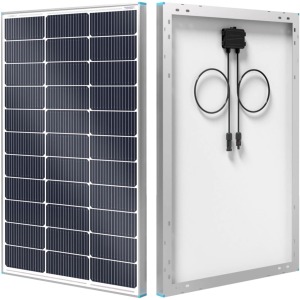
With over 4,270 reviews at 4.6 stars, this is the Renogy panel that most UK buyers are actually using. The compact design is physically smaller than standard 100W panels, which makes it easier to fit on shed roofs, smaller motorhome roofs, or tight installations where a full-size 100W wouldn’t quite work. The monocrystalline cells deliver a certified efficiency of around 21%, which is competitive for the price point and means you get useful output even from UK winter sun.
The panel comes with pre-drilled holes and mounting feet, which takes some of the installation guesswork out of the process. It’s built to withstand UK weather conditions, with a tempered glass surface and aluminium frame that handles wind, rain, and temperature cycling without issues. The IP67 junction box protects the electrical connections from moisture ingress, which matters in a climate where rain can appear without warning at any point of the year.
At £123.53, this sits in the mid-range for 100W panels. The compact design does mean the panel is slightly less wide than a standard unit, which can actually be an advantage when mounting space is constrained. Renogy’s build quality is consistently better than generic alternatives at similar price points, and the review volume here is the strongest evidence that this product delivers on its specification over time.
If you’re adding a second panel to an existing system or buying your first Renogy, this compact 100W is the default recommendation. It works well with any Renogy charge controller and pairs with 12V leisure batteries, lithium batteries, or LiFePO4 setups depending on your application.
Features
- 100W, 12V monocrystalline cells
- ~21% cell efficiency
- Compact design, smaller footprint than standard 100W
- Tempered glass, aluminium frame
- IP67-rated junction box
- Pre-drilled mounting holes included
- 4,270 reviews at 4.6 stars, proven track record
- Compact footprint fits tighter installations
- High-efficiency monocrystalline cells
- Solid build quality for UK weather conditions
- Higher price than the standard 100W monocrystalline model
- Compact design means narrower panel than standard 100W
2. Renogy 100W Portable Solar Suitcase with 20A Controller
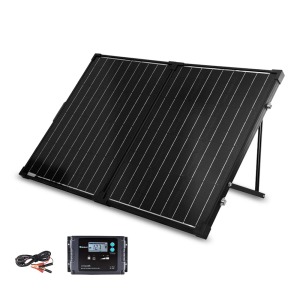
The solar suitcase format is the best choice for anyone who needs solar power that moves with them rather than stays in one place. This Renogy 100W kit folds into a case with a handle, opens up to two 50W panels, and comes with a waterproof 20A charge controller included. You carry it to wherever you need power, angle it at the best available sky, and connect your battery. It doesn’t get much simpler than that.
The 1,622 reviews at 4.6 stars confirm this works reliably in practice. UK buyers use these primarily for camping, touring, festivals, and as backup power for motorhomes when shore power isn’t available. The adjustable kickstand holds the panels at an optimal angle without any extra equipment, and the built-in carry handles mean you’re not balancing an awkward rigid panel across a campsite.
The included 20A waterproof controller adds value that a bare panel doesn’t offer. You’re getting a complete charging system in one purchase. The controller handles overcharge protection, battery type selection (lead-acid, lithium, etc.), and load control. For someone setting up their first mobile solar system, the suitcase kit removes the guesswork of pairing a panel with a compatible controller.
Features
- 2 x 50W panels in foldable suitcase format
- Waterproof 20A charge controller included
- Adjustable kickstand for optimal angle
- Carry handles, compact folded profile
- Compatible with 12V lead-acid and lithium batteries
- IP67 junction boxes on both panels
- Complete system, panel and controller in one purchase
- Portable and self-contained for camping/touring
- 1,622 reviews at 4.6 stars
- No tools or mounting required
- Not suitable for permanent roof installation
- Heavier than a single rigid panel
3. Renogy 100W 12V High-Efficiency Monocrystalline for Motorhomes and Caravans
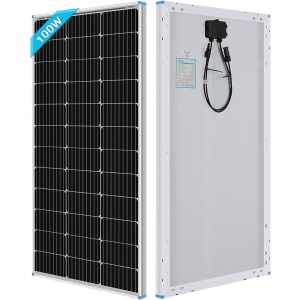
This is the most straightforwardly affordable rigid 100W panel in the Renogy range, and at £59.99 it significantly undercuts the compact design model above whilst still delivering the same core specification: 100W at 12V, monocrystalline cells, aluminium frame, tempered glass. The difference is that this is a standard-sized panel, which makes it slightly larger but easier to pair with standard mounting rail systems.
The product listing specifically calls out motorhomes, boats, caravans, and campervans as target applications, and the 1,423 reviews at 4.6 stars confirm this is where it performs. UK caravan and motorhome owners are amongst the most experienced solar users in the country, and the strong review performance here reflects that these buyers know what they’re comparing this against.
For a permanent roof installation where space isn’t critically constrained, this is the panel to buy. The lower price point means you can add more panels for the same budget, which translates directly into more stored energy and longer off-grid capability between charging stops.
Features
- 100W, 12V monocrystalline standard size
- High-efficiency cells for reliable UK output
- Aluminium frame, tempered glass
- Pre-drilled holes for standard mounting rails
- Compatible with any 12V charge controller
- Applications: motorhomes, boats, caravans, off-grid sheds
- Best value 100W Renogy panel at £59.99
- 1,423 reviews at 4.6 stars
- Standard size fits existing mounting rail systems
- Ideal for multi-panel rooftop arrays
- Slightly larger than the compact design model
- No controller included, purchase separately
4. Renogy 50W 12V Monocrystalline Solar Panel (Compact Design)
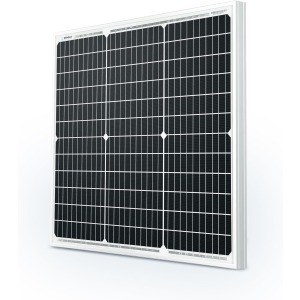
Not every application needs 100W. A garden shed running LED lights, a phone charger, and a small radio draws well under 10W continuously. A boat at anchor keeping a bilge pump and navigation lights active overnight needs modest daily input. A caravan fridge running during a UK summer weekend away charges adequately from 50W when the sun cooperates. The compact 50W Renogy is the right-sized panel for these applications, and at £70.58 with 694 reviews at 4.7 stars, the highest average rating on this list, it earns its place.
The compact design means the physical size is notably smaller than a standard 50W panel, which opens up installation options in tight spaces. Small narrowboat roofs, compact caravan roof sections, and garden building installations where only a modest area is available are all good fits. The 4.7-star average is particularly encouraging, buyers at this price point tend to be experienced enough to know what they’re getting, and the consistent satisfaction rate speaks well of the panel’s real-world performance.
Features
- 50W, 12V monocrystalline cells
- Compact design, small physical footprint
- 4.7 stars, highest-rated panel on this list
- Aluminium frame, tempered glass
- Pre-drilled mounting holes
- Good for small off-grid applications
- 4.7 stars, best rating on this list
- Right-sized for small off-grid needs
- Compact footprint for tight spaces
- Half the output of a 100W panel, unsuitable for larger energy needs
- Higher cost-per-watt than the 100W models
5. Renogy EFLEX-CORE 200W Portable Foldable Solar Panel
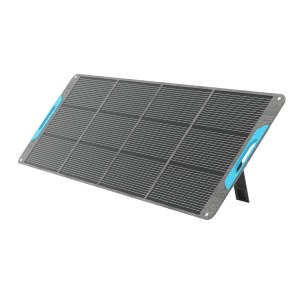
The EFLEX-CORE 200W represents Renogy’s answer to the growing demand for high-output portable solar. Power stations are now a common item in UK camper vans, off-grid cabins, and emergency preparedness kits. Charging a 1000Wh power station from solar is a practical way to extend its useful life, and 200W of input makes that viable even on partial-sun UK days. The IP65 waterproof rating is a specific call-out that makes this more suitable for UK outdoor use than many portable panels with lower weather ratings.
The 615 reviews at 4.5 stars is a solid result for a product at this price point (£179.98). The foldable format means it packs down considerably for transport and storage. The EFLEX design uses a semi-rigid construction that’s more durable than purely fabric-based portable panels, which is the right trade-off for buyers who want portability without the fragility concerns of soft panels.
This is the panel for buyers who want to charge a portable power station quickly. The high output means a full charge in reasonable conditions rather than waiting for two days of mediocre UK sun to top up a large battery.
Features
- 200W foldable panel system
- IP65 waterproof rated
- Semi-rigid EFLEX-CORE construction
- Designed for portable power station charging
- Compact folded profile for storage and transport
- 615 reviews at 4.5 stars
- 200W output charges power stations meaningfully on UK days
- IP65 rated for genuine outdoor use in UK weather
- More durable than soft portable panels
- 615 reviews at 4.5 stars
- Pricier than single rigid panels
- Heavier and bulkier than suitcase-format portable panels
6. Renogy 100W 12V Semi-Flexible Solar Panel (LTWT-Flex)
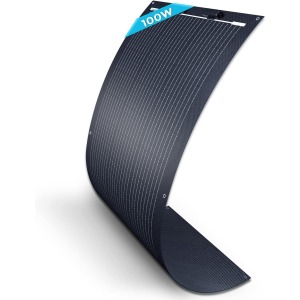
Semi-flexible panels solve a specific problem that rigid panels can’t: curved surfaces. Van conversions, narrowboat cabin roofs, RV aerodynamic rooflines, and sailing boat cabin tops all have gentle curves that make a rigid aluminium-framed panel impractical to mount flush. The Renogy LTWT-Flex bends to a modest degree without damaging the cells, which allows it to follow the curve of the surface it’s mounted to.
The 185 reviews at 4.4 stars is reasonable for a specialist product. The lightweight construction is a genuine advantage in weight-sensitive applications like sailboats and van conversions where every kilogram matters for handling and fuel economy. At £162.48 it’s priced at a premium over rigid panels, which reflects the specialist manufacturing required for flexible solar cells.
The limitations of flexible panels are real and worth understanding: they degrade faster than rigid glass-fronted panels when installed flat without an air gap underneath, the maximum bend angle is not as extreme as fully flexible thin-film panels, and they’re not suitable for walking on. But for the specific use case of a mildly curved surface where rigid panels won’t work, the LTWT-Flex is the right solution.
Features
- 100W semi-flexible monocrystalline cells
- Bends to follow mildly curved surfaces
- Lightweight construction for weight-sensitive installs
- Black design for low-profile aesthetic
- Suitable for van roofs, boat cabin tops, RV rooflines
- 185 reviews at 4.4 stars
- Conforms to curved surfaces rigid panels can’t fit
- Lightweight, good for weight-critical installs
- Low-profile black design
- Degrades faster than rigid glass panels if installed without air gap
- Higher cost per watt than rigid alternatives
- Limited bend radius, not for sharply curved surfaces
7. Renogy 100W N-Type 16BB Solar Panel
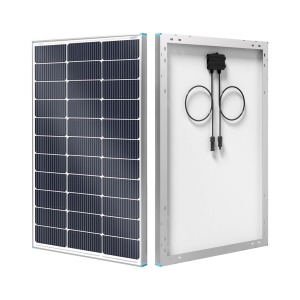
N-type cells represent the current generation of solar technology, and the 16BB (16 busbars) design is the most recent advance in maximising current collection across the cell surface. Renogy’s 100W N-Type 16BB claims 25% efficiency, which puts it ahead of standard monocrystalline P-type cells typically running at 20-22%. At £59.48 it’s actually the cheapest panel on this list, which makes the N-type technology surprisingly accessible.
The lower review count (60 reviews) reflects that this is a newer product. N-type cells have a genuinely better performance profile than P-type, including lower temperature coefficient and improved performance in diffuse light conditions, which is directly relevant for UK buyers dealing with frequent overcast skies. Early adopters who have reviewed it are satisfied at 4.6 stars, though the limited review history means there’s less track record to draw on than the established models above.
Features
- 100W N-type monocrystalline cells
- 16BB (16 busbars) for maximum cell efficiency
- 25% efficiency rating
- Better diffuse light performance than P-type cells
- 12V output
- 60 reviews at 4.6 stars, newer product
- 25% efficiency, best in Renogy’s range
- N-type performs better in diffuse UK light conditions
- Competitive price for N-type technology
- Only 60 reviews, limited long-term track record
- Newer technology with less field experience
Renogy Solar Panels Buying Guide
Key Takeaways
- Renogy is the de facto standard brand for UK caravan, motorhome, narrowboat, and van conversion solar installations — not because their panels are the most efficient or cheapest, but because their product range, MPPT controller compatibility, and MC4 standard connectors make system design and expansion straightforward; a Renogy 100W panel bought today will connect without adaptors to any future Renogy Rover controller or any third-party MPPT you choose
- The Renogy 100W 12V Monocrystalline Starter Kit — panel, 20A PWM controller, cables, and mounting brackets — is consistently one of the best-selling solar products on Amazon.co.uk in the caravan and leisure category; it’s the most practical starting point for a first 12V leisure battery system
- Renogy uses PERC (Passivated Emitter and Rear Cell) monocrystalline technology across its rigid panel range, achieving efficiencies of 21–23%; PERC panels perform better in high-temperature conditions and diffuse light than standard mono cells, which suits the UK’s mix of summer heat and overcast skies
- Renogy’s folding Suitcase range (80W and 100W) includes a built-in PWM controller with the panel, a built-in kickstand for angle adjustment, and alligator clip cables for direct connection to a leisure battery or car battery — the most self-contained and portable 12V charging solution the brand offers
- Renogy has a 5-year material and workmanship warranty and a 25-year power output performance guarantee — the performance guarantee is standard in the industry for rigid panels, but the 5-year workmanship cover is notably longer than ECO-WORTHY’s 1-year coverage; it gives meaningful reassurance for a permanent caravan or shed installation expected to last a decade
- Renogy does not have a UK office or UK-based customer support team — all warranty claims and support queries go through US-based customer service, which Amazon.co.uk buyers occasionally find slow; UK returns processed through Amazon’s own returns system (for Prime-fulfilled orders) are generally faster than going through Renogy directly
- For serious off-grid systems, Renogy’s own Rover MPPT controllers (10A, 20A, 40A) are well-regarded and pair cleanly with Renogy panels; the Bluetooth monitoring app allows real-time system tracking from a phone, which is useful for monitoring caravan battery charge levels remotely
Rigid Panels vs Suitcase vs Flexible: The Three Renogy Formats
Renogy’s UK range covers three distinct physical formats, and choosing the wrong format is the most common buying mistake.
Rigid aluminium-framed panels: The standard format. An aluminium frame surrounds a tempered glass front face with monocrystalline PERC cells. These are designed for permanent or semi-permanent installation: on a caravan roof, shed roof, ground mount frame, or boat deck. They’re heavier than folding panels (a 100W rigid panel weighs around 7kg), require mounting hardware, and are not practical to carry. The advantage is higher wattage per panel (50W–400W in the Renogy range), long-term durability, and MC4 connectors compatible with any standard charge controller.
Suitcase (folding) panels: A folded rigid panel pair with a built-in PWM controller, kickstand, and battery connection cables. The suitcase format opens like a briefcase to deploy and folds flat for storage. Unlike folding fabric-surface panels, the Renogy Suitcase uses the same tempered glass and aluminium construction as the rigid range — it’s more durable than fabric-surface portable panels but heavier (the 100W Suitcase weighs around 9kg). Designed for: camping where you drive to site (not carry), touring caravan pitch use, and temporary charging at a stationary vehicle.
Flexible panels: Thin, lightweight panels with a flexible backing for curved surface installation — typically on the rounded roofs of caravans and motorhomes that don’t suit flat rigid panels. Efficiencies are slightly lower than rigid panels (18–20%) and the mounting method (adhesive or clip mounting to the surface) means no air gap beneath the panel, which increases cell temperature and reduces output versus equivalent rigid panels on a tilt frame. Use these where a rigid panel genuinely won’t fit, not as a lighter alternative to rigid panels.
The UK Caravan and Van Standard: Why Renogy Dominates This Use Case
| System Type | Recommended Renogy Configuration | Battery Needed | Typical UK Summer Daily Output | Good For |
|---|---|---|---|---|
| Weekend caravan, light use | 100W rigid + Rover 20A MPPT | 100Ah AGM or 50Ah LiFePO4 | 40–70Wh (overcast) / 80–95Wh (sunny) | Lighting, phone charging, 12V device |
| Touring caravan, moderate use | 200W (2× 100W) + Rover 20A MPPT | 200Ah AGM or 100Ah LiFePO4 | 80–140Wh (overcast) / 160–190Wh (sunny) | 12V fridge, TV, laptop, lighting |
| Van conversion | 200–400W rigid + Rover 40A MPPT | 200Ah LiFePO4 | 160–280Wh (overcast) / 320–380Wh (sunny) | Fridge, inverter, device charging, fan |
| Off-grid shed or cabin | 200–400W rigid + Rover 40A MPPT + inverter | 200Ah+ LiFePO4 | As above | Lighting, tools, TV, small appliances |
| Narrowboat supplemental | 200W rigid + Rover 20A MPPT | Existing bank (400Ah+ typical on boats) | 80–140Wh (overcast) / 160–190Wh (sunny) | Supplementing engine alternator charging |
Renogy’s MC4 connectors are the industry standard in the UK caravan and van market. If you buy Renogy panels today and want to add more panels in the future, they’ll chain together using standard MC4 in-line connectors available from any solar supplier. The controller range scales from 10A to 60A, covering systems from a single 50W panel up to a 1,200W array. This expandability is a genuine long-term advantage.
MPPT vs PWM: What to Buy for UK Conditions
Renogy’s starter kits include their Wanderer PWM controller (10A or 20A). PWM controllers are simpler, cheaper, and perfectly adequate for summer use in good UK weather. For year-round use or any installation where you’re asking the system to charge a battery in November through January — when UK irradiance is a fraction of summer levels — upgrading to a Renogy Rover MPPT controller is worth the additional £30–60.
MPPT controllers track the maximum power point on the panel’s power-voltage curve in real time. In partial sun and low-light conditions, this can deliver 20–30% more charging current than PWM from the same panel. For a 100W panel producing 25W on a grey November day, that 20–30% MPPT advantage is the difference between a useful trickle charge and barely moving the battery needle.
The Renogy Rover range also includes a Bluetooth module (sold separately or built into higher-spec models) that connects to the Renogy DC Home app on Android or iOS. For a touring caravan where you might want to check battery state of charge from the awning or a walk away from the van, this monitoring capability is genuinely useful.
What Renogy Doesn’t Cover Well
Renogy’s product range has gaps worth knowing. Their flexible panel range is competent but not their strongest product — the efficiencies are lower and the adhesive mounting method creates long-term durability concerns. For curved caravan roofs, SunPower-backed flexible panels (which use higher-efficiency cells) or a professional in-roof installation with specially profiled brackets often produce better long-term results.
Renogy also doesn’t make portable power stations. If you want an integrated panel-plus-station system for camping rather than a 12V leisure battery system, Jackery and EcoFlow are better-matched choices. Renogy is the right brand when you’re building a 12V system around a leisure battery — not for portable camping use where a power station is the destination for the solar power.
Quick Buying Decision Guide
| Your Situation | Recommended Renogy Configuration | Key Upgrade to Consider | Expected Lifespan | Budget (panels + controller) |
|---|---|---|---|---|
| First caravan system, summer touring | 100W Starter Kit (panel + PWM controller) | Rover MPPT if using year-round | 8–10 years | £90–130 |
| Caravan with 12V fridge, touring UK | 200W (2× 100W) + Rover 20A MPPT | LiFePO4 battery for full capacity in cold | 8–10 years | £170–220 |
| Van conversion or off-grid shed | 400W (4× 100W) + Rover 40A MPPT | Bluetooth module for monitoring | 8–10 years | £320–420 |
| Suitcase portable (camping, touring) | 100W Suitcase with built-in controller | Not needed — self-contained | 6–8 years | £140–180 |
| Narrowboat supplemental charging | 200W rigid + Rover 20A MPPT | DC-DC charger if alternator charging already in use | 8–10 years | £170–220 |
Case Study: Off-Grid Garden Office Installation
Background
A property owner in the East Midlands had a timber garden office at the end of their garden that needed power for a laptop, monitor, LED lighting, and a small fan heater for winter working. Running mains cabling from the house was quoted at over £800 including the required electrical inspection and Part P sign-off. A solar system seemed like the more practical alternative for the modest energy needs of the space.
Project Overview
The goal was to power a standard laptop (65W), a 27-inch monitor (30W), and LED strip lighting (15W) for 6-8 hours per working day, plus a 2kW fan heater for 1-2 hours on cold days. Total daily consumption excluding the heater was approximately 880Wh. The heater requirement meant a separate mains-voltage solution was needed regardless of the solar setup, as a system capable of supplying 2kW continuously from a 12V battery would be prohibitively expensive.
Implementation
The property owner installed two Renogy 100W Monocrystalline Compact panels on the south-facing roof section of the garden office, paired with a Renogy 40A MPPT charge controller and a 100Ah lithium iron phosphate battery. The 200W array charges the battery throughout the day, and a 500W pure sine wave inverter powers the laptop, monitor, and lighting. A separate small electric heater running from a 13A extension cable from the house handles winter warming needs.
Results
From April through September, the system runs the office independently without the battery dropping below 50%. October through March sees reduced generation, but the laptop and monitor loads remain manageable on good charging days. The total system cost was around £550, compared to the £800+ quoted for mains connection. The payback period relative to the mains quote was immediate.
Expert Insights From Our Solar Panel Installers About Renogy Solar Panels
One of our senior solar panel installers, with over 16 years of experience across both residential and off-grid solar installations in the UK, offered this perspective on Renogy panels:
“Renogy is a solid brand for off-grid and mobile applications. The panels do what they say on the tin, the build quality is consistent, and the fact that they sell complete system components means you can put together a functional setup without needing to become an expert in component compatibility. For motorhomes, narrowboats, garden offices, and sheds, they’re a very reasonable choice at the price point. What I’d caution buyers on is understanding the real-world UK output expectations, a 100W panel in the UK is not going to produce 100W most days. Budget for 70-80W peak and work backwards from there. If you want a solar system for your home that actually makes a meaningful dent in your electricity bill, that’s a different conversation involving larger panels, a grid-tie inverter, and MCS certification. But for off-grid applications, Renogy gets the job done.”
Frequently Asked Questions
Are Renogy solar panels any good?
Yes. Renogy panels consistently earn 4.5 to 4.7-star ratings across thousands of UK reviews, which reflects genuine buyer satisfaction over time. They’re not the highest-efficiency panels on the market, but they offer reliable performance at competitive prices with good UK availability. For off-grid and mobile applications, they’re amongst the best-value choices available on Amazon.co.uk.
How much power does a Renogy 100W solar panel produce in the UK?
In real UK conditions, expect roughly 200-300Wh per day in summer (June-August) on reasonably clear days, dropping to 50-150Wh per day in winter (November-January) due to shorter days and more overcast weather. The Standard Test Condition (STC) 100W rating is measured under 1000W/m² irradiance, which UK sites rarely achieve for sustained periods. Always size your battery capacity and panel array assuming these realistic figures, not the STC rating.
What charge controller do I need for a Renogy 100W panel?
For a single 100W panel, a Renogy 20A MPPT controller is the standard recommendation. PWM controllers are cheaper but less efficient, particularly in variable UK light conditions. For arrays of 200W or above, step up to a 30A or 40A MPPT controller. Always check that the controller’s maximum input voltage exceeds the open-circuit voltage (Voc) of your panel array with a safety margin.
Can Renogy panels be used for home solar installation in the UK?
Renogy panels can technically be connected to UK homes, but they’re not the product designed for this application. Professional residential installations use higher-wattage panels (typically 400-450W per panel) from suppliers with MCS certification, and the installation itself must be carried out by an MCS-accredited installer to qualify for the Smart Export Guarantee (SEG). For a professional residential installation, contact an MCS-accredited installer for a proper assessment and quote.
How long do Renogy solar panels last?
Renogy quotes a 25-year power output warranty on their rigid panels, with a guarantee that panels will produce at least 80% of rated output after 25 years. In practice, well-maintained rigid monocrystalline panels typically last 25-30 years. Semi-flexible panels have a shorter expected lifespan, typically 5-10 years in outdoor conditions, due to material fatigue from thermal cycling and UV exposure on the flexible substrate.
Do Renogy solar panels work in the UK winter?
Yes, though output is significantly reduced. UK winter days are short (7-8 hours of usable daylight) and typically overcast. A 100W Renogy panel might produce 50-80Wh on a bright December day. For applications that need consistent winter power, size your array and battery bank with UK winter performance in mind, and consider south-facing tilt angles of 50-60 degrees to maximise the low winter sun angle.
What is the difference between Renogy’s N-type and standard monocrystalline panels?
N-type panels use a different silicon doping process that results in higher efficiency (around 25% vs 20-21% for P-type), a lower temperature coefficient (less performance loss on hot days), and better resistance to light-induced degradation. In UK conditions, the lower temperature coefficient is less relevant than in sunnier climates, but the improved diffuse light performance of N-type cells is a genuine advantage given the UK’s frequent overcast conditions.
Is Renogy a good brand for motorhomes and caravans?
Yes, it’s one of the most popular brands among UK motorhome and caravan owners for good reason. The panels are correctly sized for 12V leisure battery systems, the range covers every common wattage, and the brand’s complete ecosystem of controllers, batteries, and inverters makes building a compatible system straightforward. The motorhome and caravan community on UK forums consistently recommends Renogy as a reliable starting point.
Summing Up
The Renogy 100W 12V Monocrystalline Compact Design is the top recommendation for most UK buyers, backed by over 4,270 reviews and delivering consistent performance across motorhomes, off-grid sheds, boats, and campervans. For those who need portability, the 100W Solar Suitcase with 20A Controller is a complete self-contained system that requires no tools or mounting. The standard 100W 12V High-Efficiency Mono at £59.99 is the best value for permanent roof installations where the compact dimensions aren’t needed.
For specific applications, the 50W Compact suits smaller energy needs at the highest average rating on this list, the EFLEX-CORE 200W handles portable power station charging efficiently, the semi-flexible LTWT-Flex solves the curved surface problem, and the N-Type 16BB offers the latest generation efficiency at a competitive price. If you’re considering a full solar installation for your property rather than an off-grid application, contact us for a free quote from our MCS-accredited installer network.
Updated