
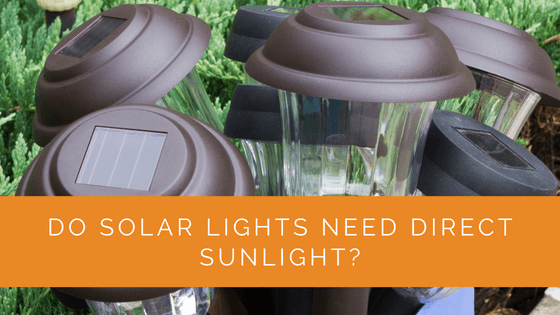
The most common question about solar lights: do they need direct sunlight? The answer is both yes and no. They work best with direct sun, but they also charge on cloudy days, in shade, and even under tree canopy – just much more slowly.
For UK homeowners this matters enormously. Not every garden is drenched in sunlight all day. Many properties have shade from trees, buildings, or neighbouring structures. Understanding what “enough light” means for solar lights helps you place them successfully and set realistic performance expectations.
Key Takeaways
- Solar lights charge best in direct, unobstructed sunlight – this produces maximum power and full charging
- Indirect (diffuse) light from cloud cover still charges solar lights, at roughly 20-40% efficiency compared to direct sun
- Partial shade reduces charging to 30-70% efficiency, depending on how much sun reaches the solar panel
- Deep shade (under dense tree canopy or covered areas) charges solar lights very slowly, usually insufficiently for reliable nightly operation
- UK cloudy days provide more charging than expected because clouds scatter sunlight rather than block it entirely
- The edge of cloud effect (bright edges around clouds) can actually accelerate charging compared to uniform cloud cover
- Solar lights need minimum 4-6 hours of direct or bright indirect sunlight daily to charge adequately in summer
- In winter, 4-6 hours of direct sun achieves less charging due to lower sun angle, but is still usually adequate
- Amorphous silicon panels (used in budget lights) handle low light and cloudy conditions better than monocrystalline panels
- If a location receives less than 3-4 hours of usable daylight, solar lights will underperform, and mains lights are preferable
Direct Sunlight: The Ideal Charging Condition
Direct sunlight delivers the maximum light intensity a solar panel can receive. On a clear day at solar noon (around 1pm UK time), a horizontal surface receives about 1000 watts per square metre of sunlight. A solar panel converts 15-20% of this into electrical power.
For a typical solar light panel (10 square centimetres), this means 1500-2000 milliwatts of electrical power generation – plenty to rapidly charge the battery and allow the light to run at full brightness all night.
Direct sun is optimal because it’s unobstructed. Every ray of sunlight reaches the panel without being scattered, filtered, or absorbed by clouds or obstacles. This is the fastest, most efficient charging condition.
A well-positioned south-facing solar light in summer direct sunlight charges fully in 4-6 hours. In winter, even with lower sun angle, 6-8 hours of winter direct sun achieves 70-90% of full battery charge due to the extended charging period.
Diffuse Light from Cloud Cover
Clouds don’t block sunlight – they scatter it. When sunlight hits cloud droplets, the light scatters in all directions, reaching the ground from many angles rather than as a direct beam. This is diffuse light.
The intensity of diffuse light depends on cloud type and thickness. A thin veil of high-altitude cloud (cirrus) reduces sunlight to about 70-80% of clear-sky intensity. Low, thick cumulus clouds reduce it to 30-50%. Heavy grey stratocumulus clouds reduce it to 10-20%.
From a solar panel’s perspective, even 30% intensity is significant. A panel that generates 2000 milliwatts in direct sun generates 600 milliwatts under heavy cloud. Over 12 hours of daylight, this is enough to charge a small solar light battery to 60-70% capacity – usually sufficient for adequate nightly operation.
This is why solar lights work on most UK cloudy days. It’s not that clouds block charging entirely – they reduce it substantially but not fatally.
The Edge of Cloud Effect
An interesting phenomenon: when clouds are breaking up and sun peeks from the sides, the bright white edges of clouds create intense diffuse light. Sometimes this “edge of cloud effect” produces more charging than uniform cloud cover, and occasionally nearly matches direct sun intensity.
This happens because sunlight reflects off cloud edges, creating localised areas of very bright diffuse light. Solar installers designing large PV arrays account for this – cloud edge effects can produce brief periods of power generation even on mostly cloudy days, improving overall daily output.
For solar lights, this means on a day with intermittent clouds and sunny breaks, charging is often better than you’d expect. A day that feels “cloudy but not dark” usually charges solar lights adequately.
Partial Shade: The Difficult Middle Ground
Partial shade – such as dappled light under tree foliage or light on a north-facing wall – presents the difficult scenario. It’s bright enough to see in comfortably, but it’s still significantly reduced from full sun.
Under a tree with semi-dense foliage, sunlight intensity drops to 30-70% of full sun, depending on how thick the canopy is. A solar panel in this light generates 30-70% of its direct-sun power.
Over a full day, this partial shade charging might achieve 40-60% battery capacity. This is marginal for reliable nightly operation, especially in winter or if the light runs for many hours at night.
The problem with partial shade: you can’t predict performance accurately. Some days are brighter (sun higher in sky, fewer clouds), charging better. Some days are dimmer (sun lower, heavier clouds), charging poorly. The light might work some nights and underperform others, creating unpredictable results that feel like failure.
If you must place a light in partial shade, choose a model with a large solar panel and high-capacity battery (expensive options) and accept that winter performance will be weak.
Deep Shade: Unsuitable Territory
Deep shade – under dense tree canopy, inside covered porches, in areas that never receive direct sun throughout the day – provides too little light for solar lights to work reliably.
A solar panel in deep tree shade receives maybe 5-15% of full sun intensity. Over a full day, this might charge a battery to 10-20% capacity. A light with such marginal charge barely glows at night, then depletes by midnight.
This is the point at which solar lights fail to function and you should choose mains lights instead. If a location is dark enough that you’d need artificial light during midday, it’s too shaded for solar lights to charge adequately.
How Much Sunlight is “Enough”?
A practical rule: solar lights need minimum 4-6 hours of direct or bright indirect sunlight daily for adequate charging, especially from winter’s perspective.
In summer with 15+ hours of daylight, almost anywhere gets 4-6 hours of usable light unless deeply shaded. In winter with only 8 hours of daylight, a location must receive sun for most of the day to achieve 4-6 hours of charging.
South-facing locations easily achieve this in both summer and winter. East and west-facing locations achieve this in summer but may fall short in winter. North-facing and deeply shaded locations almost never achieve 4 hours of useful charging in winter.
If you’re uncertain whether a location has enough sunlight, try this: observe it on a winter day. If the spot receives any direct sun between 9am and 3pm (winter solar window in the UK), it’s probably adequate. If it remains shaded throughout winter daylight hours, it’s unsuitable for solar lights.
Seasonal Variation in Charging
The same location provides dramatically different charging in summer versus winter, even with the same weather.
In June, the sun is high in the sky, daylight lasts 15-16 hours, and even a partially shaded location receives adequate charging. A south-facing garden gets intense direct sun for most of the day.
In December, the sun barely rises above the horizon, daylight is only 8 hours, and even well-positioned locations receive sun for only a few hours. A south-facing garden receives 4-6 hours of winter sun. An east-facing location receives only 2-3 hours before the sun sets.
This is why solar lights feel seasonal in performance. The same light that glows brilliantly at 11pm in July might be completely dark by 10pm in January. This seasonal variation is normal and expected, not a malfunction.
Amorphous vs Crystalline Silicon Panels
Two types of solar panels appear in consumer lights: monocrystalline (or polycrystalline) and amorphous silicon.
Monocrystalline panels: Most efficient in direct sun (15-20% efficiency). Used in expensive premium lights. Excellent when sunlight is abundant. Disadvantage: perform less well in low light and have a steeper efficiency drop in shade.
Amorphous panels: Lower efficiency in direct sun (5-10%) but superior performance in diffuse light and shade. They lack the sharp “cliff” (rapid efficiency drop) that crystalline panels have in low light. Used in budget lights. Better suited to the UK’s cloudy climate and shaded gardens.
For UK use, amorphous silicon panels are often more practical despite lower peak efficiency. They handle cloudy days and partial shade better than crystalline panels, resulting in more consistent performance year-round.
Testing if Your Location Gets Enough Light
Before investing in multiple solar lights, test a single one in your chosen location. Purchase an inexpensive solar light (£10-20) and place it in the spot where you want it. Monitor it for several days through varying weather.
Summer test: If the light glows brightly all night in summer, the location is definitely suitable.
Winter test: If the light glows for 4+ hours on a clear winter day, the location is adequate for winter use too. If it glows dimly for 1-2 hours, the location is marginal and better suited to decorative lights (lower brightness requirements) than security lights.
A low-cost test light gives you real-world data specific to your location, weather patterns, and seasonal variation – far more useful than general guidance.
Case Study: Positioning Solar Lights in a Shaded Garden
Background
A property owner in Surrey had a north-facing garden with large mature trees. The garden received almost no direct sun year-round. She wanted solar lighting for safety and ambiance but was concerned about shade.
Project Overview
The team surveyed the garden and identified one corner (southeast-facing fence line) that received 3-4 hours of winter sunlight. This was the only suitable location. The rest of the garden was too shaded for standard solar lights.
Implementation
Solar lights were concentrated in the sunny southeast corner where they charged adequately. The rest of the garden received decorative mains lights (no charging required). This hybrid approach combined the simplicity of solar lights in the sunniest spot with practical mains lighting elsewhere.
Results
The southeast corner lights performed reliably. The rest of the garden had proper lighting for evening use. By accepting that only part of the garden was suitable for solar lights, the owner achieved a workable solution that required minimal installation (solar lights) whilst covering the shaded areas adequately.
Expert Insights From Our Solar Panel Installers About Sunlight and Solar Lights
One of our installers with 18 years in renewable energy shared this: “Sunlight availability is the biggest factor in solar light success. You can buy the best solar light on the market, but if it’s sitting in shade, it’ll underperform. Conversely, even a budget solar light in a good sunny spot works well. Always assess the actual sunlight at your location before choosing lights. Watch it through a winter day – that’s the worst case and tells you exactly what to expect.”
Frequently Asked Questions
Do solar lights work on cloudy days?
Yes. Clouds scatter sunlight rather than block it entirely. Even on heavy overcast days, diffuse light charges solar panels at 20-40% of direct-sun efficiency. A cloudy day often provides adequate charging for 4-8 hours of nightly light, depending on cloud density and battery size. Only persistent heavy cloud (multiple consecutive days) noticeably impacts performance. Light under cloud cover rarely prevents charging.
How much shade is too much for solar lights?
Deep shade (under dense tree canopy, inside covered structures, areas with no direct sun throughout the day) is unsuitable. Partial shade (dappled light, light on north walls) is marginal and works better in summer than winter. The practical test: if a location receives less than 3-4 hours of usable daylight in winter, solar lights will underperform. South-facing and east/west-facing spots usually work. North-facing rarely works.
Can solar lights work under trees?
Only if the tree isn’t densely shaded. Dappled light under a thin-canopy tree or deciduous tree with sparse leaves can work, especially in summer. Deep shade under a coniferous tree or dense canopy won’t support reliable solar light operation. Deciduous trees are better than evergreens because winter bare branches allow more sunlight through. If under a tree is your only option, choose amorphous silicon panels (better in low light) and accept reduced winter performance.
Do solar lights need sun all day?
No. They need 4-6 hours of direct or bright indirect sunlight spread through the day, not continuous all-day sun. A location that receives morning sun, loses it to afternoon shade, then gets evening sun can work well if the total usable sunlight hours reach 4-6. The panel doesn’t care whether the sun arrives in one continuous block or as three 2-hour sessions – total daily light is what matters.
What’s the difference between amorphous and crystalline solar panels?
Crystalline panels (monocrystalline) are more efficient in direct sun (15-20%) but perform less well in shade and diffuse light. Amorphous panels are less efficient overall (5-10%) but maintain better performance in cloudy conditions and shade without a sharp drop-off. For UK climate with frequent clouds, amorphous is often more practical despite lower peak efficiency. Check product specifications to see which your light uses.
Does sunlight reflecting off water help solar lights charge?
Yes, slightly. Reflected sunlight from water, white walls, or light-coloured surfaces increases total light reaching the panel. Positioning a solar light where it catches reflected as well as direct sunlight can improve charging by 5-10%. However, reflection is a minor effect. The primary factor remains the direct and diffuse light the panel receives from the sky. Don’t rely on reflection alone to compensate for a shaded location.
Can I clean the solar panel to improve charging?
Yes. Dust, dirt, algae, and bird droppings reduce solar panel efficiency. A clean panel charges 10-20% faster than a dirty one. Clean your solar light panels every 2-3 months, or monthly if in a dusty area. Use a soft cloth, lukewarm water, and mild soap. Avoid harsh chemicals or abrasive materials. A monthly rinse with rainwater or a gentle hose spray keeps panels clean and maintains peak charging efficiency.
Is there a minimum temperature for solar lights to work?
Solar panels generate power at any temperature. However, cold weather reduces battery efficiency and run time. A fully charged solar light in winter cold (5-10°C) won’t run as long as the same light in summer warmth (20-25°C) due to battery chemistry limitations at low temperatures. This is why solar lights perform noticeably better in summer than winter, even with identical charging conditions. The reduction is normal and expected.

Summing Up
Solar lights don’t strictly need direct sunlight – they work in shade and clouds, just more slowly. The real question is whether they’ll charge sufficiently for your needs at your specific location. South-facing spots receive adequate charging year-round in the UK. East, west-facing and partial shade locations work well in summer but may struggle in winter. Deep shade and north-facing areas usually fail. The practical approach: observe your location in winter (worst case), noting how many hours of sun it receives. If 4+ hours, solar lights are viable. If less, consider mains lights. A simple test with an inexpensive solar light clarifies whether your location will support reliable solar performance.
Updated