
The intelamp 3-Head Dual PIR Solar Security Light is our top pick for UK buyers who want the most reliable motion detection coverage from a single unit. The dual PIR sensor design eliminates the blind spots that single-sensor lights create, and three independently adjustable heads mean you can cover a corner, a driveway approach, and a side passage from one mounting point. At £29.99 with IP65 waterproofing and a 4.5-star rating, it covers the security brief without compromise.
Solar security lights have improved significantly in recent years. The best current models deliver genuine deterrent-level brightness, multi-mode operation, and battery capacity that holds up through a British winter night. This roundup covers eight options from trusted brands like Philips to budget 4-packs, so whether you’re lighting a single gate post or a full driveway, there’s a model here that fits the position and the budget.
Our Top Picks
| Image | Name | |
|---|---|---|
| intelamp 3-Head Dual PIR Solar Security Light | |
| TECKNET 495 LED Solar Security Light 2-Pack IP66 | |
| Philips Solar Motion Sensor Light 1000LM 7000K | |
| JumJam 280LED 3-Head Solar Security Light | |
| Lepro 1200LM 3-Head Solar Security Light | |
| CLAONER 286 LED 360° Solar Security Light | |
| LOTMOS 342LED Solar Security Light with Remote | |
| Outdoor Garden Solar 238 LED Security Light 4-Pack |
8 Best Solar Security Lights
1. intelamp 3-Head Dual PIR Solar Security Light
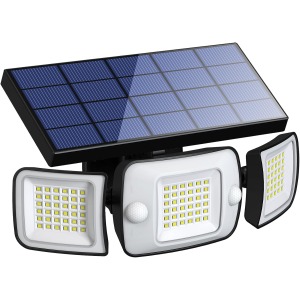
The intelamp earns its top position through the dual PIR sensor design, which is genuinely different from the single-sensor alternatives in this roundup. Most solar security lights have one passive infrared sensor pointing in a fixed direction. Miss that angle and the light stays off. The intelamp uses two sensors covering a wider combined arc, so the detection zone wraps around rather than pointing straight ahead. For a corner position, a gate post where people approach from two directions, or a drive where movement comes from multiple angles, this matters considerably.
Three adjustable heads add to the coverage flexibility. Each head rotates independently, so you can angle two heads down the driveway and one toward a side passage, or spread all three across a wide frontage. At £29.99 you’re paying a premium over the single-head options here, but you’re getting a product that solves a problem the cheaper lights can’t. IP65 waterproofing is standard for outdoor security use in the UK, and the 4.5-star rating confirms the build holds up over time.
The three operating modes cover the sensible range: motion-activated only (good for battery conservation in winter), permanent dim with motion-triggered full brightness (best for driveways where you want some ambient light), and permanent full brightness (for constant security illumination). Most buyers will find motion-activated mode covers their use case. The full-brightness mode drains the battery quickly in winter but is useful for short periods when guaranteed illumination is needed.
The dual PIR advantage is real on a corner property or any position where movement can come from more than one direction. Single-sensor competitors leave a cone-shaped blind spot on each side of their detection zone; the intelamp shrinks those blind spots significantly. If you’re installing on a standard single-approach position like a straight driveway, the single-sensor alternatives below are perfectly adequate and cheaper. But for complex positions, this is the one to buy.
Features
- Dual PIR sensors for wider detection coverage with fewer blind spots
- 3 independently adjustable heads
- 3 operating modes: motion-only / dim+motion / constant
- IP65 waterproof
- 4.5 stars
- £29.99
- Dual PIR reduces detection blind spots on corners and multi-approach positions
- Three adjustable heads cover complex layouts from one mounting point
- Three modes give genuine flexibility for different use cases
- IP65 handles UK conditions reliably year-round
- £29.99 is the highest per-unit price in this roundup
- Permanent mode drains battery quickly in December
- Larger form factor than single-head units
2. TECKNET 495 LED Solar Security Light 2-Pack IP66
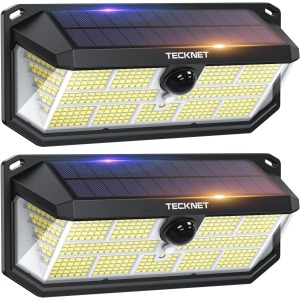
TECKNET is a UK-established brand with genuine retail presence, and this 2-pack at £26.99 is the strongest value proposition in the roundup if you need to light two positions. At £13.50 per unit, you get 495 LEDs, IP66 waterproofing (a step above the standard IP65), and 4.5-star reviews. The higher IP rating means the light is protected against powerful water jets as well as rain, which matters for exposed positions on a house front or garage corner that catches driving rain from the south-west.
The 495 LED count is the highest in this lineup and translates to a wide flood of white light when triggered. This is a security light designed to deter rather than just illuminate, and the output achieves that. Positioned above a garage door or driveway entrance at 2.5 to 3 metres, the coverage is wide enough to catch movement well before it reaches the property. Because it comes as a 2-pack, the main consideration is whether you have two south-facing or south-east/south-west-facing positions for the solar panels. Each unit has its own panel, so they operate independently. Both need reasonable sun exposure for the pair to deliver consistently.
TECKNET’s brand backing is worth something here. Anonymous budget brands with identical-looking products often use lower-grade components that become brittle or fail within two years. TECKNET products are stocked and sold through UK retailers with UK customer support, which matters when you need to make a warranty claim rather than navigate a Chinese seller’s returns process.
Features
- 495 LEDs, highest output in this roundup
- IP66 waterproof (above standard IP65)
- 2-pack at £26.99 (£13.50 per unit)
- PIR motion sensor
- 4.5 stars
- IP66 provides better protection against driving rain than most rivals
- 495 LEDs delivers deterrent-level flood output
- 2-pack makes sense for paired driveways or double gate posts
- TECKNET brand gives UK retail-backed peace of mind
- Requires two south-facing or near-south positions to work properly
- Each unit operates independently; no paired or synchronised modes
3. Philips Solar Motion Sensor Light 1000LM 7000K
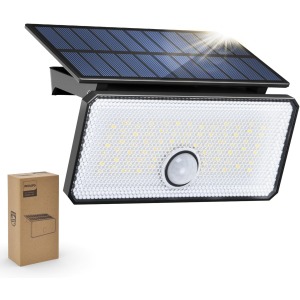
Philips is the only mainstream lighting brand in this roundup, and it brings what you’d expect: a product built to a specification rather than a price point. The 1000LM output and 7000K colour temperature are clearly stated, which is more than most competitors offer. Most solar security light listings say “super bright” without a lumen figure. Philips tells you exactly what you’re buying, and that transparency itself signals quality control.
At 7000K, this is a cool daylight output. Colours render clearly, shadows are sharp, and the light reads as a proper security flood rather than the slightly orange glow of warm-white solar alternatives. At £22.99 it’s competitive with mid-range no-name brands. Three operating modes (permanent dim, motion-triggered bright, and always-bright) cover the same functional range as the intelamp. The 2-year manufacturer warranty is the strongest cover in this roundup.
The honest caveat is review volume. As a newer product on the UK market, it doesn’t yet have the thousands of ratings that CLAONER or Lepro carry. But Philips’s quality control and warranty give it credibility that review count alone doesn’t provide. If you want a known brand with defined specifications and retail warranty support, this is the pick.
Features
- 1000LM rated output, clearly specified
- 7000K cool daylight colour temperature
- 3 modes: dim / motion bright / constant bright
- 2-year Philips manufacturer warranty
- Waterproof construction
- 4.5 stars
- £22.99
- Philips brand with 2-year warranty, strongest cover in this roundup
- 1000LM and 7000K are clearly specified, not vague claims
- 7000K cool daylight looks like a proper security flood
- Competitive price for a branded product
- Fewer reviews than established rivals, less real-world validation
- Single head, less flexible than multi-head units for complex positions
4. JumJam 280LED 3-Head Solar Security Light
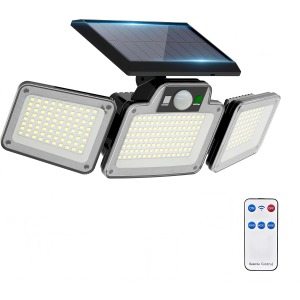
JumJam’s 3-head design at £23.99 sits in the middle of the price range and delivers the adjustable coverage of a multi-head unit without the dual-sensor premium of the intelamp. Three heads that each rotate and tilt independently means you cover a wider area than any fixed single-head can manage. For a corner position where you want to cover both the front of the property and the side passage, or a garage with both doors and an adjacent path, the flexibility is real and genuinely useful.
At 280 LEDs it’s not the brightest unit here, but brightness alone doesn’t define an effective security light. Detection sensitivity and coverage angle matter as much. A light that triggers reliably at 8 metres and covers 120 degrees is more effective than a brighter light that misses movement from the side. JumJam’s sensor performance is solid at this price, and the 4.5-star rating with decent review volume confirms it works in practice as well as on paper.
The 3-head format is particularly useful where the solar panel placement and the illumination direction need to be different. The panel goes south-facing; the heads can point north, east, and west if needed. That separation of charging and illumination direction is one of the genuine advantages of larger multi-head solar security lights over small integrated models.
Features
- 280 LEDs across 3 independently adjustable heads
- Each head rotates and tilts independently
- PIR motion sensor
- IP65 waterproof
- 4.5 stars
- £23.99
- Three adjustable heads cover complex illumination layouts from one unit
- Good mid-range value for multi-head coverage
- Panel faces south while heads can point in any direction
- IP65 adequate for all UK conditions
- Single PIR sensor compared to intelamp’s dual-sensor design
- 280 LEDs is mid-range for raw brightness
5. Lepro 1200LM 3-Head Solar Security Light
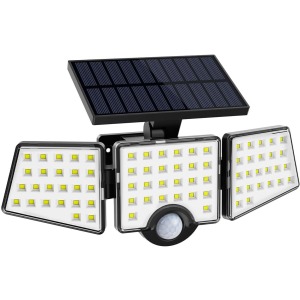
Lepro claims 1200LM and backs it up with one of the highest-rated products in the category. At £15.97 for a 3-head unit, the value ratio is outstanding. Three adjustable heads at a price more commonly associated with single-head budget models. The question any buyer should ask about 1200LM at £15.97 is whether real-world performance matches the listing. With 4.4 stars across a large review base, Lepro appears to deliver consistently.
The 3-head design covers the same broad illumination zone as the JumJam and intelamp above, and the adjustability is comparable. At this price, compromises exist: the battery may not sustain full output through a full December night in northern England, and the plastics may yellow faster after two or three years of UV exposure than premium models. But for a front door, back garden gate, or garage in a sheltered south-facing position, it’s capable at a price that makes buying two units entirely affordable.
Features
- 1200LM claimed output
- 3 adjustable heads
- PIR motion sensor
- IP65 waterproof
- 4.4 stars
- £15.97
- Outstanding value: 3-head unit at single-head budget prices
- 4.4 stars across a large review base confirms real-world performance
- Adjustable heads provide coverage flexibility at entry-level cost
- Lumen claims from budget brands should be treated as approximate
- Plastics may UV-fade faster than premium models after 3+ years
- Winter battery performance less proven than in premium models
6. CLAONER 286 LED 360° Solar Security Light
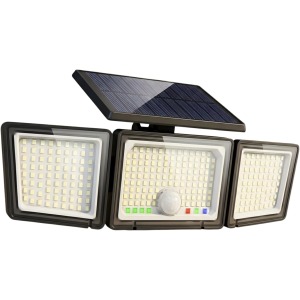
The 360-degree coverage design makes CLAONER different from every other product in this roundup. Rather than pointing in one direction, the light illuminates a full circle around the mounting point. For a central garden post, a standalone pole in a car park, the apex of a shed or outbuilding, or a gatepost on a corner, this is the right format. For a wall-mounted position where you only need to illuminate one direction, it’s less efficient since half the output illuminates the wall behind it.
At £12.99 it’s one of the least expensive single-unit options here. The 286 LED count is decent for the all-around format, and 4.4 stars confirms the coverage works. The trade-off is that full-circle coverage from a single unit necessarily delivers less light in any one direction than a focused multi-head unit. For a driveway requiring deterrence-level brightness in one direction, the TECKNET or intelamp is the better choice. For ambient all-around coverage for a garden, shed, or pole position, CLAONER is the right format for the job.
Features
- 360-degree all-around illumination
- 286 LEDs
- PIR motion sensor
- IP65 waterproof
- 4.4 stars
- £12.99
- 360-degree coverage is unique in this roundup, ideal for poles and central positions
- Good value for all-around garden and shed illumination
- 4.4 stars from solid review volume
- All-around coverage delivers less intensity in any single direction
- Not efficient for wall mounting where focused directional output is needed
7. LOTMOS 342LED Solar Security Light with Remote Control
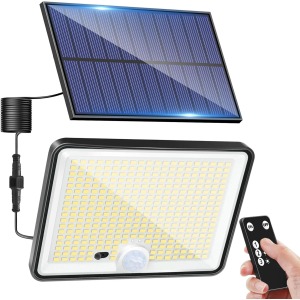
The remote control is what makes LOTMOS notable at £11.99. Switching modes, adjusting sensitivity, and turning the light on or off from a distance is genuinely useful for a security light mounted 2.5 metres up on a wall. Without a remote, changing the settings means getting a ladder out. LOTMOS solves that with an RF remote that works at a reasonable range. 342 LEDs at this price is solid, and 4.3 stars from a decent review count confirms it delivers.
As a budget pick, the plastics won’t age as gracefully as premium models and winter battery performance in Scotland or northern England will be reduced compared to models with larger battery and panel capacity. For a south-facing sheltered position in the Midlands or further south, it’s a capable and affordable security light with the practical bonus of remote control. The lowest per-unit cost of any single proper security light in this roundup.
Features
- 342 LEDs
- Remote control for mode and sensitivity adjustment
- PIR motion sensor
- IP65 waterproof
- 4.3 stars
- £11.99
- Remote control makes post-installation mode changes practical without a ladder
- 342 LEDs is solid for the price
- £11.99 is the lowest per-unit cost for a proper PIR security light here
- Budget plastics will UV-fade and yellow over 2-3 years outdoors
- Winter battery performance limited in northern UK regions
- 4.3 stars slightly below the 4.4-4.5 of the top picks
8. Outdoor Garden Solar 238 LED Security Light 4-Pack
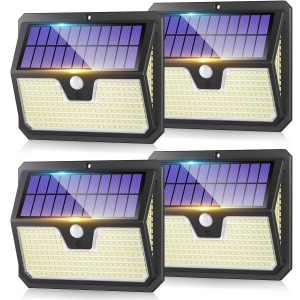
The 4-pack format at £16.98 works out to roughly £4.25 per light, the lowest per-unit cost in this roundup. At that price, you’re buying a compact PIR motion light suited to lower-demand positions: a back door, a bin store, a side gate, or a garden shed. These won’t replace a proper security flood for deterrence-level illumination on a driveway, but for marking a perimeter with motion-activated light at minimal cost, four lights cover more ground than one premium unit.
The honest assessment: 238 LEDs per unit at £4.25 is fine for the task. Don’t expect winter performance comparable to the larger single units above. The battery is small, the panel is small, and they’re designed for lighter-use seasons. In summer they work well. In December, particularly in the north of England or Scotland, they may only manage a handful of activations per night before the battery is flat. Buy these for multiple low-demand positions where coverage matters more than intensity.
Features
- 4-pack format, approximately £4.25 per light
- 238 LEDs per unit
- PIR motion sensor
- Waterproof construction
- 4.3 stars
- £16.98 for 4
- Lowest per-unit cost in this roundup at around £4.25
- Four lights cover a full perimeter at the cost of one mid-range single unit
- Small battery limits winter performance, especially in northern UK
- Not suitable as a primary security light for driveways or front doors
- Basic build quality at this price point
Solar Security Lights Buying Guide
Key Takeaways
- Multi-head lights (3 heads) cover corners and complex layouts that single-head units can’t reach from one mounting point
- Dual PIR sensors reduce detection blind spots and are worth the premium for exposed corner positions
- Panel placement is the single biggest performance factor: a south-facing panel outperforms a north-facing one by 60-70% in winter
- IP65 is the minimum for outdoor UK use; IP66 is worth choosing for exposed positions that catch driving rain
- Battery capacity matters more in winter; budget lights may manage only a few activations on a December night
- 7000K cool daylight looks and performs better for security than warm white alternatives
- Motion-activated mode only is the right default in winter for conserving battery
Types of Solar Security Light
| Type | Best For | Typical Lumens | Price Range |
|---|---|---|---|
| Single-head fixed | Front door, back gate, single-approach positions | 400-800LM | £8-18 |
| Multi-head (2-3 heads) | Corners, driveways, wide-coverage positions | 800-1500LM combined | £15-35 |
| 360-degree | Garden poles, standalone posts, shed apexes | 400-800LM all-around | £10-20 |
| Multi-pack | Perimeter marking, multiple low-demand positions | 200-400LM per unit | £4-8 per unit |
| Dual PIR sensor | Corners with multiple approaches, high-security positions | 600-1200LM | £25-45 |
The Panel Placement Problem
This is the issue that causes most disappointment with solar security lights, and it’s almost never addressed in product listings. The solar panel must receive direct sunlight to charge the battery adequately. On a south-facing wall in the UK, a solar security light charges well from March through September and adequately from October through February. On a north-facing wall, the panel receives only reflected light year-round, with no direct sun at all.
The practical result: a solar security light on a north-facing wall may deliver only 20-30% of its stated battery capacity in December. A light rated for 8 hours of operation may only manage 2 to 3. If your primary security concern covers winter nights, and your installation position doesn’t receive direct sun, you have two options. Choose a model with a separate panel on a cable that can be routed to a south-facing surface independently of the light head. Or accept reduced performance and compensate by using motion-activated mode only to minimise battery drain.
Before buying, check the sun exposure of your planned installation position using a compass or a sun-tracking app. Even a south-east or south-west facing position will significantly outperform true north. The panel placement decision matters more than which brand you choose.
Lumens and What’s Actually Enough
Lumen claims from solar security light manufacturers are frequently exaggerated or measured at peak rather than sustained output. Apply a 20-30% discount to claims from budget brands. The more useful question is what output is needed for your specific application.
For a back door or side gate where you need to see clearly when entering: 200-400LM is adequate. For a driveway approach where you want movement clearly lit as a deterrent: 600-1000LM is the right range. For a large frontage or commercial property where you want visible flood-level illumination: 1000LM+ from a quality, specified source. The Philips 1000LM rating is more reliable than a budget brand claiming 1500LM with no independent verification.
PIR Sensor Quality and Detection Range
The PIR (passive infrared) sensor detects body heat moving across its field of view. The sensor angle, range, and sensitivity all affect triggering reliability. Most solar security lights specify a detection angle (120 degrees is common) and a range (8 metres is standard). In practice, a PIR that triggers at 8 metres on a warm evening may only reliably trigger at 4-5 metres on a cold night in January, because the temperature difference between the body and the cold air narrows.
Dual PIR sensors, as used in the intelamp, address the main limitation of single sensors: the blind spot on each side of the detection cone. With two sensors, the combined detection arc is wider and blind spots are smaller. For a gate post where someone might approach from multiple directions, dual PIR is a genuine performance advantage rather than just a marketing claim. For a straight single-approach driveway, a single quality PIR is perfectly adequate.
IP Ratings for Solar Security Lights
The IP (Ingress Protection) rating tells you how well the unit resists water and dust. For UK security lights, the relevant ratings are:
- IP44: Protected against splashing water only. Not adequate for direct rain exposure. Avoid for any outdoor position in the UK.
- IP65: Protected against low-pressure water jets from any direction. Handles UK rain including sideways rain on an exposed wall. The minimum acceptable rating for outdoor security use.
- IP66: Protected against high-pressure water jets. Better for exposed corners and positions that catch driving rain from the south-west. The TECKNET in this roundup carries IP66.
- IP67: Temporarily submersible. More than needed for a wall-mounted security light, but no harm in it if available.
Note that the IP rating applies to the light housing. The cable entry points and joins between the panel and cable are often weak points in cheaper units. After two to three years, water ingress through a poorly sealed cable gland is a common failure mode. You’ll notice it when the light starts switching on randomly at night or stops working after heavy rain.
Build Quality and UV Fading Over Time
Solar security light housings are almost universally made from ABS plastic. The difference between a light that looks functional after three years and one that has yellowed, cracked, or become brittle is the UV stabilisation quality of the plastic compound. Budget models use basic ABS without UV stabilisers. After one or two UK summers, white plastic yellows and the housing becomes more brittle. After three years, cheap units often develop hairline cracks that allow water ingress.
You can’t confirm from a listing whether the ABS is UV-stabilised. Review photos showing products installed for two or more years are the most useful indicator. Brand names with retail track records (Philips, TECKNET, Lepro) tend to use better-quality materials than anonymous budget imports, though the premium for UV-stable housing is modest and not always reflected in price.
Colour Temperature for Security
Most solar garden lights use warm white (2700-3000K) for a soft, welcoming appearance. Solar security lights should not. For security purposes, cool white or daylight colour temperatures (5000-7000K) are more effective. Cool white light renders colours clearly, creates sharp shadows, and looks like a proper security installation rather than a decorative garden feature. A sudden flood of 7000K daylight-white light is a better deterrent than the same output in warm amber.
Check the colour temperature in the product listing before buying a security light. Listings that don’t specify colour temperature typically default to warm white. The Philips at 7000K is the most clearly specified in this roundup. Any product claiming to be a security light should be at least 5000K.
Common Buying Mistakes
- Mounting on a north-facing wall without checking sun hours. The most common cause of poor solar security light performance. Always verify your position gets direct sun before buying an integrated-panel model.
- Buying based on LED count or lumen claims alone. These figures are unreliable from budget brands. Focus on IP rating, battery capacity, review quality, and brand.
- Installing too high. PIR sensors have a maximum effective height. Mounting above 4 metres reduces detection reliability significantly. The sweet spot for most security lights is 2.5 to 3 metres.
- Running constant-on mode in winter. Constant output drains the battery quickly and leaves you with no light after midnight in December. Motion-activated mode is the right default for most users through winter.
- Choosing a 360-degree light for a wall-mounted position. Half the output illuminates the wall directly behind the unit. The 360-degree format is for poles and standalone posts only.
When Solar Security Lights Are Not the Right Choice
Solar security lights are not the right solution for every position. If your property has a large north-facing frontage with no south-facing surface within cable reach of the light position, a mains-powered security light will perform more reliably year-round. Solar is a genuinely good option for south-facing positions, remote outbuildings without mains power, and supplementary lighting where mains installation cost is disproportionate to the requirement.
For commercial properties requiring 24-hour deterrent lighting, consumer solar security lights are unlikely to meet the specification without a dedicated solar array and battery system. The products in this roundup are designed for residential and domestic use. Commercial security applications need a specialist assessment.
Quick Buyer Checklist
- Confirm your installation position gets direct sun: south, south-east, or south-west facing
- Decide on format: single-head, multi-head, 360-degree, or multi-pack based on your position
- Choose IP65 minimum; IP66 for exposed positions catching driving rain
- Target mounting height: 2.5 to 3 metres for reliable PIR detection
- Check cable length if panel placement and light head position need to be separate
- Use motion-activated mode as the default for winter battery conservation
- For corners with multiple approaches, choose dual PIR (intelamp) or 360-degree (CLAONER)
- Prefer clearly specified lumen ratings (Philips 1000LM) over unverified claims (1500LM super bright)
Case Study: Solar Security Lighting on a Semi-Detached Property in Coventry
Background
A homeowner in Coventry had two security concerns: the front driveway was unlit at night, and the side passage to the back garden had no motion-activated lighting. The property had no outdoor electrical sockets and running mains cable to both positions would have cost approximately £400 to £500 in installation.
Project Overview
The brief was to add motion-activated security lighting to both positions without mains installation. Total budget was £60 to £70. The front driveway faces south with good sun exposure. The side passage faces east with reasonable morning sun.
Implementation
The intelamp dual PIR 3-head was mounted on the front corner of the property at 2.8 metres, covering both the driveway approach and the front garden. The dual PIR sensor was the key decision for the corner position, where movement can come from the pavement and from the driveway simultaneously. The JumJam 3-head was mounted above the side gate, angled to cover the passage and back garden entrance.
Results
Total cost: £53.98 for both units, well within budget. The front driveway light triggers reliably from 7 to 8 metres in all weather from March through October. In December and January, both lights perform adequately in motion-activated mode only. Switching from the always-dim setting to motion-only resolved the battery depletion issue the homeowner noticed in the first winter. The mains installation equivalent would have cost eight to nine times more and delivered little practical benefit over the solar alternative on these south and east-facing positions.
Expert Insights From Our Solar Panel Installers About Solar Security Lights
One of our senior solar panel installers with over 12 years of experience fitting both mains and solar lighting systems made these observations about solar security lights in the UK: “The question we get asked most is why the light stops working properly in November. Nine times out of ten it’s panel placement. The product works; it’s just not getting enough charge. Move the panel to a south-facing position, or choose a model with a separate panel on a cable, and the problem disappears. The second most common issue is mounting height. People install these too high thinking they’ll get better coverage, but the PIR is calibrated for 2.5 to 3 metres. Above that and the detection range drops off significantly, and you start missing people close to the wall directly below.”
Frequently Asked Questions
How bright does a solar security light need to be?
For most residential security positions, 600 to 1000 lumens is sufficient. A front door or back gate needs 400 to 600LM. A driveway or large frontage needs 800LM or more for genuine deterrence-level brightness. Apply a 20-30% discount to lumen claims from budget brands, as these figures are often exaggerated or measured at peak rather than sustained output.
Do solar security lights work in winter in the UK?
Yes, but with reduced performance compared to summer. A south-facing panel charges adequately through winter, though output and duration will be lower than in July. On a north-facing wall, performance in December and January may be significantly reduced. Using motion-activated mode only, rather than constant dim, conserves battery and ensures the light triggers reliably even in winter.
What IP rating do I need for a solar security light?
IP65 is the minimum for permanent outdoor use in the UK. It protects against rain from any direction, including sideways. For exposed corner positions or south-west-facing walls that catch heavy rain, IP66 provides better protection against high-pressure water jets. Avoid any security light rated below IP65 for outdoor installation.
How high should I mount a solar security light?
Between 2.5 and 3 metres is the optimal height for most solar security lights. This gives the PIR sensor a good detection angle without being so high that it misses movement close to the wall below. Above 3.5 metres, detection reliability drops significantly for most consumer-grade PIR sensors.
Can I fit a solar security light on a north-facing wall?
You can, but performance will be significantly reduced, particularly in winter. A north-facing panel receives only reflected rather than direct sunlight, providing roughly 20-30% of the charge of a south-facing installation. If your required position is north-facing, choose a model where the solar panel is on a cable and can be routed to a south-facing surface separately from the light head.
What’s the difference between a PIR sensor and a microwave sensor on security lights?
PIR (passive infrared) sensors detect heat and movement crossing their field of view. They’re the standard on solar security lights and work well for most residential applications. Microwave sensors emit a signal and detect reflections, which allows them to detect movement through thin walls or around corners. Microwave sensors are less common on solar lights and can produce false triggers from traffic or wind. For standard residential security, PIR is the right choice.
How long do solar security lights last?
The LED components typically last 25,000 to 50,000 hours, effectively the lifetime of the product. The limiting factor is usually the rechargeable battery, which degrades over charge cycles. Most solar security lights use NiMH or lithium batteries rated for 500 to 1000 cycles. With daily charge and discharge cycling, this translates to 1.5 to 3 years before noticeable capacity loss. Some models allow battery replacement; many do not, so factor this into your buying decision.
Do solar security lights actually deter burglars?
Motion-activated security lighting is consistently cited by police and security advisors as an effective deterrent. The sudden activation of a bright light draws attention and removes the cover of darkness. Solar security lights work the same way as mains-powered equivalents in this regard. The key is adequate brightness (600LM+) and reliable triggering from the approach direction. A security light that triggers at 7 to 8 metres is more effective than one that only activates after someone is already at the door.
Summing Up
The intelamp dual PIR 3-head is the best solar security light in this roundup for complex positions with multiple approaches. The TECKNET 2-pack is the strongest value if you need to light two south-facing positions and want IP66 protection. The Philips is the pick if brand trust and a defined specification matter more than LED count claims. And if budget is the priority and you need to cover several lower-demand positions, the 4-pack covers the ground for less than £17.
Get the panel placement right, use motion-activated mode in winter, and any of these lights will do the job from spring through autumn. That’s the honest picture of solar security lighting in the UK in 2026, and the products above are the ones that deliver on it.
Updated