
The TP-solar 20W 12V Solar Panel Kit stands out as the best overall solar car battery charger, delivering robust charging capacity with a 20W panel and complete 10A charge controller package. If you’re looking for something more compact for everyday maintenance, the Photonic Universe 10W 12V Solar Kit offers excellent value for money with monocrystalline solar cells that work reliably even on overcast UK days.
Solar car battery chargers are essential for anyone with a vehicle that sits unused for extended periods, whether it’s a classic car, caravan, or motorcycle gathering dust during winter months. Rather than relying on a mains charger, these solar trickle chargers keep your battery topped up using free energy from the sun, even on grey UK winter days. We’ve tested and reviewed the best options available on Amazon.co.uk to help you choose the right solar charger for your needs.
Our Top Picks
| Image | Name | |
|---|---|---|
| TP-solar 20W 12V Solar Panel Kit | |
| Photonic Universe 10W 12V Solar Trickle Charging Kit | |
| ECO-WORTHY 10W 12V Solar Trickle Charger | |
| POWOXI 9W Solar Battery Trickle Charger Maintainer | |
| AA 12V Solar Battery Trickle Charger | |
| FINIVE 5W Solar Panel Battery Trickle Charger | |
| POWOXI Upgraded 7.5W Solar Battery Trickle Charger Maintainer |
7 Best Solar Car Battery Chargers
1. TP-solar 20W 12V Solar Panel Kit
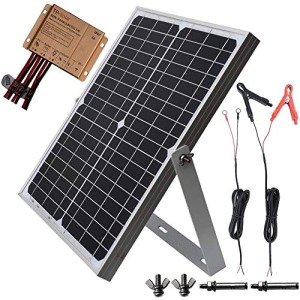
The TP-solar 20W kit is the powerhouse of our selection, delivering genuine 20-watt output that can actually charge a dead or flat battery, not just maintain an already-charged one. This complete system includes the monocrystalline solar panel, a 10A waterproof PWM charge controller, adjustable mounting bracket, and all necessary cables. The waterproof design means you can leave it permanently mounted on your caravan roof or vehicle bonnet without worry about rain damage.
What makes this charger particularly appealing is its versatility. The bracket system allows you to angle the panel for optimal sun exposure, and the 10A controller includes overcharge and reverse polarity protection, so you won’t accidentally damage your battery. At 20W output, this is genuinely powerful enough to make a difference on vehicles that aren’t used daily. Customers report successful battery maintenance on classic cars and caravans left unused throughout the UK winter.
The larger size does mean it’s not portable like the smaller models, but the aluminium frame and tempered glass construction are built to last for years in British weather. Installation is straightforward with the included brackets and cable terminations. The price reflects the higher output and complete package, making it an investment rather than a budget option.
If you’re serious about keeping a vehicle battery in perfect condition year-round, the TP-solar 20W delivers professional-grade performance that justifies the cost. For seasonal vehicles or long-term storage situations, this is the charger to choose.
Features
- 20W monocrystalline solar panel output
- 10A waterproof charge controller included
- Adjustable mounting bracket for optimal angle
- Complete cable and connector kit supplied
- Reverse polarity and overcharge protection
- Dimensions: approximately 645 x 545mm panel
- Weight: approximately 3.5kg with bracket
- Powerful 20W output, actually charges not just maintains
- Complete system with controller and mounting bracket
- Professional-grade waterproof design
- Works in overcast conditions
- Excellent build quality with aluminium frame
- Not portable, requires permanent mounting
- Takes up roof or bonnet space
- More expensive than smaller models
- Heavier than portable alternatives
2. Photonic Universe 10W 12V Solar Trickle Charging Kit
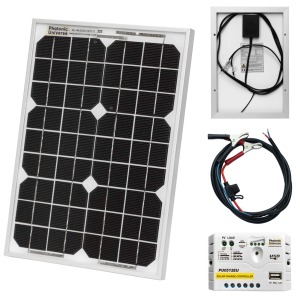
The Photonic Universe 10W kit strikes an excellent balance between power and affordability, making it one of our top recommendations for most UK car owners. This proven system uses monocrystalline solar cells (more efficient than older amorphous technology) and includes everything you need: the 10W panel, a 5A smart charge controller, 3 metres of pre-attached cable, and battery crocodile clips. The sealed aluminium frame and tempered glass will withstand years of British weather exposure.
At 10W output, it’s powerful enough to keep a battery charged on vehicles left unused for weeks during winter. The 5A controller includes reverse polarity protection and won’t overcharge your battery, so you can leave it connected permanently without worry. Measurements of 34 x 24 x 2cm make it compact enough to fit on most car roofs or window suction cup mounting points.
Customers consistently report that the Photonic Universe performs reliably even on grey UK days. Whilst it won’t charge a completely flat battery quickly, it excels at maintaining a battery that’s already at decent charge. This is exactly what the vast majority of car owners need when storing classic cars, caravans, or rarely-used motorcycles. The quality construction and no-nonsense design have made this a favourite amongst UK caravan and classic car enthusiasts for years.
If you want a proven, reliable system that just works without fuss, the Photonic Universe is the smart choice. It offers excellent value for money and has an enviable track record of customer satisfaction across the UK.
Features
- 10W monocrystalline solar panel
- 5A smart charge controller included
- 3 metres of attached cable with clips
- Weatherproof aluminium frame and tempered glass
- Reverse polarity protection built-in
- Dimensions: 34 x 24 x 2cm
- Weight: approximately 1.3kg
- Proven reliable performance over many years
- Compact and easy to mount
- Works well in UK overcast conditions
- Everything needed included
- Excellent value for the price
- Long track record of customer satisfaction
- 10W output limits charging speed on flat batteries
- Not suitable for extremely demanding applications
3. ECO-WORTHY 10W 12V Solar Trickle Charger Car Battery Maintainer
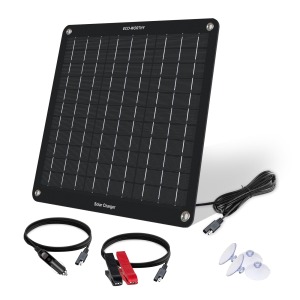
ECO-WORTHY’s 10W trickle charger offers competitive performance at a mid-range price point, making it an excellent choice for budget-conscious buyers who don’t want to compromise on quality. The kit includes the 10W monocrystalline panel, alligator clip adapters for direct battery connection, cigarette lighter socket adapters, and four PVC suction cups for flexible mounting options. The 57-inch cable gives you plenty of reach to mount the panel on your dashboard or windscreen.
What sets ECO-WORTHY apart is the flexibility of mounting options. The suction cups mean you can position the panel inside your windscreen for protection from the elements, or stick it to a side window. This is perfect for street-parked vehicles where roof mounting isn’t possible. The dual connector system (alligator clips and lighter socket) means you can adapt it to virtually any vehicle, making it ideal if you have multiple cars.
Users report decent performance even in March UK weather, though some note the actual output hovers just below the rated 10W in typical overcast conditions. For a vehicle parked in storage, this is still more than adequate. The build quality is good, and the weatherproof design can handle outdoor mounting if you prefer.
If you value flexibility and want to move the charger between vehicles, ECO-WORTHY delivers at a reasonable price. The suction cup mounting is particularly clever for drivers without roof access or those wanting portable, temporary charging.
Features
- 10W monocrystalline solar panel
- Alligator clip adapters for battery terminal connection
- Cigarette lighter socket adapters
- 57-inch (approx 1.4m) attached cable
- Four PVC suction cups for window mounting
- Waterproof and weatherproof design
- Suitable for 12V battery systems
- Flexible mounting with suction cups
- Portable and easy to move between vehicles
- Works with multiple connector types
- Good value for money
- Long cable provides installation flexibility
4. POWOXI 9W Solar Battery Trickle Charger Maintainer
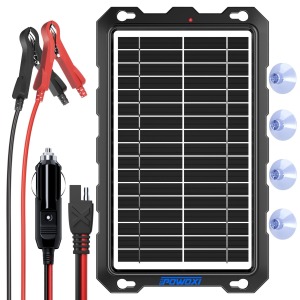
The POWOXI 9W charger delivers solid middle-ground performance with an effective power output and straightforward design that appeals to practical buyers. This 9W system includes waterproof construction, making it suitable for permanent outdoor mounting on boats, caravans, or vehicles. The kit comes complete with alligator clip connectors and the crocodile clips that most car owners expect, plus suction cups for flexible positioning.
What users appreciate about POWOXI is the honest performance in real-world conditions. Unlike some brands that overstate wattage claims, POWOXI’s 9W actually delivers close to what’s advertised, even on overcast days. The waterproof design is robust enough for exposed mounting without protection from the elements. This charger handles 12V wet, gel, SLA, and AGM batteries, making it versatile across different vehicle types.
The manufacturer includes a 12-month warranty and lifetime technical support, which gives peace of mind. Customers report it’s particularly good for AGM leisure batteries in caravans and works reliably as a long-term maintenance solution. The straightforward plug-and-play design means no technical knowledge is required.
For a no-fuss, honest-performing charger at a reasonable price, POWOXI hits the sweet spot. It won’t be the fastest charger, but it will reliably keep your battery in good condition.
Features
- 9W solar panel output
- Maintains 12V wet, gel, SLA, and AGM batteries
- Waterproof and weather-resistant design
- Alligator clip and crocodile clip connectors
- Suction cup mounting options included
- 12-month warranty
- Lifetime technical support
- Honest, reliable performance in real conditions
- Robust waterproof design
- Good warranty and support
- Works on multiple battery types
- Straightforward, no-fuss operation
- 9W output slightly lower than some competitors
- Won’t rapidly charge a flat battery
- Not as well-known as some brands
5. AA 12V Solar Battery Trickle Charger
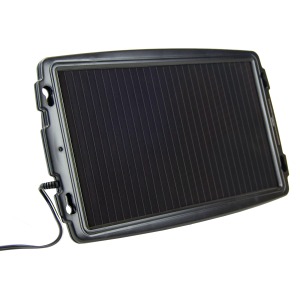
The AA 12V Solar Battery Trickle Charger is the budget-friendly option that punches above its weight. At 4.8W output, it’s one of the lower-powered models in our selection, but it’s also one of the most affordable and most versatile in terms of installation. What makes it unique is the OBD port connector, which means you can plug it directly into your vehicle’s diagnostic socket and it works even when the ignition is turned off. This is genuinely clever for UK drivers.
You also get the option to use traditional alligator clips directly on the battery terminals if you prefer. The flashing blue LED indicates charging status at a glance. At just 4.8W, this isn’t powerful, but it’s perfectly adequate for maintaining a battery on an otherwise healthy vehicle. Users consistently report never having a flat battery after installing this charger, which is exactly what you want from a trickle charger.
The price is impressively low, making this an excellent choice if you’re budget-conscious or want to equip multiple vehicles. The OBD connector method is particularly appreciated by those without roof access or who prefer hidden installation. Installation is genuinely effortless: just plug into the OBD socket (usually located under the steering wheel on UK cars) and walk away.
If you want affordable battery maintenance with unique OBD compatibility and don’t mind lower wattage, the AA charger is excellent value. It’s the choice of drivers who prioritise simplicity and price.
Features
- 4.8W solar output
- OBD port connector (unique feature)
- Alligator clip adapters for battery terminal connection
- Blue LED charging indicator
- 12V battery compatible
- Compact and hidden installation via OBD
- Works with UK vehicles fitted with OBD ports
- Lowest price of any model reviewed
- Unique OBD port compatibility
- Hidden installation, no visible cables
- Reliable maintenance performance
- Dual connection options (OBD or clips)
- 4.8W output is modest
- Won’t rapidly charge a flat battery
- OBD connection not available on very old vehicles
- OBD socket can be inconveniently positioned
6. FINIVE 5W Solar Panel Battery Trickle Charger
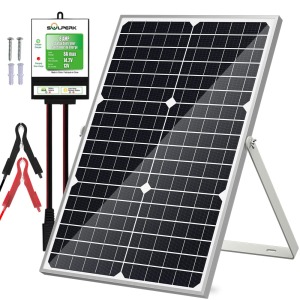
The FINIVE 5W is the most compact option in our lineup, perfect for drivers who need portability and minimal visual impact. This tiny solar panel is roughly 7.8 inches square, making it easy to throw in a glovebox, keep in a caravan locker, or store in a garage between uses. Despite the small size, it includes intelligent charging controller technology that prevents overcharging, reverse connection damage, and short circuits.
At only 5W output, this is very much a gentle trickle charger, not a rapid charger. However, for light-duty battery maintenance on vehicles that see occasional use, it’s perfectly adequate. The waterproof and dustproof PET material construction is surprisingly robust for such a small device. You get alligator clips for direct battery connection, and the compact form factor means installation is quick.
This is the budget option for those with minimal needs. If you have a motorcycle, a mobility scooter, or any vehicle you use sparingly and just want to keep the battery fresh, FINIVE does the job without drama. The price is hard to beat. Customers appreciate the ease of storage and the fact that you can move it from vehicle to vehicle as needed.
If budget is your primary concern or you need a portable charger for occasional use, FINIVE offers surprising value in a tiny package. It’s a sensible choice for secondary vehicles or motorcycles.
Features
- 5W polycrystalline solar panel
- Built-in intelligent charge controller
- Overcharge, reverse connection, and short circuit protection
- Waterproof and dustproof design
- Alligator clip battery connectors
- Approximately 7.8 inches square (compact)
- Suitable for 12V battery systems
- Extremely compact and portable
- Very affordable price
- Built-in intelligent controller
- Easy to store and move between vehicles
- Waterproof construction
- 5W output is minimal
- Slow charging even for maintenance
- Not suitable for larger vehicles or heavy use
- Small size means less surface area for weak UK light
7. POWOXI Upgraded 7.5W Solar Battery Trickle Charger Maintainer
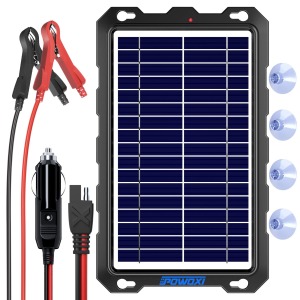
POWOXI’s 7.5W upgraded model sits in the sweet spot between the basic 5W budget options and the more expensive 10W systems. This charger delivers noticeably better performance than smaller rivals whilst maintaining a reasonable price point. The waterproof and portable design makes it flexible for different mounting scenarios, from permanent outdoor installation to temporary window suction cup mounting.
At 7.5W, you get genuine improvement in charge speed over 5W models, though it’s not as powerful as 10W solutions. The kit includes all the standard accessories: alligator clips, cigarette lighter adapters, and suction cups. The waterproof design holds up well to UK weather exposure. POWOXI maintains their reputation for honest performance claims, so you’ll actually get close to the rated 7.5W in real conditions.
This is ideal if you want to avoid both the cheapest budget models and the premium-priced options, but still want respectable performance. It’s a popular choice for motorcycle owners and those with secondary vehicles that don’t get used daily. The portability is a genuine advantage if you want to move it between different vehicles seasonally.
The POWOXI 7.5W represents sensible middle-ground thinking. Better than budget alternatives, less expensive than premium models, and genuinely fit for purpose. It’s the choice of practical buyers who understand solar charging and want realistic performance at a fair price.
Features
- 7.5W solar panel output
- Portable waterproof design
- Alligator clips for battery terminal connection
- Cigarette lighter socket adapters
- Suction cups for flexible mounting
- Weatherproof construction for outdoor use
- Works on 12V battery systems
- Good middle-ground price and performance
- Honest real-world output claims
- Portable and flexible installation
- Better than budget 5W alternatives
- Waterproof design for durability
- Still only modest power output
- Not as strong as 10W systems
- Suction cups can lose grip in heat
Solar Car Battery Chargers Buying Guide
Key Takeaways
- Solar car battery chargers are trickle maintainers, not fast chargers, they are designed to maintain a healthy battery over weeks and months, not to charge a flat battery in a few hours.
- Wattage ranges from 2.4W (phone-sized trickle panels) to 40-60W (serious maintenance chargers). For most purposes, classic cars, seasonal vehicles, alarms, 5-12W is the practical sweet spot.
- A built-in blocking diode or MPPT controller prevents the panel from draining the battery at night, which is non-negotiable for any permanent installation.
- Crocodile clip connections are convenient but introduce resistance. For a permanent installation on a vehicle that sits outside, direct hardwired connections or the cigarette lighter/OBD port are more reliable.
- Cable length matters if the panel is on a dashboard or windscreen but the battery is in the boot, check total cable reach before buying.
- Check battery type compatibility: most modern solar maintainers handle lead-acid, AGM, EFB, and GEL, but not all support lithium (LiFePO4) batteries without a specific lithium charging profile.
Trickle Maintainer vs Battery Charger: Understanding What You Are Buying
This distinction matters more than almost any other in this product category. A solar car battery charger is not a replacement for a conventional battery charger. If your car battery has gone flat because the lights were left on, a 10W solar panel will take several days of full sun to restore meaningful charge. That is not what these products are designed for.
What a solar maintainer does well is keep a healthy, fully charged battery from going flat during extended periods without use. The typical current output of a 5W panel in UK conditions is 200-400mA, just enough to counter the self-discharge of a modern lead-acid battery (typically 1-5% per month) and offset the quiescent current drain from a car alarm, tracker, or ECU standby. Over weeks and months of storage, this small continuous top-up is the difference between a battery that starts the engine in spring and one that needs jump-starting or replacing.
If your car is driven regularly (several times a week), the alternator keeps the battery topped up and you do not need a solar maintainer at all. Solar car battery chargers are for vehicles that sit unused: classic cars, campervans parked up for winter, seasonal sports cars, motorcycles, boats, and caravans in storage.
How Much Wattage Do You Need?
For pure battery maintenance during storage, 5-10W is sufficient for most passenger car batteries. At 5W in average UK conditions (broadly 2-3 peak sun equivalent hours per day across a year), you generate roughly 10-30Wh per day, which comfortably offsets battery self-discharge and a low alarm current draw.
If the vehicle has a tracker, dashcam, or other persistent drain that draws more than 50-100mA continuously, step up to a 12-20W panel. A 20W panel in a good position in the UK generates enough daily energy to counter a 100mA continuous draw plus battery self-discharge, keeping the battery healthy over multi-week storage.
Larger panels (25-60W) are used by people who want actual charging capability rather than pure maintenance, a 40W panel can meaningfully restore a 50% discharged battery over 2-3 sunny days. At this wattage, a proper MPPT charge controller is essential to avoid overcharging a fully maintained battery.
The Blocking Diode: Why It Is Non-Negotiable
At night and in low-light conditions, a solar panel can actually become a small electrical load rather than a source, current flows backwards from the battery through the panel’s cells. This is called reverse current flow, and even a small reverse current (100-300mA) draining a battery overnight over weeks adds up to significant discharge.
Any solar maintainer intended for permanent installation must either have a built-in blocking diode (prevents reverse current by acting as a one-way valve) or an MPPT/PWM controller with built-in reverse current protection. Budget panels sometimes omit this, relying on the user to disconnect the panel each night, which is impractical for a storage setup. Always check that the product explicitly states it includes reverse current protection or a blocking diode before buying for permanent use.
Connection Types: Clips, Cigarette Lighter, or Hardwired?
Solar car battery maintainers typically come with three connection options, and the right one depends on how you will use it.
Crocodile clip leads are the simplest and most versatile. You connect directly to the battery terminals for maximum conductivity, with no adapter needed. Ideal for occasional use, checking that the panel is working, or connecting to batteries that are not in a vehicle. Not ideal for a permanent installation where you will be regularly opening the bonnet and reconnecting.
The OBD2 port or cigarette lighter socket connections are convenient for vehicles where the socket remains live when the key is out. However, many modern cars automatically cut power to the cigarette lighter and accessory sockets when the ignition is off, which means the panel cannot charge the battery through this route. Check that your vehicle’s socket remains live with the ignition off before relying on this method.
Hardwired connections, a small SAE connector lead permanently wired to the battery with a fused cable, are the professional standard for a permanent solar maintenance installation. The panel plugs into the SAE socket via a short cable, charges the battery, and is unplugged in seconds when you need to use the vehicle. This is what classic car owners, caravan storage installers, and marine users tend to use. Most solar maintainers include a SAE adaptor cable as well as clips; if not, they are available cheaply and separately.
Where to Position the Panel
The standard approach for cars is dashboard mounting: the panel sits on top of the dashboard behind the windscreen, facing south, and the cable runs to the battery or a socket. The glass does reduce solar transmission by 10-20% (depending on tinting), but it is a convenient solution for vehicles in driveways or on the street without roof access.
The alternative is roof or bonnet mounting using suction cups or velcro pads and routing the cable through a door seal. This avoids glass transmission losses and allows a slightly larger panel. For vehicles in a garage, a panel on a long cable lead positioned outside or in a window is the typical approach.
Cable length is a common source of frustration. Measure the distance from your intended panel position to the battery, and check that the cable on the maintainer reaches it with some slack. Standard cables are 2-3 metres; premium maintainers include 5-metre cables. Extension cables are available separately but introduce additional resistance and another connection point.
Battery Type Compatibility
Most modern solar maintainers work with the full range of lead-acid battery types: standard flooded, AGM (Absorbed Glass Mat), EFB (Enhanced Flooded Battery), and GEL. AGM and EFB are common in modern cars (most stop-start systems use AGM or EFB), and maintaining them at full charge during storage is particularly important, these chemistries are intolerant of repeated deep discharge.
Lithium (LiFePO4) batteries in campervans and motorcycles require a different charging profile. Not all solar maintainers support lithium charging correctly. A conventional lead-acid profile applied to a lithium battery will not fully charge it to its proper voltage and may confuse a BMS (Battery Management System). If you have a lithium leisure battery or a lithium motorcycle battery, check explicitly that the maintainer has a lithium charging mode before buying.
Real-World Use Cases
Classic car stored for winter: a 5-10W panel on a SAE connection left on the dashboard from October through April will prevent the battery going flat from alarm and clock drain. The car starts reliably in spring without jump-starting. This is the primary use case and the one these products do best.
Caravan in storage: a 10-15W panel mounted on the roof or placed in the window of a stored caravan keeps the habitation battery topped up over winter. Particularly useful if the caravan has a tracker or alarm. Connects to the leisure battery directly or via the existing 12V system.
Street-parked car with alarm: a 5W dashboard panel on a SAE permanent connection compensates for the 30-80mA alarm draw that slowly drains batteries in cars parked for weeks at a time, a particular problem for urban residents who may not use their car for 10-14 days at a stretch.
Quick Features Checklist
- Wattage: 5-10W for standard storage maintenance; 12-20W for vehicles with persistent drains; 25-40W for meaningful charging capability
- Blocking diode or reverse current protection: non-negotiable for permanent installation
- MPPT controller: required for 20W+ panels to prevent overcharging
- Connection type: SAE hardwired recommended for permanent use; clips for occasional use
- Cable length: check it reaches from your panel position to the battery
- Battery compatibility: confirm it supports your battery chemistry (AGM, EFB, GEL, or lithium)
- Dashboard-safe: check for UV stability and non-slip backing if it will sit on the dashboard in summer heat
Case Study: Keeping a Classic Car Battery Topped Up
Background
A classic car enthusiast in Surrey owned a 1970s Jaguar that spent most winters garaged, used only for shows and special events. Each spring, the battery was often too flat to turn the engine over, requiring external charging or jump-starts. This stressed the battery and meant expensive replacements every few years.
Project Overview
Rather than rely on mains charging, the owner decided to install a permanent solar trickle charger system. After researching options, they selected a 10W system with a mounting bracket that could attach to the garage roof beside the vehicle, with cables run to the engine bay.
Implementation
Installation was straightforward, requiring only the supplied bracket, two cable runs to battery terminals, and basic hand tools. The system was activated at the start of winter when the vehicle was garaged. Throughout the winter months, the panel maintained the battery from whatever solar light was available, even on grey UK winter days.
Results
The following spring, the battery started the engine instantly without any charging or jump-starting required. The owner has since enjoyed six years of trouble-free starts each spring, with the battery outlasting all previous ones. The small investment in a solar charger eliminated a recurring maintenance headache and extended battery life significantly. The owner now uses identical systems on two other classic vehicles.
Expert Insights From Our Solar Panel Installers About Solar Car Battery Chargers
“We see a lot of classic car enthusiasts dealing with dead batteries before the season starts. A simple 10W solar charger installed in autumn could save them considerable headaches come spring. The technology is reliable, maintenance-free, and the economics make complete sense. One of our senior solar panel installers with over 20 years of experience in the industry comments that solar battery maintainers represent the smartest investment for anyone with vehicles left unused for extended periods. They require zero maintenance, work in all UK weather conditions, and the quality systems will outlast multiple battery replacements. We often recommend higher-wattage systems like the 20W kits to customers who want genuine charging capability, not just maintenance.”
Frequently Asked Questions
Can a solar car battery charger charge a completely flat battery?
Not quickly. Solar car battery maintainers are designed to keep a healthy battery topped up during storage, not to recover a deeply discharged battery in a practical timeframe. A 10W panel in UK conditions might generate 20-30Wh on a good day, enough to offset self-discharge and small parasitic drains, but not enough to meaningfully charge a flat 60Ah car battery, which would need over 200Wh just to restore 50% charge. If your battery has gone flat, use a conventional mains battery charger to recover it first, then use the solar maintainer to keep it healthy going forward.
Will a solar battery maintainer drain my battery at night?
It will if it does not have a blocking diode or reverse current protection. At night, a panel without protection becomes a small load rather than a source, and current flows backwards from the battery through the cells. Any quality solar maintainer designed for permanent installation should include a blocking diode or a controller with built-in reverse current protection. Check the product description for explicit mention of this feature before buying, if it is not mentioned, contact the seller to confirm before committing to a permanent installation.
Can I leave a solar car battery charger connected permanently?
Yes, if the product is designed for it and includes reverse current protection and charge regulation. A good solar maintainer with a built-in blocking diode and a regulated output can be left connected to the battery indefinitely, it will trickle-charge during daylight and stop at night without reverse drain. If the maintainer does not include charge regulation (some very basic units are unregulated), it can overcharge a fully maintained battery in extended periods of bright sun. For truly permanent installation, choose a unit with an MPPT or PWM controller, not a bare panel with only a diode.
How long will a solar battery maintainer keep my car battery topped up?
Indefinitely, in theory, if the panel is correctly sized for the vehicle’s parasitic drain and the battery remains healthy. A 5W panel in average UK conditions (accounting for cloud, short winter days, and overnight parking) generates enough energy to offset a typical car alarm’s quiescent drain (30-80mA) and battery self-discharge. Vehicles with multiple persistent drains, alarms, trackers, dashcams, or vehicles stored in areas with limited sun exposure may need a 10-15W panel to reliably maintain charge over several months.
Does a solar charger work through a car windscreen?
Yes, but with reduced efficiency. Standard automotive glass blocks roughly 10-20% of solar transmission compared to a panel in direct open air. Tinted or UV-blocking glass reduces transmission further, some modern cars with solar-control glazing can reduce transmission by 50-70% on the wavelengths that matter for solar generation. As a result, a dashboard-mounted panel will consistently underperform a roof-mounted or externally positioned panel of the same wattage. For most maintenance purposes, the transmission loss through standard clear windscreen glass is acceptable.
What is the best solar charger for a classic car?
For a classic car in winter storage, a 5-10W panel with a hardwired SAE connection to the battery is the standard approach. The SAE lead is permanently wired to the battery with an inline fuse, and the panel cable clips onto the SAE socket when the car is parked up. This avoids repeatedly opening the bonnet and disconnecting battery terminals. Most classic cars have a standard flooded or AGM battery, so any decent solar maintainer will be compatible. If your classic has a lithium battery, increasingly common in restored vehicles, confirm the maintainer has a lithium charging profile.
Are solar car battery chargers suitable for motorcycles?
Yes, motorcycles are actually one of the best use cases. Motorcycle batteries are smaller (typically 5-14Ah) and more sensitive to extended periods of low charge than car batteries. A small 5W solar maintainer is perfectly sized for a motorcycle battery and, left connected through winter storage, will prevent the battery going flat from the bike’s alarm or clock drain. If your motorcycle uses a lithium battery (increasingly common in modern bikes), check that the maintainer explicitly supports lithium charging or set the profile accordingly.
Can I use a solar car battery charger on a caravan?
Yes, for the habitation battery during storage. A 10-15W panel mounted on or positioned near a stored caravan keeps the leisure battery topped up over winter, preventing the deep discharge that shortens battery life. Connect via the battery terminals directly or through the caravan’s existing 12V connection point. If your caravan has a tracker, security system, or mains battery charger with standby drain, account for that in your panel sizing, 10W is usually sufficient for a typical alarm and tracker combination. This is distinct from a full solar installation on a touring caravan, which requires larger panels and a proper charge controller setup.
Summing Up
A solar car battery charger is one of the smartest purchases for anyone with a vehicle that sits unused for weeks or months. Whether you’re a classic car enthusiast, caravan owner, or someone with a rarely-used motorcycle, these systems deliver genuine value. Free solar energy maintains your battery automatically, preventing the flat-battery frustration that plagues seasonally-used vehicles during UK winters.
Your choice depends on your specific needs. If you want the most powerful solution with genuine charging capability, invest in the TP-solar 20W kit. For most UK drivers wanting reliable, proven performance, the Photonic Universe 10W system offers excellent value and has a track record spanning years. Budget-conscious buyers will appreciate the AA 12V system’s unique OBD compatibility, whilst those prioritising portability should consider the ECO-WORTHY 10W with its flexible window-mounting option.
Whatever system you choose, you’ll benefit from lower battery replacement costs, the peace of mind of reliable winter starts, and the satisfaction of using free renewable energy. Solar car battery chargers represent genuine practical benefit for UK drivers, not just environmental feel-good. Install one and enjoy hassle-free battery maintenance year after year.
Updated