
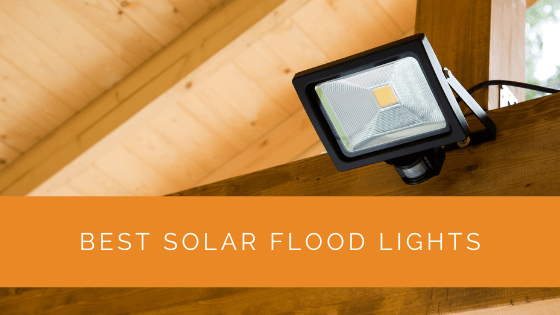
Finding a solar flood light that actually holds up through a British winter is harder than it sounds. Most of the market is flooded with cheap units that look impressive in the listing photos but fade, flicker, or simply stop working after a few months of rain and overcast skies. After testing and researching the options available right now on Amazon.co.uk, our top pick is the KIBTOY Solar Flood Lights, a 2-pack of triple-head units that combines a serious review count, solid build quality, and a price that makes them a practical choice for driveways, gardens, and back gates alike.
Below you’ll find seven of the best solar flood lights available in the UK right now, followed by a buying guide covering everything you need to know before committing to a set.
Our Top Picks
| Image | Name | |
|---|---|---|
| KIBTOY Solar Flood Lights Outdoor, 70 LED 3 Heads (2-Pack) | |
| Solar Wall Lights Outdoor 178 LED (6-Pack) | |
| CLAONER Solar Flood Lights 214 LED, 4 Adjustable Heads | |
| 156LED Solar Security Lights with 3-Panel Design | |
| intelamp Solar Flood Light 108 LED, 1200lm, 6000mAh | |
| Solar Security Light 189 LED with Remote Control | |
| JumJam 280 LED Solar Flood Lights (2-Pack) |
7 Best Solar Flood Lights for UK Gardens and Driveways
1. KIBTOY Solar Flood Lights Outdoor, 70 LED 3 Heads (2-Pack)
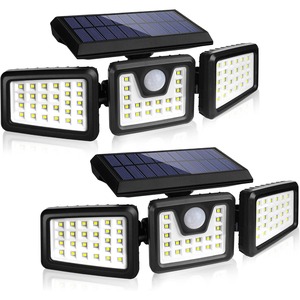
With over 3,570 reviews and a 4.5-star rating, the KIBTOY is the most battle-tested solar flood light on this list. That review count matters on a UK-focused purchase because it tells you that thousands of people have actually lived with this light through changing seasons, not just written it up after a week in summer. The 2-pack deal also makes it among the most cost-effective options here, coming in at under £30 for both units combined.
The three independently adjustable heads are a genuine selling point. You can point one toward the driveway, one up the side path, and one covering the back gate, all from a single mounting point. The 270-degree pivot range gives you plenty of flexibility, and the PIR motion sensor covers a 40-foot range with a 120-degree detection angle. That’s enough to catch movement from most garden approaches before anyone gets close to the house.
Charging takes six to eight hours of good sunlight, and the light runs for around eight hours on a full charge. In practice across UK summer conditions, that’s more than adequate. In December and January, you may find performance drops a little, as it will with any solar product, but the motion-only mode helps conserve battery for the moments it actually counts. The IP65 rating covers it against rain and dust, which is the minimum you’d want for a permanent outdoor installation in this country.
The main caveat is the LED count. Seventy LEDs across three heads is respectable, but it’s not the highest output on this list. If you need to illuminate a very large area like a commercial yard or a long, wide driveway, you may want to step up to one of the higher-lumen options below. For most domestic gardens and driveways, though, this is the one to buy.
Features
- 70 LED total across 3 adjustable heads
- 270-degree horizontal pivot range
- PIR motion sensor: 40-foot range, 120-degree detection
- IP65 weatherproof rating
- 6–8 hour charge time, up to 8 hours lighting
- Comes as a 2-pack
- 3,570+ reviews, 4.5 stars
Pros:
- Huge review count gives real confidence
- Three adjustable heads per unit
- Excellent value as a 2-pack
- Solid IP65 weatherproofing
Cons:
- Lower LED count than some competitors
- Performance dips in prolonged overcast weather
2. Solar Wall Lights Outdoor 178 LED (6-Pack)
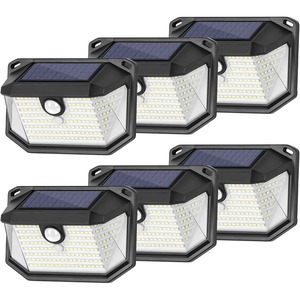
If you need to light up multiple areas of a property without spending a fortune, this 6-pack option is hard to argue with. At under £48 for six lights, you’re paying roughly £8 per unit. Each one packs 178 LEDs with a 270-degree coverage angle, and the manufacturer quotes 8–10 hours of lighting per charge. The monocrystalline solar panels, rated at 20.5% efficiency, are a notch above what you’d find on cheaper sets, that matters in the UK, where overcast charging conditions are common.
The built-in reflector design is worth noting. It scatters light more evenly across a wide area rather than projecting a narrow beam, which makes these better suited to path illumination, patio lighting, or wrapping around the perimeter of a building. The IP65 rating keeps them protected from rain and wind-driven moisture, and the install is straightforward: drill two screws, hang the light.
The trade-off compared to the KIBTOY is that each light has a fixed position rather than adjustable heads. You get more units, but each one is less flexible. For most perimeter lighting applications that’s fine, mount them at corners and they’ll cover the angles you need. Just don’t expect to redirect them once they’re screwed to the wall.
Features
- 178 LEDs per light with wide-angle reflector
- 270-degree coverage angle
- Monocrystalline solar panel at 20.5% efficiency
- IP65 weatherproof rating
- 8–10 hour lighting per charge
- 6-pack for large properties
- 3,359+ reviews, 4.5 stars
Pros:
- Exceptional value per unit in a 6-pack
- High-efficiency monocrystalline panels
- Wide coverage angle with reflector
- Long runtime on a full charge
Cons:
- Fixed position, no adjustable heads
- Less focused beam than directional lights
- Not ideal if you only need one or two lights
3. CLAONER Solar Flood Lights 214 LED, 4 Adjustable Heads
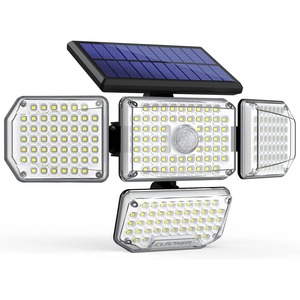
The CLAONER stands out from most of the competition because of what’s sitting on top: four independently adjustable heads rather than the usual two or three. If you want to light up a broad front garden, a large patio, or a commercial car park from a single mounting point, that flexibility is genuinely useful. The 3,000-lumen output is the highest quoted figure on this list, and the 360-degree pivot range means you can position each head wherever you need it without being constrained by mounting angle.
At £39.99 for a single unit, it’s priced in the middle of the market. The PIR motion sensor covers the same territory you’d expect from a security-grade light, and the IP65 rating means it can handle British weather without issue. The 214 LED count backs up the brightness claims, this is a noticeably brighter option than the 70-LED KIBTOY, though for most driveways the KIBTOY will be plenty.
The 780-review count is lower than the KIBTOY or the 6-pack, which means slightly less real-world feedback to draw from. That said, the reviews that are there are consistent and positive. This would be the one to choose if you want maximum adjustability and are covering a larger area than a standard domestic garden.
It’s also worth mentioning that four heads creates more installation flexibility if your property has an awkward layout. You can cover a front garden, side passage, and driveway entrance from one mounting point rather than needing two separate fixtures. That may actually save money on the install overall.
Features
- 214 LED across 4 independently adjustable heads
- 3,000-lumen output
- 360-degree pivot range
- PIR motion sensor
- IP65 weatherproof rating
- 780+ reviews, 4.5 stars
Pros:
- Four adjustable heads for maximum coverage
- Highest lumen output on this list at 3,000lm
- 360-degree pivot range
- Good value for a high-output single unit
Cons:
- Lower review count than top picks
- Overkill for small gardens
- Slightly bulkier than two-head alternatives
4. 156LED Solar Security Lights with 3-Panel Design
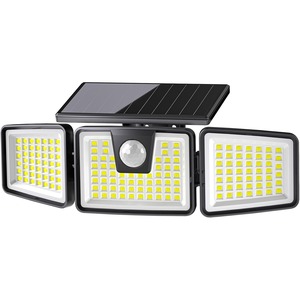
The 156LED option offers the best rated product on this list, holding a 4.6-star average from over 1,200 reviews. The distinctive three-panel solar charging design gives it a larger panel surface area relative to the light body, which helps it charge more reliably in low-light UK conditions. At £20.99, it’s also the most affordable individual unit here if you don’t want to buy in multi-packs.
The PIR sensor detects motion between five and eight metres away, with a 120-degree detection angle, functional and practical for a domestic property. The 270-degree coverage angle on the light itself means you’ll illuminate a good arc even from a corner mounting position. IP65 weatherproofing is standard across most decent solar lights now and this one is no exception.
The main limitation is LED count. 156 LEDs across the light head is solid, but the lumen output isn’t specified in the listing, and it doesn’t claim the 3,000lm figures of the CLAONER. For path and boundary lighting it’s excellent. For a large commercial yard or a very long driveway, you’d want to step up to a higher-output option.
Features
- 156 LED with 270-degree coverage
- Three-panel solar charging design for better low-light charging
- PIR detection: 5–8 metre range, 120-degree angle
- IP65 weatherproof rating
- 1,226+ reviews, 4.6 stars (highest-rated on the list)
- Single unit at £20.99
Pros:
- Highest star rating on the list at 4.6 stars
- Three-panel design aids charging in low light
- Most affordable single-unit option
Cons:
- Lumen output not specified
- Detection range shorter than some competitors
- Less adjustability than multi-head units
5. intelamp Solar Flood Light 108 LED, 1200lm, 6000mAh
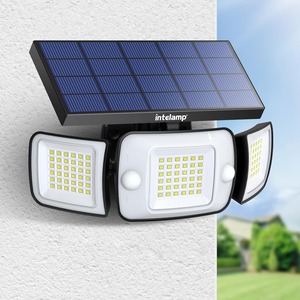
The intelamp earns its place on this list mainly because of the battery. A 6,000mAh capacity is significantly larger than most competitors in this price range, and it’s the figure that matters most on a gloomy January day when your panels haven’t had a proper charge in three days. The monocrystalline solar panel adds to that resilience, delivering more charge per square centimetre of panel than polycrystalline alternatives.
Coverage area is quoted at 70 square metres, which is a generous spread for a domestic installation. Three adjustable heads give you the same directional flexibility as the KIBTOY, and the 1,200-lumen output is solid enough for most garden security applications. The IP65 rating and standard PIR sensor round out a competent spec sheet at £36.26.
It’s worth noting this one has a slightly lower review count at 721, but 4.5 stars across that base is encouraging. The 6,000mAh battery is the main differentiator here. If you have a garden that doesn’t get consistent direct sunlight and you want a light that can weather a few grey days without going dim, the intelamp is the sensible choice.
Features
- 108 LED, 1,200-lumen output
- 6,000mAh lithium battery for extended runtime
- Monocrystalline solar panel
- 3 adjustable heads, 270-degree coverage
- Coverage area: 70m²
- IP65 weatherproof rating
- 721+ reviews, 4.5 stars
Pros:
- 6,000mAh battery handles multiple grey days
- Monocrystalline panel for efficient low-light charging
- Large 70m² coverage area
Cons:
- Lower LED count than some competitors
- Fewer reviews than the top three picks
- Mid-range price for mid-range brightness
6. Solar Security Light 189 LED with Remote Control
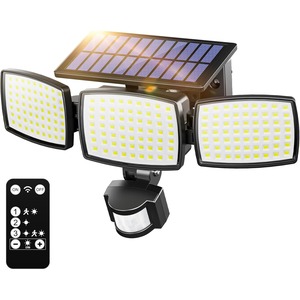
At £17.99, this is the budget option on the list, and it earns its place because of one feature that none of the others have: a remote control. Being able to switch between the three lighting modes, motion sensor, always-on dim, and always-on bright, without climbing a ladder or fiddling with a reset button is surprisingly useful. If you want to manually control the light for outdoor dining or a garden party, you’ll actually use that remote.
The 189 LED count and 1,200-lumen output compare well at this price, and the 300-degree coverage angle is slightly wider than some competitors. The IP65 rating is present and correct. The main concession is a lower review count (414 reviews) and a 4.4-star average, which is solid but a notch below the top picks on this list. At this price point, that’s an acceptable trade-off.
Worth looking elsewhere if you need maximum reliability or are installing in a high-crime area, the intelamp’s larger battery and the KIBTOY’s proven track record are more reassuring for security use. But as a practical, affordable floodlight for a patio or back garden, the remote control makes this genuinely useful rather than just cheap.
Features
- 189 LED, 1,200-lumen output
- Remote control for mode switching
- 300-degree coverage angle
- 3 lighting modes: motion, dim always-on, bright always-on
- IP65 weatherproof rating
- 414+ reviews, 4.4 stars
Pros:
- Remote control is a unique and useful feature
- Best price on the list at £17.99
- Wide 300-degree coverage
Cons:
- Lower star rating than most on this list
- Fewer reviews means less proven longevity
- Not the strongest option for primary security use
nelsnetwork-21″ class=”btn standard-button shop-now-link” target=”_blank” rel=”nofollow noopener”>CHECK PRICE
7. JumJam 280 LED Solar Flood Lights (2-Pack)
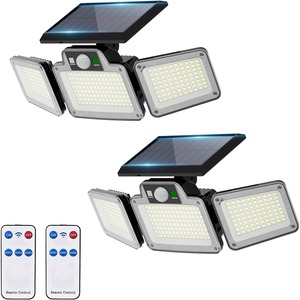
The JumJam has the highest LED count on this list at 280 per unit, and it comes as a 2-pack for £38.22. On paper, the numbers look impressive. In practice, the review count of 288 is the lowest here, which means there’s less certainty about long-term performance than with the KIBTOY or the 156LED option. If you’re buying primarily on spec rather than reputation, the JumJam is worth considering. But if longevity matters more than raw LED count, you’d probably be better served by one of the other options.
The 12-hour quoted runtime is the longest on this list, and the remote control (shared with the 189LED option) adds mode flexibility. Three lighting modes, 270-degree coverage, and IP65 weatherproofing round out a feature set that looks good in a side-by-side comparison. The 2-pack pricing also makes it competitive against the KIBTOY at a similar total cost.
Features
- 280 LED per unit, highest LED count on this list
- Remote control included
- 3 lighting modes
- 12-hour quoted runtime
- 270-degree coverage
- IP65 weatherproof rating
- Comes as a 2-pack at £38.22
- 288+ reviews, 4.5 stars
Pros:
- Highest LED count on the list
- Longest quoted runtime at 12 hours
- Remote control included
Cons:
- Lowest review count, least proven option
- LED count doesn’t always equal brightness quality
- Less certainty on longevity than the top picks
Solar Flood Lights Buying Guide
Key Takeaways
- Lumen output matters more than wattage: aim for 800-2,000lm for path and driveway security, 2,000-5,000lm for larger areas like driveways, garages and outbuildings
- PIR motion sensor range varies enormously: 5-8m for basic models, 10-15m for quality flood lights, up to 20m for premium security-grade units
- Separate solar panels on cables are the single most important feature for reliable UK use, allowing the panel to face south in full sun whilst the light covers a north-facing wall
- Battery capacity of 2,000mAh or more is essential for all-night motion-triggered coverage, particularly in UK winter when solar charging is limited to a few weak hours daily
- IP65 is the minimum acceptable rating for UK outdoor use; IP66 or IP67 provides better protection against heavy rain and pressure washing
- Cold white (6,000K) is the standard for security lighting: bright and alarming. Warm white (3,000K) suits decorative or driveway illumination where a welcoming tone is preferred
- Wide beam angles (120-270°) maximise coverage per unit; narrow beams create a strong but limited pool of light suited to specific paths or entrances
- Three-mode operation (motion-on, dim-always-on, off) gives flexibility without sacrificing battery life
Lumen Output and What It Actually Means
Lumen output is the one number that determines whether a solar flood light is genuinely useful or just decorative. Watts tell you power consumption, not brightness. A 20W solar LED might produce 2,000lm. A poor-quality 50W claim from the same manufacturer might produce the same figure because the LED chips are lower quality. Always focus on lumens, not watts.
For path lighting and low-level security near a side gate or back door, 800-1,500lm is adequate. You can see clearly, the area is illuminated when the sensor triggers, and any movement is visible from inside the house. For a driveway, garage area, or wider garden space, 2,000-3,500lm is the right range. At this level, a triggered flood light genuinely floods the area with light, discourages intruders, and gives you clear visibility across a 6-10 metre span. For large commercial-style applications, car parks, or very wide property frontages, 4,000lm and above is where to look.
Be cautious of inflated claims. Budget solar flood lights frequently advertise “equivalent to 500W” whilst delivering 1,000lm or less. This kind of comparison is meaningless. Trusted UK sellers list actual lumen output alongside independent verification or BSRIA testing. If only wattage equivalents are listed, treat the claim with scepticism until confirmed by customer photos or reviews.
Motion Sensor Range, Sensitivity, and Modes
The PIR (passive infrared) sensor is the heart of a security flood light. Its detection range determines how far away a person must be before the light triggers. Basic budget flood lights offer 5-8m detection range. This is adequate for a small back yard or narrow path where movement happens close to the wall. For a wider driveway, front garden, or open car park, you need 10-15m range to catch movement before it reaches the property. Premium security flood lights offer up to 20m detection range with adjustable sensitivity.
Detection angle matters as much as range. A 120-degree PIR covers a wide arc. A 180-degree PIR sweeps most of a wall-facing area. Some models offer adjustable detection zones so you can reduce sensitivity in areas with high wildlife traffic, avoiding the light triggering repeatedly on cats or foxes at 2am. This battery-preserving feature is genuinely valuable in UK gardens where urban wildlife is active nightly.
Three-mode operation is worth specifically looking for. Mode one: the light stays off until motion triggers it, then runs at full brightness for a set time (30 seconds to 3 minutes). Mode two: the light stays on at very low brightness (5-10lm, barely visible) all night as a presence indicator, then fires to full brightness when motion triggers. Mode three: permanently off. Three-mode lights give you flexibility across seasons, letting you run on dim-always in summer when nights are short, and trigger-only in winter to preserve battery through the longer dark hours.
Separate Solar Panels: Why They Matter for UK Properties
The single biggest obstacle to solar flood light performance in UK gardens is this: the spot where you want the security light is almost never the spot that receives the most sun. North-facing walls at the front of terraced houses, garage walls facing east, alley gates between properties, carport ceilings, and sheltered back entrances all suffer from limited sun exposure. A flood light with an integral solar panel mounted on that wall will barely charge on a standard UK day.
Separate solar panels solve this problem entirely. The panel sits on an adjustable bracket, angled at 30-45 degrees facing south, mounted on a fence post, roof edge, or separate wall section that receives 5-6 hours of direct sun. A cable, typically 3-5 metres long, connects the panel to the flood light body. The light itself can sit wherever the security purpose demands, regardless of sun exposure at that spot. In UK conditions this feature is not a luxury: it is genuinely essential for reliable year-round charging.
When buying, check whether the panel cable length is sufficient for your layout. A 3m cable handles most single-storey wall applications. A 5m cable gives flexibility for mounting the panel on a roof edge or a taller south-facing fence. Some models offer extension cables as accessories, which is useful if you’re covering a particularly deep property.
Battery Capacity and UK Winter Performance
UK December sees 7-8 hours of daylight with significantly reduced solar irradiance compared to summer. A 1,500mAh battery receiving partial charge on a grey December day might power 3-4 motion-triggered bursts of 60-second illumination before depleting. A 2,000mAh battery on the same panel and same day can handle 5-7 triggers. A 3,000mAh battery provides meaningful reserve.
The maths become important if your flood light covers a busy area, a driveway used morning and evening, or a path regularly used by multiple household members. Each motion trigger consumes battery. In summer this is irrelevant because the panel recharges the battery fully each day. In winter, accumulated triggers across a 16-hour night on limited charge can exhaust even a decent battery by midnight. This is why separate south-facing panels and higher battery capacities both matter specifically for UK winter performance.
Some premium flood lights now include USB-C input for backup charging, allowing you to top up the battery directly in particularly gloomy weeks without removing it. This feature adds resilience and is worth paying for if reliable all-night coverage in winter is a priority.
IP Ratings: What You Need for UK Weather
IP65 is the baseline for any outdoor solar light in the UK. The 6 means completely dust-tight. The 5 means protected against water jets from any direction. This handles rain, splash, and garden hose spray without issue. Most quality solar flood lights on the UK market are rated IP65 or better.
IP66 upgrades the water protection to high-pressure jets, and IP67 adds temporary submersion tolerance (up to 1 metre for 30 minutes). In UK gardens, IP66 is a practical upgrade for exposed locations: exposed corners of buildings, coastal properties, north-facing walls that receive driving rain, and paths near hosepipe reach. IP67 is overkill for standard garden use but adds genuine confidence in the most demanding environments.
Beyond the IP rating, look at the quality of cable entry seals and the housing material. ABS plastic is lighter but less durable than aluminium alloy housing in cold conditions. Aluminium flood light housings retain IP ratings better over multiple winters because the seals compress and maintain their seal even as temperatures vary. Budget plastic housings can crack or warp after 2-3 UK winters in exposed positions.
Colour Temperature and Beam Angle
Cold white light at 5,000-6,500K is the standard choice for security flood lights. It is harsh, high-contrast, and instantly attention-grabbing. The stark white light is psychologically associated with security lighting and surveillance, which adds deterrent value beyond the illumination itself. Cold white also renders detail more clearly at night, making it easier to identify movement and faces if reviewing footage.
Warm white at 2,700-3,200K produces softer, more amber-toned light. It is less startling but more welcoming. For driveway flood lights used by family members returning home after dark, or for front entrance lighting where you want illumination without the alarm-style starkness, warm white is worth considering. It reduces the “prison searchlight” effect that neighbours may object to on closely-spaced properties.
Beam angle determines coverage width. A 90-degree beam creates a focused, intense column of light useful for illuminating a specific entrance or path. A 180-degree beam sweeps a wide arc. A 270-degree beam approaches a full panoramic flood. For most security applications covering a driveway or garden perimeter, a 120-180 degree beam balances coverage with intensity. Very wide angles dilute brightness across a larger area, which can reduce the security impact of the light if the illuminated zone is too broad to be effectively covered.
Mounting Options and Installation
Most solar flood lights mount on a wall bracket using two or three screws. The flood light head typically tilts on a pivot so you can angle it precisely at the area you want covered. Many models also include a ground spike for freestanding use in gardens or along driveways, giving flexibility about where to position the light without drilling. This spike option suits rented properties, temporary security needs, or flexible layouts.
For separate panel models, the panel bracket usually allows adjustment across a tilt range of 0-90 degrees. Set the panel at the angle that maximises sun exposure at your latitude (30-40 degrees from horizontal for most of the UK). The cable runs from panel to flood light body and should be secured to the wall or fence with cable clips to prevent wind movement or trip hazards.
Before drilling, check for concealed wiring or pipes using a cable detector. Most flood lights are straightforward to mount: mark the bracket position, drill, plug and screw, then route the panel cable to its optimum position. The entire installation typically takes 15-30 minutes per unit.
Quick Features Checklist
- Lumen output: 800-1,500lm for paths/small areas, 2,000-3,500lm for driveways/garages, 4,000lm+ for large spaces
- PIR range: 8-10m minimum, 12-15m for driveways and larger areas
- PIR sensitivity: adjustable where possible to avoid wildlife false triggers
- Panel type: separate panel on cable strongly preferred for UK north/shaded wall positions
- Panel cable length: 3-5m sufficient for most layouts; check extension cable availability
- Battery capacity: 2,000mAh minimum for UK winter performance, 3,000mAh+ for high-use positions
- Three-mode operation: motion-only / dim-always-on / off for seasonal flexibility
- IP rating: IP65 minimum, IP66+ for exposed or coastal positions
- Housing material: aluminium alloy preferred over ABS plastic for longevity
- Colour temperature: 6,000K cold white for security, 3,000K warm white for welcoming driveway use
- Beam angle: 120-180 degrees for most security applications
- Timer control: adjustable lighting duration (30 seconds to 3 minutes) after motion trigger
- USB backup charging: valuable for winter resilience
- Mounting: wall bracket plus optional ground spike for flexibility
Case Study: Securing a Victorian Terrace in South London
Background
A homeowner in South London had a problem common to Victorian terraced houses: a narrow side passage running from the street to the back garden with no lighting, no power supply nearby, and a history of attempted break-ins at neighbouring properties. Adding a mains-powered light would have required a licensed electrician and running a cable through an interior wall, expensive and disruptive.
Project Overview
The goal was to illuminate the side passage and the rear garden gate with motion-triggered security lighting that would activate before an intruder reached the back of the house, without any electrical work and at a reasonable budget.
Implementation
Two solar flood lights with triple heads were installed: one at the street end of the passage, facing inward, and one at the garden gate end. The south-facing aspect of the terrace’s rear extension provided good solar charging. Both lights were set to motion-sensor mode rather than always-on, preserving battery for the winter months. The whole installation took under an hour and required nothing more than a drill, a screwdriver, and a wall plug kit.
Results
Both lights have been running reliably for over a year, including through two full winters. The passage, previously a dark approach that went unlit from dusk, is now visible from the street when motion triggers the lights. The homeowner reports no further security incidents at their property and has since added a third unit covering the front doorstep.
Expert Insights From Our Solar Panel Installers About Solar Flood Lights
We asked one of our senior solar panel installers, with over 12 years of experience working on residential and commercial properties across the UK, for their take on solar flood lights.
“The question I get most often is whether solar lights actually work in winter, and the honest answer is yes, but with caveats,” they told us. “The key thing people miss is the difference between a monocrystalline panel and a cheap polycrystalline one. In July, both will charge fine. In November in the north of England, on a day when you’re getting an hour of weak sun through cloud cover, the monocrystalline panel will still accumulate usable charge. The polycrystalline one might not. For security lighting, where you really need it to work in winter, that distinction matters. The same applies to battery capacity, I always recommend people buy a light with a bigger battery than they think they need, because the nights are long and the days are short for a good six months of the year.”
Frequently Asked Questions
How many lumens do I need for a solar flood light?
For illuminating a path or small back entrance, 800-1,500 lumens is sufficient. For a driveway, garage area, or side passage, aim for 2,000-3,500 lumens. For large open areas like car parks or wide garden frontages, 4,000 lumens or more is appropriate. Lumen output is a more reliable guide than wattage claims, which vary significantly by manufacturer.
Do solar flood lights work in UK winter?
Yes, but performance is reduced compared to summer. UK December days provide 7-8 hours of weak sunlight, meaning batteries charge more slowly and to lower capacity than in summer. A flood light with a separate south-facing solar panel, a 2,000mAh or larger battery, and three-mode operation will still trigger reliably through UK winter. Models with integral panels on north or east-facing walls struggle most in winter months.
What is the difference between IP65 and IP66 for outdoor lights?
Both ratings indicate the light is completely dust-tight. IP65 protects against low-pressure water jets from any direction, which handles UK rain without issue. IP66 upgrades to high-pressure jets, making it more resistant to driving rain and pressure washing. For most UK gardens, IP65 is adequate. IP66 is worth choosing for exposed corners, coastal properties, or positions that receive heavy rainfall directly.
Why does my solar flood light keep triggering at night with no one there?
Likely causes are: cats, foxes, or other animals entering the detection zone; a nearby tree or bush moving in the wind and creating infrared contrast; or the PIR sensitivity set too high. Most flood lights include a sensitivity adjustment dial or screw. Reducing sensitivity so the sensor only fires on large warm-body movement (humans, large animals) rather than small heat sources usually resolves nuisance triggering. Also check that the sensor is not aimed at a surface that heats up and cools rapidly.
Can I use a solar flood light on a north-facing wall?
You can, but only if the model has a separate solar panel on a cable. Mount the flood light on the north-facing wall where you need the security coverage, and position the separate panel on a south-facing surface nearby. A 3-5 metre cable is typically sufficient. Flood lights with integral panels mounted on north-facing walls rarely charge adequately in UK conditions, especially from October to March.
How long does a solar flood light stay on after motion is detected?
Most solar flood lights allow adjustment of the “on time” after motion triggers, typically between 10 seconds and 5 minutes via a dial or switch. 30-60 seconds is the standard default and is appropriate for most security applications. Shorter times conserve battery; longer times give more reassurance for arriving home after dark. Some models reset the timer if motion continues to be detected, so the light stays on throughout movement in the area.
Are solar flood lights bright enough to act as genuine security deterrents?
A quality solar flood light producing 2,000 lumens or more with cold white (6,000K) light is genuinely effective as a visual deterrent. The sudden bright flash of light when triggered is startling and draws attention, which is the primary security mechanism. Pairing a solar flood light with a visible CCTV camera or a camera doorbell increases deterrent effect significantly, as the combination suggests active monitoring of the area.
Do I need planning permission for solar flood lights in the UK?
No planning permission is required for security flood lights in standard residential gardens in the UK. However, you should be considerate of neighbours: a very bright light angled towards a neighbouring window can cause a statutory nuisance complaint under the Environmental Protection Act 1990. Aim flood lights downward and across your own property rather than towards neighbouring buildings. In conservation areas or on listed buildings, check with your local planning authority before installing any external fittings.
Summing Up
For most UK homes, the KIBTOY solar flood lights are the straightforward choice. The review count alone tells you these work, the triple-head design gives you real flexibility, and the 2-pack pricing makes them good value. If you need more coverage or a higher output for a larger property, the CLAONER’s four adjustable heads and 3,000-lumen output step things up meaningfully. And if you’re lighting up a whole perimeter on a tight budget, the 6-pack option is hard to beat at roughly £8 per unit. Whatever you choose, stick to IP65-rated, monocrystalline-panel options and you’ll have something that can handle whatever a British winter throws at it.
If you need more focused, directional light for illuminating a specific tree, shrub, or architectural feature rather than wide-area coverage, our guide to the best solar spotlights covers narrower-beam accent options suited to that use case.
Updated