
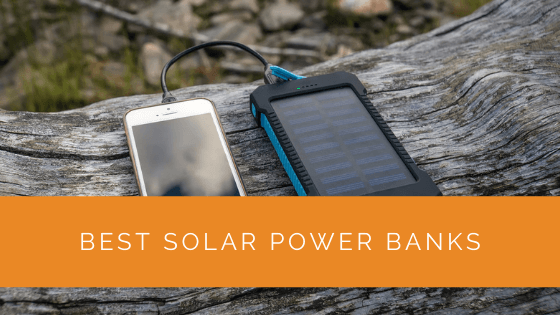
The Vikeri Solar Power Bank 26800mAh is our top pick for UK buyers who want a genuinely waterproof solar charger with real outdoor credentials. It handles British drizzle, clips to a rucksack, and has enough capacity to charge your phone six or seven times before you need to look for a plug socket.
Before you buy any model, it’s worth understanding how solar power banks actually work. The solar panel tops up the battery slowly over the course of a day. You’re not plugging your phone into sunlight, you’re building charge in the battery, then using the battery to charge your devices. On a good UK summer day, a single solar panel adds roughly 500 to 1,500mAh. That’s one extra phone charge per sunny day. On overcast days, the panel adds very little. Capacity and charging speed matter more than solar panel size for most buyers.
Our Top Picks
| Image | Name | |
|---|---|---|
| Vikeri Solar Power Bank 26800mAh | |
| BLAVOR Solar Power Bank 20000mAh Built-in Cables | |
| Riapow Solar Power Bank 20000mAh Wireless | |
| A ADDTOP Solar Power Bank 20000mAh 5-Port | |
| WOWMVP Solar Power Bank 26800mAh Fast Charging | |
| Solar Power Bank 20000mAh with 4 Foldable Panels | |
| BLAVOR Solar Power Bank with Hand Crank 20000mAh | |
| Solar Charger Power Bank 20000mAh (Budget Pick) |
8 Best Solar Power Banks for UK Buyers
1. Vikeri Solar Power Bank 26800mAh
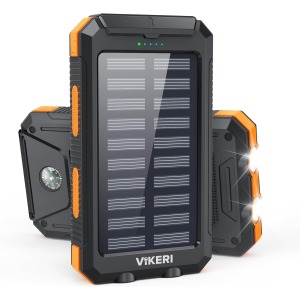
The Vikeri earns its top spot through a combination that’s hard to argue with at £23.52: genuine IP67 waterproofing, a 26,800mAh capacity that’s large enough to matter on multi-day trips, and a form factor that doesn’t feel like you’re carrying a house brick. It clips to the outside of a rucksack via the carabiner, which is the right way to use a solar power bank, panel facing the sky while you walk, topping up without any extra effort.
In practice, you get four output ports (three USB-A and one USB-C), plus a built-in LED flashlight and a compass. None of these feel like box-ticking extras. The flashlight is bright enough to be useful at a campsite. The compass is one fewer thing to pack. And the three USB-A ports means you can charge multiple devices simultaneously without an adapter, which matters when you’re sharing power with other people on a camping trip.
The solar input is honest. A single panel on a UK July day adds around 1,000 to 1,500mAh. That’s about one additional phone charge per full sunny day. Clip it to a sunny surface when you can, treat the mains charge as your base, and the solar becomes a reliable daily bonus. It won’t disappoint you because it doesn’t overpromise.
There’s no wireless charging, and the USB-C output caps at standard speeds rather than PD fast charging. If you specifically need 20W+ USB-C output, the WOWMVP below is the one to look at. But for most hikers, campers, and festival-goers who want a dependable outdoor power bank that happens to also harvest some solar energy, the Vikeri is the right call.
Features
- 26,800mAh capacity: 6-7 smartphone charges
- IP67 waterproof and dustproof
- 4 output ports: 3x USB-A, 1x USB-C
- Built-in LED flashlight and compass
- Carabiner clip for rucksack attachment
- Solar panel for outdoor top-up charging
- IP67 waterproofing handles British rain without fuss
- 26,800mAh at this price is outstanding value
- Flashlight and compass earn their place on a real trip
- Carabiner clip makes hands-free solar charging practical
- No wireless charging
- USB-C port is not PD fast charging
2. BLAVOR Solar Power Bank 20000mAh with Built-in Cables
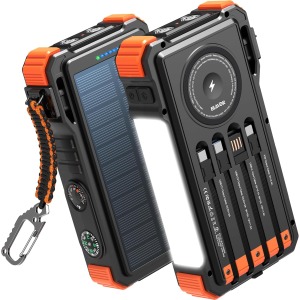
BLAVOR is one of the most reviewed solar power bank brands in the UK, and this 20,000mAh model with four built-in cables is the one to buy if you want to leave your cable bag at home. The two USB-C cables, one iOS cable, and one USB-A cable cover every phone type you’re likely to encounter in a group. And that’s exactly when this product earns its money. Add a camping light and a flashlight, and you’ve got a genuinely multipurpose outdoor companion.
The 20W USB-C fast charging is properly fast. Connected to a compatible charger, a modern Android phone goes from flat to 80% in around an hour. The wireless charging pad at 15W handles the newer Qi2 compatible devices comfortably, including Apple Watch charging which is a rarity at this price bracket.
At £56.99, it’s the second most expensive pick here, and that price is mostly justified by the build quality and the 1,422 reviews that confirm it holds up over time. The trade-off is weight: the cable housing adds bulk, and it’s noticeably heavier than the Vikeri. The solar panel is also small relative to the battery size, so solar input here is slower than the quad-panel option below.
Features
- 20,000mAh capacity
- 4 built-in cables: 2x USB-C, 1x iOS, 1x USB-A
- 20W USB-C fast charging
- 15W wireless charging, including Apple Watch
- Built-in camping light and flashlight
- 1,422 customer reviews at 4.3 stars
- Four built-in cables eliminate cable clutter on trips
- 1,422 reviews gives genuine confidence in real-world reliability
- Apple Watch wireless charging is a practical bonus
- Camping light adds actual value beyond box-ticking
- Bulkier than rivals due to cable housing
- £56.99 is a significant premium over the Vikeri
- Small solar panel, even slower top-up than single-panel rivals
3. Riapow Solar Power Bank 20000mAh Wireless
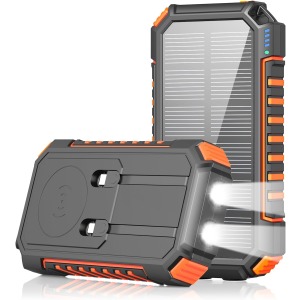
The Riapow is the most-reviewed product in this roundup with 1,824 ratings at 4.2 stars, which matters when you’re buying a product from a brand you’ve never heard of. Those reviews tell you that thousands of real buyers have used this and found it worth rating. It delivers 22.5W wireless charging, genuinely fast for a wireless pad, alongside two built-in cables and a USB-C fast charge port, at £29.99. That’s a strong package.
Where it sits in the lineup is the mid-range wireless charging slot. The BLAVOR above costs nearly twice as much and offers Apple Watch support and more cables. The Riapow skips Apple Watch but gives you fast wireless charging at a more accessible price. If your phone supports Qi wireless charging (virtually all modern smartphones do) and you want to avoid cable faff at a campsite or festival, the Riapow does the job well.
The solar panel is consistent with other single-panel models in this size class. It is useful for a top-up on sunny days, not a primary charging source. The design is chunky but not excessively so for a 20,000mAh wireless bank.
Features
- 20,000mAh capacity
- 22.5W wireless charging output
- 2 built-in cables (USB-C and USB-A)
- USB-C PD fast charging port
- Solar panel for outdoor top-up
- 1,824 customer reviews
- Most-reviewed solar power bank in this roundup. Real confidence.
- 22.5W wireless is meaningfully faster than the standard 10W
- Two built-in cables cover most device types
- No Apple Watch charging unlike BLAVOR
- Solar top-up only, single panel same as others
- Form factor is chunky for everyday carry
4. A ADDTOP Solar Power Bank 20000mAh 5-Port
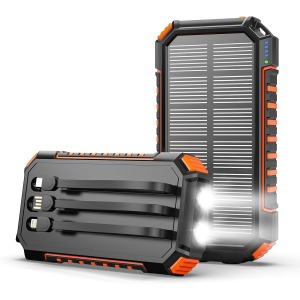
The A ADDTOP stands out for the sheer number of devices it can power at once, with five outputs with three built-in cables (USB-C, iOS, and USB-A) means you can charge five people’s devices simultaneously. At £29.91, this is the right pick when you’re leading a group on a hiking weekend or managing a family camping trip where everyone needs topping up. Dual flashlights (one per side) add to the practical outdoor package.
With 1,232 reviews at 4.2 stars, it’s a well-tested product at a reasonable mid-range price. The 15W maximum output is slower than the 22.5W models above, so individual devices charge more slowly. But when you’re sharing power across five ports, raw speed per port matters less, you’re prioritising breadth of coverage.
No wireless charging here, and the solar panel delivers the same supplemental top-up as other single-panel models. But the five-device simultaneous charging capability genuinely earns its place in this roundup as the go-to group charger.
Features
- 20,000mAh capacity
- 5 output ports simultaneously
- 3 built-in cables: USB-C, iOS, USB-A
- Dual LED flashlights
- 15W max output
- 1,232 customer reviews
- 5 output ports for group charging situations
- 3 built-in cables cover all common device types
- Strong review count at 1,232 ratings
- 15W max is slower than fast-charging rivals
- No wireless charging
- Single solar panel, top-up charging only
5. WOWMVP Solar Power Bank 26800mAh Fast Charging
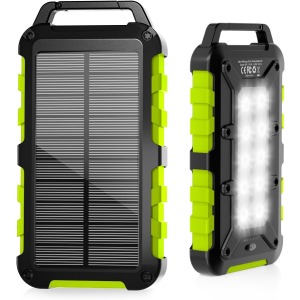
If fast USB-C charging is the priority, the WOWMVP is the one to pick. Its 22.5W bidirectional USB-C PD port charges a modern smartphone from flat to 60% in around 30 minutes, useful when you have limited time at a plug point before heading back outdoors. It also charges the power bank itself via USB-C at 22.5W, cutting full recharge time to around four hours compared to six or more hours on slower models.
The 26,800mAh capacity at £26.99 is honest value. Waterproofing handles UK outdoor conditions reliably. The trade-off is a lower review count of 62 ratings compared to the top three picks, it’s a newer product and less proven at scale. The fundamentals are right, but if review count is a deciding factor for you, the Vikeri or Riapow offer similar specs with considerably more real-world validation.
Features
- 26,800mAh capacity
- 22.5W bidirectional USB-C PD fast charging
- 3 outputs, 2 inputs
- Waterproof construction
- LED flashlight
- Charges phone from 0% to 60% in 30 minutes
- 22.5W PD is the fastest wired charging speed here
- 26,800mAh at £26.99, good value per mAh
- Proper waterproofing for outdoor UK use
- Only 62 reviews, less proven than top picks
- No wireless charging
- No built-in cables
6. Solar Power Bank 20000mAh with 4 Foldable Panels
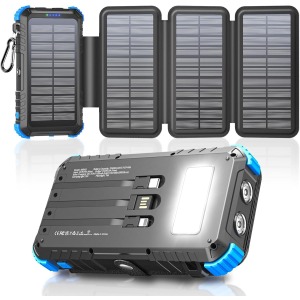
Every other product in this roundup has a single integrated solar panel. This one has four foldable panels that open like a book, giving 300% more solar surface area than a standard single-panel design. That matters in the UK. Where a single panel adds 500 to 1,500mAh on a decent summer day, four panels can add 2,000 to 4,000mAh under the same conditions, enough to charge a phone two or three times from solar alone on a good day.
For anyone spending multiple days genuinely off-grid, such as wild camping, long-distance walking, or sailing, the extra solar input changes the maths considerably. You’re less dependent on finding a mains point, and the battery lasts longer between planned charges. The built-in cables are an added convenience. At £35.99, the premium over single-panel models is justified if solar input is genuinely important to you rather than a marketing feature you won’t use.
Features
- 20,000mAh capacity
- 4 foldable solar panels, giving 300% larger solar surface area
- USB-C input/output with 15W fast charging
- Built-in cables included
- LED flashlight
- 127 customer reviews at 4.2 stars
- Best actual solar charging performance of any model here
- Foldable design allows flexible panel positioning
- Built-in cables included
- Foldable panels add bulk over single-panel rivals
- 127 reviews is still relatively new on Amazon
- No wireless charging
7. BLAVOR Solar Power Bank with Hand Crank 20000mAh
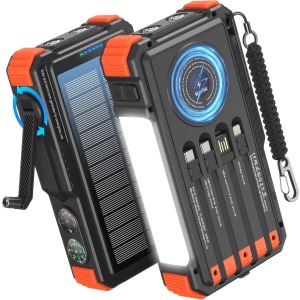
The hand crank is the defining feature here, and it’s worth being clear about what it does and doesn’t do. One minute of cranking generates approximately five minutes of emergency LED light, not meaningful power for your phone, but enough to illuminate a tent, read a map, or signal for help. As a backup when the battery is depleted and there’s no sun, the crank means you’re never entirely without light. That’s the specific scenario this product solves.
Beyond the crank, this BLAVOR offers dual solar panels (genuinely faster solar top-up than single-panel models), 15W wireless charging, and four built-in cables covering every phone type. At £59.98 it’s the most expensive option here. It’s the right buy for mountain leaders, adventure guides, and anyone whose safety genuinely depends on having a last-resort power source, not for the average festival-goer who could save £36 with the BLAVOR built-in cable model above.
Features
- 20,000mAh capacity
- Hand crank generator for emergency power
- Dual solar panels for faster solar top-up
- 15W wireless charging
- 4 built-in cables: USB-C, iOS, USB-A
- Built-in camping light and flashlight
- Hand crank provides genuine emergency last-resort power
- Dual panels give better solar top-up than single-panel models
- At £59.98, it’s the priciest model here
- Hand crank produces very little usable energy for device charging
- Bulkiest option in the roundup
8. Solar Charger Power Bank 20000mAh (Budget Pick)
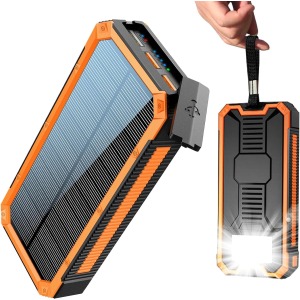
At £18.99, this is the most affordable entry in the roundup, and 415 reviews confirms it’s a real product that works as described. Four USB-A outputs let you charge multiple devices at once, the LED flashlight is functional, and the 20,000mAh capacity is the same as the mid-range models. You lose fast charging, wireless charging, and IP-rated waterproofing, but if you want to try solar power bank ownership without committing significant money, this is a sensible starting point.
It’s worth being honest: there is no USB-C PD port, so you’re relying on standard 5-10W USB-A charging throughout. A modern smartphone takes 2-3 hours to fill from flat. And without a waterproof rating, you’ll want to keep this out of heavy rain. For casual outdoor day trips and festivals where you can keep it in a bag, the budget pick does the job. For serious multi-day trips in variable British weather, invest in the Vikeri.
Features
- 20,000mAh capacity
- 4 USB-A output ports
- Bright LED flashlight
- Solar charging panel
- 415 customer reviews at 4.2 stars
- £18.99, the most affordable option here
- Most affordable option at £18.99
- 415 reviews confirms reliable real-world performance
- No USB-C PD fast charging, only standard USB-A
- No waterproof rating for outdoor use
- No built-in cables
Solar Power Bank Buying Guide
Key Takeaways
- Solar panels are a top-up source. Expect 500 to 1,500mAh per sunny UK day from a single panel, or 2,000 to 4,000mAh from a quad-panel model
- 20,000mAh charges a modern smartphone 4 to 5 times; 26,800mAh delivers 6 to 7 charges
- USB-C PD at 18 to 22.5W charges most modern phones from flat to 80% in around an hour; standard USB-A takes 2 to 3 hours
- IP67 is the minimum waterproof rating worth trusting for UK outdoor use. IP65 is splash-resistant only.
- Built-in cables are a genuine travel convenience, not just a gimmick, especially in group settings
- Hand crank models add emergency light capability, not meaningful phone charging. Useful for safety-critical outdoor use
- Always charge the power bank fully from the mains before a trip. That’s your main power source.
Solar as a Top-Up, Not a Primary Charger
The single most important thing to understand about any solar power bank is that the solar panel tops up a battery. It doesn’t replace mains charging. In direct UK summer sun (roughly 6 hours of usable solar input on a good day in July), a single solar panel on a 20,000mAh bank adds approximately 500 to 1,500mAh. That’s one extra phone charge from a full day of sun exposure. On overcast days, the panel generates almost nothing useful.
This is why the advice is always the same: charge your power bank fully from the mains the night before you leave. The battery is your primary power source. The solar panel is a bonus that extends the bank’s useful life between mains charges. Buyers who understand this are satisfied with their purchase. Buyers who expect the solar panel to be the main power source are disappointed.
The exception is the quad-panel model (our sixth pick), which adds meaningfully more solar input across a day. On a full UK summer day, it can genuinely add 2,000 to 4,000mAh, enough to change the maths for multi-day off-grid use.
Solar Power Bank Types Compared
| Type | Solar Input/Day (UK Summer) | Best For | Price Range |
|---|---|---|---|
| Single panel, no cables | 500-1,500mAh | Day trips, light outdoor use | £15-30 |
| Single panel, built-in cables | 500-1,500mAh | Festivals, group travel | £25-60 |
| Single panel, wireless charging | 500-1,500mAh | Qi device owners, comfort preference | £25-60 |
| Quad-panel foldable | 2,000-4,000mAh | Multi-day off-grid trips | £30-50 |
| Dual panel, hand crank | 1,000-2,500mAh | Emergency preparedness, remote expeditions | £55-80 |
Choosing the Right Capacity
10,000mAh covers 2 to 3 smartphone charges, adequate for a day trip or an overnight stay where you can charge the bank at night. 20,000mAh gives 4 to 5 charges and suits 3 to 5 day trips between mains charges. 26,800mAh delivers 6 to 7 charges, useful for longer trips, tablet users, or anyone sharing with another person. The difference in price between 20,000 and 26,800mAh is typically small, so the larger capacity is usually worth it unless weight is a genuine concern.
USB-C PD vs Standard Charging Speed
Standard USB-A charging operates at 5 to 10W. A modern smartphone with a 4,500mAh battery takes 2.5 to 3 hours to fill from flat. USB-C Power Delivery (PD) at 18 to 22.5W cuts that to 60 to 75 minutes. If your phone supports PD fast charging (most iPhones from iPhone 11 onwards, most Android flagships from 2026), a model with 22.5W USB-C output is worth the small price premium. If you’re charging an older phone via USB-A, the standard speed is fine.
Waterproofing: IP Ratings Explained
IP65 means protection against water jets from any direction, sufficient for light drizzle but not sustained rain. IP66 adds stronger water jet protection. IP67 means the device survives submersion up to 1 metre for 30 minutes. This handles British weather reliably, including being caught in heavy rain or dropped in a shallow puddle. IP68 is rated for deeper submersion. For most UK outdoor use, IP67 is the right minimum. The budget pick (our eighth pick) has no IP rating, keep it dry.
Built-in Cables: Genuinely Useful or Just Marketing?
Built-in cables are genuinely useful in the right context. At a festival, you don’t need to hunt for a cable when someone asks to borrow a charge. On a long walk, you have fewer things to lose. And in a downpour, you’re not fumbling with separate connector pieces. The trade-off is bulk, models with built-in cables are heavier and chunkier than equivalent cable-free models. If you usually travel solo and always carry your own cables, you don’t need them. If you travel in groups or want to minimise what you pack, they’re worth it.
Common Buying Mistakes
- Expecting the solar panel to be the primary charger. It won’t be. Charge from the mains first, treat solar as a bonus.
- Overlooking USB-C PD wattage. A USB-C port without Power Delivery is just a 5W charger in a USB-C housing. Check the actual wattage before buying.
- Buying without an IP rating for UK outdoor use. British weather is unpredictable. A splash on an unrated bank can end a trip.
- Confusing hand-crank charging with regular charging. One minute of cranking gives roughly five minutes of emergency light, not a phone charge. It’s for last-resort emergency use only.
- Buying a heavy solar bank for everyday urban commuting. If you’re mostly in cities near plug sockets, a standard lightweight power bank is the better choice.
When a Solar Power Bank Is Not the Right Buy
If your use case is primarily urban, such as commuting, office use, gym trips, a standard lightweight power bank will be cheaper, lighter, and charge faster. Solar banks weigh 300 to 500g more than equivalent non-solar models because of the panel and housing. That weight penalty is worth it when you’re genuinely outdoors for multiple days. It’s not worth it for someone who’ll be within 100 metres of a wall socket most of the time.
Quick Buyer Checklist
- Capacity: 20,000mAh+ for multi-day trips; 26,800mAh+ for tablets or sharing
- Charging speed: USB-C PD 18W+ if your phone supports fast charging
- Waterproofing: IP67 minimum for reliable outdoor UK use
- Solar input: quad-panel if solar top-up genuinely matters; single panel for occasional outdoor bonus
- Built-in cables: consider if travelling in groups or wanting minimal kit
- Review count: 400+ confirms real-world reliability
- Weight: check before buying, as solar banks are heavier than their non-solar equivalents
Case Study: Powering a 14-Day Coast to Coast Walk
Background
A walker from Yorkshire completed the 190-mile Coast to Coast route over 14 days with no support vehicle. She needed to keep a smartphone running OS Maps navigation for 8 to 10 hours daily, a DSLR camera battery, and a GPS tracker charged throughout. She had mains access every 3 to 4 nights at bed and breakfast stops.
Project Overview
After researching options, she chose the Vikeri 26800mAh based on its IP67 waterproofing, large capacity, and the carabiner clip that allowed hands-free solar top-up while walking. She specifically avoided hand-crank models due to the extra weight on a long-distance walk.
Implementation
The power bank was clipped to the outside of her rucksack on clear days, angled towards the sun. On an average July day, it gained approximately 1,200 to 1,500mAh of solar charge while she walked. Between mains charges, this gave her one additional phone charge per full day of sun exposure.
Results
Over the 14 days, the power bank was never depleted below 25%. The solar top-up meant she needed one fewer mains charge than expected, which avoided a diversion on Day 9 when she was behind schedule. Total cost of the power bank: £23.52. She rated the IP67 waterproofing as the feature that gave her most peace of mind during a particularly wet day crossing the North Yorkshire Moors.
Expert Insights From Our Solar Panel Installers About Solar Power Banks
One of our senior solar engineers with over 18 years in the industry sees a lot of confusion around what solar power banks can realistically do: “People come to us expecting the solar panel to do most of the work. In British conditions, with our cloud cover and the angle of the sun, that’s just not realistic for a small panel. What’s realistic is treating the solar as a daily top-up, on a good day in summer you’ll get one extra phone charge, maybe two if you’re walking all day with the bank facing south. That’s genuinely useful on a week’s hiking trip. It’s not useful if you’re expecting to never plug in. The battery capacity is what does the real work, and the IP rating is what makes it worth trusting outdoors.”
Frequently Asked Questions
How much charge does a solar power bank get per day in the UK?
A single-panel solar power bank adds roughly 500 to 1,500mAh per full day of direct summer sun in the UK. That equates to about one additional phone charge. Quad-panel models like our sixth pick can add 2,000 to 4,000mAh under the same conditions. On overcast days, solar input is negligible for any model. July and August offer the best results; October through March offer very little. Always charge from the mains before heading out.
Can I charge my phone directly from the solar panel?
No. All solar power banks in this guide store solar energy in the internal battery first, then discharge the battery to charge your phone. Your phone charges at the battery’s output speed, up to 22.5W for fast-charging models, regardless of how much solar the panel is receiving at that moment. There’s no direct solar-to-phone charging path in any consumer solar power bank.
Are solar power banks allowed on aeroplanes?
Yes. All models in this guide use lithium-ion batteries of 100Wh or less (26,800mAh at 3.7V equals roughly 99Wh), which falls within most airlines’ carry-on limits. Check with your specific airline before travelling, as policies vary and some carriers have lower thresholds. Solar power banks must go in hand luggage, not checked baggage, following standard lithium battery regulations.
What do IP65, IP67, and IP68 mean on a power bank?
IP65 means protection against water jets, handles light rain but not sustained downpours. IP67 means the device survives submersion to 1 metre for 30 minutes, which reliably covers British weather including heavy rain and accidental drops in shallow water. IP68 adds deeper submersion protection and is typically needed for extreme water sports rather than general outdoor use. For most UK hiking and camping, IP67 is the right minimum.
How long does it take to fully charge a solar power bank from the mains?
A 20,000mAh bank takes approximately 4 to 6 hours from a 20W USB-C adapter. Using a standard 5W USB-A charger extends that to 10 to 12 hours. The WOWMVP (22.5W bidirectional) is the fastest option in this roundup, reaching full charge in around 4 hours with a compatible fast charger. Charge overnight before any outdoor trip so you start with a full battery.
Do wireless charging solar power banks charge slower than wired?
Yes, wireless charging is inherently less efficient than wired, typically 60 to 70% as efficient at the same rated wattage due to inductive losses. A 15W wireless pad effectively delivers around 10 to 12W of usable energy to your phone. That said, the Riapow in this roundup offers 22.5W wireless, which performs closer to a good wired charger than older 10W wireless pads. If speed is critical, wired charging via USB-C PD is always faster.
Can a solar power bank charge a laptop?
Some can, partially. Models with USB-C PD at 20 to 22.5W, like the WOWMVP in this roundup, can slow-charge or maintain the battery level of a laptop that would otherwise require 30 to 45W. Budget laptops may charge slowly; MacBooks and gaming laptops typically need 65 to 100W and will only slow the discharge rate rather than charge fully. A solar power bank is not a substitute for a proper laptop charger, but it can extend working time in a pinch.
How long does a solar power bank last before the battery degrades?
Most solar power banks use lithium-ion batteries rated for 500 to 800 full charge cycles before noticeable capacity loss. At one full cycle per week, that’s 10 to 15 years of regular use. The solar panel itself is the more durable component, silicon solar cells last 20 or more years in normal outdoor conditions. In practice, the battery is the component that will degrade first, typically showing reduced capacity after 3 to 5 years of heavy use.
Summing Up
Solar power banks fill a specific niche: outdoor use where mains power isn’t always available and you want a daily solar top-up to extend the gap between charges. The Vikeri 26800mAh is the right pick for most UK buyers, genuinely waterproof, large capacity, and honest value at £23.52. For built-in cable convenience and wireless charging, the BLAVOR 20000mAh is the established choice with over 1,400 reviews behind it. If solar charging performance genuinely matters to you rather than being a secondary feature, go for the quad-panel model. And for any use case where being caught without power could be a safety issue, the BLAVOR hand-crank adds a last-resort emergency option that nothing else in this list provides.
Updated