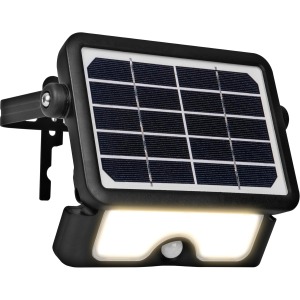
If you want to light up your garden boundary without running cables, solar fence lights are one of the smartest upgrades you can make. They charge during the day and come on automatically at dusk, with no electrician and no ongoing electricity cost. The trick is knowing which style suits your fence: post caps sit on top of wooden posts, clip-on lights attach to fence panels, and wall-mount security lights screw to any flat surface.
The best solar fence light right now is the InnoGear 24 LED Solar Lights, which comes as a pack of four, has a huge number of verified reviews, and mounts cleanly on any fence or wall with a dim-to-bright motion sensor. Below you’ll find our full breakdown of the eight best options available on Amazon.co.uk in 2026.
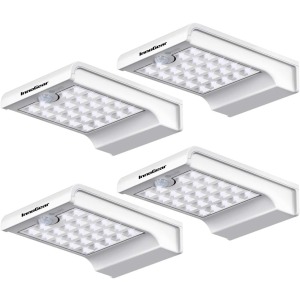
With over 4,000 verified reviews and a 4.5-star rating, the InnoGear 24 LED Solar Lights are the most proven solar fence lights you can buy in the UK right now. They come as a pack of four, which covers a good stretch of fence or wall, and the dim-to-bright motion sensor means they’re on standby all night and blazingly bright the moment they detect movement.
Each light has 24 LEDs and mounts via two keyholes on the back: standard screw fixing, no fuss. The ABS casing is IP65 rated, which means it handles British weather without any drama. You turn them on with a physical switch rather than having to fiddle with an app, which is exactly the right decision for a product this simple in concept.
At £43.98 for four, the per-unit cost is reasonable compared to buying lights individually. The main thing to know is that these are security lights, not decorative ones. They throw a strong white beam when triggered, which is excellent for deterring intruders or spotting the cat knocking over the wheelie bin at midnight, but they won’t add a warm ambient glow to a garden dinner.
The motion sensitivity works well even through rain, and the solar panel charges fast enough that even overcast UK summer days keep them going. In December and January, expect shorter runtime on cloudy stretches: but the motion-only activation mode preserves the battery well through winter.
Features
24 LED per unit, dim-to-bright motion sensor
IP65 waterproof ABS construction
Pack of 4, wall/fence/gutter mountable
Simple on/off switch operation
4.5/5 stars from 4,223 reviews
Pros:
Huge number of genuine reviews: reliability is proven
Pack of 4 gives great coverage for the price
Dim-to-bright mode saves battery without sacrificing security
IP65 handles UK rain and frost well
Cons:
Cool white light only: not suitable if you want decorative warmth
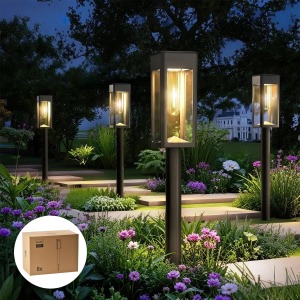
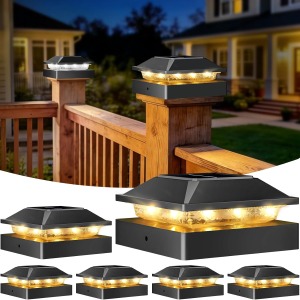
If your fence has timber or composite posts and you want lights that sit neatly on top without screwing into the sides, post cap lights are the way to go. The JOFIOS 6 Pack are some of the best on the market right now: black metal construction with a diamond-patterned shade that casts a lovely soft pattern across the fence top at night. Each unit charges during the day and comes on automatically at dusk, staying lit until dawn.
They’re designed for 4×4 posts: actual 3.5″ x 3.5″ timber posts which is the UK standard for most fencing. Installation is straightforward: drop them over the post and screw them down with the provided fixings. The metal construction feels genuinely robust, unlike the plastic alternatives that start looking weathered after one winter. The IP65 rating means rain and frost won’t be a problem.
At £43.97 for six, the cost per cap is reasonable given the quality. The warm white light is purely decorative: these aren’t security lights. Expect 5-20 lumens per cap, which is enough to see the fence line clearly and add atmosphere, but won’t illuminate your garden. If you want to mark your fence posts elegantly and have the lights come on automatically every evening, this is the pick.
Features
Black metal construction with diamond-patterned shade
Designed for 4×4 (3.5″ x 3.5″) timber/composite posts
IP65 waterproof
Auto dusk-to-dawn operation
Pack of 6, screws included
Pros:
Solid metal construction that looks good and lasts
Warm, attractive light pattern from the diamond shade
Easy drop-over-post installation
Good pack size for typical garden fence runs
Cons:
Decorative only: no motion sensor or security function
Only fits 4×4 posts: check your post size before buying
Low output means you need the full run of posts lit for effect
3. Luceco Solar Powered LED Outdoor Floodlight with PIR
Luceco is a serious British electrical brand whose products turn up in B&Q, Screwfix, and major electrical wholesalers: so you know the quality control is real. Their Guardian solar floodlight brings proper security lighting to your fence for £24.30, which is excellent value given what you get. The 5W LED produces 550 lumens at 4000K, which is a crisp, neutral-to-cool white that lights up a fence panel completely when triggered.
The PIR sensor offers two modes: dim constantly then bright on motion, or off then bright on motion. The angular design allows you to tilt and aim the head, which matters when you’re mounting to a fence and want the beam directed at a specific area rather than straight ahead. The polycarbonate body is IP65 rated and genuinely feels like it’ll shrug off a British winter rather than crack in a frost.
It needs 8-10 hours of sunlight to fully charge, which in a UK context means you’ll want it south-facing or at least not fully shaded. On good summer days it delivers excellent performance. In January, the motion-only mode preserves battery significantly. Worth noting: this is a proper floodlight, not a soft ambient light. It’s the right choice for anyone who wants their fence to actually provide security lighting.
Features
5W LED, 550lm output, 4000K colour temperature
PIR motion sensor with 2 modes
IP65 polycarbonate body, adjustable tilt
UK brand with wide retail availability
4.7/5 from 555 reviews
Pros:
Genuinely bright at 550lm: provides real security illumination
When you genuinely need to flood your garden with light the moment something moves: not just illuminate a patch of fence: this is the product to buy. The Philips Solar Security Light puts out 1,200 lumens from 302 LEDs arranged across three independently adjustable heads. You can angle all three at different parts of the garden or fence line, giving you coverage that single-head lights simply can’t match.
The PIR sensor is sensitive and has three modes: always-on dim with bright-on-motion, motion-activated only, and constant bright. The upgraded solar panel and high-capacity battery mean it holds up better than many competitors in the UK’s grey autumn months. At £67.28, it’s the most expensive product on this list, but Philips’ quality standards and the sheer output justify the price for anyone who’s serious about security.
The three-head design makes this best suited to corners or gate posts where you want to cover multiple angles simultaneously. If you only need to light a single fence panel, the Luceco or InnoGear options are more cost-effective. But for a proper external security setup on a fence or wall, this is the one to buy and forget about for years.
Features
302 LEDs, 1200lm output: very bright
Three independently adjustable heads
PIR motion sensor, 3 modes
IP65, upgraded polycrystalline solar panel
4.7/5 from 132 reviews
Pros:
1200lm from three heads: unbeatable coverage
Philips quality assurance and brand reliability
Three adjustable heads for multi-angle coverage
High-capacity battery handles UK cloudy spells
Cons:
Most expensive option on this list at £67.28
Overkill for decorative use: purely security-focused
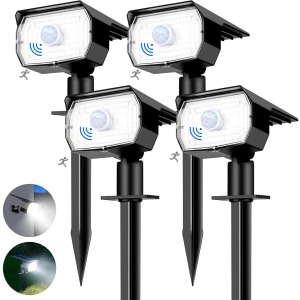
The nipify 4 Pack is a strong value proposition: four motion-sensor solar spot lights for £26.48, with a 4.8-star rating from 91 reviews. Each light has 56 LED beads and uses a solar panel with a claimed 24% conversion rate, which is towards the higher end for consumer solar lights. The 6500K cool white output is sharp and bright: more security than ambience, but effective.
The 2-in-1 installation means each unit can either be wall/fence-mounted or ground-staked, which gives you flexibility in how you deploy them across your garden boundary. Three modes cover the main use cases: constant bright, motion-activated bright, and dim with motion-activated full brightness. The IP65 rating is solid for UK outdoor use.
At £6.62 per unit in a pack of four, these are competitive on price for the spec. The relatively newer product (fewer than 100 reviews currently) means there’s less long-term reliability data than the InnoGear alternative, but the early ratings are excellent. A good choice if you want flexible uplighting/fence lighting across a larger area without spending over £100.
Features
56 LED per unit, 6500K cool white, 24% solar conversion
3 modes: constant / motion / dim-to-bright
2-in-1: wall mount or ground stake
IP65, pack of 4
4.8/5 from 91 reviews
Pros:
Excellent value at about £6.60 per light
Flexible 2-in-1 installation (wall or stake)
High conversion rate solar panel
Cons:
Fewer reviews than the InnoGear: less proven long-term
Cool white only: no warm option
Uplighter/spotlight style rather than fence-panel specific
6. Solar Motion Sensor Lights 43LED 650lm (2 Pack)
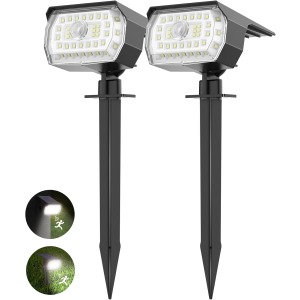
At £19.99 for a pair, these 43-LED solar spotlights offer solid security performance at a genuinely budget price. The 650-lumen output is higher than most budget solar lights claim (and usually actually achieve), and the 120-degree PIR detection angle means they’re hard to approach without triggering. Three modes give you the standard options: always dim, motion-activated, or constant bright.
The 2-in-1 design: wall mount or ground spike: makes them genuinely versatile. You could mount one on the fence post and spike the other in the border as an uplighter. The UV-resistant ABS body is IP65 rated. These aren’t premium-feeling products, but the 608 reviews and 4.7-star rating suggest they deliver what they promise.
The honest downside: ABS plastic at this price point won’t look as smart as metal alternatives after a year or two outdoors, and 650lm while good for the price is still noticeably less than the Luceco at 550lm (which has a superior quality panel and body). But as budget security lights for a fence or garden boundary, these are hard to beat at £10 per unit.
Features
43 LED, 650lm, 120° PIR detection angle
3 modes: dim / motion / constant
IP65, UV-resistant ABS, 2-in-1 install
2 Pack, £19.99
4.7/5 from 608 reviews
Pros:
Well-priced at £10 per unit
Wide 120° detection angle
608 reviews at 4.7 stars: well proven
Cons:
ABS build quality won’t age as well as metal alternatives
Cold white only
Only 2 in a pack: may need multiple orders for full fence coverage
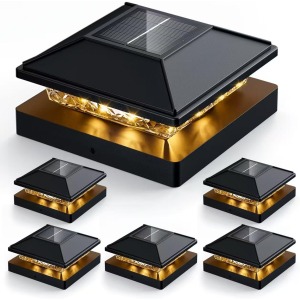
The Peasur post cap lights do something the JOFIOS lights don’t: they give you two colour mode options. A remote or physical switch lets you toggle between warm white and cool white, which is actually more useful than it sounds: warm white looks welcoming in summer evenings, while cool white provides better visibility in the dark depths of winter. The 16-LED array gives decent output for a post cap light.
They fit 4×4 posts (actual 3.5″ x 3.5″) and vinyl posts too, with detachable base adapters that make marking and drilling the screw holes easier. The IP64 rating (rather than IP65) means they’ll handle rain but shouldn’t be submerged: which is fine for a fence post cap. At £36.85 for six, they’re slightly cheaper per cap than the JOFIOS and the dual-colour feature adds practical value.
One thing to note: with 59 reviews, there’s less user data than the JOFIOS. The reviews are very positive (4.6 stars), but you’re relying on a smaller sample. Worth the slight uncertainty given the lower price per unit and the additional colour mode: but if reliability is paramount, the JOFIOS has the track record.
Features
16 LED, 2 colour modes (warm white / cool white)
Fits 4×4 and 3.5×3.5 posts, vinyl and timber
IP64, monocrystalline solar panel
Pack of 6, detachable base for easy install
4.6/5 from 59 reviews
Pros:
Two colour modes: more versatile than most post caps
Works on vinyl posts as well as timber
Slightly cheaper per cap than the JOFIOS
Cons:
Only 59 reviews: less data on long-term reliability
IP64 rather than IP65: marginal difference but worth noting
8. Soiarllt Solar Fence Lights: 9 Modes Warm & RGB
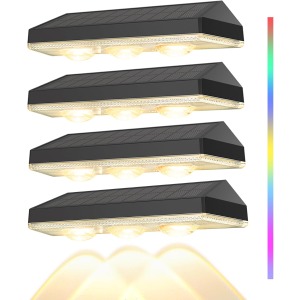
The Soiarllt is the most fence-specific light on this list. The patented I-bracket and L-bracket system allows three mounting orientations specifically designed for fence panels, fence posts, and flat walls: so whatever surface you’re fixing to, there’s a bracket for it. Nine modes span from warm white (2700K, the most flattering for a garden) through to full RGB colour cycling, which is perfect if you want festive or party lighting from the same fixture.
At £12.99, it’s the most affordable product on this list and the 3-LED focus lens design gives it higher apparent brightness than many cheap single-LED alternatives. The 14-hour runtime claim is ambitious but achievable in summer with good sun exposure. In winter, expect 6-8 hours on a good day. The IP65 build and monocrystalline solar panel are both solid at this price point.
Features
3-LED focus lens, 9 modes (warm white + RGB)
Patented I & L brackets: 3-way fence/wall mounting
IP65, monocrystalline solar panel
14H rated runtime, dusk-to-dawn
4.8/5 from 62 reviews
Pros:
Fence-specific mounting brackets are a genuine advantage
Excellent value at £12.99
Warm white and RGB modes: versatile for different occasions
Cons:
62 reviews: still building a track record
RGB modes drain battery faster than warm white
Lower absolute brightness than the security-focused options
There are three main types: post cap lights (for fence posts), clip/bracket-mount lights (for fence panels), and wall-mount security lights (for any flat surface)
Always measure your fence post before buying post cap lights: UK posts are typically 75mm, 100mm, or 125mm square (not the same as “4×4″ which is 100mm/3.5”)
North-facing fences charge poorly: if your solar panel can’t tilt south, expect 40-60% of rated performance
Choose IP65 or higher for any product mounted on or near a UK garden fence: IP44 is the minimum, but won’t hold up as well over years
Motion sensor modes preserve battery significantly in winter: especially important from October to February
Post Cap, Panel, or Wall Mount: Which Type Do You Need?
The most common mistake when buying solar fence lights is not thinking clearly about which type of mounting will actually work for your fence. Post cap lights are the most attractive option visually: they sit cleanly on top of each fence post and create a row of evenly-spaced glowing caps along the fence line. But they only work if you have wooden or composite fence posts of the right dimensions, and the caps have to match your post size exactly.
Panel-mount or bracket-mount lights attach to the face of a fence panel using screws, clips, or specifically-designed brackets (like the Soiarllt I/L bracket system). These work on any fence type regardless of post size, but you need to consider where the solar panel will face and whether it’s shaded by overhanging plants or the fence cap itself.
Wall-mount security lights are the most versatile: they go on any flat surface, including fence posts and panels, but are primarily designed for walls and gate posts. This is the category that gives you the most lumen output and motion sensor reliability, at the cost of a more utilitarian appearance.
Measuring UK Fence Posts Correctly
UK fence posts don’t follow a single standard, which catches a lot of buyers out. The most common residential fence post sizes are 75mm x 75mm, 100mm x 100mm, and 125mm x 125mm. When post cap lights list “4×4 posts”, they typically mean 100mm (3.94 inches) which rounds to 4 inches. But this isn’t always the case: some products mean 4″ (101.6mm) while others follow US lumber conventions where a “4×4″ is actually 3.5″ x 3.5” (89mm).
The only reliable way to buy correctly is to measure your posts with a tape measure before ordering. Measure both dimensions of the post top: they should be square, but some fence posts taper slightly. If your post is between standard sizes, always go slightly smaller rather than larger, as some cap lights have adjustable or flexible fittings that can accommodate minor variations.
The North-Facing Fence Problem
In the UK, a large proportion of garden fences face north or north-east because houses typically sit south-facing, leaving the rear fence pointing north. A north-facing solar panel receives significantly less direct sunlight than south-facing: during winter months, it may receive as little as 1-2 hours of usable solar irradiance per day compared to 4-6 hours for a south-facing panel at the same location.
The practical solution is to choose solar fence lights with panels that can be tilted or that have a separate panel on a cable. Some wall-mount security lights allow you to angle the solar panel independently from the light head, which means you can point the panel south while the light faces north. Post cap lights are usually fixed-panel designs: if your fence is north-facing, look for models with a high-capacity battery (1,200mAh or more) to compensate for reduced charging time.
Motion sensor modes help considerably in this situation because the light only activates for short bursts rather than running continuously, meaning the battery lasts much longer per charge. If you have a north-facing fence and want dusk-to-dawn lighting, you’ll be disappointed with most solar products in winter: that’s an honest limitation of solar power in northern latitudes.
Lumen Output: What Do You Actually Need?
Lumen ratings on solar fence lights are frequently optimistic. The figure you see on the packaging often refers to the maximum LED output rather than the actual average output accounting for panel efficiency, battery capacity, and weather conditions. A product claiming 800 lumens may realistically deliver 400-500 lumens in typical UK conditions.
With that in mind, here’s a practical guide to what you actually need:
Decorative accent lighting: 5-30lm per light. This gives a warm glow visible from the house and marks the fence line attractively. Post cap lights typically sit in this range.
Functional pathway and border lighting: 30-100lm. Enough to see where you’re walking and identify the garden layout at night.
Security lighting: 300lm minimum, ideally 500lm+. Motion-activated, bright enough to be startling and to see a person’s face clearly at 5-10 metres.
Serious security: 800lm+. The territory of the Philips and similar multi-head products. Comparable to mains-powered security lights.
Battery Capacity and UK Winter Performance
Most solar fence lights have batteries between 600mAh and 2,000mAh. In a UK winter, a 600mAh battery will typically give you 4-5 hours of continuous light from a single full charge: which may not make it through a full winter night (16+ hours of darkness in December). A 1,200mAh+ battery is much more practical for year-round dusk-to-dawn operation.
However, motion-sensor modes dramatically change this calculation. In motion-only mode, a 600mAh battery that would run out by midnight in always-on mode can last 2-3 nights of normal activity because it only activates for 30-90 second bursts. If you want your fence lights on all night from dusk to dawn in December, budget for a higher-capacity battery or accept they’ll switch off after a few hours.
Materials: What Holds Up to UK Outdoor Conditions
UK gardens are not kind to outdoor products: temperature swings from -5°C to 30°C, persistent damp, UV exposure in summer, and frost cycles in winter. Here’s how common materials compare:
Powder-coated or painted metal: Looks great, durable, but watch for rust on cheaper units where the coating chips: stainless or aluminium frames avoid this
UV-stabilised ABS plastic: The standard for most solar lights, acceptable if the UV stabilisation is genuine. Look for “UV resistant” in the spec. Cheaper ABS yellows and becomes brittle after 2-3 years.
Stainless steel: Excellent for exposed fence tops (post caps particularly): won’t rust or corrode regardless of weather
Standard ABS: Avoid for fence tops where there’s no shelter: UV degradation and frost cracking are common
Common Buying Mistakes to Avoid
Not measuring your posts: The single most common return issue with post cap lights. Measure first, order second.
Choosing dusk-to-dawn when you need motion-sensor: In winter, dusk-to-dawn will drain the battery before midnight on many models. Motion sensor is far more practical for UK winters.
Ignoring panel placement: A fence-mounted light with a fixed-position solar panel pointing into shade will never perform well. Check whether the panel can be aimed independently.
Buying security lights for decorative use: A 550lm cool white motion-activated floodlight looks harsh and clinical in a garden setting. Match the product to the purpose.
Expecting consistent summer performance in winter: Any solar product will perform significantly worse in October-February than in May-August. Factor this into your expectations.
Case Study: Lighting a Victorian Terraced Garden Boundary in Leeds
Background
A homeowner in Leeds with a small Victorian terraced garden wanted to improve both the security and the atmosphere along their rear garden boundary. The rear fence was a mix of 6ft close-board panels with 100mm timber posts, with the fence line running roughly east-west. The garden faced roughly south, but the rear fence itself was on the north side of the garden (between the garden and the back lane), meaning the fence tops and posts didn’t receive a great deal of direct midday sun.
Project Overview
The goal was two-part: warm decorative lighting along the fence post tops to create ambience during evening garden use from May to September, and motion-triggered security lighting on the gate post for year-round deterrence. Budget was around £150 for the whole project.
Implementation
The homeowner measured their fence posts and confirmed 100mm (4″) square posts throughout. They installed a set of six JOFIOS post cap lights on the main fence posts for decorative ambience, and a Luceco Solar Guardian floodlight on the gate post for security. The Luceco’s adjustable head was angled to face south to improve the panel’s charging angle despite the north-facing gate post location.
Total spend: £43.97 (JOFIOS 6 pack) + £24.30 (Luceco) = £68.27, well under budget. The remaining budget went on a separate clip-on Soiarllt fence light near the gate for a colour temperature option that could be switched to warm white for social evenings in the garden.
Results
Over the first summer, the post cap lights ran reliably from dusk to dawn on most nights, with the occasional short battery in very overcast spells in early May. The Luceco security light triggered correctly every time the back lane was accessed, and the south-angled panel meant it held up well through October and November. By January, the post cap lights were running about 5-6 hours on average before dimming: shorter than summer, but sufficient to cover early evening garden use. The setup cost under £70 and required no electrician, cable, or ongoing electricity cost.
Expert Insights From Our Solar Panel Installers About Solar Fence Lights
We asked one of our senior solar panel installers with over 12 years of experience to share their perspective on solar fence lights from an installation professional’s viewpoint.
“The main thing customers get wrong is treating solar fence lights as the same product regardless of their fence orientation. I’ve had people ring up saying their lights barely charge and it turns out their fence runs north-south with the light panel facing dead west. You’re asking that panel to charge on a few hours of afternoon sun: it won’t be enough in winter. If you’re buying solar fence lights for a mixed-orientation garden, spend a bit more on something with a higher-capacity battery and definitely use the motion sensor mode rather than dusk-to-dawn. The motion-only mode is the trick that makes solar fence lights viable in northern UK winters.”
“The other thing I’d say is don’t underestimate how much difference the material makes on fence tops. Post caps sit on the very top of a fence post: that’s the most exposed position in the garden. Full sun in summer, frost in winter, nothing to shelter them. I’ve seen cheap ABS post caps crack within two years from frost cycles. Metal or UV-stabilised ABS is worth paying for in that position.”
Frequently Asked Questions
How bright should solar fence lights be?
It depends on the purpose. Decorative post cap lights typically produce 5-30 lumens, which is enough to create a warm glow and mark the fence line attractively without being harsh. For functional lighting that helps you navigate the garden at night, aim for 30-100 lumens. Security lighting needs at least 300 lumens: ideally 500lm or more with a PIR motion sensor: to properly illuminate a person or intruder approaching your fence line.
Do solar fence lights work in the UK winter?
Yes, but with reduced performance compared to summer. UK winters bring shorter days, more overcast skies, and lower solar angles, which means less charging time. Most solar fence lights will charge adequately on a reasonable autumn or winter day: even through cloud, solar panels generate some output. The bigger issue is runtime: with 16-17 hours of darkness in December, lights with smaller batteries (under 1,000mAh) may not run dusk to dawn. Motion sensor mode preserves battery significantly and is recommended for year-round use.
What size post cap do I need for my fence?
Measure your fence posts before ordering: never guess. UK fence posts are typically 75mm x 75mm, 100mm x 100mm, or 125mm x 125mm. When a product says “4×4”, this usually means 100mm (approximately 4 inches), but always check the product specification rather than assuming. Some US-standard products use “4×4″ to mean 3.5″ x 3.5” (89mm), which will be loose on a 100mm post. The manufacturer’s spec should state the actual inside dimension of the cap fitting.
Will solar fence lights work on a north-facing fence?
They’ll work, but with reduced performance, particularly in winter. A north-facing solar panel in the UK receives significantly less direct sunlight than a south-facing one: sometimes as little as 1-2 usable hours per day in November-January. To compensate, choose a light with a higher-capacity battery (1,200mAh+), use motion sensor mode rather than dusk-to-dawn, and look for products where the solar panel can be angled or separated from the light head so you can aim it more southward.
Can I use solar fence lights on fence panels rather than posts?
Yes: several types are designed specifically for fence panels. Wall-mount lights with standard screw holes will attach to any fence panel. Clip-on lights grip the top rail of a fence panel without any drilling. Bracket-mounted lights (like the Soiarllt with its I and L brackets) offer multiple mounting positions for panels, posts, and walls. Post cap lights, however, are specifically for the tops of fence posts and won’t work on flat panels.
How long do solar fence lights last per charge?
Runtime varies significantly by battery capacity, mode, and weather. In summer on a good UK sunny day, most solar fence lights will run 8-12 hours per charge in dim/decorative mode. In dusk-to-dawn mode through a December night (16+ hours of darkness), lights with batteries under 1,000mAh will typically dim or switch off before dawn. Motion-only activation can extend this to 2-3 nights of activity on a single charge, making it the practical choice for year-round UK use.
What IP rating do solar fence lights need?
IP65 is the practical minimum for any fence light that will be permanently mounted outdoors in the UK. IP65 means the product is fully dust-protected and can withstand direct water jets: sufficient for rain, garden hoses, and the general UK climate. IP44 (protected from splashing water) is acceptable for sheltered positions but won’t hold up as well on exposed fence tops. Flush-recessed ground lights need IP67 or IP68. Avoid products without a stated IP rating for permanent outdoor installation.
Do solar fence lights need any maintenance?
Very little. An occasional wipe of the solar panel with a damp cloth is the main maintenance task: dirt and debris accumulate on the panel surface and reduce charging efficiency. In autumn, keep an eye on falling leaves that might shade the panel. Post cap lights may need their screws checked once a year as timber posts can expand and contract with moisture changes. After 2-3 years, the rechargeable battery may need replacing in some products: check whether the battery is user-replaceable before buying if long-term cost is a consideration.
Summing Up
Solar fence lights cover a wide range: from decorative post caps that add warmth and character to your garden boundary, to serious security floodlights that will deter intruders and flood the garden with light on motion. The key is matching the product to the purpose and being honest about your fence orientation. A north-facing fence with a small-battery solar light is a recipe for disappointment in winter; a south-facing fence on a well-reviewed motion-sensor model is a genuinely effective, cost-free lighting solution for years.
If you want our single recommendation, the InnoGear 24 LED pack wins on proven reliability: 4,223 reviews don’t lie. For decorative post caps, the JOFIOS 6 pack is the best build quality at a fair price. And if budget is the priority, the Soiarllt fence-specific light at £12.99 delivers surprising quality for the money. Whichever you choose, measure your posts before ordering and use motion sensor mode through winter. You’ll get years of trouble-free use from any of the products on this list.