
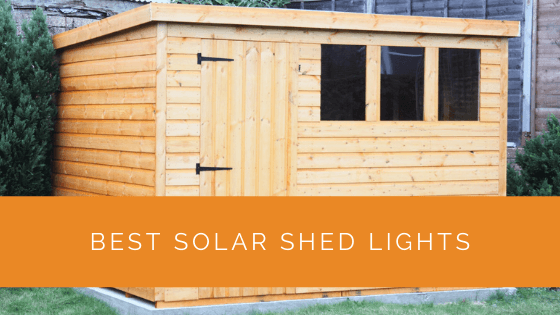
The APILAB Solar Shed Light Dual Lamp is our top pick for solar shed lighting. It’s the only system in this guide that powers two pendant lights from a single solar controller, giving wider coverage from one installation, and the 12,000mAh battery is large enough to handle extended cloudy periods without the light going dark. For anyone who needs reliable, practical illumination in a shed, garage, or outbuilding without running mains cable, it does the job properly.
The rest of this guide covers the full spectrum of solar shed lights available on Amazon.co.uk right now, from budget 50-lumen options for casual shed use to 4,000-lumen systems with motion sensors and remote controls for workshop environments. All eight lights use an external solar panel with a cable — which is what separates a proper solar shed light from an ordinary outdoor solar security light.
Our Top Picks
| Image | Name | |
|---|---|---|
| APILAB Solar Shed Light Dual Lamp 2000LM | |
| CLAONER Solar Shed Light 2000LM | |
| Solar Shed Light 3200LM with Motion Sensor | |
| Solar Shed Light 4000LM 360° with Three Colour Temperatures | |
| FabStyl Solar Shed Light with E27 Bulb | |
| intelamp Solar Pendant Light 4000mAh | |
| Solar Shed Light 6500K Day and Night | |
| SolarCentre Beam Solar Shed Light |
8 Best Solar Shed Lights
1. APILAB Solar Shed Light Dual Lamp 2000LM
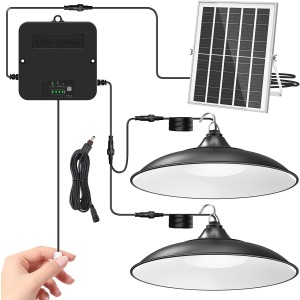
The APILAB stands apart from every other light in this guide because it powers two separate pendant lights from a single solar panel and control box. Most solar shed lights give you one bulb. The APILAB gives you two, each on a 9.8ft cable that you can hang in different parts of the shed. If your shed is large enough that one light leaves corners in shadow, this is the solution that fixes it at a reasonable price.
The 12,000mAh battery is notably larger than competitors. In practical terms, that means it runs significantly longer through UK winter evenings and handles multiple overcast days better than lighter systems. The solar panel connects via a 16.4ft cable, and an additional 9.8ft extension cable is included, giving real flexibility for positioning the panel on a south-facing roof section even when the shed faces the wrong direction.
Three operating modes via pull cord: medium brightness for 6-8 hours, full brightness for 3-4 hours, and automatic dusk-to-dawn. The pull cord is on the control box itself, not on the light, which works well for sheds where the light hangs high and the control box sits at a convenient height nearby. Battery and mode indicators are on the control box so you can check status without guessing.
The main trade-off is price. At around £76, it’s the most expensive light here by some margin. But it’s genuinely doing more than a single-lamp system, and if you need two lights, buying two separate units would cost just as much without the unified control box advantage.
Features
- Dual lamp: two 2000LM pendant lights from one solar system
- 12,000mAh battery for extended UK winter runtime
- 16.4ft panel-to-box cable plus 9.8ft extension included
- Pull cord control on power box with battery and mode indicators
- Three lighting modes including dusk-to-dawn auto
- 30% solar conversion efficiency panel
- Two lights from one system: better coverage per installation
- 12,000mAh battery handles UK winter overcast well
- Long panel cable with extension gives real placement flexibility
- Battery and mode indicators take the guesswork out of operation
- Most expensive in this guide by a significant margin
- Control box needs a dry, sheltered location — not itself weatherproof
- Bulkier setup than single-lamp alternatives
2. CLAONER Solar Shed Light 2000LM with Pull Cord
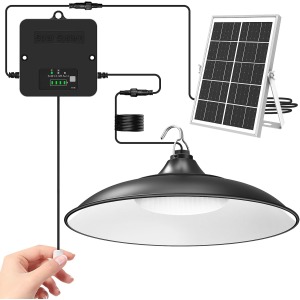
The CLAONER is the most practical single-lamp solar shed light in this guide. Where a lot of competitors give you an on/off switch and nothing else, the CLAONER’s power box includes both a battery level indicator and a mode indicator in three colours. You can tell at a glance whether the system is fully charged, which mode it’s running in, and how much power is remaining. These details make a real difference when you’re using the light regularly and want to manage how you run it through a UK winter.
The cable setup is generous: 16.4ft from solar panel to power box, plus an additional 9.8ft from box to bulb. The total reach allows you to mount the panel in a well-exposed position whilst keeping the light exactly where you need it. At 2000LM, this is comfortably bright enough for hobby work and moderate task lighting. It won’t replace a workshop ceiling bank, but it performs well above the storage-tier lights in this list.
Three modes via pull cord: medium for 6-8 hours, high for 3-4 hours, and dusk-to-dawn auto mode. IP65 rated throughout. Pull cord control means no remote to lose and no battery to replace in a controller. It’s the solar shed light that handles daily use well without complication.
Features
- 2000LM brightness with pull cord switching
- Battery level and mode indicator lights on power box
- 16.4ft panel cable plus 9.8ft extension to bulb
- Three modes: medium (6-8hr), high (3-4hr), dusk-to-dawn auto
- IP65 weatherproof rating
- Works in daytime as well as at night
- Battery and mode indicators: know what your system is doing at a glance
- Long combined cable gives good placement flexibility
- Pull cord more reliable than a remote for a shed environment
- Single lamp only: covers one area of the shed
- 2000LM is hobby-work bright, not full workshop bright
- Power box must stay in a dry, sheltered location
3. Solar Shed Light 3200LM with Motion Sensor and Remote
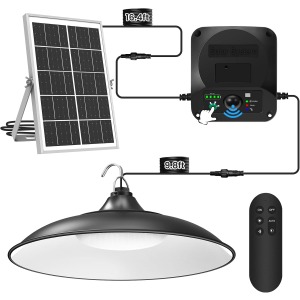
This is the workshop-capable option for those who want high output without wiring in mains power. At 3200LM, it’s noticeably brighter than the CLAONER per bulb, and the PIR motion sensor makes it useful for security and convenience simultaneously. The motion mode activates the light when you enter and turns it off 20 seconds after you leave, which conserves battery significantly during a UK winter when charging days are short.
Four modes give good range: medium steady, dusk-to-dawn auto, motion-triggered night only, and full-brightness steady. The metal lamp shade provides better durability and light direction than plastic alternatives, and the IP65 rating handles outdoor weather on the solar panel. The remote control is practical for changing mode without walking to the power box, though the button on the box itself works as a backup if the remote is misplaced.
Price is higher than the CLAONER but justified by the additional output and the motion sensor feature. If you’re using your shed as a workshop and want a light that serves both as task lighting and as security when you’re away, this handles both well.
Features
- 3200LM output with directional metal lamp shade
- PIR motion sensor with 20-second auto-off delay
- 4 modes: medium, dusk-to-dawn, motion-night, high brightness
- Remote control plus button on power box as backup
- IP65 weatherproof rating
- Battery and mode indicator on power box
- 3200LM is proper workshop-level brightness
- Motion sensor conserves battery through UK winter overcast
- Metal shade more durable and better at directing light than plastic
- Higher price than standard pull-cord alternatives
- Remote requires line of sight to function reliably
- Motion sensor mode only activates after dark
4. Solar Shed Light 4000LM 360° with Three Colour Temperatures
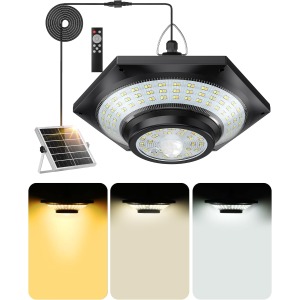
4000LM with a 360° light distribution and three colour temperatures in one unit. The 360° emission angle means the light spreads in all directions rather than pointing down like a traditional pendant, which is particularly useful for a shed with a workbench along one wall and storage along another. You get even coverage rather than a brighter centre and darker edges.
Three colour temperature options (warm white, neutral, cool white) let you choose the feel of the light for different tasks: warmer for casual storage and evening atmosphere, cooler and brighter for precision work. Five operating modes including two that work in daytime mean you can use it like a standard light fixture without waiting for dusk. The 16.4ft cable gives reasonable placement flexibility.
At £26.99, it represents good value for the feature count. The brand has less of a track record than the CLAONER or APILAB, and the 4.3-star rating is the lowest in the top half of this guide, so there’s slightly more uncertainty about long-term reliability. But the specification-to-price ratio is hard to argue with if maximum output is the priority.
Features
- 4000LM with 360° omnidirectional light distribution
- Three colour temperatures: warm white, neutral, cool white
- 5 modes including 2 daytime-available modes
- PIR motion sensor with night-only and all-day options
- 16.4ft panel-to-light cable, IP65 rated
- Remote control included
- 4000LM is the highest output in this guide
- 360° spread gives even coverage across a whole shed interior
- Three colour temps give genuine flexibility for different activities
- Less-established brand with fewer long-term customer reviews
- 4.3 stars is the lowest rating in the top half of this guide
- No pull cord — depends on remote or motion activation only
5. FabStyl Solar Shed Light with Pull Cord and E27 Bulb
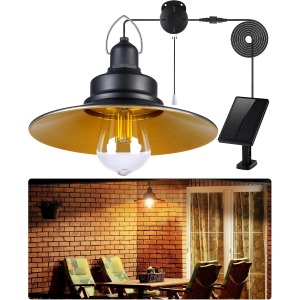
The FabStyl takes a different approach to the rest of the guide: it uses a traditional E27-style warm white incandescent-look bulb rather than a panel of LEDs. The result is a softer, warmer light with a more domestic feel, which suits storage sheds, garden rooms, and summer houses where you want illumination without it feeling like a garage. It’s not bright enough for workshop tasks, but that’s not what it’s designed for.
Pull cord control with two brightness levels keeps operation simple. The aluminium housing is well-built for the price, and the 16.5ft cable between solar panel and light gives good placement flexibility. IP65 weatherproofing is solid for UK conditions. At £27.99, it’s a practical choice for casual use in a storage shed or garden room where appearance matters as much as output.
Features
- Traditional E27 warm white bulb with retro aesthetic
- Pull cord with two brightness levels
- 16.5ft panel cable for flexible mounting
- High-quality aluminium construction
- IP65 waterproof rating
- Up to 10 hours per full charge
- Warm retro aesthetic suits garden rooms and summer houses
- Aluminium build quality is above its price point
- Simple two-setting pull cord: nothing to lose or program
- Not bright enough for hobby work or workshop use
- Only two brightness settings with no auto dusk-to-dawn mode
- E27 bulb style is less energy-efficient than modern LED panels
6. intelamp Solar Pendant Light 4000mAh with 5M Cable
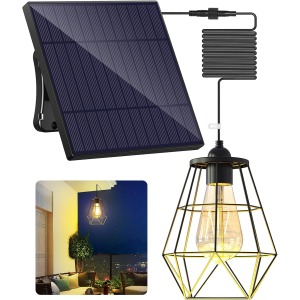
The intelamp is the decorative option in this guide. An octagonal diamond lantern frame crafted from anti-rust low-carbon steel, 300 lumens of warm white light, and a smart adaptive dimming system that reduces brightness automatically as the battery depletes rather than switching off abruptly. It charges fully in about 7 hours of direct sun and claims up to 36 hours runtime on a full charge — significantly more than most competitors, thanks to the efficient 300lm output.
The 5-metre (16.4ft) waterproof split cable and IP65 rating work the same way as the other lights. But this one is clearly designed for garden rooms, gazebos, and decorative spaces rather than working sheds. The lantern design projects attractive light patterns and suits timber-framed outbuildings and summer houses well. It’s not a practical task light and shouldn’t be bought with that expectation.
Worth considering if you want a solar light that looks good in a garden room or outdoor entertaining space. For a functional workshop or storage shed, the CLAONER or APILAB serve you better.
Features
- Octagonal diamond lantern frame in anti-rust steel
- 4000mAh battery with up to 36-hour runtime at 300lm
- Smart adaptive dimming prevents abrupt shutdown
- 5-metre (16.4ft) waterproof split cable, IP65 rated
- Timer adjustment function
- 17.6% solar panel conversion efficiency
- 36-hour claimed runtime: the longest in this guide
- Smart dimming prevents sudden shutdown as battery depletes
- Attractive lantern design for decorative or social spaces
- Only 300lm: not suitable for workshop or task work
- Decorative style won’t suit practical shed environments
- Auto operation only — no pull cord or remote control
7. Solar Shed Light 6500K Day and Night Use
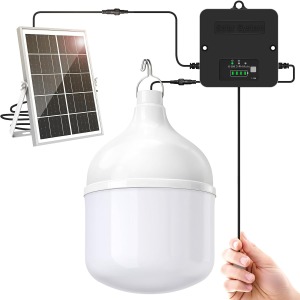
The 6500K daylight colour temperature is the distinguishing feature here. Most solar shed lights run at 2700-3000K warm white. This one matches natural daylight more closely, which matters if you’re doing colour-sensitive work — painting, woodwork finishing, checking fabric colours, or any task where accurate colour rendering matters. Under a 6500K source, colours look the same as they do in daylight. Under warm white they shift warmer.
The 150% boost mode (three-pull activation) provides extra intensity when you need maximum brightness for a short period. Three modes including 14-hour dusk-to-dawn auto cover routine use well. At £23.99, it’s the best-value option in this guide. The one genuine limitation is that the cool white tone won’t suit relaxation spaces or decorative use — for casual evening shed visits, warm white feels more comfortable.
Features
- 6500K cool daylight colour temperature
- 150% boost brightness mode for maximum short-burst output
- 3 modes: 100% brightness (6-8hr), 150% boost (3-4hr), auto dusk-to-dawn (14hr)
- Pull cord with battery and mode indicator lights
- IP65 waterproof solar panel
- 360° diffused lighting angle
- 6500K daylight tone is better for colour-accurate work
- 150% boost mode for extra brightness when needed
- Best value in this guide at under £24
- Cool white tone not suited to relaxation or decorative use
- Power box is not waterproof and must stay sheltered
- Fewer customer reviews than most others in this guide
8. SolarCentre Beam Solar Shed Light
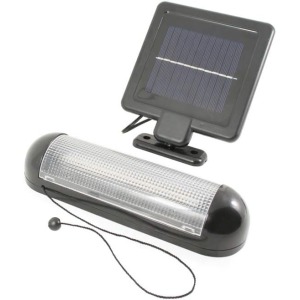
SolarCentre is a British solar lighting brand, and the Beam is their entry-level shed light. At 50 lumens, it’s significantly dimmer than everything else in this guide — this is storage-shed territory, not hobby or workshop use. But it does exactly what it says: provides enough light to find what you’re looking for in a dark shed, works through UK winter months, and installs in under 10 minutes using the supplied adhesive pads. No drilling, no fuss.
The honest limitation is the 2-metre cable between panel and light. That’s far shorter than the 5m-16.4ft cables on the other lights here, which gives much less flexibility for positioning the panel where it gets best sun. For a south-facing shed with good roof exposure, it works fine. For sheds that face away from the sun, the short cable becomes a genuine problem. The 12-month warranty and replaceable components — you can swap just the panel if it’s damaged by a storm — are worth noting for a UK-facing brand.
Features
- 50 lumens: suitable for storage use and basic navigation
- Pull cord control for daytime or night use
- 2-metre cable between panel and light
- Tool-free adhesive installation for the light head
- 12-month SolarCentre warranty with replaceable components
- Weatherproof solar panel for UK outdoor mounting
- UK brand with proper warranty and replaceable parts
- Tool-free installation in under 10 minutes
- Reliable for basic storage-shed use through UK winters
- 50 lumens: not usable for any task or hobby work
- 2-metre cable seriously limits panel positioning flexibility
- 4.0-star rating is the lowest in this guide
Solar Shed Light Buying Guide
Key Takeaways
- The defining feature of a solar shed light is a separate external panel connected by a cable — this allows the panel to face south whilst the light goes inside
- Measure the cable length you need before buying: most UK garden sheds need 5m (16.4ft); longer outbuildings need 10m+
- Lumen output by use case: 50-200lm for storage checks, 300-500lm for hobby and craft work, 1000lm+ for workshop tasks with power tools
- UK winter is the real test: a battery of 3,000mAh or larger handles the 3-4 overcast days common from November through February
- Pull cord control is more practical for shed use than a remote — remotes get lost and need batteries
- The power box on most solar shed lights is NOT weatherproof — it must stay inside the shed or in a completely sheltered location
Why the External Panel Is Non-Negotiable
A proper solar shed light has a solar panel outside (mounted on the shed roof or a fence post) connected by a cable to a light fitting inside the shed. This is fundamentally different from a standard solar garden light that has the panel built into the top of the fitting. The cable is what makes shed lighting possible: you position the panel where it gets the best sun — typically south-facing — and run the light to where you actually need illumination inside.
Any product described as a solar shed light should clearly state that the panel and light are separate units joined by cable. If a product doesn’t specify this, it’s likely just an outdoor security light that happens to have LED output and solar charging. All eight lights in this guide use the external panel design. The cable lengths in this guide range from 2 metres (SolarCentre) to 16.4ft plus a 9.8ft extension (APILAB).
Measuring Cable Length Before You Buy
The single most important specification to check before ordering is cable length. Walk around your shed with a tape measure before you buy. Measure from where you want the panel to sit on the roof or fence to where the cable will enter the shed wall, plus the distance inside to the light’s hanging point. Add half a metre for routing around corners and eaves.
A 3m cable covers small sheds where the panel mounts directly above or beside the cable entry point. A 5m cable (16.4ft) — the most common length in this guide — handles most standard UK garden shed installations with some routing flexibility. A 10m cable is needed when the panel needs to reach across a distance, such as when your shed faces north and the nearest south-facing surface is a fence or wall some metres away. Getting this wrong means either a cable that won’t reach or one with unnecessary coils — size up if you’re near the limit.
Lumen Tiers and What They Mean for Shed Use
50-200lm is the storage tier. The SolarCentre Beam at 50lm is at the low end of this range. This level is enough to navigate without tripping, find stored items, and check on the shed at night. It’s not enough for any sustained work — you’ll be squinting at anything that requires reading or precision.
300-500lm covers hobby and casual work. The intelamp at 300lm is at the lower end here. Potting plants, reading labels, light crafting, and sorting boxes are all manageable. It’s not sufficient for power tools or anything requiring consistent strong task lighting.
1000lm and above is what you need for a working shed. The CLAONER and APILAB at 2000LM, the 3200LM and 4000LM options — these provide genuine workshop-level illumination. If you’re doing woodwork, bike maintenance, model making, or any DIY that requires following plans and seeing detail clearly, this is the tier to aim for. Don’t buy a 50lm light and expect to do woodwork by it.
Battery Capacity and UK Winter Performance
UK November through February is the hardest test for any solar shed light. Days are short — 7-8 hours of daylight at best, often less with cloud cover — and low-angle sun means panels work at a fraction of summer capacity. Overcast spells of 3-4 consecutive days are routine in most of the UK, particularly in Scotland, Wales, and the north of England.
A 2,000mAh battery handles casual use through a UK winter with 2-3 overcast days between sunny intervals — adequate for a shed visited occasionally. A 3,000-4,000mAh battery bridges 4-5 overcast days more comfortably. The APILAB’s 12,000mAh is the standout for year-round resilience, handling the kind of extended January grey that depletes smaller systems. For lights that don’t publish battery capacity directly, use claimed runtime as a proxy: 14 hours of dusk-to-dawn auto means more reserve than 6 hours.
Pull Cord vs Remote vs Motion Sensor
A pull cord is the most practical control mechanism for shed environments. It works without batteries, doesn’t require line of sight, doesn’t get lost under a workbench, and still functions when your hands are dirty or gloved. For daily shed use, it’s the default recommendation. The CLAONER, APILAB, FabStyl, and 6500K models all use pull cord operation.
Remote controls are convenient for changing between modes without walking to the power box. They make the most sense on higher-output systems where switching between a full-brightness working mode and a lower-power mode during a session is genuinely useful. But remotes need line of sight, need occasional battery replacement, and do get misplaced. The 3200LM and 4000LM models include remotes alongside a button on the power box as backup.
Motion sensor mode is most useful on lights you don’t use every day. If your shed is primarily storage and you visit occasionally, motion-triggered activation is more battery-efficient than a dusk-to-dawn system running all night for no reason. The 20-second off delay on the 3200LM is a practical default — long enough to stay on whilst you’re moving around, short enough to conserve battery when the shed is empty.
IP Ratings and the Power Box Problem
The solar panel on every light in this guide is IP65 rated, covering sustained UK rain from any direction. The bulb or lamp unit is also typically IP65. But the power box — which contains the battery and control electronics — is generally not rated for outdoor exposure. On the CLAONER, APILAB, 3200LM, and most others, the power box must be inside the shed or in a completely sheltered, dry location.
In practice: drill or cut a small hole in the shed wall for the panel cable, route it through, and hang the power box on the interior shed wall. The panel weathers everything outside; the electronics stay protected inside. Only the SolarCentre Beam avoids this issue by integrating everything in a simpler fashion, but at the cost of the 2m cable limit and much lower output.
Quick Buyer Checklist
- Measure the cable run from panel position to light position — add 0.5m for corners and routing
- Check the panel cable length matches or exceeds your measurement before ordering
- Decide your lumen requirement: storage (50-200lm), hobby (300-500lm), or workshop (1000lm+)
- Confirm where the power box will be mounted and that it’s in a dry, sheltered location
- South-facing panel mount is optimal — check what’s available on or near your shed before choosing cable length
- Consider motion sensor mode for security use and battery conservation through UK winter
Case Study: Equipping a Workshop Shed in Leicestershire
Background
A property owner in Leicestershire had a 3m x 4m timber shed used as both storage and a weekend workshop for woodworking. The shed had no mains power connection, and running a cable from the house would require digging up a garden path. The goal was adequate task lighting for bench work without the cost and disruption of an electrical installation.
Project Overview
The shed faced south-west, so the roof had reasonable sun exposure through spring and summer. The main challenge was winter: the shed was used year-round, and a light that failed to charge adequately from October through February wasn’t a practical solution.
Implementation
They chose the APILAB dual lamp system for the main shed area. The panel mounted on the south-facing roof section, with both lamps hanging from the ceiling — one above the workbench, one above the storage wall. This gave consistent illumination across the whole shed interior from a single solar installation. Total installation time was under an hour without any electrical work or tools beyond a drill for the panel screws and a small hole in the shed wall for the cable.
Results
Through the first winter, the system provided reliable task lighting for weekend woodworking sessions without supplementation. The 12,000mAh battery survived a 5-day overcast period in January with around 30% remaining. The bench lamp ran in high-brightness mode during evening sessions and medium mode when less intensity was needed. The property owner noted the battery and mode indicators on the power box as particularly useful for managing run time through the shorter winter days.
Expert Insights From Our Solar Panel Installers About Solar Shed Lights
One of our senior solar panel installers with over 14 years of experience across residential and commercial solar projects offered this view: “The most common mistake with solar shed lights is buying something rated for summer performance and expecting it to behave the same in January. A system that claims 10 hours of runtime is quoting ideal summer conditions with a full charge. In December, with low sun angle and overcast days, cut that estimate significantly and you’ll be closer to reality. If your shed is used year-round and you need reliable winter lighting, buy double the battery capacity you think you need and look for a panel with at least a 5-metre cable so you can optimise its position independently of where the light hangs.”
Frequently Asked Questions
Do solar shed lights work in UK winter?
Yes, but with reduced performance from November through February. Lights with larger batteries (3,000mAh+) handle UK winter overcast periods better than those with smaller cells. The APILAB’s 12,000mAh battery is the standout for year-round reliability. Motion sensor mode also conserves battery during winter by only activating the light when someone enters the shed.
How long does the cable need to be for a solar shed light?
Measure the distance from where you want the panel mounted (ideally south-facing) to where the cable enters the shed, plus the distance inside to the light position. Most standard UK garden sheds work with a 5m (16.4ft) cable. Larger outbuildings or situations where the panel needs to reach a south-facing surface some distance away may need 10m. Always add a little for routing around corners and eaves.
How bright does a solar shed light need to be?
50-200lm is enough for storage use and basic navigation in the dark. 300-500lm covers hobby and craft work. 1000lm and above is what you need for workshop tasks involving power tools, reading technical plans, or working with fine detail. The CLAONER and APILAB at 2000LM, and the 3200LM and 4000LM options, all cover workshop needs.
Can I install a solar shed light myself?
Yes. That’s the primary advantage over a mains-powered installation. No electrician is needed and no Part P electrical notification is required. You mount the panel outside (screwed to the shed roof or a fence post), route the cable through a small hole in the shed wall, mount the power box inside the shed, and hang the light. Most installations take under an hour with basic tools.
Is the power box waterproof on solar shed lights?
Usually not. Most solar shed lights have a weatherproof solar panel and a weatherproof bulb unit, but the power box — which contains the battery and control circuitry — is not designed for outdoor exposure. Mount it inside the shed or in a completely sheltered, dry location. Route the panel cable through the shed wall and keep the power box on an interior shelf or wall mount.
Which direction should I face the solar panel?
South-facing is optimal in the UK, ideally tilted at 30-45 degrees from horizontal. South-west or south-east loses about 10-15% of peak output but still charges adequately for most uses. North-facing panels receive very limited direct sun in the UK and will underperform significantly, particularly in winter. The longer the cable, the more flexibility you have to position the panel on a south-facing surface even when the shed itself faces the wrong direction.
Do solar shed lights work if my shed has a north-facing roof?
They can, but you need to position the panel elsewhere. The split design of a solar shed light means you can mount the panel on a south-facing fence post, the south-facing wall of the house, or any other exposed surface — even if the shed roof itself faces north. Use the longest available cable and mount the panel wherever it gets the best direct sun exposure through the day.
How long do solar shed lights last?
The LED components in quality solar lights are rated for 25,000-50,000 hours, effectively lasting the life of the product. The battery is what degrades first. NiMH batteries typically show noticeable capacity reduction after 2-3 years. LiFePO4 batteries last 5-8 years before significant degradation. Products from brands like SolarCentre offer replaceable components, so you can swap the battery or panel rather than replacing the whole system when capacity eventually drops.
Summing Up
For most UK shed owners, the CLAONER 2000LM is the best value starting point: reliable pull cord control, useful battery indicators, generous cabling, and enough brightness for hobby and moderate task work. If you need two areas lit from one system or UK winter performance is a priority, the APILAB dual lamp is worth the extra cost. For a proper workshop shed where task lighting matters, the 3200LM motion sensor or 4000LM 360° remote options get the output right. The SolarCentre Beam at the budget end does what it says — 50 lumens for storage use, backed by a UK warranty you can actually call.
Updated