
For most UK gardens and driveways, the Ring Solar Stick Up Cam is the solar security camera to start with. It combines genuinely easy installation, reliable connectivity in the Ring ecosystem, and a solar panel that keeps it charged without any wiring whatsoever. For property owners who want something that simply works without subscription juggling or technical configuration, it’s the default recommendation.
That said, the solar security camera market has expanded considerably. Whether you need 4G LTE connectivity for a remote outbuilding, a subscription-free solution with local storage, or a pan-tilt-zoom camera covering a wide outdoor area, there are strong options at every level. This guide covers eight of the best available on Amazon.co.uk right now, with an honest assessment of what each one actually delivers in UK conditions.
Our Top Picks
| Image | Name | |
|---|---|---|
| Ring Solar Stick Up Cam | |
| Ring Outdoor Camera Plus Solar | |
| eufy eufyCam C37 Solar 2-Cam Kit | |
| Xega 4G LTE Solar Camera | |
| Xega 4G LTE 24/7 Solar Camera | |
| ieGeek 2K PTZ Solar Security Camera | |
| Tical 4MP Solar Security Camera | |
| PESAIR 2K Solar Camera (2-Pack) |
8 Best Solar Security Cameras
1. Ring Solar Stick Up Cam
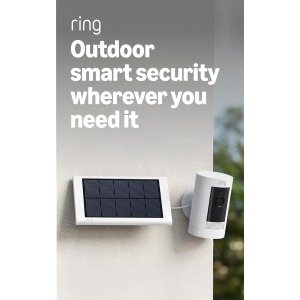
The Ring Solar Stick Up Cam earns its position at the top through sheer ease of use. Installation takes under 30 minutes for most users: mount the bracket, connect the solar panel cable, and follow the Ring app through configuration. Once set up, the solar panel keeps the camera charged indefinitely during UK spring through autumn, and the battery acts as a buffer during extended overcast periods or winter.
Ring’s integration with Alexa is a genuine advantage for households already in that ecosystem. Motion notifications, live view, and two-way talk work reliably, and the Ring app is mature and consistently well-supported. The 1080p HD video quality is clear enough for identifying faces and vehicles at typical distances from a front door, gate, or garden perimeter.
The honest limitation is the Ring subscription model. Without a Ring Protect plan (starting at £4/month), you get live view and instant alerts but no video history. For most users the Basic plan is sufficient, but it’s an ongoing cost that some competitors avoid entirely. That cost is worth factoring into the total ownership price before deciding.
In UK winter, the solar charging panel may not fully maintain charge during extended overcast spells lasting more than a week. The battery is substantial enough to handle several days of low sun without issue, and most Ring owners find that even a few hours of partial cloud-filtered sun every couple of days keeps the system running through November and December without intervention.
Features
- Solar-powered with integrated panel cable connection
- 1080p HD video with night vision
- Two-way talk and live view via Ring app
- Works with Alexa and Ring ecosystem
- PIR motion detection with customisable zones
- Weatherproof design for UK outdoor use
- Straightforward installation: no wiring required
- Strong Ring app and Alexa integration
- Solar keeps it charged through most of the UK year
- Good night vision clarity for a consumer camera
- Ring Protect subscription needed for video history
- 2.4GHz WiFi only: weaker at range than 5GHz
- Winter charging can fall short in northern UK regions
2. Ring Outdoor Camera Plus Solar
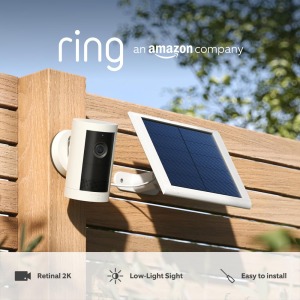
The Ring Outdoor Camera Plus Solar steps up from the Stick Up Cam with improved resolution and a wider field of view designed specifically for outdoor perimeter coverage. The head-to-toe framing captures a taller slice of the scene, which is particularly useful on driveways or paths where you want to capture the full height of a person rather than cutting off at the chest.
Where the Plus earns its extra cost is in image quality at range. Details that soften in the standard Stick Up Cam remain clearer at 5 to 10 metres, which matters for identifying visitors at a garden gate or reading a vehicle registration plate near a driveway. The solar charging setup is otherwise identical to the Stick Up Cam, with the same battery buffer and similar UK winter behaviour.
This is the Ring camera to choose if the standard Stick Up Cam feels adequate but you find yourself wishing for sharper resolution at range. The same Ring subscription caveat applies, and for users who don’t need the resolution upgrade, the Stick Up Cam is the better value starting point.
Features
- Enhanced resolution with head-to-toe field of view
- Solar powered with Ring Stick Up mount compatibility
- Two-way talk and live view via Ring app
- Alexa compatible
- Weatherproof design for permanent outdoor installation
- Improved resolution and taller framing vs Stick Up Cam
- Same reliable Ring ecosystem and app
- Solar panel included in the box
- Ring Protect subscription still required for video history
- Higher price than Stick Up Cam for marginal everyday improvement
- No 5GHz WiFi support
3. eufy eufyCam C37 Solar 2-Cam Kit
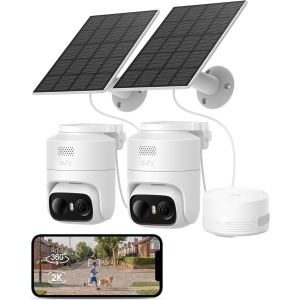
The eufy eufyCam C37 Solar Kit is the strongest subscription-free option in this roundup. The kit includes two cameras and a HomeBase 3 hub with 16GB of onboard storage, which means footage saves locally without any ongoing monthly fees. For anyone who balked at Ring’s subscription requirement, this is the most capable alternative at a comparable price point.
Video quality at 2K is a step above the Ring Stick Up Cam’s 1080p, and eufy’s AI detection does a better job distinguishing between people, animals, and vehicles than basic PIR alternatives. False alarm rates are lower as a result, which matters significantly if your camera overlooks a garden path used by both people and pets.
The two-camera configuration gives better whole-property coverage out of the box. Installing two cameras on the Ring system at a comparable coverage level adds up faster once subscription costs are included. The kit’s value case is strong for anyone planning to cover more than one area from the outset.
The trade-off is ecosystem dependency of a different kind: you’re tied to the HomeBase hub, which needs mains power and a wired internet connection. The cameras themselves are wireless and solar-charged, but the system as a whole isn’t entirely infrastructure-free the way a standalone camera is. For most home installations this isn’t an issue, but it’s worth noting for more remote setups.
Features
- 2-camera kit with HomeBase 3 hub included
- 2K video with AI person, vehicle, and animal detection
- 16GB local storage included: no monthly subscription required
- Solar-powered cameras with integrated panels
- Two-way talk and motion alerts via eufy app
- Works with Alexa and Google Home
- No monthly subscription: local storage included
- 2K resolution with accurate AI detection
- Two cameras provide better coverage than single-camera setups
- Works with Alexa and Google Home
- Requires HomeBase hub: not completely infrastructure-free
- Higher upfront cost than a single camera
- Cloud storage backup is a paid add-on
4. Xega 4G LTE Solar Camera (No WiFi Required)
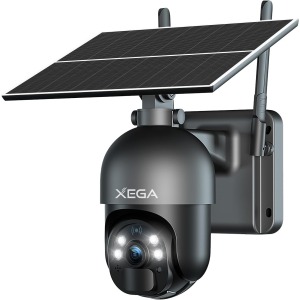
The Xega 4G LTE camera fills a genuinely different niche to the WiFi cameras above. If you’re covering a remote outbuilding, a driveway gate 80 metres from the house, or agricultural land with no broadband connection nearby, 4G LTE connectivity removes the fundamental constraint that makes most security cameras impractical in these locations.
You supply a standard nano SIM (not included), and the camera connects directly to the mobile network with no router or hub required. Data usage for motion-triggered clips is typically modest, and a data-only SIM from a UK network on a monthly rolling contract is straightforward to set up. The 2K Super HD resolution is sharp enough for identifying faces and registration plates in clear conditions, and the PIR detection is responsive without being overly trigger-happy.
Night vision quality is adequate rather than outstanding. In total darkness, the IR illumination covers a reasonable distance, but colour night vision is the more useful mode for distinguishing clothing and vehicle colours in dawn and dusk conditions. That’s typical of cameras at this price point and not a specific weakness of the Xega.
Features
- 4G LTE connectivity via nano SIM (SIM not included)
- 2K Super HD resolution
- Solar powered with integrated panel
- PIR motion detection with two-way audio
- IR and colour night vision modes
- IP66 weatherproof rating
- Works without any WiFi: ideal for remote or outbuilding locations
- 2K resolution sharp in daylight conditions
- Solar powered: no mains connection needed at the camera
- IP66 for robust UK outdoor use
- Ongoing SIM data cost adds to running expenses
- 4G coverage required: check signal at location before buying
- Night vision clarity lags behind cameras with larger sensors
5. Xega 4G LTE Solar Camera with 24/7 Continuous Recording
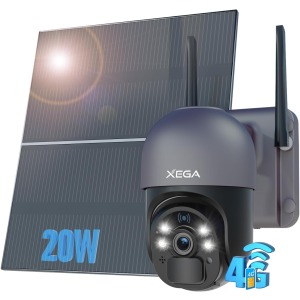
This is the serious power option in the lineup. Where most solar security cameras use motion-triggered recording to conserve battery, this Xega model supports 24/7 continuous recording by pairing a 20W solar panel with a 20,000mAh battery. In UK conditions through spring and summer, the system generates enough solar energy to sustain round-the-clock recording without depleting the battery, giving you genuine CCTV-style continuous coverage from an entirely off-grid setup.
The 20W panel is substantially larger than the panels on other cameras in this guide. It needs more space and a position with clear sky exposure, but in return it provides a charging headroom that keeps the system running through the kinds of extended overcast spells a UK winter can produce. The 20,000mAh battery provides several days of continuous recording reserve even with no solar input at all.
4G LTE connectivity means it shares the same remote-location advantage as the standard Xega model. For high-security commercial properties, agricultural sites, or construction plots needing 24/7 coverage without any mains infrastructure, this is a serious piece of kit at a fraction of the cost of a hardwired CCTV system.
Features
- 20W solar panel with 20,000mAh battery for 24/7 continuous recording
- 4G LTE connectivity via SIM card (not included)
- 2K HD resolution with colour night vision
- IP66 weatherproof rating
- PIR motion detection with instant alerts
- Two-way audio
- 24/7 continuous recording: not just motion-triggered clips
- 20W panel and 20,000mAh battery handles UK winter overcast
- No WiFi needed: works anywhere with 4G coverage
- Larger panel requires more installation space and planning
- Higher price reflects the serious power and storage setup
- SIM data costs for 24/7 recording are significantly higher than motion-only
6. ieGeek 2K PTZ Solar Security Camera
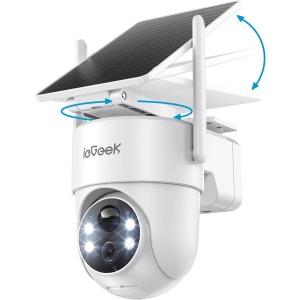
The ieGeek PTZ camera adds pan-tilt-zoom functionality to the solar security camera lineup. Instead of a fixed field of view, you can remotely control the camera’s direction via the app, rotating horizontally and tilting vertically to track movement or check different areas of your garden or driveway. For covering a large outdoor space with a single camera, PTZ capability is significantly more versatile than any fixed camera.
The removable solar panel is a practical design choice. You mount the camera body and position the solar panel separately, optimising the panel’s orientation for maximum sun exposure regardless of where the camera itself needs to face. In gardens where the best camera position faces north or east, this separation eliminates the solar charging compromise that fixed-panel cameras impose.
The Alexa integration works for voice-triggered live view, and the 2K/3MP resolution provides good image quality for a PTZ camera at this price. PTZ cameras at the consumer end of the market sometimes have slower motors or imprecise movement. The ieGeek is adequate for home use, though it doesn’t match the response speed of higher-priced commercial PTZ units.
Features
- 360 degree pan and tilt with remote app control
- 2K/3MP resolution with colour night vision
- Removable solar panel: position independently from camera body
- IP65 weatherproof rating
- PIR motion detection with smart alerts
- Works with Alexa voice control
- PTZ covers wide areas without needing multiple cameras
- Removable panel solves the solar-vs-camera direction trade-off
- Alexa compatible for voice-triggered live view
- PTZ motor response slower than higher-end commercial units
- IP65 rather than IP66: not the highest weatherproofing rating
- Requires WiFi: no 4G option for remote locations
7. Tical 4MP Solar Security Camera
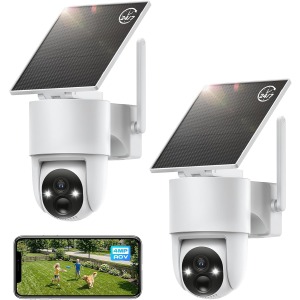
The Tical 4MP camera offers the highest resolution in this roundup, providing noticeably sharper images than 2K cameras when viewing footage on a larger screen or cropping into a frame to identify details. The 360 degree coverage combined with AI human and vehicle detection makes it a capable all-round garden security camera without the complexity of a PTZ motor.
WiFi-only connectivity and a 2.4GHz-only band limit its usefulness in congested wireless environments or at range from the router. For most residential applications where the camera is within 20 metres of the access point, this isn’t a problem. But for outbuildings or locations at the edge of WiFi range, signal stability can become an issue that the Xega 4G cameras avoid entirely.
It’s a competent camera for the price, but the brand has less of a track record in the UK market than Ring or eufy. There’s less long-term data on reliability, and the app experience is less mature. Worth considering if resolution is your primary priority and you’re comfortable with a less established ecosystem.
Features
- 4MP resolution: highest in this roundup
- 360 degree coverage with AI human and vehicle detection
- Solar powered with integrated panel
- 2.4GHz WiFi connectivity
- IP66 weatherproof rating
- Colour night vision
- 4MP is the sharpest resolution in this guide
- AI detection reduces false alarms from animals and foliage movement
- IP66 weatherproofing handles UK conditions well
- 2.4GHz WiFi only: weaker at distance than dual-band alternatives
- Less established brand than Ring or eufy in the UK market
- No 4G option for locations without WiFi
8. PESAIR 2K Solar Security Camera (2-Pack)
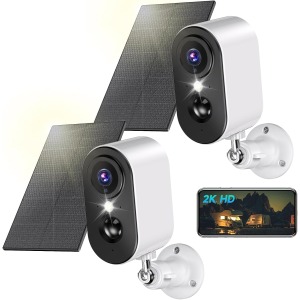
The PESAIR 2-pack is the most straightforward value proposition in this guide: two solar-powered 2K cameras at a price that makes multi-camera coverage genuinely affordable. If your goal is covering both a front door and a rear garden without spending significantly more than a single premium camera costs, this pair delivers a reasonable standard at a practical price.
Build quality and image quality are adequate rather than impressive. The IP66 rating is solid for UK outdoor use, and the colour night vision captures usable footage in low-light conditions around a porch or driveway. But both cameras are noticeably behind the Ring or eufy options in terms of clarity at range and detection accuracy. Expect more false triggers from passing animals or foliage movement than the smarter systems above deliver.
Features
- 2-pack: two cameras for multi-location coverage
- 2K resolution with colour night vision
- Solar powered with integrated panels
- PIR motion detection with instant alerts
- IP66 weatherproof rating
- 2.4GHz WiFi connectivity
- Two cameras at an entry-level price: good value for coverage
- IP66 rating for reliable UK outdoor use
- 2K resolution adequate for basic monitoring tasks
- Detection accuracy lags behind AI-powered alternatives
- Image quality at range softer than the premium options
- Limited long-term reliability data as a newer brand
Solar Security Camera Buying Guide
Key Takeaways
- For most UK homes with WiFi coverage, the Ring Solar Stick Up Cam or eufy eufyCam C37 kit cover the vast majority of needs without specialist configuration
- 4G LTE cameras (Xega range) are the right choice for remote locations, outbuildings, or any position without reliable WiFi
- Subscription-free local storage (eufy) is more economical over three to five years than subscription-dependent cloud storage (Ring)
- Resolution matters most for identification at range: 2K is the practical minimum for reading registration plates at 5 metres
- Separate solar panels (ieGeek design) solve the direction conflict between optimal camera angle and optimal sun exposure
- IP66 is adequate for UK outdoor use; IP67 adds submersion protection that most wall-mounted cameras don’t need
- UK winter performance depends primarily on solar panel wattage and battery capacity: larger is consistently better in both
WiFi vs 4G LTE Connectivity
The most fundamental decision in solar security cameras is connectivity. WiFi cameras require a router signal at the installation location. Most home WiFi reaches to about 20 to 30 metres in open conditions, less through walls and at angles. For front doors, garden walls, and driveways within range of the house, WiFi is simpler and cheaper to run.
4G LTE cameras use a mobile data SIM and connect to the cellular network regardless of WiFi infrastructure. They’re the only practical option for remote outbuildings, agricultural land, construction sites, and any location where running WiFi infrastructure to the camera would be complex or costly. The ongoing SIM data cost (typically £5 to £15/month depending on usage) is the trade-off against the installation simplicity.
Before buying a WiFi camera, check signal strength at the planned installation point with a WiFi analyser app on your phone. Unstable WiFi produces offline periods, missed motion events, and failed notifications. If the signal is marginal, a 4G camera is more reliable even if it costs more to run.
Solar Panel Wattage and Battery Sizing for UK Conditions
The solar panel on most consumer security cameras is small, typically 2 to 5 watts. This is adequate for motion-triggered recording during UK spring and summer, when even partial-cloud days provide enough charge to keep the battery topped up between motion events.
Problems arise in November through February. With 6 to 8 hours of low-angle winter sun on a clear day (and far fewer on typical overcast days), a 2W panel on a substantial battery takes considerably longer to recover from a day of heavy motion recording than it would in July. The practical result is that budget solar cameras with small panels may spend significant periods of a UK winter running on battery reserve alone, potentially depleting fully during extended overcast spells.
The Xega 24/7 model’s 20W panel addresses this directly. For critical security applications that must run reliably through winter, a camera with a larger dedicated solar panel and a higher-capacity battery is the proper solution.
Storage Options and Subscription Costs
Cloud storage with a monthly subscription is the Ring approach. You get video history for 30, 60, or 180 days depending on the tier, accessible anywhere via the app. The convenience is real, but the ongoing cost adds up: Ring Basic at £4/month is £48/year per camera, indefinitely.
Local storage with no subscription is the eufy approach. Video saves to the HomeBase hub’s onboard storage. No ongoing cost, but if someone steals the hub or a power event corrupts the drive, you lose footage. Combining local storage with optional paid cloud backup (which eufy supports) gives the best of both approaches.
SD card storage (supported by some cameras including the ieGeek and Tical) sits between the two: cheap and locally stored, but vulnerable if the camera itself is stolen or damaged. For cameras in exposed positions, cloud backup of critical event footage is worth having even if it means a subscription.
PTZ vs Fixed Cameras
Fixed cameras cover a single defined field of view. They’re simpler, cheaper, and have no moving parts to fail. For monitoring a doorway, a parking space, or a specific path, a fixed camera is the right tool: the covered area is consistent and the footage is always from the same angle.
PTZ cameras add pan, tilt, and sometimes zoom through motorised movement. They can cover a much larger area than a fixed camera, particularly useful for wide garden spaces or commercial car parks where a single fixed camera would leave blind spots. But the motor adds complexity, moving parts can fail over time, and lower-cost PTZ motors have slower response times that can mean the subject has moved before the camera finishes panning to track it.
PIR vs AI Detection
PIR (passive infrared) detection triggers on heat movement within the sensor’s field. It’s reliable and fast, but doesn’t distinguish between a person, a cat, a fox, or a branch blowing in the wind. In UK gardens with wildlife and foliage, PIR cameras often generate high volumes of false alerts overnight that condition users to ignore notifications entirely.
AI-based detection (used in the eufy and Tical cameras in this guide) uses image processing to classify detected objects. A trained model can distinguish a human shape, a vehicle, a pet, and background movement with reasonable accuracy. False alert rates drop significantly. For most users, the reduction in night-time false alerts is worth the upgrade in price.
IP Ratings for UK Conditions
IP65 means fully dust-proof and protected against water jets from any direction, which covers UK rain thoroughly. IP66 adds protection against more powerful water jets and is worth having in exposed coastal or highland positions where wind-driven rain is particularly forceful. IP67 means submersion up to 1 metre for 30 minutes, which is more than any wall-mounted camera needs but indicates a higher standard of sealing overall.
IP44 (appearing on some budget cameras not in this guide) means splash protection only. Avoid IP44 for year-round outdoor installation in the UK, particularly in Scotland, Wales, and northern England where sustained horizontal rain is common.
Common Buying Mistakes
Assuming WiFi coverage at the installation point. Check signal strength before buying a WiFi camera. A camera showing two bars of WiFi in the house may have no usable signal at the driveway gate 30 metres away.
Expecting subscription-free video history from Ring. Ring cameras work without a plan for live view and motion alerts, but you lose all video history. Most buyers discover this only after installation and then need to factor in an ongoing subscription cost they hadn’t planned for.
Overlooking the sun direction vs camera direction conflict. For cameras with integrated solar panels, the panel faces the same direction as the lens. A camera covering a north-facing front door may have very limited solar charging if the panel consequently faces north. A camera with a separate panel (like the ieGeek) or a 4G camera with a larger offset panel solves this.
Underestimating UK winter charging reduction. Solar panel output in December and January in the UK is typically 10 to 20 per cent of July output. A camera that charges easily in summer may run primarily on battery from November through February. Choose larger batteries and panels if reliable winter operation is a priority.
Buying a 2-pack when one camera with better detection would serve better. Two cameras with poor AI detection generate twice the false alerts of one good camera covering the same area intelligently. More cameras at a lower quality tier isn’t always better than fewer cameras at a higher quality tier.
Case Study: Securing a Rural Property in Lincolnshire
Background
A property owner in Lincolnshire had a converted farmhouse with a long driveway, an outbuilding used as a workshop, and a rear garden backing onto open countryside. Previous break-ins at similar rural properties in the area had made them want proper security coverage, but running mains cabling to the outbuilding and the driveway gate 150 metres from the house was impractical without significant groundworks.
Project Overview
The main challenge was the absence of WiFi signal at the outbuilding and driveway gate. The house had broadband, but at 150 metres through farm buildings and walls, no conventional WiFi extender solution was practical. The rear garden was within range of the house’s WiFi.
Implementation
They used a three-camera setup: the eufy eufyCam C37 2-cam kit covering the rear garden and the main house approach (both within WiFi range), and a Xega 4G LTE camera at the outbuilding on a dedicated data SIM. The eufy HomeBase was installed inside the house, providing local storage with no ongoing cloud costs for the two WiFi cameras. The Xega at the outbuilding ran on an £8/month rolling data SIM.
Results
All three cameras remained operational through the first UK winter without intervention. The eufy cameras handled the winter overcast well, with the HomeBase logging all motion events reliably. The Xega at the outbuilding had one period of approximately four days in late January where sustained heavy cloud reduced solar charging enough that the battery depleted to 20 per cent before a clearer day recovered it. The camera kept recording throughout. Total monthly running cost was £8 for the Xega SIM, with no subscription costs for the two eufy cameras.
Expert Insights From Our Solar Panel Installers About Solar Security Cameras
One of our senior solar panel installers with over 16 years of experience working with residential and commercial solar across the UK offered this view: “The question we get most often about solar security cameras is why they go offline in January. The answer is almost always panel sizing. Manufacturers rate these cameras under summer test conditions. A 3W panel that fully charges a 5,000mAh battery in July provides a fraction of that energy in a UK January. If you need reliable winter operation, double the panel wattage you think you need, and look for a battery with enough reserve to handle four to five overcast days without full recharge.”
Frequently Asked Questions
Do solar security cameras work in UK winter?
Yes, but with reduced charging performance from November through February. Standard solar security cameras with 2 to 5W panels may not maintain full charge through extended overcast periods in a UK winter. Most cameras have sufficient battery reserve to handle several cloudy days before depleting, but cameras with larger panels and batteries handle UK winter conditions significantly better. The Xega 24/7 model’s 20W panel is the standout in this guide for winter reliability.
Do I need a subscription for a solar security camera?
It depends on the camera. Ring cameras require a Ring Protect subscription (from £4/month) to access video history. Without it you still get live view and motion alerts but no recorded footage to review. eufy cameras store video locally on the HomeBase hub with no subscription required. Cameras with SD card storage also avoid subscriptions for local recording. If avoiding ongoing costs is a priority, choose a camera with local storage built in from the outset.
What is the best solar security camera for a remote location without WiFi?
A 4G LTE solar camera is the only practical option for locations without WiFi coverage. The Xega 4G LTE models in this guide connect via mobile data using a nano SIM card. You need 4G signal at the installation point, which you can verify with a phone signal check before purchasing. Data costs are typically £5 to £15 per month depending on recording volume and provider choice.
How long do solar security cameras last on battery without sun?
Most motion-triggered solar security cameras with typical battery sizes run for 3 to 7 days without any solar charging, depending on how frequently motion events trigger recording. Continuous recording cameras drain faster. The Xega 24/7 model’s 20,000mAh battery provides several days of continuous recording reserve without sun. If your installation faces extended UK winter overcast, choose a camera with the largest available battery and highest wattage solar panel.
Can I use a solar security camera on a north-facing wall?
You can mount the camera on a north-facing wall, but if it has an integrated solar panel facing the same direction, charging will be significantly reduced. In the UK, north-facing panels receive very limited direct sunlight throughout the year. The practical solutions are: choose a camera with a separately positionable solar panel (as the ieGeek offers), use a 4G camera with a larger offset panel that you position on a south-facing surface, or accept that a north-facing integrated panel will rely heavily on battery reserve and may underperform through winter.
What resolution do I need for a security camera?
2K (2560×1440 pixels) is the practical minimum for identifying faces at 3 to 5 metres or reading vehicle registration plates at typical driveway distances. 1080p HD is adequate for general monitoring and close-range identification but softens at distance. 4MP (the Tical camera in this guide) provides noticeably sharper detail when cropping into footage. For front door or close-range monitoring, 1080p is fine. For covering a wide driveway or garden where you need to zoom into details, 2K or higher is worth the upgrade.
Are solar security cameras legal in the UK?
Yes, with some conditions. UK law permits residential security cameras covering your own property. If the camera’s field of view captures a neighbour’s property, public space, or shared areas, you should consider registering with the Information Commissioner’s Office (ICO) under GDPR and inform people the area is monitored with a small sign. Pointing a camera directly into a neighbour’s private garden or windows is not permitted. Check the ICO guidance for full details on domestic CCTV use.
What IP rating do I need for a solar security camera in the UK?
IP65 is the minimum for reliable year-round UK outdoor use, covering sustained rain from all directions. IP66 adds protection against more powerful water jets and is preferred for exposed coastal, highland, or rooftop positions where wind-driven rain is a significant factor. IP67 (submersion protection) is more than most mounted cameras require but indicates a higher build standard overall. Avoid cameras rated IP44 or lower for year-round UK outdoor installation.
Summing Up
For most UK homeowners, the choice comes down to Ring versus eufy. The Ring Solar Stick Up Cam is the easier starting point: fast to install, reliable in its ecosystem, and well-supported. The eufy eufyCam C37 Solar Kit is the better long-term value choice for anyone who objects to ongoing subscription costs, offering 2K resolution, AI detection, and local storage without any monthly fees. For remote or off-grid locations without WiFi, the Xega 4G LTE cameras are the only options here that actually work reliably, and the 24/7 version with the 20W panel is genuinely impressive for continuous-coverage security without any mains infrastructure at all.
Whatever camera you choose, sort out the solar panel orientation before installation. In a UK garden where optimal camera angle and optimal sun angle rarely align perfectly, taking time to plan panel placement separately pays off in consistent charging performance throughout the year.
Updated