
If you want the most reliable flexible solar panel available on Amazon UK right now, the EcoFlow 100W Flexible Solar Panel is the one to buy. It carries IP68 waterproof certification, an ETFE film surface built to handle years of outdoor exposure, and 641 customer reviews sitting at 4.5 stars. For a flexible panel, that review count is exceptional, and the real-world feedback consistently praises its output consistency and build durability.
Flexible solar panels have changed enormously in the past few years. What was once a compromise product has become a serious option for motorhome owners, narrowboat enthusiasts, and anyone fitting panels to curved or irregular surfaces. The key is picking one with decent ETFE encapsulation rather than cheaper PET film, as this makes all the difference to longevity in the UK’s damp climate.
Our Top Picks
| Image | Name | |
|---|---|---|
| EcoFlow 100W Flexible Solar Panel IP68 waterproof ETFE flexible panel with 641 reviews. Our top pick for motorhomes, boats, and caravans. | |
| ECO-WORTHY 130W Flexible Solar Panel Best value pick at £82.99. 4.7 stars, 130W monocrystalline, ideal for caravans and motorhomes. | |
| Renogy 100W Semi-Flexible Solar Panel Reliable brand with 88 reviews. Semi-flexible fibreglass backing suits gentle curves on vehicle roofs. | |
| ECO-WORTHY 260W Flexible Solar Panel Highest wattage on this list. 4.7 stars, 260W monocrystalline for serious off-grid setups. | |
| ALLPOWERS SF200 200W Flexible Solar Panel 200W with IP68 and ETFE. For serious off-grid users who need high wattage in a flexible format. | |
| Renogy 200W Flexible Solar Panel 4.6 stars from 60 reviews. Renogy reliability at 200W for motorhomes, caravans, and boats. | |
| Technaxx 100W ETFE Flexible Solar Panel Highest rated at 4.9 stars. ETFE construction and strong early buyer feedback, though review count is limited. | |
| enjoysolar ETFE Semi-Flexible 50W Solar Panel Budget pick at under £52. ETFE surface at an affordable price for supplemental charging on smaller setups. |
8 Best Flexible Solar Panels
1. EcoFlow 100W Flexible Solar Panel
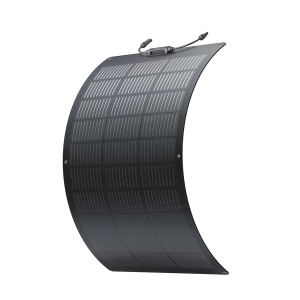
Of all the flexible panels on this list, the EcoFlow has the most robust real-world evidence behind it. With 641 reviews at 4.5 stars, buyers have tested it in conditions ranging from Scottish coastal cruising to Alpine motorhome trips, and the feedback is consistent: it delivers what it promises. The IP68 waterproof rating is proper submersion-level protection, not just splash-resistant, which matters on boats and in heavy UK downpours.
The ETFE film surface is a significant factor in longevity. Cheaper flexible panels use PET film, which degrades faster under UV exposure and moisture cycling. EcoFlow’s ETFE encapsulation is far more durable, and given the UK climate, this is worth paying for. The panel is rated at 100W with monocrystalline cells delivering strong output even in lower light conditions.
Installation is straightforward. The panel comes with pre-drilled holes around the perimeter and includes an MC4 connector with a 1.5-metre cable. It bends up to 248 degrees, covering most curved roof and hull profiles without issue. At £109.00, it sits at mid-range pricing for a quality flexible panel, and the combination of output, durability, and review depth makes it the clear top pick.
Weight is around 1.8kg, which is lighter than most rigid alternatives of similar wattage. For applications where every kilogram matters, this is a practical advantage alongside the obvious space-saving benefits of going flexible.
Features
- 100W monocrystalline solar cells
- IP68 waterproof certification
- ETFE film surface for UV and moisture resistance
- Bends up to 248 degrees
- MC4 connector with 1.5m cable included
- Pre-drilled mounting holes
- Highest review count on the list (641), most proven in real use
- IP68 waterproofing is genuinely robust
- ETFE film offers superior longevity over PET alternatives
- Lightweight at around 1.8kg
- 100W may not be enough for high-demand setups
- Cable length (1.5m) may need extending for some installations
2. ECO-WORTHY 130W Flexible Solar Panel
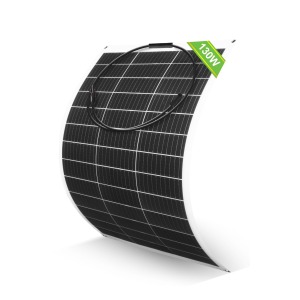
The ECO-WORTHY 130W sits at a very competitive £82.99 for a flexible panel that delivers noticeably more wattage than most 100W options at a similar or lower price point. It’s rated 4.7 stars from 69 reviews, which is a solid score for a newer product in this category. If you want maximum output per pound spent, this is a hard panel to argue against.
ECO-WORTHY have put a lot into their flexible panel range over the past couple of years, and it shows in the specification here. The monocrystalline cells offer good low-light performance, and the 12V output makes it straightforward to integrate with standard leisure battery setups found in caravans and motorhomes. The flexible body handles curves up to 30 degrees, covering most vehicle roof profiles comfortably.
At this price with this wattage, it’s the best-value option on the list for anyone prioritising output over brand prestige. The 69 reviews aren’t as deep as EcoFlow’s numbers, but the 4.7-star rating suggests buyers are consistently pleased.
Features
- 130W monocrystalline cells
- 12V output for standard leisure battery compatibility
- Flexible body, bends up to 30 degrees
- Lightweight design for vehicle roof mounting
- Pre-installed grommets for straightforward fitting
- Compatible with standard MC4 connectors
- 130W at under £85, excellent watt-per-pound value
- 4.7-star rating from genuine buyers
- Straightforward 12V compatibility
- Fewer reviews than top-tier brands
- 30-degree bend limit may not suit tighter curves
- No IP68 rating specified
3. Renogy 100W Semi-Flexible Monocrystalline Solar Panel
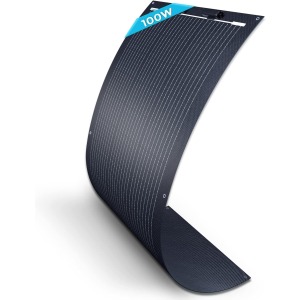
Renogy is one of the more established names in solar equipment, and their 100W semi-flexible panel at £80.99 is a reliable choice for buyers who want a known brand at a sensible price. The 4.4-star rating from 88 reviews reflects a solid, dependable product rather than an outstanding one. It does what it should, and Renogy’s after-sales support is generally regarded as responsive if issues arise.
The semi-flexible construction uses a fibreglass backing that provides structural integrity while still allowing a useful degree of flex. It suits rooftops and deck surfaces that need a panel to follow a gentle curve rather than lie perfectly flat. The monocrystalline cells perform well in partial shade, which is worth considering for UK conditions where dappled or overcast light is common.
At this price, the Renogy 100W is a trustworthy buy for anyone new to flexible panels. It won’t excite with its spec sheet, but it’s unlikely to disappoint either.
Features
- 100W monocrystalline cells
- Semi-flexible fibreglass backing
- High conversion efficiency cells
- Pre-drilled holes for surface mounting
- Bypass diodes to minimise power loss in shade
- Compatible with 12V or 24V battery systems
- Established brand with good customer support
- 88 reviews, solid evidence base for the price
- Affordable entry point at under £81
- 4.4 stars, competent but not exceptional
- Semi-flexible rather than fully flexible, less curvature range
- No IP68 waterproofing specified
4. ECO-WORTHY 260W Flexible Solar Panel
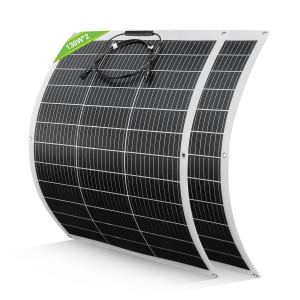
If raw power is the priority, the ECO-WORTHY 260W flexible panel is the most capable option in this bracket. At £145.99, it offers a substantial wattage increase over 100W panels without requiring a rigid frame, making it viable for larger motorhomes or narrow boats where roof space is available and weight still matters. The 4.7-star rating from 69 reviews is encouraging for a high-wattage flexible product.
The 260W output requires more surface area than a 100W panel, but for anyone with a large flat roof section or a rigid catamaran deck, the efficiency per installation footprint is compelling. ECO-WORTHY’s cells are monocrystalline throughout, giving this panel a meaningful output advantage over older polycrystalline flexible panels of similar physical dimensions.
This is the panel to consider if you’re running high-demand appliances off-grid, a small fridge, lighting, phone charging, and laptop use simultaneously, where a single 100W panel would leave you perpetually short.
Features
- 260W monocrystalline cells for maximum output
- 12V flexible design for curved surface mounting
- Suitable for larger off-grid systems
- Pre-installed grommets for mounting
- High efficiency monocrystalline technology
- Compatible with standard solar charge controllers
- Highest wattage flexible option on this list
- 4.7-star rating, well regarded by buyers
- Flexible design with serious output
- Larger physical footprint, needs more roof space
- 69 reviews, growing evidence base, not yet extensive
- Higher price point at £145.99
5. ALLPOWERS SF200 200W Flexible Solar Panel
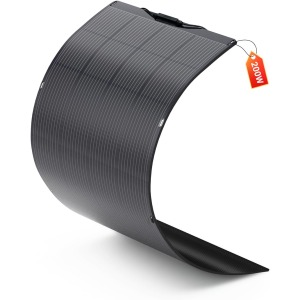
ALLPOWERS make portable and flexible solar products across a range of price points, and the SF200 200W sits towards the premium end of their flexible panel range. The IP68 waterproof rating and ETFE film construction put it on a par with the EcoFlow at the top of this list, but at 200W it delivers double the output at a higher price of £159.99. From 31 reviews at 4.3 stars, buyer sentiment is positive if not universally enthusiastic.
The SF200 is aimed at serious off-grid users who need 200W without the rigidity of a framed panel. It’s well suited to expedition vehicles, large boats, and fixed installations on curved substrates where output matters more than the lowest possible cost. The IP68 certification means it can be left fully exposed in any UK weather conditions without concern.
At 31 reviews, the evidence base is still building, and the 4.3-star average sits slightly lower than competitors. But for buyers who specifically need 200W in a flexible format with ETFE durability, it fills a genuine gap in the market.
Features
- 200W output from monocrystalline cells
- IP68 waterproof rating, full outdoor protection
- ETFE film surface for UV durability
- Flexible construction for curved surfaces
- High efficiency mono cells
- MC4 connectors for standard solar system integration
- 200W with both IP68 and ETFE, strong spec combination
- Suits serious off-grid applications
- ALLPOWERS is a recognised brand in portable solar
- Only 31 reviews, limited real-world feedback
- 4.3 stars is the lowest rating on this list
- £159.99 is a significant outlay for an unproven product
6. Renogy 200W Flexible Solar Panel
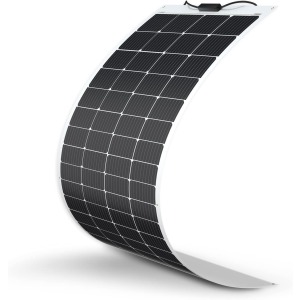
Renogy’s 200W flexible option brings the brand’s reliability credentials to higher wattage territory. At £179.99 with 60 reviews at 4.6 stars, it’s better rated than the ALLPOWERS 200W above, and Renogy’s longer UK market presence gives buyers additional confidence if things go wrong. It’s designed specifically for motorhomes, caravans, campers, and boats, so the use cases are well understood and documented.
The 200W output from a lightweight, flexible panel is genuinely useful for anyone running a proper off-grid setup. The monocrystalline cells maintain decent efficiency in the diffused light that characterises most of the British summer, and Renogy’s integration with common charge controllers and battery management systems makes setup relatively uncomplicated.
It’s the most expensive panel on this list, but Renogy’s track record and the 4.6-star rating justify the premium for buyers who prioritise brand accountability alongside output.
Features
- 200W monocrystalline flexible panel
- 12V lightweight design
- Suitable for motorhomes, caravans, campers, and boats
- Pre-drilled mounting holes
- Bypass diodes to reduce shading loss
- Compatible with standard Renogy and third-party charge controllers
- 4.6 stars from 60 reviews, well rated for a 200W flexible
- Renogy brand reliability and support
- 200W output from a lightweight, flexible profile
- Most expensive on the list at £179.99
- No IP68 rating, less protected than EcoFlow or ALLPOWERS
- 60 reviews is a decent base but not extensive for the price
7. Technaxx 100W ETFE Flexible Solar Panel
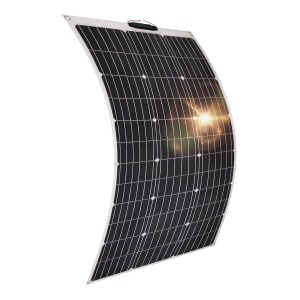
The Technaxx 100W has the highest star rating on this list at 4.9, but that figure comes from only 15 reviews. It’s worth including because those 15 reviews are uniformly positive, and the ETFE film construction at £129.99 positions it as a quality mid-range option. Those who have bought it report solid output and good build quality.
The catch is the low review volume. In a product category where durability over time is the key variable, 15 reviews doesn’t tell you enough about how these panels hold up after two or three UK winters. Worth a look, but approach with appropriate caution given the limited data.
Features
- 100W monocrystalline flexible panel
- ETFE film surface for UV protection
- Lightweight flexible design
- Pre-drilled mounting points
- MC4 connector included
- Highest star rating on the list (4.9)
- ETFE construction for durability
- Only 15 reviews, insufficient long-term data
- More expensive than better-reviewed 100W alternatives
- Less established brand in the UK market
8. enjoysolar ETFE Semi-Flexible Solar Panel 50W
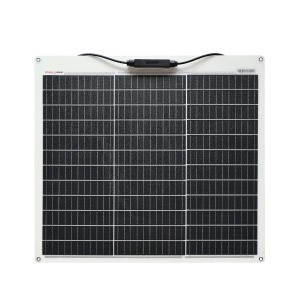
For smaller setups where budget is tight and 50W is genuinely all you need, the enjoysolar ETFE semi-flexible panel at £51.74 is worth a look. It’s the most affordable option here and carries 83 reviews at 4.2 stars. The ETFE surface is a positive differentiator at this price point, and the semi-flexible design fits curved surfaces adequately for most leisure vehicle roofs.
The 4.2-star average and budget price mean this is best suited to supplemental charging rather than as the primary power source for a serious off-grid system. If you’re topping up a leisure battery on a smaller caravan or day boat, it will serve that purpose without complaint.
Features
- 50W monocrystalline semi-flexible panel
- ETFE film surface
- Lightweight, thin profile
- Pre-drilled holes for surface mounting
- Standard MC4 connector
- Most affordable option at under £52
- ETFE surface at a budget price
- 83 reviews, reasonable evidence base
- Only 50W, not suitable for high-demand systems
- 4.2 stars, the lowest-rated panel on the list
- Semi-flexible rather than fully flexible
Flexible Solar Panels Buying Guide
Key Takeaways
- ETFE laminate (transparent front layer) is superior to PVC: better durability, higher light transmission, more UV stable. ETFE panels cost 15-25% more but last 5-10 years longer
- Flexible panels cannot be folded repeatedly without damage; they are bend-tolerant, not fold-tolerant. They suit permanent or semi-permanent mounting on curved surfaces, not portable use
- UK summer output peaks at 120-140 W/m² irradiance; winter output drops to 20-40 W/m². A 100W panel produces 100W only in peak summer sun. Plan for 60-70W average winter output
- Adhesive mounting (3M VHB tape or silicone) offers weatherproofing but makes removal very difficult. Mechanical fasteners (clamps, brackets) are reversible and suit rental vehicles or temporary installations
- Monocrystalline cells are standard; thin-film cells are obsolete for flexible panels. Check specifications: cells should be high-efficiency monocrystalline, not low-grade multi-crystalline
- Connector type affects usability: MC4 connectors are standard but weather poorly in salt air; Anderson PowerPole or SAE connectors are better for marine or damp environments
Laminate Type: ETFE vs PVC
The transparent layer bonded to the solar cells dramatically affects performance and durability.
| Attribute | ETFE (Ethylene Tetrafluoroethylene) | PVC (Polyvinyl Chloride) |
|---|---|---|
| Light transmission | 93-96% (maximum light to cells) | 88-91% (some light absorbed by PVC) |
| UV stability | Excellent. No yellowing over 20 years | Fair. Yellows after 5-7 years, reducing output 5-10% |
| Temperature coefficient | Lower (panel stays cooler, better output in heat) | Higher (panel runs hotter, output drops in summer heat) |
| Flexibility | Good bending tolerance, no cold-brittleness | Acceptable. Can crack if bent in cold weather |
| Durability | 25-30 year lifespan | 15-20 year lifespan |
| Cost | £1.50-2.00 per watt | £1.20-1.50 per watt |
| Common brands | Sunpower, SunPower Maxeon, Renogy Elite | Budget brands, Amazon-only panels |
For UK installations, ETFE is worth the premium. PVC panels work fine for three seasons (spring through autumn) but start yellowing in their fourth year. UK summers are mild and cloudy anyway, so PVC’s poor heat tolerance is not a major loss. However, the yellowing effect compounds with age. By year seven, a PVC panel produces 5-10% less output than when new, purely from laminate degradation. ETFE panels maintain 97-98% of their rated output after 20 years.
Buy ETFE if the panel is intended to stay mounted for more than five years. Buy PVC if you’re renting a vehicle or running a temporary installation you plan to move or remove.
Mounting Methods: Adhesive vs Mechanical
How a flexible panel attaches to the surface determines both weatherproofing and reversibility.
- Adhesive mounting (3M VHB or silicone sealant). Strongest weatherproofing. VHB tape creates an airtight seal around the entire panel perimeter, preventing water ingress under the panel. Adhesive bonding is permanent: attempting removal will damage the panel. Best for RVs, boats, and off-grid cabins where the installation is semi-permanent. The adhesive must be applied to a clean, dry surface (isopropyl alcohol wipe, then wait 24 hours). Cold weather (below 10°C) prevents proper adhesive curing.
- Mechanical fasteners (clamps, brackets, corner mounts). Non-permanent and reversible. Fasteners grip the panel at corners and edges, leaving the main surface unobstructed. Weatherproofing is good if gaskets are used under the fastener feet, but not as perfect as adhesive. Fasteners suit caravans being hired, boats not yet fully rewired, and temporary test installations. Mechanical fastening also allows for easy panel removal for inspection or cleaning underneath.
- Hybrid approach (adhesive edges plus screw corners). Some installers use VHB tape on the long edges for weatherproofing, then add stainless steel clamps at corners for mechanical security. This gives redundancy: if adhesive fails, the clamps hold the panel. If a clamp rusts, the adhesive still seals. This approach is ideal for long-term outdoor exposure.
For caravans and rented vehicles, avoid permanent adhesive. For boats and off-grid cabins, adhesive plus mechanical fasteners is the robust choice.
UK Seasonal Output Expectations
Flexible panels are rated at Standard Test Conditions (STC): 1000 W/m² irradiance, 25°C cell temperature. Real-world conditions are always lower.
| Season | Typical Irradiance (UK) | % of Rated Output | 100W Panel Produces | Daily Output (per 6 peak-sun-hours) |
|---|---|---|---|---|
| Summer (June-August) | 700-800 W/m² average | 85-95% | 85-95W | 510-570 Wh |
| Spring/Autumn (Mar-May, Sep-Nov) | 400-600 W/m² average | 50-70% | 50-70W | 300-420 Wh |
| Winter (Dec-Feb) | 150-300 W/m² average | 20-40% | 20-40W | 120-240 Wh |
Winter output is critically low in the UK. A 100W panel produces 20-40W in December and January. For off-grid caravans or boats relying on solar as the sole power source, plan for 2-3x the rated wattage to ensure winter functionality, or accept that you will need alternative charging (shore power, generator, or engine alternator) during the dark months.
Cell Type and Efficiency
Solar cells inside flexible panels fall into two camps.
- Monocrystalline silicon (high-efficiency). 18-22% cell efficiency. Standard for modern flexible panels. Recognisable by uniform black cells with distinct individual boundaries. All quality flexible panels use monocrystalline. These cells perform well in low-light conditions (UK cloudy days), which makes them ideal for British weather.
- Multi-crystalline silicon (lower efficiency). 15-17% cell efficiency. An older technology used in budget panels and now phased out. Recognisable by a speckled blue appearance (you can see individual crystals). Avoid multi-crystalline flexible panels: they are either old stock or low-cost imports with poor longevity.
- Thin-film (CIGS or CdTe). Once popular for flexible panels due to weight savings. Now obsolete. CIGS panels performed well in low light but were expensive. CdTe panels contained cadmium and had environmental concerns. Neither is commonly available in the UK anymore. If you encounter thin-film flexible panels in reviews, treat them as old product.
Check the product description or datasheet: it should say “monocrystalline” and specify efficiency (18-22%). If the product avoids mentioning cell type, contact the seller. Refusal to state cell type is a red flag indicating low-quality cells.
Connectors and Weatherproofing
How the panel connects to the outside world affects reliability.
- MC4 connectors. Industry standard for residential panels. Two-pin push connectors that are weatherproof when mated. Concern: MC4 terminals are bare copper and corrode in salt air or damp environments within 1-2 years. For caravans parked year-round in a damp UK climate or boats in salt spray, MC4 is not ideal.
- Anderson PowerPole connectors. Heavier-duty than MC4. Gold-plated contacts resist corrosion. Cost is higher but lifespan is longer (10+ years in damp conditions). Common in marine and RV off-grid systems.
- SAE connectors (2-pin automotive). Light-duty but simple and reliable. Older marine and RV standard. Still used on small camping panels (under 50W). Waterproofing is good when mated.
- Bare wire with junction box. Some budget flexible panels have bare wires exiting a junction box for hard-wiring to the charge controller. This means crimped terminals and no quick disconnect. Weatherproofing depends on the junction box design. Avoid if the box is plastic with exposed screw terminals.
For UK caravans in damp storage or boats in spray zones, choose Anderson PowerPole over MC4. The corrosion resistance justifies the cost and hassle of replacing connectors if needed.
Rigid Panel vs Flexible Panel: When Flexible Makes Sense
Flexible panels have legitimate use cases, but they are not a general replacement for rigid panels.
- Curved surfaces. Caravans with a curved roof, boats with a cabin trunk curve, campervan bus roofs with contours. Flexible panels conform (slightly) to these curves. Rigid panels cannot and would require custom frames.
- Weight savings. Flexible panels weigh 2-3 kg per 100W; rigid panels weigh 15-20 kg. For lightly-built structures (canvas boat dodgers, fabric tent frames), flexible is necessary to avoid overloading the structure.
- Aerodynamics. Rigid panels create windage. On a fast motorboat or truck, rigid panels increase fuel consumption. Flush-mounted flexible panels reduce drag.
- Portability within reason. A flexible panel can be rolled and stowed when underway (boats), bundled into a storage bag (camping), or temporarily removed (hired caravans). This portability is valuable for seasonal or temporary use.
- Aesthetics. Flexible panels lie flat and look sleeker. Rigid panels on a residential caravan look industrial. Some people prefer the subtle look of a flexible panel.
Flexible panels are not suitable for: backpacking (they bend and crease, not fold), portable charging on the move, or anywhere a rigid panel would fit and weigh is not a constraint. For a garden or shed, use rigid panels: they are cheaper, more durable, and perform slightly better.
Things to Keep in Mind Before Buying
- Size your system for winter, not summer. A 100W panel producing 20-40W in December is inadequate if your load exceeds 20W continuously. Size for 150-200W if winter output must meet 50W demand.
- Plan the cable run before mounting. Flexible panels are glued or clamped permanently. Running new cables after installation is disruptive. Route cables, test the system, then mount the panel.
- Use UV-resistant marine-grade cable (tinned copper, polyethylene or chlorinated polyethylene jacket). Standard automotive wiring degrades in sunlight within 2-3 years.
- Consider mounting angle. A panel mounted flat on a caravan roof loses 30-40% output compared to a 20-degree south-facing tilt (in the UK). Flexible panels on flat surfaces produce noticeably less than the same wattage on a tilted rigid mount.
- Check compatibility with your charge controller. MPPT controllers (Maximum Power Point Tracking) extract 15-20% more power from flexible panels than PWM controllers. If the panel is a key energy source, budget for an MPPT controller (£80-150).
- Plan for cleaning. Dust, bird droppings, and tree sap reduce output. Flexible panels mounted flat on caravans are harder to clean than panels on an angled mount. Rinse regularly with fresh water in summer.
- Warranty matters less than brand reputation. No warranty is useful if the manufacturer goes bankrupt. Buy from established brands (Renogy, Eco-Worthy, Sunwalk, Acopower) with reviews spanning 5+ years, not unknown Amazon-only sellers.
Case Study: Narrowboat Solar Upgrade on the Kennet and Avon Canal
Background
A narrowboat owner based in Berkshire had been relying on a small, ageing rigid panel bolted to the rear of the boat. The panel provided minimal supplemental charging and was poorly angled for most of the year. Running the engine to charge the leisure bank was eating into fuel costs and disrupting the quiet cruising experience. They wanted a proper flexible solar installation on the curved cabin roof.
Project Overview
The goal was to install two 100W flexible panels along the cabin roof, providing around 200W of combined capacity. The curved profile of the narrowboat roof ruled out rigid panels without significant and expensive mounting modifications. The property owner wanted a clean installation with no elevated mounts, minimal wind resistance, and enough output to run LED lighting, a 12V water pump, phone charging, and a small 12V refrigeration unit through a typical summer cruising day.
Implementation
Two EcoFlow 100W flexible panels were bonded to the cabin roof using a suitable adhesive sealant, following the panel’s installation guidelines. Wiring was routed along the gunwale and into the engine bay, connecting to an MPPT charge controller rated for the combined panel output. The existing leisure battery bank was upgraded at the same time to a 200Ah lithium setup to handle the increased charging capacity effectively.
Installation took a weekend, most of which was spent routing cables tidily rather than mounting the panels themselves. The flexible panels conformed to the roof profile without any cutting or modification.
Results
On a clear summer day on the canal, the two panels routinely achieved 150 to 180W of actual output, keeping the battery bank comfortably topped up without running the engine. On overcast days typical of a British summer, output dropped to 40 to 80W combined, which was enough to cover lighting and phone charging but required a short engine run to maintain the battery state ahead of evening use. The fuel savings over a full cruising season were significant, and the reduction in engine running hours noticeably extended the comfort of river mooring.
Expert Insights From Our Solar Panel Installers About Flexible Solar Panels
One of our senior solar panel installers with over 12 years of experience in off-grid and marine solar systems shared this perspective:
“Flexible panels have genuinely improved in quality over the past five years, and we’re now recommending them routinely for boat and motorhome installations where we’d previously have insisted on rigid panels. The key question we always ask is what the encapsulation material is. ETFE panels are the ones we’ll stand behind for long-term outdoor use. PET film panels, particularly the very cheap ones, can look fine on day one and be peeling and cracked within two years in a marine environment.
The other thing buyers often underestimate is the charge controller. A flexible panel is only as good as the system it’s connected to. A decent MPPT controller will extract significantly more energy from the same panel than a basic PWM type, particularly on the overcast days that dominate the UK calendar from October through March. If someone’s buying a quality flexible panel and then pairing it with a cheap controller, they’re leaving a lot of their investment on the table.”
Frequently Asked Questions
Can flexible solar panels be folded for transport?
No. Flexible panels are bend-tolerant but not fold-tolerant. A flexible panel can conform to a curved surface (cabin trunk, coach-roof) but cannot be repeatedly folded like a cloth without damaging the cells and wiring underneath. If you need a portable panel for camping, choose rigid panels on a foldable frame (two panels on a hinge) instead. Flexible panels suit permanent or semi-permanent mounting only.
What is the difference between ETFE and PVC flexible panel laminate?
ETFE (ethylene tetrafluoroethylene) transmits 93-96% of light to the cells and resists UV degradation for 20+ years. PVC transmits 88-91% of light and yellows within 5-7 years, reducing output by 5-10%. ETFE panels cost 15-25% more but last 10-15 years longer. For UK installations staying mounted beyond five years, ETFE is worth the premium. For temporary or rental vehicle installations, PVC is acceptable.
How much power does a flexible panel produce in UK winter?
A 100W rated flexible panel produces 20-40W average in UK winter (December-February) due to short daylight and low sun angle. Spring and autumn production is 50-70W. Summer production peaks at 85-95W. If your boat or caravan needs 50W continuous power in winter, size the system for 150W of flexible panels. Alternatively, accept winter power limitations and plan to anchor near shore power or use alternative charging methods seasonally.
Should I use adhesive or mechanical fasteners for flexible panel mounting?
Adhesive (3M VHB tape or silicone) provides superior weatherproofing but is permanent: removal damages the panel. Mechanical fasteners (clamps, brackets) are reversible and suit rental vehicles or temporary installations. Hybrid approach (adhesive on long edges plus corner clamps) combines weatherproofing redundancy with some reversibility. For caravans being hired or shared, use mechanical fasteners only. For personal boats and off-grid cabins, adhesive plus clamps is robust.
Can I use MC4 connectors on a boat with flexible panels?
MC4 connectors are standard on flexible panels but corrode rapidly in salt air within 1-2 years. For boats, replace MC4 connectors with Anderson PowerPole (marine-grade, gold-plated) or SAE (automotive) connectors. Replacement requires cutting panel wires and re-crimping to new connectors: a 15-minute task with the right tools. Cost is £10-20 for replacement connectors. If your boat will see salt air, budget for this connector upgrade as part of the installation.
How do monocrystalline and thin-film flexible panels differ?
Monocrystalline cells (18-22% efficiency) are standard in all modern flexible panels. They perform well in low-light conditions, making them ideal for UK cloudy weather. Thin-film cells (CIGS, CdTe) were used historically in flexible panels but are now obsolete. CIGS was expensive and uncommon. CdTe raised environmental concerns. Check the product datasheet: it should specify monocrystalline. If cell type is not mentioned, the seller is hiding information, indicating low-quality cells. Always buy monocrystalline flexible panels.
Is mounting angle important for flexible panels mounted flat on a caravan roof?
Yes. A flat-mounted flexible panel on a caravan roof produces 30-40% less output than the same panel mounted at a 20-30 degree south-facing tilt. If your caravan roof is flat, consider installing an adjustable mounting frame (£50-150) to tilt the panel toward the sun. Alternatively, accept reduced winter output and plan for longer charging times or supplemental power sources (shore power at caravan parks). Flat mounting is simpler and reduces wind resistance but costs efficiency.
Do I need an MPPT controller with flexible solar panels?
MPPT (Maximum Power Point Tracking) is recommended if the flexible panel is a key energy source. MPPT controllers extract 15-20% more power than PWM controllers by continuously optimising voltage. For a 100W flexible panel system, MPPT recovers 15-20W of extra power, equivalent to 90-120 Wh daily gain. Cost is £80-150. Payback period is 2-3 years. For small supplementary systems (30-50W), PWM is acceptable. For systems 150W+, MPPT is worth the investment.
Summing Up
Flexible solar panels have matured into a practical choice for any installation where a rigid panel simply won’t fit. The EcoFlow 100W leads this list on the strength of its IP68 certification, ETFE durability, and 641-strong review base. For best value, the ECO-WORTHY 130W delivers more wattage at a lower price than most rivals. And for the highest output in a flexible format, the ECO-WORTHY 260W or Renogy 200W cover serious off-grid power needs without requiring a rigid mounting system.
Whatever you choose, prioritise ETFE encapsulation over PET, pair your panel with a quality MPPT charge controller, and verify that the mounting surface is clean and structurally sound before installation. Get those fundamentals right, and a flexible panel will deliver years of reliable, low-maintenance power.
Updated