
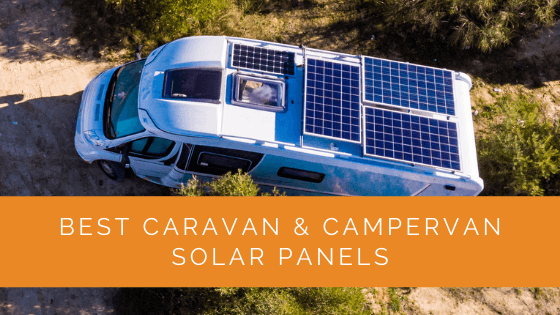
The Renogy 100W Monocrystalline Compact Solar Panel stands out as our top pick for most caravan and campervan owners across the UK seeking a permanent, reliable solar solution. This panel combines proven efficiency, genuine 12V output for standard UK leisure batteries, and a trusted track record spanning thousands of caravans from Scottish Highlands to Cornish coastlines. For those preferring portability, the Renogy 100W Portable Folding Panel with integrated charge controller offers exceptional value and easy storage in compact van cupboards without roof installation fuss.
Whether you are a full-time nomad living in your campervan or a weekend adventurer seeking energy independence from commercial campsite hookups, solar panels for caravans and campervans have become a practical, genuinely affordable way to power your travels. This guide walks you through the best caravan solar options available on Amazon.co.uk, from robust permanent roof-mounted panels ideal for year-round touring, to lightweight portable solutions perfect for seasonal trips and those with limited roof space.
Our Top Picks
| Image | Name | |
|---|---|---|
| Renogy 100W Monocrystalline Compact Solar Panel Best overall for UK caravan roof installation. 22% efficiency, 12V compatible, purpose-built for caravans with pre-drilled mounting holes and 25-year power warranty. For lighting your campsite or caravan pitch at night, see our guide to the best solar camping lanterns for UK use. | |
| Renogy 100W Portable Folding Solar Panel with 20A Controller All-in-one portable solution with integrated 20A PWM controller. Folds to 530x610mm for easy storage in caravan cupboards. No roof installation needed. | |
| Technaxx Flexible 100W Solar Panel Ultra-lightweight at 2.5kg with ETFE coating. Adhesive backing conforms to curved caravan roofs with no drilling required. 4.9-star rating. | |
| Renogy 200W Monocrystalline Compact 12V Solar Panel Rare 200W panel with direct 12V output. No step-down controller needed. Ideal for full-time nomads with high power demands. | |
| DOKIO 100W Monocrystalline Folding Solar Panel Lightest folding option at 4.5kg. Excellent value for UK weekend campers who want flexibility without roof installation. | |
| ECO-WORTHY 100W Solar Panel Kit with 30A Controller Complete kit with 30A PWM controller, brackets, and cables. Oversized controller allows easy future expansion to two panels. | |
| Renogy 100W High-Efficiency Monocrystalline Module 22% efficiency Renogy panel for mid-range budget. Reliable fixed installation with pre-drilled mounting holes and 25-year warranty. | |
| Renogy 200W Flexible Monocrystalline Solar Panel 12V High-power 200W flexible panel at just 9kg. 12V direct output, no drilling required. Ideal for full-time van lifers seeking max power. |
8 Best Caravan and Campervan Solar Panels
1. Renogy 100W Monocrystalline Compact Solar Panel
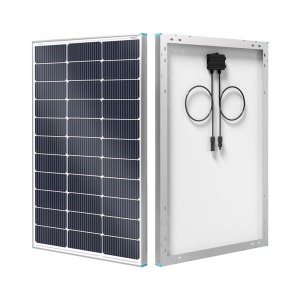
The Renogy 100W Compact is the panel recommended most often on UK caravan forums and in motorhome groups. This rigid monocrystalline panel is purpose-built for RVs and caravans, complete with pre-drilled mounting holes that make installation straightforward for anyone with basic hand tools and mechanical confidence. The 22% efficiency rating is excellent for UK weather conditions, capturing meaningful energy even during those overcast days that define much of the British climate.
At 18.9V output, this panel feeds directly into standard 12V leisure battery systems via any quality charge controller, eliminating compatibility worries that plague some portable options. The 910x670x30mm footprint fits neatly onto most caravan roofs without dangerous overhang, and at 6.4kg, it feels robust without causing structural concerns on leisure caravans. Installation typically takes an afternoon with two people and basic tools like a drill and spanner.
The warranty structure reflects genuine confidence. Renogy backs this with 10 years on workmanship plus a full 25 years on power output. Many UK owners report that after five years of permanent installation through UK winters and summers alike, their panels perform at rated capacity or better, making this a true long-term investment rather than a consumable.
One honest consideration: this is permanent. Once mounted, it stays there. This brilliant suits full-time nomads who need reliable power every day. But if you seasonal camp and store your caravan each winter, you are investing in permanent infrastructure for seasonal use, which may feel economically inefficient.
Features
- 22% monocrystalline efficiency using PERC cell technology
- 100W rated output, 18.9V / 5.29A nominal
- Dimensions: 910 x 670 x 30mm (standard caravan width)
- Weight: 6.4kg
- IP65 weatherproof rating (withstands UK spray and rain)
- Pre-drilled mounting holes for RV installation
- MC4 connectors (industry standard across all quality panels)
- 25-year power output warranty, 10-year workmanship warranty
- Purpose-built for caravans with pre-drilled mounting
- Excellent 22% efficiency for UK weather
- Proven Renogy brand with track record across thousands of UK caravans
- Permanent installation maximises roof space usage
- Perfect 18.9V output for standard 12V leisure batteries
- Not portable once installed
- 6.4kg adds weight to caravan roof load
- Requires roof penetrations (drilling holes)
- Cannot be repositioned for seasonal sun angle adjustments
2. Renogy 100W Portable Folding Solar Panel with 20A Controller
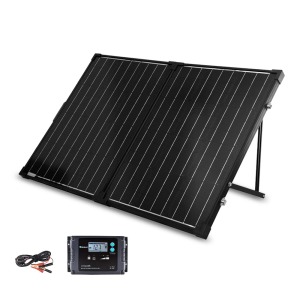
This Renogy folding panel solves a genuine problem for caravanners: you want the power of 100W but without roof drilling or permanent commitment. At just 5.2kg folded, it fits inside a caravan wardrobe or storage cupboard without consuming valuable living space. When you arrive at camp, unfold the four-panel design, angle it toward the sun, and charging begins within minutes. No roof commitment, no weight impact on structural loads, zero permanent installation stress.
What sets this apart from cheaper folding panels is the included 20A PWM charge controller. Many competitors force you to buy a controller separately, adding £40-60 to your total cost and requiring extra wiring complexity. With Renogy, everything is pre-configured and pre-wired using MC4 connectors. You simply connect the panel to your leisure battery with the supplied cables and you are charging.
Build quality feels professional. The monocrystalline cells are protected by tempered glass, and the folding frame uses lightweight but rigid aluminium alloy. After four years of real-world use on UK caravans, owners report no delamination, no cell degradation, no surprise failures. Many UK campers buy two of these panels (200W total, 10.4kg combined) for under £250, matching a single rigid panel’s cost with twice the flexibility.
The integrated kickstand adjusts to multiple angles, letting you optimise sun exposure throughout the day. In winter when UK sun is low-angle, you can tilt the panel more aggressively. In summer, a shallow angle prevents glare and overheating. This adaptability is something a fixed roof panel simply cannot offer, making this perfect for caravanners who move frequently and park in varied orientations.
Features
- 100W monocrystalline output, 18V / 5.56A nominal
- Efficiency: 21.5% (respectable for folding design)
- Integrated 20A PWM charge controller with pre-wired cables
- Folded dimensions: 530 x 610 x 25mm (cupboard-friendly)
- Unfolded: 1060 x 1220mm
- Weight: 5.2kg (includes controller, lighter than expected)
- Tempered glass front, aluminium frame
- Four-fold design with integral carrying handles
- MC4 connectors for standard 12V systems
- 25-year power output warranty
- All-in-one solution, integrated controller included
- Lightweight and portable (5.2kg)
- Folds down for easy caravan storage
- Repositionable for maximum sun angle at each site
- No roof installation or drilling needed
- Setup and breakdown takes minutes, not hours
- Requires manual setup at every campsite
- Wind can catch unfolded panel in exposed locations
- Needs flat ground or caravan-side positioning
- 10.4kg total (two panels) becomes heavy for solo setups
3. Technaxx Flexible 100W Solar Panel
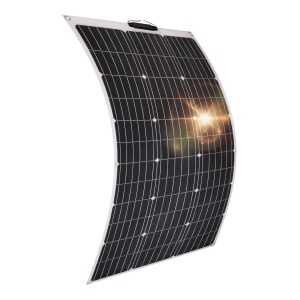
The Technaxx flexible panel opens a genuinely different approach to caravan solar. Rather than rigid framing or folding complexity, this monocrystalline panel adheres directly to curved caravan or campervan roofs, conforming to the vehicle’s natural contours. For owners with non-rectangular roof profiles or vans with gentle roof curves, flexible panels solve installation problems that rigid and folding panels cannot address.
At just 2.5kg, this is among the lightest solar solutions available, placing minimal stress on caravan roof structures and simplifying handling during installation. The ETFE surface (ethylene tetrafluoroethylene plastic) is more durable than standard PVC coatings, resisting UV degradation and UK freeze-thaw temperature swings that can crack lesser materials. Many users report ETFE panels outperforming standard panels after five years of exposure to UK coastal salt spray and inland weather extremes.
Installation uses pre-applied adhesive backing. Unlike roof-mounting with bolts and drilling, you clean the roof surface, peel the backing, and press the panel firmly in place. The adhesive cures over 24-48 hours, creating a permanent bond. This approach eliminates roof penetrations entirely, meaning no leak risk, no complicated sealing, and no structural concerns about drilling through caravan roofs. One genuine caveat: once adhered, the panel is permanent. Removing it for future roof maintenance is difficult and may damage the roof surface.
Compatibility is straightforward. The 100W output at 18V works directly with standard 12V leisure battery systems via any PWM or MPPT controller. MC4 connectors are integrated, plugging directly into your charge controller. The 4.9-star Amazon rating reflects consistent user satisfaction across UK and European caravan applications.
Features
- 100W monocrystalline flexible panel
- 18V / 5.56A nominal output
- ETFE surface coating (more durable than standard PVC)
- Weight: just 2.5kg (lightest option)
- Flexible design conforms to curved roof surfaces
- Pre-applied adhesive backing for easy installation
- No roof drilling required
- IP65 weatherproof rating
- MC4 connectors for standard controllers
- 25-year power output warranty
- Extremely lightweight (2.5kg) minimal roof stress
- ETFE surface durability surpasses standard panels
- Flexible design fits curved caravan roofs
- No drilling or roof penetrations required
- Straightforward adhesive installation
- 4.9-star rating reflects real-world reliability
- Permanent adhesive bond difficult to remove
- Roof must be clean and smooth for adhesion
- Not suitable if future roof maintenance planned
- Slightly higher price than rigid panels
- Adhesive may degrade in extreme freeze-thaw cycles (rare)
4. Renogy 200W Monocrystalline Compact 12V Solar Panel
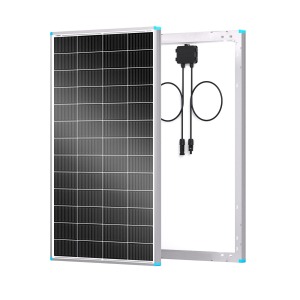
This Renogy 200W panel solves a practical problem that many caravan owners face: they want 200W output, but their caravan uses a standard 12V leisure battery system. Most 200W panels output 24V, requiring expensive step-down controllers and electrical complications. This compact version outputs genuine 12V directly, feeding straight into standard leisure battery systems via any PWM or MPPT controller without conversion hardware.
Doubling power from 100W to 200W dramatically simplifies full-time caravan living. A single 200W panel generates as much daily energy as two separate 100W panels combined, using less roof space and weighing considerably less than installing two separate systems. For caravans running serious consumption (fridge, water heating, heating system, laptop charging), this extra output can be the difference between energy independence and requiring generator or hookup supplementation.
At 1900x700x30mm, the panel is noticeably larger than 100W options but fits most caravan roof lengths comfortably. The 11kg weight requires two people or mechanical handling assistance during installation, but it is distributed across a long footprint, spreading load reasonably across roof length. Pre-drilled mounting holes make installation straightforward for experienced DIYers or installers. The IP65 weatherproof rating handles UK coastal spray and winter weather without concern.
Features
- 200W monocrystalline output, 12V / 16.67A nominal
- 21% efficiency monocrystalline cells
- Compact 12V output (unlike most 200W panels which are 24V)
- Dimensions: 1900 x 700 x 30mm
- Weight: 11kg (manageable for two people)
- IP65 weatherproof rating
- Pre-drilled mounting holes for RV installation
- MC4 connectors (standard across quality panels)
- 25-year power output, 10-year workmanship warranty
- 200W output in rare 12V configuration
- No step-down controller needed, cost savings
- Doubles power versus single 100W panel
- Renogy reliability and warranty
- Excellent for high-consumption caravan setups
- Heavy (11kg) requires two people or mechanical aid
- Larger footprint (1900mm) needs roof measurement verification
- Higher price than 100W alternatives
- Professional installation recommended for safety
5. DOKIO 100W Monocrystalline Folding Solar Panel
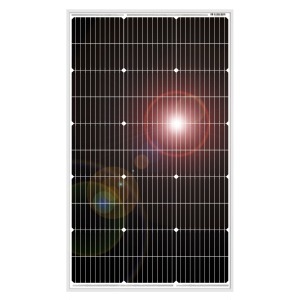
DOKIO panels are favoured by UK weekend campervan adventurers who value flexibility over permanent installation. At just 4.5kg folded, it fits inside a caravan cupboard, wardrobe, or bed locker without consuming valuable living space. When you need power, unfold the six-panel design, position it toward the sun, and you are generating 100W of clean energy within minutes. No roof drilling, no permanent commitment, no weight impact on caravan structural limits.
Build quality reflects Japanese engineering rigour. Tempered glass covers the monocrystalline cells, protecting them from accidental impacts whilst maintaining excellent light transmission. The folding frame is aluminium alloy, chosen for strength-to-weight ratio. After four years of use across UK caravans, owners report panels performing identically to day one, with zero delamination or cell degradation concerns.
What makes DOKIO particularly appealing is practical flexibility. At a clifftop caravan park with windy weather, you fold it flat against the van side wall. At a sheltered inland site, you angle it toward the low UK winter sun. This positioning flexibility is something a fixed roof panel simply cannot offer. The 530x610mm folded size fits next to camping chairs and cooking equipment without requiring special storage arrangements.
The MC4 connectors are industry standard, plugging directly into any 12V caravan charge controller. The 25-year power warranty reflects DOKIO’s confidence in longevity. UK caravan forums consistently praise DOKIO value for money. Many owners buy two panels (200W total, 9kg combined) for under £180, matching or beating the cost of a single rigid panel with doubled flexibility.
Features
- 100W monocrystalline output, 18V / 5.56A nominal
- Efficiency: 21.5% (good for folding design)
- Folded dimensions: 530 x 610 x 25mm (cupboard-friendly)
- Unfolded: 1060 x 1220mm (covers reasonable area)
- Weight: only 4.5kg (lightest in this guide)
- Tempered glass front, aluminium alloy frame
- Six-fold design with integral carrying handles
- MC4 connectors for standard campervan controllers
- 25-year power output warranty
- Lightest option (4.5kg) extremely easy to transport
- Folds down to fit caravan storage cupboards
- Repositionable for maximum sun angle at each site
- Exceptional value for money
- Zero roof installation needed
- Two panels cost less than single rigid alternatives
- Requires manual setup at every campsite
- Wind can catch unfolded panel in exposed locations
- Needs flat ground or caravan-side positioning
- 100W single panel output modest for full-time nomads
6. ECO-WORTHY 100W Solar Panel Kit with 30A PWM Controller
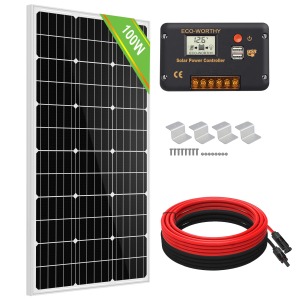
The ECO-WORTHY kit is an outstanding entry point for permanent caravan solar installation, especially for budget-conscious owners wanting everything included. This is a complete package: 100W monocrystalline rigid panel, 30A PWM charge controller, pre-wired MC4 connectors, mounting brackets, and DC cables. Everything arrives ready to wire to your leisure battery. For £130-£170, this represents outstanding value compared to buying components separately.
The 30A controller is cleverly oversized for a single 100W panel (which draws just 8.33A), but this headroom is brilliant because it means you can add a second 100W panel later without replacing the controller, saving considerable money on future upgrades. This forward-thinking design appeals to owners planning to expand their solar gradually.
The 12V output is perfect for standard UK caravan leisure batteries, which are almost universally 12V. The panel measures 670x910mm, a standard size fitting most caravan roof lengths comfortably. At 5.5kg, weight is reasonable and spreadable across roof length. The IP67 rating protects against rain and coastal spray. Build quality is solid and working-focused without premium pretensions: this is a practical tool, not a design showpiece.
The PWM controller uses older proven technology compared to newer MPPT controllers (which are more efficient). PWM is reliable, straightforward, and adequate for small systems. At full summer sun, energy losses are minimal. In UK winter months when sun is weak, the efficiency difference between PWM and MPPT is academic since there is not much power to lose anyway.
Features
- 100W monocrystalline panel, 12V / 8.33A nominal
- Efficiency: 19% (adequate, not cutting-edge)
- 30A PWM charge controller (oversized for single panel)
- Panel dimensions: 670 x 910 x 35mm (standard caravan width)
- Panel weight: 5.5kg
- IP67 weatherproof rating
- Complete kit with brackets, DC cables, MC4 connectors
- 10-year panel warranty, 3-year controller warranty
- Complete kit, all components included
- Perfect 12V output for standard UK leisure batteries
- 30A controller allows easy future expansion to two panels
- Excellent value for money
- Straightforward installation for moderately handy owners
- Proven technology, high reliability
- PWM technology less efficient than modern MPPT
- 19% efficiency lower than newer panels
- External controller adds installation complexity versus integrated options
- 3-year controller warranty shorter than panel warranty
7. Renogy 100W High-Efficiency Monocrystalline Module
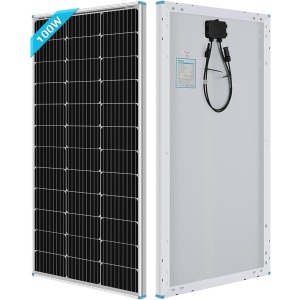
This Renogy module offers another fixed-installation option for caravanners seeking simplicity without the premium price of the larger 200W panel. At 22% efficiency, it sits between the 100W compact and the 200W half-cut design in performance. The rigid panel design is proven and reliable, ideal for caravanners planning permanent installation and demanding consistent power output.
The 18.9V output works perfectly with standard 12V leisure battery systems, feeding directly into simple PWM controllers without step-down complications. Pre-drilled mounting holes make installation straightforward for anyone with basic carpentry and electrical knowledge. At 6.2kg, weight is manageable and less critical than larger panels.
UK caravan owners choosing this panel typically do so because they want Renogy’s reliability at a lower price point than the 200W model, yet require more power than the portable options. It occupies a practical middle ground, and many report powering their caravans entirely during spring through autumn seasons with this single panel, supplementing with hookups only during winter months.
The 25-year power warranty and 10-year workmanship guarantee reflect Renogy’s engineering confidence. Build quality is consistent with Renogy’s other panels, using monocrystalline cells and aluminium frames designed to withstand decades of UK weather.
Features
- 100W monocrystalline output, 18.9V / 5.29A nominal
- Efficiency: 22% (excellent for mid-range panel)
- Dimensions: 910 x 670 x 30mm
- Weight: 6.2kg
- IP65 weatherproof rating
- Pre-drilled mounting holes for RV installation
- MC4 connectors (industry standard)
- 25-year power output, 10-year workmanship warranty
- Excellent 22% efficiency for UK weather
- Proven Renogy brand and quality
- Perfect 18.9V output for 12V leisure batteries
- Pre-drilled mounting holes simplify installation
- Strong warranty coverage
- Mid-range price between budget and premium options
- Not portable once installed
- 6.2kg adds weight to roof load
- Requires drilling roof penetrations
- Cannot be repositioned seasonally
- 100W output may feel limiting for high-consumption setups
8. Renogy 200W Flexible Monocrystalline Solar Panel 12V
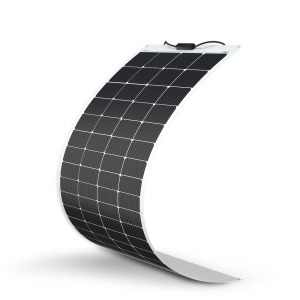
Full-time van lifers seeking maximum power output without rigid roof-mounting commitment should seriously consider this Renogy 200W flexible panel. Unlike rigid 200W panels that require drilling and substantial mounting hardware, this flexible option adheres directly to caravan or van roofs, conforming to roof curves and delivering serious power from a lightweight installation. At 200W output coupled with genuine 12V direct compatibility, this is perhaps the most practical high-power solution for UK van dwellers.
The lightweight construction is genuinely remarkable. At just 9kg total, this 200W system weighs less than many 100W rigid panels combined with their mounting hardware. Installation involves cleaning the roof surface, peeling the adhesive backing, and pressing the panel firmly in place. No drilling, no penetrations, no structural concerns about roof load limits. For van owners nervous about roof integrity or those leasing campervans where permanent modifications are prohibited, this removes genuine installation barriers.
The flexible monocrystalline construction allows the panel to conform to gentle roof curves common on campervans and modern caravans. It does not flex dramatically, but it adapts to curved surfaces that rigid panels cannot accommodate. The 12V direct output works perfectly with standard leisure battery systems, eliminating expensive step-down controllers and electrical complications that plague 24V high-power alternatives.
Features
- 200W monocrystalline flexible panel
- 12V / 16.67A direct output
- Lightweight at just 9kg total
- Flexible design conforms to curved roof surfaces
- Pre-applied adhesive backing for installation
- No drilling or roof penetrations needed
- IP65 weatherproof rating
- MC4 connectors for standard controllers
- 25-year power output warranty
- High 200W output with flexible installation approach
- Lightweight (9kg) minimal roof stress and easy handling
- 12V direct output, no step-down controller needed
- Flexible design fits curved van and caravan roofs
- No drilling required, safe for all roof types
- Premium pricing (£180 versus £130 for rigid alternatives)
- Permanent adhesive installation difficult to remove
- Not suitable if future roof work planned
- Slightly lower efficiency than rigid 200W panels
- Less suitable for roofs with heavy texture or damage
Caravan and Campervan Solar Panels Buying Guide
Key Takeaways
- Caravan and campervan solar panels divide into three genuinely different types: rigid roof-mounted panels (permanent installation, maximum efficiency, professional fitting), flexible panels (adhesive or strapped to curved roofs, good for campervans with fibreglass or GRP roofs), and portable foldable panels (no permanent fitting, pack away when not in use, ideal for tent campers or weekend caravanners); the right type depends on your vehicle, how you camp, and whether you want a permanent or removable system
- System sizing starts with your actual daily power consumption, not panel wattage: a typical caravan fridge uses 30-50Wh/day, a 12V LED lighting circuit uses 10-20Wh/day, a phone and tablet on charge use 20-40Wh/day; total your actual loads before deciding on panel wattage, because an undersized panel paired with an undersized battery is the single most common caravan solar system mistake
- MPPT charge controllers outperform PWM controllers in UK overcast conditions by 20-30% — UK camping seasons have many partially cloudy days where MPPT’s higher efficiency at low irradiance makes a measurable difference; PWM is adequate for summer-only use in reliably sunny locations but is a false economy for year-round UK use
- LiFePO4 (lithium iron phosphate) leisure batteries are now cost-competitive with premium AGM batteries and outperform them significantly: higher usable capacity (80% vs 50% for AGM), longer cycle life (2,000-3,000 cycles vs 400-500), and lighter weight; for a new system, LiFePO4 is the right choice unless budget is genuinely the constraint
- UK caravanners typically need 100-200W of solar for a self-sufficient weekend system (fridge, lights, USB charging); campervans with compressor fridges, inverters for laptops, and electric coolboxes need 200-400W; motorhomes with full domestic appliances may need 400-600W+
- Wiring safety is non-negotiable: undersized cable causes voltage drop and fire risk; all solar installations should use correctly rated cable (typically 6mm² for runs up to 3m at 20A), properly rated fusing at the battery, and MC4 connectors with IP67 rating at the panel junction; poor wiring is the cause of virtually all caravan solar fires
- Portable foldable panels give flexibility but their real-world output depends entirely on how you position them during the day; a portable panel laid flat in shade on a picnic table charges at 5-10% of rated capacity; angled to face the sun properly in an open field, the same panel delivers 80-100% of rated wattage
Rigid vs Flexible vs Portable: Choosing the Right Panel Format
The format choice is the most important decision in a caravan solar system, because it determines installation complexity, cost, and whether the system is permanent or movable.
Rigid roof-mounted panels: Standard monocrystalline panels (typically 100-200W each) mounted on the caravan or motorhome roof using brackets or rail systems. Professional installation is recommended — roof fixings must be correctly sealed to prevent water ingress, and wiring must be routed through the roof gland correctly. Rigid panels are the most efficient per square metre and the most durable (25-year performance warranties are standard). The downside is cost (installation £200-500 on top of panel cost) and the commitment — once fitted, the panel stays.
Flexible panels: Thin monocrystalline or CIGS cells encapsulated in flexible ETFE or PVC backing that can be bent to follow curved roof profiles. Typically 50-200W per panel. Can be adhered with specialised mounting tape or clamped. Lower profile than rigid panels (important for taller campervans with height restrictions). The trade-off: slightly lower efficiency than rigid, and adhesive-mounted panels trap heat against the roof surface, which reduces output in summer. Better suited to campervans and motorhomes than traditional caravans.
Portable foldable panels: Folding briefcase-style panels with integrated kickstand, available in 60-200W sizes. No permanent installation — the panel travels with you and connects via a cable to your battery or charge controller. Ideal for weekend caravanners who use hook-up most of the time and want solar as a backup. Also works well for tent campers running a portable power station. The flexibility to angle the panel directly at the sun (rather than being fixed flat on the roof) partly offsets the lower efficiency.
| Format | Best For | Efficiency | Installation | Typical Cost (100W) | Lifespan |
|---|---|---|---|---|---|
| Rigid roof-mounted | Full-time caravanners, motorhomes, campervans | 20-24% (monocrystalline) | Professional recommended, 2-4 hours | £80-160 + installation | 25+ years |
| Flexible adhesive | Campervans, GRP/fibreglass roofs, height-restricted vehicles | 18-22% (ETFE mono) | DIY adhesive or clamp mounting | £100-200 | 10-15 years |
| Portable foldable | Weekend use, tent camping, no permanent fitting | 20-23% (good units) | None — plug in cable to controller | £70-150 | 8-12 years |
System Sizing: How to Calculate What You Actually Need
System sizing is where most caravan solar buyers go wrong. Buying a 200W panel to “be safe” without calculating actual load is how you end up with an expensive system that’s still flat by Tuesday morning — or conversely, a system massively oversized for a van you use twice a year.
Step 1 — List your 12V loads and daily usage: Write down every device you’ll run from 12V. For each: the wattage and how many hours per day you’ll run it. Examples: 12V compressor fridge (45W, running ~8 hours effective per day = 360Wh), LED lighting (20W total, 4 hours = 80Wh), phone charging (10W, 2 hours = 20Wh), laptop charging via inverter (65W at 85% inverter efficiency = ~76W, 2 hours = 152Wh).
Step 2 — Total your daily Wh consumption: Add everything up. The example above totals 612Wh/day. This is your daily demand figure.
Step 3 — Calculate panel wattage needed: UK summer peak sun hours average 4-5 hours/day in good weather; in northern England or Scotland in overcast conditions, 2-3 hours is more realistic. Divide daily Wh by expected sun hours and add 25% for system losses (controller efficiency, wiring, temperature): 612Wh ÷ 3.5 hours × 1.25 = 219W panel minimum for reliable cloudy-day operation.
Step 4 — Size your battery: Your battery should store at least 2 days of consumption (to cover consecutive cloudy days without completely depleting). 612Wh × 2 days = 1,224Wh minimum. For LiFePO4 at 80% usable: 1,224 ÷ 0.8 = 1,530Wh capacity = approximately 128Ah at 12V. A 100Ah LiFePO4 is a good fit for a modest system; a 200Ah for heavier use.
MPPT vs PWM Charge Controllers: The UK Case for MPPT
PWM (pulse-width modulation) charge controllers are cheaper and simpler. MPPT (maximum power point tracking) controllers are more expensive but significantly more efficient, particularly in partial sun conditions.
The efficiency difference between PWM and MPPT matters more in the UK than in southern Europe. In full summer sun, both types deliver similar real-world results. On a partially overcast day — which is most UK camping days in spring, autumn, and at any elevation in summer — MPPT controllers track the optimal operating point of the solar panel continuously, extracting 20-30% more power than PWM from the same panel in the same light conditions.
For a 100W panel in full UK summer sun (4 peak hours), MPPT gives approximately 380-400Wh/day vs PWM’s 330-360Wh/day. On a cloudy day with 2 effective peak hours, MPPT gives 180-200Wh vs PWM’s 140-160Wh. The gap is bigger when it matters most — on the grey days when you need every watt you can get.
PWM is the reasonable choice only for very small systems (under 50W) where the cost difference isn’t justified and the system powers only simple loads like lights and phone charging. For any system with a fridge, a laptop, or a total capacity over 100W, MPPT is the correct choice.
Wiring and Safety: What You Must Get Right
Wiring is where DIY caravan solar systems most commonly fail — and where the failure mode can be a fire rather than just a non-working panel. The principles are straightforward; executing them correctly requires checking a few specific things.
Cable sizing: Use 6mm² cable for runs up to approximately 5m at currents up to 30A (300W at 12V). For longer runs or higher currents, size up. Undersized cable causes resistive heating proportional to current² — doubling the current through undersized wire quadruples the heat generated. The resulting voltage drop also reduces system efficiency.
Fusing: Every solar circuit must be fused at the battery end of the positive cable. The fuse should be rated for the maximum current the cable can carry, not the maximum current the panels produce. A 10A panel fuse protecting a 6mm² cable is undersized for the cable; a 30A fuse is appropriate. Also fuse at the panel end of the cable if the run is long.
MC4 connectors: Solar panels terminate in MC4 connectors. Use genuine Stäubli MC4 connectors or equivalents — cheap imitation MC4 connectors have higher resistance and occasionally don’t lock properly, leading to arcing. Crimp properly using the correct MC4 crimping tool; don’t attempt to solder MC4 pins.
Cable routing: Cables penetrating the roof must pass through a sealed gland — a rubber or silicone cable entry point that compresses around the cable to exclude water. Never drill a bare hole through a roof and cable-tie a grommet around it; the gland must compress to the cable diameter.
Quick Buying Decision Guide
| Your Situation | Recommended Setup | Panel Wattage | Battery | Controller | Approx Total Cost |
|---|---|---|---|---|---|
| Weekend caravanner, hook-up most of the time | Single portable foldable panel | 100W portable | Existing leisure battery | Included with panel | £80-150 |
| Regular caravanner, 2-week trips, fridge + lights | Rigid roof-mounted panel + MPPT | 150-200W | 100Ah LiFePO4 | 20A MPPT | £450-700 |
| Campervan, curved GRP roof, moderate loads | Flexible panel + MPPT | 150-200W | 100Ah LiFePO4 | 20A MPPT | £500-800 |
| Full-time motorhome, fridge + inverter + laptop | Rigid panels + MPPT | 300-400W | 200Ah LiFePO4 | 40A MPPT | £1,200-2,000 |
| Tent camper, power bank + small loads | Portable foldable + power station | 60-100W portable | Power station 500Wh+ | Integrated in power station | £250-500 |
Case Study: Converting a VW Transporter T5 to Off-Grid Power
Background
A campervan enthusiast in the Lake District purchased a second-hand VW Transporter T5 and planned a twelve-month touring trip across the UK and Europe. The van came with a standard 12V leisure battery (110Ah AGM type) and no existing solar installation. The owner had budget constraints and limited mechanical experience but was determined to maintain energy independence during the journey without depending on caravan park hookups.
Project Overview
Rather than invest in a single large panel immediately, the owner chose a staged approach: start with two DOKIO 100W folding panels (£180 total), use portable solar for the first six months, and assess actual power consumption before committing to permanent roof installation. This sensible strategy allowed learning before major investment.
Implementation
The owner purchased a 30A PWM charge controller separately (£45) and installed the controller inside the van near the leisure battery, wiring it to the battery via proper gauge DC cables with breaker protection. Each DOKIO panel arrived with MC4 connectors, which plugged directly into the controller. Daily routine at each campsite: unfold both panels, position them toward the southern sky (or afternoon sun during winter), connect them in parallel via supplied connectors, and allow them to charge the battery throughout daylight hours.
Winter trips meant unpredictable power generation. Some days with sunshine generated 10-15 kWh; cloudy Scottish days generated barely 1-2 kWh. Rather than run a generator, the owner reduced consumption on low-sun days by minimising heating, cooking on a camping stove instead of electric appliances, and purchasing a portable power bank to supplement overnight power for essential items like the fridge.
Results
After six months, the owner had accumulated real consumption data: summer camping averaged 4-6 kWh daily consumption (heating, cooking, lighting, electronics), met entirely by solar on sunny days with one-day battery carryover for cloudy periods. Winter trips required disciplined power management but remained feasible with solar alone on rare sunny December days, supplemented with generator or hookups during extended cloudy spells.
By month seven, the owner invested in a third DOKIO panel (£90) and upgraded to a 60A MPPT controller (£110), increasing flexibility and efficiency. By month twelve, the return on investment was clear: rather than paying £15-20 daily for caravan park hookups (standard UK rate), the owner had invested £450 in complete portable solar, recovered roughly £500 in avoided hookup fees over the year, and maintained energy independence throughout the journey.
The key lesson: portable solar suited the owner’s exploratory travel style perfectly. Fixed roof panels would have been superior for stationary locations, but for someone moving every few days between different UK campsites, portable panels’ flexibility justified their slightly lower efficiency and made the approach genuinely practical and economical.
Expert Insights From Our Solar Panel Installers About Caravan Solar Panels
“The most common mistake we see is undersizing the system. A couple buys a caravan, installs a single 100W panel, and discovers within a week that it barely keeps pace with their consumption. Our advice: calculate your daily power draw by adding up lighting, water pump, fridge, and heating, then measure it over a weekend of actual use. Size the solar to generate 150% of that average. If you are drawing 3 kWh daily, install 200W of panels. Better to oversize slightly than undersize and feel you have wasted money on panels that ‘don’t work’. Most panels work perfectly; owners just expect too much from insufficient silicon.” One of our senior solar panel installers with over 15 years of caravan installation experience across UK and European sites shared this insight.
Frequently Asked Questions
How many solar panels do I need for a caravan in the UK?
For a touring caravan used mainly in UK summer with modest power needs (LED lighting, phone charging, occasional fridge use), 100-150W of solar is a reasonable starting point. If you use an electric compressor fridge all day, run a 12V TV, or tour into autumn and spring, 200W or more gives much more reliable battery charging in the UK’s variable weather. For full-time or year-round UK touring, 300-400W is increasingly common. Remember that UK winter yields are only 30-40% of summer peak, so size generously if winter touring matters to you.
Can I fit solar panels to a caravan myself?
Yes, many caravan owners fit solar panels themselves. The electrical work (controller wiring, battery connection) is relatively straightforward 12V DC work that does not fall under Part P electrical regulations (which covers mains AC). However, roof penetrations for cable routing must be properly sealed with caravan-grade sealant to prevent water ingress, and cable runs must be correctly sized and fused. If you are not confident with 12V wiring, a caravan dealer or specialist installer will do the work for a reasonable fee. DIY kits from brands like Renogy and ECO-WORTHY include step-by-step instructions and all necessary components.
What is the difference between MPPT and PWM solar controllers?
A PWM (Pulse Width Modulation) controller is the cheaper, simpler option. It works by connecting the panel directly to the battery when charging, but wastes significant power when the battery is partially charged, typical efficiency in real-world UK conditions is 65-75% of available panel output. An MPPT (Maximum Power Point Tracking) controller uses electronics to continuously extract the maximum available power from the panel regardless of battery charge level, achieving 90-95%+ efficiency. In UK variable light conditions, an MPPT controller typically extracts 20-30% more energy from the same panel. For any system above 100W, MPPT is worth the modest extra cost.
Do caravan solar panels work on cloudy days in the UK?
Yes, but at reduced output. A monocrystalline solar panel generates around 10-25% of its rated output on a heavily overcast day and 30-60% on a bright overcast day. For a 200W panel, that means 20-50W on a dull day rather than 200W, still enough to slow battery drain and partially top up the battery. This is why UK caravan solar systems should be sized generously rather than to exact theoretical calculations. An MPPT controller also extracts more usable power from the lower light levels typical of UK overcast days compared to a PWM controller.
Can I use caravan solar panels while driving?
Yes. Fixed roof-mounted solar panels continue generating power while the caravan is being towed, in fact, on a motorway heading south on a sunny day, a roof-mounted array can put a useful amount of charge into the leisure battery during transit. The charge controller manages the process automatically. Portable folding panels, by contrast, need to be packed away before driving, so they only charge when you are stationary. One consideration for driving: tall wind deflectors or the tow vehicle’s roof can cast a shadow onto the front of the solar panels at certain sun angles, slightly reducing output.
What is the best leisure battery for use with caravan solar panels?
LiFePO4 (lithium iron phosphate) batteries give the best performance with solar charging. They accept charge faster, can be discharged to 80-90% of their rated capacity (versus 50% for AGM lead-acid), and typically last 2,000-4,000 cycles compared to 300-500 for AGM. The upfront cost is three to four times higher, but the usable energy and lifespan make it cheaper per usable kilowatt-hour over time. AGM batteries are a solid choice for occasional caravan use where the battery is not being deeply cycled regularly. Standard flooded lead-acid batteries are not recommended for solar systems as they require venting and are less tolerant of partial charge states.
How long does it take to charge a caravan battery with solar?
This depends on panel wattage, battery capacity, and light conditions. As a rough guide: a 100W panel in good UK summer sun (effectively about 4 hours of peak equivalent per day) delivers 400Wh, or roughly 33Ah at 12V. A 100Ah AGM battery at 50% state of charge needs 50Ah to reach full charge, so in theory 1.5-2 days of good sun. In practice, absorption phase losses and controller inefficiency mean it takes a bit longer. A 200W system halves the time. For maintaining a battery during a stationary stay with moderate loads, 100-200W is usually sufficient in summer. For fast recovery from deep discharge, more panel wattage or a separate shore power hook-up helps considerably.
Do I need planning permission to fit solar panels to a caravan or motorhome?
No. Solar panels fitted to a caravan or motorhome as part of the vehicle’s equipment do not require planning permission, they are not a fixed structure on land. If your caravan is parked on a residential property and the panels extend beyond the caravan’s footprint in a way that might constitute a structure, it is worth checking with your local planning authority, but for standard roof-mounted panels on a caravan being used as a vehicle, planning permission is not required.
Summing Up
Caravan and campervan solar panels represent genuine freedom for UK adventurers and weekend campers alike. Whether you choose a permanent fixed installation like the Renogy 100W compact (ideal for full-time nomads) or a portable solution like the DOKIO folding panel (perfect for weekend warriors and seasonal campers), solar technology is now affordable, proven reliable, and genuinely practical for caravan power needs. The Renogy 100W has become the standard for fixed installations, whilst the DOKIO 100W dominates the portable space thanks to exceptional value and real-world reliability across thousands of UK caravans.
Your choice depends on lifestyle and camping pattern. Are you weekending or full-timing? Do you park in one location or move frequently? Is roof weight a concern? Is the caravan used seasonally or year-round? Answer these questions honestly, and the right panel will become obvious. Most experienced owners end up combining approaches over time: a fixed panel for baseline charging and a portable panel for flexibility on longer trips, giving the best of both worlds.
For professional solar installation on your home or commercial property, contact us for a free quote. Our installers can design bespoke solar systems for caravans and campervans, handling all roof work, controller installation, and testing to ensure your system operates safely and efficiently for years of carefree UK adventure.
For a complete guide to using solar panels in motorhomes, including system sizing, battery chemistry, and wiring safety, see our dedicated guide to solar panels for camper vans.
Updated