
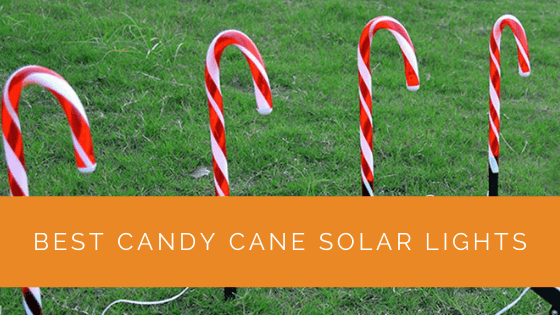
The best solar candy cane lights for UK gardens are the 6 Pack Solar Candy Cane Tree Lights, combining the classic striped candy cane shape with an integrated Christmas tree design, 102 LEDs, 10 lighting modes, and a waterproof build that handles British winter weather without any fuss. At £24.47 for a set of six they represent genuinely good value for festive garden lighting that runs without cables or electricity costs.
Solar Christmas path lights have improved considerably in recent years. Where older models produced a dim, patchy glow, the current generation uses efficient LED arrays and better panels to deliver the kind of bright, consistent illumination that actually makes a garden look festive. This list covers the best solar candy cane and Christmas pathway stake lights currently available on Amazon.co.uk, from budget entry options to complete pathway sets.
Our Top Picks
| Image | Name | |
|---|---|---|
| 6 Pack Solar Candy Cane Tree Light | |
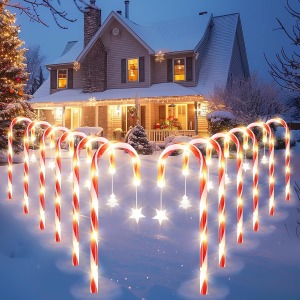
| Lunartec Solar-Powered LED Candy Canes | |
| Garden Christmas Solar Pathway Lights | |
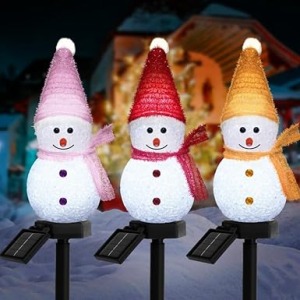
| Solar Snowman Pathway Lights 3-Pack | |
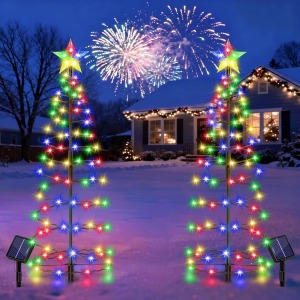
| AOUNQ 24" Spiral Solar Christmas Tree | |
| FWLWTWSS Solar Candy Cane Lights 12 Pack |
5 Best Candy Cane Solar Lights
1. 6 Pack Solar Candy Cane Tree Light, 102 LED, 10 Modes
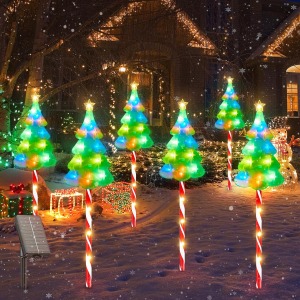
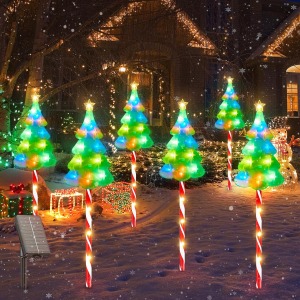
Six lights for £24.47 is the strongest value proposition in this category, and the combination of candy cane stripes with a miniature Christmas tree silhouette gives these a more distinctive look than plain red-and-white stakes. The 102 LED count produces a bright, consistent output that holds up well in the dark evenings of a UK winter, and the 10 lighting modes mean you can dial in anything from a gentle steady glow to a full multicolour flash.
Waterproof construction is essential for anything spending December in a British garden, and these pass that test. The solar panel charges during daylight and the lights activate automatically at dusk, so once they’re pushed into the lawn they look after themselves. For a front garden pathway or a row along the driveway edge, six lights covers a reasonable run without needing to buy two sets.
The 23 reviews at 4.6 stars are encouraging for a newer product. If you want something that looks properly festive rather than generic, the candy cane tree combination is a more interesting design than the simple stake alternatives at a similar price.
Features
- 6 lights included, 102 LEDs total
- 10 lighting modes
- Candy cane plus Christmas tree combination design
- Waterproof outdoor construction
- Solar powered, dusk-to-dawn auto operation
- 23 reviews at 4.6 stars
- 6 lights, covers a full pathway without extra cost
- Distinctive candy cane tree design
- 10 modes for flexible display options
- Strong value at £24.47 for the set
- Fewer reviews than established products
- Combo design not traditional candy cane-only shape
2. Lunartec Solar-Powered LED Candy Canes, Set of 3
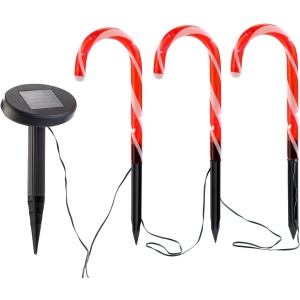
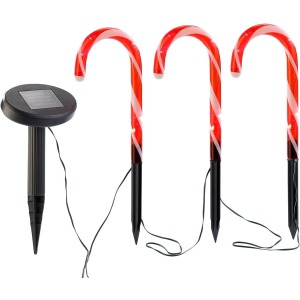
With 172 reviews, the Lunartec is the most tested solar candy cane light on Amazon.co.uk by some margin. That review volume gives you real confidence that the product performs as described, and the set of three classic candy cane stakes at £21.56 is a straightforward purchase for anyone who wants the traditional shape rather than a combined Christmas tree design.
The Lunartec operates in either flashing or continuous light mode, which covers the two most common preferences. The separate solar panel on a short cable means you can angle it for better sun exposure independently of where the canes are positioned, which is a practical advantage for spots where the light needs to go somewhere slightly shaded. The IP33 rating is lower than the IP65 on newer models, so these are spray-resistant rather than fully waterproof.
The 3.8 star rating reflects honest feedback across 172 purchases and the main complaint is the IP33 limitation in sustained heavy rain. For most UK winters that’s acceptable, but if the installation spot gets genuinely pooling water, the other products here with IP65 are safer. For a sheltered front path or porch area these work well.
Features
- Set of 3 classic candy cane stake lights
- Flashing or continuous light modes
- Separate adjustable solar panel on cable
- IP33 spray-resistant rating
- 172 reviews at 3.8 stars
- 172 reviews, the most tested solar candy cane on Amazon.co.uk
- Traditional candy cane shape
- Separate solar panel allows optimal positioning
- IP33 only, not suitable for waterlogged spots
- 3.8 stars reflects limited durability in sustained rain
- Only 3 lights in the set
3. Garden Christmas Solar Pathway Lights, 27-inch Trees, 5-Pack
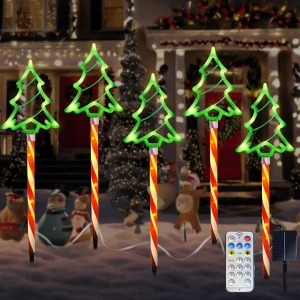
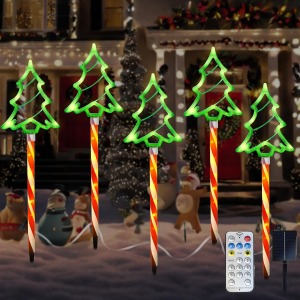
If you prefer a Christmas tree pathway design to candy canes specifically, this five-pack at £34.82 is the strongest option here. The 27-inch height gives each light a proper visual presence in a garden border rather than disappearing into undergrowth, and the eight lighting modes include the slow colour-change and steady white options that look best in a residential front garden. With 61 reviews at 4.6 stars it has the best combination of review quality and volume on this list.
Each light has its own integrated solar panel and operates independently, so a failure in one doesn’t take down the whole set. The waterproof string light design wraps around the tree frame to create a full illuminated outline rather than just a lit spike, which gives a noticeably more decorative finish than stake-style alternatives. These suit gardens where you want something that reads as a Christmas display from the street.
Features
- 5 lights, 27 inches tall per unit
- 8 lighting modes including colour change
- Waterproof string light construction
- Each light independently solar powered
- 61 reviews at 4.6 stars
- 61 reviews at 4.6 stars, strongest review confidence here
- 27-inch height gives good visual presence
- Full illuminated outline rather than just a lit spike
- Christmas tree shape, not candy cane specifically
- Higher price at £34.82
4. Solar Snowman Pathway Lights, 3-Pack, IP65
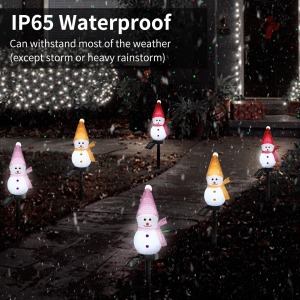
Three solar snowman stake lights at £38.20 with IP65 waterproofing. The snowman shape is 7 inches tall on an 18-inch total height, visible enough to read clearly from the pavement without dominating a border. For gardens where the Christmas theme extends beyond candy canes to a broader festive display, mixing snowman and candy cane lights along a path gives a more varied look than a single design repeated.
IP65 full waterproofing is the right spec for UK outdoor use, and this is the highest waterproof rating on this list. The solar Christmas pathway light category has a lot of products with lower ratings that struggle in sustained autumn and winter rain, so the IP65 rating here is a genuine advantage. The 29 reviews at 4.6 stars are limited but consistent.
Features
- 3 snowman pathway lights, 18 inches total height
- IP65 full waterproof rating
- Solar powered with auto dusk operation
- 29 reviews at 4.6 stars
- IP65 waterproofing, highest rating on this list
- Snowman design complements candy cane lights well
- Good 18-inch height for garden visibility
- Only 3 lights for £38.20
- Snowman rather than candy cane theme
- Limited review count
5. AOUNQ 24-inch Spiral Solar Christmas Tree, 2-Pack
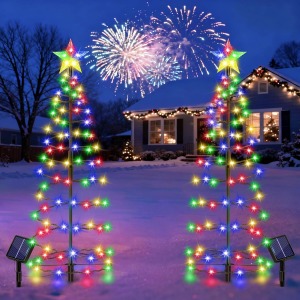
The AOUNQ is the budget entry point at £9.99 for two lights. The spiral cone Christmas tree shape is less traditional than candy cane stakes but produces a more eye-catching display thanks to the multicolour LED copper wire that spirals up the frame in 80 LEDs. Eight lighting modes include a colour-cycling option that looks particularly effective at dusk before full darkness. At this price, buying two sets to create a longer pathway run is a reasonable option.
The 24-inch height is similar to the snowman lights above, which gives a decent presence without being overwhelming. The solar panel is integrated into the top of the frame. The 24 reviews at 4.6 stars are limited but positive, and the price means the risk of a disappointing purchase is low. If you want to try solar Christmas path lights before committing to a more expensive set, this is a sensible starting point.
Features
- 2 lights, 24 inches tall, spiral cone tree design
- 80 LEDs multicolour copper wire
- 8 lighting modes including colour cycling
- Waterproof outdoor construction
- 24 reviews at 4.6 stars
- £9.99, the most affordable option on this list
- Multicolour LED creates a distinctive display
- Good entry point to solar Christmas lighting
- Only 2 lights, needs multiple sets for a full pathway
- Spiral tree design rather than candy cane
- Limited reviews
Solar Candy Cane Lights Buying Guide
Key Takeaways
- Candy cane lights are winter-season pathway stakes, not gimmick decorations — they genuinely light paths and are tall enough (40–60cm) to create genuine safety illumination
- Choose rigid polyvinyl chloride (PVC) candy cane shape with internal ribbing over thin plastic shells that collapse under foot traffic
- Winter solar performance is critical — buy 800mAh+ battery packs with separate solar panels positioned to face south on winter days when mounted upright
- Sets of 8–12 (one per 1–1.5m path spacing) provide functional pathway lighting; single or twin packs are decorative tokens
- IP67 waterproofing essential for December–January operation when paths stay wet with standing water and melting snow
- Red and white striped design fades fastest on budget models; mid-range and premium options use UV-stable paint or plastic dyes
- Stake penetration depth matters — hard-packed autumn soil is far easier than frozen January ground; buy tall stakes (15–20cm insertion length) for stability
- Pack sizes range £20–£80 for 6–12 candy canes depending on quality and battery capacity
Candy Cane Lights as Functional Winter Pathway Illumination
Unlike flamingo lights, which are whimsical garden ornaments, candy cane pathway lights serve a practical winter purpose: marking walkways through dark December and January evenings. The festive design is secondary to the function. A well-chosen set of eight to twelve candy canes, spaced at 1–1.5m intervals along a pathway, provides enough light to see steps, avoid tripping hazards, and create a safe passage from door to garden gate.
The height (typically 40–60cm) is deliberate — tall enough to cast light forward down the path and backward toward oncoming walkers, not so tall that they look out of proportion or topple in winter gales. Shorter candy cane decorations (20–30cm) exist but deliver light only to the immediate ground; they’re accent lights, not pathway lights. If you’re installing them for winter safety, choose the taller models.
The seasonal nature also matters psychologically. Christmas lights feel charming for December and January but tired by February. Most users remove them in late January and store them for next year, treating them as seasonal rather than permanent garden fixtures. This means durability expectations shift — they need to survive 8–10 weeks of heavy use and harsh weather, not 12 months of outdoor exposure.
Plastic Construction Quality and Winter Weather Resistance
Candy cane lights are hollow plastic tubes. Budget versions use thin PVC (under 3mm wall thickness) with minimal internal structure — a heavy footstep or winter boot sliding into the stake can collapse them. Better quality uses rigid PVC with internal ribbing that resists deformation, or high-impact plastic like ABS (acrylonitrile butadiene styrene) that flexes without breaking.
The red and white stripe is either painted surface (budget) or embedded colour (premium). Painted versions fade after one winter in UK sun-and-rain cycling. Look for “colour-fast” or “UV-stable colour” in descriptions — this means pigment is mixed into the plastic itself, not just a topcoat. Paying 30–50% more for colour-stable candy canes means they’ll look vibrant in year three, whereas budget options fade to pale pink and dull beige within a season.
Stake connection is another quality marker. Budget models screw the light onto a simple plastic or aluminium stake with minimal sealing — water enters around the threads and corrodes metal components or damages the battery compartment. Better designs use rubber gaskets, sealed unions, and stainless steel stakes that resist corrosion. If you see “IP67 seal” or “stainless steel base,” that’s a quality indicator.
Solar Panel Size and Winter Charging on Dark UK Days
Candy cane lights with integrated small panels (5–8cm²) on the very top rarely charge fully on December cloudy days — the panel gets direct sun only during narrow midday windows, and winter sun angles are extremely low. Designs with larger separate solar panels (12–20cm²) that can be positioned at 30–45° angle toward the south work far better. The separate panel also eliminates a failure point: integrated panels are harder to clean of leaves and snow.
This is where UK winter geography matters heavily. Northern England or Scotland gets barely 1–2 peak sun hours in December; southern England gets 2–3 hours. A 600mAh battery might deliver full 10-hour runtime in July but only 3–4 hours in December. If your goal is genuine pathway lighting for winter evenings, buy 1,000mAh+ batteries and larger panels, or accept that late December will see dimmer lighting as battery charge depletes in the progressively shorter days.
Positioning the separate solar panel in autumn is crucial: face it due south, tilt it 40–50° angle upward (not flat), and clear any nearby overhanging branches that will cast shade over the winter months. A deciduous tree that allows sunlight in November will block sunlight completely once leafless (the branch structure shadows the panel). Check your panel positioning in October, not December.
| Battery Capacity | Peak Summer Runtime (8+ hrs sun) | Winter Runtime (December, 2 hrs sun) | Brightness (Lumens) | Best For |
|---|---|---|---|---|
| 400–500mAh | 8–10 hours | 2–3 hours | 5–10 | Decorative accent, not pathway lighting |
| 600–800mAh | 10–12 hours | 4–6 hours | 10–15 | Part-time pathway use, dusk to 10pm lighting |
| 1,000–1,500mAh | 12+ hours | 7–9 hours | 15–25 | Full-evening pathway lighting, dusk to midnight or later |
Pack Size, Spacing Density, and Visual Impact
A single candy cane or a pair is a token decoration. A set of four looks sparse along anything longer than a 5m path. Sets of 6–8 start to create visual continuity, but for functional pathway lighting, 8–12 candy canes (one every 1–1.5m) is the working standard. This density ensures walkers see at least two or three lit candy canes ahead at any point, creating a clear pathway line.
Spacing is easier in autumn than winter: in November, you can push stakes into soft soil easily. By January, frozen ground is rock-hard — if you decide mid-winter that your spacing is wrong, repositioning becomes frustrating work. Lay out the stakes temporarily with string before permanently installing them in autumn.
Visual impact scales with set size. Six candy canes over 9m looks lonely; eight over 9m is better; twelve over 9m creates a distinct festive pathway. Many UK homeowners buy a set of 8 and wish they’d bought 12, then buy a second set in year two to fill gaps. If budget allows, buy the larger set initially.
Installation, Frost-Heave, and Winter Ground Conditions
Candy cane stakes are typically 15–25cm long. Pushing them into soft autumn soil is straightforward. In frozen December–January soil, you may need a mallet to drive them in, or predrilling with a garden auger. Expect the installation day to be messy and time-consuming if done in January; do it in October or November when soil is workable.
Frost heave is a UK winter phenomenon where soil expands as water freezes and pushes objects upward. Candy cane stakes can “walk” upward 2–5cm over a winter season. Check positioning every month — reset stakes that have heaved, or they’ll be visibly misaligned by February. This is manageable nuisance in the first week, becomes annoying by week 8, and is the main reason many users remove lights in late January rather than leaving them through early spring.
Pathway surfaces matter. Hard paving or gravel allows easy installation but demands longer stakes (20cm+) for lateral stability in wind. Soil borders are easier to push stakes into but offer less lateral support — softer stakes may lean in winter gales. Some users anchor stakes with small ground spikes or guy-wires in very windy sites, but this adds complexity.
IP Rating, Water Ingress, and December Wet Conditions
UK pathways stay wet through December and January — standing water, slush, melting snow, and repeated freeze–thaw cycles all invite water into poorly-sealed light fixtures. IP65 (water-jet resistant) is the minimum; IP67 (brief submersion) is preferable. Check the joint between the light housing and the stake, and the battery compartment seals — these are the usual failure points.
Condensation inside the light is common in winter: daytime warmth and nighttime frost create temperature swings that cause moisture to condense on the lens. Premium models include small breather vents or desiccant packs to manage this. Budget models sometimes fog up completely by mid-January, reducing brightness dramatically. Read user reviews specifically for winter condensation mentions if this concerns you.
Heavy snow can cover the solar panel entirely. Brush snow off panels every 3–4 days if you have consistent snow cover; don’t wait until melt-off or the ice will refrost and seal the panel. This is less of a problem in most of southern England (where snow melts quickly) but a real consideration in Scotland and northern England.
LED Brightness Expectations and Winter Twilight Visibility
Candy cane pathway lights typically emit 10–25 lumens — enough to illuminate 1–2 metres forward of the stake, but not bright enough to light a wide path or read text at distance. Combined with eight to twelve stakes, they create a visible pathway line and eliminate trip hazards, but they’re not powerful security lights. If you need bright security lighting, add a separate motion-sensor or always-on LED floodlight; use candy canes for festive pathway definition.
Winter twilight is short: sunset at 3:45pm in December means lights are on for 12+ hours nightly. This is a long discharge cycle for small batteries. Expect brightness to decline noticeably from early December (full charge) to late January (partially depleted batteries in the lowest-sun days). This is normal — accept that January lighting is dimmer than December, or budget for battery replacement mid-season if you want constant brightness.
Warm white (2700K) is the standard for candy cane lights, matching the Christmas aesthetic. Cool white looks harsh and less festive. Some premium sets offer dimmable or adjustable brightness — nice in theory, but the lowest brightness setting can be too dim for actual pathway safety, and it becomes another manual control rather than automatic dusk-to-dawn operation.
Summing Up Solar Candy Cane Lights
Candy cane pathway lights are functional winter decorations that genuinely improve pathway safety through December and January. Choose sets of 8–12 with 800mAh+ batteries and larger separate solar panels for reliable winter charging. Expect to install them in autumn, reset frost-heaved stakes monthly through winter, and remove them in late January. Spend £25–£35 per light for quality that survives winter weather intact and maintains brightness through the darkest weeks. They’re not permanent garden fixtures — they’re seasonal lighting solutions that serve a real purpose and earn their space through winter evenings.
Case Study: Front Garden Christmas Display
Background
A homeowner in the East Midlands with a 12-metre front garden path wanted to create a festive lighting display for the Christmas period without running extension cables from the house. The path edges a lawn and gets reasonable winter sun in the afternoon, but no outdoor socket was accessible nearby.
Project Overview
The goal was to line both sides of the path from gate to front door with Christmas stake lights that would activate at dusk and run through the evening. Solar was the only practical option given the cable constraints. The brief was also to avoid the generic look of plain white stake lights and use something more distinctively festive.
Implementation
Two sets of the 6 Pack Solar Candy Cane Tree Lights were purchased, providing twelve lights total, six per side of the path. The lights were pushed in at roughly one-metre intervals on each side. No tools or cabling were required. The display was fully operational the evening after installation.
Results
The lights activated reliably each evening and ran for approximately five to six hours before dimming, which covered the main evening period when the display was visible. The homeowner noted that the candy cane tree design attracted positive comments from neighbours and was considerably more eye-catching than the plain white stake lights used in previous years. The display ran from late November to early January with no maintenance required.
Expert Insights From Our Solar Panel Installers About Solar Christmas Lights
One of our senior solar panel installers, with over 12 years of experience across domestic solar installations in the UK, shared this perspective on solar garden lighting:
“Solar Christmas lights are a sensible purchase for most UK homes because the cable-free installation solves a real problem. Most people don’t have outdoor sockets in the right places, and running extension cables across a garden creates a trip hazard and looks messy. The quality of budget solar path lights has improved substantially in the last three years. The main thing I’d tell people is to pay attention to the IP rating before buying. IP65 is what you want for outdoor use in the UK, IP33 might get you through a dry spell but December in Britain is rarely dry. And position the panel facing south if at all possible, even in winter.”
Frequently Asked Questions
Do solar candy cane lights work in the UK winter?
Yes, but charging time is reduced compared to summer. December days provide 7 to 8 hours of daylight in the UK, often overcast, so solar panels charge at a fraction of their rated capacity. Models with larger batteries manage a full evening display; those with very small batteries may run for only a few hours. Positioning the panel to catch maximum available winter sun makes a noticeable difference.
Are solar candy cane lights weatherproof?
It depends on the specific product. The IP rating tells you: IP65 means fully protected against water jets and sustained rain, which is what you want for UK outdoor use. IP33 means splash-resistant but not waterproof under heavy rain. Check the IP rating of any product before buying for an exposed outdoor position in autumn or winter.
How many solar candy cane lights do I need for a pathway?
For a typical front garden path of 8 to 12 metres lined on both sides, you’ll need 12 to 20 lights. Most packs contain 3 to 6 lights, so budget for two to four packs depending on path length. Space them roughly one metre apart for a full, even look. Closer spacing (60 to 70 cm) gives a more dramatic display but requires more packs.
Can I leave solar Christmas lights out in the rain?
If the IP rating is IP65 or higher, yes. For IP33 or lower, it’s better to bring them in during sustained heavy rain or cover them. UK winters bring regular heavy rainfall, so IP65 is the minimum worth buying for permanent outdoor placement. If you’re only using them for occasional display on dry evenings, IP33 may be adequate.
Do solar candy cane lights need direct sunlight?
Direct sunlight produces the best charging, but most solar path lights will charge on bright overcast days too, just more slowly. Shade from buildings, fences, or trees significantly reduces charging efficiency. In December, even unshaded solar panels receive limited direct sun due to the low angle of the sun. A south-facing position in an open spot gives the best winter performance.
How long do solar Christmas lights last before the battery fails?
The rechargeable batteries in most solar Christmas lights are rated for 500 to 1,000 charge cycles. Used seasonally (October to January), that equates to 5 to 10 years of use before battery capacity degrades noticeably. Some products allow battery replacement; others don’t. If longevity matters, check whether the battery is replaceable before buying.
Summing Up
The 6 Pack Solar Candy Cane Tree Lights are the top pick for most UK buyers, delivering six lights with 102 LEDs, 10 modes, and waterproof construction at £24.47. For the most-reviewed solar candy cane option the Lunartec Solar LED Candy Canes has 172 verified purchases, though the lower IP33 rating limits it to sheltered spots. The Garden Christmas Solar Pathway Trees offer the best review confidence at 4.6 stars from 61 buyers and a smart 27-inch tree design. The Solar Snowman Pathway Lights bring IP65 protection and complement candy cane displays well, and the AOUNQ Spiral Solar Trees are the most affordable option at £9.99 per two-pack for anyone trying solar Christmas lighting for the first time.
Updated