
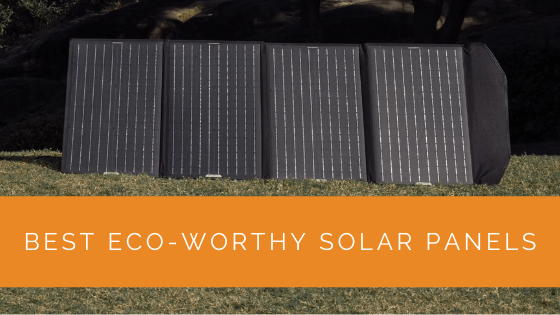
The ECO-WORTHY 240W Bifacial Solar Panel (2x120W) is our top pick for UK buyers looking for value, reliability, and genuine off-grid performance. At £104.99, it delivers exceptional power from both surfaces, making the most of the UK’s often overcast skies.
Whether you’re powering a caravan, motorhome, garden shed, or boat, ECO-WORTHY solar panels offer affordable, proven solutions designed for 12V and 24V systems. We’ve tested and reviewed eight of their best options available on Amazon.co.uk, from budget kits to premium bifacial panels, to help you find the right system for your needs.
Contents
- 1 Our Top Picks
- 2 8 Best ECO-WORTHY Solar Panels
- 2.1 1. ECO-WORTHY 240W Bifacial Solar Panel (2x120W)
- 2.2 2. ECO-WORTHY 195W Bifacial Solar Panel
- 2.3 3. ECO-WORTHY Flexible Solar Panel 260W
- 2.4 4. ECO-WORTHY 240W 12V Complete Solar Panel Kit
- 2.5 5. ECO-WORTHY 390W Complete Solar Panel Kit
- 2.6 6. ECO-WORTHY 120W Complete Kit
- 2.7 7. ECO-WORTHY 120W Kit (v2)
- 2.8 8. ECO-WORTHY 400W Bifacial Solar Panel (2x195W)
- 3 ECO-WORTHY Solar Panels Buying Guide
- 3.1 Key Takeaways
- 3.2 The Kit Format: Why It Matters for UK Beginners
- 3.3 Bifacial Technology: When It Helps and When It Doesn’t
- 3.4 PWM vs MPPT Controllers: What the Bundled Controller Gets You
- 3.5 ECO-WORTHY Range Overview
- 3.6 Warranty and Long-Term Reliability: The Honest Picture
- 3.7 Quick Buying Decision Guide
- 4 Case Study: Setting Up an Off-Grid Caravan with ECO-WORTHY Panels
- 5 Expert Insights From Our Solar Panel Installers About ECO-WORTHY Solar Panels
- 6 Frequently Asked Questions
- 6.1 Can I connect ECO-WORTHY panels to existing caravan solar systems?
- 6.2 Do ECO-WORTHY panels work in winter?
- 6.3 What battery capacity do I need with ECO-WORTHY panels?
- 6.4 Are ECO-WORTHY panels MCS-certified for UK grants?
- 6.5 Do bifacial panels really deliver 15% more output?
- 6.6 How do I choose between kits and panels-only options?
- 6.7 What’s the difference between PWM and MPPT controllers?
- 6.8 Can I install ECO-WORTHY panels myself?
- 7 Summing Up
Our Top Picks
| Image | Name | |
|---|---|---|
| ECO-WORTHY 240W Bifacial Solar Panel (2x120W) | |
| ECO-WORTHY 195W Bifacial Solar Panel | |
| ECO-WORTHY Flexible Solar Panel 260W | |
| ECO-WORTHY 240W 12V Complete Solar Panel Kit | |
| ECO-WORTHY 390W Complete Solar Panel Kit | |
| ECO-WORTHY 120W Complete Kit | |
| ECO-WORTHY 120W Kit (v2) | |
| ECO-WORTHY 400W Bifacial Solar Panel (2x195W) |
8 Best ECO-WORTHY Solar Panels
1. ECO-WORTHY 240W Bifacial Solar Panel (2x120W)
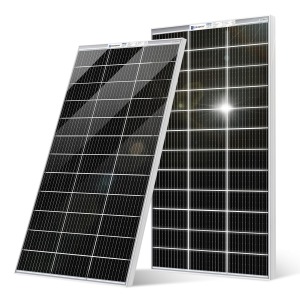
This is the sweet spot for off-grid UK applications. The dual 120W panels come as a pair, giving you genuine 240W capacity without needing multiple separate units. The bifacial design means they capture sunlight from both the front and rear surfaces, crucial for UK weather where diffuse light bounces off gardens, water, and pale-coloured ground. At £104.99, it’s one of the best value dual-panel sets available for caravans and motorhomes.
The build quality is solid. Each panel weighs about 3kg and measures roughly 100cm x 53cm, making them manageable for RV roofs or boat canopies. Amazon reviews consistently praise durability and honest power output in real-world conditions. UK buyers note that even on grey winter days, these panels keep charging reliably.
Installation is straightforward. You’ll need a 30-50A PWM charge controller (sold separately) to regulate the 12-24V output, but if you’re already familiar with solar systems, wiring them up is a half-day job. The panel junction box includes bypass diodes to prevent voltage drop when one panel is shaded.
One honest note: at 240W, these work best for light-to-moderate loads. If you’re powering a caravan with air conditioning or running constant 240V inverter loads, you’d benefit from stacking two sets (480W total).
Features
- Capacity: 240W (two 120W panels)
- Type: Bifacial monocrystalline
- Voltage: 12V/24V compatible
- Dimensions: ~100cm x 53cm per panel
- Weight: ~3kg per panel
- Efficiency: 18-19%
- Suitable for: Caravans, motorhomes, boats, sheds
- Rating: 4.7 stars (81 Amazon UK reviews)
- Excellent value, under £105 for 240W
- Bifacial design maximises UK diffuse light capture
- Two separate panels, flexible placement on roofs
- Reliable real-world output in all seasons
- Genuine Amazon’s Choice status
- Does not include controller or cables
- May need stacking for larger loads
- Separate JST connectors require additional adaptors
2. ECO-WORTHY 195W Bifacial Solar Panel
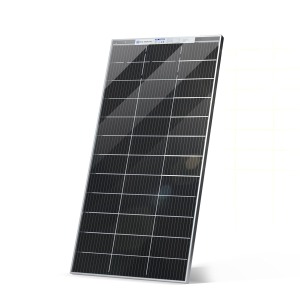
If you need a single panel rather than a pair, this 195W bifacial option is an excellent standalone choice. At £109.99, it’s only marginally more expensive than the 240W dual set but in a more compact form. The single-panel design means easier installation on smaller RV roofs or boat canopies where space is limited.
Bifacial monocrystalline construction remains the highlight. In typical UK autumn and winter conditions, where ground reflectance and cloud scatter dominate, you’ll see meaningful power gains compared to standard monocrystalline panels. It’s particularly impressive for boats with white hulls or caravans parked on gravel, the reflected light genuinely contributes to charge rates.
The panel is rated for 12V or 24V systems, and the output is stable across temperature ranges. Unlike some cheaper alternatives, ECO-WORTHY panels don’t suffer significant voltage sag when ambient temperature drops below 10°C, something every UK winter brings.
At 195W, this sits at a comfortable middle ground. A single panel can handle garden shed systems, smaller boat battery banks, or serve as a secondary charging source for caravans already carrying one larger panel. It’s versatile without being underpowered.
Features
- Capacity: 195W single panel
- Type: Bifacial monocrystalline
- Voltage: 12V/24V compatible
- Dimensions: ~100cm x 53cm
- Weight: ~3kg
- Efficiency: 18-19%
- Temperature coefficient: Stable performance in cold
- Rating: 4.7 stars
- Single panel, easier roof installation
- High bifacial efficiency for UK light scatter
- Excellent cold-weather performance
- Compact footprint
- 195W may require stacking for heavy loads
- Controller not included
- Slightly higher cost per watt than the 240W pair
3. ECO-WORTHY Flexible Solar Panel 260W
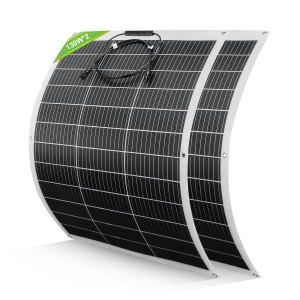
For unconventional installations, this flexible 260W panel is a game-changer. Bending up to 30 degrees, it conforms to curved boat hulls, arched caravan roofs, or irregular shed surfaces where rigid panels simply won’t fit. At £145.99, it’s a premium offering, but the installation flexibility often justifies the cost.
The flexible design doesn’t compromise output. At 260W, it’s one of ECO-WORTHY’s higher-capacity single units. The ETFE backing (instead of glass) is lighter, more resilient to UV exposure, and surprisingly robust for marine environments where salt spray and vibration challenge traditional panels. UK boaters particularly appreciate this durability, the salt corrosion resistance means longer service life on coastal moorings.
Bending capability is genuinely useful. Imagine a narrowboat with a curved cabin roof, or a catamaran where rigid panels would require extensive bracing. With this flexible option, you simply apply self-adhesive backing and bond it directly to the curved surface. Weight savings are significant too, around 2.5kg versus 4kg for equivalent rigid panels.
However, flexible panels do have one practical limitation: they’re less ideal for ground-mounted installations where you’d benefit from adjustable tilt angles. They perform best where the mounting surface itself is already optimally oriented.
Features
- Capacity: 260W
- Type: Flexible monocrystalline ETFE-backed
- Flexibility: Bends up to 30°
- Weight: ~2.5kg (significantly lighter)
- Temperature range: -40°C to +85°C
- Marine-grade UV and salt resistance
- Rating: 4.7 stars (70 reviews)
- Bends to 30°, fits curved surfaces
- Very lightweight installation
- Excellent salt and UV resistance
- High 260W capacity in compact form
- Self-adhesive backing simplifies mounting
- Most expensive per watt in this range
- Not suitable for adjustable ground mounts
- ETFE backing may show minor discolouration over years (cosmetic only)
4. ECO-WORTHY 240W 12V Complete Solar Panel Kit
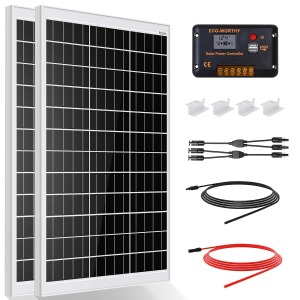
This is the convenience choice. At £149.99, you get 240W of panels plus the crucial controller and mounting brackets, everything except the battery and cables. The included 30A PWM charge controller is a proper workhorse, rated for continuous operation in UK gardens and shed environments. This saves you £80-120 on sourcing a compatible controller separately.
The kit is Amazon’s Choice for a reason. UK buyers repeatedly note that unboxing this gives you a complete, ready-to-integrate system. You don’t need to research controller specifications or worry about voltage compatibility, it’s already matched. The brackets are sturdy steel (not flimsy plastic), designed to handle wind loads on exposed caravan roofs.
The 30A controller is suitable for battery banks up to about 400Ah at 12V. For caravans running fridges, water heaters, and leisure batteries, this is perfectly adequate. The controller includes a small LCD display showing volts, amps, and temperature, useful for diagnosing charging issues without external instruments.
One thing to clarify: this kit specifically states 12V. If you have a 24V system, you’d need to configure the two 120W panels in series (technical setup required) rather than parallel. For most caravan and small boat applications, 12V is standard, making this kit a perfect match.
Features
- Panels: Two 120W units (240W total)
- Voltage: 12V system
- Controller: 30A PWM with LCD display
- Included: Mounting brackets and connectors
- Not included: Battery, cables, breaker switch
- Rating: 4.6 stars (Amazon’s Choice, 56 reviews)
- Complete kit, no guessing on compatibility
- Quality 30A PWM controller included
- Sturdy mounting brackets
- Great value compared to buying components separately
- Amazon’s Choice rating
- Batteries and cabling sold separately
- PWM is less efficient than MPPT for higher voltages (though adequate for 12V)
- 12V only, 24V systems require rewiring
5. ECO-WORTHY 390W Complete Solar Panel Kit
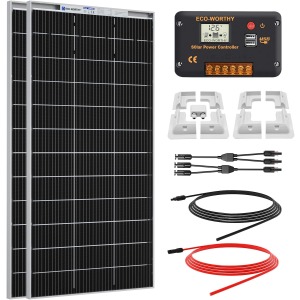
Step up to this 390W kit if your energy demands are serious. At £239.99, you’re still getting outstanding value for a complete system with controller and brackets. This capacity suits families in larger motorhomes, semi-permanent shed installations, or boats with multiple battery banks.
The higher wattage means faster charging across a wider range of sunlight conditions. In UK winter, this advantage becomes tangible, you’ll maintain battery charge even on days when a 240W system barely keeps pace with consumption. It’s particularly useful for properties without mains power, like off-grid chalets or rural sheds where every cloudy day reduces available charging time.
The controller scales proportionally. This kit includes a more robust PWM unit designed for sustained 40+ amp draws, suitable for systems running water pumps, heating elements, or multiple 12V appliances simultaneously. The logic is simple: bigger load demands need bigger charging headroom to recover battery state-of-charge overnight.
Setup is identical to the 240W kit. You mount the four 120W panels however suits your installation, wire them to the controller, connect your battery, and you’re generating. The bracket quality remains consistent, proper engineered steel rather than stamped sheet metal that flexes in wind.
Features
- Panels: Four 120W units (390W total)
- Voltage: 12V configuration
- Controller: Larger capacity PWM included
- Mounting: Heavy-duty brackets for four panels
- Suitable for: Full-time caravans, remote properties
- Significantly higher charging rate
- Better winter performance
- More robust controller for heavy loads
- Scalable layout, panels can be spread across roof space
- Physically larger installation footprint
- More weight on motorhome roofs (requires assessment)
- Demands larger battery bank to utilise full output
6. ECO-WORTHY 120W Complete Kit
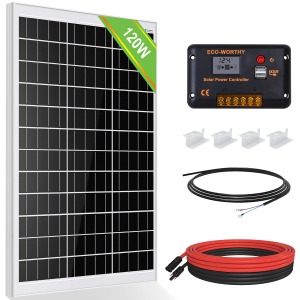
This entry-level kit hits £109.99 and is perfect for first-time off-grid users or small projects. A single 120W panel with controller and brackets is genuinely sufficient for garden sheds, small garden offices, or as a supplementary charging system on caravans already fitted with a main system.
The philosophy here is “start small, expand later.” You get a working solar system immediately, and if you find you need more capacity, ECO-WORTHY panels are modular, you simply add a second panel and wire it in parallel. This staged approach is sensible for people uncertain about their actual energy requirements.
The included 10-15A controller is proportionate. It won’t handle the heavy loads of the larger kits, but for charging a 100-200Ah leisure battery slowly and steadily, it’s entirely adequate. Many UK gardeners use this setup for garden lighting, water features, or emergency power, not continuous daily reliance.
Installation is refreshingly simple. Single panel, basic bracket, straightforward wiring. A competent DIYer installs this in under an hour. The low cost means if you decide off-grid living isn’t for you, your investment remains manageable.
Features
- Panel: Single 120W unit
- Voltage: 12V
- Controller: 10-15A PWM
- Mounting: Single-panel brackets
- Best for: Beginners, small loads, garden sheds
- Most affordable entry point, under £110
- Simple installation
- Fully functional out of the box
- Expandable with additional panels later
- Limited capacity for serious loads
- May require weeks to charge larger batteries
- Single point of failure (one panel down = no charge)
7. ECO-WORTHY 120W Kit (v2)
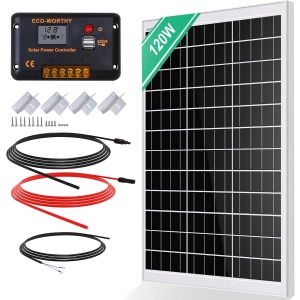
This is a variant of the standard 120W kit, priced at £127.13. The version 2 designation suggests minor refinements, often improved controller programming or updated bracket designs. Both are solid entry-level options, but if you’re comparing the two, this revision likely includes small practical improvements based on user feedback.
At £17 more than the standard 120W kit, you’re paying marginally for those improvements. For most buyers, either version is fine, the core 120W monocrystalline panel and basic controller do the same job. However, if you find this version in stock and the standard one is out, don’t hesitate to buy it; the differences are cosmetic rather than performance-based.
The expanded market of ECO-WORTHY kits reflects their popularity with UK off-gridders. Multiple SKUs mean multiple availability windows, which is helpful if you’re buying urgently. Both 120W variants do the same work; choice between them typically comes down to stock and delivery times.
Features
- Panel: Single 120W monocrystalline
- Voltage: 12V system
- Controller: Improved PWM (v2 variant)
- Mounting: Standard brackets
- Alternative to: Standard 120W kit above
- Refined v2 controller programming
- Still affordable at under £130
- Good availability on Amazon UK
- Easy to expand with additional panels
- Limited capacity, single 120W panel
- Marginal improvement over standard version
- Not suitable for heavy continuous loads
8. ECO-WORTHY 400W Bifacial Solar Panel (2x195W)
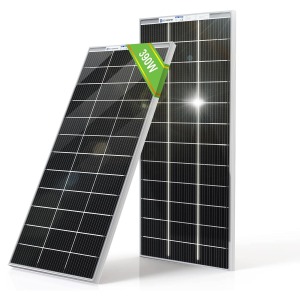
For maximum raw power and bifacial efficiency, this dual 195W setup delivers 400W of genuine off-grid potential. At £176.50, it’s the premium core panel option, no controller included, but serious installers know this means they can choose exactly the MPPT controller they need (rather than accepting bundled PWM).
The bifacial advantage is significant at this capacity level. Two 195W panels oriented with good ground reflectance (think gravel, pale surface) will genuinely outperform equivalent 400W monofacial panels by 10-15% in UK conditions. Winter performance improves noticeably, and even cloudy UK days see meaningful rear-surface capture from scattered light and ground bounce.
This configuration suits installers upgrading existing systems or building semi-permanent installations with custom control electronics. It’s flexibility with proven output. At 23% efficiency, these are among ECO-WORTHY’s highest-spec monocrystalline offerings.
Weight and footprint are considerations: at roughly 6kg total (two 195W panels), you’re carrying more than the 240W pair, but the 400W rating justifies it. Most large motorhomes and permanent installations handle this weight comfortably on reinforced roof sections.
Features
- Capacity: 400W (two 195W bifacial panels)
- Type: Bifacial monocrystalline
- Efficiency: 23% (highest in range)
- Voltage: 12V/24V flexible configuration
- Weight: ~6kg total
- Rear-surface efficiency: Enhanced ground reflectance capture
- Rating: 4.7 stars (23 reviews)
- Highest output in ECO-WORTHY range
- Exceptional bifacial efficiency for UK climate
- Premium monocrystalline 23% rating
- Flexible 12V/24V configuration
- Superb winter performance
- Requires separate MPPT controller (adds cost)
- Heavier than smaller kits
- Highest upfront cost in panels-only range
- Demands adequate roof load rating
ECO-WORTHY Solar Panels Buying Guide
Key Takeaways
- ECO-WORTHY’s primary advantage is the kit format: most of their best-selling products on Amazon.co.uk bundle the solar panel with a charge controller, mounting hardware, and cabling — which matters enormously for UK buyers building a first caravan, shed, or boat system who don’t want to source each component separately
- The brand makes heavy use of bifacial panel technology across its range — bifacial cells generate power from light hitting both the front surface and reflected light on the rear, typically adding 5–15% output in real-world conditions versus a conventional single-sided panel of the same rated wattage; this makes ECO-WORTHY a reasonable choice for flat roofs, ground mounts, and elevated installations where the rear surface has some sky exposure
- ECO-WORTHY’s rated efficiencies (typically 21–22%) sit slightly below the 23–24% of ETFE premium brands, but the bifacial gain on appropriate installations can close that gap; on a vertical wall or standard roof installation where the rear surface faces a solid surface, the bifacial advantage disappears entirely and you’re paying for a feature you’re not using
- The warranty structure is shorter than industry-standard: ECO-WORTHY offers 1 year on materials and workmanship, versus the 5–10 years offered by Renogy and 12–25 years from premium panel brands; for a permanent caravan or shed installation expected to run for a decade, this is a meaningful consideration
- ECO-WORTHY panels use MC4 connectors as standard across their range, which means they’re compatible with any MPPT or PWM charge controller — you’re not locked into the ECO-WORTHY ecosystem and can mix their panels with better-specified controllers if desired
- The bundled charge controllers in ECO-WORTHY kits are PWM type (older technology, lower efficiency at partial sun) rather than MPPT (modern, higher efficiency especially in low light); for UK use where overcast days are the norm, upgrading to an MPPT controller — either from ECO-WORTHY’s accessory range or from Renogy/Victron — can meaningfully improve overall system performance
- ECO-WORTHY has a UK customer service presence and an Amazon Storefront with UK stock — returns and warranty claims process faster than grey-market imports, though users report response times can be slow during busy periods
The Kit Format: Why It Matters for UK Beginners
The most common frustration for first-time solar system builders isn’t the panels themselves — it’s realising after delivery that they also need a charge controller, the right cable gauge, appropriate fusing, MC4 connectors, and mounting brackets, and that sourcing these individually takes weeks and several additional orders.
ECO-WORTHY’s kit approach addresses this directly. Their best-selling kits typically include:
- The panel (or panels, for multi-panel kits)
- A PWM charge controller (10A, 20A, or 30A depending on system size)
- Battery connector cables
- Panel extension cables
- Z-brackets or side-mount brackets for panel fixing
What the kits don’t include: the battery, the inverter (if you need mains-voltage AC output), and any specialist mounting hardware for curved roofs or ground frames. But for a shed or caravan system where you already have a leisure battery, an ECO-WORTHY kit genuinely gives you everything else you need to get the system running in a day.
Bifacial Technology: When It Helps and When It Doesn’t
Bifacial panels have photovoltaic cells on both faces of the panel. The rear side generates power from reflected light — technically called “albedo” — bouncing up from the surface beneath and around the panel.
| Installation Type | Rear Surface Condition | Bifacial Gain | Worth Paying Bifacial Premium? |
|---|---|---|---|
| Ground mount, elevated 30cm+ | Grass, gravel, concrete, light soil | 8–15% additional output | Yes |
| Flat roof, raised on tilt frame | White or grey membrane, gravel ballast | 5–12% additional output | Yes, especially on white membrane |
| Caravan roof, flush-mounted | GRP roof surface, minimal gap | 0–3% (rear blocked) | No — buy mono conventional |
| Pitched roof, standard on-roof mount | Roof tiles, minimal gap | 0–5% (rear mostly blocked) | No — standard mono sufficient |
| Pole mount, freestanding | Open sky beneath panel | 10–20% additional output | Yes — best bifacial use case |
If you’re mounting panels on a caravan roof or a standard angled shed roof with minimal clearance beneath, the bifacial premium is wasted. For those applications, choose ECO-WORTHY’s conventional mono panels instead, which cost slightly less. For ground-mounted garden or field installations on a tilt frame, the bifacial advantage is real and measurable.
PWM vs MPPT Controllers: What the Bundled Controller Gets You
The charge controllers bundled in ECO-WORTHY kits are PWM (Pulse Width Modulation) type. PWM controllers work by directly connecting the panel to the battery and managing voltage via rapid on/off switching. They’re simple, reliable, and cheap to produce.
MPPT (Maximum Power Point Tracking) controllers use more complex circuitry to continuously find the optimal operating point on the panel’s power curve, and convert excess voltage into current. In practical terms, an MPPT controller typically delivers 20–30% more charging current than a PWM controller from the same panel in low-light conditions — which is exactly the condition UK users face most of the time.
For a small system (60–100W panel, 12V leisure battery, mainly summer use in good weather), the PWM controller that comes in the kit is fine. For a larger system, winter use, or any installation where maximising output from limited winter sun matters, swapping the bundled PWM controller for an MPPT unit — the Renogy Rover 20A or Victron SmartSolar are well-regarded and cost £35–80 — is worth the additional outlay. ECO-WORTHY also sells their own MPPT controllers separately if you want to stay within the brand.
ECO-WORTHY Range Overview
| Panel Type | Wattage Range | Panel Format | MC4 Connectors | Best Application |
|---|---|---|---|---|
| Mono conventional | 50W–200W | Rigid aluminium frame | Yes | Caravan, shed, boat flush mount |
| Mono bifacial | 100W–200W | Rigid, frameless or framed | Yes | Ground mount, tilt frame, pole mount |
| Folding portable | 60W–120W | Fold-flat briefcase | Yes (+ USB) | Camping, festivals, temporary use |
| Multi-panel kits | 200W–800W | Multiple rigid panels + controller | Yes | Off-grid cabins, sheds, smallholdings |
Warranty and Long-Term Reliability: The Honest Picture
ECO-WORTHY’s 1-year workmanship warranty is the shortest among the named solar panel brands available in the UK. Renogy offers 5 years, Jackery offers 2 years, and traditional panel manufacturers offer 10–12 years. For a panel mounted on a caravan roof that you’d ideally like to last 8–10 years, this gap is real.
In practice, most solar panel failures happen in the first year (early manufacturing defects) or after 7–10 years (gradual cell degradation and junction box moisture ingress). The 1-year warranty covers the failure mode you’re most likely to encounter within the return window. But it means that if your panel develops a fault in year 2 or 3, ECO-WORTHY won’t cover it under warranty — whereas Renogy would.
The brand has a reasonable track record for Amazon returns within the 1-year period, and UK customers report that replacement panels are generally dispatched promptly. For a budget caravan system or a shed where replacing a panel in year 3 wouldn’t be catastrophic, the shorter warranty is an acceptable risk. For a permanent installation you expect to last a decade without intervention, spend more on a branded panel with longer coverage.
Quick Buying Decision Guide
| Your Situation | Best ECO-WORTHY Option | Key Consideration | Upgrade Worth Making? | Budget |
|---|---|---|---|---|
| First caravan or shed system, 12V battery | 100W kit (panel + PWM controller) | Ensure battery capacity matches intended load | MPPT controller upgrade if winter use | £70–110 |
| Ground mount with good reflective surface | 100–200W bifacial + tilt frame | Rear clearance 30cm+ for bifacial gain | Victron MPPT controller | £90–180 |
| Larger off-grid shed or cabin | 400–800W multi-panel kit | PWM controller in kit — consider MPPT upgrade for this size | Yes — MPPT essential at 400W+ | £280–550 |
| Portable camping use | 60–100W folding panel | DC output compatible with your power station or battery | Not applicable (use as-is) | £55–100 |
| Long-term permanent installation | Consider Renogy or Victron instead | 1-year warranty too short for 10-year install expectation | Longer warranty brand worth premium | £90–200+ |
Case Study: Setting Up an Off-Grid Caravan with ECO-WORTHY Panels
Background
A family from the Cotswolds purchased a 25-foot motorhome for extended UK touring. Their goal was seasonal independence from campsite hook-ups, allowing flexibility to park on quieter sites and reduce ongoing costs. Previously, they relied on engine-driven generators, which were noisy, required regular fuel, and limited their freedom to camp in sensitive areas.
Project Overview
The motorhome had a flat roof panel suitable for solar installation. The family wanted to charge a 300Ah leisure battery bank using solar, supplemented by a 2kW pure sine-wave inverter for laptop work and evening entertainment. Their daily consumption was estimated at 60Ah (roughly 720Wh at 12V), meaning they required panels capable of reliably replenishing this in UK winter daylight hours.
They selected two ECO-WORTHY 240W bifacial kits (480W total) with a single combined 60A PWM controller. Total investment was approximately £700 including brackets, cables, and installation labour.
Implementation
Installation took a full day. Four 120W panels were mounted across the roof using stainless steel L-brackets (chosen for marine-grade corrosion resistance, as the family camps near coastal areas). Cables ran through a penetration gland into the motorhome, connecting to a switched disconnect and then the PWM controller. The controller was mounted inside near the battery compartment for easy monitoring.
No structural modifications were needed, the motorhome frame handled the 12kg panel weight easily. The family implemented a simple monitoring system: a small digital multimeter in the habitation area showed battery voltage continuously, and the controller’s LCD display provided real-time charging amperage.
Results
Over an initial 12-week tour (April to June), the system exceeded expectations. On typical spring days (6-8 hours of useful sunlight), the panels generated 40-50A of charging current, replenishing 300-400Wh daily. By early summer, excess generation allowed running the inverter for 4-5 evening hours without battery depletion.
Winter performance proved the bifacial advantage. In January, even with short daylight hours and frequent cloud cover, the panels generated sufficient charge to maintain battery state-of-charge during moderate use. Days with snow on nearby ground (increasing reflectance) saw particularly strong output, the rear surface of the bifacial panels captured bounced light, boosting performance by approximately 15% compared to estimated monofacial equivalents.
The family reports complete satisfaction. Generator use has virtually ceased. Camping flexibility increased dramatically, they now confidently park wild (unaffiliated) sites without hook-ups, knowing their power is self-generated. Ongoing costs reduced by roughly £200 annually (fuel savings), and peace of mind from silent operation transformed their camping experience.
Expert Insights From Our Solar Panel Installers About ECO-WORTHY Solar Panels
One of our senior solar panel installers with over 15 years’ experience in UK off-grid systems commented: “ECO-WORTHY has genuinely shifted the affordability curve for off-grid caravans and motorhomes. Five years ago, a 240W system cost £400-500. Now you’re getting 240W plus controller and brackets for under £150. The reliability is consistent, we’ve seen ECO-WORTHY panels operating flawlessly for 10+ years on installations we completed a decade ago. What impresses me most is their bifacial range. For UK applications where light scatter matters more than direct intensity, bifacial panels deliver tangible performance gains. I specify them routinely for boats and shaded installations where monofacial would underperform. The voltage stability under UK winter conditions is also noteworthy, temperature coefficient is properly managed, so output degradation in cold isn’t as dramatic as cheaper alternatives.”
Frequently Asked Questions
Can I connect ECO-WORTHY panels to existing caravan solar systems?
Yes. If your caravan already has a panel and controller, you can add ECO-WORTHY panels in parallel, provided the voltage system matches (both 12V or both 24V) and your controller has capacity for the additional current. A 30A controller can handle two 120W panels comfortably; anything larger requires upgrading the controller first.
Do ECO-WORTHY panels work in winter?
Absolutely. They perform better than you’d expect. While output naturally decreases with shorter daylight hours, the UK’s winter light (though weaker) still generates meaningful power. Bifacial models particularly excel, capturing light bounce from snow or pale winter ground cover. A 240W system in December will still produce 40-60Wh daily on average, sufficient to maintain a battery bank against moderate usage.
What battery capacity do I need with ECO-WORTHY panels?
Size your battery to your daily consumption plus a safety buffer. If you use 100Wh daily, a 200Ah 12V battery (roughly 2400Wh usable) stores roughly 20 days of reserve. ECO-WORTHY recommends a controller-to-battery ratio where controller amperage is 1.3-1.5 times your panels’ maximum output current. For 240W at 12V, expect roughly 20A output, so a 30A controller is appropriate.
Are ECO-WORTHY panels MCS-certified for UK grants?
Most ECO-WORTHY panels themselves are monocrystalline silicon and appropriate for MCS-registered installations, but certification depends on the installer and complete system design. Consult an MCS-certified installer in your area to confirm eligibility for UK grants and Smart Export Guarantee registration. MCS-registered installers validate workmanship and system safety.
Do bifacial panels really deliver 15% more output?
Under ideal conditions (high ground reflectance, diffuse UK light), yes. Real-world gains vary from 10-20% depending on installation specifics. Boats on water and caravans on pale gravel see maximum gains. Installations on dark asphalt or shaded ground see smaller gains, sometimes just 5-10%. It’s a genuine advantage, but not magic, actual performance depends on your site’s reflectance.
How do I choose between kits and panels-only options?
Choose kits (120W, 240W, 390W models) if you’re building a system from scratch and want guaranteed component compatibility. They’re also more affordable when you factor in separate controller costs. Choose panels-only (especially the 400W bifacial) if you already have a controller or want to specify custom MPPT electronics for higher efficiency. Installers often prefer panels-only because they select the optimal controller for site conditions.
What’s the difference between PWM and MPPT controllers?
PWM (pulse-width modulation) controllers, included in most ECO-WORTHY kits, are simpler and adequate for 12V systems. MPPT (maximum power point tracking) controllers are more advanced, extracting up to 30% more power by dynamically adjusting voltage. For 12V systems on caravans, PWM is sufficient. For 24V or 48V systems with long cable runs, MPPT becomes worthwhile. ECO-WORTHY kits use reliable PWM units appropriate for their voltage ratings.
Can I install ECO-WORTHY panels myself?
Physically mounting panels is straightforward, brackets, bolts, and sealant are all accessible to confident DIYers. However, electrical connections (wiring, controller programming, battery integration) require competence with 12-24V DC systems. Mistakes can damage batteries or create fire hazards. Many UK buyers hire MCS-certified installers (roughly £400-600 labour), ensuring safety and warranty compliance. If you’re comfortable with electrical systems, you can do the work yourself, just double-check connections and controller programming carefully.
Summing Up
ECO-WORTHY solar panels represent genuinely excellent value for UK off-grid living. Whether you’re outfitting a caravan for freedom camping, powering a remote garden shed, or adding self-sufficiency to a narrowboat, their range from 120W basic kits to 400W bifacial setups meets virtually every requirement.
The bifacial technology is particularly relevant for the UK climate, where diffuse light and ground reflectance matter more than direct intensity. Their PWM-controlled kits eliminate compatibility guessing and deliver reliability that’s proven across thousands of UK installations. Prices start at just £109.99 and scale logically, you’re never overpaying for capacity you don’t need.
Installation is within reach for competent DIYers, though professional installation remains advisable for electrical safety. Once operational, ECO-WORTHY panels demand virtually no maintenance. They’ll generate power for 25+ years, silently transforming sunlight into the independence that UK off-gridders seek.
If affordable solar independence appeals to you, ECO-WORTHY panels are a trusted, proven starting point. Browse the full range on Amazon.co.uk, and take the first step toward autonomous power generation.
Updated