
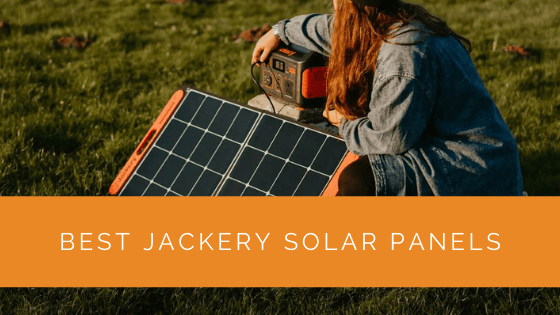
The Jackery SolarSaga 100W is our top pick for most UK buyers, combining proven 23% efficiency with a genuinely portable foldable design and over 1,800 Amazon reviews to back it up. Whether you’re charging a power station at a music festival in Somerset, keeping a campervan battery topped up on a Scottish road trip, or running emergency backup power from your back garden during a winter outage, Jackery’s SolarSaga range has become the benchmark by which portable solar panels are judged in the UK.
Jackery operates differently from budget panel brands. Their SolarSaga lineup is designed specifically to pair with the Explorer range of portable power stations, creating a seamless solar-to-storage ecosystem. In this guide we’ve reviewed every SolarSaga model available on Amazon.co.uk, from the compact 40 Mini through to the high-output 200W, plus the best-value Explorer bundle options for buyers who want panels and storage in one purchase.
Contents
- 1 Our Top Picks
- 2 5 Best Jackery Solar Panels
- 3 Jackery Solar Panels Buying Guide
- 3.1 Key Takeaways
- 3.2 The SolarSaga Range: Models and What Each One Is For
- 3.3 The Ecosystem Advantage: Why Jackery Panels Work Best with Jackery Stations
- 3.4 IP Ratings: Why Jackery’s Waterproofing Stands Apart
- 3.5 Efficiency and UK Real-World Output: What the Numbers Mean
- 3.6 The Value Question: Is Jackery Worth the Premium?
- 3.7 Quick Buying Decision Guide
- 4 Case Study: Wild Camping Weekend on the Gower Peninsula
- 5 Expert Insights From Our Solar Panel Installers About Jackery SolarSaga Panels
- 6 Frequently Asked Questions
- 6.1 Are Jackery solar panels any good?
- 6.2 Do Jackery solar panels work in the UK?
- 6.3 Do Jackery solar panels work with other brands’ power stations?
- 6.4 How long does a Jackery solar panel take to charge an Explorer power station?
- 6.5 What’s the difference between the SolarSaga 100W and SolarSaga 200W?
- 6.6 Can you leave Jackery solar panels out in the rain?
- 6.7 Is the Jackery Explorer bundle worth buying?
- 6.8 How many Jackery solar panels do I need for an Explorer 1000?
- 7 Summing Up
Our Top Picks
| Image | Name | |
|---|---|---|
| Jackery SolarSaga 100W | |
| Jackery SolarSaga 40 Mini | |
| Jackery SolarSaga 200W | |
| Jackery Explorer 500 v2 + SolarSaga 100W Bundle | |
| Jackery Explorer 1000 v2 + SolarSaga 100W Bundle |
5 Best Jackery Solar Panels
1. Jackery SolarSaga 100W
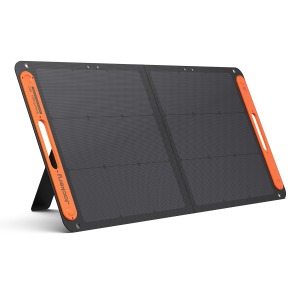
The SolarSaga 100W is the panel that built Jackery’s UK reputation, and with 1,817 Amazon ratings averaging 4.6 stars, the numbers speak for themselves. At £199 it sits in the sweet spot between the budget 40 Mini and the premium 200W, delivering genuine 100W output through monocrystalline cells at 23% conversion efficiency. In typical UK summer conditions you’ll realistically pull 50-70W from it, which is enough to meaningfully charge an Explorer 240 or 500 power station over a day of camping.
The physical design is smarter than it looks. Folded, it’s about the size of a briefcase and weighs 4.7kg, manageable for one person to carry from the boot of a car to a pitch or picnic spot. The TPE rubber handle is properly comfortable rather than the flimsy afterthought you get on cheaper panels. Open it out and the kickstand lets you angle it toward the sun without fiddling with improvised props. There’s a useful USB-A and USB-C port built in, so you can charge a phone directly off the panel without needing the power station as an intermediary.
Where the SolarSaga 100W genuinely earns its premium over budget alternatives is durability. The ETFE-laminated surface handles rain without complaint, and the panel’s history on UK campsites and canal boats over several years gives confidence that it won’t delaminate or lose output after a British summer of mixed conditions. A single panel paired with an Explorer 240 or 500 covers the power needs of most weekend campers comfortably. Those with bigger power stations or longer stays often run two panels in parallel.
The only honest caveat is that used SolarSaga 100W panels sometimes appear on resale sites at around £100-130, and Jackery’s build quality means used examples perform almost as well as new. If budget is the primary concern, that secondary market is worth knowing about. But for a brand-new panel with full warranty coverage, £199 from Amazon is fair value for what you’re getting.
Features
- 100W monocrystalline output
- 23% conversion efficiency
- Foldable design with TPE rubber carry handle
- Adjustable kickstand for angle optimisation
- USB-A and USB-C output ports
- Weight: 4.7kg
- ETFE surface lamination
- Compatible with Jackery Explorer 240, 500, 1000 and later models
- 2-year warranty
- Over 1,800 Amazon reviews at 4.6 stars – proven reliability
- 23% efficiency performs well in UK overcast conditions
- Comfortable handle, well-built kickstand
- USB ports allow direct phone charging without a power station
- 4.7kg is manageable but not ultralight for backpacking
- 100W output may be limiting for larger power station models
- No official IP waterproofing rating (splash-resistant but not submersible)
2. Jackery SolarSaga 40 Mini
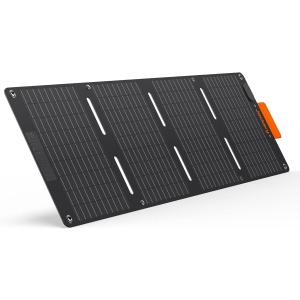
The 40 Mini is Jackery’s answer to a very specific question: what do you take when weight is everything? At 1.2kg and roughly the size of a hardback book when folded, this is the panel you clip to the outside of a rucksack and forget about until you need it. The 4-fold design means it collapses down to just 25cm x 30cm, and the included carabiner clips attach directly to most hiking packs without any extra gear. IP68 waterproofing is a genuine and rare feature at this price – the panel can get completely soaked in a Scottish Highland downpour and carry on charging.
At 40W, it won’t charge a power station quickly, but that’s not really the point. The USB-C output (up to 45W) and USB-A port let you charge phones, headlamps, and small devices directly from sunlight. Realistic UK output in overcast summer conditions runs around 15-25W, which is enough to keep a smartphone topped up through a day on the hill. The 23% efficiency means it punches above its weight for the panel surface area. And at £99, it’s the entry point into genuine Jackery quality without a significant financial commitment.
It’s not designed to replace a full portable power system. But for the walker, cyclist, or festival-goer who wants a lightweight solar safety net rather than serious power generation, the 40 Mini is genuinely useful kit.
Features
- 40W monocrystalline output
- 23% conversion efficiency
- IP68 waterproofing (fully waterproof)
- 4-fold compact design: 25cm x 30cm folded
- USB-C output (up to 45W) and USB-A output
- Weight: 1.2kg
- 2 carabiner clips included
- Suitable for direct device charging and small Jackery power stations
- IP68 waterproofing handles British rain without worry
- Ultralight at 1.2kg, clips to rucksack
- USB-C 45W output charges modern phones and tablets directly
- 23% efficiency despite compact size
- 40W output is limited for power station charging
- Fewer reviews than the SolarSaga 100W
- Not suitable as a primary power source for camping with significant loads
3. Jackery SolarSaga 200W
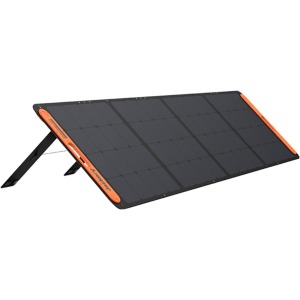
The SolarSaga 200W pushes Jackery’s efficiency to 24.3% – currently among the highest of any foldable panel in its class – and delivers the output needed to seriously charge larger Explorer power stations like the 1000 or 1000 Pro. Two kickstands provide better stability than the single stand on the 100W, and a magnetic fastening system holds the two panels together neatly when folded for transport. A carrying bag is included in the box, which the 100W notably lacks.
In good UK summer conditions, 100-140W is a realistic output, which fills an Explorer 1000 (1002Wh) in roughly eight hours of decent sunshine. That’s a full day of Scottish summer sun – entirely achievable in June and July. Pair two 200W panels and you halve that time. For motorhome owners, liveaboard boaters, or anyone running significant electrical loads off-grid, the 200W is the right starting point rather than an upgrade down the line.
At £399 it’s a significant outlay for a single panel. The 67-review count on Amazon.co.uk is relatively modest compared to the 100W’s 1,800+, which suggests it appeals to a narrower, more committed off-grid buyer rather than casual campers. If you’re unsure whether 200W is right for you, starting with two 100W panels is worth considering – you get the same output with more flexibility in deployment and storage.
Features
- 200W monocrystalline output
- 24.3% conversion efficiency
- Dual kickstands for stable freestanding deployment
- Magnetic panel closing
- Carrying bag included
- Compatible with all Jackery Explorer power stations
- 2-year warranty
- 24.3% efficiency – highest in the SolarSaga range
- 200W output charges large power stations meaningfully
- Two kickstands provide better stability than single-stand designs
- Carrying bag included out of the box
- £399 is a substantial investment for a single panel
- Fewer reviews than the 100W model
- Larger folded footprint requires more boot space
4. Jackery Explorer 500 v2 + SolarSaga 100W Bundle
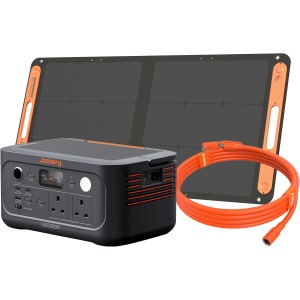
For buyers who want a complete solar power system in a single purchase, the Explorer 500 v2 bundled with the SolarSaga 100W panel is the most accessible entry point Jackery offers on Amazon.co.uk. The Explorer 500 v2 holds 519Wh – enough to charge a smartphone around 40 times, run a CPAP machine for a night, or keep lights, a small fan, and device charging running over a weekend campsite stay. The 500W AC output handles most small appliances without issue.
Buying as a bundle at £449 works out cheaper than purchasing the power station and panel separately, and the setup genuinely takes minutes: unfold the panel, connect the included cable, point it at the sky. Jackery’s ecosystem means everything works together without compatibility headaches. The combination fits neatly in the boot of most hatchbacks, and the Explorer 500 v2 is one of Jackery’s lighter power stations, meaning the full kit isn’t an ordeal to move around a campsite or festival ground.
This bundle is best suited to occasional campers and festival-goers rather than full-time off-gridders. A 519Wh capacity fills reasonably quickly from a single 100W panel, and the 500W output covers typical weekend needs comfortably. If you’re planning extended motorhome trips or running larger appliances like a travel fridge on a regular basis, step up to the Explorer 1000 v2 bundle below.
Features
- Jackery Explorer 500 v2: 519Wh LiFePO4 battery
- 500W AC output (pure sine wave)
- SolarSaga 100W panel and 5m extension cable included
- Full charge via solar in approximately 5.5 hours in good UK conditions
- USB-A, USB-C, and 12V car socket outputs
- LiFePO4 battery: 3,000+ cycle lifespan
- Complete plug-and-play solar system in one box
- Bundle price is cheaper than buying components separately
- Explorer 500 v2 is a manageable weight for campsite use
- LiFePO4 battery: 3,000+ cycle lifespan
- 519Wh capacity may not be sufficient for longer trips
- Single 100W panel charges slowly on overcast UK days
- Power station adds bulk – not suitable for backpacking
5. Jackery Explorer 1000 v2 + SolarSaga 100W Bundle
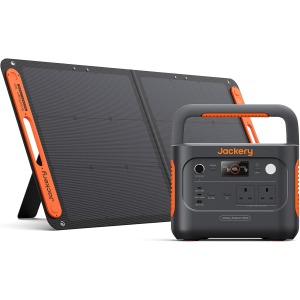
The Explorer 1000 v2 paired with the SolarSaga 100W is Jackery’s mid-range complete solar solution, and for serious campers, motorhomers, and off-grid enthusiasts it represents the best balance of capacity, output, and portability in their lineup. The 1070Wh LiFePO4 battery handles extended trips – a long weekend with moderate usage, or a week with careful power management. The 1,500W AC output is enough to run a travel fridge, power a laptop, or drive a small projector without the hesitation you get from smaller units.
The v2 generation brings meaningful improvements over its predecessor: 1-hour mains charging via the ChargeShield 2.0 system, smartphone app control for monitoring charge state and power draw, and 4,000 battery cycles before capacity drops below 70% – roughly ten years of daily use. At 4.5 stars from 106 Amazon reviews, it’s well-regarded by UK buyers. The SolarSaga 100W panel in the bundle is the same proven model reviewed above, connecting via a dedicated DC port with included cables.
At £579 this is a proper investment. But for anyone planning to camp off-grid regularly, equip a motorhome with solar power, or have reliable emergency backup at home, the Explorer 1000 v2 bundle provides a capable, expandable system that will last years. You can add a second SolarSaga 100W panel later to halve solar charging times, or a third when your needs grow.
Features
- Jackery Explorer 1000 v2: 1070Wh LiFePO4 battery
- 1,500W AC output (pure sine wave)
- SolarSaga 100W panel included
- 1-hour fast charge via mains (ChargeShield 2.0)
- Smartphone app control and monitoring
- 4,000 battery life cycles
- USB-A, USB-C 100W, AC outlets, 12V car socket
- CE certified
- 1070Wh handles extended trips and heavy electrical loads
- 1,500W AC output covers most small appliances
- 1-hour mains fast charge when solar isn’t available
- Smartphone app for monitoring and management
- 4,000 cycle LiFePO4 battery – excellent long-term value
- £579 is a significant purchase for first-time buyers
- Single 100W panel charges the 1070Wh battery slowly in UK conditions
- Heavier than smaller power stations – not for casual day trips
Jackery Solar Panels Buying Guide
Key Takeaways
- Jackery SolarSaga panels are the premium option in the UK portable solar panel market — you pay significantly more per watt than any other folding panel brand, and the trade-off you’re getting is genuine: ETFE laminate construction, best-in-class build quality, and panels designed to work as a seamless system with Jackery Explorer portable power stations
- The SolarSaga range uses ETFE (ethylene tetrafluoroethylene) laminate rather than the PVC laminate found on budget panels — ETFE is lighter, more UV-stable, and transmits more of the usable light spectrum to the cells, which means both better initial efficiency and better retention of that efficiency over years of use
- Jackery panels are designed around the Explorer power station ecosystem: the primary output connector is Jackery’s proprietary 2-pin solar input connector, which plugs directly into any Explorer station without adaptors; a DC5521 barrel jack port is included for use with other devices, and USB ports cover direct device charging
- The SolarSaga 200W is the standout model in the range — it’s bifacial (generates power from both panel faces), IP68 dust and waterproof, and folds to a compact 57 × 54 × 4 cm; IP68 is meaningfully better than the IPX4 you get from most competitors and matters for UK camping where the panel may need to charge in light rain
- Efficiency ratings of 23–25% on Jackery SolarSaga panels are among the highest available in the folding panel segment — in practice on a UK overcast day, the difference versus a 21% budget panel is around 10–15% more power from the same panel footprint
- Jackery’s main limitation is cost: the SolarSaga 100W costs roughly 2–3× what an equivalent-wattage ALLPOWERS or ECO-WORTHY panel costs; if you don’t own a Jackery Explorer power station and aren’t planning to buy one, the ecosystem advantage disappears and you’re buying build quality at a significant premium
- Jackery UK operates from a UK base with genuine UK customer support and a 2-year warranty — claims are handled directly rather than through third-party Amazon processes, and the product pages on Amazon.co.uk are fulfilled directly by Jackery rather than through grey-market resellers
The SolarSaga Range: Models and What Each One Is For
| Model | Wattage | Efficiency | IP Rating | Bifacial? | Folded Size | Weight | Best Paired With |
|---|---|---|---|---|---|---|---|
| SolarSaga 40W | 40W | 23.5% | IP67 | No | 29 × 24 × 3 cm | 1.0 kg | Explorer 240, 300 Plus |
| SolarSaga 80W | 80W | 23% | IP67 | No | 37 × 29 × 3 cm | 1.8 kg | Explorer 300 Plus, 500 |
| SolarSaga 100W | 100W | 23.7% | IP67 | No | 41 × 29 × 3 cm | 2.1 kg | Explorer 500, 1000 Plus |
| SolarSaga 200W | 200W | 24.3% | IP68 | Yes | 57 × 54 × 4 cm | 4.7 kg | Explorer 1000 Plus, 2000 Plus |
The SolarSaga 100W is the most widely sold model in the UK and the natural choice for most Explorer power station owners. The SolarSaga 200W is the model to choose if you need faster charging for a larger Explorer station (1000 Plus or above) and want the additional protection of IP68 waterproofing and bifacial rear-face output.
The Ecosystem Advantage: Why Jackery Panels Work Best with Jackery Stations
The primary connector on all SolarSaga panels is Jackery’s proprietary 2-pin solar connector — the same connector used on every Explorer power station. There are no adaptors needed, no compatibility questions to work through, and no risk of mismatched voltage or wattage causing charging issues. You unfold the panel, plug it in, and charging begins automatically.
This simplicity is genuine and valuable, particularly if you’re new to portable solar. The Explorer stations include solar input management — they regulate the charging process, protect the battery from overcharge, and display real-time solar input wattage on the station’s screen. The panel and station behave as a designed system because they are one.
If you already own a different brand of portable power station — a Bluetti, EcoFlow, or ALLPOWERS R600 — the Jackery panel becomes more complicated. The DC5521 barrel jack port on SolarSaga panels connects to most stations via an adaptor, but you’ll need to check the solar input specifications of your specific station and source the right adaptor. The ecosystem advantage is entirely gone, and you’re buying ETFE construction and Jackery’s build quality at a premium price without the integration benefit.
IP Ratings: Why Jackery’s Waterproofing Stands Apart
Most folding solar panels carry an IPX4 rating — splash-resistant from any direction, suitable for light rain but not sustained exposure. The SolarSaga 40W, 80W, and 100W models carry IP67 ratings: dust-tight and waterproof to 1 metre submersion for 30 minutes. The SolarSaga 200W goes further with IP68: sustained submersion beyond 1 metre.
In practical UK camping terms, IP67 means your panel won’t be damaged if you leave it deployed in a rain shower — the kind of situation that happens on most UK camping weekends. IPX4 means you can use it in light rain but should bring it under cover in heavy rain. The difference is meaningful for UK users in a way it might not be for users in sunnier climates.
The IP rating covers the panel body and connector ports. The ETFE laminate surface is also more abrasion-resistant than PVC, so the panel surface survives being stored with other gear in a rucksack without scratching or surface degradation.
Efficiency and UK Real-World Output: What the Numbers Mean
Jackery’s published efficiencies of 23–24% for SolarSaga panels are verified under Standard Test Conditions (1,000W/m² irradiance, 25°C cell temperature). On a typical UK overcast summer day (around 300–400W/m² diffuse irradiance), a 100W SolarSaga panel will produce approximately:
- Clear UK summer day at noon, south-facing: 75–85W
- Overcast UK summer day: 35–55W
- Overcast UK autumn day: 20–35W
- Overcast UK December day: 8–15W
An ALLPOWERS 100W panel at 21% efficiency in the same conditions would produce roughly 85–90% of those figures — so the efficiency premium translates to perhaps 5–8W more output on an average UK day. This is real but not dramatic. The stronger arguments for Jackery are the build quality, IP rating, and ecosystem integration — not raw efficiency alone.
The Value Question: Is Jackery Worth the Premium?
The honest answer depends on how you’ll use it. Jackery SolarSaga panels cost around £120–180 for the 100W model. A comparable-wattage ALLPOWERS costs £65–90. That’s a £55–90 premium for ETFE construction, IP67 rating, and seamless Explorer integration.
The Jackery premium is worth it if you own or plan to own a Jackery Explorer station, expect to use the panel in rain or challenging conditions, plan to use it heavily over several years (ETFE laminates degrade significantly slower than PVC), or simply value the certainty of buying a product that works as documented.
The Jackery premium is not worth it if you only camp a few times a year in reasonable weather, don’t own a Jackery power station, or are primarily using the panel for device charging where the IP rating doesn’t change your day-to-day use.
Quick Buying Decision Guide
| Your Situation | Best SolarSaga Model | Expected Real-World Output (UK summer overcast) | Key Advantage | Budget |
|---|---|---|---|---|
| Light camping, Explorer 240/300 Plus owner | SolarSaga 40W or 80W | 15–35W | Direct Explorer plug-in, lightweight | £65–120 |
| Camping, Explorer 500/1000 Plus owner | SolarSaga 100W | 35–55W | IP67, ETFE, direct ecosystem fit | £120–160 |
| Heavy camping or van use, Explorer 1000+ owner | SolarSaga 200W bifacial | 60–90W (front) + 5–12% bifacial gain | IP68, bifacial, fastest Explorer charging | £240–300 |
| Using with non-Jackery power station | Any SolarSaga (check adaptor) | As above | Build quality and IP rating only | £120–300 + adaptor |
| Budget-conscious, weather usually fine | Consider ALLPOWERS or BigBlue instead | Slightly lower output per watt | PVC laminate acceptable for occasional use | £65–100 |
Case Study: Wild Camping Weekend on the Gower Peninsula
Background
A couple from Cardiff made regular trips to the Gower Peninsula for wild camping weekends. Their requirements were modest: keep smartphones charged, run a small 12V camping fan on warmer nights, and occasionally power a Bluetooth speaker. They had no prior experience with solar power and wanted a system that required no technical knowledge to operate.
Project Overview
After researching options, they settled on the Jackery Explorer 500 v2 and SolarSaga 100W bundle at £449. The complete system arrived in a single delivery with everything needed to get started immediately.
Implementation
Setup on their first camping trip took around five minutes. The SolarSaga 100W panel unfolded onto a south-facing rock ledge with its kickstand propped at roughly 45 degrees. The DC cable connected to the Explorer 500 v2 and charging began immediately. Over a day of mixed cloud and sun, the panel delivered enough to top the power station from 40% to 85% capacity. Smartphones, the fan, and the speaker ran from the Explorer throughout the weekend without the battery dropping below 30%.
Results
After a full summer of weekend use, the system had performed without a single failure. They used mains charging only twice when consecutive overcast days depleted the battery faster than the panel could recover it. The following season they added a second SolarSaga 100W panel, which halved their dependence on mains top-ups and made the system genuinely off-grid capable for their style of camping.
Expert Insights From Our Solar Panel Installers About Jackery SolarSaga Panels
“Jackery’s SolarSaga panels occupy an interesting space,” explains one of our senior solar panel installers with over 12 years of experience. “They’re not professional-grade fixed installation panels, but for portable power they’re genuinely well-made. The 23-24% efficiency is impressive for a foldable panel, and the build quality holds up to UK conditions better than most budget alternatives I’ve tested. Where I see buyers make mistakes is oversizing the power station but undersizing the panel array. A single 100W panel will struggle to keep pace with a 1,000Wh power station in UK conditions. Budget for at least two 100W panels running in parallel if you’re using an Explorer 1000 or larger, and you’ll be much happier with the results.”
Frequently Asked Questions
Are Jackery solar panels any good?
Yes. The SolarSaga 100W has over 1,800 Amazon reviews averaging 4.6 stars, which is strong real-world validation. Jackery’s build quality, 23-24.3% efficiency ratings, and 2-year warranty make them reliable and well-suited to UK outdoor and off-grid use. They’re not the cheapest panels available, but they’re among the most proven.
Do Jackery solar panels work in the UK?
Yes, but with lower output than the rated figures suggest. In UK summer conditions, expect 40-60% of stated wattage. A SolarSaga 100W will typically generate 40-65W on a bright day and 20-35W when overcast. Plan your system around realistic UK output figures rather than peak ratings, and size your panel array accordingly.
Do Jackery solar panels work with other brands’ power stations?
Generally yes, with MC4 adapter cables available to connect SolarSaga panels to other power stations. But they’re designed and optimised for the Explorer range – using them with other brands means losing the plug-and-play simplicity and potentially affecting warranty coverage. Check compatibility carefully if you’re building a mixed-brand system.
How long does a Jackery solar panel take to charge an Explorer power station?
One SolarSaga 100W panel will charge an Explorer 240 (240Wh) in roughly 4-6 hours of good UK summer sun, and an Explorer 1000 (1002Wh) in 14-20 hours. Running two 100W panels in parallel roughly halves those times. Always use real-world output figures – 40-65W in UK summer – rather than rated wattage for planning.
What’s the difference between the SolarSaga 100W and SolarSaga 200W?
The 200W delivers twice the output and slightly higher efficiency (24.3% vs 23%), includes dual kickstands and a carrying bag, and costs £399 vs £199. Two SolarSaga 100W panels in parallel match the 200W output with more deployment flexibility and often similar total cost. The 200W makes most sense if you prefer managing one large panel rather than two smaller ones.
Can you leave Jackery solar panels out in the rain?
The SolarSaga 40 Mini is IP68 rated and handles rain without any issue. The SolarSaga 100W and 200W are weather-resistant with ETFE surface coatings but don’t carry an official IP rating. They’ll handle light rain and splashes fine, but prolonged heavy soaking isn’t recommended. Bring them under cover during sustained downpours.
Is the Jackery Explorer bundle worth buying?
Yes, if you don’t already own an Explorer power station. Bundles are priced below the combined cost of buying components separately and eliminate compatibility concerns entirely. For first-time buyers wanting a complete solar system, a bundle is the most straightforward and cost-effective option. If you already own an Explorer, buy a standalone panel instead.
How many Jackery solar panels do I need for an Explorer 1000?
In realistic UK conditions, you’ll want at least two SolarSaga 100W panels running in parallel to charge an Explorer 1000 (1002Wh) meaningfully within a day. One panel can do it given enough daylight hours, but two panels are much more practical, filling the battery in 8-12 hours of reasonable UK summer sun rather than 15-20 hours with a single panel.
Summing Up
Jackery’s SolarSaga range covers the main bases for portable solar power in the UK, from the ultralight 40 Mini for backpackers through to the high-output 200W for serious off-grid setups. The SolarSaga 100W remains the best starting point for most buyers, with its combination of proven reliability, direct USB charging capability, and over 1,800 five-star Amazon reviews providing genuine reassurance. If you’re buying your first portable solar setup and don’t yet own a power station, the Explorer 500 v2 or Explorer 1000 v2 bundles deliver complete systems at prices that beat buying components separately. For professional solar panel installation for your home, contact us for a free quote.
Updated