
When it comes to reliable camping light that charges itself during the day, the MPOWERD Luci Pro Outdoor 2.0 is the best solar camping lantern you can buy for UK conditions. It inflates to a glowing 150-lumen lantern, runs for up to 48 hours on a charge, charges via both solar and USB-C, and doubles as a phone charger for genuine multi-night usefulness.
Below you’ll find six of the best solar camping lanterns available on Amazon.co.uk, covering everything from premium inflatable models to high-brightness foldable lanterns and budget multi-packs. Whether you’re backpacking through the Lake District or setting up a car camping spot in the Peak District, there’s a solar lantern here that suits the way you camp.
Our Top Picks
| Image | Name | |
|---|---|---|
| MPOWERD Luci Pro Outdoor 2.0 | |
| MPOWERD Luci Outdoor 2.0 | |
| BioLite SiteLight Solar | |
| Bravzurg Solar Camping Lantern | |
| LETMY Solar Camping Lantern 4-Pack | |
| Solar Hand Crank Emergency Lantern |
6 Best Solar Camping Lanterns
1. MPOWERD Luci Pro Outdoor 2.0
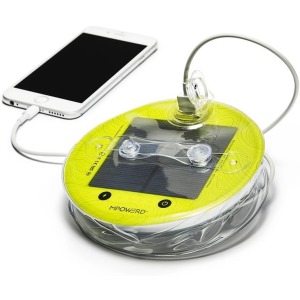
The MPOWERD Luci Pro is the benchmark solar camping lantern, and it’s earned that reputation through consistent performance across almost 1,800 UK reviews. It inflates to a cylindrical lantern in seconds, producing 150 lumens across 360 degrees that comfortably lights a two-person tent or small group sitting area. The diffused light through the translucent body is gentle and glareless, which makes it far easier to spend an evening under than a harsh LED spotlight.
The 2000mAh battery gives up to 48 hours on the low setting and around 8 hours on full brightness. In UK camping terms, that means a full weekend of evening use from a single day’s solar charge, with the USB-A input available as backup on particularly overcast days. The phone charging output via USB-A is a genuinely useful addition: a single full charge of the Luci Pro will give around 40 to 60 percent battery to a modern smartphone, which can make a real difference on a multi-day trip.
The waterproofing is rated to IP67, meaning it will survive accidental drops into puddles and heavy rain without issue. At 133 grams when deflated and folded flat, it packs down to virtually nothing in a pack. The one caveat is price: at around £50 it costs more than most of the alternatives. But given that it genuinely replaces both a camping lantern and an emergency phone charger, the value case is strong.
Features
- 150 lumens, 360-degree diffused illumination
- 2000mAh battery with up to 48hrs runtime (low mode)
- Solar charging and USB-A input charging
- USB-A output for phone charging
- IP67 waterproof
- 133g deflated, folds flat for pack storage
- Dual solar and USB-A charging for UK overcast reliability
- Phone charger output is genuinely useful on multi-night trips
- IP67 waterproofing handles immersion, not just rain
- Nearly 1,800 UK reviews with strong feedback
- Most expensive option on this list at ~£50
- Needs inflating each time, which takes a few seconds
2. MPOWERD Luci Outdoor 2.0
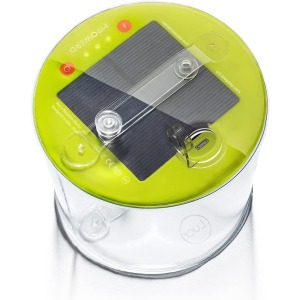
If the Luci Pro is more than your budget allows, the standard Luci Outdoor 2.0 gives you the same inflatable format at roughly half the price. You drop from 150 to 75 lumens and lose the phone charging output and the higher-capacity battery, but the core experience of a soft, omnidirectional solar lantern that packs flat is identical. At around £22, it’s one of the better value solar camping lanterns on Amazon.co.uk right now.
The 1000mAh battery provides up to 24 hours on low mode and around 6 hours on full brightness. For weekend camping that means a full night’s low-level ambient light from a single solar charge, with USB-C input available if the weather has been grey. The 4.8-star rating across its reviews suggests very consistent satisfaction, even though the sample size is smaller than the Pro model.
The compact, lightweight inflatable design remains the biggest selling point. When deflated and folded it’s roughly the size of a small paperback book and weighs just over 100 grams, which makes it entirely reasonable to throw into a day pack alongside your other kit. It’s a solid choice for solo campers or light travellers who want an affordable, packable solar lantern without the premium features.
Features
- 75 lumens, 360-degree diffused illumination
- 1000mAh battery with up to 24hrs runtime (low mode)
- Solar charging and USB-C input charging
- IP67 waterproof
- Lightweight and folds flat for pack storage
- Dusk-to-dawn sensor and dimmer control
- Half the price of the Luci Pro with the same core format
- USB-C input for overcast days
- Excellent 4.8-star rating
- No phone charging output (charge input only)
- 75 lumens is modest for lighting a larger group area
- Smaller battery means less multi-night buffer
3. BioLite SiteLight Solar LED Lantern
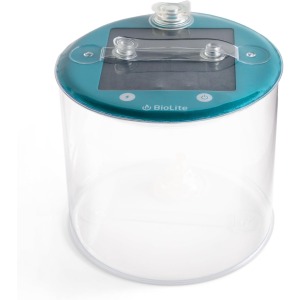
BioLite’s SiteLight Solar is the ultralight option for backpackers who need to count grams. At just 4.4 ounces (125g), it’s marginally lighter than the Luci Pro and packs flat in the same way. Where it differs is the collapsible rigid design rather than an inflatable. You pull up the body from the flat disc to create a structured lantern shape, which feels a little more robust and stable on a tent floor or hanging hook than an inflated balloon.
Output is 75 lumens via USB-C top-up charged battery, with solar charging via the integrated panel on the outer surface. Runtime of up to 24 hours at low brightness covers multi-day trips with careful management. The IP67 rating matches the MPOWERD products, giving full confidence in UK wet weather. At 4.8 stars, the early feedback from users is extremely positive, though the review count is smaller, so treat that with appropriate caution.
BioLite is a well-regarded outdoor brand, particularly popular with serious backpackers, and the SiteLight design reflects their focus on minimal weight and reliable construction. At around £37 it sits in the mid-range price bracket. The absence of a phone charging output keeps the feature set focused, but for weight-conscious campers who just want a reliable solar lantern that packs flat, it delivers.
Features
- 75 lumens from collapsible rigid disc format
- Solar charging with USB-C input backup
- IP67 waterproof
- 4.4oz / 125g ultralight design
- Up to 24hrs runtime on low brightness
- Hanging hook for tent use
- Ultralight at 125g, ideal for backpacking
- Rigid collapsible body feels more stable than inflatable
- IP67 waterproofing for UK conditions
- No phone charging output
- Fewer reviews than the MPOWERD models
- 75 lumens output is modest
4. Bravzurg Solar Camping Lantern
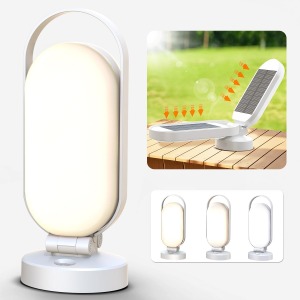
For those who need serious brightness, the Bravzurg is the outlier on this list: 350 lumens from 240 individual LED beads, which is more than double the output of any other lantern here. If you’re camping with a group, running a base camp setup, or need to light a larger canopy or picnic area, the difference between 75 and 350 lumens is immediately noticeable. It genuinely illuminates a space rather than just marking your location.
The foldable design opens flat to expose a wide panel of LEDs across two flippable wings, allowing you to direct light in any configuration from a concentrated beam to a full 360-degree spread. The 5000mAh battery is substantial for the category, providing a significant charge buffer for multi-night use even with limited UK solar input. Solar charging is supplemented by USB input, so a quick top-up from a power bank or car charger is always an option if the weather has been grey.
The tradeoff versus the inflatable options is size and weight. At 350 lumens with a 5000mAh battery, this is not an ultralight option. It’s better suited to car camping, festivals or family camping where weight isn’t the primary concern. At around £39, it’s also competitively priced for the output level.
Features
- 350 lumens from 240 individual LED beads
- Foldable bi-wing design with adjustable light spread
- 5000mAh battery for extended multi-night runtime
- Solar charging with USB input backup
- Multiple brightness settings and modes
- Hanging hook and standing base
- 350 lumens is by far the brightest on this list
- 5000mAh battery provides substantial multi-night charge buffer
- Foldable design adjustable from directional to 360-degree spread
- Heavier and bulkier than inflatable options
- Fewer reviews than the MPOWERD models
- Overkill for solo tent use where 75 lumens is sufficient
5. LETMY Solar Camping Lantern 4-Pack
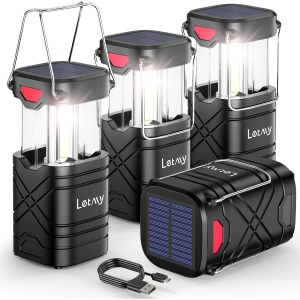
The LETMY 4-pack offers the best value-per-lantern on this list by a significant margin. Four compact cylindrical COB LED lanterns for around £35 works out at under £9 each, and with nearly 2,800 reviews at 4.6 stars, this is the most thoroughly tested product in this guide. The 360-degree illumination from the COB strip design lights a tent or small seating area effectively.
The three-power-source design is a genuine practical advantage for UK camping: solar charging for fair days, USB charging when you have a power source nearby, and AA batteries as a completely independent fallback that doesn’t rely on any charging at all. If you’re camping for two weeks straight and encounter a run of grey weather, the battery backup means you’re never left without light. This level of redundancy is rare in solar lanterns at this price point.
Individual units are compact enough to clip to a tent ceiling, hang from a tarp guyline or stuff in a coat pocket. The main honest caveat is that these are budget products: the construction feels lighter than the MPOWERD or BioLite options, and the solar panels are smaller with correspondingly less charging capacity. But for family camping, festivals or anyone who wants multiple lanterns distributed around a site, four reliable light sources for £35 is a compelling proposition.
Features
- 4-pack of COB LED cylindrical lanterns
- 3 power sources: solar, USB charging, AA batteries
- 360-degree COB illumination
- Compact and lightweight with hanging clip
- Multiple brightness and flash modes
- Comes with USB charging cable
- Best value at 4 lanterns for ~£35
- AA battery fallback for UK overcast camping trips
- 2,800+ reviews with strong consistent feedback
- Budget construction compared to MPOWERD
- Small solar panel, limited charging in low light
- Lower individual lumen output than the Bravzurg
6. Solar Hand Crank Emergency Camping Lantern
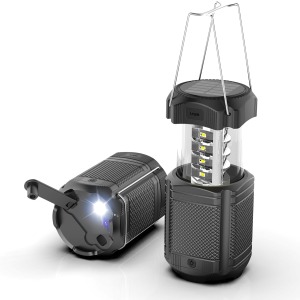
This is the lantern for anyone who takes a belt-and-braces approach to off-grid lighting. Where most solar camping lanterns rely on either solar or USB charging, this one adds a hand crank generator as a third option. If you’ve had four days of overcast weather in the Scottish Highlands and your USB power bank is depleted, five minutes of cranking will give you another hour of light. It’s an old-fashioned backup that becomes genuinely valuable in extended bad weather.
The 5000mAh battery is the largest on this list, providing a substantial charge reserve that softens the impact of unreliable solar input. The telescopic design extends from a compact disc to a taller lantern shape that stands well on a surface. It also doubles as a phone charger via USB output, similar to the Luci Pro. At around £35, it fills a useful niche between the budget LETMY 4-pack and the premium MPOWERD Pro.
The honest caveat is that the hand crank is an emergency option, not an efficient charging method. It takes considerably longer to generate the same charge as USB or solar. And with 110 reviews, the evidence base is thinner than the top picks. But for UK camping in genuinely remote locations where solar reliability is uncertain, the hand crank fallback is a feature you’ll be glad you have if you ever need it.
Features
- Three power sources: solar, USB charging, hand crank
- 5000mAh large-capacity battery
- USB output for phone charging
- Telescopic design extends from compact disc
- Multiple brightness and SOS flash modes
- 360-degree LED illumination
- Hand crank provides power even without sun or USB
- 5000mAh battery is the largest on this list
- Phone charging output for multi-night independence
- Lowest review count on this list at 110
- Hand cranking is slow and tiring for significant charge
- Bulkier than the inflatable or collapsible alternatives
Solar Camping Lanterns Buying Guide
Key Takeaways
- Solar-only charging is unreliable for UK camping. Choose lanterns with USB backup charging for overcast multi-day trips
- Inflatable lanterns pack the flattest and lightest; rigid collapsible designs feel more stable; foldable panel designs offer higher lumen output
- 75 lumens is plenty for a solo tent interior; 150 lumens works for a group; 350+ lumens is suitable for lighting a canopy or communal area
- Battery capacity of 2000mAh or more provides a meaningful buffer for UK multi-night camping
- For car camping, weight is not a primary concern; for backpacking, aim for under 150g
- Phone charging output on the Luci Pro and hand crank lantern adds practical value on multi-day remote trips
Why Solar Charging Alone Isn’t Enough for UK Camping
The UK averages between 1.5 and 4 peak sun hours per day depending on season and location. In summer in the south of England you might get 4 to 5 hours of strong direct sunshine to charge your lantern. In the Scottish Highlands in September you might get 1.5 hours of useful solar charge before cloud rolls in. In either case, a solar lantern with only solar charging introduces real uncertainty over whether you’ll have light each evening.
This is why every lantern on this list includes USB backup charging as a minimum. Most experienced UK campers carry a power bank of 10,000mAh or more, which can top up a lantern battery multiple times. Combined with whatever solar charging the day provides, the system becomes genuinely reliable. The LETMY 4-pack adds AA battery support as a third fallback, and the hand crank lantern takes that concept to its logical extreme.
If you camp exclusively in sunny southern Europe or are only camping in summer in southern England, solar-only charging might be adequate. For anyone who camps regularly across the British Isles from spring to autumn, USB backup is essential rather than optional.
Inflatable vs Collapsible vs Foldable: Which Design Suits You?
Inflatable lanterns like the two MPOWERD Luci models are the packability champions. They fold down to a disc roughly 15cm across and 3cm thick, weighing around 100 to 133 grams. That’s smaller and lighter than most lanterns of equivalent output. The translucent material diffuses light very evenly, producing a glow that’s genuinely soft and glareless. The limitation is that they need inflating before use, and some people find them slightly fiddly to store properly deflated.
Collapsible rigid lanterns like the BioLite SiteLight use a pull-up mechanism to extend from a flat disc to a structured cylinder. They pack to a similar footprint as inflatables but feel more robust because the structure is rigid rather than pressurised air. If you’ve ever had an inflatable lantern slowly deflate mid-evening from a microscopic puncture, the rigid approach feels reassuringly dependable.
Foldable panel lanterns like the Bravzurg open out like a book to expose a wide LED surface. They’re less compact than the disc-format options but offer significantly higher lumen output because you can fit many more LEDs across the unfolded surface. This makes them the practical choice when you need to genuinely light an area rather than create ambient glow.
Lumens Guide for Camping Use
Choosing the right brightness level for a camping lantern depends entirely on what you’re using it for. Here’s a practical guide for UK camping scenarios:
- 20 to 50 lumens: map reading in a tent, bedtime reading, marking your tent entrance
- 75 to 100 lumens: standard solo tent interior lighting, cooking at a picnic table
- 150 lumens: comfortable lighting for two to three people, small group cooking area
- 250 to 350 lumens: larger group seating area, lighting under a shelter or canopy, task lighting for cooking with multiple people
Most solo and couples campers find 75 lumens entirely sufficient for evening tent use. The jump to 150 lumens (the Luci Pro) starts to become meaningful when you’re cooking outside and need to see clearly. The Bravzurg at 350 lumens is genuinely different in character: it turns night into day within a small area, which is exactly what you want for a communal camping kitchen but overkill for reading in a sleeping bag.
Battery Capacity: Planning for Multi-Night UK Camping
A camping lantern’s battery is your buffer against days when the solar panel can’t fully recharge. In summer UK conditions, a lantern getting 3 to 4 hours of direct sun will typically recharge from 20 percent to full in a single day. In autumn or during a rainy spell, it might gain only 30 to 40 percent in a full day’s indirect light.
For a three-night trip with a 1000mAh battery, you need each day to roughly replenish what you used the previous evening. In good UK summer weather that’s achievable. In unsettled autumn weather, you’ll be glad of a larger reserve. The Bravzurg and hand crank lantern at 5000mAh are significantly better positioned for extended multi-night trips in uncertain conditions, assuming you supplement solar with USB charging from a power bank.
Weight and Packability for Backpacking vs Car Camping
For backpacking where every gram matters, the inflatable and collapsible disc designs are the clear choice. The MPOWERD Luci Pro at 133g and BioLite SiteLight at 125g are the lightest options with meaningful output. Both pack to a disc around 15cm across, which slots easily into a side pocket or the lid of a pack.
For car camping or festivals, weight is largely irrelevant and you can choose based purely on brightness, battery capacity and features. The Bravzurg and LETMY 4-pack become much more attractive options when you’re not carrying everything on your back. At a festival or family camping site, four LETMY lanterns distributed around your pitch for £35 total is a very practical approach.
Extras That Add Genuine Value: Phone Charging, Hand Crank, Hooks and Modes
Phone charging output is more useful than it might first appear. On a multi-night camping trip without mains access, keeping a phone charged for safety and navigation can be genuinely important. The Luci Pro’s USB-A output and the hand crank lantern’s USB output both fulfil this role, effectively replacing the need for a separate small power bank on shorter trips.
A hanging hook is worth having. Most camping lanterns include one, but check before buying. Hanging a lantern from a tent peak loop distributes light far more effectively than placing it on the ground. The hook also lets you hang the lantern outside the tent door during cooking.
SOS flash modes are included on several options here. For camping in remote UK areas like the Highlands or coastal paths, an SOS strobe visible at distance is a meaningful safety feature that costs nothing in terms of weight.
Case Study: A Family Wild Camping Weekend in North Wales
Background
A family of four planned a two-night wild camping trip in Snowdonia in early September. The forecast showed mixed weather with one clear day and one overcast day. Weight was a concern for two parents and two teenagers each carrying their own packs.
Project Overview
The lighting requirement was for tent interior use in two separate tents, plus a shared cooking area outside. The family needed light that was light enough to carry comfortably, reliable enough to work across two nights in uncertain weather, and bright enough for cooking and reading.
Implementation
The parents took the MPOWERD Luci Pro as their tent light, using it on low mode for reading after the teenagers had gone to bed, and on full brightness for cooking. The two teenagers each had a LETMY lantern from the 4-pack, giving them individual lights in their shared tent and a spare unit for the cooking area. The Luci Pro’s USB output charged the teenagers’ phones on the second night when the power bank was getting low.
Results
On the clear day, all lights recharged fully. On the overcast day, the Luci Pro gained around 60 percent charge from solar and was topped up to full via USB from the power bank. The LETMY lanterns used their AA battery fallback on the second overcast evening rather than depleting the power bank further. Total lighting cost for the trip was around £85 across both products, and all four units are still in regular use for subsequent camping trips.
Expert Insights From Our Solar Panel Installers About Solar Camping Lanterns
One of our senior solar panel installers with over 14 years of experience offered this practical perspective: “UK campers consistently underestimate how much the weather affects solar lantern charging. A 1000mAh lantern left on the north-facing side of a tent in September might gain 20 percent charge in a full day. Always position your solar panel facing south and as unobstructed as possible during the day. Drape it over the tent flysheet in direct sun, not tucked in the shade of the tent. And honestly, a 10,000mAh power bank as backup makes any solar camping lantern system completely reliable, whatever the weather does.”
Frequently Asked Questions
Are solar camping lanterns reliable for UK weather?
They can be, but solar-only charging is genuinely unreliable in the UK. Choose a lantern that includes USB backup charging alongside solar, and carry a small power bank. In summer in southern England, solar charging is usually adequate. On multi-night trips in autumn, in Scotland, or in unsettled weather, USB backup makes the difference between reliable and unreliable light.
How many lumens do I need for camping?
For a solo tent interior, 50 to 75 lumens is comfortable. For a group of two to three people, 100 to 150 lumens works well. For lighting a larger group cooking or seating area, 250 to 350 lumens is where you start to see a meaningful difference. The MPOWERD Luci Pro at 150 lumens is the right balance for most camping scenarios.
Can solar camping lanterns charge phones?
Some can. The MPOWERD Luci Pro and the solar hand crank lantern on this list both include a USB output for charging phones. Not all solar camping lanterns include this feature, so check the specifications carefully. Lights with USB charging input (for the lantern) are not the same as those with USB output for devices.
What is the difference between inflatable and collapsible solar lanterns?
Inflatable lanterns like the MPOWERD Luci use pressurised air to create a translucent body that diffuses light very evenly. They fold completely flat when deflated. Collapsible lanterns like the BioLite SiteLight use a pull-up rigid structure rather than air, which feels more stable and doesn’t require inflation. Both formats pack to a similar disc size and weight.
How long does a solar camping lantern last on a single charge?
Runtime varies widely by model and brightness setting. The MPOWERD Luci Pro lasts up to 48 hours on low mode and around 8 hours on full brightness. The LETMY lanterns provide similar runtime. High-brightness models like the Bravzurg at 350 lumens consume more power and have shorter runtime at maximum output. Most solo camping lanterns will run through a full evening (6 to 8 hours) on a single full charge.
Are solar camping lanterns waterproof?
Most quality solar camping lanterns are waterproof to at least IP54 or IP65. The MPOWERD Luci Pro and BioLite SiteLight are rated to IP67, meaning they can be temporarily submerged. For UK camping where rain is a constant possibility, IP65 or above is the sensible minimum to look for.
How do I get the best solar charge on a camping trip?
Position the solar panel facing south at an angle perpendicular to the sun, not flat on the ground. Drape it over the flysheet in direct sun rather than leaving it in tent shade. Move it during the day to track the sun if possible. On overcast days, diffuse light still provides some charge but at a much slower rate, typically 20 to 30 percent of the clear-day rate. Always have a USB backup plan for overcast stretches.
Which solar camping lantern is best for backpacking?
For backpacking, the MPOWERD Luci Pro or BioLite SiteLight are the best options. Both weigh around 125 to 133g and pack to a flat disc that takes up virtually no space in a pack. The Luci Pro adds phone charging capability, which is valuable on multi-day remote routes. If budget is the priority, the MPOWERD Luci Outdoor 2.0 gives similar packability at half the price with 75 lumens output.
Summing Up
The MPOWERD Luci Pro Outdoor 2.0 is the best all-round solar camping lantern for UK use, combining genuine 150-lumen output, dual solar and USB charging, phone charging capability, IP67 waterproofing and a pack weight under 140g. The MPOWERD Luci Outdoor 2.0 gives the same core experience at half the price if phone charging isn’t a priority. The BioLite SiteLight suits weight-conscious backpackers who prefer a rigid collapsible design. For family camping and car camping, the Bravzurg’s 350-lumen output and the LETMY 4-pack’s value and battery fallback flexibility make them the practical choices. And if you camp in genuinely remote UK locations where weather uncertainty is the norm, the hand crank emergency lantern covers the situation where everything else has run out of charge.
Updated