
If you want to add a splash of colour to your garden after dark, the Linkind RGBW Solar Spotlight 4-Pack is the standout choice. With nine lighting modes, reliable IP65 weatherproofing and a generous 1800mAh battery, it delivers vibrant, consistent colour through long UK evenings without any fuss.
Below, you’ll find six of the best solar colour changing lights available on Amazon.co.uk, covering everything from app-controlled spotlights to decorative jellyfish ornaments and colourful mushroom path lights. Whether you want programmable RGB scenes or simply lights that cycle automatically through colours, there’s an option here for your garden.
Our Top Picks
| Image | Name | |
|---|---|---|
| Linkind RGBW Solar Spotlight 4-Pack | |
| Linkind Smart Solar Spotlight SL5C 4-Pack | |
| Weepong Solar Jellyfish and Butterfly 3-Pack | |
| KEROVI 8-Inch Solar RGB Globe Light | |
| AONELAS Solar Mushroom Pathway Lights 8-Pack | |
| Shapelights Solar Mini Pebble Colour Changing Light |
6 Best Solar Colour Changing Lights
1. Linkind RGBW Solar Spotlight 4-Pack
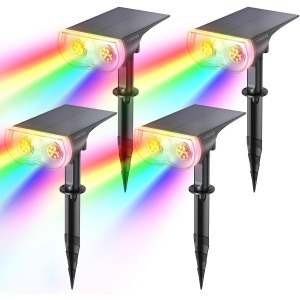
The Linkind RGBW 4-Pack is the most popular solar colour changing spotlight on Amazon.co.uk for good reason. You get four separate units with nine distinct lighting modes, including seven pure colours and two automatic colour-cycling sequences. The spotlight design means you can angle each unit to highlight a specific shrub, feature wall or garden ornament, giving you far more control than fixed-position pathway lights.
What makes these stand out for UK gardens is the RGBW chip design. That final ‘W’ means there’s a dedicated warm white LED element alongside the red, green and blue. The result is that the whites actually look white rather than the washed-out off-white you get with pure RGB mixing. On steady white mode, each spotlight produces a clean, warm glow suitable for illuminating pathways or patios even when you want to dial back the colour show.
The 1800mAh battery gives you around 12 hours on a fixed colour mode and roughly 6 hours on the more power-hungry colour-cycling modes. On a full UK summer day’s charging that’s comfortably sufficient. In winter you’ll get less from the panel, but switching to a fixed colour rather than cycling extends runtime considerably. IP65 weatherproofing keeps them reliable through rain and frost.
One honest observation: the stake design means they sit fairly low to the ground, typically about 30cm. If you want uplighting on taller plants, you’ll want to look at globe-style or taller stake options. But for pathway borders and low-level accent lighting, the position works well and the adjustable head lets you tilt the beam where you need it.
Features
- RGBW chip with 9 colour modes including warm white
- 1800mAh rechargeable battery, approx 12hrs steady / 6hrs cycling
- IP65 waterproof and weatherproof
- Adjustable spotlight head for directional lighting
- Set of 4 individual ground stake spotlights
- Dusk-to-dawn automatic sensor
- RGBW chip produces genuine warm white (not washed-out)
- Four separate adjustable spotlights in one pack
- Strong review count (2,920+) with consistent feedback
- Good battery life at 12hrs on fixed modes
- Low ground position, not ideal for uplighting tall plants
- Cycling mode halves battery life to ~6hrs
2. Linkind Smart Solar Spotlight SL5C 4-Pack
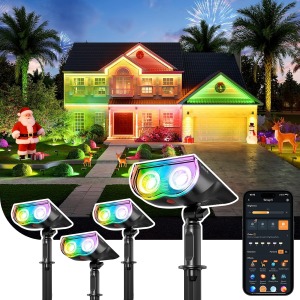
If you want full smartphone control over your garden lighting, the Linkind SL5C is the app-controlled upgrade. Connect via Bluetooth to the Linkind app and you can access over 16 million colours, create custom lighting schedules, set timers, and synchronise colour changes across all four units simultaneously. For anyone who likes to theme their garden lighting for different occasions, it’s genuinely impressive.
The app control works reliably within standard Bluetooth range, around 10 metres from your phone. Beyond that you’ll need to be closer, though in practice most garden patios fall within range. The lights remember your last settings and revert to them each evening after charging, which means you only need to open the app when you want to change the scene.
These share the same core spotlight hardware as the standard RGBW units, so the IP65 weatherproofing and adjustable head carry across. The main practical tradeoff is price: at around £59.99 for four, you’re paying roughly £24 more than the standard RGBW pack. Whether the app control is worth that premium depends on how often you’ll actually use it.
Features
- Bluetooth app control via Linkind app (iOS and Android)
- 16 million colour options including custom mixing
- Programmable schedules and timers
- IP65 weatherproof, adjustable spotlight head
- Set of 4 units
- Syncs multiple units for coordinated colour scenes
- 16M colour options with custom RGB mixing
- App-controlled scheduling and timers
- Syncs all four units together
- Premium price for app control feature
- Bluetooth range limited to ~10m
- Newer listing with fewer reviews than standard RGBW version
3. Weepong Solar Jellyfish and Butterfly Colour Changing Lights 3-Pack
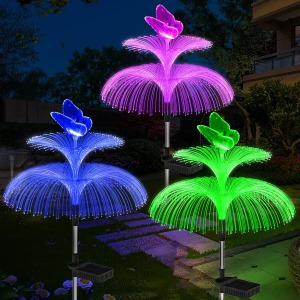
These decorative jellyfish and butterfly figures are the most visually distinctive entries on this list. Standing around 29 inches tall with translucent acrylic panels, they fill with slowly shifting colour at night and create a genuinely striking display on a patio or lawn. The three-pack includes a mix of jellyfish and butterfly designs, and the seven-colour cycle moves smoothly between hues rather than jumping abruptly.
Unlike spotlight-style colour changers, these are entirely about ambience. The light output is gentle and diffused, making them best suited as decorative garden art rather than functional illumination. Think of them as living garden ornaments that happen to glow rather than high-output lights you’d use to light a path. Placed among border plants or beside a garden seating area, the effect is quite magical.
With over 1,100 UK reviews and a solid 4.5-star average, the quality is well-validated. The metal stakes are robust enough for UK soil and the IP waterproofing handles British rain without any reported issues across the review base. Runtime is good across UK summer evenings, though like all solar colour changers, winter performance depends heavily on how much sun hits the panel during the day.
Features
- 3-pack with jellyfish and butterfly figure designs
- 7-colour automatic colour-cycling
- Translucent acrylic panels for diffused glow effect
- Approximately 73cm (29in) tall on ground stakes
- Waterproof construction for outdoor use
- Dusk-to-dawn solar charging with auto on/off
- Visually striking decorative garden figures
- Smooth 7-colour transitions, not harsh jumps
- Strong reviews with 1,100+ ratings
- Decorative only, low functional light output
- Single mode, no option to hold a fixed colour
- Best for calm spots, not exposed windy gardens
4. KEROVI 8-Inch Solar RGB Globe Light
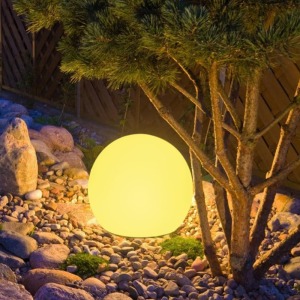
The KEROVI globe takes a completely different approach, presenting colour in a large spherical form that casts 360-degree coloured light across the surrounding ground. The 8-inch frosted globe sits on a ground stake and cycles through 16 RGB colour modes, with a remote control included so you can switch modes without bending down to the stake. For a garden centrepiece or focal feature beside a seating area, this format works beautifully.
Globe-style solar lights tend to spread light more evenly than spotlights, giving a softer ambient glow that fills the surrounding area rather than targeting a specific point. With 6 to 8 hours of runtime on a full charge, it should comfortably cover most UK summer evenings. The remote makes it practical to change the colour from your garden chair, which sounds minor but is genuinely useful when you want to adjust the mood.
The review count is lower at around 106 ratings, so the evidence base is thinner than for the other picks on this list. The existing feedback is positive at 4.2 stars, but do factor in the smaller sample when making your decision. At around £46, it’s priced at a premium for its category, which makes sense for the larger format and included remote.
Features
- 8-inch frosted sphere globe design
- 16 RGB colour modes with remote control
- 360-degree light diffusion
- Ground stake mounting with adjustable height
- 6 to 8 hours runtime on full charge
- Dusk-to-dawn sensor
- Distinctive 8-inch globe centrepiece format
- Remote control for mode changes from a distance
- 360-degree ambient light spread
- Lower review count than other picks
- Higher price point for a single unit
- RGB only, no white mode
5. AONELAS Solar Mushroom Pathway Lights 8-Pack
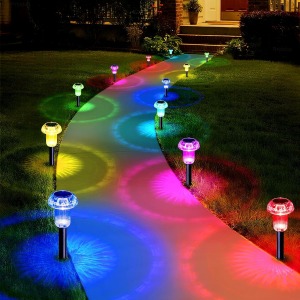
For border and pathway edging, the AONELAS mushroom lights offer the best value on this list. Eight individual colour-changing mushroom figures for under £30 is genuinely good value, and with over 1,200 reviews at 4.6 stars the quality is well-proven. Each mushroom cap glows with smoothly transitioning multicolours and the cap shape creates a natural, whimsical garden look that works particularly well in planted borders.
The IP64 weatherproofing is solid for UK rain conditions. It’s one rating step below the IP65 of the spotlights, meaning protection from splashing water in all directions but not sustained water jets, which in practical garden terms is more than adequate. Runtime of 6 to 8 hours covers most summer evenings without issue.
The main limitation with pathway mushroom lights is that they don’t illuminate in the traditional sense. They’re accent lights that mark a border rather than genuinely lighting your path. If you need functional path lighting, you’d pair these with a brighter primary light source. But for decorative colour-changing border definition, they’re charming and the eight-pack count means you can line a reasonable length of path or border without needing a second set.
Features
- 8-pack of individual colour-changing mushroom figures
- Automatic multicolour cycling
- IP64 weatherproof rating
- Ground stake design with short mushroom cap format
- 6 to 8 hours runtime on full charge
- Dusk-to-dawn sensor
- Best value on the list at 8 units for under £30
- 1,200+ reviews with strong 4.6-star average
- Charming mushroom figures ideal for planted borders
- Accent-level light output, not functional illumination
- Colour-cycling only, no fixed colour mode
- Shorter stake height limits visibility in taller planting
6. Shapelights Mini Solar Pebble Colour Changing Lights
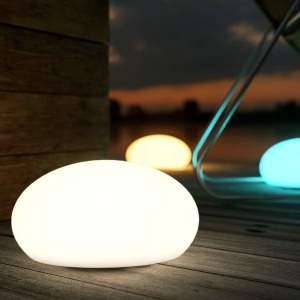
The Shapelights pebbles offer a unique combination not found elsewhere on this list: solar charging, USB backup charging and the option to plug directly into mains power. For a UK garden where solar charging can be unreliable during grey winter months, that flexibility is genuinely useful. The realistic pebble design sits naturally in a garden bed or rockery, and the eight colour modes include both cycling and fixed options.
IP67 waterproofing makes these the most water-resistant option on this list, rated for temporary submersion. That’s reassuring for garden use in the wet British climate, and the pebble format is inherently low-profile so there’s no stake to get knocked over in wind or damaged by a lawnmower.
At around £21 for a set of three, these are the most affordable option here. The tradeoff is a lower lumen output than the spotlights, which positions them firmly in the decorative accent category. They glow attractively at night and the colour range is pleasing, but don’t expect to illuminate your garden with them. They work best scattered through a rockery or tucked beside border planting where the low-level glow creates depth.
Features
- Realistic pebble design, suitable for rockeries and borders
- 8 colour modes including cycling and fixed colours
- Triple power input: solar panel, USB charging, mains power
- IP67 waterproof rated for temporary submersion
- Ground-level, no-stake format
- Dusk-to-dawn sensor with auto on/off
- Triple power source flexibility (solar/USB/mains)
- IP67 is the best waterproofing on this list
- Realistic pebble format suits rockeries and planted borders
- Low light output, purely decorative
- Small panel size limits solar charging on overcast days
- Low profile may be obscured by taller border plants
Solar Colour Changing Lights Buying Guide
Key Takeaways
- RGBW lights include a dedicated white LED and produce cleaner whites than pure RGB
- App-controlled lights offer 16 million colour options but cost significantly more than preset-mode lights
- IP65 is the minimum you should accept for UK outdoor use; IP67 is better for ground-level lights in rainy climates
- Battery capacity matters for UK winters when solar charging is limited, with 1800mAh being a reasonable minimum
- Spotlight formats allow directed lighting; globe and decorative formats produce ambient diffused effects
- Colour-cycling modes use more power than fixed colour modes, reducing runtime by up to half
RGBW vs RGB: What’s the Difference?
RGB stands for red, green and blue. By combining these three colours at different intensities, an RGB light can theoretically produce any colour in the spectrum. The issue is that mixing RGB to produce white creates a cool, slightly blue-tinged result that lacks the warmth of a traditional light source. This can look a little clinical outdoors.
RGBW adds a fourth chip, a dedicated warm white LED, alongside the RGB elements. When you select white mode on an RGBW light, it activates that dedicated white element rather than mixing the three colours. The result is a genuinely warm, natural-looking white that works well for pathway and feature illumination. If you want a light that can switch between colourful modes and a clean ambient white, RGBW is well worth the modest price premium over RGB-only options.
For colour modes only (no white required), a good RGB light is perfectly adequate. The jellyfish and mushroom ornamental lights on this list are pure RGB and their colour output is vibrant and consistent.
App-Controlled vs Remote vs Auto-Cycling
Solar colour changing lights fall into three control categories, and which is right for you depends on how actively you want to manage your garden lighting.
Auto-cycling lights need no interaction at all. They turn on at dusk, run through their built-in colour sequence, and turn off at dawn. This is ideal if you want your garden to look good without any effort. The limitation is that you can’t customise the sequence or fix a single colour for a particular occasion.
Remote-controlled lights, like the KEROVI globe, let you change modes from your garden chair without kneeling down to adjust a small button on the stake. This is a practical middle ground. You get the convenience of hands-off operation most of the time, with the ability to change the scene when you want to.
App-controlled lights, like the Linkind SL5C, give you the most flexibility: 16 million colours, custom schedules, timers and synchronised scenes across multiple units. The drawback is that you need your phone within Bluetooth range, and the app adds a small setup step. For most gardens, auto-cycling or remote control is sufficient. App control makes most sense if you regularly host outdoor events and want to change the lighting mood to match the occasion.
Ground Stakes vs Globe vs Decorative Ornamental
The format of a colour changing solar light determines where it works best in your garden. Ground stake spotlights like the Linkind RGBW are the most versatile: you can position them at various angles to uplight features, and they’re easy to move around. They suit borders, the base of trees and alongside paths.
Globe lights like the KEROVI provide 360-degree diffused ambient glow rather than a directed beam. They work as centrepieces in the middle of a lawn or feature area, or as flanking accents beside a seating spot. The spherical light spread feels more social and welcoming than a directional spotlight beam.
Decorative ornamental formats, like the jellyfish, mushroom and pebble designs on this list, prioritise visual character over light output. They’re garden art that happens to glow, not lights that happen to look decorative. Position them where you’d place any garden ornament, ideally somewhere visible from the house or main seating area at night.
IP Ratings for UK Weather
For any solar light intended to live outdoors in a UK garden through the full year, IP65 is the minimum acceptable waterproofing standard. IP65 means complete dust protection and protection from water jets in any direction. This covers everything from heavy rain to the spray from a garden hose washing down your patio.
IP67 adds temporary submersion protection (up to 1 metre for 30 minutes), which is particularly useful for ground-level lights that might sit in a puddle after heavy rain. The Shapelights pebbles are rated IP67 for exactly this reason. If you’re placing lights in a garden bed that can pool water, IP67 gives extra peace of mind.
Avoid lights rated below IP44 for year-round outdoor UK use. IP44 covers splashing water but not water jets, which is acceptable in a sheltered spot but less reliable in an exposed garden in winter.
Battery Capacity for UK Winters
Battery capacity is rarely a concern in summer, when UK days are long enough to fully charge even moderately sized cells. Winter is a different matter. December in the UK averages around 1.5 to 2 peak sun hours per day, even in the south. A 600mAh battery might only receive 2 to 3 hours of usable charge on a grey December day, which translates to 2 to 3 hours of light in the evening, and often much less on colour-cycling modes.
For year-round reliability, look for a minimum of 1200mAh. The Linkind RGBW spotlights with their 1800mAh cells are well-suited for UK conditions. If you mainly use your garden lights seasonally from spring through autumn, smaller capacities are less of a concern. But for lights you want running reliably through December evenings, prioritise battery size or look for lights that offer USB backup charging, as the Shapelights pebbles do.
Case Study: A Surrey Garden Renovation
Background
A homeowner in Surrey undertook a rear garden redesign in 2026, replacing an ageing wooden deck with a new Indian sandstone patio and replanting the surrounding borders. The brief included lighting the garden for evening use without the cost or disruption of burying cable for mains-powered lights.
Project Overview
The garden features a main seating area, a lawn, and curved planted borders with a mix of ornamental grasses, roses and seasonal bedding. The lighting requirement covered the patio perimeter, the central lawn borders and a feature planting bed near the back fence.
Implementation
The homeowner chose three different solar colour changing light types for different zones. Two sets of the Linkind RGBW spotlights were positioned in the planting beds flanking the patio, angled to uplight ornamental grasses. Along the curved lawn borders, three packs of the AONELAS mushroom pathway lights were staggered at roughly 40cm intervals. For the patio table area, a pair of KEROVI globe lights on either side created a focal glow for evening dining.
Results
The installation required no electrician, no cable runs and no planning permission. The homeowner spent around two hours placing and positioning the lights during installation. On summer evenings the patio lighting runs from dusk until well past midnight. In winter, the mushroom lights and spotlights typically run for four to five hours on their fixed colour modes, which covers the main evening hours comfortably. The homeowner noted that switching from colour-cycling to a single fixed warm amber improved winter runtime significantly.
Expert Insights From Our Solar Panel Installers About Solar Colour Changing Lights
One of our senior solar panel installers with over 12 years of experience in UK solar installations offered this advice on solar colour changing lights for British gardens: “The most common mistake people make is expecting colour-cycling modes to run all night through winter on a small panel. In December and January, you’re getting maybe two hours of useful solar charging in many parts of the UK. If you want lights that actually run all evening in winter, choose a fixed colour mode over cycling, which uses significantly less power, and look for lights with a battery of at least 1500mAh. Also position the panel where it gets the best exposure during the short winter daylight hours, even if that means the ornament itself faces slightly away from its ideal decorative position.”
Frequently Asked Questions
Do solar colour changing lights work in the UK climate?
Yes, though summer performance is noticeably better than winter. In summer the longer daylight hours provide plenty of charging time for a full night’s runtime. In winter, shorter days mean less charge, and colour-cycling modes use more power than fixed single-colour modes. Choosing lights with batteries of 1500mAh or more and switching to fixed colour in winter months keeps them reliable year-round.
What is the difference between RGB and RGBW solar lights?
RGB mixes red, green and blue LEDs to produce colours, but the resulting “white” looks cool and slightly blue. RGBW adds a fourth dedicated warm white LED, producing a genuinely warm white when selected. If you want a light that can switch between colour modes and a natural-looking white, RGBW is the better choice.
Can I keep solar colour changing lights on a fixed colour?
Most solar colour changing lights with multiple modes allow you to hold a single fixed colour as well as cycle through colours. The Linkind RGBW spotlights, for example, offer both fixed and cycling options. Fixed colour mode typically extends battery runtime compared to cycling mode, sometimes by a factor of two.
What IP rating do I need for UK outdoor solar lights?
For year-round UK outdoor use, a minimum of IP65 is recommended. This covers protection from water jets in any direction, which handles heavy rain reliably. For ground-level lights that may sit in standing water, IP67 (temporary submersion protection) is preferable. Avoid lights below IP44 for exposed outdoor positions.
How long do solar colour changing lights last per charge?
Runtime varies by model and mode. Most solar colour changing spotlights run for 8 to 12 hours on a fixed colour after a full day’s charge. Colour-cycling modes typically halve that runtime to 4 to 6 hours. In winter, reduced charging means shorter runtimes regardless of mode, typically 3 to 5 hours in December across most of the UK.
Can solar colour changing lights be controlled with an app?
Some models offer app control via Bluetooth, including the Linkind SL5C featured in this guide. App-controlled lights allow access to millions of custom colour options, scheduling and the ability to sync multiple units. Most solar colour changers use preset modes rather than app control, which is sufficient for most gardens.
Where should I position solar colour changing lights in my garden?
Spotlights work best angled up at plants, walls or features to create uplighting effects. Globe lights work as centrepieces or flanking accents beside seating areas. Decorative ornamental figures like jellyfish or mushrooms work in planted borders where they’re visible from the house or seating area. In all cases, position the solar panel to face south and avoid shade from overhanging plants or fences for best charging.
Are solar colour changing lights suitable for front gardens?
Yes, they’re popular in front gardens too. Spotlight formats work well for uplighting bay trees, topiary or front door pillars. Globe lights suit symmetrical placements flanking a path or front entrance. For front gardens visible from the street, fixed warm white or warm amber modes often look more refined than constant colour cycling, which can look distracting.
Summing Up
The Linkind RGBW Solar Spotlight 4-Pack is the clear best buy for most UK gardens, combining RGBW chip quality, strong battery life and a proven track record across thousands of reviews. For those who want full smartphone control, the Linkind SL5C is the natural step up. The Weepong jellyfish and butterfly figures, KEROVI globe, AONELAS mushroom path lights and Shapelights pebbles each serve different garden styles and positions, giving you plenty to choose from depending on where and how you want to use colour in your outdoor space.
Updated