
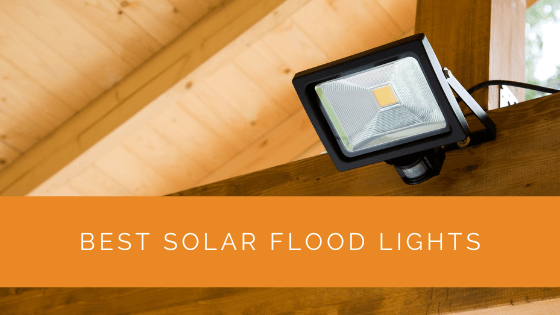
The KIBTOY Solar Security Light 70 LED 2-Pack is our top pick for UK buyers who want serious flood light coverage from a solar-powered unit. At 4.5 stars from 3,589 reviews, 360° wide-angle illumination, and IP65 weatherproofing, it delivers reliable performance across the range of positions UK homeowners actually need to light: driveways, side returns, garage approaches, and garden boundaries.
Solar flood lights have improved substantially since the early generation of dim, short-lived solar security products. The best current models deliver 1,000 to 3,000+ lumens, multi-head designs that cover wide frontages, and battery capacities that hold up through British winter nights. This guide covers seven of the best available on Amazon.co.uk right now, from value 6-packs to premium dual-PIR sensor units.
Our Top Picks
| Image | Name | |
|---|---|---|
| KIBTOY Solar Security Light 70 LED (2-Pack) | |
| 6-Pack Solar Wall Lights Outdoor 178 LED | |
| CLAONER 214 LED 4-Head Solar Flood Lights | |
| 156 LED Solar Security Lights 270° Wide Angle | |
| intelamp 3-Head Dual PIR Solar Security Light | |
| Solar Security Light 189 LED with Remote Control | |
| JumJam 280 LED Solar Flood Lights (2-Pack) |
7 Best Solar Flood Lights
1. KIBTOY Solar Security Light 70 LED (2-Pack)
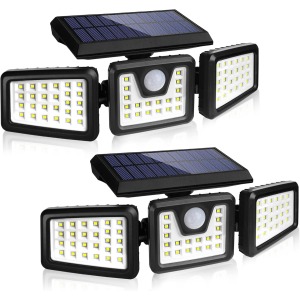
The KIBTOY 70 LED 2-pack earns the top position through one number: 3,589 reviews at 4.5 stars. In a product category full of brands with minimal real-world feedback, that volume of genuine buyer experience matters considerably. You’re not buying on spec-sheet faith; you’re buying on a substantial body of evidence that this light does what it says across UK driveways, garage walls, and side gates.
The 360° wide-angle illumination is the headline feature. Most solar flood lights have a defined beam angle. The KIBTOY uses a wider spread that covers not just the area directly in front of the unit but the peripheral zones that standard 120° or 180° motion sensors miss. For a driveway approach where pedestrians or vehicles can come from multiple angles, that peripheral detection matters. The PIR motion sensor activates on movement within range and the IP65 rating covers the full range of UK weather conditions including sustained rain and frost.
For two units, the per-unit cost is very competitive for a well-reviewed, wide-angle solar flood light. Each unit mounts independently, so you can position one at the main approach and one at a side passage without needing a shared power source or cable run. The integrated design means panel and light body are one unit, so sun access at the mounting position is the key installation consideration. South or south-west facing walls with clear sky access from around 10am to 4pm are ideal.
Three operating modes cover the main use cases: motion-triggered only (best for battery conservation), dim ambient plus motion-triggered full brightness (useful for driveways where you want constant low-level light), and full brightness throughout. Motion-triggered is the sensible default for most UK installations. The full brightness mode drains the battery quickly in winter but has its place for short periods when constant illumination is required.
Features
- 70 LED, 360° wide-angle illumination
- PIR motion sensor, 3 operating modes
- IP65 waterproof
- 2-pack for dual-position coverage
- 4.5 stars, 3,589 reviews
- 3,589 reviews at 4.5 stars is the most validated product in this roundup
- 360° wide angle catches motion from peripheral approaches standard lights miss
- 2-pack gives dual-position coverage at a competitive per-unit cost
- IP65 handles all UK weather conditions year-round
- Integrated panel means mounting position must have good sun access
- 70 LED output is moderate, not the highest lumen option in this roundup
2. 6-Pack Solar Wall Lights Outdoor 178 LED
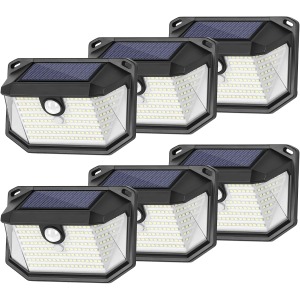
The 6-pack format is the most practical solution for buyers who need to cover multiple positions around a property in one purchase: front door, garage, side gate, garden boundary, rear access, and a spare. At £41 for six units, the per-unit cost is very low and the 178 LED count per unit is high for the price. This is the pick for buyers who want blanket coverage without the cost of buying six individual premium units.
The three modes give you motion-triggered only, constant dim with motion-triggered boost, and constant full brightness. The reflector design mentioned in the product listing helps direct the output forward rather than dispersing it in all directions, which is a practical design choice for mounting positions where you want to cover a specific zone rather than light the whole garden. IP65 waterproofing is confirmed and the build quality appears consistent from reviews.
The trade-off for the 6-pack format and price point is that individual units are simpler than the premium options in this roundup. You don’t get dual PIR sensors, remote control, or the review volume of the KIBTOY. But for comprehensive property coverage on a budget, this is the most cost-effective route to having something on every corner that matters.
Features
- 178 LED per unit, 6 units per pack
- 3 operating modes including reflector-directed output
- IP65 waterproof
- £41 for six units (under £7 per light)
- 6-pack covers an entire property perimeter in one purchase
- Under £7 per unit is exceptional value for 178 LED output
- 3 modes including reflector-directed output for targeted coverage
- Fewer reviews than top picks for real-world validation
- Simpler specification than premium dual-PIR or remote-control options
- 6 identical units may not be the right fit for every position on a varied property
3. CLAONER 214 LED 4-Head Solar Flood Lights
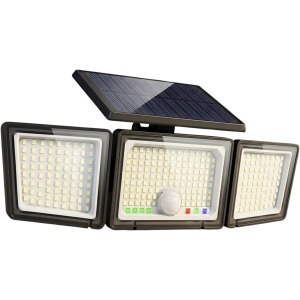
CLAONER’s 4-head design puts it in a different category from single or 3-head alternatives. Four independently adjustable heads mean you can cover a wide frontage, a corner position with two approaches, or spread coverage across a large garden from a single mounting point. The 3,000 lumen output is one of the highest in this roundup and at 4.5 stars from 775 reviews, the real-world performance backs up the spec sheet claims.
The 360° adjustable heads is the key selling point here. Each head rotates and tilts independently, so you can angle two heads down a long driveway and two across a wide garden boundary, or direct all four to different quadrants of a corner position. For a complex property layout where one standard flood light leaves coverage gaps, the 4-head configuration solves the problem without requiring multiple separate installations.
The PIR motion sensor covers the detection arc and at 3,000 lumens the triggered output is genuinely deterrent-level rather than just notification. IP65 waterproofing handles UK conditions. At around £12, this is underpriced for what it delivers, which means it’s worth double-checking current availability before buying.
Features
- 214 LED, 3,000 lumens output
- 4 independently adjustable heads
- 360° adjustable coverage per head
- IP65 waterproof
- 4.5 stars, 775 reviews
- 4 independently adjustable heads cover complex property layouts from one mount
- 3,000 lumens is deterrent-level output, not just ambient
- Strong 4.5-star rating with 775 reviews
- 4 heads increase the mounting complexity slightly compared to single or 3-head units
- Higher LED count means more battery drain in constant-on mode
4. 156 LED Solar Security Lights 270° Wide Angle
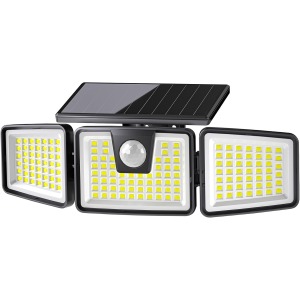
The 270° wide-angle coverage of this unit is its defining specification. While most solar flood lights cover 120° to 180°, the 270° spread fills in the wide peripheral zones that standard-angle lights miss. For a corner mounting position where you need coverage in front, to the left, and partially behind, a standard 180° light leaves a significant blind spot. The 270° design reduces that substantially. At 4.6 stars, this is the highest-rated model in this roundup.
For a single unit it is the most affordable individual unit here, which makes it practical to buy multiple units for different positions without committing to a fixed 6-pack format. The 156 LED count delivers solid output for the price. IP65 waterproofing and the standard dusk-to-dawn plus motion sensor modes cover the typical UK use cases. A single unit with 270° coverage from a corner position can protect an area that might otherwise need two standard-angle lights.
Features
- 156 LED, 270° wide-angle coverage
- IP65 waterproof, motion sensor
- 4.6 stars (highest in this roundup)
- 4.6 stars is the highest rating in this roundup
- 270° coverage significantly reduces peripheral blind spots vs standard-angle lights
- Affordable per-unit price makes it practical to buy multiple for different positions
- Single unit only, coverage quantity depends on how many you buy
- Lower LED count than the 4-head CLAONER at the same price point
5. intelamp 3-Head Dual PIR Solar Security Light
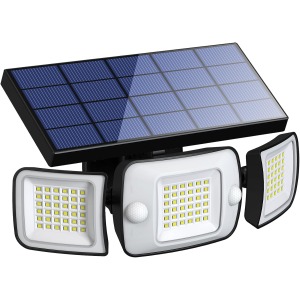
The intelamp dual PIR sensor design is the premium option in this roundup. Most solar security lights have one passive infrared sensor pointing in a fixed direction. The intelamp uses two sensors covering a wider combined detection arc, which reduces the blind spots on corners and multi-approach positions that single-sensor competitors leave undetected. At £29 for a single 3-head unit, you’re paying more per unit than the alternatives, but you’re getting a genuinely differentiated detection system.
The three adjustable heads give you the coverage flexibility to handle complex positions: two heads down the driveway and one across a side approach, or all three spread across a wide garden frontage. Combined with the dual PIR system, this is the right choice for a corner property, a drive with multiple approach angles, or a garden where movement can come from the south, east, or west within the sensor’s range.
At 4.5 stars and with the dual PIR specification, the intelamp is the most technically sophisticated solar flood light in this guide. It is not the best value per pound, but it solves problems the cheaper lights cannot. If your position is a standard single-approach driveway, the KIBTOY at half the price is perfectly adequate. If your position is genuinely complex, this is the one to buy.
Features
- Dual PIR sensors for reduced detection blind spots
- 3 independently adjustable heads
- 3 operating modes
- IP65 waterproof
- 4.5 stars
- £29
- Dual PIR sensors cover wider detection arc than single-sensor competitors
- 3 adjustable heads handle complex multi-approach positions
- Premium build quality reflected in consistent review performance
- Highest per-unit cost in this roundup
- Dual PIR advantage is only relevant for complex multi-approach positions
6. Solar Security Light 189 LED with Remote Control
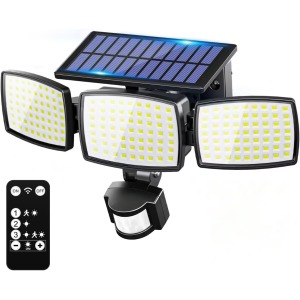
The remote control feature on this 189 LED unit gives you a practical convenience that most solar flood lights lack: you can switch modes, adjust settings, and check on the light without climbing a ladder or going outside at night. For lights mounted at height on a garage wall or above a doorway, that matters. Having to physically access the unit to change from motion-triggered to constant-on mode is inconvenient; being able to do it from the ground with a remote is a genuine quality-of-life improvement.
At £13 per unit with 1,200 lumens and 3 adjustable heads, the specification is strong for the price. 1,200 lumens is meaningful deterrent output rather than just ambient light. The 3 modes (motion sensor, dim + motion boost, constant) cover the standard use cases. IP65 waterproofing applies. The remote control range is practical for adjusting a light mounted at standard eaves height from ground level.
Features
- 189 LED, 1,200 lumens
- Remote control for mode switching without ladder access
- 3 adjustable heads
- 3 operating modes
- IP65 waterproof
- £13
- Remote control allows mode changes without physical access to the unit
- 1,200 lumens at £13 is exceptional value for money
- 3 adjustable heads give coverage flexibility
- Fewer long-term reviews than KIBTOY for confidence in durability
- Remote control adds one more thing to lose or replace
7. JumJam 280 LED Solar Flood Lights (2-Pack)
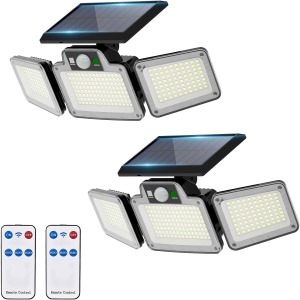
The JumJam 2-pack leads on LED count: 280 LEDs per unit is the highest in this roundup. More LEDs doesn’t always mean more useful light (beam angle, reflector design, and LED efficiency matter too), but at the price point for two units it’s a strong value proposition for buyers who want to maximise visible output. The remote control is included, matching the convenience of the product above at a lower two-unit price.
At 4.5 stars from 341 reviews, this is a newer product with less long-term feedback than the KIBTOY, but the current review profile is solid. The IP65 waterproofing and standard motion sensor modes apply. For a buyer who wants high LED count and remote control in a 2-pack format at budget pricing, this is the pick.
Features
- 280 LED per unit (highest in this roundup)
- Remote control included
- IP65 waterproof, motion sensor
- 2-pack
- 4.5 stars, 341 reviews
- 280 LEDs is the highest count in this roundup
- Remote control + 2-pack at under £19 is excellent value
- 4.5-star rating gives reasonable confidence for a newer product
- 341 reviews is lower long-term validation than KIBTOY’s 3,589
- High LED count draws more battery power in constant-on mode
Solar Flood Lights Buying Guide
Key Takeaways
- Lumens matter more than LED count. 1,000 to 3,000 lumens covers the range from useful ambient security to genuine deterrent-level brightness.
- Multi-head designs (3 or 4 heads) are essential for complex properties. A single head on a corner position will always leave coverage gaps.
- Dual PIR sensors reduce blind spots significantly on multi-approach positions. Single PIR sensors leave a detection cone with blind zones on each side.
- Separate panel vs integrated panel determines where you can mount the light. Integrated designs need sun access at the mounting point; separate panels can be positioned independently.
- IP65 is the minimum for UK outdoor use. It covers sustained rain, not just splash, which matters through October to March.
- Motion-triggered mode conserves battery and is the right default for UK winters. Constant-on mode drains batteries quickly on short December days.
- Remote control is worth having for lights mounted at height, as changing modes without a ladder access is a practical improvement.
- UK winter performance drops to roughly 40-60% of summer runtime. Size up battery capacity if winter is a priority.
Lumens vs LED Count: What Actually Matters
Solar flood light listings frequently lead with LED count: 70 LED, 189 LED, 280 LED. This is useful shorthand but it’s not the whole story. What determines useful output is lumens, not raw LED numbers. A design with 280 low-efficiency LEDs can produce less usable light than a design with 108 high-efficiency LEDs. When comparing products, prioritise the lumen figure over the LED count.
| Output level | Lumen range | Best use |
|---|---|---|
| Ambient security | 300 to 600 lumens | Garden path, patio edge, low-threat areas |
| Useful deterrent | 600 to 1,500 lumens | Side gate, rear garden access, garages |
| High-deterrent | 1,500 to 3,000+ lumens | Driveways, front approaches, commercial use |
For a typical UK home, a driveway or front approach benefits from 1,000 lumens minimum. Side and rear access points can work with 600 to 800 lumens. Garden ambient lighting needs only 300 to 500 lumens. Match the lumen level to the security priority of the position rather than buying maximum lumens everywhere.
Motion Sensor vs Dusk-to-Dawn: Which Mode for Which Position
Most solar flood lights offer both modes, and the best ones offer three: motion-only, constant dim plus motion boost, and constant full brightness. Understanding which mode suits which position saves battery and extends the useful life of each charge.
Motion-triggered is the right default for most UK positions. It conserves battery so the light is at full power when activated rather than dim from a depleted cell. It also creates a more effective deterrent: a sudden activation is more alarming than a light that is already on. For a driveway where you regularly arrive at night and want the light active from arrival to entry, the constant dim plus motion boost mode works better.
Constant full brightness drains the battery rapidly in UK winter. On a December day with 7 to 8 hours of weak sun, a battery that needs 6 to 8 hours of charging to power 8 hours of constant output will not make the maths work. Use constant mode only for short periods, not as a default winter setting.
The North-Facing Wall Problem
Integrated solar flood lights mount the solar panel on the light body itself. This is convenient but creates a real problem for the most common UK security light position: the north-facing front wall or garage above the main entrance.
A north-facing wall in the UK receives minimal direct sun. The integrated panel on a north-facing mount will charge slowly, particularly from October through February, and battery performance will drop significantly. If your primary lighting position faces north, you have two options: choose a product with a separate solar panel on a cable (the panel goes in a sunny spot; the light body mounts where you need it), or accept reduced winter performance from an integrated design and compensate by using motion-triggered mode to conserve battery.
Products with separate panels solve this cleanly. They’re common in higher-end solar security lights. Check the listing before buying if your target position faces north or north-east.
Number of Heads and Coverage Area
Single-head flood lights suit simple single-approach positions: a straight driveway, a rear door facing one direction. When properties have corners, wide frontages, or multiple access points that fall within a single mounting position’s reach, multi-head designs are more effective.
| Head count | Coverage pattern | Best position |
|---|---|---|
| 1 head | Single directed beam | Straight driveway, rear door, single path |
| 3 heads | Split adjustable coverage | Wide frontage, garage approach, corner |
| 4 heads | Near-360° with adjustable angles | Corner property, complex multi-approach layout |
Common Buying Mistakes
- Mounting on a north-facing wall without a separate panel. An integrated panel on a north wall charges slowly in UK conditions. Check for separate-panel options or accept the limitation.
- Choosing LED count over lumens. 280 LEDs does not automatically mean brighter than 108 LEDs. Read the lumen figure in the specification.
- Setting constant-on mode in winter. This drains the battery fast on short December days. Use motion-triggered mode as the winter default.
- Buying a single-head light for a corner position. One fixed-direction beam leaves coverage gaps. A 3 or 4 head unit covers multiple angles from a single mount.
- Ignoring the IP rating detail. IP65 means protection against sustained water jets. IP44 means splash only. For UK outdoor use, IP65 is the minimum for anything mounted in an exposed position.
- Expecting summer performance year-round. A light rated for 8 hours constant-on in summer will give 3 to 4 hours in December. Motion-triggered mode compensates for this, but constant-on mode will not meet summer spec in winter.
Quick Buyer Checklist
- Does your mounting position face south or receive direct afternoon sun? (Critical for integrated-panel designs)
- Is your position a corner or multi-approach? (3 or 4 heads, or dual PIR sensor)
- What lumen level matches the security priority of the position? (600+ for side access, 1,000+ for driveways)
- Do you need remote control for a high-mounted unit?
- How many positions need covering? (6-pack vs individual units)
- Is IP65 confirmed in the specification, not just the title?
Case Study: A Detached House in Surrey Gets Full Perimeter Coverage
Background
A homeowner in Surrey had a detached property with a wide gravel driveway, a side gate accessing the rear garden, and a rear access point from a shared lane. Previous solar lights had failed within a year and didn’t provide meaningful deterrent output. The brief was full perimeter coverage with reliable winter performance.
Project Overview
The homeowner selected three products: two KIBTOY 2-packs for the driveway approach and garage wall (four units total at two driveway positions), the intelamp dual PIR unit for the corner where the driveway met the side gate approach, and two individual 270° wide-angle units for the rear lane access point. Total installation: seven lights covering the full perimeter.
Implementation
All units were mounted at 2.5 to 3 metres with the integrated panels facing south-west to maximise afternoon charging. The intelamp was positioned at the corner with one PIR sensor covering the driveway approach and the second covering the side gate angle. Installation took one afternoon with a standard drill, rawl plugs, and the mounting brackets supplied with each unit.
Results
Through the first summer and autumn all seven lights performed consistently in motion-triggered mode. Winter performance dropped as expected: runtime in motion-triggered mode remained adequate, but two units on the less sun-exposed rear elevation required the sensor to be switched from constant dim to motion-only to conserve battery through December. By February performance had recovered as day length increased. The full perimeter coverage was maintained without any electrical installation or cable runs.
Frequently Asked Questions
How long do solar flood lights last at night in the UK?
In summer with full charging, most solar flood lights run for 6 to 12 hours in motion-triggered mode. In constant-on mode, expect 4 to 8 hours depending on battery capacity. In UK winter, these figures drop to roughly 40 to 60% of summer performance. Motion-triggered mode is essential in winter to stretch battery output across the long dark hours. Products with 6,000mAh batteries hold up better through consecutive overcast winter days than smaller-battery alternatives.
Do solar flood lights work on north-facing walls?
Integrated-panel solar flood lights work poorly on north-facing walls in the UK. The panel receives minimal direct sun from October through March when days are short and the sun stays low. Performance drops significantly in winter. If your priority position faces north, look for a solar flood light with a separate panel on a cable so the panel can be positioned in a sunnier spot. Alternatively, accept the limitation and use motion-triggered mode to conserve battery.
What is the difference between 1 PIR and 2 PIR sensors on solar flood lights?
A single PIR sensor covers a cone-shaped detection zone in front of the unit, with blind spots on each side of that cone. A dual PIR design uses two sensors covering a wider combined arc, which reduces the blind spots significantly. For a straight single-approach driveway, single PIR is adequate. For a corner position or any location where movement can come from multiple angles, dual PIR reduces the chance of missed activations.
How many lumens do I need for a driveway?
For a typical UK residential driveway, 800 to 1,500 lumens provides meaningful deterrent output that is clearly visible from the street and to anyone approaching the property. Under 500 lumens is ambient rather than deterrent. Over 2,000 lumens is high-deterrent and appropriate for large driveways, commercial premises, or properties in higher-risk areas. The beam angle matters as much as lumens: a 3,000 lumen light with a narrow beam covers less practical area than a 1,200 lumen light with a 270° spread.
Do solar flood lights need direct sunlight to charge?
Solar panels charge from daylight, not just direct sun, so UK cloudy weather does not prevent charging entirely. However, output on a fully overcast day is typically 20 to 40% of direct-sun output. Extended periods of heavy cloud (common in UK winters) progressively deplete batteries. South or south-west facing mounting positions with clear sky access maximise available charging. North-facing or heavily shaded positions will underperform significantly, especially from October through February.
What is the best operating mode for solar flood lights in UK winter?
Motion-triggered only is the best default for UK winter. Short days and weak sun mean limited charging; conserving battery by only activating at full brightness when motion is detected allows the light to remain functional across long winter nights. Constant-on mode depletes a typical solar battery within 3 to 5 hours in midwinter, leaving hours of darkness uncovered. If ambient constant light is important, use the dim-plus-motion-boost mode, which uses much less power than full constant brightness.
Can I use solar flood lights for a garage?
Yes, solar flood lights work well for garage applications provided the mounting position gets adequate sun. A garage with a south-facing wall is ideal. A garage with a north-facing wall or one that’s shaded by trees or adjacent structures will charge slowly. For garage interiors, separate-panel solar lights (where the panel mounts outside and a cable runs inside) work much better than integrated designs. For garage external walls, any of the products in this roundup with IP65 waterproofing handle the typical UK garage exterior environment.
Are solar flood lights bright enough for security use?
The better models in this roundup deliver 1,000 to 3,000 lumens on activation, which is genuinely deterrent-level output. For context, a standard 100W incandescent bulb produces around 1,600 lumens. A solar flood light activating at 1,200 to 1,500 lumens creates a sudden, jarring level of illumination that is effective as a deterrent for opportunistic intruders. The key is ensuring the sensor activates reliably, and motion sensor sensitivity, detection angle, and positioning all affect whether the light actually triggers when needed.
Summing Up
The best solar flood light for most UK buyers is the KIBTOY 70 LED 2-pack: the review volume and consistent rating give confidence that the wide-angle illumination and IP65 build actually deliver what they promise across real British conditions. For complex corner positions or multi-approach driveways, the intelamp dual PIR unit justifies its premium with detection coverage that single-sensor alternatives can’t match. And for comprehensive full-property coverage on a budget, the 6-pack at under £7 per unit is the most cost-effective route to having something meaningful on every corner that matters.
If you’re thinking about solar panel installation for your home rather than just garden lighting, contact us for a free quote and we’ll assess what system size suits your property.
Updated