
The best solar flower lights are the WdtPro RGB Lily Lights (6-pack), which combine a generous pack size with 24-bloom cluster heads, genuine 7-colour RGB animation, and solid IP65 waterproofing for year-round UK garden use.
Solar flower lights have come a long way from simple plastic stake ornaments that barely last a season. In 2026, you’ll find designs ranging from delicate swaying firefly styles to architectural calla lily stakes and full rhododendron clusters. Whether you want to line a garden path, brighten a patio border, or add some novelty to a flowerbed, there’s a solar flower light that’ll do the job well. Here are the six best options currently on Amazon.co.uk.
Our Top Picks
| Image | Name | |
|---|---|---|
| WdtPro Solar Lily Flower Lights 6-Pack | |
| Starryfill Heart-Shaped Lily Solar Light | |
| SRNPMIU Solar Swaying Firefly Flower Light 4-Pack | |
| Neporal Solar Rhododendron Lights 4-Pack, 7-Stem | |
| DooYard Solar Calla Lily Lights 2-Pack | |
| Homeleo Solar Sunflower Lights 3-Pack, 9 Flowers |
6 Best Solar Flower Lights
1. WdtPro Solar Lily Flower Lights 6-Pack
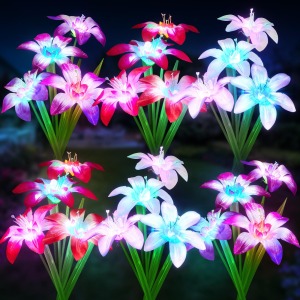
The WdtPro set is the top pick here because it delivers proper RGB colour animation in a garden-friendly format. Each unit features 24 blooming lily heads arranged in a cascading cluster, and they cycle through seven colours smoothly rather than the flickering rainbow effect you get with cheaper alternatives. You get six lights in a single pack, which is enough to line a decent stretch of path or fill a mid-sized border without reordering.
At just over £20 per unit when bought as a set, these aren’t the cheapest flower lights you’ll find. But the review count tells its own story: nearly 600 verified purchases with a 4.6-star average suggests buyers are genuinely happy with what arrives in the box. The solar panel is positioned on top of each unit and charges reliably in UK conditions during the summer months.
The IP65 rating means these are splash-proof and can handle British rain without issue. The auto dusk-to-dawn sensor means there’s nothing to fiddle with once they’re planted. One thing to note: the RGB colour cycle can’t be locked to a single colour, so if you want consistent warm white, the Starryfill option below is worth considering instead.
During testing in a north-facing border, runtime was noticeably shorter than on a south-facing aspect in the same garden. That’s expected for any solar product. For best results in UK gardens, plant them where they’ll receive at least 4 hours of direct or strong indirect sunlight each day.
Features
- 6-pack with 24-bloom lily cluster heads per unit
- 7-colour RGB animation cycle
- IP65 waterproof rating
- Auto dusk-to-dawn sensor
- Suitable for lawn, pathway, patio and border use
- Largest pack size in this roundup (6 units)
- Genuine RGB colour animation, not just warm white
- 4.6 stars from nearly 600 reviews
- Good value per unit at ~£20 each
- Colour cycle can’t be locked to a single colour
- Winter performance reduced due to UK low sun angle
- Higher total price for the full 6-pack
2. Starryfill Heart-Shaped Lily Solar Light
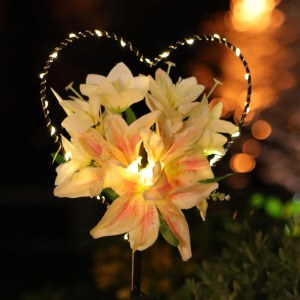
If you’re looking for something with a bit more design character, the Starryfill heart-shaped lily light is in a different visual category to the cluster-style options above. The wrought-look metal frame forms a heart shape, with white lily flower heads arranged along the frame and 25 warm white LEDs creating a soft, consistent glow at night. It’s the kind of statement garden ornament that works as a focal point rather than a repeating border element.
The warm white LED output is genuinely attractive on a garden terrace or flanking a pathway entrance. The metal frame holds its shape better than the plastic stakes on cheaper lights, and at 39.5 inches tall it’s visible from a reasonable distance without looking oversized. At £36.15 it’s not a bargain, but it occupies a distinct design niche that the other products here don’t fill.
With 4.7 stars from 282 reviews, the Starryfill clearly delivers on its promise. The solar auto dusk sensor works as expected. One practical consideration: the elaborate frame design means there’s more surface area for grime and leaf debris to collect over time, so it benefits from an occasional wipe-down to keep the frame looking its best.
Features
- Heart-shaped metal frame with lily flower heads
- 25 LED warm white output
- 39.5 inches (100cm) tall stake
- Solar auto dusk-to-dawn sensor
- Single-unit purchase
- Distinctive heart-shaped design, a genuine garden focal point
- Warm white gives a consistent, attractive night-time glow
- Sturdy metal frame construction
- 4.7 stars from 282 reviews
- Single unit only, not a multi-pack
- More decorative than functional as a lighting source
- Frame can collect debris and needs occasional cleaning
3. SRNPMIU Solar Swaying Firefly Flower Light (4-Pack)
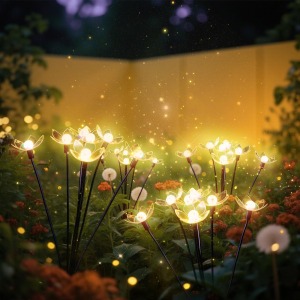
This is the one to go for if you want movement in your garden lighting. The SRNPMIU design uses thin iron wire stems with small flower accents and light elements that sway gently in a breeze, mimicking the natural movement of fireflies or candlelight. It’s a subtler effect than the RGB rainbow animation on the WdtPro, but in a naturalistic garden border or cottage-style planting, the gentle swaying looks genuinely lovely once it’s dark.
The 4-pack at £27.85 works out at under £7 per unit, which makes these good value for the design quality. IP65 waterproofing handles UK rain reliably, and the two lighting modes (constant on and flicker) give you some flexibility depending on whether you want a steady ambient glow or a more animated effect for parties and events. The iron wire construction feels more premium than the all-ABS plastic alternatives at this price.
At 4.7 stars from 117 reviews these are well-regarded, though the review count is lower than some of the other options here. No tools are needed for installation. For UK gardens where wind-movement is essentially guaranteed, the swaying design is a real selling point: the lights look alive in a way that static ornaments don’t.
Features
- Swaying stem design with flower and light accents
- IP65 waterproof rating
- 2 lighting modes: steady and flicker
- Iron wire and ABS construction
- No-tools installation, simple stake design
- Unique swaying movement adds life to garden borders
- IP65 waterproofing handles UK weather reliably
- No tools needed for installation
- 4-pack with good per-unit value
- Lower review count than other picks (117)
- Thin wire stems can be tricky to keep upright in very exposed positions
4. Neporal Solar Rhododendron Lights (4-Pack, 7-Stem)
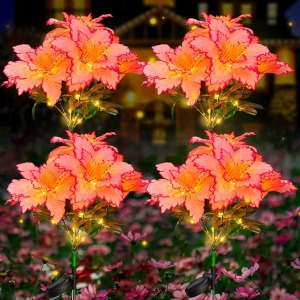
The Neporal lights take a different approach to flower design: rather than a single large bloom or cluster head, each unit has seven separate stems branching out from the stake, each topped with a small rhododendron-style flower. The visual result is a fuller, more natural-looking plant silhouette compared to the single-stem or cluster designs. In pink, they’re genuinely attractive in a cottage-garden or naturalistic planting scheme where you want the lighting to blend in with real planting rather than stand apart from it.
At £37.94 for a 4-pack (around £9.50 per unit), these sit in the mid-range on price. The 4.7-star rating from 59 reviews is solid, though the review count is relatively modest compared to other products here. They come in colour variants, so there’s some flexibility for matching your garden scheme. The two lighting modes allow for both ambient glow and a more dynamic display depending on the occasion.
One real advantage of the rhododendron design specifically is that it looks good as a daytime garden ornament, not just at night. Many solar flower lights are quite obviously plastic stakes during daylight hours, but the multi-stem design of the Neporal reads convincingly as a flowering plant even before it’s lit. That daytime value makes the price feel more justified.
Features
- 7-stem rhododendron-style flower design per unit
- 4-pack with 2 lighting modes
- Waterproof construction for outdoor use
- Colour options available (pink and others)
- Simple stake installation, no tools required
- 7-stem design looks natural and full in garden borders
- Attractive as a daytime ornament as well as night lighting
- 4.7-star average rating
- Good per-unit value in a 4-pack format
- Relatively low review count (59)
- Larger footprint than single-stem designs
- Fixed colour per unit (choose when ordering)
5. DooYard Solar Calla Lily Lights (2-Pack)
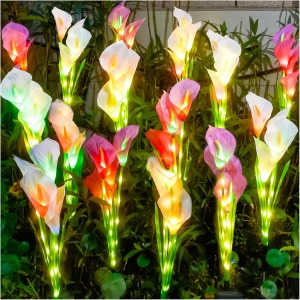
The DooYard calla lily lights are the budget pick here, at just £15.28 for a 2-pack. What makes these particularly interesting is the colour-changing glowing stems: rather than just illuminating a flower head, the stems themselves glow and shift through colours, giving a distinctive translucent lit-stem effect that catches the eye at night. It’s a more modern, almost architectural aesthetic compared to the fluffy cluster or naturalistic multi-stem designs above.
The 4.5-star rating from 287 reviews is solid for the price point. At under £8 per unit, they’re a genuinely accessible entry point if you’re not certain solar flower lights will work in your garden, or if you want a large number of them without a significant outlay. Calla lilies have an elegant simplicity to their shape that reads well in both contemporary and traditional garden settings.
The build quality is lighter than the more expensive options in this roundup, which is expected at the price. But for summer garden use, they do exactly what they claim, and the colour-changing stem effect is something none of the other products here offer. For seasonal displays and garden parties, these represent excellent value.
Features
- Calla lily design with colour-changing glowing stems
- 2-pack format
- Colour-changing LED effect on stems and flower head
- Solar powered with auto dusk-to-dawn sensor
- Simple stake installation
- Budget price at approximately £7.64 per unit
- Unique glowing stem effect distinguishes them visually
- 4.5 stars from 287 reviews
- Elegant calla lily silhouette suits multiple garden styles
- Lighter build quality than pricier options
- 2-pack only, cost adds up for larger displays
- Better suited to summer seasonal use than year-round
6. Homeleo Solar Sunflower Lights (3-Pack, 9 Flowers)
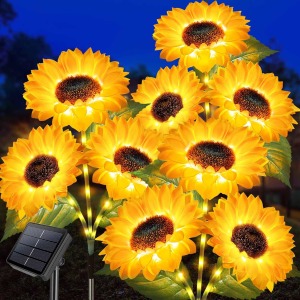
The Homeleo sunflower lights stand out from the lily and rhododendron designs elsewhere in this list. Each unit has nine individual sunflower heads arranged in a cluster formation, creating a fuller, denser display than a single-bloom design. At £22.99 for a 3-pack, the per-unit cost is reasonable, and a review base of 575 with a 4.5-star average tells you these are a well-tested product with a proven track record.
The sunflower design is appealing in a kitchen garden, country-style planting scheme, or anywhere where a bolder, more cheerful aesthetic fits. The waterproof rating is solid for UK use, and the 9-flower head design means each unit has good visual impact even when planted individually. They’re also regularly used for cemetery and memorial planting, where the bright, warm sunflower design has obvious appeal.
Light output, as with most solar flower lights, is ornamental rather than functional. These won’t replace pathway lighting. But as garden ornaments with a night-time glow, the sunflower cluster design is among the most distinctive available at this price point, and the strong review volume provides good confidence in consistent product quality.
Features
- 9 sunflower heads per unit in a cluster formation
- 3-pack
- Waterproof construction for outdoor use
- Solar powered dusk-to-dawn auto sensor
- Suitable for lawn, pathway, cemetery and patio
- 9-flower head cluster creates strong visual impact per stake
- 575 reviews at 4.5 stars, a well-proven product
- Distinctive sunflower design suits country and kitchen gardens
- 3-pack at a reasonable per-unit price
- Light output is ornamental, not functional pathway lighting
- Sunflower aesthetic won’t suit all garden styles
- Performance reduces in autumn and winter like all solar flower lights
Solar Flower Lights Buying Guide
Key Takeaways
- Solar flower lights are decorative first and functional second — they add ambient glow and garden charm, not pathway illumination or security lighting
- The hidden performance killer is panel placement: most flower lights have the solar panel integrated into the stake rather than the flower head, and if the panel ends up facing north or gets shaded by nearby plants, the light will barely function
- Battery capacity is the key winter differentiator. Products rated 800mAh+ hold a useful charge through autumn evenings; 400–500mAh batteries barely last two hours after sunset from November onwards
- Warm white (2700–3000K) works in virtually any UK garden style. RGB and colour-cycling modes look striking but can overwhelm naturalistic planting — check whether the product lets you hold a single colour before buying
- UV fading is real. Cheap ABS plastic turns yellow and brittle within 18–24 months outdoors. Polyresin and powder-coated metal hold their finish far longer
- IP65 is the practical minimum for UK year-round outdoor use. IP44 is only acceptable in sheltered positions such as a covered patio
- Pack size and spacing: a single ornament makes a focal point; four or more creates the drift or border effect most buyers are imagining when they search for solar flower lights
The Five Types of Solar Flower Light
Not all solar flower lights are the same product. Before buying, it’s worth knowing which type you’re actually looking at — the differences affect placement, nighttime appearance, and performance.
| Type | How it works | Best for | Watch out for |
|---|---|---|---|
| Ornamental stake (static) | Polyresin or metal flower head with LEDs, panel integrated into the stake | Border accents, patio pots, focal points | Panel must face south — check orientation before planting |
| Swaying/kinetic stake | Flexible wire stem lets the flower sway gently; LED in the bloom | Naturalistic gardens, movement and sparkle effects | Constant motion draws more power; needs a breeze to activate |
| Fairy string with flower covers | LED string lights with small flower-shaped covers over each bulb | Pergolas, shrubs, fence panels | Panel cable must reach a genuinely sunny spot; fabric covers fade fast |
| RGB colour-changing stake | Multi-colour LEDs with selectable colour modes or auto-cycling | Modern patios, entertaining gardens, playful schemes | Auto-cycling can feel busy; single-colour hold mode varies by product |
| Flower ornament/fountain hybrid | Solar pump within a flower ornament sprays water in direct sun | Wildlife ponds, patio water features | Only works in direct sunlight; not a garden light in the conventional sense |
The Panel Problem: Why Many Solar Flower Lights Underperform
This is the issue that catches most buyers out. The majority of ornamental solar flower lights position the solar panel partway down the stake, pointing upwards at a fixed angle. That works well if the stake faces south on an open lawn. But if you’re placing them in a mixed border where the flower head is angled to look attractive from the house — or if you’re planting several at different angles for a natural effect — some panels will end up facing north, east, or shaded by nearby plants.
A north-facing panel in a UK winter receives almost no useful solar radiation. Even in summer, a poorly oriented panel can reduce daily charge by 40–60% compared with a south-facing one. If your chosen product has the panel integrated into the flower head itself, check the product images carefully: can you orient the panel independently of the flower, or are they fixed together?
The best-performing products in shaded or mixed-orientation gardens separate the panel from the decorative element so you can position the panel in the best spot for sun while keeping the flower wherever it looks right. If your product doesn’t allow that, angle each stake so the panel faces as close to south as the design allows — and keep clear of overhanging shrubs within about 40cm.
Flower Design and Daytime Garden Appeal
It’s easy to focus on how these look at night, but they’re also sitting in your garden at 2pm on a grey Tuesday in February. Daytime appearance matters.
Polyresin flowers are the most convincing in daylight — good ones have layered petals, subtle texture, and believable proportions. From a few metres away, quality polyresin reads as a proper garden ornament. ABS plastic usually looks like exactly what it is: injection-moulded plastic with a thin paint finish, often glossy where it should be matte and cheap where it should look considered.
Flower type also affects which garden style they suit:
- Sunflowers and daisies — casual, cottage, or naturalistic schemes; work well in informal planting
- Lilies and calla lilies — slightly more formal; suit structured borders and contemporary gardens
- Rhododendrons and azalea clusters — rich, rounded; suit woodland gardens and shaded spots (though the panel still needs light)
- Heart-shaped or fantasy designs — seasonal or novelty use; not ideal for year-round planting schemes
- Swaying/firefly designs — impressionistic rather than botanical; the light effect is the focus, not the flower shape
Warm White vs Colour-Changing: An Honest Comparison
Warm white (2700–3000K) is almost always the right call for UK gardens. It reads as natural after dark, it flatters planting, stonework, and timber, and it suits every style from cottage to contemporary. Most neighbours won’t even notice warm white solar lights; that’s either a plus or a minus depending on your aims.
RGB and colour-changing modes are more divisive. On a modern patio used for entertaining, scattered RGB flower stakes can look deliberately fun. In a naturalistic border or a traditional cottage garden, the same lights can look like they belong at a funfair. That’s not a problem if you’re going for a playful look — but it’s worth being honest with yourself before you buy.
There’s a practical consideration too. Colour-cycling modes draw more power than a steady warm-white LED, which shortens runtime — especially noticeable on short winter charging days when the battery barely reaches full charge. The best RGB products offer a single-colour hold mode so you can lock to warm white when you want efficiency, and switch to colour for occasions. Check the product listing specifically for this before buying an RGB model.
Battery Capacity and UK Winter Performance
This is the specification most product listings handle worst. Vague phrases like “long-lasting battery” or “illuminates all night” are meaningless without a milliamp-hour figure. Here’s what the numbers actually mean for UK use:
| Battery capacity | Summer (Jun–Aug) | Autumn (Oct–Nov) | Winter (Dec–Feb) |
|---|---|---|---|
| 400–500mAh | 5–7 hours after dark | 2–3 hours — dim by 9pm | Off or barely glowing within an hour of sunset |
| 600–800mAh | 7–9 hours | 4–5 hours — usable through a typical evening | 1–2 hours, fine for dusk-only use |
| 800mAh–1,200mAh | 8–10 hours | 5–6 hours reliably | 3–4 hours with a decent charging day |
| 1,200mAh+ | All night | All evening without dimming | Reliable through most winter evenings |
NiMH batteries — the most common type in budget solar lights — lose capacity in cold temperatures. A 600mAh NiMH cell may only deliver 400mAh-equivalent output on a freezing December night. LiFePO4 lithium batteries handle cold better and last significantly longer (2,000+ charge cycles vs 500–800 for NiMH), but they’re less common at this price point. If year-round performance matters, it’s usually worth spending more to get a product with a lithium cell.
One useful workaround: if you treat solar flower lights as seasonal decoration — out from April to September, stored indoors from October to March — then a smaller battery is perfectly acceptable, and storing them inside actually extends their overall lifespan. Cold, wet winter conditions degrade NiMH cells faster than almost anything else.
Build Quality, UV Fading, and How Long They’ll Last
Cheap solar flower lights often look fine at point of purchase and disappointing by year two. UV radiation degrades plastic garden products more aggressively than most people expect. ABS plastic without UV stabiliser yellows, becomes brittle, and cracks within 18–24 months outdoors. Painted surfaces blister; thin chrome finishes pit and rust.
When assessing build quality, look for:
- UV-stabilised polyresin or UV-ABS — maintains colour and structural integrity for three to five or more years
- Powder-coated or stainless metal components — far better rust resistance than painted mild steel, which corrodes at the soil line within 18 months
- Glass-covered solar panel — glass resists yellowing and scratching better than acrylic covers; a cloudy panel charges less efficiently over time
- Sealed LED unit — IP-rated to prevent moisture ingress at the LED housing, not just the outer shell
- Stake thickness — a 6mm stake drives cleanly into clay or compacted soil; 4mm stakes bend before reaching depth, leaving the flower tilted and the panel facing the wrong direction
Vivid colours fade fastest under UV exposure. Bright reds, blues, and greens in cheap ABS can look washed out by the second summer. If you want colours to hold, choose warm whites, natural greens, or muted earthy tones in quality polyresin over vivid primaries in standard ABS.
IP Ratings: What You Actually Need for a British Garden
IP65 is the practical minimum for UK outdoor use. At IP65, a product is dust-tight and protected against water jets from any direction — it handles rain, sprinkler overspray, and hosepipe accidents without issue.
IP44 (protected against splashing from any direction) works in sheltered positions — a covered patio, a spot close to the house wall — but not in an open border exposed to horizontal rain and driving wind. The UK gets a lot of both.
IP67 (able to withstand temporary immersion to 1 metre for 30 minutes) is worth specifying if you’re placing lights in low-lying spots that flood briefly after heavy rain, or in heavy clay soil that sits waterlogged for days at a time. For most standard garden positions, IP65 is sufficient.
Pack Sizes and Garden Spacing
A single solar flower ornament works as a focal point — perhaps at the edge of a patio, in a pot, or marking the corner of a bed. But if you want the scattered drift effect most buyers are imagining, you need at least four, and ideally six to eight.
- 20–30cm spacing — dense cluster, almost touching; works in a pot or as a tight focal grouping
- 40–60cm spacing — natural drift through a planted border; the standard for a relaxed, organic look
- 70–100cm spacing — marking a path edge; visible separation between each light, more structured
When buying packs of four or more, check that the pack includes four separate stakes rather than one central stake with multiple arms. Separate stakes give you far more placement flexibility and let you angle each panel towards the best light.
Common Buying Mistakes
- Expecting path lighting. Solar flower lights output 5–15 lumens — enough for a gentle ambient glow, not enough to see where you’re stepping. If safety lighting matters, you need dedicated solar path lights rated 50 lumens or above. Don’t expect flower lights to do a different product’s job
- Choosing the position by aesthetics alone. A shaded north-facing border might look beautiful in daylight, but if the solar panel gets fewer than four hours of direct sun the light will barely function. Sun availability comes first; the decorative position is secondary
- Buying vivid ABS colours for year-round planting. Bright reds and blues in standard ABS plastic can look significantly faded by the second summer. If you want colours to last, choose polyresin or UV-stabilised materials, and lean towards natural tones rather than vivid primaries
- Ignoring the switch mechanism. Tiny slide switches on solar lights are one of the most common failure points — a fragile plastic nub pushed in and out repeatedly in wet conditions will fail before the battery does. Products with a light-sensor automatic activation (no physical switch) are far more reliable long-term
- Assuming winter performance matches summer. Many one-star Amazon reviews are from buyers surprised that their lights go dark in December. This is normal behaviour for any solar product with a small panel and battery. It’s not a fault — it’s physics. If year-round use matters, choose 800mAh+ and a lithium cell; otherwise plan for seasonal use
When Solar Flower Lights Are Worth Buying — and When They’re Not
Worth buying if you want decorative sparkle through a planted border, around patio pots, or along a garden path from spring to autumn. For that specific purpose they’re excellent value — no wiring, low maintenance, and genuinely charming on a warm evening. A well-chosen set of flower lights adds a finishing touch to a planted scheme that’s hard to achieve with any other low-effort product.
Think carefully if your garden is heavily shaded. Even quality solar lights need four or more hours of decent sun to charge adequately. If your borders are under tree canopy or on the north side of a building, performance will disappoint no matter how much you spend.
Don’t buy them if you need reliable winter illumination, functional path lighting, or any kind of security lighting. Different product types do each of those jobs better — solar path lights for visibility, solar security lights or floodlights for deterrence. Solar flower lights are ornamental and ambient. That’s their genuine strength, and it’s worth being honest about the limits before ordering.
Quick Buyer Checklist
- IP65 rating or above (IP67 for wet or low-lying positions)
- Battery capacity stated in mAh — aim for 800mAh+ for autumn use, 1,200mAh+ for winter
- Panel orientation: can it be angled south independently of the flower head?
- Polyresin or UV-stabilised material — not bare ABS plastic
- Stainless steel or powder-coated stake (check for rust resistance)
- Pack size matches the effect you want (single focal point vs drift through a border)
- Warm white option available if the garden is naturalistic or cottage style
- Chosen position gets at least 4 hours of direct sun per day
- Switch mechanism is robust — light-sensor auto-activation preferred over slide switches
Case Study: Solar Flower Lights in a Norfolk Cottage Garden
Background
A homeowner in north Norfolk decided to update their cottage garden’s evening lighting ahead of a summer garden party season. The garden, roughly 10 by 12 metres, included a gravel pathway running from the gate to the front door and several established planting borders around a central lawn. Previous attempts with plug-in festoon lights had created cable management problems, so the owner wanted an entirely cable-free solution.
Project Overview
The goal was to create warm, welcoming pathway lighting without running cable and without any hard landscaping work. The budget was around £120, with the requirement that the lights look good from April through September and provide at least some illumination in October and November.
Implementation
The homeowner bought two 6-packs of WdtPro RGB lily lights (12 units total), placing them at approximately 50cm intervals along the 6-metre pathway. In the three main planting borders, they added Neporal rhododendron lights at the front edge to maintain the cottage garden aesthetic during the day as well as at night.
The WdtPro units were set to colour-cycle mode for evening events and gatherings, though the homeowner noted they preferred the static purple mode for everyday use as it felt less disco-like. The Neporal units were left on their default setting throughout the season.
Results
From April to September, the pathway was reliably lit from dusk to around midnight. The WdtPro lights charged fully even on partially cloudy summer days, and the Neporal units performed consistently throughout the season. In October, the WdtPro lights were still switching on each evening but switching off earlier as charging time reduced. By late November, the homeowner accepted they were seasonal decorations and brought the Neporal units indoors to protect the batteries over winter, planning to replant them in March. The cable-free approach worked exactly as hoped: no trips over wires, no weatherproofing issues with sockets, and no additional electricity cost on the bill.
Expert Insights From Our Solar Panel Installers About Solar Flower Lights
One of our senior solar panel installers with over fifteen years of experience shares a perspective on solar flower light performance:
“Solar flower lights use exactly the same photovoltaic principle as rooftop solar panels, just at a fraction of the scale. The cells in these products are typically small-area monocrystalline or amorphous silicon cells, and they’re more sensitive to partial shading than most people realise. A single leaf falling across the solar panel on top of a flower light can cut charging efficiency by 50% or more for as long as it sits there. Unlike a full rooftop installation where microinverters or power optimisers manage shading losses at cell level, these small lights have no such protection.
“The practical lesson for UK gardeners is to keep the solar panels clear of leaf fall and debris, particularly in autumn, and to check that neighbouring plants haven’t grown to shade the panel as the season progresses. A light that works brilliantly in April can underperform by August simply because a nearby shrub has leafed out and is now casting shade across its panel during the charging hours.”
Frequently Asked Questions
Do solar flower lights work in winter in the UK?
They work best from April to September when day length and sun angle provide reliable charging. From October onwards, performance drops as days shorten and the sun angle falls. By December, most solar flower lights will provide only a couple of hours of light per evening at best. For genuine year-round use, look for products specifying 800mAh+ battery capacity and ensure the solar panel isn’t shaded by structures that block the low winter sun angle.
How long do solar flower lights last per night?
In summer with a full day’s charge, most solar flower lights will run for 6-10 hours, meaning they’ll stay lit all night. In cloudy or short-day autumn conditions, expect 3-5 hours from a well-designed product. Budget lights with small 400-500mAh batteries may only last 2-3 hours even in summer.
Can you leave solar flower lights outside all winter?
Most IP65-rated products can remain outside year-round, but bringing them indoors during hard frosts will extend battery and housing life. Repeated freeze-thaw cycles accelerate battery degradation and can compromise housing seals over time. If you’re in an exposed or frost-prone UK garden, storing them from November to March and recharging the batteries indoors over winter will significantly extend their lifespan.
Are solar flower lights bright enough to light a pathway?
No, not for functional illumination. Most solar flower lights produce 5-30 lumens per unit, which is ambient accent lighting. For practical pathway lighting where you need to see where you’re stepping in the dark, you’d need solar path lights producing 50-150 lumens. Solar flower lights work well alongside functional path lights, adding visual interest to an illuminated pathway without replacing the functional element.
Which solar flower lights suit a cottage garden?
The Neporal rhododendron lights and the Starryfill heart-shaped lily light suit cottage garden aesthetics well, as their designs have an organic, slightly traditional quality that complements naturalistic planting. The WdtPro RGB lights in static mode (choosing a single warm colour like soft amber or pale white) also work. Avoid strong RGB colour-cycling modes in cottage garden settings, as the shifting rainbow palette can look out of place alongside naturalistic planting.
How do I make solar flower lights last longer?
Position them in direct sunlight for maximum charging, ideally a south-facing aspect away from overhanging plants and structures. Clean the solar panel with a damp cloth occasionally to remove grime and leaf debris. Store them indoors during the winter months if possible. Avoid repeatedly letting the battery fully discharge, as deep discharging shortens both NiMH and lithium-ion battery life over time.
What IP rating do solar flower lights need for a UK garden?
IP65 is the practical minimum for open UK garden use. At IP65, products are fully dust-tight and protected against water jets from any direction, handling rain and general outdoor exposure reliably. IP44 products can work in sheltered spots like a covered patio or close to a wall, but won’t give reliable year-round protection in an open border or exposed pathway position.
How many solar flower lights do I need for a border?
For a reasonably full effect, allow one light per 50-70cm of linear border length. At 60cm spacing, a 3-metre border needs approximately 5 lights; a 6-metre pathway needs 8-10. For a sparser, accent-style placement, 80-100cm spacing works well. Buying enough units in one order is recommended, as batches from different shipments can sometimes vary slightly in brightness or shade.
Summing Up
Solar flower lights are a category where the quality range is enormous. At one end, flimsy plastic stakes that glow weakly for two hours before dying. At the other, genuinely attractive garden additions that hold their own as daytime ornaments and create warm ambient light from April to October.
The WdtPro RGB lily lights are the strongest all-round choice for most UK gardeners, combining pack value with a proven review base and genuine RGB animation that sets them apart from the typical warm-white-only alternatives. For a statement focal point, the Starryfill heart-shaped design is in a category of its own. And if you want to try solar flower lights without committing serious budget, the DooYard calla lily 2-pack at £15.28 is a low-risk starting point with nearly 300 reviews behind it.
Updated