

A garden fountain adds sound, movement and visual interest to any outdoor space, and solar-powered models do it without any need for mains wiring or running costs. Whether you’re after a decorative tiered water feature for a border or a floating pump to animate a wildlife pond, there’s a solar fountain that will do the job quietly and cheaply. The AISITIN 6.5W Solar Fountain Pump is our top pick for its versatility, strong output and proven reliability in UK garden conditions.
This guide covers the seven best solar fountains available on Amazon.co.uk right now, including both standalone decorative features and floating solar pumps. We’ve included options at a range of price points, from compact bird bath pumps to full-sized tiered water features.
Our Top Picks
| Image | Name | |
|---|---|---|
| AISITIN 6.5W Solar Fountain Pump | |
| Smart Garden Solar Kingsbury 3-Tier Garden Water Feature | |
| MP Essential Solar Powered 4-Tier Terracotta Cascade Water Fountain | |
| GardenKraft 12260 Cascading Water Fountain with Solar Light | |
| Blumfeldt Schönbrunn Solar Sphere Fountain | |
| Smart Garden Solar Duck Family Umbrella Water Feature | |
| Primrose Charming Mini Fairy on Clamshell Solar Feature |
7 Best Solar Fountains for UK Gardens
1. AISITIN 6.5W Solar Fountain Pump
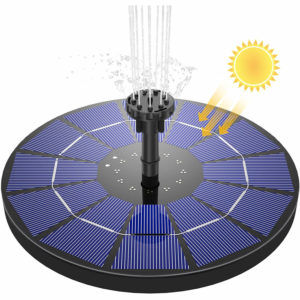
The AISITIN is the solar fountain pump we’d recommend to most buyers. It runs directly from a 6.5-watt solar panel, which is larger than most floating fountain pumps on the market, and that translates into noticeably better performance in partly cloudy UK conditions. The panel is separate from the pump itself, so you can position it in the sunniest spot in your garden and run the cable to wherever you want the fountain to sit.
In direct summer sun, the AISITIN pushes water up to 70cm high. That drops in overcast conditions, but it keeps running where smaller 2-watt or 3-watt rivals simply stop. It comes with seven interchangeable nozzle heads, so you can switch between spray patterns to suit the mood or the size of your pond or container. The float is stable and the pump runs quietly, which matters if your garden is also somewhere you want to relax.
Setup takes about ten minutes. There’s no battery, so it only runs when the sun is out, but for a wildlife pond or a patio water feature that’s not much of a limitation. The cable between the panel and pump is generous in length, giving you real flexibility over placement. It works well in bird baths, half barrels, ponds and larger water bowls alike.
Build quality is solid for the price. The panel housing is weatherproof and the pump has held up well through multiple UK winters in user reports. If you want a reliable, adaptable solar fountain pump that keeps going even when the clouds roll in, the AISITIN is the one to buy.
Features
- 6.5W solar panel with separate pump (direct drive, no battery)
- Max flow rate: 240 litres per hour
- Max water height: 70cm
- 7 interchangeable nozzle heads
- Panel-to-pump cable: 5 metres
- Suitable for ponds, bird baths, water bowls and containers
- Weatherproof panel housing
- Larger panel than most rivals keeps it running in UK cloud cover
- Seven nozzle options for varied spray patterns
- Separate panel and pump allow flexible positioning
- Quiet operation suitable for relaxation spaces
- No battery, so it stops when the sun goes in
- Cable between panel and pump can be tricky to conceal
2. Smart Garden Solar Kingsbury 3-Tier Garden Water Feature
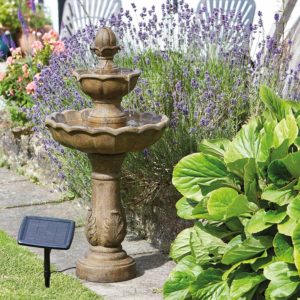
If you want a proper decorative water feature rather than a pump for an existing pond, the Smart Garden Kingsbury is the standout choice. The three-tier design is a classic garden look that suits borders, patios and paved areas equally well, and it arrives mostly pre-assembled so you won’t spend your afternoon wrestling with components. Water circulates through the tiers and returns to the basin at the base, running on a small integrated solar panel that sits at the rear of the feature.
The Kingsbury also doubles as a bird bath. The upper tier sits at a height that birds find inviting, and the gentle sound of moving water attracts them reliably. If wildlife is a priority, this is one of the few solar fountains that genuinely functions as a bird bath rather than just resembling one. The basin is wide enough to hold a useful volume of water, which matters during dry spells when top-up frequency becomes an issue.
Performance in UK sun is predictable for a self-contained solar feature: it runs confidently in bright conditions and slows or stops in heavy cloud cover. It won’t run at night without an external power source. For purely decorative daytime use, though, it performs well throughout spring and summer. Smart Garden is a well-established UK brand with reasonable availability and customer support.
The stone-effect finish looks better in person than in photographs. At a sensible garden distance it reads as a substantial feature rather than a plastic ornament. For an all-in-one solar water feature that requires no additional components, the Kingsbury is hard to fault.
Features
- 3-tier cascading design with bird bath function
- Integrated solar panel (rear-mounted)
- Self-contained water circulation system
- Stone-effect resin finish
- Arrives mostly pre-assembled
- Suitable for patios, borders and paved areas
- Complete decorative feature, no additional components needed
- Doubles as a working bird bath
- Good stone-effect appearance from garden distance
- Simple setup with minimal assembly required
- Slows or stops in overcast conditions and doesn’t run at night
- Integrated panel limits optimal solar positioning
3. MP Essential Solar Powered 4-Tier Terracotta Cascade Water Fountain
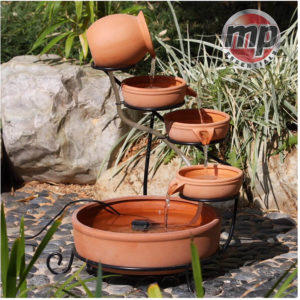
Terracotta is a traditional material for UK garden water features, and the MP Essential does a solid job of capturing that aesthetic in a lightweight resin construction. The four-tier design is taller than most in this category, giving it a more commanding presence in a border or courtyard garden. Water cascades from tier to tier and returns to a base reservoir, circulating continuously while the sun is out.
The solar panel is integrated into the top of the unit, which means it needs to be positioned in a south-facing, unobstructed spot for best results. In UK summer conditions it runs reliably during daylight hours. The terracotta colouring develops a slightly weathered appearance over time outdoors, which actually suits the aesthetic rather than detracting from it.
It’s a solid pick if you want a taller feature with a more traditional material finish than the grey stone effect that dominates most of this category. Not the easiest to move once filled and positioned, so think carefully about placement before committing.
Features
- 4-tier cascading terracotta-effect design
- Integrated solar panel (top-mounted)
- Lightweight resin construction
- Self-contained recirculating water system
- Base reservoir for water storage
- Taller four-tier design for more visual presence
- Traditional terracotta aesthetic suits cottage and walled gardens
- Lightweight resin is easier to move than ceramic
- Integrated panel gives no placement flexibility
- Heavier when filled and not easy to reposition
- Resin construction won’t fool close inspection
4. GardenKraft 12260 Cascading Water Fountain with Solar Light
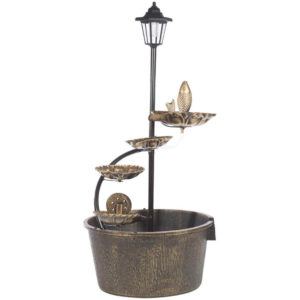
The GardenKraft stands out in this category for including a solar LED light in the base, which means it continues to provide ambient illumination after the pump stops at sunset. It’s not a powerful light, but it’s enough to make the fountain visible as a garden ornament through the evening, adding genuine value over purely daytime features.
The cascading design is compact and understated, which suits smaller patios and courtyard gardens where a full three-tier feature would feel oversized. GardenKraft is a UK brand with solid availability, and build quality is consistent with the price point. It runs well in direct sun through the UK summer months.
The combination of daytime water movement and evening light makes this a useful all-day garden feature rather than something that only performs during peak solar hours. If multi-function matters to you and you have a smaller space, it’s the one to consider.
Features
- Cascading water feature with integrated solar LED light
- Compact design suited to smaller gardens and patios
- Solar-powered pump and lighting from separate circuits
- Self-contained construction
- UK brand with good availability
- Integrated solar LED provides evening illumination
- Compact size suits smaller outdoor spaces
- Useful multi-function feature from day into evening
- LED is ambient rather than a true feature light
- Smaller basin requires more frequent topping up
- Pump slows significantly in low light
5. Blumfeldt Schönbrunn Solar Sphere Fountain
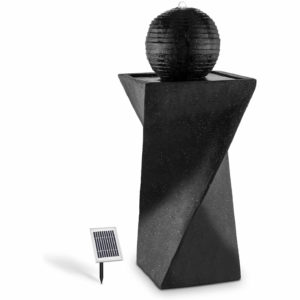
Of all the decorative solar fountains here, the Blumfeldt Schönbrunn is the most architecturally distinctive. The sphere design is more contemporary than the tiered and cascading options and sits well in modern or minimalist garden schemes where a traditional tier would look out of place. Water flows over the sphere surface and returns to the base, creating a smooth, quiet effect rather than an audible cascade.
It’s the most expensive standalone decorative feature on this list, and the price reflects a premium finish and more considered design. The sphere has an attractive weathered stone appearance that holds up well outdoors. If you’re creating a focal point rather than just adding movement and sound, the Blumfeldt is worth the premium. It’s quieter and more refined than alternatives at a similar or lower price.
Worth noting: sphere fountains move less water than tiered designs of similar panel sizes. If you want noticeable water sound as well as appearance, look at the tiered options instead. If you want a quiet, visually striking focal point, this is the standout choice.
Features
- Contemporary sphere design with smooth surface water flow
- Integrated solar panel
- Weathered stone-effect finish
- Quiet operation (water flows over sphere surface, not cascades)
- Self-contained construction with base reservoir
- Distinctive contemporary design for modern garden schemes
- Quieter than tiered and cascading alternatives
- Premium finish that reads as a genuine focal point feature
- The most expensive option on this list
- Less audible water sound than tiered alternatives
- Stops when cloud cover reduces output
6. Smart Garden Solar Duck Family Umbrella Water Feature
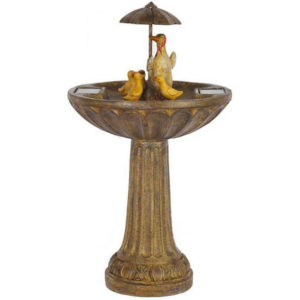
This one is cheerful rather than sophisticated, and that’s exactly why it belongs on the list. The duck family and umbrella design is unapologetically decorative, intended for gardens where the tone is playful rather than formal. It’s a good pick for family gardens with children, or as a lighter-hearted feature in a patio corner. Water bubbles up through the umbrella and circulates back through the basin, all powered by an integrated solar panel.
At this price point it works well as an ornamental accent rather than a main feature. The size is compact, making it easy to place and reposition. Build quality is consistent with Smart Garden’s other products in this range, reliable for the season and beyond with reasonable care.
Features
- Decorative duck family and umbrella design
- Integrated solar panel
- Recirculating water pump
- Compact size for flexible placement
- Suitable for patios, balconies and small gardens
- Playful design suits family gardens and informal spaces
- Compact and easy to reposition
- Good value as an ornamental accent
- Decorative aesthetic won’t suit formal or minimalist gardens
- Small basin requires frequent topping up
- Not a focal point feature at this scale
7. Primrose Charming Mini Fairy on Clamshell Solar Feature
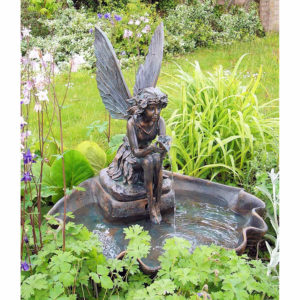
The Primrose is the smallest feature on this list and the most purely ornamental. The mini fairy on clamshell is a cottage garden classic, and the solar element means water trickles from the shell without any mains connection. If you have a small bird bath, a half barrel or a container pond, this sits on the surface and adds gentle movement with no fuss whatsoever.
It won’t work as a main garden feature, and it’s not meant to. But for a windowsill container, a small patio pot or a tucked-away corner of a larger garden, it’s a charming and affordable addition. Primrose is a UK garden supplier with consistent quality at this end of the market.
Features
- Mini fairy on clamshell decorative design
- Integrated solar panel
- Designed for bird baths, small containers and water bowls
- Compact and lightweight
- UK garden supplier with good availability
- Very compact and easy to place in any small space
- No mains connection needed
- Too small to serve as a main garden focal point
- Minimal water output compared with larger pumps
- Won’t attract birds looking for a proper bathing area
Solar Fountains Buying Guide
Key Takeaways
- Direct solar fountains work only in sunlight; battery-backed models (1,500–2,500mAh) run 4–6 hours post-sunset, essential for UK cloudy seasons
- Pump power ranges from 0.5W (small desktop fountains) to 3.5W (tall water features); UK performance is typically 40–60% of summer output in winter
- Integrated solar panels limit positioning to south-facing; separate panels (£20–40 extra) allow mounting on north-facing or shaded walls
- Resin and stone fountains crack in hard frost; stainless steel and plastic base designs survive UK winters without removal
- Nozzle variety (4–10 spray patterns) adds visual appeal but increases cleaning frequency; 1–3 nozzles need minimal maintenance
- Evaporation rates in UK summer reach 1–2cm per week; fountains under 10L capacity need refilling every 5–7 days
- Most fountains are 45–80cm tall; measure your garden space and solar access before buying — undersized pumps produce underwhelming spray in shaded gardens
- Price range: £39–150 GBP for small to medium fountains; battery-backed and stainless models command 30–50% premiums
Direct Solar vs. Battery-Backed Fountains: Understanding the Trade-Off
The most important decision is whether you want your fountain running only during sunlight or continuously through the day. Direct solar fountains have no battery — the pump stops the moment clouds arrive or dusk falls. They cost £35–70 and are simple (fewer components mean fewer failures). Battery-backed fountains add a lithium or NiMH pack (typically 1,500–2,500mAh) that stores charge during the day and powers the pump for 4–6 hours after sunset. This costs £50–120 extra, but in the UK’s grey winters, the battery makes the difference between a feature that runs 2 hours daily (November–February) versus not running at all.
Battery-backed fountains suit UK gardens where you want year-round visual interest. Direct solar fountains work best for summer-only garden use or locations with guaranteed afternoon south-facing sun. Consider too that battery models require replacing the battery every 2–3 years (£8–15 per replacement), whereas direct solar needs no maintenance beyond cleaning the panel.
| Feature | Direct Solar | Battery-Backed |
|---|---|---|
| Cost | £35–70 | £60–150 |
| Winter daily runtime (Nov–Feb) | 1–3 hours cloudy days; 0 hours overcast | 6–8 hours (if charged) |
| Maintenance | Clean panel monthly | Battery replacement every 2–3 years |
| Reliability | Stops in cloud cover | Consistent unless battery depletes |
| Best for UK use | Summer display only | Year-round visual interest |
Pump Power and Spray Height: Matching to Your Garden Size
Solar fountain pump power is measured in watts. A 0.5–1.0W pump lifts water 30–50cm with a gentle trickle — perfect for small tabletop fountains or bird baths where you want soothing sound, not dramatic spray. A 1.5–2.5W pump reaches 50–90cm and creates visible splashing suitable for garden ornament fountains. A 3.0–3.5W pump achieves 90–150cm height and is the maximum reliable output for residential solar fountains; beyond this, the pump becomes demanding for UK solar conditions.
The critical point: pump power output drops as water height increases. A 3.5W pump advertised as reaching “150cm” means that in full summer sun (south-facing, unshaded panel). In UK winter or partially shaded locations, expect 40–60% of that height. If your garden gets only 4–5 hours of direct sun daily, a 3.5W pump may deliver only 60–90cm spray, not the advertised 150cm.
| Pump Power | Water Height (Summer Sun) | Water Height (Winter/Shade) | Best Use |
|---|---|---|---|
| 0.5–1.0W | 30–50cm | 15–30cm | Bird bath, tabletop, whisper sound |
| 1.5–2.0W | 50–80cm | 25–50cm | Garden ornament fountain (typical choice) |
| 2.5–3.0W | 80–120cm | 40–70cm | Large feature fountain, tall garden space |
| 3.0–3.5W | 120–150cm | 50–90cm | Maximum for residential solar; needs full sun 5+ hours/day |
Integrated vs. Separate Solar Panels: The Positioning Problem
Cheap fountains have a small solar panel glued to the fountain body — convenient but inflexible. If your garden’s sunny corner is 2 metres from where you want the fountain, the integrated panel won’t reach. Separate panel models come with 2–5 metre cables, letting you place the panel in full sun while the fountain sits in the shade. This costs £20–40 extra upfront but makes the difference between a working fountain and a non-starter.
UK gardens typically have limited south-facing space. Shaded patios are common. If your fountain location gets less than 4 hours of direct sunlight, a separate panel becomes necessary. Integrated panels are adequate only if the fountain sits in a genuinely sunny spot all day — rare in most UK gardens.
Materials and Frost Damage: Surviving UK Winters
Resin fountain bodies (decorative animal shapes, ornamental urns) look beautiful but are vulnerable to frost. Resin is porous; water penetrates tiny cracks and freezes, expanding the material. A resin fountain can develop permanent cracks after a single hard winter. Plastic-based designs fare better. Stainless steel and powder-coated aluminium bases are the most durable but cost 40–50% more.
If you buy a resin or decorative stone fountain, expect to drain it completely and move it to a garage or shed before the first frost (November in most UK regions). This adds seasonal labour. Plastic and metal fountains can stay outdoors year-round; many still benefit from being covered or moved to sheltered spots during extreme freezes, but they won’t crack.
Nozzle Variety and Cleaning Reality
Marketing emphasises nozzle count — 10-spray patterns sound impressive. In practice, more nozzles mean more blockages. A single spray column or fountain bell (2–3 nozzles) needs cleaning every 4–6 weeks. Ten nozzles need weekly inspection to prevent algae buildup and calcium deposits. UK tap water is often hard; mineral deposits clog small nozzles quickly, reducing spray height visibly within 2–3 weeks of use.
Choose based on your commitment to maintenance. If you enjoy regular fountain upkeep, 6–10 nozzles are fine. If you prefer a low-maintenance garden feature, select 1–3 nozzle designs and plan monthly cleaning with white vinegar to dissolve deposits.
Reservoir Size and Evaporation Refilling Schedule
Solar fountains typically hold 3–10 litres of water. In summer, UK gardens experience 1–2cm daily evaporation from exposed water surfaces. A 5-litre fountain (roughly 15cm diameter x 20cm depth) will lose 0.3–0.6 litres per day. Add pump circulation (which increases evaporation), and you’re refilling weekly in June and July. Smaller fountains (3 litres) need refilling 2–3 times weekly. Larger reservoirs (8–10 litres) stretch refilling to 7–10 days.
Fountain placement affects evaporation. A fountain in shade evaporates 30–40% slower than one in full sun. Wind exposure accelerates evaporation significantly. If your garden is windswept, expect faster water loss regardless of size.
Budget Tiers and What You Get
Entry-level fountains (£39–60) are direct solar, compact (30–50cm), 1.0–1.5W pumps, limited nozzles (1–3), integrated panels. These work but underperform in UK winter and shaded gardens. Mid-range fountains (£60–100) add battery backup, more nozzle variety (5–7), better materials (plastic or powder-coated bases), and sometimes separate panels. Premium fountains (£100–150+) feature 2.5–3.5W pumps, high-capacity batteries (2,000mAh+), stainless steel construction, artistic designs, and longer warranties. They perform reliably across UK seasons and last 5–7 years.
For most UK buyers, the mid-range (£70–95) represents best value — battery-backed, decent pump power, materials that survive UK winters, and minimal fuss. Entry-level saves money upfront but frustrates when they stop working November through March.
When Not to Buy a Solar Fountain
Solar fountains disappoint in heavily shaded gardens (less than 3 hours direct sun daily), windy coastal locations, and areas with hard water that clogs nozzles weekly. If your garden is shadier than it is sunny, invest in a mains-powered fountain instead — you’ll get reliable year-round operation and better water pressure. If you want fountain noise as a garden feature, solar fountains are often underwhelming; their spray-to-noise ratio is lower than mains alternatives. Finally, if you have no interest in monthly maintenance, choose a simpler garden feature. Fountains require cleaning, algae management, and seasonal adjustments.
Case Study: Adding a Solar Water Feature to a South-Facing Patio in Worcestershire
Background
A homeowner in Worcestershire wanted to add movement and sound to a south-facing patio without the cost and disruption of running a mains cable from the house. The patio received around six hours of direct sun on a clear summer day. The budget was modest and reliability was the priority over pure aesthetics.
Project Overview
A floating solar fountain pump with a separate panel was chosen, placed in a large ceramic water bowl on a patio table. The panel was positioned on a small stand at the edge of the patio, angled south. A second, smaller decorative feature was added to a nearby border as a visual accent.
Implementation
The bowl was filled with water and a small amount of pond treatment added to keep it clear. The pump was positioned in the centre of the bowl and the panel placed roughly two metres away in the direct sun path. Both features were running within fifteen minutes of setup. The cable between the panel and pump was run along the edge of the patio and partially hidden under a pot. Fresh NiMH batteries were purchased to replace the depleted ones in the decorative border feature, restoring it to full function for the first time in two years.
Results
The pump fountain ran reliably from mid-morning to late afternoon through spring and summer. On overcast days it slowed noticeably but kept circulating at reduced pressure. The decorative accent feature ran for around four hours per day on average. The water bowl needed topping up roughly every three days during warm spells. Both features performed without maintenance issues through two full seasons. Total setup cost including the ceramic bowl was under £80.
Expert Insights From Our Solar Panel Installers About Solar Fountains
We spoke with one of our solar installation team with over ten years of experience working with solar products across the UK about the mistakes buyers most commonly make with solar fountains.
“The single biggest issue is panel size versus expectations,” they said. “People buy a beautiful three-tier feature, put it in the garden, and it works brilliantly on one sunny afternoon and then barely moves on a cloudy morning. The integrated panel on most of those ornamental features is tiny. Maybe 2 or 3 watts. That’s fine in ideal conditions but it gives you very little margin in the kind of weather we actually have here.”
“If performance matters more than appearance, get a separate panel pump rather than an integrated feature. A 6-watt panel will keep a fountain running in overcast conditions where a 2-watt panel just stops. The downside is the cable, which takes some effort to conceal neatly. But if you want something that actually works on a British summer day rather than just on the two weeks when it’s properly sunny, that’s the way to go.”
Frequently Asked Questions
Do solar water fountains work on cloudy days in the UK?
Direct-solar fountains stop or slow significantly in cloud, as they only run when the panel is generating enough voltage. Battery-solar fountains run consistently through overcast weather because the battery stores energy from earlier in the day. For the UK climate where cloudy days are common from September through April, a battery-solar fountain is the practical choice. Even a full day of UK overcast typically provides enough diffuse light to top up a good battery from a previous sunny day.
How long does a solar fountain run each day?
A battery-solar fountain typically runs 4 to 8 hours from a full charge, depending on battery capacity and pump flow rate. A 2,000mAh battery running a 300 l/h pump will last around 4 to 5 hours. A 5,000mAh battery may run the same pump for 8 to 10 hours. In UK summer with good panel placement, most battery-solar fountains will recharge fully during the day and run from dusk until well after midnight. In November, the same fountain may run for 2 to 3 hours from a short, low-angle day’s charging.
Can I leave a solar fountain out over winter in the UK?
It depends on the material. Stainless steel and high-quality resin fountain shells can remain installed through winter provided they are drained of water and the pump is removed. Ceramic, terracotta, and cheap painted resin features must be stored indoors or covered, as water trapped in cracks will freeze and cause irreparable splitting. The pump should always be removed, cleaned, and stored indoors from November to March regardless of the feature material, as frost can damage the impeller and seals.
Do I need a pond for a solar water feature?
No. Most solar garden fountains are self-contained features with an internal reservoir. The pump recirculates water within the feature itself, so you only need to top up evaporation occasionally. Bird baths, tiered bowl fountains, wall-mounted spout features, and ceramic jar fountains all work this way. A solar pond pump is a different product designed to circulate water in an existing garden pond and requires the pond as its water source.
Why has my solar fountain stopped working?
The most common causes in order of frequency are: the panel is shaded and not generating enough charge; the pump impeller is blocked with debris or algae; the battery has reached end of life (typically after 2 to 3 years); or the float switch (if fitted) has become stuck. Start by moving the panel to the sunniest available position. Then remove and clean the pump impeller. If neither resolves it, check whether the battery holds charge by running the fountain indoors after charging. If the battery is flat, replacement packs are available for most models.
How do I maintain a solar fountain pump?
Clean the pump filter and impeller every 4 to 6 weeks during the running season. Algae, mineral deposits, and debris from the garden accumulate quickly and reduce flow rate significantly. Remove the pump, open the housing, and clean the impeller under running water. For heavy mineral scaling, soak the pump in white vinegar diluted in water for 30 minutes. At the end of the season, clean thoroughly before storing, as dried algae is harder to remove in spring and can permanently reduce impeller performance.
What flow rate do I need for a solar fountain?
For a bird bath or small compact feature: 100 to 300 litres per hour. For a standard garden bowl fountain or ceramic tiered feature: 300 to 600 l/h. For a large feature, a wall-mounted spout into a pool, or a garden pond: 600 to 1,000 l/h or more. Always check the flow rate in the product specification rather than relying on “small”, “medium”, or “large” descriptions, as these are inconsistently applied by different manufacturers.
Do solar fountains work at night?
Direct-solar fountains stop completely at night as there is no power source. Battery-solar fountains continue running after sunset until the battery depletes. How long they run after dusk depends on battery capacity: a 2,000mAh battery may run for 2 to 3 hours into the evening; a 5,000mAh battery may run until midnight in summer. Some battery-solar fountains include an LED light that illuminates the water at night, which is a worthwhile feature for a feature visible from the house in the evening.
Summing Up
For most UK gardens, the AISITIN 6.5W Solar Fountain Pump offers the best balance of performance and flexibility. Its separate panel-and-pump design means it keeps going in the kind of mixed weather we actually have, and the seven interchangeable nozzles let you adapt it to different settings. If you want a complete decorative water feature without a separate pump and container, the Smart Garden Kingsbury 3-Tier is the most impressive all-in-one option. For guidance on getting the most from your solar garden products through the colder months, our article on how solar products perform in UK winter covers what to expect when the days get shorter. And if other solar garden items are giving you trouble, our guide to why solar lights stop working covers the most common faults and how to fix them.
Updated