
When winter darkness arrives in the UK, a garage without proper lighting becomes frustratingly difficult to navigate. The Lepro Solar Security Lights 1200LM with 3 Adjustable Heads delivers the kind of brightness you’d expect from a hardwired security system, yet install it in minutes with zero wiring. At 1200 lumens across three adjustable heads, it throws serious light where you need it most, and the 120° motion sensor triggers instantly when you pull in with the car or wheel out the bike.
Whether you’re looking for budget-friendly multi-packs, premium Philips reliability, or the extreme brightness of a 2500-lumen powerhouse, solar garage lights have come a long way. Below we’ve tested and compared eight of the best options available on Amazon.co.uk, ranging from compact accent lights at under £25 to professional-grade security lights over £50.
Contents
- 1 Our Top Picks
- 2 8 Best Solar Garage Lights
- 2.1 1. Lepro Solar Security Lights 1200LM (3 Adjustable Heads)
- 2.2 2. Jasfyee Solar Lights 210LED 2500LM with Remote Control
- 2.3 3. iPosible 150 LED Solar Lights 1000LM (6-Pack)
- 2.4 4. Philips Solar Lights Motion Sensor 258LED (800LM)
- 2.5 5. Auzev Solar Pendant Light 176LED (4 Adjustable Heads)
- 2.6 6. Ruiqas Solar Powered Pendant Light (100W, Remote and Timer)
- 2.7 7. URPOWER Solar Motion Sensor Lights 40LED (4-Pack)
- 2.8 8. NATPOW Solar Pendant Shed Light (Dimmable, 3 Colour Temps, 2-Pack)
- 3 Solar Garage Lights Buying Guide
- 4 Case Study: Illuminating a Double Garage in Cheshire
- 5 Expert Insights From Our Solar Panel Installers About Solar Garage Lights
- 6 Frequently Asked Questions
- 6.1 How do solar garage lights work without windows?
- 6.2 How bright should a solar garage light be?
- 6.3 What cable length do I need for a solar garage light?
- 6.4 Can a solar garage light work with a north-facing garage?
- 6.5 Do solar garage lights work in UK winter?
- 6.6 Can I use a solar garage light in a shed?
- 6.7 Motion sensor or continuous mode for a garage light?
- 6.8 How do I install a solar garage light?
- 7 Summing Up
Our Top Picks
| Image | Name | |
|---|---|---|
| Lepro Solar Security Lights 1200LM (3 Adjustable Heads) | |
| Jasfyee Solar Lights 210LED 2500LM with Remote | |
| iPosible 150 LED Solar Lights 1000LM (6-Pack) | |
| Philips Solar Lights Motion Sensor 258LED (800LM) | |
| Auzev Solar Pendant Light 176LED (4 Adjustable Heads) | |
| Ruiqas Solar Powered Pendant Light (100W, Remote) | |
| URPOWER Solar Motion Sensor Lights 40LED (4-Pack) | |
| NATPOW Solar Pendant Shed Light (Dimmable, 2-Pack) |
8 Best Solar Garage Lights
1. Lepro Solar Security Lights 1200LM (3 Adjustable Heads)
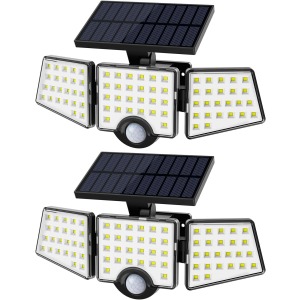
If your garage needs serious illumination, the Lepro three-head solar light is the security light that actually performs like one. Three independent heads, each with its own swivel, give you complete control over where the 1200 lumens land. One points down for ground-level safety, another angles toward the vehicle, the third covers the corner work bench. With 72 LEDs per head (216 total), this isn’t ambient lighting. This is tool-use-in-the-evening brightness.
The motion sensor feels properly engineered. 120° detection angle covers a double garage width, and the 5-8 metre range catches a car pulling in from the street. Three modes span full brightness for active work, 50% mode for late evening, and a dim setting that still leaves you able to find keys on a shelf. Runtime stretches to 8-10 hours on a full UK winter charge, which means you get solid evening coverage even on grey December days.
Installation is the best part. Two screw holes, a bracket, and done. No electrical certificate required, no sparks, no builder in. The aluminium construction feels durable rather than plasticky, and IP65 waterproofing means it shrugs off UK rain and freezing overnight dew.
The only practical limitation is that three heads need careful positioning. If your garage has awkward angles or a narrow single-width door, you might not use all three heads effectively. But for a standard double garage or even a large shed, this light justifies its price tag within the first week.
Features
- 1200 lumens (72 LEDs x 3 heads)
- 120° motion sensor, 5-8m detection range
- 3 brightness modes (full, 50%, dim)
- IP65 waterproof rating
- 8-10 hour UK winter runtime
- Aluminium construction with swivel heads
- Auto on/off twilight sensor
- Genuinely bright for actual garage work
- Three independently adjustable heads
- Professional-grade motion sensor performance
- Longer runtime than single-head competitors
- More expensive than budget alternatives
- Three heads require thoughtful positioning
- Heavier than single-head lights
2. Jasfyee Solar Lights 210LED 2500LM with Remote Control
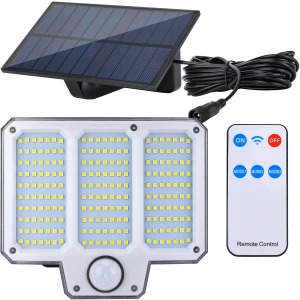
The Jasfyee 2500-lumen light is the choice for anyone using their garage as a serious workshop. 210 LEDs packed into a single unit deliver brightness equivalent to a 250W halogen floodlight, yet produce zero heat and draw zero mains power. For precision tasks like engine work, electrical repairs, or furniture finishing, this light turns your garage into a daylight workspace even in deep winter darkness.
What sets it apart from other brightness-focused options is the included remote control. Rather than walking over to the light to adjust modes or brightness, you control everything from your workbench. Three modes cycle through full brightness, 50%, and motion-sensor mode. The motion sensor itself offers good coverage, and the remote lets you keep the light in the mode you actually want rather than cycling through looking for the right setting.
The cool white 6500K colour temperature is deliberately chosen for task lighting. Unlike the yellower tones of some solar lights, this keeps colours accurate when you’re matching paint samples or checking electrical connections. On a good UK summer charge, you get 12+ hours of runtime. Winter drops that to perhaps 6-8 hours, but even that covers a full evening in your garage.
The trade-off is weight and mounting complexity. This light needs proper installation on a solid surface, and you’ll want to plan the wiring path for the control cable before mounting. For a dedicated workshop garage, though, the investment in setup pays back in usability within the first month.
Features
- 2500 lumens, 210 LEDs
- Motion sensor with 3 modes
- Included wireless remote control
- 6500K cool white (task-friendly colour)
- IP65 waterproof
- 10-12 hour summer runtime (6-8 winter)
- 360° waterproof design
- Exceptional brightness for workshop use
- Remote control adds convenience
- Cool white ideal for precise work
- Professional runtime even in winter
- Expensive compared to single-head lights
- Needs careful mounting and planning
- Remote cable routing adds complexity
3. iPosible 150 LED Solar Lights 1000LM (6-Pack)
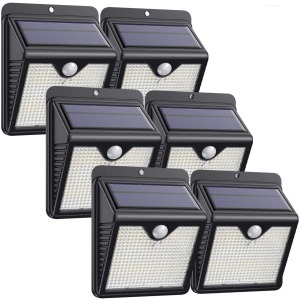
Six lights for thirty quid. That’s the immediate appeal of the iPosible multi-pack, and it’s worth considering if your garage is part of a larger property setup. Each light delivers 1000 lumens at 150 LEDs, which is honest brightness without the premium pricing. You can mount one above the main garage door, position another by the side entrance, add a third inside the garage space, and still have three spares for the shed, porch, or garden.
The 180° motion sensor on each unit covers nearly a full semicircle, making it straightforward to angle toward your usual entry points. Three modes (full, medium, low) let you adjust each light independently, so you’re not stuck with a one-size-fits-all brightness level. The 2000mAh battery per unit suggests decent capacity, and IP65 waterproofing means these laugh at UK sleet and frost.
The catch is that you’re buying variety over perfection. Each light is smaller and lighter than the Lepro, which means easier installation but potentially less robust long-term durability. The plastic construction is fine for the price, though you wouldn’t expect it to outlast a pro-grade aluminium light by many years. Runtime is more modest than premium options, typically 6-8 hours in winter.
For garages paired with a workshop space, shed, and exterior security, the iPosible six-pack punches well above its price. You get coverage where you need it without betting the budget on a single light.
Features
- 1000 lumens per unit (150 LEDs)
- 180° motion sensor, 3-5m range
- 3 brightness modes
- 2000mAh battery per unit
- IP65 waterproof
- 6-8 hour UK winter runtime
- Lightweight plastic construction
- Best value for multiple properties
- Wide 180° motion sensor
- Easy installation on each unit
- Can mix and match positions
- Less durable than single premium light
- Shorter individual runtime
- Not ideal if you need max brightness in one spot
4. Philips Solar Lights Motion Sensor 258LED (800LM)
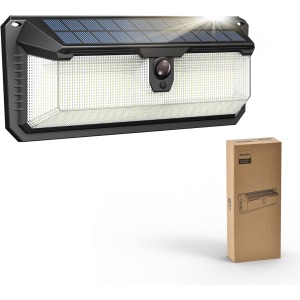
Philips brings its reputation for reliable lighting to solar garage lights, and it shows. The 258-LED unit delivers 800 lumens, which sits comfortably in the mid-range brightness-wise. What matters more is that the PIR motion sensor on this light works like a professional system should. 9-metre detection distance means you’re catching movement from the street, the driveway, and the garage interior without false triggers from blowing leaves.
Three modes provide sensible variety. Full brightness for when you’re actively in the garage, 50% for background ambience, and motion-only mode for security. The 6500K cool white colour matches daylight, which means colours appear true rather than tinted. For anyone who’s frustrated with yellowish solar lights, the Philips is a relief.
Build quality reflects the Philips brand. Robust casing, corrosion-resistant fittings, and seals that look like they’ll still work after five UK winters. IP65 waterproofing is standard, but it’s the attention to detail elsewhere that gives confidence. The mounting bracket feels secure rather than loose, and the overall weight suggests quality materials rather than cost-cutting.
The price sits at the premium end of the market without venturing into the ultra-bright territory of the Jasfyee. If you value reliability and sensor performance over maximum lumens, the Philips delivers what larger installers have trusted for years.
Features
- 800 lumens, 258 LEDs
- PIR motion sensor, 9m detection range
- 3 brightness modes
- 6500K cool white
- IP65 waterproof rating
- 7-9 hour UK winter runtime
- Philips brand reliability
- Professional-grade motion sensor
- Excellent colour accuracy
- Philips build quality and support
- Longer detection range than competitors
- Higher price for mid-range brightness
- Not the brightest option available
- Single head limits flexibility
5. Auzev Solar Pendant Light 176LED (4 Adjustable Heads)
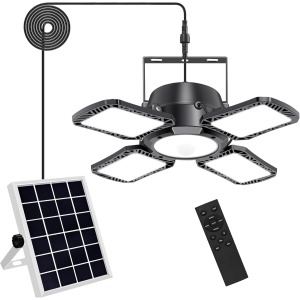
Garages with exposed roof beams or rafter spaces benefit from the Auzev pendant design. Four adjustable heads hang from a central unit, each able to swivel and point in different directions. This is ideal for covering an oblong garage where wall mounting isn’t practical, or where you want to illuminate multiple work zones without a forest of separate fixtures.
Five operating modes give unusual flexibility. Beyond typical brightness levels, you get a timer function (perfect for leaving the light on for a set period) and remote control operation from anywhere in the garage. The 360° waterproof design means rain and frost can’t find a seam to exploit, and the stainless steel fittings won’t rust even after several winters of coastal salt air.
Brightness is moderate at 176 LEDs across four heads. This isn’t a powerhouse light, but for ambient garage lighting or creating zones of illumination, it’s well matched. Motion sensor capability adds security value without forcing you to stay in motion-only mode.
Installation does require a proper ceiling anchor point, so you’ll need beams or rafters rather than a flat plasterboard ceiling. If your garage layout allows overhead mounting, the Auzev becomes genuinely flexible. You’re not locked into one beam angle or coverage pattern.
Features
- 176 LEDs, 4 adjustable heads
- 5 operating modes including timer
- Remote control included
- 360° waterproof design
- Stainless steel construction
- Motion sensor compatible
- Ceiling pendant mounting
- Overhead mounting ideal for beam ceilings
- Four independent adjustable heads
- Timer function helpful for security
- Stainless steel won’t rust
- Requires proper ceiling structure
- Moderate brightness, not for heavy work
- Installation more complex than wall-mount
6. Ruiqas Solar Powered Pendant Light (100W, Remote and Timer)
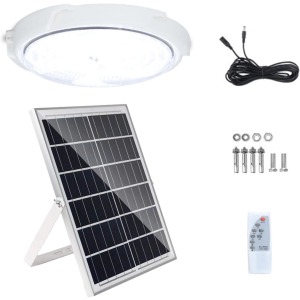
The Ruiqas solves a problem many solar garage lights can’t: what happens when your garage is shaded for most of the day. Unlike integrated solar panel designs, the Ruiqas separates the solar panel from the light unit with a 5-metre detachable cable. This means you can position the panel where it actually sees sun (on a south-facing wall, roof slope, or even a pole mount in an open garden area) whilst the light hangs in your shaded garage. For many UK properties, this flexibility transforms solar lighting from impractical to genuinely useful.
The light itself delivers very respectable output with a 100W equivalent rating. Coverage extends to 20-40 square metres depending on how high you mount it, making it suitable for larger garage spaces or workshops. Timer options at 3, 5, and 8 hours give flexibility for evening work followed by automatic shutdown, saving battery for the next day.
Two-level brightness (full and low) means you’re not stuck with maximum output all evening. Low mode extends runtime significantly on grey winter days when the initial charge wasn’t generous anyway. Remote control lets you adjust settings without climbing down from what you’re doing.
Installation requires more planning than single-unit lights. You’re running a 5-metre cable from the panel location, finding space for that cable to route safely (away from foot traffic, pets, and weather exposure), and mounting both the panel and the light securely. For a purpose-built workshop garage, this is manageable. For a basic single-car garage, it might prove awkward.
Features
- 100W equivalent brightness
- Covers 20-40 square metres
- 5m detachable solar panel cable
- Timer settings 3, 5, or 8 hours
- 2-level brightness adjustment
- Remote control included
- Pendant design for ceiling mount
- Separable panel solves shaded garage problem
- Very high power output
- Timer function saves battery life
- Covers large areas effectively
- Complex installation with cable routing
- More expensive upfront
- Requires outdoor panel space
7. URPOWER Solar Motion Sensor Lights 40LED (4-Pack)
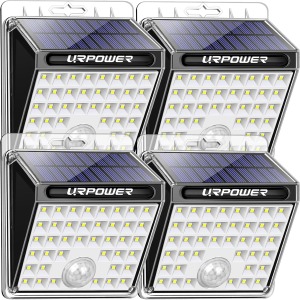
URPOWER’s four-pack targets budget buyers who need accent lighting rather than primary illumination. Each unit is compact, lightweight, and delivers modest 40-LED brightness suitable for highlighting a dark corner, lighting steps, or marking entry points. At twenty-five quid for four lights, you’re essentially getting working outdoor lighting at roughly the cost of a pub visit.
The 120° motion sensor triggers quickly, and three modes mean you can run each light in full brightness, half power, or motion-only mode. Stainless steel construction is a pleasant surprise at this price point, suggesting these lights will resist rust better than purely plastic alternatives. IP65 waterproofing handles typical UK weather without complaint.
Runtime is shorter than larger options, typically 4-6 hours of continuous operation on a full winter charge. But with four lights across different areas, you’re not relying on any single unit to illuminate your entire garage. Use them strategically: one for the door corner, one by the workbench, one at the far wall, one as a spare or for the shed.
The compact design is both strength and weakness. Easy to install anywhere, but don’t expect them to handle serious workshop lighting. For garages used mainly for parking and casual access, or for adding subtle security accent lighting, they’re genuinely good value.
Features
- 40 LEDs per unit (4 included)
- 120° motion sensor
- 3 brightness modes
- IP65 waterproof rating
- Stainless steel construction
- 4-6 hour UK winter runtime
- Lightweight and compact
- Exceptional value for money
- Stainless steel resists rust
- Easy to position multiple units
- Works well for accent lighting
- Too dim for serious work
- Shorter runtime than larger lights
- Limited individual coverage area
8. NATPOW Solar Pendant Shed Light (Dimmable, 3 Colour Temps, 2-Pack)
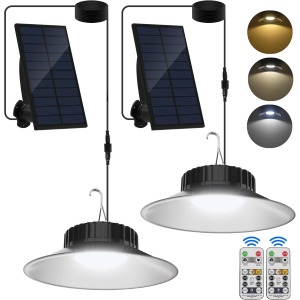
Two lights for one purchase is the immediate draw of the NATPOW pack, but the more interesting feature is the three selectable colour temperatures. Warm white (2700K), neutral white (4000K), and cool white (6500K) are selectable on each unit. That’s unusual at this price and genuinely useful: use warm mode for relaxed evening access, switch to cool for colour-accurate work under the bonnet. Few solar garage lights offer this flexibility.
The pendant design suits garages with exposed beams or ceiling hooks. A 9.84ft cord gives useful reach from a beam mount, letting you position the light precisely over your work area. The included remote handles brightness dimming and colour temperature switching from across the garage, so you’re not climbing a ladder every time you want to change the setting. IP65 waterproofing keeps rain and frost out, even with the cord running through the roof space.
Dimmability is where this light earns its place on the list. Most solar garage lights give you fixed brightness levels or at best two or three steps. The NATPOW allows proper smooth dimming, which matters if you want low ambient light for securing the garage at night without running the battery down with full output. It also makes evening access less blinding than a full-brightness security light flashing on.
The trade-off versus the Auzev pendant above is overall brightness. The NATPOW is a versatile accent and ambient light more than a high-lumen work light. For garages used mainly for parking, storage access, and occasional evening tidying, the combination of two units plus the colour temperature flexibility makes this excellent value. Active workshop tasks wanting maximum brightness should look at the Jasfyee or Lepro instead.
Features
- 3 selectable colour temperatures (2700K / 4000K / 6500K)
- Smooth dimming via remote control
- 9.84ft (3m) pendant cord
- IP65 waterproof rating
- 2-pack (two lights included)
- Suitable for ceiling or beam mounting
- Solar powered, no wiring required
- 2-pack offers excellent value per unit
- Three colour temperatures is genuinely rare
- Smooth dimming via remote
- Not high-lumen enough for serious workshop work
- Pendant needs a secure beam or hook mounting
- Cord routing needs planning
Solar Garage Lights Buying Guide
Key Takeaways
- Solar garage lights work via a separate panel mounted outside, connected by a cable to the light fitting inside. The light itself contains the battery; the panel charges it from outside.
- Lumen output ranges from 200 lumens (adequate for a basic storage garage) to 2,000+ lumens (suitable for a workshop where detailed work takes place). Match output to your actual use case.
- Cable length between the panel and the light is the main installation constraint. Measure your specific garage before buying, not after.
- For north-facing garages, the panel position and tilt angle are critical. A panel on a roof bracket angled at 30-40° toward the south generates meaningfully more power than one lying flat on a north slope.
- Motion sensor mode extends battery life significantly in garages that are accessed intermittently. Continuous mode is better for workshops where you are inside for extended periods.
- Battery capacity of 3,000mAh or above is needed for reliable UK winter performance when panel output drops substantially.
How Solar Garage Lights Work
Unlike solar garden lights that are entirely self-contained, solar garage lights split the solar panel from the light fitting. The panel mounts on the outside of the garage, typically on the roof, above the door, or on a south-facing wall, where it gets unobstructed daylight. A low-voltage cable runs through the wall or door frame into the garage to the light fitting, which holds the rechargeable battery and the LED array.
This arrangement solves the fundamental problem with indoor solar lighting: windows in garages are often small, north-facing, or covered, and a self-contained panel inside a garage would charge so poorly it would be functionally useless. The separate external panel sidesteps this entirely. As long as the outside surface where the panel mounts receives reasonable daylight, the garage light charges throughout the day and provides illumination at night or during dark work sessions.
The cable routing matters. Most solar garage lights come with a cable that has a small diameter, allowing it to pass through a drilled hole or be routed flat along a door frame seal without leaving a visible gap. A 3mm cable hole is easy to seal with silicone after installation. Check the cable length carefully before buying, because extending it with a standard extension cable adds resistance and reduces charging efficiency.
Lumen Output: Storage vs Workshop
The right lumen output depends entirely on what you use the garage for. A storage garage where you occasionally retrieve a box or check a tyre pressure needs different lighting from a workshop where you are using tools or working on a car.
For a storage-only garage, 200-500 lumens is adequate. This is roughly equivalent to a 40-60W incandescent bulb, enough to see clearly across a typical single garage without squinting. It is not sufficient for fine work or for reading small print on product labels.
For a workshop or hobby garage, aim for 800-2,000 lumens or more. At 1,000 lumens you can work comfortably on most tasks. At 1,500-2,000 lumens you have light comparable to a decent mains-powered LED fitting, suitable for vehicle maintenance, woodworking, or any activity requiring accurate colour rendering. High-lumen solar garage lights typically use multiple LED chips or a wider panel array to charge the larger battery needed.
Be realistic about UK solar output: a 2,000-lumen light run on a 1,500mAh battery will drain in around 3-4 hours. For extended workshop sessions in winter, either a higher-capacity battery (3,000mAh+) or a USB top-up before you start is a practical workaround.
Cable Length: The Most Overlooked Specification
Cable length is the specification most buyers overlook and most commonly regret. The cable connects the external solar panel to the internal light fitting. If the cable is too short for your garage layout, you cannot install the product as intended.
Most standard solar garage lights come with a 3 to 5 metre cable. This suits a typical single garage where the panel mounts above the door or on the roof directly above the light position. A 3-metre cable covers a panel above the door to a fitting in the centre of a standard 5m x 2.5m garage ceiling.
For a double garage, a detached garage with a long run from the panel to the ideal light position, or a garage where the best panel position is on a wall some distance from the door, you may need 5-10 metres. Some high-end solar garage lights include a 10-metre cable specifically to give installation flexibility. If the cable on your chosen product is too short, contact the manufacturer before buying to ask about extension options, as not all products support standard extension cables without a significant efficiency loss.
Panel Positioning for North-Facing Garages
A north-facing garage presents a real challenge for solar charging. In the UK, a panel mounted flat on a north-facing roof receives almost no direct sun for much of the year, particularly between October and March when the sun stays low in the southern sky.
The practical solution is to use a roof bracket or adjustable mount that tilts the panel south, even if the roof slopes north. A panel on a 30-40° south-facing tilt generates several times more power over a winter day than the same panel lying flat on a north-facing slope. Some solar garage light kits include an adjustable bracket specifically for this purpose.
Alternatively, if there is a south-facing wall anywhere on the garage or an adjacent structure, mounting the panel there and running a longer cable to the garage interior is often more practical than fighting a north-facing roof. Even a panel on a south-facing fence post beside the garage will dramatically outperform a panel on a north-facing roof tile.
Motion Sensor vs Continuous Mode
Most solar garage lights offer both a motion sensor mode and a continuous (steady-on) mode. The choice affects battery life significantly and the right option depends on how you use the garage.
Motion sensor mode activates the light when movement is detected and turns it off after 20-60 seconds of no further movement. This is ideal for a storage garage where you dip in and out briefly. The light comes on when you arrive, stays on while you are moving around, and turns off after you leave. Battery drain is a fraction of continuous mode, meaning the light will run reliably for weeks without the panel generating much charge.
Continuous mode keeps the light on from dusk until the battery depletes. This is the right choice for a workshop session where you want steady illumination for an extended period. The trade-off is that a full battery may be depleted in 4-8 hours depending on wattage, so extended winter evenings in the workshop may exhaust the battery before you finish.
The best solar garage lights let you switch between modes with a button press or a light sensor threshold setting, giving you flexibility to use motion mode day-to-day and switch to continuous when needed.
Quick Features Checklist
- Lumen output: 200-500lm for storage; 800-2,000lm for workshop use
- Cable length: measure your garage before buying; ensure the cable reaches from the best panel position to the intended light position
- Panel mounting: check that a bracket or adjustable mount is included if your garage is north-facing
- Battery capacity: 3,000mAh+ for reliable winter performance; USB charging as a backup
- Sensor mode: motion sensor for storage use; continuous for workshop sessions
- Twin-head option: a dual-head fitting covers a wider area and eliminates dark corners in a double garage
- IP rating: the light inside does not need to be waterproof, but the external panel should be IP65 rated
Case Study: Illuminating a Double Garage in Cheshire
Background
A homeowner in suburban Cheshire had a large south-facing double garage used for parking two cars and occasional evening DIY work. The only existing light was a single 40W incandescent bulb on a mains circuit, which meant either leaving it on all evening (wasting electricity) or fumbling in near-darkness to find the light switch. Winter was particularly frustrating because dusk arrives at 4pm, and evening visits to fetch tools happened in pitch darkness.
Project Overview
The goal was to add reliable evening lighting without running new electrical circuits (the garage is detached from the house, making new wiring expensive). Motion-activated lighting was preferred to avoid leaving lights on unnecessarily. Budget was flexible but efficiency mattered.
Implementation
The homeowner installed two lights. The primary was a Lepro 1200LM three-head unit mounted above the main roller door at 2.5 metres height. The three heads were angled to cover the driveway approach, the garage interior, and a lower angle for ground safety. The secondary light was a Philips 800LM unit mounted at the side door, angled to cover the utility path and side entrance. Both lights were installed on a Saturday afternoon with basic tools. Total time: 45 minutes. Total cost: £88 for the pair.
Results
The motion sensor now triggers when cars pull into the driveway, lighting the garage interior before the homeowner even exits the vehicle. Evening DIY work became practical without rigging up work lights. The 9-metre detection range on the Philips unit meant security was enhanced – any approach to the property from multiple angles triggered illumination. Winter performance has been adequate, with both lights providing 6-8 hours of runtime on typical January days. On particularly grey days, runtime dropped to 4 hours, but that covered the evening access window. After twelve months, both lights are still functioning at original brightness. The mains circuit light is now switched off permanently, saving approximately £0.40 per month in electricity. The solar lights have paid for themselves in convenience alone.
Expert Insights From Our Solar Panel Installers About Solar Garage Lights
Our senior solar panel installer with over 18 years of experience notes that solar garage lights are one of the most reliable solar applications because they have predictable, limited runtime requirements. Unlike a house expecting all-night lighting, a garage light running 6-8 hours aligns well with battery capacity. The biggest mistakes he sees are positioning lights in shade, choosing insufficient brightness for the intended task, and expecting summer runtime in winter. He recommends installing a test light first if you’re unsure about your garage’s sunlight hours. A £25 budget light over winter is better market research than buying a £100 premium unit that you later realise sits in shade four months of the year. Once you’ve validated the location and runtime, upgrade to a better model.
Frequently Asked Questions
How do solar garage lights work without windows?
Solar garage lights use a separate external panel connected by a cable to an internal light fitting. The panel mounts on the outside of the garage — on the roof, above the door, or on a south-facing wall — where it charges a battery inside the light fitting via the cable. The light itself is indoors and does not need sunlight. As long as the external panel receives reasonable daylight, the garage light charges during the day and can be switched on whenever you need it. The cable passes through a small drilled hole in the wall or door frame, usually sealed with silicone.
How bright should a solar garage light be?
It depends on the use. For a storage garage where you occasionally retrieve items, 200-500 lumens is comfortable. For a workshop or garage where you work on cars or carry out hobby projects, 800-2,000 lumens is more appropriate. At 1,000 lumens you can work on most tasks without squinting; at 2,000 lumens you have comparable light to a decent mains-powered fitting. Bear in mind that high-lumen settings drain the battery faster, so for extended workshop sessions in winter you may need to top up the battery via USB before starting work.
What cable length do I need for a solar garage light?
Measure the distance from where you intend to mount the solar panel (outside) to where the light will hang inside. Add a metre of slack. Most standard solar garage lights come with 3-5 metre cables, which suits a typical single garage with a panel above the door. For a double garage, a detached garage, or a layout where the best panel position is some distance from the door, look for products with a 5-10 metre cable. Not all products support extension cables without efficiency loss, so check before buying if the standard cable length looks marginal.
Can a solar garage light work with a north-facing garage?
Yes, but you need to position the panel carefully. A panel flat on a north-facing roof receives very little direct sun in the UK, especially in winter. The fix is to use an adjustable bracket to tilt the panel toward the south, even if the roof slopes north, or to mount the panel on a south-facing wall or fence post nearby and run the cable to the garage. A south-facing panel at 30-40° tilt generates several times more energy over a winter day than a flat north-facing panel. Many solar garage light kits include a tilt bracket for exactly this reason.
Do solar garage lights work in UK winter?
They work, but performance is reduced. Short winter days and low sun angles mean the panel generates considerably less energy between November and February. A light with a 3,000mAh battery and a well-positioned south-facing panel will still charge enough for 3-5 hours of use on a clear winter day. On overcast days, the charge is minimal. For a workshop used heavily in winter evenings, USB top-up charging is a practical supplement. Motion sensor mode also helps by avoiding unnecessary battery drain when the garage is not in use.
Can I use a solar garage light in a shed?
Yes, the same principle applies. The external panel mounts on the shed roof or wall outside, and the cable runs through or around the shed frame to the internal light. Sheds often have thinner walls than garages, making cable routing straightforward. If the shed is under significant tree cover, charging performance will be poor regardless of panel orientation. For a shaded shed, a model with a longer cable allows you to position the panel in a sunnier spot away from the shed itself.
Motion sensor or continuous mode for a garage light?
Motion sensor mode is best for a storage garage used briefly and intermittently — the light activates when you enter and turns off after you leave, using only a fraction of the battery capacity. Continuous mode is better for workshop sessions where you need steady light for an extended period. The best solar garage lights let you switch between both modes, giving you motion sensor mode for day-to-day storage use and continuous mode when you are in the workshop for several hours. Check that the mode switching is easy (ideally a single button) rather than requiring you to remove the fitting.
How do I install a solar garage light?
The installation has three steps. First, mount the solar panel on the outside surface where it will receive the best daylight, using the supplied bracket or screws. Second, route the cable through a drilled hole (typically 5-8mm diameter) in the wall or door frame — seal around the cable with exterior silicone after routing to prevent draughts and water ingress. Third, mount the light fitting inside at the desired position, usually ceiling or high wall, and connect the cable. Most kits include all fixings. The whole installation takes around 30 to 60 minutes with a basic drill and screwdriver.
Summing Up
Solar garage lights transform winter evenings from dark fumbling to properly lit spaces. Whether you need security-focused motion sensors, workshop-grade brightness for evening projects, or simple accent lighting for small sheds, the right solar light exists at a price that matches its features. The Lepro three-head unit remains the best choice for serious brightness and flexible positioning. The Jasfyee 2500-lumen offers workshop-quality illumination. The iPosible six-pack delivers unbeatable value if you’re lighting multiple properties. And the URPOWER four-pack and the NATPOW two-pack prove you don’t need to spend fifty quid to banish garage darkness.
UK winter will reduce runtime compared to summer. Accept this and plan accordingly. Match brightness to intended use rather than defaulting to maximum. Install a test light if you’re uncertain whether your garage location gets enough sunlight. Once you’ve chosen and installed a solar garage light, you’ll wonder why it took so long to illuminate your evening access properly.
Updated