
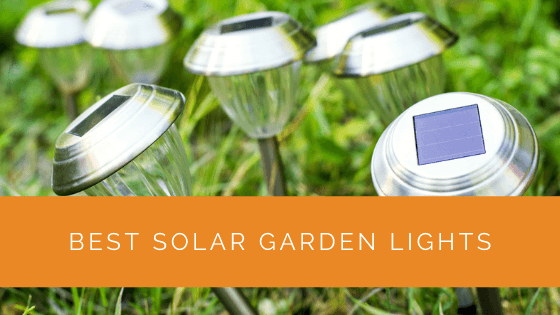
The best solar garden lights we’ve tested are the Hixyer Bright Solar Pathway Lights 10-Pack, which combine stainless steel and glass construction, a 10 to 12-hour runtime, and IP65 waterproofing in a 10-light set that handles most garden sizes in one purchase. Whether you’re lining a path, marking a border, or simply adding some evening atmosphere to the garden, these deliver the right balance of build quality, brightness, and value.
Solar garden lights cover a much broader range of products than most people realise when they first start looking. You’ve got stake-mounted path lights, spotlights for uplighting trees and shrubs, string lights for fences and pergolas, security floodlights with motion sensors, fence-mounted panels, and decorative ornamental styles in everything from copper to filament glass. If you’re specifically after garden stake lights shaped like flowers, take a look at our guide to the best solar flower lights. This list covers all of them, so whatever your garden setup, there’s something here worth considering.
Contents
- 1 Our Top Picks
- 2 8 Best Solar Garden Lights
- 2.1 1. Hixyer Bright Solar Pathway Lights 10-Pack
- 2.2 2. KOOPER Solar Lights 4-Pack
- 2.3 3. Goodia 50 LED Teardrop Solar String Lights
- 2.4 4. Solar Security Lights 248 LED 4-Pack
- 2.5 5. Solpex Solar Spotlights 4-Pack
- 2.6 6. Solpex 63 LED Solar Spotlights 2-Pack
- 2.7 7. VOLISUN Solar Fence Lights 8-Pack RGB
- 2.8 8. GIGALUMI Solar Pathway Lights 6-Pack
- 3 Solar Garden Lights Buying Guide
- 3.1 Key Takeaways
- 3.2 Light Type and Garden Application: Choosing the Right Form Factor
- 3.3 Brightness in Lumens: Understanding the Plateau Effect
- 3.4 Colour Temperature: Warm White vs. Cool White Trade-Offs
- 3.5 Operating Modes: Dusk-to-Dawn vs. Timer vs. Motion Sensor
- 3.6 Installation Challenges: Ground Conditions and Stake Depth
- 3.7 Battery Capacity and Winter Performance Expectations
- 3.8 Waterproofing and Long-Term Reliability
- 3.9 Material Durability: Stainless vs. Aluminium vs. Plastic
- 3.10 Quantity and Spacing: How Many Lights Do You Need?
- 3.11 When Not to Buy Solar Garden Lights
- 4 Case Study: Full Garden Lighting Renovation
- 5 Expert Insights From Our Solar Panel Installers About Solar Garden Lights
- 6 Frequently Asked Questions
- 6.1 How many lumens do solar garden lights need?
- 6.2 What IP rating do outdoor solar garden lights need for the UK?
- 6.3 Do solar garden lights work in UK winter?
- 6.4 How long do solar garden lights last?
- 6.5 Why do my solar garden lights not come on at night?
- 6.6 How do I stop solar garden lights flashing?
- 6.7 What is the best position for solar garden lights?
- 6.8 Do solar garden lights need direct sunlight or do they work in shade?
- 7 Summing Up
Our Top Picks
| Image | Name | |
|---|---|---|
| Hixyer Bright Solar Pathway Lights 10-Pack | |
| KOOPER Solar Lights 4-Pack | |
| Goodia 50 LED Teardrop Solar String Lights | |
| Solar Security Lights 248 LED 4-Pack | |
| Solpex Solar Spotlights 4-Pack | |
| Solpex 63 LED Solar Spotlights 2-Pack | |
| VOLISUN Solar Fence Lights 8-Pack RGB | |
| GIGALUMI Solar Pathway Lights 6-Pack |
8 Best Solar Garden Lights
1. Hixyer Bright Solar Pathway Lights 10-Pack
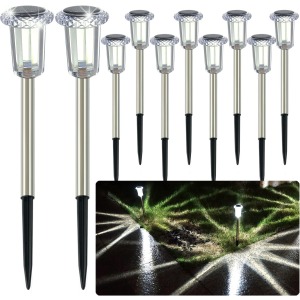
Ten lights, stainless steel and glass construction, IP65 waterproofing, and a 10-to-12-hour runtime. That’s the Hixyer 10-Pack in one sentence, and it’s an impressive combination at around £21.59. The glass diffuser cap gives these a noticeably more premium look than the plain plastic-capped alternatives that dominate this price point. In an evening garden, the warm glow through glass is visibly warmer and more diffused than through opaque plastic.
The stainless steel stake doesn’t rust. That sounds like a basic requirement, but plenty of cheaper options develop rust streaks within a season of UK weather. The Hixyer resists corrosion properly, which matters for something that’s going to spend every night exposed to rain, frost, and morning dew from September through to April.
Runtime is the other standout feature. Ten to twelve hours is at the top end of what you’ll find in this category, which means these will typically run through the entire night from dusk to dawn, even in winter when nights are long. You don’t get that from most budget stake lights, which often cut out around midnight after a short winter day’s charging.
The cool white output is the one stylistic trade-off. If you prefer warm amber tones in a garden setting, look at the KOOPER or GIGALUMI options below. But for brightness and runtime, the Hixyer is the one to beat at this price point.
Features
- Stainless steel and glass construction
- IP65 waterproof rated
- 10-12 hour runtime
- Cool white LED output
- Automatic dusk-to-dawn operation
- Pack of 10
- Glass diffuser gives a more premium evening light quality
- Excellent 10-12hr runtime for UK winter nights
- Stainless steel resists corrosion in wet conditions
- 10-pack covers most garden paths in one purchase
- Cool white rather than warm white output
- Fewer online reviews than established brands like GIGALUMI
If you want something taller and more architectural than standard path stakes, our guide to the best solar bollard lights covers the top UK options. If you want to add vibrant RGB or RGBW lighting to your garden, our guide to the best solar colour changing lights covers spotlights, ornaments and app-controlled options.
2. KOOPER Solar Lights 4-Pack
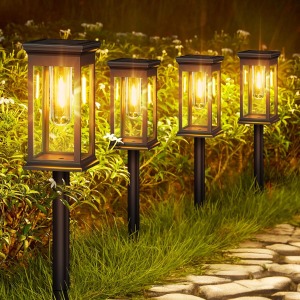
If warm, inviting light is the priority, start with the KOOPER 4-Pack. The filament LED design inside a decorative housing creates a vintage bulb effect that few other garden lights at this price point can match. Where most solar garden lights produce a functional if uninspiring beam, the KOOPER produces something that actually looks considered and attractive in a garden setting.
The 800mAh battery is a decent size for a decorative stake light, giving a comfortable 6 to 8 hours of runtime on a good charge. The IP65 rating means UK weather isn’t a concern, and the automatic on/off means you never have to think about switching them on or remembering to turn them off in the morning. Push the stake in, point the panel towards the best available sky, and you’re done.
These are best suited to garden borders, patio edges, and feature spots rather than long driveway runs. Four lights is the right number for a compact garden feature or a short entrance path. For larger areas, you’d want to add additional packs, though the per-unit cost is very competitive for the quality of light these produce.
Features
- Filament LED design for decorative warm white glow
- 800mAh rechargeable battery
- IP65 waterproof rating
- Automatic dusk-to-dawn sensor
- Stake mount installation
- Pack of 4
- Decorative filament LED looks premium in the garden
- Warm white output is flattering and atmospheric
- IP65 rated for UK weather
- 800mAh battery gives good runtime
- Only 4 lights per pack
- Better suited to accent use than functional path lighting
3. Goodia 50 LED Teardrop Solar String Lights
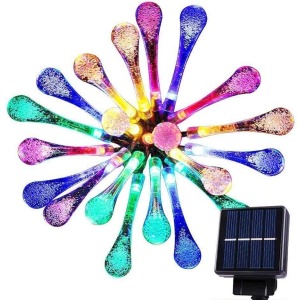
The only string lights on this list, and they earn their place. The Goodia 50 LED teardrop lights have accumulated 4,438 reviews at 4.4 stars, which tells you that a lot of UK buyers have taken a chance on these and been genuinely happy with them. The 6.9 metre run of LED drops gives you enough length to wrap around a pergola, line a fence panel section, or drape across shrubs for a really effective garden lighting display.
Eight lighting modes cover everything from steady-on warm white through to colour cycling and flashing patterns. Most buyers end up using the steady-on or slow-fade modes, and the multicolour option is particularly popular for summer evenings when you want something more festive. The IP65 rating means they can stay out permanently in UK conditions without any special treatment.
The solar panel is integrated into one end of the string and needs to be positioned where it can see the sky while the lights themselves are in their display position. In practice this usually means running the panel to a nearby fence post or stake while the string drapes where you want it. A minor layout consideration, but worth planning for before you start threading them through a hedge.
Features
- 50 LED teardrop bulb design
- 6.9 metre total string length
- 8 lighting modes including multicolour and steady-on
- IP65 waterproof rating
- Automatic dusk operation
- 4.4 stars across 4,438 reviews
- 4,438 reviews at 4.4 stars, proven performer
- 6.9m covers a fence panel or pergola in one run
- 8 modes for different occasions
- IP65 for permanent outdoor use
- Solar panel placement needs thought to reach good charging position
- String lights aren’t suited for path marking
4. Solar Security Lights 248 LED 4-Pack
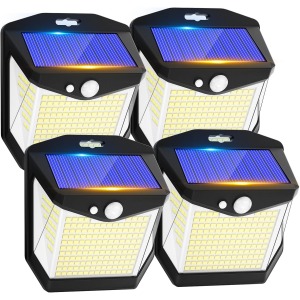
For anyone who wants their solar garden lights to do double duty as security lighting, this 248 LED motion sensor pack is remarkable value at £14.99 for four. The motion sensor triggers a bright flood of light when movement is detected, which makes these a different proposition from the atmospheric stake lights on this list. These aren’t garden decoration; they’re a practical security tool that also happens to be solar-powered.
The 270-degree wide-angle coverage means each unit monitors a substantial arc around itself. Mounted at gate posts, garage corners, side passage entry points, or above a back door, four of these cover the vast majority of a typical residential property’s vulnerable areas. The IP65 rating handles UK weather without issue, and the wall-mount bracket means installation is a matter of a couple of screws rather than pushing stakes into ground.
The 288 reviews at a strong rating confirm these work as described. Motion activation is responsive, and the battery holds enough charge to run through the evening and trigger through the night on a normal charge cycle. At under £15 for four, even budget-conscious buyers can cover the whole perimeter.
Features
- 248 LED per unit for very bright output
- PIR motion sensor activation
- 270-degree wide-angle beam coverage
- IP65 waterproof rated
- Wall-mount bracket included
- Pack of 4, £14.99
- Exceptional value at £14.99 for 4 lights
- Motion sensor for security use
- 270° wide angle covers broad areas
- 248 LED gives genuinely bright output when triggered
- Motion-only activation not suited to decorative garden use
- Wall-mount style, not stake-in-ground
5. Solpex Solar Spotlights 4-Pack
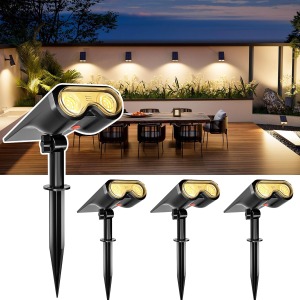
Spotlights serve a different function from path stake lights. Rather than marking where you’re walking, they direct a focused beam at something specific: a tree trunk, a garden wall feature, a statue, a specimen plant. The Solpex Solar Spotlights 4-Pack is a solid option for this application, with IP67 waterproof protection (better than most on this list), warm white output, and three brightness modes that let you dial in exactly how much light you want on the feature.
The 4.4-star rating across 76 reviews suggests early buyers are satisfied, though the lower review count means there’s less accumulated experience to draw on than with higher-volume products. Solpex has a generally good reputation for solar outdoor lighting, and the IP67 rating specifically is worth noting: it’s waterproof to one metre submersion depth, which means even the worst UK winter downpour isn’t going to cause problems.
Use these for garden features you want to highlight rather than for path lighting. Angled correctly, four spotlights can transform the look of a garden completely at night, picking out architectural elements, planting areas, or focal points that are invisible after dark without them.
Features
- Adjustable spotlight head for directed beam
- IP67 waterproof rating (submersion-proof)
- Warm white output
- 3 brightness modes
- Automatic dusk-to-dawn operation
- Pack of 4
- IP67 rated, the best waterproofing on this list
- Adjustable spotlight head for precise aiming
- 3 brightness modes
- Warm white suits garden feature uplighting
- Only 76 reviews, less track record than other options
- Not suitable for path lighting
6. Solpex 63 LED Solar Spotlights 2-Pack
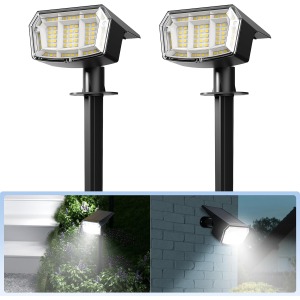
Where the Solpex 4-pack above produces a tight, focused beam, the 63 LED 2-pack spreads a much broader wash of warm white light. Sixty-three LEDs per unit creates a wide flood rather than a spotlight effect, making these better suited to illuminating a garden wall, a shrub bed, or a wider area of planting rather than picking out a single tree or feature. Think of them as solar-powered floodlights for the garden rather than theatrical spotlights.
The IP65 rating is solid, the three lighting modes let you adjust for ambience or brightness as needed, and the 4.4-star average across 100 reviews is encouraging for a relatively new product. The 2-pack format is the right choice if you have two key garden features to illuminate but don’t want the cost of a full 4-pack when you only need coverage for specific zones.
These are a slightly niche choice that suits gardens with defined features to illuminate. If you’re still in the planning stage of your garden lighting, start with the more versatile stake lights before adding spotlights. But if you know exactly where you want broad-beam solar lighting, the Solpex 63 LED does the job reliably.
Features
- 63 LEDs per unit for wide-angle flood lighting
- IP65 waterproof rating
- Warm white output
- 3 lighting modes
- Adjustable mounting head
- Pack of 2
- 63 LEDs gives wide, bright coverage
- 4.4 stars across 100 reviews
- Good for broad garden feature illumination
- Only 2 in a pack
- Fewer reviews than established options
- Wide flood, not suitable where precise spotlighting is needed
7. VOLISUN Solar Fence Lights 8-Pack RGB
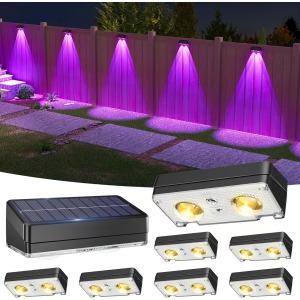
The VOLISUN fence lights occupy a distinct space on this list: they’re the premium decorative option for people who want colour and control in their garden lighting. At £49.99 for eight lights, the per-unit cost is the highest here, and for that premium you get 9 colour modes, remote control operation, and the flexibility to switch between colour-cycling, single colour, and steady-on modes without going outside to fiddle with any buttons. The 4.7-star average across 55 reviews is the highest rating on this list.
These mount flush to fence panels, decking uprights, or garden walls, providing a side-wash of coloured light along the fence line. They’re a party and entertainment garden product as much as a functional lighting one, and anyone who uses their garden regularly for summer evenings, gatherings, or al fresco dining will appreciate the ability to set a colour mood with a remote control from a sun lounger.
The IP65 rating means they can be left out permanently, and the RGB capability means they’re equally useful for a single consistent warm white as for more dramatic colour displays. But at this price point, you’re paying for the versatility of the colour and remote control features. If you just want white fence lights, there are cheaper options. If you want the full package, this is the one.
Features
- RGB with 9 colour modes
- Remote control operation
- IP65 waterproof rating
- Fence and wall mount design
- 4.7 stars across 55 reviews
- Pack of 8
- Highest rating on this list at 4.7 stars
- Remote control for colour and mode changes
- 9 colour modes for full flexibility
- 8-pack covers a full fence panel run
- Priciest option at £49.99
- Only 55 reviews so far
- Fence-mount only, not suitable for stake-in-ground
8. GIGALUMI Solar Pathway Lights 6-Pack
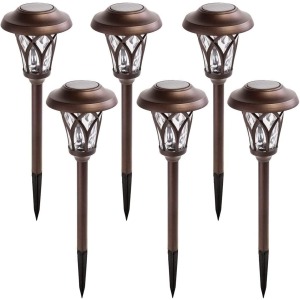
GIGALUMI is one of the most trusted names in solar garden lighting, and this copper and bronze decorative 6-pack demonstrates why. The finish is warmer and more traditional than standard stainless steel options, which makes these a natural fit for cottage-style gardens, period properties, and any outdoor space where you want the lighting hardware to look like it belongs rather than like an afterthought.
The super-bright high-lumen output is genuinely impressive for a decorative stake light. GIGALUMI’s engineering focuses on maximising panel efficiency, which translates into brighter light and better winter performance compared to similarly-priced alternatives. The lights come on automatically at dusk and run through the night on a full charge.
These are a reliable, established choice for anyone who wants proven garden lighting from a brand with a strong track record. The 4.0+ star rating across a meaningful number of reviews puts them firmly in the trusted category. Won’t win any awards for novelty, but if you want copper-toned decorative stake lights from a brand you can rely on, these deliver consistently.
Features
- Copper and bronze decorative finish
- Super bright high-lumen LED output
- IP65 waterproof rating
- Automatic dusk-to-dawn operation
- Stake mount installation
- Pack of 6
- Copper/bronze finish suits traditional gardens
- GIGALUMI brand reliability
- Super bright high-lumen output
- Traditional styling won’t suit all gardens
- 6-pack only, not available in larger bundles
- Lower review count than the brand’s most popular products
Solar Garden Lights Buying Guide
Key Takeaways
- Light type depends on garden layout — stake lights suit open borders and paths, uplights accent plants and architectural features, bollards define boundaries, hanging lights work on pergolas and trees
- Brightness plateaus around 80 lumens; above that, human eyes perceive diminishing additional brightness, so spending on lights rated 150+ lumens offers little visual advantage over 80-lumen models
- Warm white (2700K) lights hide plant detail and create cosy atmosphere; cool white (4000–5000K) shows plant structure and is safer for pathways; choose based on purpose, not branding
- Dusk-to-dawn mode runs lights all night (8–12 hours winter, 10–14 hours summer); timer/dimming modes halve battery drain but require nightly resets — choose all-night only for forgetful gardeners
- Ground stake depth matters: shallow stakes (5cm) pull free in wind or frost heave; 15–20cm stakes stay put. Hard or clayey soil requires pre-drilling or shallower stakes that won’t bend
- Battery capacity below 1,000mAh delivers weak winter performance (2–3 hours light); 1,500mAh provides 6–8 hours winter operation; 2,500+ mAh gives full-night light even November–February
- IP65 or IP67 waterproofing is non-negotiable for UK gardens; IP44 lights fail within one season from damp soil contact, standing water, and rain infiltration
- Material choice mirrors deck lights: stainless steel lasts 8+ years, aluminium 4–6 years, plastic 1–2 years — stainless is the only material worth buying for permanent garden features
Light Type and Garden Application: Choosing the Right Form Factor
Garden lights come in five main forms, each suited to different garden zones. Stake lights (the most common) are vertical spikes driven into soil — perfect for illuminating open borders, outlining pathways, and accenting specimen plants. Uplights are angled or directional lights that throw light upwards and can highlight trees, architectural features, or be submerged in water for dramatic effects. Bollard lights are short (30–60cm) post-like fixtures that define pathways and seating areas without looking like lights. Wall-mounted lights hang on fences, pergolas, or sheds and are ideal for sheltered spaces. Hanging or drooping lights dangle from wires or cables and work on pergolas, archways, or suspended above borders. Matching form factor to your space prevents buying lights that don’t fit.
A typical garden might use stake lights in planting beds, bollards along the pathway edge, and uplights under a key tree. Small urban gardens may use only wall-mounted lights due to space constraints. Larger gardens afford uplights as focal features. Assess your garden layout and identify 3–5 key zones you want lit at night; choose light types to suit those zones, then calculate quantity. Random assortment of different light types looks chaotic; coordinated placement looks intentional.
Brightness in Lumens: Understanding the Plateau Effect
Solar garden lights range from 10 lumens (barely visible) to 200+ lumens (very bright). Lumens measure light output, but human perception of brightness plateaus around 80 lumens. A 200-lumen light doesn’t look twice as bright as an 80-lumen light — most people perceive them as “about the same brightness”. The practical plateau is that garden lights rated 50–100 lumens are suitable for most purposes, and spending extra for 150+ lumens rarely pays off in improved experience. Where higher lumens DO matter: narrow pathways where you need clear visibility (100+ lumens), security spotlights (100–200 lumens), and focal uplights where drama is intended (100+ lumens).
The hidden tradeoff: brighter lights drain batteries faster. An 80-lumen light lasts 6–8 hours post-sunset; a 150-lumen light may last only 3–4 hours. If your goal is ambiance all night, lower brightness (30–50 lumens) is more practical than chasing the highest brightness. Match lumens to both your purpose and your tolerance for evening darkness hours. Accent lighting suits 20–40 lumens; pathway safety needs 60–100 lumens; dramatic features can push toward 150 lumens.
| Lumens | Visual Effect | Best Purpose | Evening Runtime (typical) |
|---|---|---|---|
| 10–20lm | Barely noticeable glow | Very subtle accent, visual interest only | 10–12 hours |
| 30–50lm | Soft visible light, no detail clarity | Border accent, mood lighting | 8–10 hours |
| 60–100lm | Clear light, features visible, safe walking | Pathway safety, focal plant uplights | 6–8 hours |
| 120+ lm | Very bright, detail sharp, potential glare | Security/drama, wide-area coverage | 3–5 hours |
Colour Temperature: Warm White vs. Cool White Trade-Offs
Warm white lights (2700K) produce soft, golden light flattering to skin tones and foliage. They’re popular for entertaining areas and create a welcoming garden atmosphere. The downside: warm white is dim in detail. If your light illuminates a narrow path lined with borders, the warm white won’t clearly reveal step edges or obstacles. Cool white lights (4000–5000K) render all details with clarity and are safer for navigation. They can feel clinical in entertainment areas but are ideal for pathways and places where visibility matters. Daylight white (6000K) is very bright but looks institutional and rarely suits residential gardens.
Choose warm white for ambiance-focused gardens where safety visibility is secondary (open lawns, entertaining patios). Choose cool white for family gardens with kids, for pathway safety, and for gardens with steps or uneven ground. Some premium lights offer dual modes (switchable warm/cool), but these cost more. If you can only choose one, match your garden’s priority — mood or safety — to your colour selection.
Operating Modes: Dusk-to-Dawn vs. Timer vs. Motion Sensor
Most solar garden lights default to dusk-to-dawn operation: they turn on automatically at dusk and stay on until dawn (8–12 hours winter, 12–14 hours summer). This is the simplest mode and requires zero effort. Timer or dimming modes are available on premium models — lights stay on for just 3–4 hours post-sunset or dim after midnight, conserving battery. Motion sensors activate light only when movement is detected (security application). For standard garden ambiance, dusk-to-dawn is best — set and forget. Timer and dimming modes suit battery-anxious gardeners concerned about winter performance, but require remembering to reset them nightly. Motion sensors suit security applications, not decor.
Installation Challenges: Ground Conditions and Stake Depth
Stake lights are deceptively simple to install — until you hit hard ground. Light stakes need to penetrate at least 15–20cm into soil to avoid frost heave (freezing soil expanding and pushing stakes up) or wind-induced wobbling. In clay-heavy or compacted soil, a 5mm stake can’t be driven deep without bending. Hard ground requires pre-drilling or choosing shallower-stake designs. Rocky soil, gravel, or areas with buried utilities demand care and sometimes manual digging. Assess your garden’s soil before buying — if it’s obviously hard (brick-hard in dry weather, clay-heavy), look for lights with shallower stakes (10cm) or uplights that mount on soft ground (no deep stake needed). Installing 10 stake lights in a 4-metre-deep border of hard clay soil can be tedious and frustrating if you miscalculate ground conditions.
Battery Capacity and Winter Performance Expectations
Solar garden lights live or die on battery capacity in UK winter. Battery measured in milliamp-hours (mAh) determines evening runtime on short winter daylight. A 600mAh light charges on 2–3 hours of weak winter sun and may light for only 2–3 hours before battery depletes. A 2,000mAh light charges more fully and powers 8+ hours of light. This is not a detail — it’s the difference between useful winter lighting and darkness by 9pm. If you want year-round ambiance, specify 1,500mAh or larger. If you accept seasonal operation (lights dimmer/absent November–February), smaller batteries suffice.
Waterproofing and Long-Term Reliability
Garden lights sit in soil that may be wet (after rain, watering, or poor drainage). They endure ground-level damp that mains-powered lights never experience. IP44 waterproofing is splash-proof but not soil-moisture-proof — within one UK winter, moisture seeps past gaskets and corrodes the LED and circuit board. IP65 is fully waterproof and can survive regular watering and wet soil. IP67 is submersion-proof (redundant for soil use but a good safety margin). Buy only IP65 or IP67 lights if you expect them to last beyond one season. This waterproofing cost (typically £5–10 per light) is worth the difference between annual replacement and 3–5 year durability.
Material Durability: Stainless vs. Aluminium vs. Plastic
Stainless steel lights last 8–12 years outdoors; aluminium (anodised) lasts 4–6 years before fading; plastic cracks within 1–3 years from frost and UV damage. Garden lights sit in sunlight daily and freeze monthly in UK winters. Plastic is not a durable choice. Aluminium is acceptable for temporary or seasonal setups. Stainless steel is the only material that truly survives perpetually. The cost premium for stainless (typically 50–100% higher than plastic) is recovered in reliability. Buy stainless for permanent gardens; buy aluminium or plastic only for temporary displays.
Quantity and Spacing: How Many Lights Do You Need?
Border and pathway lighting typically uses 1 light per 1–1.5 metres of linear space. A 10-metre pathway needs 7–10 lights for consistent coverage. A 4-metre deep planting bed might use 4–6 lights, spaced every 0.5–1 metre. Focal/uplights (fewer, brighter) need just 2–3 per garden to accent key plants or features. Aim to create visual rhythm — evenly spaced lights feel intentional; scattered lights feel random. Plan your layout on paper before buying to calculate accurate quantities. A common mistake is buying too few lights, resulting in dark gaps; overbuying makes the space feel overly lit. Most people underestimate quantities and wish they’d bought more.
When Not to Buy Solar Garden Lights
Solar garden lights disappoint in gardens with less than 3 hours direct daily sun or heavily shaded spaces under trees. If your garden is shadier than it is sunny, a mains-powered path lighting system is more reliable. Skip them if you need consistent security lighting — motion-sensor spotlights on mains power are more dependable than solar alternatives in UK winter. Finally, don’t buy plastic lights expecting durability; the upfront savings evaporate when you replace them annually. Stainless or quality aluminium offers better lifetime value.
Case Study: Full Garden Lighting Renovation
Background
A family in the West Midlands had a medium-sized rear garden with a decked patio area, a central lawn, and a long side path running from the front gate to the back garden. The garden was entirely unlit at night. Previous attempts with mains outdoor lighting had been abandoned after the installation cost came in higher than expected.
Project Overview
The goal was comprehensive garden lighting without any electrical work. Budget was around £70 total. The priority areas were: the side path for safe navigation, the patio deck edge for evening use, and two garden feature trees that made attractive focal points during the day but disappeared completely after dark.
Implementation
The family used three types of solar garden lights. For the side path, they chose the Hixyer 10-Pack, using eight of the ten lights to cover the full run at regular spacing. For the deck edge, they installed the VOLISUN fence lights along two fence panels behind the decked area. For the two trees, they positioned the Solpex 63 LED 2-pack, one spotlight aimed at each trunk base.
Results
Installation took one afternoon and required no tools beyond a rubber mallet for the path stakes. The path lighting resolved the navigation issue immediately, and the deck edge lights transformed the patio from unusable after dark to a genuinely pleasant evening space. The tree uplighting created a focal point that the family had not anticipated enjoying as much as they did. Total spend came to around £65, and the garden has been consistently better lit on every evening since.
Expert Insights From Our Solar Panel Installers About Solar Garden Lights
One of our senior solar panel installers, with over 14 years of experience working with residential solar installations across the UK, shared these thoughts on solar garden lighting:
“The mistake I see most often with solar garden lights is people buying the wrong type for what they actually need. They see a great price on security floodlights and use them where they needed path markers, or they buy string lights and then wonder why their side passage isn’t lit at night. Before you look at specific products, spend five minutes working out exactly which areas you need to light and what kind of light you need in each area. Do you need to see where you’re walking? You need stake path lights. Do you want atmosphere around the patio? String lights or fence lights. Security near the garage? Motion sensor floodlights. Get that right first and then find the best product in that category. You’ll save money and get a result you’re actually happy with.”
Frequently Asked Questions
How many lumens do solar garden lights need?
It depends entirely on the application. Path stake lights need only 10 to 50 lumens to define a path and create atmosphere at this level they are comfortable to walk past without dazzle. Feature spotlights need 50 to 200 lumens to illuminate a tree or wall highlight effectively. If you need functional area lighting for a driveway or parking area, 200 to 800 lumens is the relevant range. Many solar garden lights sold in the UK are in the 10 to 50-lumen range, which suits decorative use but is not enough for practical working light.
What IP rating do outdoor solar garden lights need for the UK?
IP65 is the practical minimum for any light that will remain permanently installed in a UK garden. It provides full protection against water jets from any direction, which is necessary for UK autumn and winter weather. IP44 is adequate for lights in sheltered positions like covered pergolas or walled courtyards. For lights near ponds, in boggy areas, or in very low positions where standing water might accumulate, IP67 provides temporary submersion protection and is the better choice.
Do solar garden lights work in UK winter?
Yes, with reduced performance. UK winters from November to February provide short days and low sun angles that limit solar charging. Monocrystalline panels and lithium batteries are the key specifications for maintaining reasonable winter performance. A light with a polycrystalline panel and NiMH battery in a partially shaded position may not illuminate reliably in December. The same light with a monocrystalline panel in a good south-facing position can still run for several hours per night through winter, though not at the same level as summer.
How long do solar garden lights last?
The LED components last 25,000 to 50,000 hours, which means decades of use. The battery is the consumable component. NiMH batteries in most garden lights last 2 to 3 seasons before capacity drops significantly, at which point simple AA or AAA NiMH replacement cells restore full performance. Lithium batteries last 3 to 5 years. The body and components of quality stainless steel or UV-stable resin lights can last 10 years or more with occasional battery replacement. Budget lights with thin plastic bodies and cheap seals typically last 2 to 3 years before failing.
Why do my solar garden lights not come on at night?
The most common causes in order are: insufficient charging from the panel position (try moving to a sunnier spot); the on/off switch is set to off rather than auto; the battery has reached end of life after 2 to 3 seasons; or the light sensor is confused by ambient light from a nearby streetlamp or house window. Test by covering the panel with your hand if the light activates, the sensor is working and the issue is the charging position or battery. If covering the panel produces no response, the battery or circuit is the problem.
How do I stop solar garden lights flashing?
Flashing or flickering on solar garden lights is almost always caused by a low or failing battery. When the battery is partially depleted, the control circuit oscillates between on and off states as voltage drops in and out of the operating range. Replacing the battery is the fix. If the lights flash even immediately after a full day of charging, the panel is not generating enough charge (likely due to shade or a dirty panel) or the battery has failed and can no longer hold charge adequately. Clean the panel and replace the battery to resolve both possibilities.
What is the best position for solar garden lights?
For optimal charging: a south-facing position in full sun from 10am to 3pm during the season of use. The panel should have clear sky access with no tree canopy, fence, or building shadow during these hours. For decorative path lights, this may mean the aesthetic position you want is not the charging position that works best. Where these conflict, lights with adjustable or separate panels allow you to position the decorative element where it works visually and orient the panel toward the sun. For year-round use, a south-facing aspect adds meaningful winter performance over an east or west position.
Do solar garden lights need direct sunlight or do they work in shade?
Solar panels generate some power from diffuse daylight even without direct sun, but significantly less than from direct sun. A panel in full shade under a dense tree canopy generates very little useful charge. A panel in open sky on an overcast UK summer day generates around 20 to 30% of its full-sun output, which is enough to maintain most garden lights. Deep shade is not workable for solar charging; partial shade reduces performance proportionally. If your garden is heavily shaded, prioritise lights with monocrystalline panels and lithium batteries, which extract more from limited light and hold charge more efficiently overnight.
Summing Up
The Hixyer Bright Solar Pathway Lights 10-Pack is our top recommendation for most UK gardens, offering stainless steel and glass construction, a 10-to-12-hour runtime, and IP65 protection in a 10-light set that handles most garden sizes in one purchase. For warm decorative atmosphere, the KOOPER filament LED 4-Pack is hard to match. String lights across a fence or pergola? The Goodia 50 LED teardrop lights with 4,438 reviews make the decision easy.
Beyond the basics, the Solar Security 248 LED 4-Pack provides exceptional security coverage for £14.99, the Solpex spotlights cover garden feature uplighting in both focused and wide-flood formats, the VOLISUN RGB fence lights bring colour and remote control to any fence line, and the GIGALUMI copper 6-pack delivers reliable, established brand quality with traditional styling. Whatever your garden needs, there’s a solar solution on this list that fits.
Updated