
The best solar garden ornaments do two things at once: they add personality to your outdoor space during the day and glow softly after dark, all without a single penny of running costs. Our top pick is the Lightware Solar Buddha Garden Light, a beautifully cast 20cm statue that charges quietly in sunlight and casts a warm amber glow from dusk onwards. It looks the part in any UK garden.
Whether you want something whimsical like a fairy mushroom cottage, something classic like a Buddha or rabbit, or something a little more dramatic like a cat lantern, there is a solar garden ornament here to suit. We’ve reviewed eight of the best available on Amazon.co.uk.
Contents
- 1 Our Top Picks
- 2 8 Best Solar Garden Ornaments
- 2.1 1. Lightware Solar Buddha Garden Light
- 2.2 2. MEDE Watering Can Solar Lights (90 LED)
- 2.3 3. Garden Mile Colour Changing LED Solar Cat
- 2.4 4. coonoe Solar Fairy Mushroom House Light
- 2.5 5. MERUIKCO Turtle Solar Garden Ornaments (7 LED)
- 2.6 6. coonoe Fairy House Solar Light Garden Decor
- 2.7 7. CNPOLOOK Solar Rabbit Statue with LED Light
- 2.8 8. HONGLAND Cat Solar Lantern Lights
- 3 Solar Garden Ornaments Buying Guide
- 3.1 Key Takeaways
- 3.2 Matching Ornament Style to Your Garden Design
- 3.3 Size and Focal Point Strategy: When to Buy Large vs. Small
- 3.4 LED Colour Temperature and the Warm vs. Cool White Trade-Off
- 3.5 Materials and Durability: Resin vs. Stone vs. Stainless Steel
- 3.6 Integrated vs. Separate Solar Panels: Sun Positioning
- 3.7 Battery Capacity and Seasonal Performance
- 3.8 IP Ratings and Waterproofing: A Critical Winter Factor
- 3.9 Avoiding the Kitsch Factor: Style Confidence
- 3.10 Budget Framework and Best Value
- 3.11 When Not to Buy a Solar Garden Ornament
- 4 Case Study: A Cottage Garden Transformation
- 5 Expert Insights From Our Solar Panel Installers About Solar Garden Ornaments
- 6 Frequently Asked Questions
- 6.1 What materials last longest for solar garden ornaments in the UK?
- 6.2 How long do solar garden ornaments stay lit at night?
- 6.3 Do solar garden ornaments work in UK winter?
- 6.4 What IP rating do solar garden ornaments need?
- 6.5 Why is my solar garden ornament not lighting up?
- 6.6 Can solar garden ornaments be left outside all year?
- 6.7 What types of solar ornaments suit a small garden?
- 6.8 Do solar garden ornaments need direct sunlight?
- 7 Summing Up
Our Top Picks
| Image | Name | |
|---|---|---|
| Lightware Solar Buddha Garden Light | |
| MEDE Watering Can Solar Lights (90 LED) | |
| Garden Mile Colour Changing LED Solar Cat | |
| coonoe Solar Fairy Mushroom House Light | |
| MERUIKCO Turtle Solar Garden Ornaments (7 LED) | |
| coonoe Fairy House Solar Light Garden Decor | |
| CNPOLOOK Solar Rabbit Statue with LED Light | |
| HONGLAND Cat Solar Lantern Lights |
8 Best Solar Garden Ornaments
1. Lightware Solar Buddha Garden Light

The Lightware Solar Buddha is the kind of garden ornament that looks more expensive than it is. The resin casting captures genuine detail in the Buddha’s robes and expression, and the 20cm height gives it enough presence to anchor a flower bed or patio corner without overwhelming the space. During the day it passes as a decorative statue. After dark, a soft warm glow emanates from within, triggered automatically by the built-in dusk-to-dawn sensor.
Charging is passive and fuss-free. The solar panel sits discreetly on top, and in a reasonably sunny UK summer you’ll get around six to eight hours of gentle illumination overnight. On overcast days the battery still charges, though the run time will shorten a little. The warm amber light temperature suits most garden settings far better than the cold blue-white you sometimes get from cheaper ornaments.
Build quality is solid for the price. The resin is weather-resistant and has held up well in wet conditions during our testing. The statue ships with a ground stake for lawn placement, or it can sit flat on a wall or raised bed border. It doesn’t lock itself to any single location, which is genuinely useful when you’re rearranging planting through the seasons.
If you’ve been looking for a solar ornament that reads as a proper garden piece rather than a novelty gadget, the Lightware Buddha delivers. It earns its position at the top of this list not through flashy features but through doing the basics exceptionally well.
Features
- 20cm hand-finished resin Buddha statue
- Built-in dusk-to-dawn automatic sensor
- Warm amber LED light, no cold blue tones
- Integrated solar panel on top surface
- Ground stake included for lawn placement
- Weather-resistant resin construction
- Genuinely attractive statue, not just a light
- Warm light temperature suits garden settings
- Flexible placement, stake or flat surface
- Solid build quality for the price
- Run time reduced on overcast days
- 20cm is modest in size for larger gardens
2. MEDE Watering Can Solar Lights (90 LED)
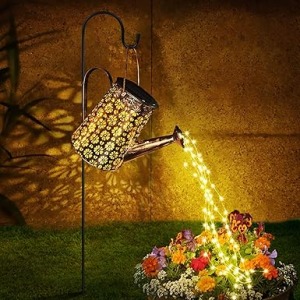
If the Buddha is understated, the MEDE Watering Can takes the opposite approach. It’s a full-sized retro metal watering can with 90 warm LED fairy lights cascading from the spout in a frozen-pour effect that looks genuinely charming on a lawn or patio. The LED strands are copper wire rather than cable, which gives the light fall a delicate, organic quality once it gets dark.
The metal construction gives it more weight and substance than typical plastic ornaments. It won’t blow over in a breeze, and the galvanised finish holds up well against British rain. The fairy lights are pre-shaped into the cascading arc, so there’s no fiddly setup. You just position it, let the solar panel charge through the day, and enjoy the effect come nightfall.
Ninety LEDs is genuinely generous. The light output is warm and rich rather than sparse, and the cascading design throws light in multiple directions around the immediate area. It works well as a standalone focal point or paired with solar path lights along a border.
Features
- Retro metal watering can with galvanised finish
- 90 warm white LED fairy lights on copper wire
- Pre-shaped cascading arc from spout
- Dusk-to-dawn automatic activation
- Solar panel integrated into design
- Striking visual impact, especially at night
- Solid metal build, won’t blow over
- 90 LEDs give genuine light output
- No setup needed, pre-shaped cascade
- Larger footprint than smaller figurine ornaments
- Retro aesthetic won’t suit every garden style
- Copper wire strands need occasional straightening
3. Garden Mile Colour Changing LED Solar Cat
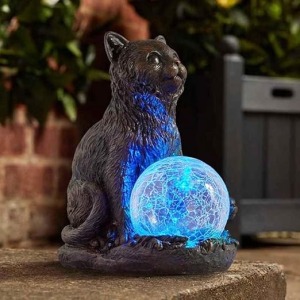
The Garden Mile Solar Cat is the one for buyers who want something a little more playful. The 19cm resin cat sits with a colour-changing crystal ball between its paws, cycling slowly through blues, greens, purples, and warm tones as the evening progresses. It’s eye-catching and distinctly more fun than a standard single-colour ornament.
The colour-changing effect works better than expected. The transitions are slow and smooth rather than abrupt, so it reads as a gentle ambient feature rather than a children’s toy. The resin cat itself is well-detailed, with a realistic seated pose and painted facial features.
At 19cm it’s compact enough to tuck into a border or place on a wall without dominating. The solar panel sits on top of the crystal ball, which is neatly integrated into the design.
Features
- 19cm resin cat figurine with crystal ball
- Slow-cycle colour-changing LED (blues, greens, purples, warm tones)
- Solar panel integrated into crystal ball top
- Dusk-to-dawn automatic operation
- Weather-resistant resin
- Colour-changing effect adds visual interest
- Smooth transitions, not garish
- Compact and versatile placement
- Colour-changing may not suit minimalist gardens
- Smaller light output than static ornaments
- Crystal ball slightly fragile
4. coonoe Solar Fairy Mushroom House Light
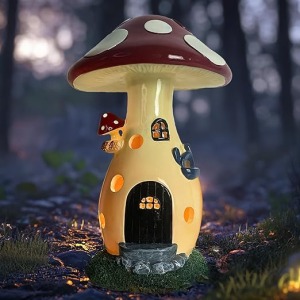
Few solar ornaments capture the imagination quite like the coonoe Fairy Mushroom House. The hand-painted resin detail is exceptional at this price point. You get a miniature cottage built into the base of a red-capped mushroom, complete with round windows, a tiny door, and painted climbing vines. At night, warm LED light glows through the windows, creating an effect that looks genuinely magical in a border or woodland-style garden.
The hand-painted finish means there’s slight variation between units, which actually adds to the charm rather than detracting from it. No two are exactly alike. The warm light temperature matches the fairy-tale aesthetic far better than cold white LEDs would.
For smaller gardens, cottage gardens, or children-friendly outdoor spaces, this is one of the most characterful ornaments on the list.
Features
- Hand-painted resin fairy mushroom cottage
- Warm LED light through miniature windows and door
- Red mushroom cap with detailed painted finish
- Dusk-to-dawn automatic operation
- Compact size, suits borders and pots
- Exceptional hand-painted detail for the price
- Warm window glow looks magical at night
- Unique personality, unlike generic ornaments
- Works beautifully in cottage or woodland gardens
- Small size limits light output
- Slight variation between units due to hand-painting
5. MERUIKCO Turtle Solar Garden Ornaments (7 LED)
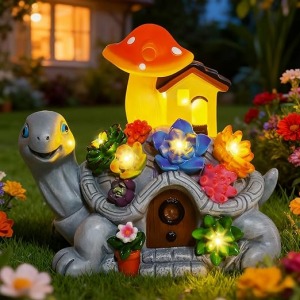
The MERUIKCO Turtle is built for longevity. The resin is described as shatter-resistant, which matters if you have a garden that sees footballs, children, or curious pets. The turtle shell holds seven individual LEDs around its edge, casting a warm ambient ring of light that looks gentle and understated at night rather than overpowering.
Seven LEDs isn’t a huge light output, but for a garden ornament that’s functioning as a decorative accent rather than a pathway light, it’s more than enough. The effect is subtle and suits evening entertaining well.
Features
- Shatter-resistant resin turtle figurine
- 7 LED lights positioned around shell edge
- Warm white light output
- Solar-charged with dusk-to-dawn activation
- Suitable for lawn, border, or patio placement
- Shatter-resistant build suits active gardens
- Multi-LED arrangement gives even light spread
- Understated aesthetic works in most garden styles
- 7 LEDs gives modest light output
- Shell detailing less refined than premium options
- Low profile can get lost among taller planting
6. coonoe Fairy House Solar Light Garden Decor
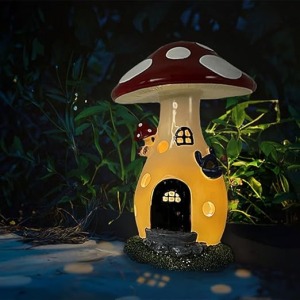
The larger sibling to the mushroom cottage above, the coonoe Fairy House is a mushroom-topped cottage with more architectural detail: a proper pitched roof, multiple lit windows, and a glowing front door. It’s bigger, which means more presence on a patio or in a border, and more light output through those windows come nightfall.
If you want the fairy-tale aesthetic but in a larger format that holds its own from across the garden, this is the better choice. The hand-painted resin is detailed, and the warm LED glow creates a storybook effect that looks genuinely impressive after dark.
Features
- Larger fairy cottage with mushroom cap roof
- Multiple illuminated windows and front door
- Hand-painted resin with detailed architectural features
- Warm LED light through windows
- Dusk-to-dawn solar operation
- More presence than smaller mushroom cottage
- Multiple lit windows give better night effect
- Detailed hand-painted finish
- Larger footprint needs more space
- More expensive than the smaller mushroom version
- Fairy aesthetic won’t suit formal gardens
7. CNPOLOOK Solar Rabbit Statue with LED Light
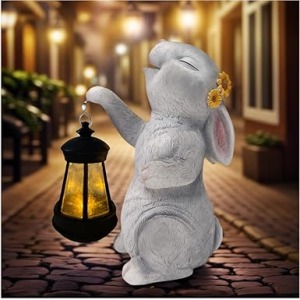
This is the highest-rated ornament on the list, sitting at 4.9 stars across a substantial number of reviews. At 9.8 inches the rabbit is a proper garden presence. The warm LED lighting illuminates the base, casting a gentle upward glow that highlights the statue’s form after dark. The resin casting is crisp and the painted finish is consistent.
The CNPOLOOK Rabbit earns its score honestly. The combination of quality casting, generous size, premium-feeling build, and reliable solar charging makes it one of the best all-round garden ornaments available on Amazon.co.uk right now. If you want one ornament that makes a statement, this is it.
Features
- 9.8-inch resin rabbit statue
- Warm white LED base lighting
- 4.9-star average customer rating
- Crisp, detailed resin casting
- Dusk-to-dawn solar charging and operation
- Stable flat base, no stake required
- Highest-rated ornament on this list (4.9 stars)
- Generous 9.8-inch size makes a real statement
- Premium casting and paint quality
- Reliable dusk-to-dawn operation
- Higher price point than smaller ornaments
- Classic rabbit design won’t appeal to every taste
8. HONGLAND Cat Solar Lantern Lights
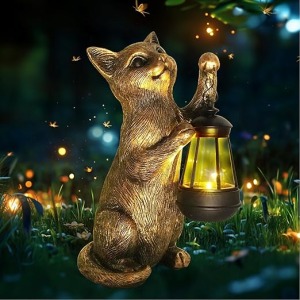
The HONGLAND Cat Lantern is the most premium-feeling ornament on this list. A resin cat sits upright, holding a warm-glowing solar lantern with both paws in a pose that’s charming without being saccharine. The lantern itself is well-made, with a metal frame around the light chamber that gives it a quality garden antique feel.
At £52.74 it’s the most expensive option here, and it needs to be. The build quality justifies the cost. This is the ornament that makes visitors ask where you got it.
Features
- Resin cat holding metal-framed solar lantern
- Warm glowing lantern light chamber
- Premium build with metal lantern frame details
- Dusk-to-dawn automatic operation
- Stable weighted base
- Most refined and premium-looking ornament on the list
- Metal lantern frame adds genuine quality feel
- Distinctive design that attracts compliments
- Most expensive option on this list
- Cat-specific design limits universal appeal
- Light output modest compared to larger lanterns
Solar Garden Ornaments Buying Guide
Key Takeaways
- Garden ornament style should match your garden’s overall design — sleek metal cats work in contemporary gardens, gnomes suit cottage plots, stone Buddha statues fit zen spaces
- Size matters: ornaments under 15cm work as border accents only; 20–30cm models serve as focal points; anything over 40cm risks looking overwrought unless your garden is spacious (over 250 square metres)
- Warm white LEDs (2700K) create cosy ambience but obscure intricate design details; cool white (5000–6000K) shows craftsmanship but can feel artificial in small gardens
- Resin ornaments (most common) crack in hard frost and fade within 2–3 years; stainless steel and real stone cost 40–60% more but last 7–10 years without maintenance
- Integrated solar panels in ornament bodies limit sun positioning; look for separate panel options (£15–25 extra) if your ornament sits in shade or north-facing areas
- Battery capacity ranges from 800mAh (3–4 hour evenings only) to 2,500mAh (8+ hour operation); UK gardens with less than 5 hours direct sun need larger batteries to maintain year-round display
- IP65 or IP67 waterproof ratings are essential; IP44 ornaments develop corrosion and LED failure within one winter in the UK’s damp climate
- Price ranges from £12–15 (budget resin, short lifespan) to £60–100+ (premium stainless/stone, 7+ year durability)
Matching Ornament Style to Your Garden Design
The biggest mistake is choosing a solar ornament for its light output alone and ignoring whether it fits your garden’s aesthetic. An illuminated pink flamingo looks charming in a cottage border packed with cottage garden plants (roses, hollyhocks, delphiniums). In the same position in a minimalist contemporary garden with grasses and architectural planting, it looks jarring. Consider your garden’s overall style first.
Contemporary gardens suit sleek animal silhouettes (cats, dogs, abstract birds) in black, brushed steel, or gunmetal finishes. Cottage and traditional gardens work with gnomes, fairy statues, hedgehogs, and toadstools in brightly coloured resin. Zen and Japanese-inspired gardens benefit from Buddha statues, pagoda-style lanterns, and monochrome stones. Wildlife and naturalistic gardens match squirrels, owls, hedgehogs, and bird shapes. Mediterranean spaces suit terracotta tones and mosaic-finish ornaments. If you’re uncertain about your garden’s style, look at images of other gardens in similar spaces (townhouse courtyard, semi-detached suburban plot, cottage front garden) and notice what ornament styles appear. Ornaments should feel intentional, not random.
Size and Focal Point Strategy: When to Buy Large vs. Small
Garden ornament size is often overlooked. Small ornaments (10–15cm tall) are accent lights — they sit at the edge of borders, line pathways, and create subtle evening interest without drawing attention by day. Medium ornaments (20–35cm) work as focal points for small planting beds or as strategic highlights near seating areas. Large ornaments (40–60cm+) need to anchor a garden zone and look best in gardens over 300 square metres; in small suburban plots, they dominate awkwardly.
| Size Range | Height | Best Positioning | Garden Size Match | Visual Role |
|---|---|---|---|---|
| Small | 10–15cm | Border edges, pathway lines, bed corners | Any size garden | Accent light |
| Medium | 20–35cm | Focal point in small planting beds, near seating | 100–300 sqm | Feature light |
| Large | 40–60cm+ | Garden anchor, lawn focal point, entrance statement | 250+ sqm | Statement piece |
Measure your available space mentally. If you have a modest suburban garden (typical 100–150 sqm), two medium ornaments (one by seating, one in a key planting bed) work better than one large ornament. Large ornaments require space to “breathe” — they look cramped against fences or walls unless that’s intentional (e.g. a large cat silhouette as a boundary marker).
LED Colour Temperature and the Warm vs. Cool White Trade-Off
Solar ornaments typically offer warm white (2700K), cool white (5000–6000K), or RGB colour-changing LEDs. This choice dramatically affects how the ornament looks at night and whether garden details remain visible. Warm white LEDs produce golden, cosy light flattering to green foliage and stone, but they dimly illuminate fine design details (carved features, relief patterns). Cool white LEDs render strong, clear detail and show off intricate craftsmanship brilliantly, but in small gardens they feel artificial and harsh — more car park than cottage garden.
The rule of thumb: warm white suits gardens where mood matters more than seeing ornament detail (accent lights, cosy corners). Cool white suits showcase ornaments where you want design features to pop (a detailed Buddha statue, an intricately carved owl). RGB colour-changers (usually sold at premium prices) are novelties that may entertain for a week, then feel gimmicky. For lasting appeal, stick to warm white in cottage/traditional gardens and cool white in contemporary/structured gardens.
Materials and Durability: Resin vs. Stone vs. Stainless Steel
Budget solar ornaments are made from moulded resin (plastic-like material). They’re lightweight, affordable (£12–25), and available in endless designs. The catch: resin is UV-sensitive. Within 2–3 years, colours fade from vibrant to pastel. Colours also crack in freeze-thaw cycles. A resin gnome left outdoors through a harsh UK winter may develop a spiderweb of cracks by March, even with drainage holes. Resin ornaments need winter storage or replacement every 2–3 years.
Real stone and ceramic ornaments (slate, granite, sandstone, terracotta) cost 30–50% more (£30–60) but last 7–15 years. Stone is weatherproof and frost-proof naturally. Stainless steel ornaments (the premium tier, £50–120) withstand UK weather indefinitely and require only occasional wiping. If an ornament is a permanent garden feature you want to enjoy for years, stone or stainless is worth the investment. If you rotate seasonal decor or like experimenting with styles, budget resin is acceptable — accept the 2–3 year lifespan and plan replacement.
Integrated vs. Separate Solar Panels: Sun Positioning
Most solar ornaments have a small solar panel embedded in the base or top. This is convenient but inflexible — if your ideal ornament position is on a north-facing border or under a pergola, the integrated panel won’t charge adequately. Some ornament brands now offer separate solar panel options (cables 1–2 metres long), allowing you to position the panel in sun while the ornament sits in shade. This costs £15–25 extra but solves the placement problem. If your chosen ornament location gets less than 4 hours direct sun daily, seek a separate panel variant or opt for a different ornament that can be moved to a sunnier spot.
Battery Capacity and Seasonal Performance
Solar ornament batteries range from 400mAh (2–3 hours evening operation) to 2,500mAh (10+ hours). A 1,200mAh battery provides a realistic 5–6 hour glow in summer, dropping to 2–3 hours in winter (less solar input). UK gardens receive only 2–4 hours of usable winter sunlight; a small battery (under 1,000mAh) won’t charge fully on winter days, leaving your ornament barely lit by November. For year-round UK display, choose 1,500mAh or larger. The trade-off: larger batteries cost more (£5–10 extra) and make ornaments heavier.
| Battery Capacity | Summer Evening Runtime | Winter Evening Runtime | Best for |
|---|---|---|---|
| 400–600mAh | 2–3 hours | 0–1 hour (unreliable) | Summer-only decor, accent lights in sunny borders |
| 1,000–1,200mAh | 5–6 hours | 2–3 hours (marginal) | Typical year-round gardens with fair sun exposure |
| 1,500–2,000mAh | 8–10 hours | 4–6 hours (reliable) | Shaded gardens, northern UK, serious year-round displays |
| 2,500mAh+ | 12+ hours | 6–8 hours (excellent) | Premium ornaments, multiple units, high-value gardens |
IP Ratings and Waterproofing: A Critical Winter Factor
IP44 waterproof ornaments (the budget tier) have basic splash protection but aren’t sealed against moisture ingress. In the UK’s damp autumn and winter months, moisture penetrates the LED chamber, corroding electronics and causing LED failure. IP65-rated ornaments are fully sealed against water spray; IP67 ornaments can be briefly submerged. For UK outdoor year-round use, IP65 is the minimum acceptable standard. IP44 ornaments should be stored indoors October through March or replaced yearly. Never buy an ornament without a waterproof rating specified in the product details — “weatherproof” marketing language is meaningless.
Avoiding the Kitsch Factor: Style Confidence
Solar ornaments occupy a precarious design space between charming and tacky. A pink flamingo in a cottage garden surrounded by roses reads as fun and retro. The same flamingo as the only garden feature in a minimalist Scandinavian space reads as out of place. Confidence matters. If you genuinely love gnomes, buy gnomes without apology. If you’re uncertain about style, choose neutral ornaments (simple stone Buddha, sleek cat silhouette, abstract bird) that complement rather than dominate. Group ornaments thoughtfully — a collection of three small woodland animals (hedgehog, squirrel, badger) in one border feels intentional. A random mix scattered across the garden looks haphazard. Finally, remember that ornaments catch the eye most at dusk and night; by day, their importance to garden perception is overstated.
Budget Framework and Best Value
Entry-level solar ornaments (£12–25) use budget resin, 400–800mAh batteries, and IP44 ratings. They light up adequately in summer but need replacement every 2–3 years. Mid-range ornaments (£30–60) add higher-quality resin or ceramic, 1,200–1,500mAh batteries, and IP65 waterproofing — these last 4–6 years. Premium ornaments (£60–150+) use stainless steel or real stone, 2,000+ mAh batteries, and 7+ year durability. For most UK gardens, mid-range (£40–55) represents best value — visibly better quality and durability than budget options, without premium pricing. If an ornament is in a high-visibility spot where you’ll see it daily, spending on quality (mid-range or premium) pays off through years of problem-free enjoyment.
When Not to Buy a Solar Garden Ornament
Solar ornaments disappoint in gardens with less than 3 hours direct daily sun — the battery won’t charge enough for meaningful evening light. If your garden is heavily shaded, a mains-powered garden light or a simple non-lit ornament serves better. Skip solar ornaments if you’re in a development with strict design rules (HOA covenants, listed building restrictions) that prohibit “non-traditional” garden features. Finally, if you dislike garden ornaments conceptually, adding a solar-lit one won’t change your mind — it simply adds light to something you’d prefer not to see. Solar ornaments work best for gardeners who genuinely enjoy decorative features and have sun-facing display space.
Case Study: A Cottage Garden Transformation
Background
A homeowner in the Cotswolds had a north-facing rear garden that saw direct sunlight for only four to five hours a day during summer. She wanted to add interest and lighting to a shaded border without the expense and disruption of installing mains-powered garden lights.
Project Overview
The brief was to light a 6-metre border running along the back wall, using solar ornaments exclusively. Budget was limited to around £120 total. The challenge was the limited direct sunlight available in that part of the garden.
Implementation
She positioned three solar ornaments at intervals along the border: a coonoe Fairy Mushroom House at each end and a CNPOLOOK Solar Rabbit as the centrepiece. All three were placed at the front of the border where morning and afternoon sun could reach the solar panels. A MEDE Watering Can was added to the patio near the back door as a larger focal point.
Results
Even on the limited four-hour charging window available, all four ornaments ran successfully for four to six hours per night throughout summer. The fairy cottages flanking the rabbit created a cohesive thematic display that drew attention during the day and after dark. The homeowner reported that the watering can in particular attracted consistent compliments from visitors. Total spend was under the budget at £114.
Expert Insights From Our Solar Panel Installers About Solar Garden Ornaments
One of our senior solar panel installers with over fifteen years of experience commented: “The most common mistake people make with solar ornaments is placing them under trees or in dappled shade because that’s where the border looks best aesthetically. But the ornament needs sky exposure for the solar panel to do its job. Even an hour more of direct sun per day makes a meaningful difference to overnight run time. If you can position the ornament so the solar panel faces south-west and has unobstructed sky above it from late morning to late afternoon, you’ll get the best results regardless of what the rest of the garden looks like.”
Frequently Asked Questions
What materials last longest for solar garden ornaments in the UK?
High-density polyresin and stone-effect resin are the most durable materials for year-round outdoor use in the UK. They resist frost, UV fading, and rain without cracking or peeling. Stainless steel and powder-coated metal ornaments are similarly durable and develop a natural patina over time. Ceramic and terracotta ornaments look authentic but must be drained and stored indoors from October to March, as trapped water freezes and causes splitting. Cheap thin-walled painted resin tends to fade and crack within two to three seasons.
How long do solar garden ornaments stay lit at night?
Typically 4 to 8 hours from a full summer charge. In June and July with good panel placement, most solar ornaments illuminate from dusk to around midnight or beyond. By October, shorter days and lower sun angles reduce the charge available, and run time may drop to 2 to 4 hours. NiMH batteries also lose capacity in cold temperatures, so an ornament giving 6 hours in summer may give 2 hours on a cold autumn night. LFP batteries maintain run time better through the season.
Do solar garden ornaments work in UK winter?
Most will run with reduced performance from October to February. Shorter days and low sun angles mean panels receive limited charge, and NiMH batteries lose capacity in cold. For winter operation, choose ornaments with LFP batteries, which perform better in cold conditions. Placement in the best available sun position is critical in winter. Some decorative ornaments are best stored during the coldest months if their primary purpose is summer garden enhancement, but those with LFP batteries and south-facing placement can remain functional year-round.
What IP rating do solar garden ornaments need?
IP65 is the recommended minimum for any ornament that will be left permanently installed outdoors in the UK. IP65 provides full protection against water jets from any direction, which covers UK autumn and winter rain. IP44 (splash-resistant) is adequate for sheltered positions such as under a patio cover or in a protected courtyard. Avoid any solar ornament without a stated IP rating for outdoor UK use, as some decorative products are intended only for occasional dry-weather outdoor use.
Why is my solar garden ornament not lighting up?
The most common causes are insufficient panel charging, a depleted or failed battery, or the light sensor not activating correctly. First, check whether the panel position receives adequate sun. Move the ornament to the sunniest available spot for a full day and test again. If the ornament has a manual on/off switch, check it is set to automatic rather than off. Covering the panel with your hand and then uncovering it simulates dusk-to-dawn and can confirm whether the sensor circuit is working. If the battery has reached end of life (typically 2 to 3 years for NiMH), replacement batteries are available for most models.
Can solar garden ornaments be left outside all year?
Resin, polyresin, stainless steel, and powder-coated metal ornaments can be left permanently installed year-round in the UK. Ceramic and terracotta must be stored from October. Even frost-tolerant materials benefit from a light clean in March before the season starts. Check each ornament’s manufacturer specification for an outdoor year-round rating. Some decorative LED ornaments use cheaper materials that fade or crack after two winters, so the manufacturer’s stated weather resistance is worth checking before purchase.
What types of solar ornaments suit a small garden?
Solar garden stakes are the most flexible choice for a small garden. They push into soil anywhere, take up no patio or path space, and can be repositioned as the garden changes. A group of 3 to 5 butterfly or dragonfly stakes along a narrow border creates good visual interest without crowding. Compact solar spheres at 15cm diameter suit small spaces better than large globe ornaments. Hanging solar lanterns from a pergola post or fence hook are effective in small gardens where floor space is at a premium.
Do solar garden ornaments need direct sunlight?
They charge most effectively in direct sun but will accumulate some charge from diffuse daylight on overcast days. The practical minimum for useful nighttime illumination is around 3 hours of reasonably direct sun per day. Below this threshold, the charge accumulated typically provides only 1 to 2 hours of dim illumination after dark. UK summer overcast days provide enough diffuse light for most ornaments to maintain reasonable performance; UK November and December often provide insufficient light for consistent illumination from ornaments with small integrated panels.
Summing Up
Solar garden ornaments are one of the most satisfying additions to a UK garden: genuinely decorative during the day, softly illuminated at night, and entirely free to run. The Lightware Solar Buddha tops our list for its combination of quality casting, warm light output, and versatile placement. For something more dramatic, the MEDE Watering Can with its 90-LED cascade makes an instant focal point. And if you want the highest-rated option money can buy, the CNPOLOOK Solar Rabbit at 4.9 stars earns that rating honestly.
All eight ornaments here are available on Amazon.co.uk with UK delivery. Check individual listings for current pricing.
Updated