
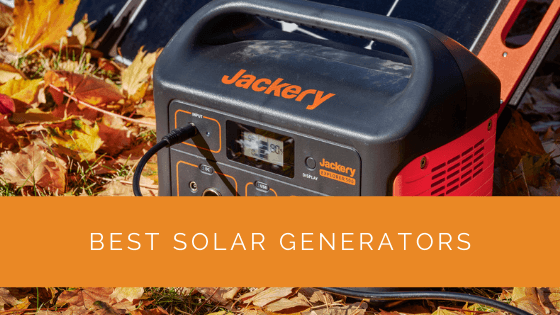
If you’re looking for the best solar generator for UK use, the EcoFlow DELTA 2 is our top pick. With 1024Wh of LiFePO4 capacity, 1800W AC output, and the ability to charge from 0 to 80% in under an hour, it hits the sweet spot between power, portability, and price for everything from camping trips to home backup.
Whether you want a compact unit for weekend adventures, a mid-range station for van life, or a high-capacity system for power cuts and off-grid living, there’s a solar generator on this list to suit you. All eight are available on Amazon.co.uk with delivery to the UK.
Contents
- 1 Our Top Picks
- 2 8 Best Solar Generators
- 2.1 1. EcoFlow DELTA 2 Portable Power Station
- 2.2 2. Jackery Explorer 1000 v2 Portable Power Station
- 2.3 3. Bluetti AC180 Portable Power Station
- 2.4 4. EcoFlow RIVER 2 Pro Portable Power Station
- 2.5 5. EcoFlow DELTA 2 Max Portable Power Station
- 2.6 6. EcoFlow RIVER 2 Portable Power Station
- 2.7 7. Bluetti AC50B Portable Power Station
- 2.8 8. Jackery Explorer 240 v2 Portable Power Station
- 3 Solar Generators Buying Guide
- 4 Case Study: Home Power Backup During a Winter Power Cut
- 5 Expert Insights From Our Solar Panel Installers About Solar Generators
- 6 Frequently Asked Questions
- 6.1 Can a solar generator power a kettle or electric heater?
- 6.2 How long does it take to charge a solar generator from solar panels?
- 6.3 What is the difference between LiFePO4 and lithium-ion in a solar generator?
- 6.4 Can I use a solar generator as a home backup during a power cut?
- 6.5 Do solar generators make noise?
- 6.6 Can I charge a solar generator while using it?
- 6.7 What size solar generator do I need for a week-long camping trip?
- 6.8 Are solar generators allowed on campsites in the UK?
- 7 Summing Up
Our Top Picks
| Image | Name | |
|---|---|---|
| EcoFlow DELTA 2 Portable Power Station | |
| Jackery Explorer 1000 v2 Portable Power Station | |
| Bluetti AC180 Portable Power Station | |
| EcoFlow RIVER 2 Pro Portable Power Station | |
| EcoFlow DELTA 2 Max Portable Power Station | |
| EcoFlow RIVER 2 Portable Power Station | |
| Bluetti AC50B Portable Power Station | |
| Jackery Explorer 240 v2 Portable Power Station |
8 Best Solar Generators
1. EcoFlow DELTA 2 Portable Power Station
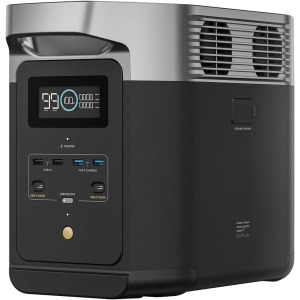
The EcoFlow DELTA 2 earns the top spot on this list because it gets the fundamentals right across the board. The 1024Wh LiFePO4 battery stores enough capacity to run a mini fridge for around 10 hours, charge a laptop 14 times, or keep a CPAP machine going through the night. The 1800W AC output handles most household appliances including kettles, electric blankets, and small heaters, with a 2700W surge capacity for motor-start loads like power tools.
What separates the DELTA 2 from the competition is charging speed. Via AC mains it goes from flat to 80% in just 50 minutes and full in around 80 minutes. That matters in the UK context: when the sun isn’t cooperating, you can top it up from the mains quickly before heading out. Via solar it accepts up to 500W of input, which means a 220W panel on a decent summer day will refill it in around five hours. It also accepts dual charging, solar and mains simultaneously, for even faster top-ups.
Thirteen output ports cover every charging scenario: AC sockets, USB-A, USB-C with 100W PD, a 12V car port, and DC barrel outputs. The EcoFlow app gives you real-time monitoring of input and output over Bluetooth and Wi-Fi. And the LiFePO4 chemistry means 3,000+ charge cycles before the battery degrades to 80% capacity, roughly double what you’d get from a lithium-NMC competitor.
At around £499 it’s not cheap, but given what it delivers across camping, emergency backup, and van life use cases, it’s exceptionally well priced. This is the one we’d recommend to most UK buyers first.
Features
- 1024Wh LiFePO4 battery, expandable to 2kWh with extra battery
- 1800W AC output (2700W surge), 13 output ports
- 100W USB-C PD output
- Charges 0-80% in 50 minutes via AC
- Up to 500W solar input
- 3,000+ cycle lifespan
- EcoFlow app control via Bluetooth and Wi-Fi
- Weight: approximately 12kg
- Fastest AC recharge in its class
- LiFePO4 battery is safer and longer-lasting than NMC
- Thirteen ports handle every device type
- Expandable capacity adds flexibility
- At 12kg it’s not light to carry far
- Solar panels sold separately
2. Jackery Explorer 1000 v2 Portable Power Station
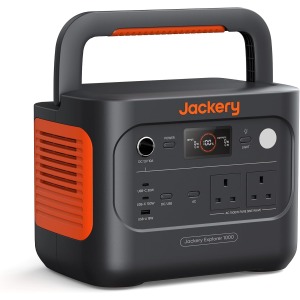
Jackery is arguably the most recognised name in portable power stations, and the Explorer 1000 v2 shows why they’ve built that reputation. The 1070Wh LiFePO4 battery pairs with a 1500W AC output (3000W surge), making it capable of running everything from laptops and drones to power drills and small appliances. The one-hour fast charge from a 70W+ adaptor is genuinely impressive and means you can top it up before a trip without planning a full day ahead.
The 100W USB-C PD port is a notable spec for this class: it can fast charge a MacBook Air or iPad Pro at full speed, which cheaper stations in this capacity range often can’t manage. Six output ports cover AC, USB-A, USB-C, and a 12V car port. The integrated handle is well-designed and the overall build quality feels solid for long-term use.
Where the Jackery differs from EcoFlow is solar flexibility: it accepts up to 800W of solar input, which is higher than the DELTA 2’s 500W. In practice this means it can refill faster from larger panel arrays, which matters if you’re doing extended off-grid trips. The LiFePO4 cells are rated to 4,000 cycles. It’s slightly heavier than the DELTA 2 and typically priced higher, but the longer battery lifespan and higher solar input ceiling make it the better choice for serious off-grid use.
Features
- 1070Wh LiFePO4 battery
- 1500W AC output (3000W surge), 6 output ports
- 100W USB-C PD output
- 1-hour fast charge with 70W+ adaptor
- Up to 800W solar input
- 4,000+ cycle lifespan
- Jackery app control
- Higher solar input ceiling than most rivals
- 4,000 cycle LiFePO4 battery is excellent longevity
- 1-hour fast charge from mains
- Strong brand reputation and UK support
- Typically priced above EcoFlow equivalent
- Fewer output ports than DELTA 2
3. Bluetti AC180 Portable Power Station
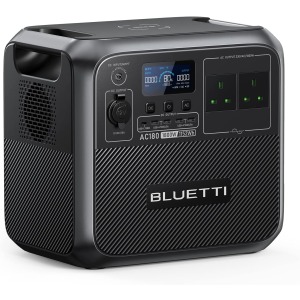
The Bluetti AC180 sits in the same capacity bracket as the EcoFlow DELTA 2 and Jackery Explorer 1000 v2 but undercuts both on price while matching them on output. Its 1152Wh LiFePO4 battery is actually the largest of the three in this tier, and the 1800W AC output (2700W surge) matches the DELTA 2 exactly. The 0-80% in 45 minutes AC charge time is even faster than EcoFlow’s 50 minutes.
The Power Lifting mode is a useful feature: it boosts the effective wattage for devices rated up to 2700W, allowing you to run appliances that would ordinarily exceed the rated output. In practice this expands what you can power without upgrading to a more expensive unit. The 500W solar input ceiling is comparable to EcoFlow. Build quality is solid throughout, and the unit has accumulated a strong track record with UK buyers.
If you’re comparing these three 1kWh-class stations side by side and price is a deciding factor, the AC180 often comes out ahead on value. It’s slightly heavier at around 16kg, and the app experience isn’t quite as polished as EcoFlow’s, but the core specs are genuinely competitive.
Features
- 1152Wh LiFePO4 battery
- 1800W AC output (2700W surge)
- Power Lifting mode: handles appliances up to 2700W
- 0-80% in 45 minutes via AC
- Up to 500W solar input
- Multiple AC, USB-A, USB-C, and DC output ports
- Largest capacity in the 1kWh tier on this list
- Fastest AC charge in class at 45 minutes to 80%
- Power Lifting mode extends appliance compatibility
- Often priced competitively against EcoFlow
- Heavier than EcoFlow DELTA 2 at ~16kg
- App less polished than EcoFlow’s
- Solar panels sold separately
4. EcoFlow RIVER 2 Pro Portable Power Station
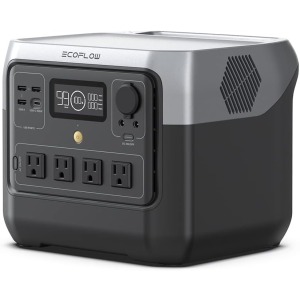
The RIVER 2 Pro slots between the compact RIVER 2 and the full-size DELTA 2, offering 768Wh of capacity in a unit that weighs around 7.8kg. It’s the sweet spot for people who want more capacity than a day-trip unit but don’t want to lug a 12kg station around a campsite. The 800W AC output covers most camping and travel needs, and EcoFlow’s X-Boost technology lets it run appliances up to 1600W by adjusting the output to match device requirements.
Charging via AC takes around 70 minutes to full, and the unit accepts up to 220W of solar input. Four AC outlets and multiple USB ports give you plenty of connections. It’s a sensible step up from basic portable power banks for campers who want to run a small appliance or two rather than just charge phones. At around £349 it offers good value for the capacity.
Features
- 768Wh LiFePO4 battery
- 800W AC output (1600W with X-Boost)
- 4 AC outlets, USB-A, USB-C, 12V car port
- Charges fully in approximately 70 minutes via AC
- Up to 220W solar input
- EcoFlow app control
- Weight: approximately 7.8kg
- Good mid-range capacity without the weight of 1kWh+ units
- X-Boost runs appliances above rated wattage
- Fast 70-minute AC charge
- 800W AC output limits heavy appliance use
- Lower solar input ceiling than larger units
5. EcoFlow DELTA 2 Max Portable Power Station
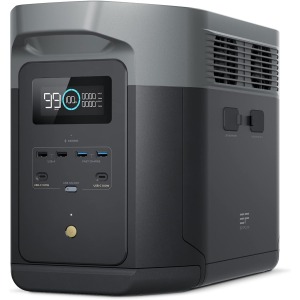
If the standard DELTA 2’s 1024Wh isn’t enough, the DELTA 2 Max doubles the capacity to 2048Wh while keeping the same fundamental design. That’s enough to run a full-size fridge for 24 hours, keep essential medical devices going through an extended power cut, or power a small campervan setup for several days with solar top-up. The 2400W AC output (3400W surge) handles virtually any household appliance short of electric showers and large ovens.
It’s expandable to 6kWh with additional smart batteries, which puts serious home backup within reach. Solar input accepts up to 1000W, meaning a 4-panel portable array on a good UK summer day can refill it entirely. The 0-80% AC charge time is under an hour. At around £999 it’s a significant investment, but for whole-home emergency backup or extended off-grid living, it’s the most capable portable unit you can buy at this price point from a major brand.
Features
- 2048Wh LiFePO4 battery, expandable to 6kWh
- 2400W AC output (3400W surge)
- Up to 1000W solar input
- 0-80% AC charge in under 1 hour
- 15 output ports including 100W USB-C PD
- EcoFlow app with Wi-Fi and Bluetooth
- 3,000+ cycle lifespan
- 2kWh+ capacity for serious home backup
- Expandable to 6kWh with extra batteries
- 1000W solar input for faster off-grid recharging
- Runs virtually any household appliance
- Around £999 is a significant outlay
- Heavy at approximately 23kg
- Overkill for casual camping use
6. EcoFlow RIVER 2 Portable Power Station
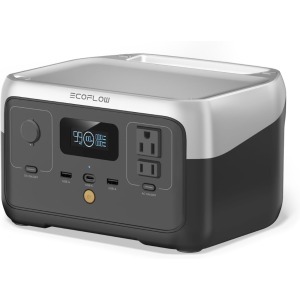
The RIVER 2 is EcoFlow’s entry-level station and, at around £199 and 3.5kg, it’s the most portable option on this list by some margin. The 256Wh LiFePO4 battery gives you enough power to charge a laptop four times, a phone fifteen times, or run a portable fan for eight hours. It’s not designed to run a kettle or power tools: the 600W AC output (1200W with X-Boost) limits it to lighter loads. But for overnight camping, travel, and keeping phones, cameras, and small devices charged, it’s excellent value.
The one-hour AC full charge is remarkable at this price. X-Boost technology means you can run some appliances rated up to 1200W, which extends its practical use beyond what the raw 600W rating suggests. At 3.5kg it fits in a carry-on bag and is genuinely convenient to travel with. If you just need a step up from a phone power bank for outdoor trips, look no further.
Features
- 256Wh LiFePO4 battery
- 600W AC output (1200W with X-Boost)
- 1-hour full AC charge
- 6 output ports: AC, USB-A, USB-C, DC
- Weight: 3.5kg
- EcoFlow app control
- 3,000+ cycle lifespan
- Lightest and most portable on this list at 3.5kg
- 1-hour full charge from mains
- X-Boost extends appliance compatibility
- 256Wh won’t power large appliances for long
- 600W base output limits heavy loads
- Not suitable as a home backup station
7. Bluetti AC50B Portable Power Station
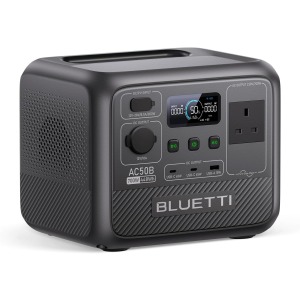
The Bluetti AC50B sits between the RIVER 2 and RIVER 2 Pro in the compact segment, offering 448Wh of capacity in a unit that weighs around 6.5kg. The 700W AC output covers standard camping and travel loads, and Bluetti’s Power Lifting mode pushes effective output to 1000W for appliances that need it. The 65W USB-C PD output is notably generous for a unit in this class, matching what you’d get from a dedicated laptop charger.
It’s a solid compact option for anyone who wants more capacity than the RIVER 2’s 256Wh but doesn’t want the bulk of a 1kWh unit. At around £249 it sits in a competitive price bracket and Bluetti’s build quality is consistently reliable. Not the most exciting unit on this list, but a dependable, well-priced workhorse for camping, travel, and light emergency use.
Features
- 448Wh LiFePO4 battery
- 700W AC output (1000W with Power Lifting)
- 65W USB-C PD output
- Multiple AC, USB, and DC ports
- Weight: approximately 6.5kg
- Solar input compatible
- Good mid-point capacity between compact and full-size units
- 65W USB-C PD is fast for laptop charging
- Power Lifting boosts effective output to 1000W
- 700W base output limits heavier appliance use
- Fewer reviews than EcoFlow equivalents
8. Jackery Explorer 240 v2 Portable Power Station
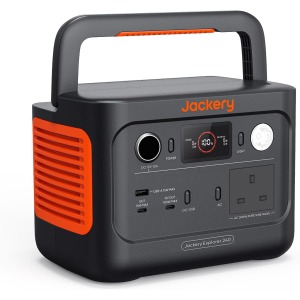
The Explorer 240 v2 is Jackery’s entry point into LiFePO4 portable power. At around £199 and 3.1kg it’s the lightest unit on this list by a fraction, with a 256Wh battery, 300W AC output, and a 100W USB-C PD port. That USB-C spec is excellent at this price point: it means you can fast charge a laptop at full speed from a unit that fits in a day bag.
The 1-hour fast charge from a 70W+ wall adaptor is the headline spec, and it genuinely delivers. For hiking, picnics, beach days, and weekend camping where you’re just topping up phones, cameras, and laptops, it does everything you’d reasonably ask of a unit this size. The LiFePO4 cells are rated to 4,000 cycles, which is exceptional longevity for the price. It’s not suitable for running anything power-hungry: 300W output rules out kettles, microwaves, and heaters. But as a reliable, lightweight companion for outdoor adventures, it’s a very strong buy.
Features
- 256Wh LiFePO4 battery
- 300W AC output, 100W USB-C PD
- 1-hour fast charge with compatible adaptor
- Weight: 3.1kg
- 4,000+ cycle lifespan
- Jackery app compatible
- Lightest unit on this list at 3.1kg
- 100W USB-C PD fast charges laptops
- 4,000 cycle LiFePO4 excellent for the price
- 300W AC limits use to light devices only
- 256Wh not enough for extended trips without solar
Solar Generators Buying Guide
Key Takeaways
- A solar generator is a portable power station, a large internal battery with an inverter built in, plus AC mains sockets and DC/USB outputs. The term “solar generator” is a marketing label. It does not generate power from solar directly. It stores energy in a battery that can be recharged from solar panels.
- Capacity (measured in Wh or kWh) is the primary specification. It determines how much energy is stored and therefore how long the unit can power your devices before recharging.
- LiFePO4 (lithium iron phosphate) battery chemistry is significantly better for long-term ownership than standard lithium-ion. LiFePO4 units deliver 2,000–3,500 charge cycles before degrading to 80% capacity; standard lithium-ion units typically manage 300–500 cycles.
- Output wattage determines what you can plug in. A 300W unit cannot power a microwave. A 2,000W unit can run most household appliances for limited periods. Match the output wattage to your highest-draw intended appliance.
- The solar input specification tells you how quickly you can recharge from panels. A 200Wh unit with a 100W solar input can theoretically recharge in 2–3 hours of UK summer sun, but only if you have a compatible 100W panel.
- For UK use, solar recharging is most effective April to September. In winter, plan on mains recharging as the primary input, with solar as a supplement.
Capacity (Wh): The Number That Matters Most
Watt-hours (Wh) is the measure of stored energy. Divide the device’s wattage into the unit’s Wh capacity to get hours of runtime. A 500Wh unit running a 50W TV gives 10 hours of viewing. The same unit running a 1,000W kettle gives 30 minutes, and that is before accounting for inverter efficiency losses of 5–15%.
| Capacity Tier | Approx. Wh | What You Can Run | Best Suited For |
|---|---|---|---|
| Entry-level | 150–300Wh | Phones (×10–20 charges), laptop (×2–4), LED lights, CPAP one night | Day trips, camping weekends, car boot emergency |
| Mid-range | 500–1,000Wh | Above plus mini fridge (8–12hrs), power tools briefly, TV evening | Week-long camping, van life, garden office backup |
| Large | 1,000–2,000Wh | Above plus fridge overnight, power tools extended, small AC unit briefly | Off-grid cabin, home power backup, extended van life |
| High-capacity | 2,000Wh+ | Full day’s home essential use, medical equipment, EV emergency top-up | Off-grid home backup, construction sites, emergency preparedness |
Output Wattage: What Can You Actually Plug In?
Every solar generator has a continuous output wattage rating and a surge wattage rating. The continuous rating is what the unit can sustain indefinitely. The surge rating is the brief spike it can handle when a motor starts, typically 2x the continuous rating for 1–3 seconds.
- Laptop: 30–100W
- LED TV (32 inch): 30–60W
- Portable mini fridge (AC type): 60–100W
- CPAP (no humidifier): 30–60W
- Variable speed angle grinder: 700–1,400W running, 2,000–4,000W startup spike
- Low-watt travel kettle: 750–1,000W
- Standard 3kW kettle: 3,000W (requires a 3,000W+ unit and drains capacity fast)
Battery Chemistry: LiFePO4 vs Standard Lithium-Ion
| LiFePO4 (LFP) | Standard Lithium-Ion (NMC/NCA) | |
|---|---|---|
| Cycle life | 2,000–3,500 cycles to 80% capacity | 300–500 cycles to 80% capacity |
| Thermal safety | Very stable under normal use | Can overheat under stress or damage |
| Cold performance | Reduced below 0°C but still functional | Poor below 5°C — significant capacity loss |
| Weight | Heavier per Wh | Lighter per Wh |
| 10-year ownership cost | Lower, unit lasts much longer | Higher, may need replacing after 2–3 years of regular use |
Solar Input and Recharging Speed
The solar input specification is the maximum wattage the unit’s charging circuitry can accept. It does not mean the unit comes with a solar panel. To recharge at maximum speed you need a compatible panel that can produce up to the unit’s maximum input wattage. Most quality units use MPPT charging controllers, which optimise the power drawn from the panel under varying light conditions. This is important for UK use where cloud cover means panel output fluctuates constantly throughout the day.
Portability: Handles, Wheels, and Weight
- Camping and hiking: Weight is paramount. Units over 5kg become impractical for carrying any distance. Under 3kg is ideal for hiking.
- Festivals and car boot use: A 10–15kg unit is fine if it has a comfortable carry handle. Trolley wheels become useful above 10kg.
- Van life and off-grid cabin: The unit lives in a fixed position. Weight matters less than capacity, output wattage, and expandability.
Quick Features Summary
- Capacity: 150–300Wh for camping weekends; 500–1,000Wh for van life; 2,000Wh+ for home backup
- Battery chemistry: LiFePO4 for anyone using the unit regularly, it lasts 5–10x longer than standard Li-ion
- Output wattage: Must exceed the continuous draw of your heaviest intended appliance
- Solar input: Check the unit’s max solar input; panels are sold separately
- Weight: Under 5kg for hiking; 10–15kg acceptable for car boot; not a factor for static off-grid use
- UK winter: Solar recharging unreliable October–March; size the battery to hold enough reserve or plan on mains recharging
Case Study: Home Power Backup During a Winter Power Cut
Background
A homeowner in the Scottish Borders experienced three power cuts over one winter, each lasting between four and eight hours. With a young child in the house and an electric-dependent heating system, each outage caused real inconvenience. He wanted a solution that could keep the heating controls, lighting, and essential devices running through a typical outage without spending thousands on a whole-home battery system.
Project Overview
After researching his options, he chose an EcoFlow DELTA 2 as a standalone home backup station, paired with a 220W EcoFlow portable solar panel for weekend recharging and a standard mains cable for weekday top-ups. The goal was to keep the boiler control panel, a few LED lights, his phone, and his laptop running through any outage up to eight hours.
Implementation
He keeps the DELTA 2 fully charged via a timed mains socket, which maintains it near 100% at all times. When a power cut hits, he connects the boiler controller (draws around 100W when active), a small LED desk lamp, and keeps his phone and laptop running from USB. The solar panel provides supplemental charging on weekends when parked in the garden.
Results
In the outages since installation, the DELTA 2 has handled all three without running below 30% capacity. The boiler controls remained powered, keeping the heating system functional. He noted that the combination of fast mains charging and LiFePO4 reliability gave him far more confidence than a petrol generator would have, with none of the storage, maintenance, or noise concerns. At around £499, he considered it money well spent for winter peace of mind.
Expert Insights From Our Solar Panel Installers About Solar Generators
“The most common misconception I see is people buying a solar generator and assuming the solar panel that comes with it will keep it fully charged,” said one of our senior solar panel installers with over 14 years of experience. “In the UK, even in summer, you realistically need to plan for 3-4 hours of productive solar generation on a clear day. A 1kWh station paired with a 200W panel means roughly 5-6 hours of good sunlight to fully recharge. That works for a weekend of camping where you’re partly recharging each day. But for serious home backup, treat the solar as a supplement and keep it charged from mains. The technology is excellent right now, the LiFePO4 batteries in these units are genuinely reliable, but you need realistic expectations about what UK weather delivers.”
Frequently Asked Questions
Can a solar generator power a kettle or electric heater?
A standard 3kW kettle requires 3,000W of continuous output, which rules out all but the largest and most expensive solar generators. A low-watt travel kettle (750–1,000W) is more realistic on a 1,500W or 2,000W unit, though it will drain a 1,000Wh battery in about an hour. Electric heaters (1,000–2,000W) are extremely inefficient to run from battery storage. For heating, a gas or diesel heater is far more practical in an off-grid or camping context.
How long does it take to charge a solar generator from solar panels?
Divide the battery capacity (Wh) by the panel wattage to get the theoretical recharge time in hours. A 500Wh unit with a 100W panel takes around 5–6 hours in direct summer sun, accounting for real-world panel losses. In overcast UK conditions, effective panel output drops to 20–40% of rated wattage, so the same charge could take 15–25 hours of diffuse daylight. Always check the unit’s maximum solar input specification before pairing it with a panel.
What is the difference between LiFePO4 and lithium-ion in a solar generator?
LiFePO4 (lithium iron phosphate) offers around 2,000–3,500 charge cycles before significant capacity loss, compared to 300–500 cycles for standard lithium-ion (NMC/NCA). For a solar generator used daily, LiFePO4 can last 8–10 years versus 1–2 years for standard Li-ion. LiFePO4 is also thermally safer and performs better in cold UK conditions. The price premium over Li-ion units is typically 20–40%, but the total cost of ownership over several years is usually lower.
Can I use a solar generator as a home backup during a power cut?
Yes, though with limitations. A 2,000Wh unit can power LED lights, a fridge, phone chargers, a router and a TV for several hours during an outage. It cannot run a full home’s worth of appliances simultaneously. For serious home backup use, look for units with pure sine wave output (required for sensitive electronics), high continuous wattage (2,000W+), and LiFePO4 chemistry for repeated cycling. Some units also support UPS (uninterruptible power supply) functionality for seamless switchover.
Do solar generators make noise?
No. Solar generators are completely silent in operation. This is one of their key advantages over petrol generators, making them suitable for campsites, glamping, residential gardens and any situation where noise is a concern. The only sound is occasionally a cooling fan activating during heavy discharge or charging. Fan noise on quality units is minimal, equivalent to a quiet computer fan.
Can I charge a solar generator while using it?
Most solar generators support pass-through charging, meaning you can charge the battery and power devices simultaneously. Check the specific product specification, as some budget units restrict pass-through to certain ports or below a maximum load. Running devices while charging from mains hookup is the most common use case on campsites. Running from solar while simultaneously powering devices is also possible, though total available power to your devices will be reduced by however much the solar is producing.
What size solar generator do I need for a week-long camping trip?
For a week of camping with a phone, laptop, LED lights and a small 12V fridge, plan on 500–800Wh of daily consumption. A 1,000Wh unit gives you roughly 1.5 days of full use before needing recharging, which works if you have a 100W+ solar panel to top up during the day. A 2,000Wh unit gives more buffer for cloudy days. If solar recharging cannot be guaranteed, size the battery to hold at least 3–4 days of consumption without any top-up.
Are solar generators allowed on campsites in the UK?
Yes, solar generators are permitted on virtually all UK campsites. Unlike petrol generators, they produce no emissions and no noise, so they are not subject to the generator restrictions that many sites enforce. Mains hook-up charges also do not apply. Some premium glamping sites may have rules about external equipment, but silent battery-based power stations are universally acceptable. Always check the individual site’s rules if you are unsure.
Summing Up
The EcoFlow DELTA 2 is our overall recommendation: the combination of 1024Wh capacity, 1800W output, rapid AC charging, and app control makes it the most capable all-rounder for the price. For a larger capacity, the EcoFlow DELTA 2 Max is the premium choice with genuine home backup credentials. Want the lightest possible unit for hiking and travel? The Jackery Explorer 240 v2 at 3.1kg and EcoFlow RIVER 2 at 3.5kg are both excellent compact options. And if you want a strong alternative to EcoFlow at a competitive price, the Bluetti AC180 delivers 1152Wh and 1800W output that matches anything at its price point.
Updated