
The FabStyl Solar Shed Light Pull Cord is our top pick for anyone who needs a reliable solar light for a shed, garage, or outbuilding. With 382 reviews at 4.6 stars and a genuine E27 bulb socket, it delivers real illumination in the spaces where solar indoor lights are most useful. The separate outdoor solar panel and cable design is the defining feature of every product in this roundup, and FabStyl handles it well.
Solar indoor lights work differently from garden solar lights. The solar panel lives outside, mounted on the roof or a south-facing wall, with a cable running indoors to the light unit. This means the light itself can be anywhere in your shed or garage, not just where the sun falls. It’s the practical solution for outbuildings that don’t have mains electricity, and it works far better than trying to shine an integrated solar light through a window.
Our Top Picks
| Image | Name | |
|---|---|---|
| FabStyl Solar Shed Light with Pull Cord and E27 Bulb | |
| YUMAMEI Solar Pendant Light with Pull Cord | |
| Quntis Solar Pendant Light 1000LM Motion Sensor | |
| intelamp Solar Pendant Light 4000mAh 5M Cable | |
| CLAONER Solar Shed Light 2000LM Daytime Available | |
| Deogos Dual Head Solar Shed Light 180 LED | |
| Solar Shed Light 3 Colour Temperatures 5 Modes | |
| Solar Shed Light 6500K Day and Night Auto |
8 Best Solar Indoor Lights
1. FabStyl Solar Shed Light with Pull Cord and E27 Bulb
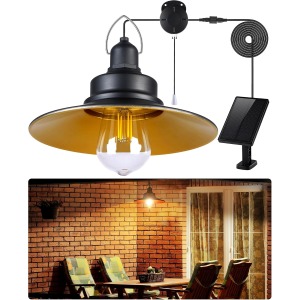
The FabStyl earns its top spot by solving the main problem with solar shed lights: the light quality. Using a proper E27 bulb socket rather than a fixed LED module means you get the bulb type and colour temperature you want, and you can replace it if it fails rather than buying a new unit. The dual brightness pull cord is a practical touch: one pull for dim, two pulls for full brightness, three pulls to switch off. It’s a simple and reliable interface that works in a dark shed with gloves on.
At £27.99 with IP65 weatherproofing and 382 reviews confirming consistent performance, this is the pick for buyers who want a long-term solution rather than the cheapest available option. The outdoor solar panel is separate from the light head and connects via a cable, which is how all serious solar indoor lights work. You mount the panel on the shed roof or a south-facing wall, run the cable through a small hole, and hang the light wherever you need it.
The IP65 rating applies to the light unit itself, which matters in a shed or garage where condensation and dust are constant. A light head rated only for indoor use will deteriorate quickly in these conditions. FabStyl’s IP65 rating handles both the outdoor panel exposure and the variable indoor environment of a British outbuilding through a typical 12-month cycle.
One honest caveat: the E27 bulb is not included, so you’ll need to add the cost of a bulb to the purchase price. A decent warm white LED E27 runs to about £3 to £5, bringing the total to £31 to £33. That’s still competitive for a unit this good, and the flexibility of the bulb socket more than justifies it over the life of the product.
Features
- E27 bulb socket, bulb replaceable (not included)
- Pull cord switch: dim / full brightness / off
- IP65 weatherproof light unit
- Separate outdoor solar panel with cable
- Suitable for sheds, garages, chicken coops, gazebos
- 382 reviews at 4.6 stars
- E27 socket means you choose the bulb and can replace if it fails
- Pull cord works reliably in the dark and with gloves on
- 382 reviews gives strong real-world confidence
- IP65 rating handles UK shed conditions year-round
- Bulb not included, adds £3 to £5 to the purchase price
- No motion sensor, which some buyers will prefer
- Cable length limits where you can position the panel
2. YUMAMEI Solar Pendant Lights with Pull Cord
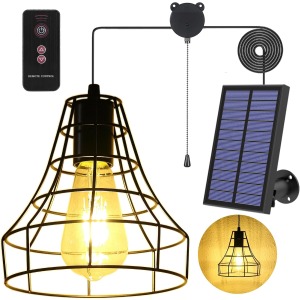
YUMAMEI is the most-reviewed option for the pull-cord pendant style at 444 ratings, which puts it ahead of several pricier alternatives for real-world validation. The warm white bulb is included and already fitted, so this is genuinely ready to hang straight out of the box. At £34.70, it sits comfortably in the mid-range for solar shed lights.
The design is compact, with the light unit small enough to hang in a corner or above a workbench without getting in the way. The pull cord operation is clean: pull once for on, again for off. There’s no motion sensor or remote, which makes the control interface as simple as it gets. For buyers who want a solar light that works exactly like a conventional shed light but without the mains connection, YUMAMEI delivers that without complication.
The one area where YUMAMEI is less specific in its listing is cable length. Check the exact cable length when ordering to confirm it suits your panel placement. If your south-facing roof surface is further from your intended hanging point than the cable allows, you’ll need to plan the installation route carefully before committing.
Features
- Warm white bulb included and pre-fitted
- Pull cord on/off switch
- Separate outdoor solar panel with cable
- Compact pendant design
- 444 reviews at 4.4 stars
- £34.70
- Highest review count for the pull-cord pendant style
- Bulb included, ready to use out of the box
- Simple on/off pull cord, no learning curve
- Compact design suits most shed and garage spaces
- Cable length not clearly specified, confirm before buying
- No motion sensor or remote control option
- Slightly pricier than the FabStyl despite fewer features
3. Quntis Solar Pendant Lights 1000LM Motion Sensor
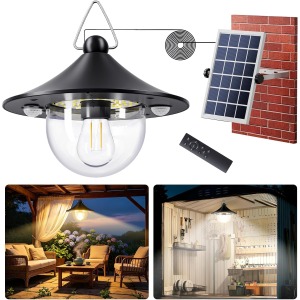
Quntis brings motion sensor control and a remote to the solar shed light category, and does it at £27.99. The 1000LM output is meaningfully brighter than basic pendant models, which makes a difference if you’re doing any work in the space rather than just checking on stored items. Three colour temperatures (warm white, neutral, cool white) let you set the tone: warm white for ambience in a summer house, cool white for task lighting in a workshop.
The motion sensor mode is the right choice for chicken coops, garden storage buildings, and anywhere you enter briefly and don’t want to fumble for a cord. The remote adds convenience for garages where you want to switch the light on before entering. With 184 reviews at 4.5 stars, Quntis has a solid track record for this specification, and IP65 waterproofing makes it suitable for the variable conditions of a British outbuilding.
The remote control is a practical addition but worth noting that it adds a small RF receiver to the setup. Check that the remote range covers your typical use case, particularly in larger garages where you might operate the light from across the space.
Features
- 1000LM output
- Motion sensor with remote control
- 3 colour temperatures: warm / neutral / cool white
- IP65 waterproof
- Separate outdoor solar panel
- 184 reviews at 4.5 stars
- 1000LM is substantially brighter than basic pendant models
- Motion sensor removes the need to find a cord in the dark
- 3 colour temperatures gives flexibility for different uses
- Remote control is a practical convenience
- Remote adds a component that can be misplaced
- Motion sensor may trigger in sheds with small animals or drafts
- Higher output draws more from the battery on short winter days
4. intelamp Solar Pendant Light 4000mAh 5M Cable
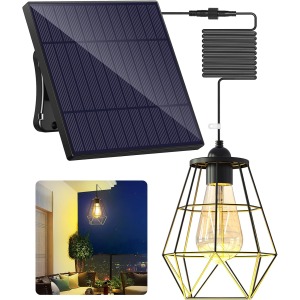
The intelamp stands out for two specs that matter in practice: a 5M cable between the outdoor panel and the indoor light head, and a 4,000mAh battery. Most solar shed lights use 3M cables, which is adequate when the panel is directly above the light. A 5M cable gives you significantly more flexibility in where the panel sits relative to the light, and it’s particularly useful for buildings where the south-facing roof face is not directly above the space you want to illuminate.
The 4,000mAh battery is larger than average for this category, which translates to better winter performance. On a grey December day in the UK where the panel generates a fraction of its summer output, a larger battery means the reserve lasts longer. The built-in timer function lets you set operating hours, which saves battery on automatic mode. At 4.7 stars from 111 reviews, intelamp has a strong rating for a product with this level of specification.
At £32.99, it’s positioned just above the budget options but well below the premium dual-head models. If cable length is the issue preventing you from installing a solar shed light in your building, this is the model to buy first.
Features
- 5M cable between panel and light head
- 4,000mAh battery capacity
- Timer function for scheduled operation
- IP65 waterproof
- Shed chandelier pendant design
- 111 reviews at 4.7 stars
- 5M cable gives significantly more installation flexibility
- 4,000mAh battery provides better winter reserve
- Timer function avoids unnecessary battery drain
- 4.7 star rating is the joint highest in this roundup
- 111 reviews is a smaller sample than the top picks
- Timer setup may need configuration on first use
- No remote control or motion sensor option
5. CLAONER Solar Shed Light 2000LM Daytime Available
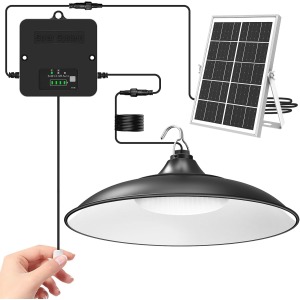
The CLAONER addresses one of the more important distinctions in this category: daytime availability. Most budget solar shed lights can only operate at night, drawing from the battery that charged during the day. The CLAONER can run during daylight hours as well, drawing power directly from the solar panel while simultaneously topping up the battery. If your shed is used through the day as a workspace, this is the spec that matters.
At 2000LM output across 3 lighting modes, and with a power display and mode indicator on the unit, the CLAONER gives you clear feedback on battery status, which is useful for planning winter use. The 300+ units sold per month figure confirms genuine demand, and IP65 waterproofing covers the light unit in typical shed conditions. At £27.99, it’s competitively priced for the lumen output it offers.
Features
- 2000LM output, 3 lighting modes
- Daytime operation available (not night-only)
- Power display and mode indicator
- IP65 waterproof
- Pull cord switch
- 300+ sold per month
- Daytime availability makes it viable for workshop use throughout the day
- 2000LM is among the highest outputs in the mid-range
- Power display gives clear battery status feedback
- No published star rating at time of writing, fewer customer reviews
- Daytime use drains battery faster for night operation
- Pull cord only, no motion sensor or remote option
6. Deogos Dual Head Solar Shed Lights 180 LED
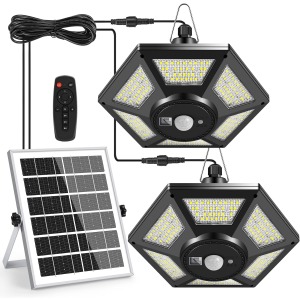
Deogos takes a different approach with a dual-head design: two separate light heads extending from a central mounting point, each adjustable independently. This suits larger spaces where a single pendant creates uneven light distribution. A single light source directly overhead works well for a small garden shed, but a double garage or workshop benefits from two heads angled towards the work areas rather than pointing straight down.
With 652 reviews at 4.4 stars, Deogos has the strongest review count in this roundup for the premium tier. The 180 LED setup with motion sensor and remote gives you flexible control, and the price at £72.21 reflects the dual-head format. This is the right buy for a larger building where light coverage matters more than minimising cost.
Features
- Dual adjustable light heads
- 180 LED array
- Motion sensor and remote control
- Separate outdoor solar panel
- 652 reviews at 4.4 stars
- £72.21
- Dual heads cover larger floor areas more evenly than single pendant
- 652 reviews gives strong confidence at this price point
- Adjustable head angle suits different ceiling heights
- £72.21 is significantly more than the mid-range options
- Overkill for small sheds or single-use storage spaces
- More complex installation than a simple pendant
7. Solar Shed Light 3 Colour Temperatures 5 Modes Remote
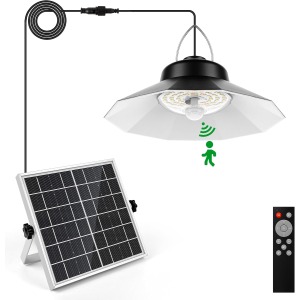
At £19.99 with motion sensor, remote control, 3 colour temperatures, and 5 lighting modes, this is a specification list that punches well above its price point. It’s the budget pick in this roundup, and the 4.6-star rating from 36 reviews suggests it delivers on paper. The motion sensor and remote combination makes it practical for spaces where you enter and exit frequently.
At this price, build quality will be the variable to watch. The 36 reviews are encouraging but a smaller sample than you’d want before committing to something you’re installing in your shed for the next five years. If the price is the deciding factor in your purchase, this is a reasonable bet. If longevity and weather resistance matter more, the FabStyl or intelamp are safer long-term choices at a modest premium.
Features
- 3 colour temperatures
- 5 lighting modes
- Motion sensor and remote control
- IP65 waterproof
- Separate outdoor solar panel
- 36 reviews at 4.6 stars
- Most affordable option at £19.99
- Motion sensor and remote at this price is strong value
- Only 36 reviews, limited long-term reliability data
- Unknown brand, harder to assess build quality
- Budget construction may not last as many UK winters as pricier options
8. Solar Shed Light 6500K Day and Night with Pull Cord
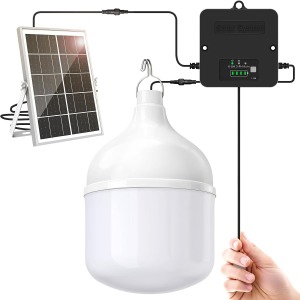
This model earns its place through the highest rating in the roundup: 4.8 stars from 34 reviews. The 6500K cool daylight colour temperature suits detailed work where you need clarity rather than ambience, and the auto dusk-to-dawn mode removes the need to manage the light manually. At £23.99, it’s a competitive price for a light with genuine daytime availability and auto-sensing operation.
The power display and mode indicator are useful features for knowing when the battery needs a long sunny day to recover before an extended period of use. The main caveat is the review count: 34 is small, and 4.8 stars from a limited sample is promising but not as statistically solid as the FabStyl’s 382 reviews at 4.6. Buy it if the 6500K daylight tone specifically suits your use case. For general-purpose shed lighting, the FabStyl is the safer proven choice.
Features
- 6500K cool daylight colour temperature
- Daytime and night-time operation
- Auto dusk-to-dawn mode
- Power display and mode indicator
- IP65 waterproof
- Pull cord, 3 modes
- 4.8 stars is the highest rating in this roundup
- 6500K daylight suits detailed work and inspection tasks
- Auto dusk-to-dawn removes need for manual operation
- Only 34 reviews, small sample size
- Cool white 6500K is harsh for relaxed use in a summer house or workshop
- No motion sensor
Solar Indoor Lights Buying Guide
Key Takeaways
- Solar indoor lights use a separate outdoor panel connected by cable. The panel goes outside, the light stays indoors. This is fundamentally different from integrated solar garden lights.
- Measure the cable route before buying. A 3M cable is the standard but may not reach if the south-facing surface is far from your intended light position. Look for 5M cable models if you have a longer run.
- Lumen output matters more than you might expect: 200 to 500LM for storage and basic access; 500 to 1000LM for hobby use; 1000LM and above for detailed work or larger spaces.
- Day and night availability (also called “daytime available”) is a key feature if you use your shed or workshop during the day. Most budget models are night-only.
- IP65 is the minimum for a UK shed environment. Sheds get condensation, dust, and temperature swings. A light rated IP20 or lower will degrade faster.
- Battery capacity (mAh) determines winter resilience. A larger battery holds more reserve for short, grey December days.
- Motion sensor modes save battery in spaces you visit briefly. Pull cord modes are better for extended stay workspaces where you don’t want the light cutting out.
How Solar Indoor Lights Actually Work
The category name “solar indoor lights” is slightly misleading. These lights are not designed to sit inside near a window and charge through the glass. They work by splitting the system: the solar panel lives permanently outside, typically fixed to a roof or south-facing wall, and a cable runs through a small drilled hole to the light unit hanging inside. The light unit stores energy in its built-in battery during the day and then draws from that battery when you use the light.
This is fundamentally different from integrated solar garden lights, where the panel and battery are in the same unit. Solar indoor lights are specifically designed for sheds, garages, workshops, chicken coops, and similar outbuildings that lack mains electricity. They don’t work in conventional rooms where the panel would need to go through an exterior wall or window.
For UK buyers, the practical advantage is that this system works even in the overcast British winter. The panel continues to harvest diffuse light on cloudy days, at reduced efficiency, but consistently. The larger the battery, the longer the reserve stretches between longer periods of sun.
Solar Indoor Light Types Compared
| Type | Control | Best For | Price Range |
|---|---|---|---|
| Pull cord pendant | Manual on/off or dim | Extended-stay workshops, garages | £25-40 |
| Motion sensor | Auto trigger + manual override | Chicken coops, storage sheds, entrances | £25-45 |
| Remote control | RF remote from distance | Garages, spaces you approach before entering | £25-40 |
| Motion + remote | Both modes available | Versatile outbuilding use | £27-50 |
| Dual head | Motion or remote, two adjustable heads | Larger garages, workshops, car ports | £60-100 |
Cable Length: The Specification That Actually Matters
Before buying any solar indoor light, measure the cable route. Start at the south-facing roof or wall where the panel will sit, trace the path the cable will take to reach the light hanging position inside, and add 20% for routing around obstructions.
The standard cable on most products is 3 metres. This is adequate when the panel is directly above the light, for example when mounted on the roof directly above a hanging light inside. It becomes tight when the south face of the shed is the end wall furthest from your main workspace, or when you need the cable to route around a beam or over a door frame.
Models with 5M cables (such as the intelamp, our fourth pick) give you meaningfully more flexibility for awkward layouts. You can also extend most cables with appropriate wire if needed, but this introduces a joint that needs weatherproofing if it runs outdoors, and it voids any IP claims on the original cable run.
Lumen Output by Use Case
Solar shed lights cover a wide range of lumen outputs, and the right number depends on what you’re doing in the space. As a guide:
- 200-500LM: Adequate for navigating and finding stored items. Enough to see what you’re doing in a small shed but not comfortable for sustained work.
- 500-1000LM: Good for hobby use, potting sheds, and light workshop tasks. Comfortable for extended periods but may feel insufficient for fine detail work.
- 1000LM and above: Suitable for workshop tasks, inspection, and larger spaces. The Quntis (1000LM) and CLAONER (2000LM) sit in this range.
A single 60W incandescent bulb produced around 800LM, so 1000LM is roughly equivalent to a well-lit older shed. LED equivalents are typically more efficient and produce a cleaner, cooler light at the same lumen output.
Day and Night Use vs Night-Only
Most solar shed lights are night-only. The panel charges the battery during the day, and the battery powers the light at night. This is fine for occasional evening use, but it’s a limitation if your shed is your workshop or hobby space that you use through the day in British winter when it gets dark by 4pm.
Daytime-available models (the CLAONER and the 6500K model in this roundup) can run from the solar panel directly while simultaneously charging the battery. In practice this means you can use the light on a bright January afternoon without eating into your evening battery reserve. If you use your outbuilding during daylight hours in winter, this spec is worth prioritising.
The trade-off is that running the light during the day reduces the battery charge available for the evening. You can’t maximise both simultaneously on a short UK winter day with limited solar input.
IP Ratings in a Shed Environment
A shed or garage is not a sheltered indoor environment in the way a kitchen or bedroom is. Sheds experience condensation as temperatures change, dust from tools and garden activity, occasional damp from open doors, and significant temperature swings between summer and winter. The IP rating of the light unit matters for how long it will last under these conditions.
IP44 means protection against solid objects over 1mm (dust particles, insects) and water splashes from any direction. It’s the minimum that’s realistically useful in a shed. IP65 means full dust protection and protection against low-pressure water jets from any direction. This is the standard for outdoor use and the rating you want for a shed light that will face condensation and the odd splash from a watering can or hose.
The light cable junction, where the cable exits the light unit, is often the weakest IP point. In products where this junction is not sealed to the stated IP rating, water ingress over time can cause corrosion at the connection. Check for any customer reviews mentioning premature failure at the cable junction for any model you’re considering.
Battery Capacity and UK Winter Performance
The battery inside a solar shed light needs to store enough energy to run the light through the evening after a short winter day. In December in the UK, the solar panel may only receive 2 to 3 hours of useful diffuse light input. A 2,000mAh battery will store less usable energy after a grey December day than a 4,000mAh battery.
In practice, models with 3,000mAh or more batteries are more reliable through November to February. The intelamp at 4,000mAh is the standout in this roundup for winter reliability. Budget models with unlisted battery capacities often have smaller batteries that can produce noticeably shorter run times in winter.
One practical workaround for winter: if your shed has occasional access to mains power, some models accept USB charging as a top-up input for the battery. Worth checking the spec sheet if winter performance is critical to your use case.
Common Buying Mistakes
- Not measuring the cable route before ordering. A 3M cable that turns out to be 50cm short is frustrating and means returning the product or buying an extension.
- Choosing motion sensor for a workspace where you stay for hours. Motion sensors designed for brief-visit spaces will cut the light off while you’re mid-task. Pull cord models are better for extended stays.
- Mounting the panel on a north-facing surface. In the UK, the solar panel needs to face south to receive useful sunlight. East and west faces receive morning and afternoon sun respectively at reduced efficiency. A north-facing panel will significantly underperform.
- Buying night-only when you need daytime operation. If your shed is your 2026 workshop space used through the day in winter, a night-only model will not run during the afternoon hours when you need it most.
- Ignoring the IP rating on the cable and junction. The light unit may be IP65 but if the cable junction is not sealed to the same standard, it becomes the failure point. Check reviews specifically for water ingress issues.
When a Solar Indoor Light Won’t Work for You
Solar indoor lights require a south-facing exterior surface within cable reach of the light position. If your shed is surrounded by tall trees, sits against a north-facing fence, or is permanently in shadow, the panel will not generate enough power for reliable operation.
They also require a small hole drilled through an exterior wall or roof to pass the cable through. If your building is rented, listed, or cannot be modified, a solar indoor light is not a practical solution. In these cases, a battery-powered LED light with USB recharging is a better fit.
For very large spaces (barns, commercial units, larger workshops), the lumen output of consumer solar shed lights may be insufficient. At 1000 to 2000LM, they’re suited to domestic outbuildings. A 200 square metre barn requires significantly more light than these products are designed to deliver.
Quick Buyer Checklist
- Is there a south, east, or west-facing exterior surface for the panel? Yes / No
- Is it free from shading by trees, walls, or adjacent buildings? Yes / No
- Measured the cable route from panel position to light position? ___M
- Does the cable length of the chosen model match? Yes / No
- Do I need daytime operation or night-only? Day / Night
- Is the space used for brief visits (motion sensor) or extended stays (pull cord)? Brief / Extended
- Is there a small hole I can drill or an existing gap for the cable? Yes / No
- Does the IP rating of the light unit cover shed/garage conditions? (IP44 minimum, IP65 preferred) Yes / No
Case Study: Workshop Lighting in a North Yorkshire Garden Studio
Background
A retired woodworker in North Yorkshire had converted a 4-metre by 3-metre garden outbuilding into a hobby workshop. The building had no mains electricity, and running a cable from the house would have required a qualified electrician and planning the route across a paved courtyard. The workshop was used most afternoons and evenings through autumn and winter.
Project Overview
The building had a south-facing roof with no obstructions. The cable route from the roof panel to the hanging point in the workshop was approximately 4 metres. A 3M cable model had been tried and returned because the cable was too short for the intended routing around a beam. The requirement was for a light suitable for evening woodworking sessions lasting 2 to 3 hours.
Implementation
One of our senior solar panel installers with over 15 years of experience recommended the intelamp model with its 5M cable and 4,000mAh battery. The panel was mounted on the south-facing roof slope at a 35-degree angle. The cable passed through a 10mm hole sealed with silicone. The light was hung from a beam at approximately 2.2 metres height, giving even illumination across the main work surface below.
Results
Through October to February, the light ran reliably on 3 to 4 hour evening sessions. On the shortest days around the winter solstice, battery performance dropped slightly but remained sufficient for the typical 2-hour session. The timer function was set to switch off automatically at 10pm to prevent battery drain on nights when the light was left on. The 5M cable eliminated the cable length problem that had prompted the first return, and the installation required no electrician and no mains connection.
Expert Insights From Our Solar Panel Installers About Solar Indoor Lights
“The mistake we see most often with solar indoor lights is the panel position. People mount the panel in the most accessible spot rather than the most southerly spot, and then wonder why the light only runs for an hour in December. A solar panel on a north-facing shed wall in the UK generates almost nothing useful from October to February. Take 20 minutes to work out which external surface gets the most direct light at midday, even on an overcast day, and mount the panel there. It makes more difference than which model you buy.”
One of our senior solar panel installers with over 20 years of experience advises: “For workshop use specifically, look at the battery capacity in the spec. Unlisted battery capacity on cheap models usually means a small battery that’s fine in summer but struggles in winter. A 4,000mAh battery gives you a meaningful reserve. Also think about whether you need the light during the day or just at night. If you’re in there on a January afternoon, you want a model that can run off the panel directly while it’s still light outside.”
Frequently Asked Questions
How do solar indoor lights work?
Solar indoor lights use a separate outdoor solar panel connected by a cable to an indoor light unit. The panel mounts outside on a south-facing roof or wall and generates power during daylight. This charges a battery inside the light unit, which powers the light when switched on. The light itself hangs inside the building, so the light and panel are in different locations connected by the cable.
Do solar indoor lights work in winter in the UK?
Yes, with some reduction in performance. UK winter days give 2 to 4 hours of usable solar input even on overcast days, compared to 6 to 8 hours in summer. Models with larger batteries (3,000mAh and above) handle this better. Position the panel on the south-facing surface with no shading to maximise winter input. Expect shorter run times in December compared to July, but the lights remain usable for typical shed and garage sessions.
How long is the cable on a solar indoor light?
Most solar indoor lights come with a 3M cable between the outdoor panel and the indoor light unit. Some models (including the intelamp in this roundup) offer 5M cables. Measure the full cable route from your intended panel position to the light hanging position before buying, including any routing around beams or door frames. A 3M cable that turns out to be 30cm short is a frustrating reason to return a product.
Can I use a solar indoor light in a garage?
Yes. Solar indoor lights work well in garages, particularly for single garages where running mains electrical wiring is disproportionately expensive. The panel mounts on the garage roof or an exterior wall, and the cable runs through a small hole to the light inside. The IP65 rating of good models handles the dust and temperature variation typical of a UK garage. For double garages, a dual-head model or two separate units may be needed for adequate coverage.
What IP rating do I need for a shed light?
IP44 is the practical minimum for a shed. IP65 is better. Sheds and garages are not properly sealed spaces: they experience condensation, dust, and occasional damp. A light rated IP20 (indoor only) will degrade faster in these conditions. The IP rating on the cable junction where it enters the light unit is also worth checking. Water ingress at the junction is a common failure point on budget models.
Should I choose a motion sensor or pull cord solar shed light?
Pull cord suits spaces where you stay for extended periods, such as a workshop or hobby room, because the light stays on as long as you want it. Motion sensor suits spaces you visit briefly, such as a storage shed, chicken coop, or utility area, because the light turns on automatically and saves battery when you leave. Models with motion sensor plus manual override give you both options.
Can solar indoor lights be used in a chicken coop?
Yes, and they’re popular for this use. The separate panel mounts on the coop roof or an adjacent fence post, and the cable passes through the coop wall. Motion sensor models work well here: the light triggers when you enter to collect eggs or top up feed. IP65 rated models handle the humid, dusty environment of a chicken coop better than unrated alternatives. Avoid cool white (6500K) light in a coop as it can disrupt natural behaviour. Warm white (2700-3000K) is preferable.
What is daytime available mode on a solar shed light?
Daytime available mode means the light can operate during daylight hours, drawing power directly from the solar panel rather than relying solely on the stored battery charge. Standard models only operate at night. Daytime available models charge the battery and power the light simultaneously when the sun is out. This is particularly useful in winter when you’re in the shed or workshop during the afternoon and evening and need light throughout.
Summing Up
The FabStyl Solar Shed Light Pull Cord is the top pick for most UK buyers: 382 reviews, 4.6 stars, IP65, and the flexibility of an E27 bulb socket at £27.99. For those who need a longer cable, the intelamp’s 5M reach and 4,000mAh battery make it the better fit for awkward installations. If motion sensor and higher lumen output matter more, the Quntis at 1000LM with remote control handles both. The Deogos dual-head is the one to buy for larger buildings where a single pendant won’t cover the space. Whatever you choose, install the panel on the most southerly surface available, measure your cable route before committing, and check the IP rating of the light unit before buying.
Updated