
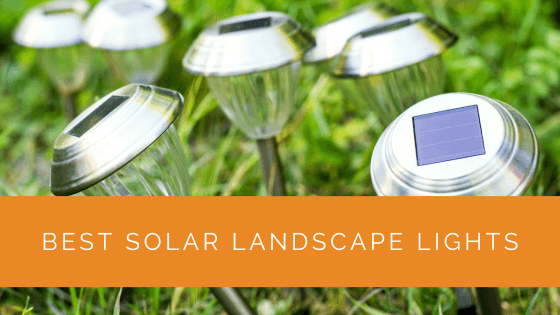
The LOTMOS 3Pcs Solar Spot Lights are the best solar landscape lights for most UK gardens in 2026, offering IP67 waterproofing, a 1500mAh battery, and three brightness modes at under £22 for a pack of three. They’re the most-reviewed solar landscape spotlight in the UK for good reason.
Solar landscape lights have improved enormously in recent years. Modern units use high-capacity lithium batteries, monocrystalline solar panels, and intelligent sensors that adapt to seasonal daylight variation, giving reliable garden illumination through the British winter as well as summer. This guide reviews the seven best options available on Amazon.co.uk, with honest assessments of performance, build quality, and value for UK buyers.
Contents
- 1 Our Top Picks
- 2 7 Best Solar Landscape Lights for UK Gardens
- 2.1 1. LOTMOS 3Pcs Solar Spot Lights Outdoor Garden
- 2.2 2. ECOWHO Solar Landscape Spotlights with Remote Control
- 2.3 3. Flaow 65 LED Solar Garden Spotlights (2 Pack)
- 2.4 4. Bowfar 4 Pack Solar Ground Disk Lights
- 2.5 5. Solar Pathway Lights 12-Pack with Side Lights
- 2.6 6. btfarm 4 Pack Solar Uplighters 72 LED
- 2.7 7. Linkind Smart Solar Spotlights, App Controlled Colour Changing
- 3 Solar Landscape Lights Buying Guide
- 3.1 Key Takeaways
- 3.2 Landscape Lighting Design Principles and Layering
- 3.3 Landscape Light Types and Their Garden Functions
- 3.4 Brightness, Colour Temperature, and Mood Creation
- 3.5 Battery Capacity and UK Winter Reliability
- 3.6 Material Quality, UV Stability, and Corrosion Resistance
- 3.7 Waterproofing, Frost Tolerance, and Seasonal Durability
- 3.8 Clustering, Spacing, and Visual Impact Strategies
- 3.9 Seasonal Positioning and Winter Shade Management
- 3.10 Summing Up Solar Landscape Lights
- 4 Case Study: A Homeowner in Kent Transforms Their Evening Garden
- 5 Expert Insights From Our Solar Panel Installers About Solar Landscape Lights
- 6 Frequently Asked Questions
- 6.1 What are the best solar landscape lights for UK gardens?
- 6.2 Do solar landscape lights work in winter in the UK?
- 6.3 What is the difference between solar spotlights and solar ground lights?
- 6.4 How long do solar landscape lights last per charge?
- 6.5 Can solar landscape lights be used in shaded gardens?
- 6.6 What IP rating do I need for solar garden lights?
- 6.7 How many solar landscape lights do I need for a garden path?
- 6.8 Are solar landscape lights worth it?
- 7 Summing Up
Our Top Picks
| Image | Name | |
|---|---|---|
| LOTMOS 3Pcs Solar Spot Lights Outdoor Garden | |
| ECOWHO Solar Landscape Spotlights with Remote Control | |
| Flaow 65 LED Solar Spotlights (2 Pack) | |
| Bowfar Solar Ground Disk Lights (4 Pack) | |
| Solar Pathway Lights Outdoor 12 Pack | |
| btfarm 4 Pack Solar Uplighters 72 LED | |
| Linkind Smart Solar Spotlights (App Controlled) |
7 Best Solar Landscape Lights for UK Gardens
1. LOTMOS 3Pcs Solar Spot Lights Outdoor Garden
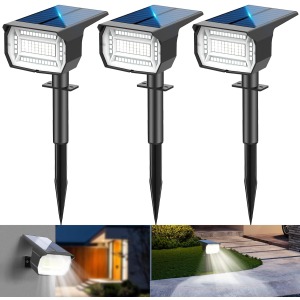
The LOTMOS 3Pcs Solar Spot Lights earn their place at the top of this list by delivering more for less. At under £22 for a pack of three, you’re getting 72 LEDs per unit with an IP67 waterproof rating, a level above the IP65 you’ll find on most rivals. That matters in a British garden where the lights will face rain, frost, and the full range of UK weather.
The built-in 1500mAh battery is the largest in this category at this price point, powering the lights for up to 30 hours on low mode or 8 hours at full brightness. Three modes give you flexibility: low for all-night garden ambiance, medium for practical path lighting, or high for security-grade illumination of driveways and entrances. The automatic dusk-to-dawn sensor handles the rest.
Installation is genuinely simple. The 2-in-1 design gives you the choice of ground spike (for lawns, borders, and flower beds) or wall/fence mount (using the included screws). Both options come in the box. The head adjusts to point where you need the light, uplifting a shrub, highlighting a garden feature, or washing a fence panel with light.
With 2,779 reviews averaging 4.5 stars, this is the most reviewed solar landscape spotlight in the UK for good reason. It’s the pick for most gardens.
Features
- 72 LED beads per unit, 3 in the pack
- 3 brightness modes: 30h / 16h / 8h run times
- IP67 waterproof (above standard for the category)
- 1500mAh high-capacity battery
- 2-in-1 stake and wall mount included
- Dusk-to-dawn auto sensor
- Best value 3-pack at this LED count and IP67 rating
- 1500mAh battery gives the longest run time in the budget bracket
- IP67 exceeds IP65 competitors for rain and frost resistance
- 2,700+ UK reviews, genuinely proven track record
- Polycrystalline solar panel, slightly less efficient than monocrystalline in cloudy conditions
- No remote control or app, modes changed manually
2. ECOWHO Solar Landscape Spotlights with Remote Control
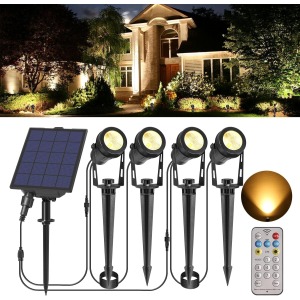
If you want more control over your garden lighting without running mains cable, ECOWHO’s remote-controlled solar spotlights are the step up to consider. The included remote gives you access to 8 lighting modes, 4-level brightness adjustment, and a power display that shows remaining battery, a genuinely useful feature on cloudy weeks when you’re wondering how much charge is left.
The monocrystalline solar panel is a meaningful spec upgrade over the polycrystalline panels in cheaper units. Monocrystalline cells extract more energy from diffuse UK daylight, the difference shows most on the overcast winter days when you most need the lights to perform. A Type-C backup charging port is a sensible safety net for the cloudiest weeks of the year.
A 9.5-metre cable between the solar panel and the lamp body gives you real installation flexibility, you can position the panel in the sunniest spot in the garden while the spotlight illuminates wherever the light is needed, across a wider radius than most integrated-panel designs allow. The 270-degree adjustable head adds to that flexibility.
At £39.99, you’re paying roughly twice the price of the LOTMOS, but you’re getting remote control, monocrystalline efficiency, USB backup charging, and that long cable separation. For feature-conscious buyers, the premium is justified.
Features
- Monocrystalline solar panel, higher efficiency in low light
- Remote control with 8 lighting modes and battery display
- Type-C backup charging port
- 9.5m cable between panel and spotlight
- 270° adjustable spotlight head
- IP65 waterproof, 4H/6H/8H timer modes
- 2-year replacement guarantee
- Remote control with 8 modes, more versatility than any rival at this price
- Monocrystalline panel, better output in typical UK overcast conditions
- Type-C backup charging keeps lights working through prolonged dull weather
- 9.5m cable gives excellent installation flexibility
- More expensive than basic spotlights
- Remote is an extra component to keep track of
- 498 reviews, less proven than top pick
3. Flaow 65 LED Solar Garden Spotlights (2 Pack)
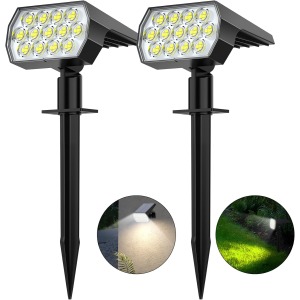
At under £11 for two spotlights, the Flaow 65 LED units represent the budget floor for outdoor solar landscaping, and they clear the bar. With 1,293 reviews at 4.4 stars, these aren’t the cheap units that fail after a month. They’re a genuine option for lower-priority areas of the garden where you want some illumination without committing more money.
The 65 LED count per unit is solid for the price, and three brightness modes give you enough flexibility to tune the run time to your garden’s needs. The 2-in-1 stake and wall mount design is standard at this price point. IP65 waterproofing covers normal UK rain and frost conditions. Don’t expect the same runtime as the premium picks on shorter autumn and winter days, the battery capacity is smaller, but for a secondary garden area or to test what solar uplighting looks like in your space before investing more, these do the job.
Features
- 65 LED per unit, 2-pack
- 3 brightness modes (30% / 60% / 100%)
- IP65 waterproof
- 2-in-1 stake or wall mount
- Dusk-to-dawn auto on/off
- Outstanding value, 2 spotlights under £11
- 1,293 reviews confirm real-world reliability
- Compact and discreet in the garden
- Smaller battery, shorter run times in winter
- Cold white light only, not for warm-tone garden schemes
- No remote, no USB backup
4. Bowfar 4 Pack Solar Ground Disk Lights
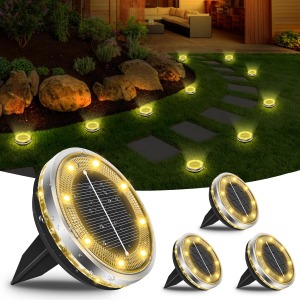
The Bowfar discs take a different approach to landscape lighting, instead of spotlights pointing up at garden features, these flush-mount ground discs embed directly into paths, decking, lawn edges, and driveways, emitting light upwards and sideways in a warm white glow. The 4+4 side-light LED configuration means these illuminate both the ground surface and the space immediately around them, creating a clean, contemporary path lighting effect.
Construction is notably solid for a ground-mounted light: stainless steel housing with IP65 sealing and a 100kg pressure rating. These won’t crack under foot traffic or driveway wheels. The 600mAh battery and 2V solar panel charge in 4–6 hours of sunlight and run for 8–10 hours, reliable for summer nights in full; somewhat reduced through the darker winter months. Dusk-to-dawn activation handles the on/off cycle automatically.
At £22.92 for four, the Bowfar discs offer a cleaner, more integrated look than protruding stake spotlights, better for formal garden designs, driveways, or any area where a spike light would look out of place. The 4.7-star rating from 184 reviews reflects high satisfaction.
Features
- 12 LED per disc (8 front, 4 side), warm white
- Stainless steel housing, 100kg pressure rated
- IP65 waterproof
- 600mAh battery, 4–6h charge / 8–10h run
- 4-pack, stake or screw installation
- Auto dusk-to-dawn
- Flush ground installation, cleaner look than spike lights
- Stainless steel body and 100kg pressure rating, genuinely durable
- Side-light LEDs create attractive ground-level illumination effect
- 4.7 stars, highest rating in this selection
- Warm white only, less versatile than adjustable spotlights
- Lower LED count, ambient rather than task lighting
- Smaller battery, reduced run time in winter months
5. Solar Pathway Lights 12-Pack with Side Lights
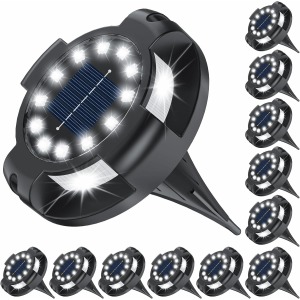
For edging a full garden path, driveway, or lawn border, this 12-pack delivers consistent illumination along an extended run at a unit cost that makes practical sense. Twelve lights cover roughly 10–12 metres of pathway edge when spaced evenly, enough to line most garden paths end to end. The side-light LED configuration adds a horizontal glow that marks the path edge clearly.
The IP65 rating handles British weather conditions reliably. 16 LEDs per unit (12 on top, 4 on the side) delivers enough brightness for comfortable path navigation without being overwhelming. Charge time of 4–6 hours provides 6–10 hours of runtime, solid through spring, summer, and early autumn; somewhat reduced in the shorter days of November through January.
Two installation options, ground stakes for soft soil or screws for decking and hard surfaces, make these versatile across different garden configurations. At £38.99 for 12, the per-unit cost of £3.25 is excellent for a complete garden path solution.
Features
- 16 LED per unit (12 top + 4 side), bright white
- 12-pack, covers 10–12m of pathway
- IP65 waterproof
- 4–6h charge / 6–10h runtime
- Stake or screw installation
- Auto dusk-to-dawn
- 12-pack gives excellent path coverage at low per-unit cost
- Side lights create clear path-edge visibility
- Two installation methods, works on lawn or hard surfaces
- Pathway/disk style, not suitable for uplighting garden features
- 102 reviews, less established than top picks
- Shorter run times in UK winter months
6. btfarm 4 Pack Solar Uplighters 72 LED
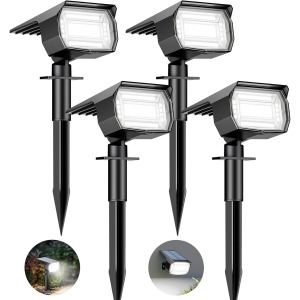
The btfarm 4-pack brings the 72 LED spotlight format to a multi-pack at a competitive price point. Four spotlights for £24.69 works out at under £6.20 per unit, practical for lighting four separate garden zones without spending significantly more than the LOTMOS 3-pack. The 72 LED count matches the LOTMOS for brightness, and three modes give you the same run time flexibility.
IP65 waterproofing is standard rather than IP67, which means these are rated for rain but not immersion. For a spotlight mounted above ground level, that distinction rarely matters in practice. The 4.2-star rating from 146 reviews is the weakest in this selection, and it does show in occasional reviews mentioning inconsistent build quality across units in a pack. Worth being aware of, but not a dealbreaker for a garden lighting application where a faulty unit in a pack of four is easily replaced.
Features
- 72 LED per unit, 4 in the pack
- 3 modes, dusk-to-dawn auto sensor
- IP65 waterproof
- Ground stake included
- 4-pack at an excellent per-unit price
- 72 LED matches premium options for brightness
- Lowest rating in this selection at 4.2 stars
- IP65 vs the LOTMOS’s IP67
- Some reviews note variable quality within packs
7. Linkind Smart Solar Spotlights, App Controlled Colour Changing
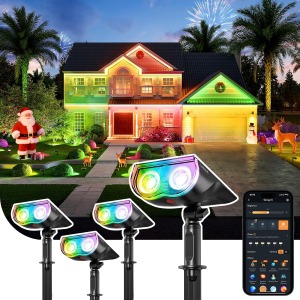
If you want solar landscape lighting that goes beyond functional illumination into fully programmable garden ambiance, Linkind’s smart spotlights are the premium pick in this selection. App control via Bluetooth gives access to 16 million colour options, set warm amber for everyday garden evenings, shift to colour sequences for parties, or programme seasonal lighting themes without going near a remote or switch.
It’s a different proposition from the rest of the picks here, more an outdoor smart lighting product than a utilitarian security or pathway light. The 4.5-star rating from 68 reviews is encouraging for a newer product. IP65 waterproofing and the standard ground stake/wall mount installation keep this practical for typical UK garden use.
For most gardens, the LOTMOS or ECOWHO are the more practical choices. But if you’re creating a genuinely designed outdoor lighting scheme where colour and mood matter, the Linkind app control opens up creative options none of the other picks can match.
Features
- 16 million colour options via app control
- Bluetooth app control, schedules, scenes, colour
- IP65 waterproof
- Ground stake and wall mount included
- Full colour control via app, unique in this selection
- Programmable schedules and scenes
- 4.5 stars, solid early reputation
- Bluetooth range limits how far from the app you can position lights
- App dependency, less convenient than a simple auto light
- Fewer reviews than other picks
Solar Landscape Lights Buying Guide
Key Takeaways
- Landscape lighting differs from path lights: stake lights (20–40cm) illuminate ground immediately below, while landscape lights (variable mounting) define borders, uplight trees, or create visual layers across garden depth
- Four distinct landscape light types: spike/stake (borders, beds), bollard (pathway posts, 50–100cm tall), uplight/spotlight (trees, architectural features, 20–100W equivalent), and in-ground (hardscaping integration, rarely used in UK)
- Lumen output ranges 10–100lm for accent lighting to 500lm+ for functional area lighting; brightness should match intended visual depth (front border vs distant tree canopy)
- Warm white (2700K) is standard for garden atmosphere; cool white (4000K+) looks commercial and harsh; colour-changing RGB models are novelty — avoid
- Battery capacity (600–1,500mAh) and panel size (10–25cm²) determine UK winter reliability; undersized batteries fail by November; 800mAh+ is minimum for winter lighting
- Material quality (UV-stable resin vs cheap plastic, stainless vs painted steel) determines multi-year durability; budget lights fade and corrode fast
- IP65 minimum for water resistance; IP67 preferred for frost-prone areas and wet UK winters
- Price ranges £20–£80 per light for quality landscape lighting; premium sculptural pieces £100–£300 each
Landscape Lighting Design Principles and Layering
Garden landscape lighting creates visual depth and interest through layering: near lighting (borders, beds), mid-ground lighting (pathways, low trees), and background lighting (distant trees, architectural features). A well-lit garden uses lights of varying brightness and colour temperature to guide eyes through the space. Solar landscape lights fit this layering strategy by offering low brightness (5–50lm typically) suited to decorative accent illumination rather than functional area lighting.
Design approach: place spike lights to graze borders (lighting perennials and foliage), use uplights to illuminate tree canopies or garden structures, and cluster lights for visual impact rather than scattering singles throughout the space. Darkness between clusters is intentional — it guides the eye and creates rhythm.
Landscape Light Types and Their Garden Functions
| Light Type | Mounting Height | Typical Output (Lumens) | Visual Function | Installation Complexity | UK Winter Performance |
|---|---|---|---|---|---|
| Spike/Stake Lights | 10–40cm, ground-mounted | 5–30lm | Border accent, flower bed definition, ground-level highlighting | Push into soil, zero installation | Good; low battery demand, winter-resilient |
| Bollard Lights | 50–100cm posts | 20–100lm | Pathway definition, feature highlight, stepping stone markers | Mounting post or spike anchor, moderate installation | Fair; taller profile increases wind catch, frost heave risk |
| Spotlight/Uplight | Variable: ground-mounted (spike), wall-mounted (building), pole-mounted | 50–200lm equivalent | Tree canopy illumination, architectural feature lighting, dramatic effect | Positioning and angle adjustment needed; more planning | Fair to good depending on mounting stability |
| In-Ground Lights | Flush with hardscape (paving, gravel) | 5–30lm | Step lighting, patio edge definition, subtle accent | Installation requires excavation; limited UK adoption | Poor; frost heave pushes fixtures up; wet UK soil damages electronics |
Spike lights are simplest and most versatile for UK gardens. Bollard lights add structure and formality. Uplights create dramatic tree illumination (effective in larger gardens). In-ground lights are rare in the UK due to frost heave and wet soil damage — avoid unless you have excellent drainage and can reset fixtures monthly.
Brightness, Colour Temperature, and Mood Creation
Warm white (2700K) is universally recommended for residential gardens — it creates an inviting, cosy atmosphere and complements most plant colours. Cool white (4000K+) appears institutional and harsh; only appropriate for commercial or security applications. RGB colour-changing models are novelty; the flashing and colour-cycling modes seem fun initially but become annoying within weeks and deplete batteries faster.
Brightness should match the visual depth you’re illuminating: a 5–10lm spike light is sufficient to define a border one metre away; the same light can barely be seen if it’s supposed to highlight a tree 10 metres away. Match brightness to distance: near borders (5–20lm), mid-ground pathways (20–50lm), distant trees (50–100lm+).
Battery Capacity and UK Winter Reliability
Landscape lights with 400–600mAh batteries deliver 4–6 hours of dusk-to-dawn operation in summer but often fail to charge fully in UK winter overcast. 800mAh–1,200mAh ensures 8–10 hour operation even on December days. Battery chemistry matters: NiMH (nickel-metal hydride) is standard, adequate for 2–3 years; LiFePO4 lasts 5+ years but costs significantly more (usually not justified for garden accent lights).
Real-world UK winter performance: a 600mAh landscape light in December might light only 4–5 hours nightly; the same light rated “8 hours” is marketing hyperbole (STC conditions assumption). If winter reliability is critical, buy 1,000mAh+ batteries or accept dimmer lighting in late December through early January.
Material Quality, UV Stability, and Corrosion Resistance
Budget landscape lights (£15–£25) use unstabilised polyresin and painted metal — the resin fades to white chalky plastic within 18 months, and painted steel corrodes. Mid-range lights (£30–£60) use UV-stabilised polyresin and stainless or powder-coated steel that hold colour for 3+ years. Premium lights (£80–£150+) add sculptural design, larger batteries, and materials (copper, bronze, stone) that age gracefully.
For longevity, spend £40–£60 per light if you want them to look good after 2–3 years. Budget options fade quickly and become eyesores. Mid-range is the sweet spot for value: sufficient durability for 3–4 seasons, reasonable cost, and acceptable aesthetics.
Waterproofing, Frost Tolerance, and Seasonal Durability
IP65 (water jets) is minimum; IP67 (submersion tolerance) is preferable for UK gardens with winter drainage issues. Check seals around the solar panel, battery compartment, and LED housing — these are failure zones. Stainless hardware resists corrosion; painted fasteners will rust and seize over time.
Frost tolerance: cheap plastic becomes brittle below freezing; dropping a frozen landscape light can crack it. UV-stabilised resin remains flexible to -10°C or lower. If your garden stays frozen January–February, invest in cold-tolerant materials (not budget plastic).
Clustering, Spacing, and Visual Impact Strategies
Single landscape lights look lost. Clusters of 3–5 lights at varying heights create drama: three 10–20lm spikes in a border, one 50lm uplight on a backdrop tree, creating visual layers. Spacing should follow garden geometry: lights along a 10m border call for 4–6 stakes (1.5–2m apart); a focal tree needs 1–2 uplights from different angles.
Experiment with positioning before permanent installation: lay lights on the soil for a few nights, evaluate visual impact, then finalize placement. What looks good in summer might be invisible under winter overgrown foliage; adjust accordingly.
Seasonal Positioning and Winter Shade Management
A landscape light perfectly positioned in November (clear sightlines to southern sky) might be completely shaded by December overgrown winter foliage. Deciduous trees lose leaves, opening panels to sunlight, but evergreen climbers and shrubs cut charging angle off. Autumn repositioning helps: ensure lights get direct morning or afternoon south-facing sun in winter months.
Remove long-dead branches that shadow panels; trim overhanging growth. This maintenance is often overlooked but critical for December reliability.
Summing Up Solar Landscape Lights
Solar landscape lights create garden atmosphere and visual interest at night. Choose spike or bollard styles suited to your garden’s layout. Cluster lights for dramatic effect rather than scattering singles. Invest in UV-stabilised polyresin and stainless hardware (£40–£60 per light) for multi-year durability. Specify 800mAh+ batteries for UK winter reliability. Warm white (2700K) is standard; avoid RGB novelty models. Plan for 40–60% of summer brightness in December, and you’ll enjoy atmospheric garden lighting through autumn and winter. A well-designed landscape light scheme transforms a garden’s nighttime character with minimal energy demand and zero maintenance.
Case Study: A Homeowner in Kent Transforms Their Evening Garden
Background
A homeowner in Tunbridge Wells, Kent, had a south-facing back garden with a mature planted border along one wall and a gravel path leading to a summer house. The garden was completely dark after sunset, limiting how much they used it on summer evenings.
Project Overview
Their goal was to create evening garden lighting without mains cable installation. The garden had excellent sunlight access from 9am to 5pm through spring and summer, making solar a practical option.
Implementation
They installed six LOTMOS spotlight units along the planted border, each angled to uplight a different shrub or specimen plant. Four Bowfar ground disk lights were positioned at 80cm intervals along the gravel path edge. Total spend: £134 for the spotlights (two 3-packs) plus £23 for the Bowfar discs. Installation took approximately 2 hours across both products.
Results
The combination of uplighting and path edge lights created an evening garden they actually use through spring, summer, and autumn. The LOTMOS units run reliably on medium mode (16 hours), seeing the garden through even midsummer evenings when it doesn’t get dark until 9pm. The path discs mark the route to the summer house clearly. In the two winters since installation, the spotlights run for a reduced but still useful 6–8 hours on medium mode during December and January.
Expert Insights From Our Solar Panel Installers About Solar Landscape Lights
One of our senior solar panel installers with over twelve years of UK experience advises:
“Solar landscape lights have improved enormously in the last three years. The LED counts are up, the batteries are bigger, and the IP ratings are more honest. The one thing I’d still caution people about is winter expectations, even the best solar garden lights slow down from November to February in the UK. Position the panels where they get the most winter sun (usually south-facing and clear of shade) and don’t buy the cheapest units if you want year-round performance. A good monocrystalline panel and a decent battery capacity make the difference between a light that works on a January morning and one that’s sat dead all winter.”
Frequently Asked Questions
What are the best solar landscape lights for UK gardens?
The LOTMOS 3Pcs Solar Spot Lights are the best all-round solar landscape spotlights for UK gardens in 2026, 72 LEDs, IP67 waterproofing, and a 1500mAh battery give reliable performance at under £22 for a 3-pack, backed by nearly 2,800 reviews. For remote control and monocrystalline panel performance, the ECOWHO is the premium step up. For path-edge lighting, the Bowfar ground disk lights or the 12-pack pathway lights are the better fit.
Do solar landscape lights work in winter in the UK?
Yes, with reduced performance. UK winter solar irradiance is significantly lower than summer, expect 40–60% of summer output on typical winter days, and near-zero on heavy overcast days. Lights with monocrystalline panels (like the ECOWHO) perform better in diffuse winter light than polycrystalline units. Larger batteries (1,000mAh+) store enough energy to run through a short winter night even when charging has been limited. For reliable year-round use, buy monocrystalline panel units with a battery of at least 1,000mAh.
What is the difference between solar spotlights and solar ground lights?
Solar spotlights are directional lights mounted on a ground stake, with an adjustable head that can be angled to illuminate specific garden features, uplighting a tree, shrub, or fence panel. Solar ground disk lights sit flush at ground level and emit upward and sideways ambient light, typically used to mark path edges, driveways, and decking. Both are solar-powered; the choice depends on whether you want directional feature lighting (spotlights) or ambient path-edge illumination (disks).
How long do solar landscape lights last per charge?
Run time depends on battery capacity, number of LEDs, and which brightness mode is selected. High-capacity batteries (1500mAh like the LOTMOS) deliver 8 hours at full brightness and up to 30 hours on low mode. Smaller batteries (400–600mAh, typical in budget units) deliver 6–10 hours in summer but may not fully recharge on short winter days, reducing effective run time. As a guide: on high mode, expect 6–10 hours from good-quality units; on low mode, 16–30 hours.
Can solar landscape lights be used in shaded gardens?
Solar landscape lights require meaningful sunlight access to charge effectively. A heavily shaded garden, dense tree cover, north-facing aspect with surrounding buildings, will significantly reduce performance. Partial shade (sun for 3–4 hours daily) is manageable if the lights have monocrystalline panels and larger batteries. Full shade produces poor results regardless of panel quality. If your garden is heavily shaded, mains-powered low-voltage garden lighting or battery-powered alternatives are more reliable solutions.
What IP rating do I need for solar garden lights?
For UK garden use, IP65 is the minimum acceptable rating, this means the light is fully dust-proof and protected against water jets from any direction (heavy rain). IP67 (protected against immersion for up to 30 minutes at 1 metre) is better for ground-level installations in lawns where water pooling might occur. IP68 is only needed for permanent pond or water feature lighting. Any solar garden light claiming outdoor suitability but rated below IP65 should be avoided.
How many solar landscape lights do I need for a garden path?
For path-edge lighting using ground disk or pathway stake lights, space them every 1–1.5 metres on one or both sides of the path. A 6-metre path needs 4–6 lights per side; a 12-metre driveway would need 8–12 lights to create consistent illumination. Spotlight uplighters for planted borders are typically spaced every 1.5–2.5 metres, depending on the size of plants being illuminated and the spread of each light’s beam.
Are solar landscape lights worth it?
Yes, for most UK garden lighting applications. At £20–40 for a multipack, good solar landscape lights are significantly cheaper than mains-powered equivalents when installation costs are included (which can run £200–500 for a professional outdoor lighting circuit). Running costs are zero. The main trade-off is winter performance, solar lights slow down in January and February in the UK, but from March through October, modern solar landscape lights are a practical, cost-effective, and genuinely attractive garden lighting solution.
Summing Up
Solar landscape lights have matured into a genuinely practical garden lighting solution for UK homeowners. The LOTMOS 3-pack is the standout choice for most gardens, three high-brightness IP67 spotlights for under £22 is exceptional value, backed by nearly 3,000 reviews. Step up to the ECOWHO for remote control and monocrystalline efficiency, or pick the Bowfar ground discs for flush path-edge illumination with a cleaner aesthetic. The Linkind smart lights are the creative choice for garden lighting enthusiasts who want full colour and app control.
All seven picks are available from Amazon UK with Prime delivery, and all are straightforward to install without tools, wiring knowledge, or an electrician.
Updated