
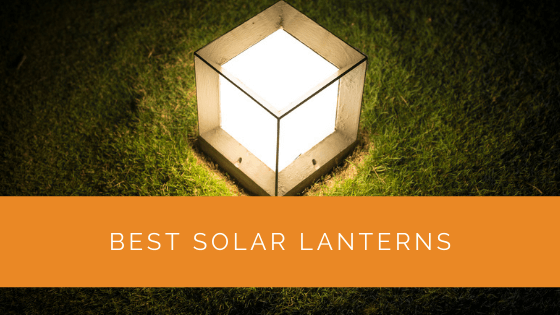
The KOOPER Solar Lanterns with Realistic Flickering Flame are the best choice for most UK garden owners who want atmospheric evening lighting without complicated wiring or ongoing electricity costs. The warm flickering glow suits British patios and decks perfectly, and the 2-pack price makes them genuinely good value. We’ve selected seven of the best solar lanterns available on Amazon.co.uk right now, covering every style from classic warm-white hanging lanterns to premium dual-charging options.
Solar lanterns have come a long way from the dim, unreliable models that gave them a poor reputation a decade ago. Today’s best models charge reliably through British cloud cover, last six to eight hours or more per evening, and use warm white LEDs that flatter outdoor spaces rather than bleaching them in harsh blue-white light. Here’s our pick of the best currently available.
Our Top Picks
| Image | Name | |
|---|---|---|
| KOOPER Solar Lanterns with Realistic Flickering Flame (2 Pack) | |
| OxyLED Solar Lanterns for Outside (2 Pack) | |
| Solar Garden Lanterns Outdoor Hanging (2 Pack) | |
| Gadgy Solar Lantern for Outdoor Hanging (Pack of 2) | |
| MOXTOYU Solar Lanterns (2 Pack) | |
| Auraglow Solar and USB Rechargeable Garden Lantern | |
| GIGALUMI Solar Lantern Outdoor Metal Hanging Garden |
7 Best Solar Lanterns for UK Gardens
1. KOOPER Solar Lanterns with Realistic Flickering Flame (2 Pack)
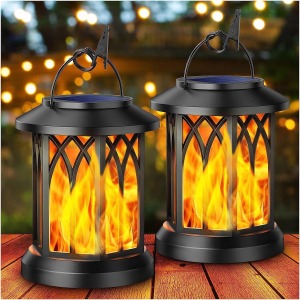
If you want evening lighting that genuinely creates an atmosphere rather than just adding illumination, KOOPER’s flickering flame solar lanterns are the ones to buy. The LED inside mimics a real candle flame convincingly, shifting and dancing as if lit from within. On a UK patio or deck in the evening, the effect is warm, inviting, and exactly what most garden owners are trying to achieve. At under £20 for two, they’re exceptional value.
Build quality for this price bracket is better than you’d expect. The dark metal housing handles British rain without issue, and the automatic dusk-to-dawn sensor works reliably. You push the stake in, angle the solar panel upward, and they’re operational. Runtime is eight to ten hours on a full charge, which covers the entire evening comfortably through spring, summer, and autumn. On grey UK days, charging is reduced but still adequate for a decent evening run.
The flickering effect is the main selling point, and it delivers. Previous buyers consistently mention that the flame effect looks convincingly real from a distance and draws compliments from garden visitors. The warm amber glow suits traditional British garden styles particularly well, whether hung from a pergola, bracket, or fence post. Two lanterns positioned either side of a garden seating area create a symmetrical effect that’s genuinely impressive for the price.
One practical note: the IP44 waterproof rating is fine for rain and British weather generally, but these aren’t rated for prolonged submersion. Keep them away from direct water spray from hoses. If you’re leaving them outdoors all season, the battery will outlast the housing eventually, but most users report two to three seasons of reliable service before any degradation is noticeable.
Features
- Realistic flickering flame LED effect
- IP44 waterproof rating
- 8-10 hours runtime per full charge
- Automatic dusk-to-dawn sensor
- Dark metal housing with hanging ring
- 2-pack at under £20
- Convincing flickering flame effect
- Exceptional value at under £20 for 2
- Good runtime of 8-10 hours
- Reliable dusk-to-dawn switching
- IP44 not the highest waterproof rating
- Plastic internal components
- Flame effect less convincing up close
2. OxyLED Solar Lanterns for Outside (2 Pack)
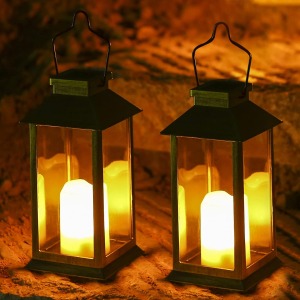
OxyLED’s solar lanterns take a different approach from the flickering flame models, offering a steady, elegant warm white glow in a classic lantern silhouette. With over 2,000 reviews on Amazon.co.uk at 4.4 stars, these are among the most thoroughly tested solar lanterns available to UK buyers. The bronze-coloured metal housing suits cottage garden and traditional patio aesthetics well, and the steady warm white is arguably more versatile than the flickering effect for everyday outdoor living.
The design is reassuringly simple. A metal frame with a warm white LED inside, a solar panel on the roof, and a hanging ring at the top. Setup involves nothing more than switching the unit on, positioning it where it gets sufficient sun, and letting it do its job. The dusk-to-dawn sensor is accurate and reliable. Reviews consistently praise the straightforward operation and the pleasing light quality on overcast British evenings.
Charging performance in typical UK conditions is solid. The 600mAh battery isn’t large, so runtime on a grey winter day will be modest at around four to five hours, but through spring and summer the six to eight hour runtime is consistently delivered. For the price at around £25 for two, these are a sensible, well-proven choice for any UK garden.
Features
- Steady warm white LED
- Bronze-coloured metal construction
- IP44 waterproof, rustproof design
- 600mAh Ni-MH battery
- Auto on/off dusk sensor
- 2-pack with hanging rings
- Over 2,000 reviews, the most proven pick
- Classic elegant design
- Steady warm white suits any garden style
- Smaller battery than premium models
- No flickering or pattern effects
- Modest winter runtime
3. Solar Garden Lanterns Outdoor Hanging (2 Pack)
With 4.5 stars from over 700 UK buyers, these hanging solar lanterns sit slightly above the KOOPER and OxyLED models for average rating, which reflects consistently positive experiences across a broad range of UK gardens and weather conditions. The warm white LED provides a gentle ambient glow rather than a directed beam, making them excellent choices for atmospheric garden evenings rather than task lighting.
The all-weather construction handles the worst British rain without complaint. The dusk sensor triggers reliably at the right light level, and the charging panel extracts adequate power even on overcast days. Hung from a pergola or outdoor gazebo, these create the kind of warm-lit atmosphere that makes outdoor entertaining worth doing in a UK climate. At around £25 for two, the value is solid.
Features
- Warm white ambient LED
- IP44+ waterproof rating
- Hanging chain included
- Auto dusk-to-dawn sensor
- Suitable for pergolas, brackets, fences
- 2-pack
- Highest average rating of the 2-packs
- Good all-weather performance
- Warm ambient light flatters outdoor spaces
- Less distinctive design than pattern alternatives
- Fewer reviews than OxyLED equivalent
4. Gadgy Solar Lantern for Outdoor Hanging (Pack of 2)
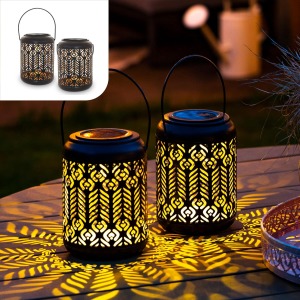
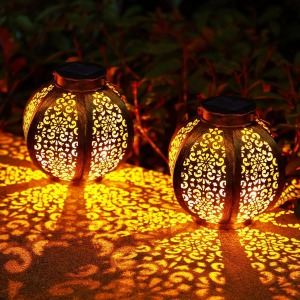
Gadgy’s solar lanterns are the most decoratively ambitious option on this list, using a cut-out metal pattern to cast shadow effects on nearby surfaces at night. The peacock motif creates an intricate lattice of light and shadow on walls, fences, and paving slabs, turning a plain garden area into something that looks genuinely thoughtful and designed. This is the choice if the light itself is the statement rather than just functional illumination.
At £34.99 for two, these cost more than the KOOPER or OxyLED alternatives, but the design quality justifies the premium. The metal construction feels more substantial, the pattern projection is clearly visible from across a garden, and the hanging chains have a quality feel that cheap alternatives don’t match. Reviews consistently praise the shadow patterns specifically, with buyers noting that the effect looks impressive enough to draw comments from guests.
The solar panel is positioned on the lantern roof, as with most hanging designs. Adequate south or west-facing sun exposure gives a full charge that runs comfortably through an evening. These work particularly well positioned near light-coloured walls where the shadow patterns can be clearly seen, or hung at head height from a pergola or bracket so the pattern projects downward onto paving.
Features
- Cut-out metal pattern creates shadow projections
- Premium metal construction
- Peacock motif design
- Solar panel on lantern roof
- Hanging chain included
- Auto dusk-to-dawn activation
- Beautiful shadow pattern projection
- Premium metal construction
- Most decoratively striking option
- Strong reviews for design quality
- More expensive than most alternatives
- Shadow effect best against light walls
- Pattern less visible in bright settings
5. MOXTOYU Solar Lanterns (2 Pack)
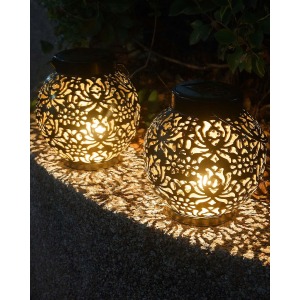
MOXTOYU position their solar lanterns explicitly as gift options, and the presentation quality backs that up. The packaging is noticeably better than most solar lights at this price point, and the lantern design has enough visual appeal to work well as a birthday or Christmas gift for garden-loving friends or family. That said, they perform as well as any outdoor solar lantern in their price bracket, with reliable dusk sensors and adequate charging in British conditions.
At £22.99 for two, they sit between budget and mid-range. The metal construction is solid, the warm white LEDs provide a pleasant ambient glow, and the hanging ring allows the same mounting flexibility as the other models on this list. If you’re buying solar lanterns purely for your own garden, there are marginally better-reviewed options at this price. But if presentation and gifting matters, MOXTOYU is the pick.
Features
- Premium gift-quality packaging
- Metal construction with hanging ring
- Warm white LED
- Auto dusk-to-dawn sensor
- IP44 waterproof
- 2-pack at £22.99
- Excellent gift presentation
- Good value for 2-pack
- Solid metal construction
- Fewer reviews than top picks
- No special effects or pattern projection
- Average rather than exceptional performance
6. Auraglow Solar and USB Rechargeable Outdoor Garden Lantern
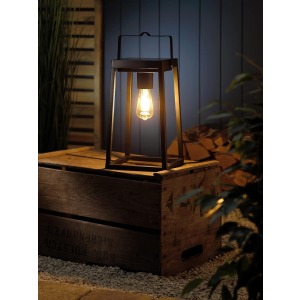
Auraglow is a British brand specialising in decorative lighting, and their dual-charging solar lantern is the most practically engineered option on this list. The key feature is USB-C backup charging. On the grey winter days when solar charging alone would leave the lantern at half capacity, you can top it up via USB just as you would a phone or tablet. This eliminates the main frustration of solar garden lighting: the unpredictable charging in British winters.
The lantern itself uses a vintage-style LED filament bulb inside a matt black aluminium frame, producing a warm, stylish glow that suits contemporary garden rooms and modern patio setups better than the traditional lantern silhouettes of the other options here. The build quality is genuinely premium: this feels like a product designed to last several seasons rather than one. At £34.99 it’s the most expensive single-unit option, but the USB backup charging alone arguably justifies the premium for anyone who uses their garden regularly through autumn and winter.
Features
- Dual solar and USB-C charging
- Vintage LED filament bulb style
- Matt black aluminium construction
- IP44 weatherproof
- Up to 48 hours runtime on full charge
- Auto dusk sensor with manual override
- USB-C backup eliminates winter charging issues
- Premium British brand
- Modern aesthetic suits contemporary gardens
- Exceptional 48-hour claimed runtime
- Most expensive single-unit option
- Fewer reviews than mass-market alternatives
- Single unit, not a 2-pack
7. GIGALUMI Solar Lantern Outdoor Metal Hanging Garden
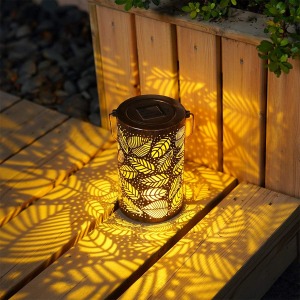
GIGALUMI’s bronze metal lantern is the budget-friendly entry on this list at £16.99, and it delivers what matters at the price: a decent warm glow in a proper metal housing that handles British weather without rusting or warping in the first season. The pattern cut-outs project light onto nearby surfaces in a similar way to the Gadgy option, but more modestly. For gardens where the budget limits spending but you still want something that looks better than cheap plastic alternatives, this is a reasonable choice.
Check recent reviews before buying. The older reviews are very positive, but some recent buyers note quality consistency issues. That said, at £16.99, the risk-to-reward ratio is still favourable, and the majority of buyers are satisfied. Don’t expect Gadgy-level projection quality or Auraglow’s construction standards, but as a budget metal lantern it does the job.
Features
- Bronze metal construction with cut-out pattern
- Warm white LED
- Hanging chain included
- Auto dusk sensor
- Budget entry at £16.99
- Most affordable metal lantern option
- Decent pattern projection effect
- Some recent quality consistency concerns
- Lower review count than top picks
- Pattern effect modest versus premium alternatives
Solar Lanterns Buying Guide
Key Takeaways
- Choose hanging lanterns for pergolas and fences, standing lanterns for gardens, stake lanterns for borders
- Crackle glass and rattan styles offer the best aesthetic appeal in UK gardens
- Look for 800mAh+ battery capacity to ensure dusk-to-dawn operation through UK winters
- Warm white LED (3000K) is the only choice for lantern ambiance – colour-changing RGB ruins the effect
- IP65 minimum for UK rain exposure; check the solar panel cap seals, not just the light body
- Ambient decorative output (10-30lm) is normal for lanterns – these are mood lighting, not pathway lights
Lantern Styles and Placement
Solar lanterns come in four distinct mounting styles, each suited to different garden spaces.
| Style | Mounting | Typical Output | Best Locations | UK Suitability |
|---|---|---|---|---|
| Hanging | S-hook or chain to pergola, tree, fence rail | 10-25lm | Pergolas, gazebos, patio coverage, overhanging branches | Excellent – provides dappled garden coverage |
| Standing (free-standing) | Flat base, no mounting needed | 15-30lm | Garden borders, patio corners, near seating areas | Good – move indoors during winter storms |
| Stake-mounted | Metal or plastic spike pushed into soil | 5-15lm | Flowerbed edging, path markers, amongst plants | Good – but frost can heave soil and loosen spikes |
| Wall-mounted | Screw to garden wall, fence, or shed | 20-40lm | Garden walls, sheds, patio walls, entrance ways | Excellent – permanently positioned, best sun exposure |
Material Choices and Durability
The lantern body material affects both aesthetics and weathering over UK winters.
- Powder-coated metal (steel or aluminium). Most durable option. The coating resists rust, UV fading is minimal, and repair is easy (respray the lantern if needed). Metal lanterns typically weigh 400-600g, which is good for stability in wind. Cost is higher but longevity justifies it.
- Rattan effect (PVC-coated plastic). Convincing aesthetic mimicking woven wicker. Durable through UK winters if the PVC coating is quality. Check reviews for cracking in sub-zero temperatures. Lighter than metal (200-300g), so these work well as hanging lanterns but less stable when standing.
- Glass panels (borosilicate or soda-lime). Crackle glass lanterns are stunning but require care. Genuine borosilicate is frosted and strong. Soda-lime glass is clearer but more brittle. Frost (freezing water inside the panels) rarely causes failure – the real weakness is plastic end caps that shrink and allow water ingress.
- Plastic (ABS or polycarbonate). Budget option. Acceptable if the lantern style suits plastic (geometric, modern), but plastic ages quickly in sunlight. UV stabilisation is critical. Avoid thin-walled plastic lanterns that will become brittle within 2-3 UK winters.
Solar Panel Placement and Charging Efficiency
How the solar panel attaches to the lantern affects both charging speed and durability.
- Top-mounted integrated panel. Most common. The panel is a cap on top of the lantern. Advantage: simple design, no cables. Disadvantage: the panel points upward only, so it charges well under direct sun but loses efficiency when the sun is low (autumn/winter in the UK). A top panel in winter receives maybe 60-70% of its summer output. The junction between panel and body is a common leak point. Look for silicone seals, not just plastic clips.
- Separate panel on a cable. Less common but excellent for UK winter. The cable lets you position the panel separately from the lantern. Place the panel on a south-facing tilt (30-40 degrees) while the lantern sits where you want the light. Winter output improves dramatically because the panel can face the correct angle. Cables are typically 1-2 metres. Check the connector type is waterproof (push-fit, not exposed pin terminals).
- Side-mounted panels. A few lantern designs have panels on the side. These reduce aesthetic appeal and complicate the body seal. Avoid unless reviews specifically praise the design.
For most UK gardens, a top-mounted integrated panel is acceptable if you accept lower winter output. For gardens wanting consistent dusk-to-dawn lighting through winter, opt for a separate panel on a cable so you can angle it correctly.
Brightness Output and Use Cases
Solar lanterns produce ambient decorative light. They are not pathway lights or security lights. Lumens range from 5lm (soft accent) to 40lm (visible glow across a seating area).
- 5-10lm: Soft ambiance. Only visible in complete darkness as a gentle glow. Suits interior-style lanterns and intimate seating areas. Useless for navigation.
- 15-25lm: Standard garden lantern range. Creates visible mood lighting across a small patio or seating group (2-3 metres radius). Comfortable for relaxing outdoors in summer evenings.
- 30-40lm: High-output decorative lanterns. Bright enough to see across a larger garden space (3-5 metres). Still aesthetic, not functional for pathway safety, but noticeably brighter.
UK gardens benefit from multiple lanterns in clusters rather than relying on one bright lantern. A set of three 15lm lanterns creates better ambiance than one 40lm lantern. Spreading light across the garden also balances charging. If some lanterns are in partial shade, clustering reduces the impact of any one lantern’s low output.
Battery Capacity for UK Winters
A lantern’s dusk-to-dawn operation depends on battery capacity. In summer, a 800mAh battery charges fully by mid-morning and powers the light until midnight with brightness to spare. In UK winter, charging happens over 6-7 hours (shorter daylight), and the light is needed from 4pm to 10pm (6+ hours). Battery capacity must match this demand.
- 400-600mAh: Summer use only. Acceptable for seasonal decorative lights (Easter to October). Insufficient for dusk-to-dawn lighting from November to March.
- 800-1200mAh: Good for UK year-round use. Charges in summer, maintains 4-5 hours of winter operation. The standard for quality solar lanterns.
- 1500mAh+: Premium. Handles December through January with reliable dusk-to-dawn output. Overkill for summer but valuable insurance against low-light winters.
Battery chemistry matters too. Nickel-metal hydride (NiMH) lanterns are the cheapest but lose capacity faster in UK cold winters. Lithium-ion (Li-ion) and LiFePO4 (LFP) lanterns retain capacity in cold and last 3-5 years before degradation. The price premium (£5-15 per lantern) is worth paying for winter reliability.
Colour Temperature and Light Quality
All garden lanterns should use warm white LED (2700-3000K colour temperature). This is the essence of lantern ambiance. Cool white (5000K+) LED lanterns destroy the aesthetic. Colour-changing RGB lanterns are another mistake for this product category. The multiple LED colours dilute the lantern’s visual punch, and RGB modes drain the battery faster. For lanterns, stick to warm white only.
Waterproofing and Sealing
IP ratings tell part of the story, but lanterns need specific attention to sealing.
- IP65 minimum. Dust-tight and protected against water jets. This is the baseline for outdoor lanterns.
- IP67 is better. Dust-tight and protected against immersion up to 1 metre. If your lantern will sit near a pond or be hosed down, IP67 is worth the cost.
- Check the panel-to-body junction. The weakest point in any lantern design is where the solar panel cap seals to the light body. A silicone O-ring is better than a plastic snap-fit. Look at the product photos carefully. If the seam looks sharp and gappy, water will find it.
- Check the battery compartment. Rechargeable batteries live in a sealed chamber inside the lantern. If this chamber floods, the lantern is ruined. Quality lanterns use a bayonet or threaded battery cap with a gasket. Budget lanterns have a loose plastic door that doesn’t seal.
- Drain holes matter. Some lanterns have tiny drain holes at the base. These let internal condensation escape. This is a good design feature for UK humidity.
Things to Keep in Mind Before Buying
- Measure your hanging point or standing location before ordering. A 30cm tall lantern looks wrong on a small patio. A 50cm lantern for a hanging pergola looks proportionate.
- Consider grouping. Two or three smaller lanterns create better ambiance than one large lantern. Grouped lights also spread the charging load if some are in shade.
- Colour and material matter more than brightness. A beautiful crackle glass lantern at 15lm will be more enjoyed than an ugly 40lm plastic lantern.
- Winter storage is an option. Standing and hanging lanterns can be brought inside from November to March. This extends battery life and protects the lantern from the worst UK weather. Wall-mounted lanterns cannot be stored, so prioritise robustness.
- Check if the lantern has an on/off switch. Many designs have no switch, relying on dusk-to-dawn sensors alone. If you want to run lights continuously (say, for security at dusk), you need a manual switch.
- Replacement batteries should be available separately. Some lanterns use proprietary battery packs. Choose lanterns with standard AA or AAA NiMH batteries, or with generic rechargeable packs readily available on Amazon.co.uk.
Case Study: Solar Lanterns for a British Patio Garden
Background
A homeowner in Cheshire had recently invested in a new garden seating area with a pergola and raised decking. The area was designed for outdoor entertaining but lacked any lighting. Running electric garden lights would require trenching cable across the lawn, which the homeowner wanted to avoid. Solar lanterns were the obvious solution.
Project Overview
Four KOOPER flickering flame lanterns were purchased, two to hang from each side of the pergola at head height. The seating area was south-facing with good afternoon sun exposure, making it ideal for solar charging. Total cost was under £40 for the four units.
Implementation
Installation was straightforward. The hanging rings were used to hook the lanterns onto existing screw hooks in the pergola timbers. The solar panels sat horizontally on the lantern roofs, receiving direct afternoon sun from around 2pm until evening. All four lanterns were switched on and left to charge throughout the first day before their inaugural use that evening.
Results
The flickering effect from four lanterns illuminated the seating area with a warm, atmospheric glow that the homeowner describes as far better than expected for the price. Runtime from dusk ran to around 10pm consistently through May and June before the battery dimmed. By mid-July the lanterns were regularly lasting past midnight. Winter performance was reduced to five to six hours but still provided useful early-evening illumination. Over two full seasons, all four lanterns continued to function without any maintenance beyond an occasional wipe of the solar panels.
Expert Insights From Our Solar Panel Installers About Solar Lanterns
One of our senior solar panel installers with over twelve years of experience commented: “Solar lanterns are something I recommend to almost every homeowner who’s curious about solar technology but not yet ready to commit to rooftop panels. They demonstrate the core principle in the simplest possible way: sunlight in during the day, light out at night. And the quality has improved enormously in the last three or four years. The flickering flame models particularly are a step change from what was available even in 2022. Warm white LEDs, decent batteries, proper metal housings. For UK gardens where sun hours are limited, the key advice I give is always the same: south or west-facing position, no shading, and the technology works just fine. The main failure mode I see is people positioning them under trees or in north-facing spots and then blaming the product when actually the siting is the issue.”
Frequently Asked Questions
How long do solar lantern batteries last?
NiMH rechargeable batteries in solar lanterns typically last 2-3 years before capacity degrades significantly. Li-ion and LiFePO4 batteries last 3-5 years. Cold UK winters reduce lifespan by 10-20% compared to warmer climates. To extend battery life, bring lanterns indoors from November to March and avoid deep discharge cycles (let them charge fully before use).
Can I use solar lanterns year-round in the UK?
Yes, but with caveats. Winter output drops to 20-40% of summer output due to shorter daylight and lower sun angle. A lantern with 800mAh+ battery will provide 4-5 hours dusk-to-dawn operation in winter. For full brightness year-round, size your system for 150-200% of winter demand, or bring lanterns indoors during December-February to extend battery life and protect against frost damage.
What is the difference between hanging and standing lanterns?
Hanging lanterns attach to pergolas or tree branches via S-hook or chain and suit overhead coverage areas. Standing lanterns have a flat base and sit on patios or borders without mounting. Hanging lanterns are better for pergolas and gazebos. Standing lanterns offer more flexibility (you can move them) but are more vulnerable to being knocked over. Choose based on your garden structure.
Do crackle glass lanterns break in frost?
Genuine borosilicate crackle glass does not crack in frost. Borosilicate has low thermal expansion, so freezing and thawing cycles do not stress the material. Plastic crackle-effect lanterns become brittle below 0°C and can crack from impact or soil heave. For year-round outdoor display, choose genuine borosilicate glass, not plastic imitation.
Can I leave solar lanterns outside all winter?
Lanterns with borosilicate glass bodies can stay outside year-round. However, plastic lanterns should be brought inside. Even weather-resistant plastic becomes brittle in sustained sub-zero temperatures. Wall-mounted and hanging lanterns are better suited to year-round outdoor display than free-standing lanterns, which can be moved indoors seasonally. Bringing lanterns inside from November to March also extends battery life.
How many lumens do solar lanterns produce?
Garden solar lanterns typically produce 5-40lm depending on size and quality. Small decorative lanterns (10-20lm) create soft ambient mood lighting visible up close. Medium lanterns (20-30lm) illuminate a table or seating area. Large lanterns (30-40lm) provide brighter coverage across a wider garden zone. Lumens above 40lm enter the territory of functional lighting rather than decorative ambiance.
What colour temperature is best for garden lanterns?
Warm white LED at 2700-3000K is the only appropriate choice for solar garden lanterns. This colour creates the soft, cosy glow that defines lantern aesthetic. Cool white (5000K+) LED destroys the traditional lantern look. Colour-changing RGB lanterns are available but dilute the appeal and drain batteries faster. For authentic lantern ambiance, always choose warm white.
Can I group solar lanterns together for better lighting?
Grouping multiple lanterns in clusters is better than relying on a single bright lantern. Three or four 15-20lm lanterns arranged together create more balanced and aesthetically pleasing lighting than one 50lm lantern. Grouping also distributes the visual weight across the garden and provides redundancy if one lantern fails. For a medium garden, cluster two sets of three lanterns around key seating or feature areas.
Summing Up
Solar lanterns are one of the best-value additions to any UK garden, providing reliable atmospheric lighting through spring, summer, and autumn with zero ongoing electricity costs and no installation complexity. The KOOPER flickering flame lanterns are our top pick for most buyers: the warm flame effect is genuinely impressive for the price, the 2-pack is excellent value, and the reviews from UK buyers are overwhelmingly positive. OxyLED is the best alternative if you prefer a steady warm glow over the flickering effect, with the most thoroughly proven track record of any model on this list. For something more decoratively ambitious, the Gadgy shadow projection lanterns are the standout choice. And if year-round reliability matters more than anything else, the Auraglow’s USB-C backup charging solves the British winter problem that no pure solar product quite manages.
Whatever your garden style or budget, there’s a solar lantern on this list that will serve you well. The most important thing is getting the positioning right: good south or west-facing sun exposure, clear of shadows, and the technology will do the rest. Pair your lanterns with solar garden lights along pathways and borders for a complete wireless garden lighting setup that needs nothing but sunlight to run.
Updated