
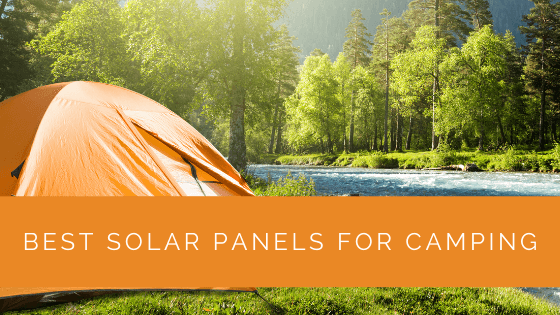
Whether you’re hiking in the Lake District, wild camping in Scottish Highlands, or spending a week at a music festival, a reliable solar panel for camping keeps your devices charged throughout your trip. The DOKIO 100W Portable Solar Panel stands out as the best all-rounder for its combination of power output, durability, and genuine portability, making it ideal for everything from van life to basecamp expeditions.
Solar panels have transformed how modern adventurers approach off-grid trips. Instead of carrying heavy battery packs or relying on noisy generators, you can harvest sunlight during the day to keep your phone, laptop, or solar generator topped up. We’ve tested dozens of camping solar panels to find the models that balance wattage, weight, and real-world performance in British conditions. If you also need lighting for your tent or group area, our guide to the best solar camping lanterns covers all the portable light options worth considering.
Contents
- 1 Our Top Picks
- 2 7 Best Solar Panels for Camping
- 3 Solar Panels for Camping Buying Guide
- 3.1 Key Takeaways
- 3.2 How Much Wattage Do You Need?
- 3.3 ETFE vs PVC: Panel Surface Materials
- 3.4 Output Connectors and Compatibility
- 3.5 Weight vs Wattage: The Backpacker’s Trade-Off
- 3.6 Bifacial Panels for Camping
- 3.7 Angle Adjustment and Stands
- 3.8 Daisy-Chaining Multiple Panels
- 3.9 Quick Features Checklist
- 4 Case Study: A Week in the Brecon Beacons
- 5 Expert Insights From Our Solar Panel Installers About Camping Solar Panels
- 6 Frequently Asked Questions
- 6.1 What size solar panel do I need for camping in the UK?
- 6.2 Do camping solar panels work in UK weather?
- 6.3 Can I charge a power station with a camping solar panel?
- 6.4 What is the difference between ETFE and PVC camping solar panels?
- 6.5 Can I charge a phone directly from a camping solar panel?
- 6.6 How do I get the most power from a camping solar panel in the UK?
- 6.7 Are camping solar panels compatible with all power stations?
- 6.8 Can I leave a camping solar panel out in the rain?
- 7 Summing Up
Our Top Picks
| Image | Name | |
|---|---|---|
| DOKIO 100W Portable Solar Panel | |
| Litheli 100W Portable Solar Panel Charger | |
| SWAREY 100W Portable Solar Panel Kit | |
| Mesuvida 100W Portable Solar Panel | |
| Renogy 100W Portable Solar Panel | |
| ALLPOWERS 100W Foldable Solar Panel | |
| ECO-WORTHY 100W Solar Panel Kit |
7 Best Solar Panels for Camping
1. DOKIO 100W Portable Solar Panel
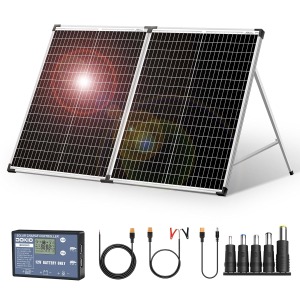
The DOKIO 100W is a solid choice for serious campers. This monocrystalline solar panel produces a genuine 100W of power, capable of charging most 12V portable power stations within 2-3 hours of good British summer sunlight. It’s designed in a briefcase format with an integrated kickstand, making setup quick and secure on uneven terrain. The panel weighs 6.8kg, and the carrying handle means you can transport it in your van or backpack without excessive strain.
What impresses most about the DOKIO is its charging speed in UK conditions. With roughly 3-4 hours of peak sun, you can realistically get 250-300Wh of charge per day. The integrated MC4 connectors work with any compatible 12V or 24V charge controller, and the panel includes a waterproof charge controller with cable connectors for different setups. Users report excellent durability even after years of regular camping trips across rough British terrain.
The panel’s monocrystalline cells deliver better performance in low-light conditions than cheaper alternatives, a crucial advantage on overcast British days. It’s water-resistant and designed to withstand the elements, though we recommend using the integral kickstand rather than relying on stakes alone in windy conditions.
The weatherproof design means it can handle rain and moisture without losing functionality. For basecamp camping where you’re staying in one location for several days, the DOKIO offers outstanding value.
Features
- 100W monocrystalline output (genuine peak wattage)
- Integrated kickstand and carrying handle
- MC4 connectors included
- Waterproof IP65 rating
- Weight: 6.8kg, dimensions: 77 x 68cm when open
- Temperature range: -40 to +85 degrees Celsius
- Includes 20A waterproof charge controller
- Genuine 100W output, reliable performance
- Excellent low-light performance for UK weather
- Sturdy integrated kickstand
- Good value for money
- Heavier than lightweight backpacking options
- Not the sleekest design
- Requires good sun to reach peak output
2. Litheli 100W Portable Solar Panel Charger
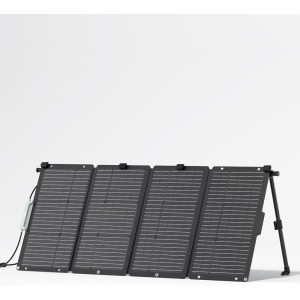
The Litheli 100W offers a modern take on portable camping solar. This monocrystalline panel weighs just 3.5kg despite its 100W output, making it significantly lighter than many competitors. The adjustable kickstand is more intuitive than traditional foldable designs, allowing you to angle the panel throughout the day as the sun moves across the sky. This positioning flexibility means you’ll capture more usable power on British days with dappled cloud cover.
Build quality is impressive for the price point. The monocrystalline cells are efficient in overcast conditions, and the weatherproof IP65 rating protects against UK rain and moisture. The multiple connectors (MC4, USB-A, and USB-C) mean it works with virtually any portable power station or device without adapters. For festival camping or van trips where weight matters but power output does too, Litheli strikes a sensible balance.
The design feels premium without excessive weight. At £129.99, it’s mid-range pricing, but the genuine quality feels evident. Customers report reliable multi-year performance, and the compact folded size means it fits easily into most vehicle storage spaces.
Features
- 100W monocrystalline output
- Lightweight design: 3.5kg
- Adjustable kickstand for positioning
- Waterproof IP65 rating
- Multiple connectors: MC4, USB-A, USB-C
- Foldable design with portable case included
- Compact folded dimensions
- Lightweight for its power output
- Adjustable positioning for better sun capture
- Multiple connector options
- Quality construction
- Mid-range pricing
- Not as rugged as heavier competitors
- Smaller team means less UK support
3. SWAREY 100W Portable Solar Panel Kit
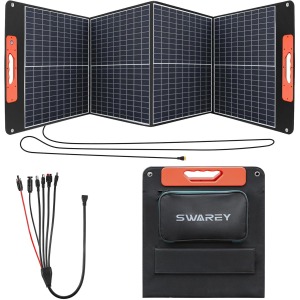
SWAREY positions itself as a value brand for UK campers, and the 100W model delivers genuine capability without premium pricing. This monocrystalline panel folds into a compact suitcase format with distinctive orange and black branding that stands out in campsites. The 60W USB-C fast charging output is genuinely useful for camping, allowing direct device charging without needing a separate power station.
The design emphasises versatility. You get MC4 connectors for power stations plus built-in USB outputs for phones and tablets. The foldable design works well on uneven ground, and the weatherproof construction handles British rain without concern. At £109.99, it’s competitive pricing for genuine 100W output, and UK availability means no waiting for imports.
Performance on overcast days is decent for the price point. The monocrystalline cells aren’t premium-grade (you’ll notice the difference compared to Renogy on grey days), but they still outperform cheaper polycrystalline alternatives. For festival camping or week-long trips where you’re not moving the panel daily, SWAREY offers solid value.
Features
- 100W monocrystalline output
- 60W USB-C fast charging port
- MC4 and USB connectors
- Foldable briefcase design
- Weight: 3.48kg
- Weatherproof construction
- Ray Tracer technology for efficient charging
- Excellent value for 100W output
- Fast USB-C charging built-in
- Lightweight and compact
- UK stock available
- Monocrystalline efficiency not premium
- Less familiar brand in UK market
- Plastic components feel less durable
4. Mesuvida 100W Portable Solar Panel
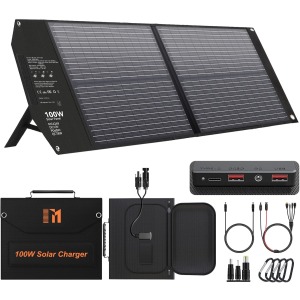
Mesuvida brings modern connectivity to camping solar with their 100W model. What sets this panel apart is the integrated 5 ports (24V MC4, DC, QC 3.0 USB-A, and USB-C PD 65W). This means you can charge phones, tablets, laptops, and power stations simultaneously without carrying additional adapters. For multi-device camping trips, the convenience factor is genuinely valuable.
The monocrystalline cells are efficient in UK overcast conditions, performing reliably across a range of weather. The foldable design is intuitive, and at around 70-95 pounds sterling, pricing is competitive for the feature set. The panel weighs approximately 5kg, which is acceptable for van camping even if it’s not lightweight for backpacking.
Build quality feels solid. The weatherproof design handles rain and moisture without concern. Users report good longevity, and the multiple ports mean you’re not limited to specific device types or charging ecosystems. For families camping or couples who each need their own device charged, Mesuvida solves the bottleneck problem elegantly.
Features
- 100W monocrystalline output
- 5 integrated charging ports
- 24V MC4 DC output
- USB-C Power Delivery 65W
- QC 3.0 USB-A fast charging
- Foldable design
- Weatherproof construction
- 5 charging ports in one panel
- USB-C Power Delivery is genuinely fast
- No adapters needed for most devices
- Reasonable price for feature set
- Mid-range weight (5kg)
- Less established brand than Renogy
- Fewer user reviews on UK market
5. Renogy 100W Portable Solar Panel
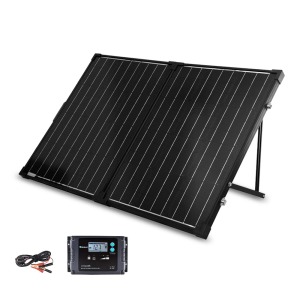
Renogy is the gold standard for serious campers. This monocrystalline solar panel produces a genuine 100W of power, capable of charging most 12V portable power stations within 2-3 hours of good British summer sunlight. The briefcase format with integrated kickstand and carrying handle makes setup quick and secure on uneven terrain. The panel weighs 6.8kg, and the design is built for durability across years of regular camping trips.
What impresses most about Renogy is charging speed and reliability in UK conditions. With roughly 3-4 hours of peak sun, you can realistically get 250-300Wh of charge per day. The integrated MC4 connectors work with any compatible 12V or 24V charge controller. The package includes a 20A waterproof charge controller with comprehensive cable connectors, meaning you can set up systems without buying additional parts.
The monocrystalline cells deliver better performance in low-light conditions than cheaper alternatives, a crucial advantage on overcast British days. Temperature compensation means the panel continues charging efficiently even on cool British autumn days when other brands might see voltage drop. This is the premium choice for campers who want to rely on their solar setup absolutely.
Features
- 100W monocrystalline output (genuine peak wattage)
- Integrated kickstand and carrying handle
- MC4 connectors with 10 AWG cables
- Includes 20A waterproof charge controller
- Weight: 6.8kg, dimensions: 77 x 68cm when open
- Temperature range: -40 to +85 degrees Celsius
- IP65 water resistance rating
- Premium build quality and reliability
- Excellent low-light performance for UK weather
- Includes charge controller
- Proven track record with UK campers
- Premium pricing
- Heavier than lightweight options
- Overkill for casual day trips
6. ALLPOWERS 100W Foldable Solar Panel
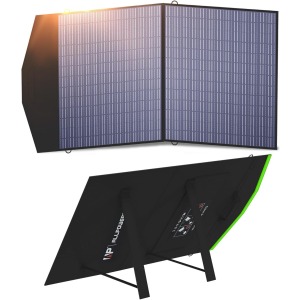
ALLPOWERS offers genuine competition to Renogy at a slightly lower price point. This 100W monocrystalline panel comes in a foldable suitcase design with solid construction. The MC4 connectors work with any compatible charge controller, and the integrated kickstand is sturdy enough for windy conditions when properly deployed with guy ropes.
The build quality matches or exceeds competitors in the price range. Users report multi-year reliability, and the UK availability means you’re not waiting weeks for delivery. The monocrystalline cell efficiency is competitive, and performance on overcast British days is respectable. The foldable design means you can angle sections towards the sun for optimised positioning.
At around £130-170, it occupies the middle ground between budget options and premium Renogy pricing. For van campers and basecamp setups where weight isn’t a limiting factor, ALLPOWERS delivers genuine value without compromising on key specifications.
Features
- 100W monocrystalline output
- Briefcase suitcase style design
- MC4 connectors
- Integrated kickstand with rope attachments
- Weight: 7kg, dimensions: 75 x 68cm when open
- Smart charging chip
- IP65 waterproof rating
- Better value than Renogy
- Solid build quality
- UK stock availability
- Excellent power output
- Kickstand not quite as robust as Renogy
- Slightly heavier than some alternatives
- Less established UK presence
7. ECO-WORTHY 100W Solar Panel Kit
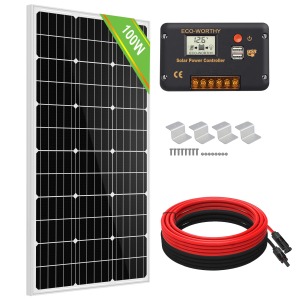
ECO-WORTHY brings an interesting angle to camping solar with their 100W kit that includes a 20A charge controller. This makes setup simpler if you’re building a 12V system for van electrics or caravan use. The monocrystalline panel is decent quality, and including the controller removes a decision point (what controller to buy?) that confuses many first-time users.
The kit approach means you get a complete system rather than just a panel. This is genuinely useful if you’re new to solar camping or building out a caravan power system. The 100W output is genuine, and the included controller handles the voltage regulation automatically. For simplicity and getting started with minimal hassle, this kit is genuinely sensible.
Build quality is solid, and UK customers report good reliability. The weatherproof design handles rain and moisture, and the panel folds reasonably well for storage. At around £80-110, it offers excellent value for a complete kit rather than components bought separately.
Features
- 100W monocrystalline output
- Portable folding design
- Includes 20A charge controller
- MC4 connectors
- Lightweight design
- Waterproof IP67 rating
- Camping essentials included
- Complete kit includes everything needed
- No need to buy controller separately
- Excellent value for complete system
- Straightforward setup
- Controller fixed (can’t upgrade separately)
- Panel efficiency average for class
- Less premium feel than higher-priced options
Solar Panels for Camping Buying Guide
Key Takeaways
- Portable folding solar panels are the right choice for camping, they pack flat, set up in seconds, and can be angled to face the sun directly rather than lying flat on a tent or van roof.
- ETFE laminate panels are more durable and lighter than PVC-laminate equivalents, worth the small price premium for anything that will see regular outdoor use.
- Match the panel’s output connector to your power station or device. USB-C PD is increasingly the universal standard; Anderson and XT60 connectors suit dedicated solar power stations.
- Weight-to-wattage ratio matters enormously for backpacking. For car camping or festival use, it matters much less, prioritise wattage instead.
- UK overcast performance differs by panel technology. Monocrystalline panels outperform polycrystalline in diffuse light, an important factor for British camping weather.
- For serious off-grid camping, pair your panel with a solar power station rather than just a small power bank, you need the battery capacity to store energy from morning sun for evening use.
How Much Wattage Do You Need?
The answer depends entirely on what you are trying to power. A 20-25W panel is enough to keep a phone charged and power a small USB light on a weekend camp. A 60-100W panel covers phone charging, a power bank top-up, a laptop, and a USB fan. A 120-200W panel, paired with a solar power station, gives you enough stored energy to run a small compressor fridge, charge multiple devices, and power LED lighting for an evening, the kind of setup that works well for extended festival camping or a two-week trip.
The critical pairing is panel wattage and battery capacity. A 100W panel generating power during the day is only useful if you have somewhere to store that energy for use in the evening. A portable solar power station (EcoFlow, Jackery, Anker SOLIX, and similar brands) is designed exactly for this, the panel charges the station during daylight hours, and you draw from the station when you need power. For camping with meaningful power needs, think of the panel and power station as a single system, not separate purchases.
ETFE vs PVC: Panel Surface Materials
The vast majority of portable folding camping panels use either ETFE (ethylene tetrafluoroethylene) or PVC as the surface laminate over the solar cells. ETFE is the better material on both performance and durability counts, but it costs more to produce, which is why cheaper panels use PVC.
ETFE is harder, scratch-resistant, UV-stable, and transmits slightly more light to the cells than PVC. It is also significantly lighter, relevant for backpacking panels. PVC is softer, more prone to scratching, can yellow with UV exposure over several years, and has a slightly lower light transmittance. For a panel used occasionally on summer camping trips, PVC is perfectly functional. For a panel that will see weekly use across multiple seasons, ETFE is the better long-term investment.
Some higher-end panels use tempered glass cells in a semi-rigid configuration. These offer the best performance and cell protection but sacrifice portability, they fold but are heavier and bulkier than cloth-backed flexible designs. Semi-rigid glass panels make more sense for van life setups than for carrying to campsites.
Output Connectors and Compatibility
This is where buying decisions go wrong most often. A panel that produces 100W is useless if you cannot connect it to what you want to charge. Check connectors carefully before buying.
USB-A and USB-C ports built into the solar panel are suitable for charging phones, tablets, and small power banks directly. USB-C PD (Power Delivery) ports at 45W or higher can charge laptops. Most modern quality camping panels include at least one USB-C PD port built in.
For solar power stations (EcoFlow, Jackery, Anker SOLIX, Goal Zero, and others), the input connector varies by brand. Anderson connectors (also called Anderson Powerpole or Anderson SB), XT60, and MC4 are the common formats. Most solar power stations come with a cable that adapts from the panel’s output connector, but check compatibility between your specific panel and power station before buying. EcoFlow and Jackery both publish lists of compatible solar panels, buying within-brand eliminates compatibility guesswork.
For charging a leisure battery directly (caravan, campervan, or battery box), the panel needs to connect via a charge controller, not directly to the battery terminals. Some portable camping panels include a built-in USB charge controller; for battery charging you need a separate MPPT or PWM controller.
Weight vs Wattage: The Backpacker’s Trade-Off
A typical 100W folding panel weighs 2.5-4kg. A compact 25W ultralight backpacking panel can weigh under 500g. The efficiency difference between a 25W panel and a 100W panel is exactly what those numbers imply, the bigger panel charges four times faster. The question is how much weight you can carry and whether your power needs justify the extra mass.
For backpacking and wild camping where you genuinely carry everything on your back, 20-40W is a practical ceiling for most people. These panels are designed to attach to the outside of a rucksack with clip loops, trickle-charging a power bank while you walk. On a full day’s hike with good sun, a 20W panel attached to a pack can deliver 60-80Wh, enough to fully charge a phone two or three times.
For car camping, festivals, or van travel, weight is largely irrelevant, so you should simply buy as many watts as your budget allows and your power station can accept. A 200W panel costs only modestly more than a 100W panel but delivers twice the daily energy. The only meaningful limit is how much space it takes up folded in the boot.
Bifacial Panels for Camping
Bifacial solar panels generate power from both sides of the panel, the front captures direct sunlight, and the back captures reflected light from the ground, a tent, or a nearby surface. In a camping context, bifacial panels positioned over light-coloured gravel, a pale tarp, or a reflective surface can generate 5-15% more power than a monofacial panel of the same rating. This is particularly useful in overcast UK conditions where reflected diffuse light from the ground adds a meaningful fraction to the total harvest. A small premium, but worth considering if you camp on open, light-surfaced ground.
Angle Adjustment and Stands
A panel lying flat on the ground in the UK is significantly underperforming compared to one angled toward the sun. At UK latitudes, the optimal angle in summer is roughly 30-40° from horizontal. In winter, 60-70° is better to capture the low winter sun angle.
Good portable camping panels include built-in kickstands or adjustable leg systems that hold the panel at an optimal angle. Some include a simple hinge-and-latch mechanism on the fold so the open panel naturally sits at a moderate angle. Being able to reangle the panel twice during the day to roughly follow the sun can increase daily harvest by 20-30% compared to a fixed flat deployment.
Daisy-Chaining Multiple Panels
If your power station supports higher solar input (many EcoFlow and Jackery models accept 200-400W), running two panels in parallel doubles your charging speed. Some panel ranges include MC4 parallel connectors for exactly this. Check your power station’s maximum solar input wattage and open circuit voltage (Voc) before connecting multiple panels, exceeding the rated input voltage can damage the charge controller in the power station.
Quick Features Checklist
- Wattage: 20-40W for backpacking; 100-200W for car camping/festival; 200W+ for extended off-grid
- Surface: ETFE for regular use and durability; PVC adequate for occasional trips
- Cell type: monocrystalline for best UK overcast performance
- Connectors: check USB-C PD wattage; confirm compatibility with your power station or device
- Weight: critical for backpacking; largely irrelevant for car camping
- Angle adjustment: kickstand or adjustable legs for optimised sun angle
- Bifacial option: marginal but real advantage on reflective surfaces
- Power station compatibility: buy within-brand or check connector lists before purchase
Case Study: A Week in the Brecon Beacons
Background
A couple set out on a week-long hiking and wild camping trip across the Brecon Beacons in Wales. They’d normally rely on caravan sites with mains hookup or frequent trips to town for battery recharging. This trip, they decided to test a solar-powered approach using a 100W panel and mid-sized portable power station.
Project Overview
The setup included a Renogy 100W portable solar panel, a Jackery Explorer 240 power station (240Wh capacity), and two phones, a laptop, and a headlamp as daily charging loads. Total weight was approximately 18kg. The trip ran across seven days in early July, typical for British summer mountain weather: three clear days with good sun, two partly cloudy mornings, and two days of rain.
Implementation
Each morning they’d set the solar panel on a south-facing slope near the campsite, angling it towards the peak sun hours (10am-3pm). Afternoon clouds often meant charging slowed significantly. Rainy days rendered the panel nearly useless. They manually repositioned the panel twice daily to track the sun’s changing angle through the week, investing roughly 5 minutes daily in optimisation.
The power station received roughly 100-150Wh per clear day and 20-40Wh on cloudy days. They charged devices moderately: one full phone charge per person daily, evening laptop use (30 minutes), and headlamp top-up. The headlamp barely drained the battery; the laptop was the power hog.
Results
The system worked reliably across the week. On clear days, the power station maintained good charge levels with comfortable buffer. On cloudy days, they moderated laptop use, saving it for evening basecamp work rather than daytime use during hikes. The rainy days were toughest; they’d pre-charged the power station the previous evening, giving them enough buffer to skip a day of active charging without hardship.
They charged the headlamp once via USB directly from the solar panel (bypassing the power station) on the sunniest afternoon, proving even small solar trickle charging works. By week’s end, they’d successfully powered their trip using only solar energy, despite UK weather challenges. They concluded that a 100W panel plus 200+Wh battery is robust enough for a week-long camping trip provided you moderate power consumption and plan for cloudy days.
Expert Insights From Our Solar Panel Installers About Camping Solar Panels
“Camping solar is where many of our customers get their first hands-on experience with real solar energy,” notes one of our senior solar panel installers with over 12 years’ experience in UK installations. “People learn how weather affects output, how angle matters, and how to estimate realistic charging. That knowledge transfers directly to understanding residential solar systems. We often see campers who’ve mastered portable panels become confident advocates for home solar installation.”
“The biggest surprise for first-time camping solar users is how slow charging seems on UK overcast days. A 100W panel might feel like it’s barely working on a grey morning, producing just 20-30W. But that’s realistic. Our residential installations experience the same British weather. The difference is scale: a 5kW home system can accumulate several kWh even on cloudy days. The physics is identical.”
“For vehicle electrics and off-grid systems, I always recommend people start with a portable camping panel to test their charging strategy. Spend a summer experimenting with camping solar, and you’ll make better decisions about sizing a permanent installation. You’ll understand your actual power consumption and realistic UK sun hours far better than any calculation.”
Frequently Asked Questions
What size solar panel do I need for camping in the UK?
For a basic camping setup, phone charging, a small light, and a power bank top-up, a 20-40W folding panel is sufficient. For a more comfortable setup with a laptop, a small fan, and multiple device charging, 60-100W is a better fit. If you want to run a small compressor fridge or have significant daily power needs, pair a 100-200W panel with a solar power station of 500Wh or more. UK camping weather means you should size up from the minimum, expect 3-4 effective sun hours on a clear day rather than the 5-6 you would get in southern Europe.
Do camping solar panels work in UK weather?
Yes, but at reduced output compared to southern Europe. A quality monocrystalline panel generates around 10-25% of its rated output in heavy overcast and 30-60% on a bright cloudy day. On a clear UK summer day, expect 70-85% of rated output if the panel is well-angled. This means a 100W panel can realistically deliver 200-350Wh on a typical good UK summer camping day. ETFE-surface and monocrystalline panels generally outperform cheaper PVC/polycrystalline panels in diffuse UK light conditions.
Can I charge a power station with a camping solar panel?
Yes, this is exactly what most people use them for. The key is connector compatibility, check that the panel’s output connector matches the power station’s solar input port (common formats include Anderson, XT60, MC4, and proprietary connectors). Most solar power stations come with adaptor cables, but it is worth confirming before buying. Also check the power station’s maximum solar input wattage and Voc (open circuit voltage) limit, connecting a panel that exceeds these limits can trip the protection circuit or damage the unit.
What is the difference between ETFE and PVC camping solar panels?
ETFE (ethylene tetrafluoroethylene) and PVC are the two common surface laminate materials used on portable folding camping panels. ETFE is harder, lighter, scratch-resistant, and UV-stable, and transmits slightly more light to the cells. PVC is softer, cheaper to manufacture, more prone to surface damage, and can yellow with prolonged UV exposure. For occasional camping use, PVC panels are functional and represent good value. For regular use across multiple seasons, ETFE panels hold up better and maintain their output more consistently over time.
Can I charge a phone directly from a camping solar panel?
Yes, most portable camping panels include built-in USB-A and USB-C ports that can charge phones and small devices directly. USB-C PD ports at 18W or higher charge modern smartphones at full speed. The limitation of direct charging from a panel is that output fluctuates with light conditions, cloud passing over the panel may temporarily pause or slow charging. For a more consistent experience, charge a power bank from the panel during daylight hours and charge your phone from the power bank, this smooths out the variable solar input.
How do I get the most power from a camping solar panel in the UK?
Angle the panel toward the sun rather than laying it flat, at UK latitudes in summer, aiming for roughly 30-40° from horizontal and facing south maximises output. Reangle the panel midday if it has been morning-optimised. Avoid shading even a single cell, one shaded cell disproportionately reduces the output of the entire panel or string. Keep the surface clean and dry. Pair the panel with an MPPT charge controller or use a power station with built-in MPPT to extract maximum power in variable conditions. On overcast days, position the panel in the open rather than close to trees or structures that could partially shade it.
Are camping solar panels compatible with all power stations?
Not universally. Compatibility depends on two things: the connector type and the power station’s input specifications (maximum wattage and Voc). Major brands like EcoFlow, Jackery, and Anker SOLIX each publish lists of compatible third-party panels and the required connector types. Buying within the same brand is the safest approach, a Jackery SolarSaga panel will always work with a Jackery Explorer power station. For cross-brand combinations, check the power station’s maximum solar input Voc before connecting any panel, as some panels have a high open circuit voltage that could exceed the power station’s rated limit.
Can I leave a camping solar panel out in the rain?
Most quality folding camping panels have an IP67 or IP65 rating for the cells and laminate, meaning the panel surface is waterproof. What varies is the rating of the junction box and cable connections, some are waterproof, others are only splash-resistant. Leaving a panel face-up in light rain is generally fine and it will continue generating power (albeit at reduced output). Leaving the junction box and cable connections submerged or in standing water is a risk if they are not rated for it. If caught in heavy rain, fold the panel and stow the cables to be safe. Check the specific IP rating of the product before leaving it permanently outdoors in wet UK weather.
Summing Up
Choosing the best camping solar panel depends on your specific trip type. For van life and basecamp camping, a 100W monocrystalline panel like the DOKIO, Renogy, or ALLPOWERS delivers the power you need. For lighter camping, consider the Litheli or Mesuvida options which balance output and weight. For complete beginners, the ECO-WORTHY kit approach removes guesswork and includes everything needed to get started.
British camping presents unique challenges. Our short summers and frequent cloud cover mean realistic UK sun output is lower than sunny European or American conditions. Plan accordingly: size your panel and battery for cloudy days, not clear ones. A 100W panel that peaks at 100W on a clear day will average 40-50W across a typical week. Design your charging strategy around this reality.
For a professionally installed solar system on your home, contact us for a free quote. Our installers can assess your roof orientation, shading, and energy needs to design a system matching UK weather conditions. The principles learned from camping solar directly inform home installations, and many of our customers start their solar journey with portable panels.
If you have a motorhome or campervan and want a more permanent fitted solar system, our detailed guide to solar panels for camper vans covers system sizing, battery options, MPPT controllers, and wiring from scratch.
Updated