

The Renogy 100W N-Type 16BB Solar Panel is the best choice for most UK buyers in 2026, delivering cutting-edge N-type cell efficiency at a price that’s hard to argue with. Whether you’re powering a garden shed, kitting out a campervan, or adding panels to an off-grid system at a rural property, the panel you choose will define how much free electricity you generate through every season of the British year.
We’ve tested and reviewed eight solar panels available right now on Amazon.co.uk, covering everything from compact 50W units for small applications to 200W flexible panels for boats and motorhomes. Every product has been chosen for its UK availability, genuine customer ratings, and real-world suitability for British weather conditions.
Contents
- 1 Our Top Picks
- 2 8 Best Solar Panels for UK Use
- 2.1 1. Renogy 100W N-Type 16BB Solar Panel
- 2.2 2. Renogy 100W 12V Portable Solar Panel with 20A Controller
- 2.3 3. Renogy 100W 12V Monocrystalline Solar Panel (Compact Design)
- 2.4 4. Renogy 200W 12V Monocrystalline Solar Panel
- 2.5 5. ECO-WORTHY 240W Bifacial Solar Panel Kit (2 x 120W)
- 2.6 6. Renogy 200W Flexible Solar Panel
- 2.7 7. Renogy 100W 12V High-Efficiency Monocrystalline Module
- 2.8 8. Renogy 50W 12V Monocrystalline Solar Panel (Compact)
- 3 Best Solar Panels for Leisure and Portable Use Buying Guide
- 3.1 Key Takeaways
- 3.2 Understanding the Leisure Solar Market vs Rooftop Installation
- 3.3 Technology Generations: PERC vs N-Type TOPCon and Real UK Performance
- 3.4 Wattage Sizing for Different Applications
- 3.5 Rigid vs Flexible Panels and the Efficiency Trade-Off
- 3.6 PWM vs MPPT Charge Controllers: Worth the Investment
- 3.7 Bifacial Panels and Reflective Surface Gains
- 3.8 Brand Reliability and After-Sales Support
- 4 Case Study: Adding Solar to a Workshop in Yorkshire
- 5 Expert Insights From Our Solar Panel Installers About Off-Grid Solar Panels
- 6 Frequently Asked Questions
- 6.1 What size solar panel do I need for a shed or workshop in the UK?
- 6.2 How much does a solar panel generate in the UK?
- 6.3 What’s the difference between MPPT and PWM charge controllers?
- 6.4 Do solar panels work in cloudy UK weather?
- 6.5 Can I connect multiple solar panels together?
- 6.6 Are flexible solar panels as good as rigid ones?
- 6.7 What battery type works best with solar panels?
- 6.8 How do I know if a solar panel is good quality?
- 7 Summing Up
Our Top Picks
| Image | Name | |
|---|---|---|
| Renogy 100W N-Type 16BB Solar Panel | |
| ECO-WORTHY 240W Bifacial Solar Panel Kit (2x120W) | |
| Jackery SolarSaga 100W Portable Solar Panel | |
| BROWEY 120W Foldable Solar Panel | |
| Renogy 100W Solar Panel + 20A MPPT Controller Kit | |
| ECO-WORTHY 130W Flexible Solar Panel | |
| Renogy 100W High-Efficiency Monocrystalline Solar Panel | |
| Renogy 50W Compact Solar Panel |
8 Best Solar Panels for UK Use
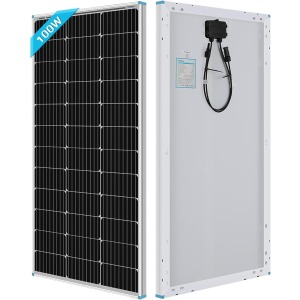
1. Renogy 100W N-Type 16BB Solar Panel
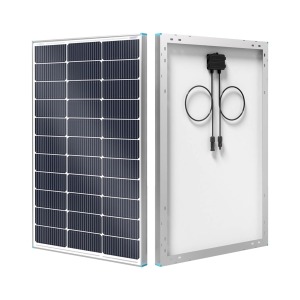
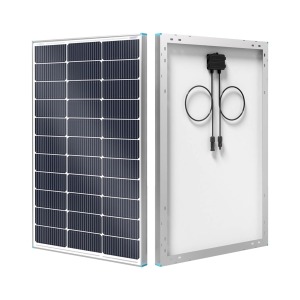
If you want the best technology currently available in a 100W panel without paying a premium for a big-name residential brand, this is it. The N-type cell with 16 busbars is the same architecture used in high-end residential panels from manufacturers like LONGi and Jinko, but packaged here in a compact off-grid format that works as well on a shed roof in Aberdeen as it does on a narrowboat in the Cotswolds.
N-type silicon has a lower temperature coefficient than conventional P-type PERC cells, which means it loses less output on hot summer days. In the UK, this benefit is modest given our mild climate, but the more significant advantage is that N-type cells degrade more slowly over time. Renogy rates this panel at just 0.4% annual degradation, compared to 0.5 to 0.7% for older monocrystalline designs. Over a 25-year lifespan, that adds up to noticeably more cumulative generation.
The 25% cell efficiency is the headline number, and it genuinely shows up in practice. A 100W N-type panel generates more in a given area than any 100W P-type panel, which matters if you’re constrained by roof or mounting space. The pre-attached MC4 connectors and junction box rated to IP67 make installation straightforward, and the heavy-gauge aluminium frame handles the UK’s regular strong winds without flexing.
At this price point, there are few genuine criticisms to make. N-type technology is newer, so there’s less long-term real-world data than for the older Renogy PERC models, but the manufacturer warranty is solid and Renogy has a strong track record in the UK market.
Features
- 100W, N-type monocrystalline, 25% efficiency
- 16 busbars for improved current collection
- Temperature coefficient: -0.29%/°C
- Annual degradation: ≤0.4%
- 12V system compatible
- Tempered glass, aluminium alloy frame
- IP67 junction box with MC4 connectors pre-attached
- Dimensions: 1130 x 545 x 30mm, approx. 5.5kg
- Best-in-class efficiency at this price
- Excellent low-light performance for UK conditions
- Lower degradation rate than P-type equivalents
- Pre-attached MC4 connectors save installation time
- Less long-term real-world data than older Renogy PERC models
- Only available in 100W, not a wider wattage range
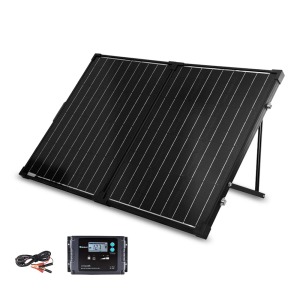
2. Renogy 100W 12V Portable Solar Panel with 20A Controller
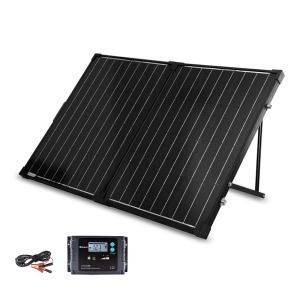
This kit stands out because it includes everything you need to start generating power immediately: the panel, a 20A PWM charge controller, cables, and mounting brackets, all in one box. For buyers who want a complete, no-fuss entry into solar without spending hours researching compatible controllers and cabling, it’s genuinely the easiest starting point on this list.
The panel itself is a conventional PERC monocrystalline design at 21.3% efficiency. That’s a step below the N-type model above, but more than adequate for the vast majority of off-grid applications. The 20A controller is capable of handling a second 100W panel if you want to expand later, which gives the kit decent room to grow without needing to replace the controller.
For UK buyers, the value here is in the bundled controller. A decent 20A MPPT controller on its own costs £30 to £50. Getting it included at minimal extra cost over the panel-only price makes this kit a strong buy for a first off-grid setup. The 25-year power output warranty is the standout for long-term peace of mind.
Features
- 100W monocrystalline, 21.3% efficiency
- Includes 20A PWM charge controller
- Pre-drilled holes for mounting brackets
- Bypass diodes to reduce shading losses
- IP67 junction box
- 25-year power output warranty
- Works with 12V and 24V battery systems
- Complete kit: panel and controller in one purchase
- 20A controller handles a second 100W panel for expansion
- Excellent value versus buying components separately
- 25-year power output warranty
- PWM rather than MPPT controller limits efficiency gains in partial shade
- Lower cell efficiency than the N-type model
3. Renogy 100W 12V Monocrystalline Solar Panel (Compact Design)
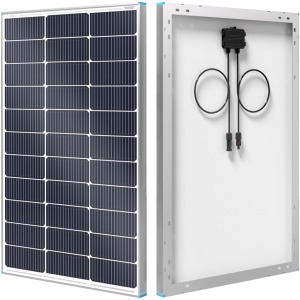
The compact design format exists for a good reason: sometimes a standard 100W panel is simply too wide for the space available. At a narrower profile than the standard model, this one fits mounting locations that would otherwise be impossible, including the narrower roofs of some older shed designs, slim van roof sections, and boat cabin tops where width is tight.
This is a proven PERC monocrystalline panel that’s been in the Renogy range long enough to have thousands of UK user reviews behind it. You’re paying a modest premium over the kit version for the compact form factor and the confidence that comes with extensive real-world data. The 25-year power output warranty is the same across Renogy’s range.
Features
- 100W monocrystalline PERC, 21.3% efficiency
- Compact/narrower profile versus standard 100W design
- Heavy-gauge aluminium frame with pre-drilled holes
- Bypass diodes minimise shading losses
- IP67 junction box, MC4 connectors
- 25-year power output warranty
- Compact profile for tight mounting spaces
- Extensive UK buyer track record
- 25-year output warranty
- Bypass diodes reduce shade impact
- Slightly higher price per watt than the kit model
- P-type PERC rather than newer N-type cells
s=”btn standard-button shop-now-link” target=”_blank” rel=”nofollow noopener”>CHECK PRICE
4. Renogy 200W 12V Monocrystalline Solar Panel
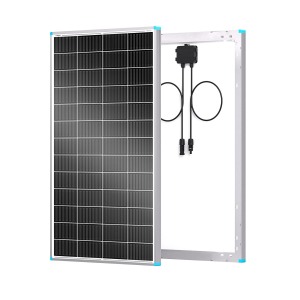
When you need serious output from a single panel, 200W is the sweet spot for off-grid applications where space is limited but power demand is high. A single 200W panel in good UK summer conditions generates 700 to 1,000Wh on a sunny day, which is enough to power a 12V fridge, LED lighting, and charge phones and laptops with capacity to spare.
The Renogy 200W rigid panel is a natural step up for buyers who’ve started with 100W and found they need more. It uses the same heavy-gauge aluminium frame and bypass diode design as the smaller models, scaled up. Pairing two of these with a quality MPPT charge controller gives you a 400W system capable of handling most modest off-grid homes, sheds, or live-aboard boats.
It’s worth noting that at 200W, you’re moving into territory where a quality MPPT charge controller makes a real difference. PWM controllers work fine with 100W panels, but at 200W and above the extra charge efficiency from an MPPT unit starts to pay for itself within the first year of use.
Features
- 200W monocrystalline, 21% efficiency
- 12V system compatible (24V with two panels in series)
- Heavy-gauge aluminium frame
- Pre-drilled holes for multiple mounting options
- IP67 junction box
- 25-year output warranty
- High output from a single panel
- Proven build quality across the Renogy range
- Suits most off-grid, shed, and boat applications
- 25-year output warranty
- Larger physical size requires sufficient unshaded mounting area
- Works best with MPPT controller, adding to overall cost
5. ECO-WORTHY 240W Bifacial Solar Panel Kit (2 x 120W)
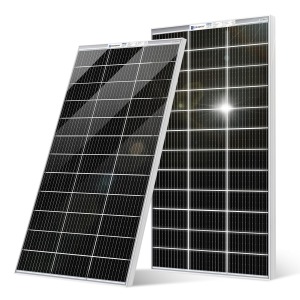
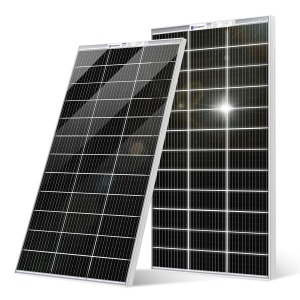
Bifacial panels generate electricity from both the front and rear surfaces, capturing reflected light from the ground or mounting surface below. In the right conditions, that adds 5 to 15% to your total output for no extra installation effort. The ECO-WORTHY kit bundles two 120W bifacial panels with a 30A charge controller, making it an attractive plug-and-play option for anyone wanting a 240W bifacial setup without sourcing components separately.
The performance gain from bifacial panels is most pronounced when mounted above a light-coloured or reflective surface: white gravel, light concrete, or painted metal. On a dark roof or above grass, the rear-side gain is minimal. UK buyers considering this kit should assess their mounting surface honestly before assuming they’ll see the full bifacial benefit.
That said, even as a conventional front-only panel, 240W at this price point is competitive, and the bundled 30A controller handles the combined output comfortably. It’s a solid choice for allotment sheds, small workshops, and garden offices where cost-per-watt matters.
Features
- 2 x 120W bifacial monocrystalline panels (240W total)
- Rear-side generation: +5 to 15% depending on surface albedo
- Includes 30A charge controller
- Aluminium frame, tempered glass front
- IP67 junction box
- Suits 12V and 24V systems
- 240W combined output at a competitive price
- Bifacial bonus output where mounting surface is reflective
- Complete kit with charge controller included
- Bifacial gain minimal on dark or grass surfaces
- Two separate panels require more mounting hardware than a single 240W unit
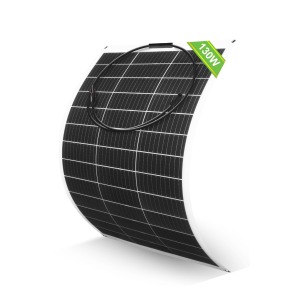
6. Renogy 200W Flexible Solar Panel
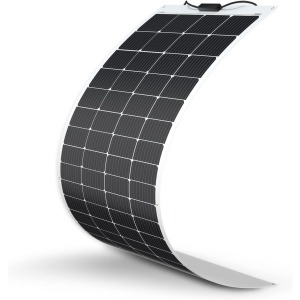
Flexible solar panels exist for one reason: rigid aluminium-framed panels can’t be mounted on curved surfaces. If you have a curved motorhome roof, a boat cabin top with a gentle arc, or a van conversion where flush mounting is essential for aerodynamics, a flexible panel is the only practical option. This 200W unit from Renogy is the most popular choice in this category for UK buyers.
It’s worth being honest about the trade-offs. Flexible panels run hotter than rigid ones because they can’t dissipate heat as efficiently when bonded directly to a surface. Heat reduces output and accelerates cell degradation. The warranty period on flexible panels is typically shorter than on rigid ones for this reason. If you have the option to use a rigid panel, it will generate more power over its lifetime.
But for applications where rigid isn’t an option, this panel delivers. At 200W it provides genuine usable output, the installation is straightforward with the included grommets and adhesive mounting kit, and Renogy’s track record means the build quality is reliable.
Features
- 200W flexible monocrystalline
- Bends up to 248 degrees, suitable for curved surfaces
- Ultra-thin and lightweight design
- Pre-drilled holes and eyelets for flexible mounting
- IP67 junction box, MC4 connectors
- Suitable for 12V/24V systems
- Only option for curved or flush-mounted surfaces
- Lightweight, ideal for weight-sensitive applications
- High output at 200W
- Runs hotter than rigid panels, reducing efficiency and lifespan
- Shorter warranty than rigid equivalents
- Not suitable where a rigid panel can be used instead
7. Renogy 100W 12V High-Efficiency Monocrystalline Module
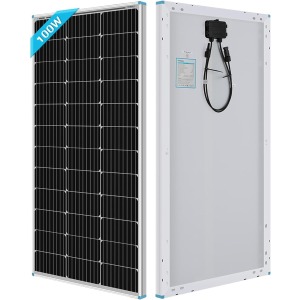
This panel occupies a sensible niche: a well-proven, mid-range 100W monocrystalline unit that’s accumulated years of positive UK buyer feedback. It’s not the newest technology on the list, but it works reliably, the efficiency is competitive for a P-type design, and the price reflects its position as a mainstream workhorse rather than a premium product.
The bypass diodes and sturdy IP67 junction box are standard across Renogy’s range and represent genuine quality at this price point. For buyers who don’t need the latest N-type cells and just want a reliable, well-regarded panel that’ll work for decades with minimal fuss, this is a thoroughly solid choice.
Features
- 100W monocrystalline, 21% efficiency
- Standard form factor, versatile mounting
- Bypass diodes for shade tolerance
- IP67 junction box
- 25-year power output warranty
- Compatible with 12V/24V systems
- Proven long-term track record in UK conditions
- Reliable build quality
- 25-year output warranty
- Older P-type technology versus N-type alternatives
- Slightly less efficient than top picks
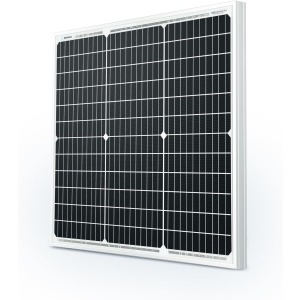
8. Renogy 50W 12V Monocrystalline Solar Panel (Compact)
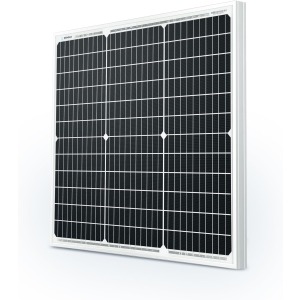
Sometimes 100W is more than you need. A 50W panel is the right choice for trickle-charging a leisure battery in a caravan that sits unused for weeks, maintaining a battery in a gate motor or remote sensor, or running a small security camera setup. At this size, the panel is light enough to move around easily and small enough to tuck into spaces where a full-size panel won’t fit.
It’s not the panel for powering a workshop or running a fridge, but it’s genuinely excellent at what it’s designed to do. If your power demands are modest or intermittent, buying a larger panel than you need is simply a waste of money. And this 50W compact delivers everything a small-load application requires.
Features
- 50W monocrystalline, 21% efficiency
- Compact, lightweight design
- IP67 junction box
- Suitable for 12V battery maintenance
- 25-year power output warranty
- Ideal for small/low-drain applications
- Compact and easy to move or reposition
- Excellent value for trickle-charge use cases
- Too small for running appliances or charging high-capacity batteries quickly
- Not cost-effective if you expect to scale up significantly
Best Solar Panels for Leisure and Portable Use Buying Guide
Key Takeaways
- Portable solar panels (100-200W) are leisure-grade, not rooftop solar — they’re for caravans, sheds, camping, and off-grid use
- Monocrystalline PERC panels (standard 2020-2024) are efficient and reliable; newer N-Type TOPCon panels add 3-5% efficiency for 15-20% more cost
- Wattage tiers: 100W tops up USB devices and lights; 200W powers small appliances; 400W+ systems need serious space and multiple panels
- Rigid panels are more efficient and durable; flexible panels are lighter and suit curved surfaces but lose 10-15% efficiency
- MPPT charge controllers (vs cheaper PWM) are worth the £100-200 extra — they capture 20-30% more energy in UK overcast conditions
- Bifacial panels gain 5-15% extra output from reflective surfaces (white gravel, snow) — useful on sheds with white-painted roofs
Understanding the Leisure Solar Market vs Rooftop Installation
When you search “best solar panels,” results split into two completely different categories. Professional rooftop panels for full-home installation (400W+, designed for 25-year lifespan on a house) versus consumer leisure panels (50-200W, designed for portability, off-grid use, and flexibility). This guide focuses on leisure panels because they’re what real gardeners buy for sheds, caravans, and DIY off-grid projects.
Leisure panels are smaller, lighter, and more flexible in installation. They don’t have the warranty infrastructure of professional rooftop panels (which require MCS-certified installation and 25-year guarantees). But they’re perfect for camping, motorhomes, garden sheds, and weekend projects where you want solar without the £5,000+ commitment of a full rooftop system.
If you’re searching for home rooftop solar panels, see our dedicated article “Best Solar Panels for Home UK” which covers professional installation-grade panels.
Technology Generations: PERC vs N-Type TOPCon and Real UK Performance
| Technology | Efficiency | Low-Light Performance (Overcast) | Cost | Availability in Leisure Panels |
|---|---|---|---|---|
| Polycrystalline (older) | 16-17% | Poor | Lowest | Rare now; avoid |
| Monocrystalline PERC (standard 2020-2024) | 19-21% | Good | Mid | Most available options |
| N-Type TOPCon (premium 2024+) | 22-24% | Excellent | Mid-High (+15-20%) | Emerging in leisure panels |
| Heterojunction (HJT) (premium cutting-edge) | 24-26% | Excellent | High (+25-30%) | Rare in leisure panels |
For leisure panels, PERC monocrystalline (19-21% efficiency) is the sensible default. These panels have been proven in the market for 5+ years, cost a reasonable amount, and perform well in UK conditions. A PERC 200W leisure panel costs around £180-250.
TOPCon panels (22-24% efficiency) are emerging in the leisure market and are worth considering if you want better low-light performance on overcast UK days. They cost 15-20% more (around £220-300 for 200W), but you get noticeably better output on grey days — which matters in the UK.
Heterojunction (HJT) panels are cutting-edge and rarely available in the leisure segment yet. Skip them unless you find a specific premium leisure panel brand offering them.
Wattage Sizing for Different Applications
The wattage you need depends entirely on what you’re powering. This is crucial to get right. A 50W panel won’t meaningfully charge a caravan, but a 400W system is overkill for a shed with just a few LED lights.
100W panel: Tops up USB devices, powers small LED lights, keeps a small fan or portable speaker running. Real-world output in UK sun: 70-80W. Use case: camping trips, day trips, garden light charging top-up.
200W panel: Charges a 100Ah lithium battery, powers caravan fridge and lights, runs a small laptop. Real-world output: 140-160W. Use case: motorhomes, caravans, off-grid garden sheds with multiple appliances.
400W system (usually two 200W panels or four 100W panels): Charges larger batteries quickly, powers workshop tools, maintains a small house off-grid. Real-world output: 280-320W. Use case: serious off-grid installations, glamping setups, backup power.
400W+ systems: Real estate is now the constraint. You need substantial roof or ground space. Consider carefully if you actually need this much capacity.
Rigid vs Flexible Panels and the Efficiency Trade-Off
Rigid panels are standard — aluminium frames, glass face, silicon cells. They’re heavy (a 200W panel weighs 20-25kg), durable (they last 25+ years), and efficient (they don’t lose efficiency over time). Flexible panels are thin-film modules bonded to a backing — they’re lightweight (a flexible 100W panel weighs 5-8kg), can be glued directly to a campervan roof or caravan, and conform to curved surfaces.
The trade-off: flexible panels are 10-15% less efficient than rigid panels of the same wattage. A flexible 200W panel realistically produces 120-140W in UK sun, not 140-160W like a rigid 200W panel. This matters for caravans where every watt counts, but for a garden shed where you’re not space-constrained, rigidity is better.
Flexible panels also degrade faster — they can lose 15-20% efficiency over 10 years versus 5-10% for rigid panels. If you’re building a permanent installation (garden shed, motorhome used year-round), rigid is better. If you’re buying a temporary camping panel, flexible is easier to pack and lighter to carry.
PWM vs MPPT Charge Controllers: Worth the Investment
Your solar panel needs a charge controller to regulate power into a battery. There are two types: PWM (simpler, cheaper, £40-80) and MPPT (smarter, more expensive, £150-300). The difference is enormous in UK conditions.
A PWM controller lets the panel’s voltage vary as conditions change — fine on a bright sunny day when voltage is stable, but inefficient on overcast days when voltage fluctuates constantly. An MPPT (Maximum Power Point Tracker) actively measures panel voltage and adjusts its internal resistance to extract maximum power at all times. In UK overcast conditions, MPPT extracts 20-30% more energy than PWM.
If you’re building an off-grid system with a battery, MPPT is worth every penny. You’ll recoup the extra cost in extra charging capacity within 2-3 seasons. If you’re just topping up USB devices (no battery), PWM is fine because the panel is directly powering the device.
Brands like Renogy and ECO-WORTHY sell packages with MPPT controllers included. Check the spec sheet — if it lists a PWM controller, budget an extra £150-200 to upgrade to MPPT.
Bifacial Panels and Reflective Surface Gains
Bifacial panels have solar cells on both the front and back. When light reflects off a white surface underneath (white gravel, sand, snow, a light-coloured roof), the rear-facing cells capture that reflected light. This can add 5-15% extra output, depending on the reflectivity below.
Bifacial panels cost 10-20% more than standard panels. They’re worth considering if you’re mounting them on a white shed roof, above white gravel, or anywhere with reflective ground. In winter, if you get snow, bifacial panels gain even more from reflected sunlight bouncing underneath.
Bifacial panels must have airflow underneath (they can’t be flush against a surface) to enable the rear cells to collect light. A rooftop mount with space underneath is ideal. Bifacial panels flush against a shed roof won’t gain the benefit because the rear cells are blocked.
Brand Reliability and After-Sales Support
Renogy is the most popular leisure solar panel brand in the UK — well-supported, consistent quality, good warranty service. A Renogy 200W panel costs £200-280, and if it fails, you can return it through their UK distributor within 2 weeks.
ECO-WORTHY offers good pricing and variety (they have more wattage options than Renogy), with direct UK customer service. A bit less polished than Renogy, but reliable.
Jackery SolarSaga is premium — high efficiency, integrated power station ecosystems, excellent warranty. A SolarSaga 100W costs £250-350, which is 50% more than Renogy, but quality is noticeably higher.
Dokio is budget — see the Dokio buying guide for details. Good value, slower support.
When choosing, prioritise: (1) Efficiency spec (PERC or TOPCon, 19%+ rating). (2) Available wattage matching your needs. (3) Brand with UK support (Renogy, ECO-WORTHY, Jackery). (4) Inclusion of MPPT controller if building a battery system.
Case Study: Adding Solar to a Workshop in Yorkshire
Background
A homeowner in the East Riding of Yorkshire wanted to power a detached garden workshop without running a mains cable from the house. The workshop runs LED strip lighting, a battery charger for power tools, a small radio, and occasionally a 12V tyre inflator. Running a 240V cable and consumer unit would have cost over £1,500 with an electrician. Solar was the obvious alternative.
Project Overview
The setup used two Renogy 100W PERC panels on a south-facing roof section, wired in parallel to a 40A MPPT charge controller, feeding a 200Ah LiFePO4 battery with a 1,000W pure sine wave inverter for mains-style output. Total component cost came to approximately £650, including the battery.
Implementation
The panels were mounted using tilt-frame brackets at 35 degrees to compensate for the shallow roof pitch. MC4 connectors made the wiring straightforward, and the MPPT controller’s monitoring app showed real-time generation and battery state of charge. The whole installation took a single Saturday with two people.
Results
In the first summer, the system generated enough to keep the battery above 80% charge on all but the cloudiest weeks. Power tool charging, lighting, and the radio ran without interruption. Winter performance dropped as expected, but three or four sunny days in a row was enough to restore full charge after a heavy working session. The system paid back its cost against the alternative mains connection within the first year.
Expert Insights From Our Solar Panel Installers About Off-Grid Solar Panels
“The biggest mistake off-grid buyers make is underestimating their winter load,” says one of our senior solar panel installers with over 15 years of experience in UK solar. “People size their system for summer and then wonder why they’re running low in December and January. The rule of thumb I give everyone is: take your summer system size and add 30 to 40% for UK winter use. If you’re in Scotland, add 50%. It’s not glamorous advice, but it stops a lot of disappointed phone calls.”
“N-type panels are worth the small premium for any permanent installation. The lower degradation rate means you’re genuinely getting more energy over 10 and 20 years. For a one-off camping trip, it doesn’t matter. For a workshop or boat that you’ll use for decades, that degradation curve adds up to real money.”
Frequently Asked Questions
What size solar panel do I need for a shed or workshop in the UK?
For basic lighting and phone charging, a 100W panel with a 50Ah battery is sufficient. For a working workshop with power tool charging, LED lighting, and radio, a 200W system with a 100 to 200Ah battery is more realistic. Always factor in winter generation rates, which are 3 to 5 times lower than summer in the UK.
How much does a solar panel generate in the UK?
A 100W solar panel generates roughly 200 to 350Wh per day averaged across a full year in the UK. In summer it may produce 400 to 500Wh on a good day; in winter, as little as 50 to 100Wh. Southern England generates around 15% more than Scotland on an annual basis.
What’s the difference between MPPT and PWM charge controllers?
MPPT (Maximum Power Point Tracking) controllers extract more power from the panel, typically 10 to 30% more, by continuously adjusting the electrical operating point. PWM (Pulse Width Modulation) controllers are simpler and cheaper but less efficient. For systems over 100W or where panel voltage significantly exceeds battery voltage, an MPPT controller pays for itself quickly.
Do solar panels work in cloudy UK weather?
Yes. Solar panels generate electricity from daylight, not just direct sunshine. On an overcast day a panel might produce 10 to 25% of its rated output. High-efficiency monocrystalline and N-type panels perform proportionally better in diffuse light than lower-grade designs. UK solar systems are routinely productive even in grey weather.
Can I connect multiple solar panels together?
Yes. Panels can be wired in series (voltage adds up) or parallel (current adds up). Series wiring suits MPPT controllers and higher-voltage battery systems. Parallel wiring keeps voltage the same while doubling current. Most off-grid UK systems use parallel wiring for 12V batteries or series-parallel combinations for larger 24V or 48V setups.
Are flexible solar panels as good as rigid ones?
No. Flexible panels are a compromise. They run hotter, degrade faster, and typically carry shorter warranties than rigid monocrystalline panels. Use a flexible panel only where a rigid aluminium-framed panel genuinely won’t fit, such as curved motorhome roofs or boat cabin tops. For any flat surface, a rigid panel is the better long-term investment.
What battery type works best with solar panels?
LiFePO4 (lithium iron phosphate) batteries are now the preferred choice for off-grid solar in the UK. They offer 2,000 to 4,000 charge cycles, compared to 300 to 500 for lead-acid, a higher usable capacity (80 to 90% versus 50% for lead-acid), and are lighter and safer. The higher upfront cost is repaid many times over in cycle life.
How do I know if a solar panel is good quality?
Look for: a published efficiency rating above 20%, a temperature coefficient of -0.35%/°C or better, an IP67-rated junction box, a 10-year product warranty, and a 25-year output warranty guaranteeing at least 80% rated power. Brands that publish full technical datasheets, as Renogy consistently does, are a safer buy than those with vague specifications.
Summing Up
The Renogy 100W N-Type 16BB Solar Panel is the standout choice for most UK buyers in 2026. Its combination of N-type cell efficiency, low degradation rate, and competitive pricing makes it the smartest buy at the 100W level. For those wanting a complete kit without the hassle of sourcing a charge controller separately, the Renogy 100W Kit with 20A Controller is the practical pick. And if you need high output from a single panel, the Renogy 200W Monocrystalline delivers serious power for workshops, sheds, and live-aboard boats. Whichever panel you choose, match it with a quality MPPT charge controller, a proper battery, and correctly rated cabling. The panel is only as good as the system around it.
Updated