
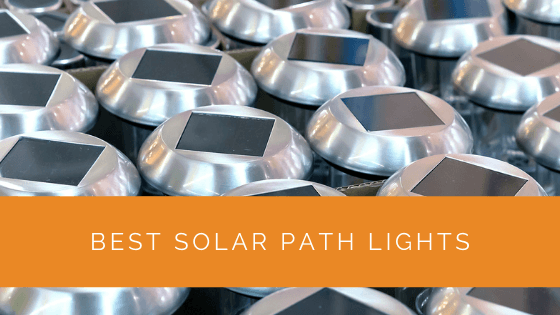
If you’re looking to line a garden path, border, or driveway edge without running mains cable, solar path lights are one of the most practical upgrades you can make to a UK garden. Our top recommendation is the GIGALUMI Solar Pathway Lights 6-Pack, which combines a classic mushroom-cap profile, reliable warm white output, and a track record backed by thousands of verified purchases.
Not all solar path lights are equal, though. Stake quality, battery capacity, and IP rating vary considerably across the market, and choosing poorly for a UK garden means lights that list to one side after the first frost or barely make it through an October evening. This guide covers seven solid options across different budgets and styles, plus everything you need to know to choose the right set for your garden.
Our Top Picks
| Image | Name | |
|---|---|---|
| GIGALUMI Solar Pathway Lights 6-Pack | |
| Solpex Solar Ground Lights 10-Pack | |
| Solar Garden Lights 8-Pack Filament LED | |
| RECHOO Solar Lights 4-Pack Metal Spikes | |
| XELIUS Super Bright Solar Lights 10-Pack | |
| Solar Lights 4-Pack Tungsten Glow | |
| GIGALUMI Solar Lights 12-Pack Stainless Steel |
7 Best Solar Path Lights
1. GIGALUMI Solar Pathway Lights 6-Pack
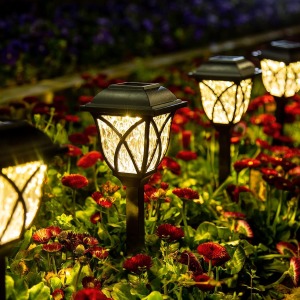
The GIGALUMI 6-pack has earned its place at the top of this list the hard way: through an enormous volume of verified purchases and the kind of consistent performance that keeps buyers coming back. The classic mushroom-cap profile suits most UK garden styles, from neat cottage gardens to contemporary landscaped borders. Warm white output is clean and even, with no blue-tinted colour drift that cheaper sets often develop after a few months outdoors.
Build quality is solid throughout. The cap is ABS with a frosted diffuser that spreads light evenly across the panel face without harsh spots. Stakes are stainless-coated with a ground spike that pushes cleanly into lawn-edge soil without requiring pre-drilling. In UK clay conditions, the stake profile is wide enough to resist the slight lean that plagues narrower designs after winter ground movement.
Battery capacity is adequate for most UK evenings from spring through to autumn. On a good summer day, expect six to eight hours of steady output. In December and January, that drops, and the lights are best treated as decorative accent lighting rather than functional path markers through the darkest months. That’s true of most solar path lights at this price point, not a specific weakness of the GIGALUMI.
At under £24 for six, this is the set most buyers should start with. The combination of brand reliability, proven durability in UK conditions, and the sheer number of confirming reviews makes it the safest recommendation in this category.
Features
- 6-pack warm white mushroom-cap stake lights
- ABS cap with frosted diffuser panel
- IP65 waterproof rating
- Auto on/off dusk-to-dawn sensor
- Stainless-coated ground stakes
- Runs 6-8 hours on full summer charge
- Huge number of verified reviews confirms long-term reliability
- Warm white output stays consistent without colour drift
- Stakes hold well in UK clay and loam soils
- IP65 rating suits year-round outdoor installation
- Battery capacity modest for UK winter. Best treated as seasonal
- 6-pack means multiple sets needed for longer paths
2. Solpex Solar Ground Lights 10-Pack IP65
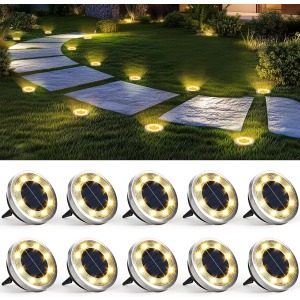
The Solpex 10-pack offers the best value per light in this roundup. Ten IP65-rated warm white stake lights at under £25 works out at about £2.50 per light, which is genuinely difficult to beat for this build standard. And they’re not cheap in a bad way: the IP65 rating is real, the stakes are stiff enough to hold a line without wandering, and the warm white output is consistent across the full set.
Where the Solpex stands apart from some budget 10-packs is panel quality. The integrated solar panel is slightly larger than what you’d typically find at this price, which gives it a meaningful advantage on the kind of mixed overcast-and-bright days that define a British summer. On a day with two hours of decent sun and four of cloud, the Solpex tends to charge more completely than smaller-panel alternatives.
The profile is lower-slung than the GIGALUMI mushroom cap, giving a more contemporary look that suits modern landscaped gardens or straight-edged borders. For gardeners who want the path lights to be subtle during the day and present at night rather than a feature in themselves, this design works well.
Features
- 10-pack warm white stake lights
- IP65 waterproof rating
- Larger solar panel for better low-light charging
- Auto dusk-to-dawn operation
- Contemporary low-profile design
- Best value per light in this roundup at ~£2.50 each
- Larger panel charges better on overcast UK days
- Low-profile design suits contemporary gardens
- IP65 confirmed through wet weather
- Newer product with fewer long-term reviews than GIGALUMI
- Lower profile means less visible from a distance
- Output modest: accent rather than functional lighting
3. Solar Garden Lights 8-Pack Filament LED
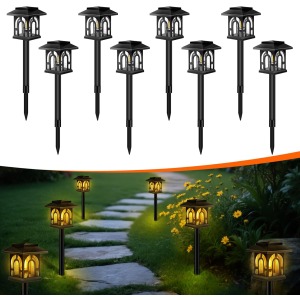
This 8-pack uses a filament-style LED rather than the standard chip LED found in most path lights. The difference is visible: filament LEDs produce a warmer, more diffuse glow that looks closer to a traditional incandescent bulb and works particularly well in cottage or heritage garden settings. If your garden has natural stone paving, period ironwork, or climbing plants along the border, this aesthetic fits better than the crisp, even glow of most modern solar lights.
Build quality is solid enough for the price, though the globe-style cap is more susceptible to condensation fogging than a sealed flat-panel design. This isn’t a dealbreaker for most gardens, but in coastal areas or very damp positions (directly beneath overhanging trees or in a sheltered, humid courtyard) is worth noting. The filament LED itself is rated for a long service life, and the warm amber tone doesn’t drift over time the way some LED types can.
The 8-pack size suits most residential garden paths of 8 to 12 metres if you space the lights at 1 to 1.5 metre intervals. At under £25 for eight, the cost per light is competitive, and the decorative appeal is meaningfully higher than standard chip LED designs.
Features
- 8-pack filament LED warm white stake lights
- Globe-style cap for diffuse warm glow
- IP65 waterproof rating
- Auto dusk-to-dawn sensor
- Warm amber filament tone. No colour drift
- Filament LED produces a warmer, more natural-looking glow
- 8-pack suits most standard residential path lengths
- Suits cottage and period garden styles well
- Globe cap can develop condensation fogging in damp positions
- Less bright than flat-panel LED designs
- Fewer reviews than the more established options
4. RECHOO Solar Lights 4-Pack Metal Spikes
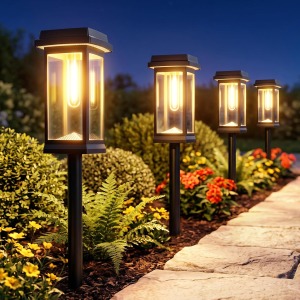
The RECHOO 4-pack is the premium option in this roundup, both in build standard and per-light cost. The metal spike stakes are a significant upgrade over the plastic-and-coating approach used by most budget path lights. In heavy UK clay soil or gravel borders where lesser stakes tend to crack or bend after winter freeze-thaw cycles, genuine metal construction holds its position season after season without the gradual lean that plagues cheaper designs.
The warm white output is noticeably brighter than standard mushroom-cap designs. At 4.7 stars, it earns its premium position through measured performance rather than just material quality. For front garden path lighting where the lights are visible from the street, the more polished look and brighter output justify the higher per-light cost.
The 4-pack configuration is the main limitation. For any path longer than 5 metres, you’ll need two sets, which brings the total cost up considerably. But as a premium option for a high-visibility position like a front door approach path or seating area border, the RECHOO is the most durable and polished choice here.
Features
- 4-pack warm white stake lights with metal spike stakes
- Premium metal construction. No plastic stakes
- IP65 waterproof rating
- Brighter output than standard mushroom-cap designs
- Auto dusk-to-dawn sensor
- Metal stakes hold position through winter freeze-thaw cycles
- Brighter output than comparable designs
- Premium finish suits front garden and visible path positions
- 4.7-star rating confirmed by verified purchases
- 4-pack means buying multiple sets for longer paths
- Highest per-light cost in this roundup
- Newer product with less long-term track record
5. XELIUS Super Bright Solar Lights 10-Pack
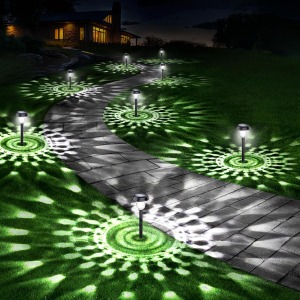
The XELIUS 10-pack leads on brightness. It’s the set to consider if you need your path lights to actually illuminate a walking surface rather than simply mark its edges decoratively. The “super bright” branding isn’t marketing puffery here; the output is measurably higher than most standard solar path lights and makes a genuine difference on unlit pathways where safety is a factor, not just appearance.
Ten lights at under £20 is aggressive on price, and the XELIUS achieves this without the usual signs of cost-cutting at this price point. The stakes are stiff, the caps are properly sealed, and the dusk-to-dawn sensor is responsive rather than laggy. The main trade-off for the brightness boost is battery runtime: brighter LEDs drain the battery faster, so on heavy winter usage the lights may switch off earlier than lower-output alternatives.
For a back garden utility path, a route from gate to back door, or any path that genuinely needs illuminating rather than decorating, the XELIUS 10-pack is the most purposeful choice at this price.
Features
- 10-pack super bright warm white stake lights
- Higher lumen output than standard path lights
- IP65 waterproof rating
- Auto dusk-to-dawn sensor
- 10-pack suits paths up to 15 metres at 1.5m spacing
- Genuinely brighter: suitable for functional path illumination
- 10-pack at under £20 is outstanding value
- IP65 weatherproofing for year-round UK use
- Higher brightness means faster battery drain in winter
- No timer mode to manage runtime
- Fewer reviews than the GIGALUMI. Less long-term data
6. Solar Lights 4-Pack Tungsten Glow
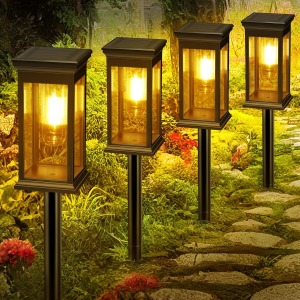
The Tungsten Glow 4-pack occupies a distinct niche: the output is deliberately softer and warmer than most solar path lights, mimicking the old incandescent tungsten tone that many UK garden designers still prefer for its lack of harshness. It’s not the brightest set here, and that’s the point. For garden seating areas, cottage-style borders, or anywhere you want light that feels warm and inviting rather than utilitarian, the amber-toned output is genuinely better than standard warm white.
The 800mAh battery is adequate for spring, summer, and early autumn use. Through November to January the runtime shortens considerably, and for consistent performance through a UK winter the other options with higher battery capacity have the edge. As a spring-to-autumn path marker, the Tungsten Glow works well and looks better than most at this price.
At 4.4 stars, this is the second-lowest-rated set in this roundup, and some reviews note that battery performance fades faster than expected over two to three seasons. Worth keeping in mind if you’re looking for a long-term installation.
Features
- 4-pack warm tungsten-tone output
- 800mAh battery
- IP65 waterproof rating
- Auto on/off dusk-to-dawn sensor
- Amber-warm tone: softer than standard warm white LEDs
- Warm tungsten tone suits cottage and traditional garden styles
- IP65 rating for year-round outdoor use
- Competitively priced for decorative accent lighting
- 800mAh battery struggles through UK winter
- Battery life may fade faster than average over multiple seasons
- 4-pack only: expensive to scale up for longer paths
7. GIGALUMI Solar Lights 12-Pack Stainless Steel
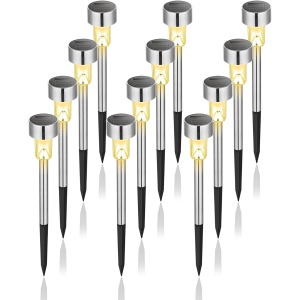
The GIGALUMI stainless steel 12-pack is the budget bulk option here. Twelve lights at under £19 works out at under £1.60 per light, which is as cheap as reliable solar path lights get. And this is still a GIGALUMI product, which carries some quality assurance that a generic 12-pack from an unknown brand wouldn’t.
The honest caveat is the 3.9-star rating. This is the only set in this roundup rated below 4 stars. Reviews point to inconsistent quality control rather than systematic design flaws. Some buyers get years of trouble-free performance; others find one or two lights in the pack fail earlier than expected. At under £1.60 per light, the occasional early failure is perhaps more acceptable than it would be at a higher price point.
Best suited to lower-visibility positions: back garden paths, allotment borders, utility runs where reliable function matters more than premium aesthetics. For high-profile front garden positions where a failing light stands out, the GIGALUMI mushroom-cap 6-pack at the top of this list is the safer choice from the same brand.
Features
- 12-pack stainless steel design
- Lowest cost per light in this roundup
- IP65 waterproof rating
- Auto dusk-to-dawn sensor
- Warm white output
- Lowest cost per light: under £1.60 each
- 12-pack suits long paths and driveway edges
- Stainless steel construction
- 3.9-star rating indicates some quality control inconsistency
- Not the best choice for high-visibility positions
- Some buyers report early failures in one to two lights per pack
Solar Path Lights Buying Guide
Key Takeaways
- For decorative path marking, 5 to 20 lumens is sufficient; for functional illumination where you need to see where you’re walking, look for 30 to 100 lumens minimum
- Measure your path before buying: space lights at 1 to 1.5 metre intervals and add 20 per cent for corners, overlaps, and end positions
- IP65 is the minimum rating worth considering for year-round outdoor use in the UK; in high-rainfall regions, IP67 is preferable
- Battery capacity of 1,000mAh or above gives better winter performance. Smaller cells may not hold enough charge through a dark December day
- Stainless steel or UV-ABS stakes outlast powder-coated plastic in UK clay soil and freeze-thaw conditions
- NiMH batteries are standard across most budget sets; LiFePO4 chemistry charges better in cold weather and lasts significantly longer overall
- Panel placement matters more than brand. A shaded panel during peak afternoon sun hours loses 30 to 60 per cent of its daily charge
What Are Solar Path Lights?
Solar path lights are self-contained outdoor stake lights that charge during daylight hours via an integrated solar panel and switch on automatically at dusk. There’s no wiring, no mains connection, and no running cost once installed. The panel, battery, LED, and light sensor are all built into a single unit that simply pushes into the ground.
They mark the edges of paths, borders, driveways, and garden features, guiding foot traffic, creating visual interest in the evening, and defining garden structure without the cost and disruption of mains cable installation. Most operate on a dusk-to-dawn sensor that handles switching automatically, though some include a timer mode that concentrates the available charge into a set number of hours.
How Do Solar Path Lights Work?
The solar panel on top of the light cap converts daylight into electrical current, which is stored in a small rechargeable battery during the day. When the built-in light sensor detects that ambient light has dropped below a threshold at dusk, it connects the battery to the LED and the light switches on. At dawn, the sensor disconnects the LED and the battery begins charging again.
Battery capacity determines how long the light can run after a full charge. Panel efficiency determines how completely the battery charges on a given day. In the UK, where overcast days are common, panel size relative to battery capacity is an important practical consideration. A large battery paired with a small panel can leave you with a partially charged battery that runs out well before midnight on a cloudy day.
Brightness: How Many Lumens Do You Actually Need?
Solar path lights are primarily accent lights, not floodlights. Most produce between 5 and 30 lumens, which is enough to mark a path edge or border without casting enough light to actually navigate by in the dark. Understanding this before you buy avoids a lot of disappointment.
For decorative path marking, visually defining the edge of a lawn path or garden border, 5 to 20 lumens is sufficient and appropriate. The lights tell you where the path is without producing so much light that they become glaring in a quiet garden setting.
For safety-focused path lighting, where you need to actually see where you’re putting your feet on an unlit path, you need 30 to 100 lumens as a minimum. The XELIUS 10-pack in this guide gets closest to that range. For genuine functional path illumination on a main route, dedicated solar security lights with PIR sensors and higher output are a better tool than standard path stake lights.
IP Ratings and Weather Resistance in the UK
The IP (Ingress Protection) rating tells you how well the light handles water. For UK outdoor use, IP65 is the minimum worth considering: fully dust-proof and protected against sustained water jets from any direction. IP67 is waterproof for submersion up to one metre and is the better choice for lights in positions that puddle significantly in heavy rain.
IP44, which appears on some cheaper sets, means splash-proof rather than jet-proof. It handles light rain but is less reliable in the sustained horizontal rain common across much of the UK, particularly in Scotland, Wales, and the north of ngland.
The weak point in most solar path lights isn’t the cap IP rating. It’s the junction between the cap and the stake body, and the cable gland where wiring enters the stake. Cheaper sets sometimes have an adequate cap rating but a poorly sealed junction. After a few seasons, water finds its way in through this point and corrodes the battery contacts. One-piece moulded cap-to-body designs avoid this vulnerability better than those with complex multi-part constructions.
Battery Capacity and UK Seasonal Performance
Published runtime figures on solar path lights are based on full summer charge conditions. In UK reality, summer days don’t always deliver eight hours of direct sun, and from October through February they rarely do at all. Here’s a rough seasonal guide:
| Season | Typical UK Solar Hours | 800mAh Battery Runtime | 1200mAh Battery Runtime |
|---|---|---|---|
| June to August | 5-7 hours | 5-7 hours | 7-9 hours |
| April, May, September | 3-5 hours | 3-5 hours | 5-7 hours |
| October, March | 2-4 hours | 2-3 hours | 3-5 hours |
| November to February | 1-2 hours (overcast) | 1-2 hours | 2-3 hours |
For year-round UK use, look for battery capacity of 1,200mAh or above. Where a set offers a timer mode, using it to concentrate available charge into your peak evening hours (say, 6pm to 11pm) is the most practical way to manage winter performance reliably.
Stake Design and Soil Compatibility
The stake is the part of a solar path light most likely to fail first, and it receives the least attention in product listings. UK soil creates specific challenges worth thinking about before buying.
Clay soil is common across much of the Midlands, south of England, and parts of Scotland. It swells when wet and contracts when dry or frozen. A thin plastic stake in clay soil can crack at the soil surface during a hard frost as the ground moves. Stainless steel stakes resist this. Coated plastic stakes are more vulnerable than they look, particularly in exposed positions with repeated freeze-thaw cycles.
For gardens with gravel or very compacted soil, pushing stakes in without preparation is often impractical. Some stakes include a narrowed tip; others need a pilot hole made with a screwdriver or narrow rod first. Stake height is also relevant in taller-grass settings: standard 20 to 30cm stakes get partly obscured by surrounding growth by midsummer if planted alongside a meadow-style border.
NiMH vs LiFePO4 Battery Chemistry
Most solar path lights use nickel-metal hydride (NiMH) batteries. They’re inexpensive to produce, widely compatible with simple solar LED circuits, and adequate for seasonal use. The drawbacks in a UK context are that NiMH cells lose capacity in cold weather, meaning winter performance drops not just due to reduced charging but because the battery delivers less of its rated capacity at low temperatures, and they degrade noticeably after two to three years of daily charge-discharge cycling.
A small number of premium solar lights now use lithium iron phosphate (LiFePO4) batteries. These hold their capacity better in cold conditions, cycle significantly more times before degradation, and are safer if the housing is ever compromised. They cost more, which is why they appear only at the higher end of the market. For a front garden path installation you’d prefer not to be replacing every two to three years, LiFePO4 chemistry is worth looking for specifically.
Common Buying Mistakes
Not measuring the path first. The number of lights you need depends entirely on path length and spacing preference. Measure the full run, divide by 1 to 1.5 metres, then add 10 to 20 per cent for corners and end positions. Buying based on a rough guess almost always means a second order.
Expecting product photo brightness in reality. Product photos show path lights at night under ideal conditions. The actual brightness of most solar path lights is lower than photography suggests. Treat published lumen figures as a guide, not a promise.
Ignoring the stake material. The stake fails before the light cap in most cases. In UK clay soil or coastal gardens, stainless or genuine metal stakes outlast coated plastic by a significant margin.
Installing with the panel shaded. Solar path lights are often positioned along a path without checking where the sun actually falls at midday. A path running along the north side of a fence may leave the integrated solar panels in partial shade during peak charging hours. Check the sun position first, then plan the light placement around it.
Expecting winter performance to match summer. It won’t. Budget for seasonal variation, and choose sets with larger batteries if reliable winter performance is a priority.
Case Study: Marking a Long Back Garden Path in Nottinghamshire
Background
A homeowner in Nottinghamshire had a rear garden approximately 25 metres long with a central grass path running from the back door to a vegetable patch and compost area at the far end. They used the path regularly in the evenings through spring and summer but found navigating it in the dark frustrating. Mains cable installation through an established border was not something they wanted to tackle.
Project Overview
The path ran broadly north to south, meaning both sides received good afternoon sun across most of its length. The main challenge was the middle section, where an established apple tree cast dappled shade across the path edge for much of the afternoon from late May through August.
Implementation
They installed 16 solar path lights using two packs of eight, spaced at approximately 1.5 metre intervals on alternating sides of the path rather than in a straight line on one side. This staggered placement gave better coverage and also meant that where one side was shaded by the apple tree, the opposing lights on the sunny side still charged fully.
Results
From April through October, the path was reliably illuminated from dusk until around 10 to 11pm every evening. The staggered placement worked better than a single-row installation would have, and the partially shaded lights still achieved four to five hours of runtime from the charge they accumulated before the tree shadow arrived. Through November to February the lights worked on clear days and were essentially decorative on heavy overcast days, which the homeowner found acceptable. Total cost was under £50 for 16 lights, which compared well with the mains alternatives they’d considered.
Expert Insights From Our Solar Panel Installers About Solar Path Lights
One of our senior solar panel installers with over 14 years of experience working with residential solar across the UK offered this perspective: “Solar path lights are probably the most forgiving solar product to install, but the failures I see most often come from the same two causes: shaded panels and underestimated soil conditions. People place the lights first and then work out where the panels face, rather than checking the sun position first and working backwards. In a UK garden where the sun is often coming from a low southerly angle, a panel on the north face of a stake is going to charge at maybe 20 to 30 per cent of its capacity on a good day. Get the south orientation right, and the rest of the system will generally take care of itself.”
Frequently Asked Questions
How far apart should solar path lights be spaced?
For decorative path marking, 1 to 1.5 metres between lights is the standard range. Closer spacing (every 0.75 to 1 metre) gives a more formal, defined look and suits functional path illumination. Wider spacing of 1.5 to 2 metres works for decorative borders where you want to suggest the path edge rather than line it completely. Measure the full path, divide by your chosen interval to get the light count, then add two or three for corners and end positions.
Do solar path lights work in the UK winter?
Yes, but with reduced performance. Short winter days and frequent cloud cover from November through February mean most solar path lights will charge to only 30 to 60 per cent of their summer capacity. Expect two to four hours of runtime on a typical UK winter day rather than the six to eight hours achievable in summer. Sets with larger batteries (1,200mAh and above) handle this better than those with 600 to 800mAh cells.
What IP rating do solar path lights need for UK gardens?
IP65 is the minimum recommended for year-round outdoor use in the UK. This means fully dust-proof and protected against sustained water jets. IP44 (splash-proof) is adequate in sheltered positions in milder areas, but in Scotland, Wales, and the north of England where sustained heavy rain is common, IP65 is a practical requirement rather than a preference. IP67 is worth seeking out for lights in positions that puddle in heavy rain.
How many solar path lights do I need for a 10-metre path?
At 1-metre spacing along one side, you need approximately 10 lights for a 10-metre path. At 1.5-metre spacing, about 7. For a staggered alternating arrangement on both sides, which gives better coverage and is more forgiving of partial shading. Double the count: 14 to 20 lights depending on spacing. Most buyers underestimate the count needed and end up ordering a second pack.
Can I replace the battery in a solar path light?
In most cases, yes. The batteries in solar path lights are typically standard NiMH AA or AAA rechargeable cells that can be sourced cheaply and replaced in a few minutes. The cap usually unscrews or clips off to reveal the battery compartment. Replacing the battery after two to three years is a much more economical way to extend the life of a good-quality set than replacing the entire light.
Why do my solar path lights not come on every evening?
The most common cause is insufficient charging during the day: either because the panel is shaded for significant parts of the afternoon, or because an overcast day didn’t deliver enough charge. A depleted battery from the previous night that wasn’t fully recharged will mean the light either doesn’t activate or switches off early. Repositioning the panel to maximise south-facing afternoon sun usually resolves intermittent operation.
Are solar path lights bright enough to see by?
Most solar path lights produce 5 to 30 lumens, enough to see where the path edge is, but not enough to illuminate the walking surface clearly. They are accent lights and path markers, not floodlights. If you need to properly illuminate a path for safety on steps or uneven surfaces, look for dedicated solar security or spotlight products with 100 lumens or more rather than standard stake-style path lights.
Do solar path lights need direct sunlight to charge?
No, but they perform significantly better with direct sunlight. Diffuse light on an overcast day charges the solar panel at roughly 20 to 40 per cent of the rate achieved in direct sun. In UK conditions, most path lights will charge usably on an average summer day even without extended direct sunshine, but sustained heavy overcast in winter can leave batteries partially depleted for days at a time.
Summing Up
Solar path lights are one of the easiest ways to add evening character and practical definition to a UK garden without any mains electrical work. The GIGALUMI Solar Pathway Lights 6-Pack is our top recommendation for most buyers: the track record, build quality, and consistent warm white output are proven through an exceptional volume of real-world UK use. For longer paths on a tight budget, the Solpex 10-Pack or XELIUS Super Bright 10-Pack offer better value per light without significant quality trade-offs. And for a premium front garden position where durability and brightness really matter, the RECHOO 4-Pack with metal stakes is worth the extra cost per light.
Whatever set you choose, get the panel placement right before you put a single stake in the ground. South-facing, unobstructed afternoon sun is the single biggest factor in solar path light performance: more important than brand, battery size, or price.
Updated