
Solar PIR lights are the practical workhorse of garden lighting. Unlike always-on stake lights or decorative string lights, a good PIR light sits dormant until something moves — then it fires up instantly, illuminating a path, doorway or driveway corner for exactly as long as it’s needed. That combination of motion-triggered response and zero running costs makes them one of the most genuinely useful things you can add to a UK garden. The problem is that the category is flooded with products that look similar but vary enormously in detection quality, brightness and winter battery life. Our top pick is the CLAONER Solar Lights 346 LED 4-Head, which delivers 3000LM across four independently adjustable heads, comes with a remote control, and covers the sort of wide area that cheaper single-head units simply can’t match.
Below you’ll find full reviews of six of the best solar PIR lights available on Amazon.co.uk, followed by a buying guide covering everything from PIR detection angles to the north-facing wall problem.
Our Top Picks
| Image | Name | |
|---|---|---|
| CLAONER Solar Lights 346 LED 3000LM 4-Head | |
| vighep Solar Lights 6 Pack PIR Flood Lights | |
| IOTSES Solar Security Lights 100 LED 270° | |
| Lepro Solar Security Lights 1200LM with Separate Panel | |
| LOTMOS Solar Lights 342 LED with Remote Control | |
| Aigostar Solar Wall Light 4-Mode PIR |
The 6 Best Solar PIR Lights for UK Gardens
1. CLAONER Solar Lights 346 LED 3000LM 4-Head
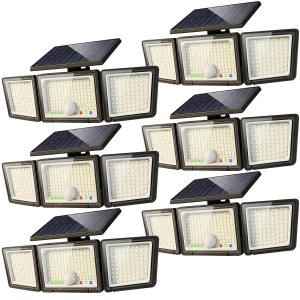
If you want the most powerful, most flexible solar PIR light in this round-up, the CLAONER 4-head is it. Four independently adjustable light heads sit on a central hub, each packed with LEDs and contributing to a 3000LM total output at 6500K cool white. That’s genuinely bright — bright enough to fully illuminate a driveway entrance, a garage area, or a rear garden corner with a single unit. The four-head format means you’re not choosing between two directions: point one head at the path, one at the door, one at the gate, and one at the dark corner where the wheelie bins live.
The 2400mAh battery is one of the larger capacities in this category and charges via a high-efficiency solar panel. Three intelligent modes give you the full range: strong light sensor mode (full blast on motion), low light sensor mode (dims down after triggering, saves battery), and medium long light mode (stays on at medium brightness). The wireless remote control is a genuinely useful feature here — being able to switch modes without climbing a ladder to press a button is the kind of convenience that sounds minor until you’ve spent five minutes balancing on a stepladder at dusk.
The PIR sensor has a sensitive detection range appropriate for detecting movement across the full coverage area, and the IP65 rating means British weather isn’t an issue. Installation is straightforward — two screws into a wall surface, point the heads where you want them, done. CLAONER backs everything with a 24-month warranty and a 60-day no-quibble return policy.
The main limitation is price: this is the most expensive unit in the round-up. For a single key position — a garage, a side entrance, or a rear door — it’s worth every penny. But if you need to cover a long driveway or multiple positions around a house, you’ll be looking at a significant spend. For those situations, the vighep 6-pack further down the list is a more practical choice.
Features
- LEDs: 346
- Brightness: 3000LM at 6500K
- Battery: 2400mAh
- Heads: 4 independently adjustable
- Modes: 3 (strong sensor / low sensor / medium always-on)
- Remote control: included
- IP rating: IP65
- 3000LM — brightest in this round-up
- Four adjustable heads for flexible coverage
- Remote control for easy mode switching
- 2400mAh battery for solid UK winter runtime
- Premium price — high cost per unit
- Cool white 6500K may not suit all settings
2. vighep Solar Lights 6 Pack PIR Flood Lights
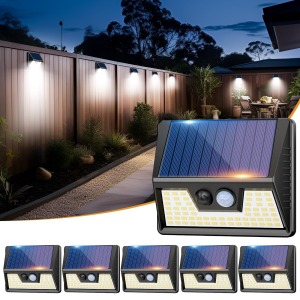
If you need to cover multiple positions around a property — both sides of a driveway, three garden gates, front and back doors — the vighep 6-pack is the obvious way to do it without spending a small fortune. At roughly £3–4 per light depending on current pricing, you’re getting six PIR wall lights in a single order, each with 66 LEDs, 500LM output, and IP65 waterproofing. The PIR sensor detects within a 120° arc out to around 20 feet, and lights auto-off after about 20 seconds of no motion — exactly the profile you want for low-battery-drain operation through a UK autumn.
Three lighting modes cover the main use cases: motion-only (fully dark until triggered), dim-plus-motion (faint ambient glow that flares to full on movement), and dusk-to-dawn (always on at medium brightness). The 22% conversion rate solar panel charges efficiently enough to give reliable triggering through UK summer and into early autumn. Winter performance will be reduced on all budget PIR lights — if you’re in Scotland or northern England, the dim-plus-motion mode helps preserve battery for the triggering response when it matters.
The quality is honest for the price: these are ABS units, not aluminium, and the 500LM output per unit is adequate for pathways and garden gates but won’t floodlight a driveway the way the CLAONER does. That’s fine — these are designed to be distributed across multiple points, and at six units the cumulative coverage is substantial. Buy two packs and you can light an entire perimeter with budget still to spare.
Features
- Pack: 6 units
- LEDs: 66 per unit
- Brightness: 500LM per unit
- PIR: 120° / 20ft detection
- Modes: 3
- IP rating: IP65
- Solar conversion: 22%
- 6-pack — covers the full property in one order
- Excellent price per unit
- IP65 handles UK rain and frost
- 20-second auto-off conserves battery
- 500LM per unit — not suitable for large driveways alone
- ABS plastic rather than aluminium construction
3. IOTSES Solar Security Lights 100 LED 270°
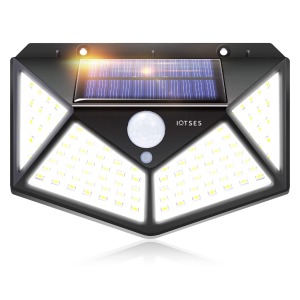
The IOTSES stands out in this round-up for one specific reason: the 270° detection and illumination angle. Most solar PIR lights cover 120° — fine for a straight path or a defined doorway, but useless for corners, open garden areas, or any spot where someone might approach from multiple directions. The IOTSES wraps around three-quarters of a full circle, which is a different kind of coverage entirely. Mount it at the corner of a house and it covers the garden, the side passage, and the front at the same time.
100 LEDs deliver a solid output for a unit of this size, and the three modes (security sensor, dim-plus-sensor, and steady-on) give the usual flexibility. IP65 waterproofing is correctly rated for year-round UK use. The durable ABS housing holds up well through a UK outdoor season, and the two-screw wall mounting takes about five minutes to install.
At this price point, the IOTSES offers genuinely good value for corner positions and open garden areas where directional lights leave blind spots. It’s not the brightest light in this round-up, but the detection arc coverage makes it the right choice for positions where movement can come from any direction.
Features
- LEDs: 100
- Detection and illumination angle: 270°
- Modes: 3 (security / dim+sensor / steady)
- IP rating: IP65
- Auto on/off: dusk-to-dawn sensor
- 270° coverage — ideal for corners and open areas
- 100 LEDs for solid output
- Good value for the coverage it provides
- IP65 for year-round UK use
- Lower lumen output than premium models
- No remote control
4. Lepro Solar Security Lights 1200LM with Separate Panel
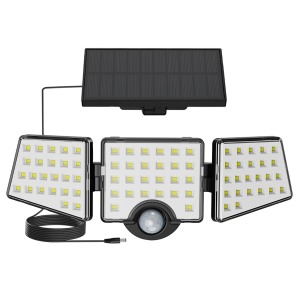
The Lepro solves the single most common solar PIR light installation problem in the UK: north-facing walls. Most integrated solar PIR lights have the panel built into the top of the unit — which means if the light needs to point north (facing your driveway from the south side of the house, for instance), the panel is pointing north too, getting minimal sun and delivering poor battery performance. The Lepro separates these two components. The 1200LM light unit goes where the light needs to be; the solar panel goes on a cable, positioned wherever gets the most sun. Problem solved.
The 1200LM output with three independently adjustable heads is genuinely useful — each head can be angled separately, so you can cover a wide driveway, a garage forecourt, or an L-shaped path with a single unit. IP65 waterproofing is standard. The motion sensor triggers a full-brightness response and the unit returns to standby after the motion clears, preserving battery effectively through the evening.
This is the right choice for any installation where the light position and the sunny position are different things — which describes a significant number of UK homes, particularly semis and terraces where the rear garden gets sun from a direction that conflicts with where the security light needs to face. At this price point, the separate panel design alone justifies it over similarly-priced integrated units.
Features
- Brightness: 1200LM
- Heads: 3 independently adjustable
- Panel: separate on cable for flexible placement
- IP rating: IP65
- PIR motion sensor
- Separate solar panel — solves north-facing wall problem
- 1200LM — bright enough for driveways
- 3 independently adjustable heads
- IP65 for year-round UK use
- More complex installation due to separate panel
- Panel cable length limits placement flexibility
5. LOTMOS Solar Lights 342 LED with Remote Control
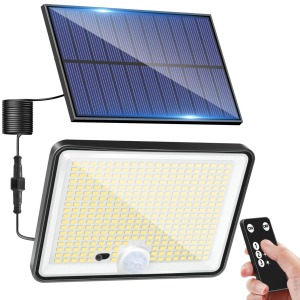
The LOTMOS earns its place in this round-up through a combination of LED count and functionality. 342 LEDs is a substantial number for a single wall unit, and the output is correspondingly bright — appropriate for garages, driveways, and any exterior position where you want to properly illuminate rather than just signal movement. The included remote control gives you easy access to the three modes without needing to re-position the light, and adds the option to override the PIR and hold the light on during, say, a barbecue or an extended session in the garden.
Three modes cover the standard range: a full motion-trigger mode, a dim background with full-trigger on motion, and a steady medium brightness. IP65 waterproofing is confirmed, and the solar panel handles UK summer charging efficiently. Build quality is solid for the price range — this isn’t a cheap plastic unit that flexes when you handle it.
Where the LOTMOS sits in this round-up is as a strong mid-tier option: more output than the budget vighep units, remote control included, and at a price point below the premium CLAONER. For a single doorway or garage position where you want genuine brightness and easy mode control, it delivers well.
Features
- LEDs: 342
- Modes: 3
- Remote control: included
- IP rating: IP65
- PIR motion sensor
- Colour: cool white
- 342 LEDs — strong output for the price
- Remote control for hands-free mode switching
- IP65 for year-round UK use
- Solid build quality
- Cool white only — no warm white option
- Fewer reviews than more established brands
6. Aigostar Solar Wall Light 4-Mode PIR
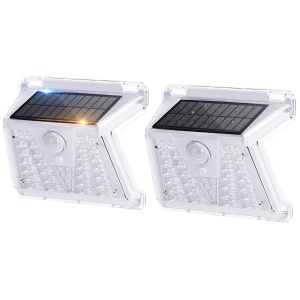
Aigostar is a brand that appears across multiple categories on Amazon UK — their products are consistently adequate, consistently priced well, and consistently backed by a reasonable support infrastructure for a budget brand. The solar wall light with PIR is a good example of that formula. Four modes give it slightly more flexibility than the typical 3-mode budget unit: motion-only, dim-plus-motion, steady-on, and a fourth that dims automatically after a set period regardless of motion — useful for front doors where you want light for a fixed duration after the last movement rather than the immediate auto-off of standard PIR mode.
IP65 waterproofing handles UK conditions, installation is a two-screw affair, and the unit is compact enough to fit on fence posts and narrow wall sections where a larger multi-head unit wouldn’t. Output is more modest than the premium options in this round-up, but for a single gate, a side passage, or a garden shed door, it does exactly what’s needed at a price that doesn’t require much justification.
The honest assessment: this is a buy-it-and-don’t-think-about-it PIR light for positions where you need basic motion-triggered illumination rather than statement brightness. It won’t disappoint at the price, and Aigostar’s customer service tends to be responsive if you do hit a problem.
Features
- Modes: 4
- IP rating: IP65
- PIR motion sensor
- Auto dusk-to-dawn sensor
- Compact wall-mount design
- 4 modes — slightly more flexibility than typical budget units
- Compact — fits narrow fence posts and wall sections
- IP65 for UK outdoor use
- Budget-friendly entry point
- Lower output than mid-range and premium options
- No remote control
Solar PIR Lights Buying Guide
Key Takeaways
- PIR stands for Passive Infrared — the sensor detects body heat movement rather than light, making it weather-independent and reliable in the dark
- Lumens matter more than LED count — 500LM is enough for a path gate; driveways and garages need 1200LM or more
- The detection angle determines where movement is captured: 120° for defined doorways, 270° for corners and open areas
- Integrated panel on a north-facing wall? Choose a model with a separate solar panel on a cable
- IP65 is the minimum for UK year-round outdoor use — it handles driving rain, frost, and damp conditions reliably
- Three-mode operation (motion-only / dim+motion / always-on) gives you full seasonal flexibility without running costs
- Battery capacity of 2000mAh or more sustains good winter performance in the UK — smaller batteries underperform significantly from October onwards
How PIR Motion Sensors Work in Solar Lights
Passive Infrared sensors detect thermal energy — specifically the difference between a warm moving body and the cooler background environment. When a person, animal, or vehicle moves through the detection zone and that thermal contrast registers above the threshold, the PIR triggers the light. The “passive” part means the sensor doesn’t emit anything itself; it just listens for heat differential. This is why PIR sensors work as well at night as in daylight, and why they’re not triggered by wind-blown leaves or shadows.
In solar PIR lights, the PIR sensor is typically integrated into the unit’s face or underside, pointing out at the angle described in the product specs. The detection range (usually 5-8 metres for budget units, up to 10m for premium models) is the distance at which a person-sized thermal source reliably triggers the light. The detection angle describes the horizontal arc covered — a 120° unit has a focused cone of coverage, while a 270° unit covers three-quarters of the surrounding circle.
A detail that matters for UK gardens: PIR sensitivity can be affected by temperature. On very cold days when the ambient temperature approaches body temperature (this rarely happens in the UK, but is worth noting for Scotland in winter), the thermal contrast is lower and the sensor may be less responsive. All the products in this round-up have adjustable sensitivity where relevant, and this is never a practical problem in normal UK conditions.
Lumens: How Bright Does a Solar PIR Light Need to Be?
This depends entirely on what you’re illuminating and for what purpose. Here’s a practical guide:
150-300LM — adequate for a garden gate, a side door, or a shed entrance. You’ll know someone’s there and be able to see well enough to navigate, but this won’t deter anyone or light up a large area.
500-800LM — the sweet spot for most garden positions: paths, gates, garden office doors, side passages. Bright enough to clearly illuminate the area and provide a deterrent effect without being dazzling or intrusive to neighbours.
1000-1500LM — appropriate for driveways, garage forecourts, and larger areas where you want clear visibility across a significant zone. Similar to a reasonable mains-powered outdoor light.
2000LM+ — premium security/floodlight territory. The CLAONER at 3000LM in this round-up is in this bracket. Appropriate for large driveways, commercial properties, and any position where maximum deterrence and visibility is the priority.
Detection Angle: 120° vs 270° — When It Matters
The detection angle is one of the most important specs to check before buying, and it’s consistently underappreciated by buyers who focus on LED count and lumens. Here’s how to think about it:
120° sensors are designed for defined, directional positions: a front door, a garage door directly ahead, a straight path. The narrow focus means fewer false triggers from passing traffic or neighbours, and the beam covers the intended area well. If you’re mounting the light directly above a door and the only approach is straight ahead, 120° is exactly right.
270° sensors are designed for corners, open garden areas, and any position where movement can come from multiple directions. A garden corner light, a summerhouse entrance, a gap between a garage and a house — these are all 270° situations. At a corner position with a 120° sensor, someone approaching from the side will walk right up to the light before triggering it. The same position with a 270° sensor catches them while they’re still 5-6 metres away.
Most budget PIR lights are 120°. If your installation is a corner or open area, specifically look for 270° or check whether the product description mentions wide-angle coverage before buying.
The North-Facing Wall Problem
This is probably the most common installation problem with integrated solar security lights in UK gardens. Many homes have the position that most needs a security light — the driveway entrance from the house side, the back garden from the shaded side — on a north-facing or north-east-facing wall. An integrated solar PIR light has its panel built into the unit; when that unit faces north, the panel gets minimal sun and delivers weak charging.
The solutions:
Separate panel with cable: The Lepro in this round-up is the clearest example — the light unit goes on the north wall, the solar panel runs on a cable to a south-facing surface. Effective, but adds installation complexity.
Rotating panel design: Some units have a panel that can be angled independently of the light head. Useful for modest deviations from south, but won’t help for a true north-facing wall.
Repositioning: For many homes, it’s worth checking whether the light can be mounted 30-40cm around a corner onto an east or west-facing section of wall — enough sun to charge properly, while still covering the north-facing area.
If your key security positions are on north or north-east facing walls, buy a model with a separate panel. The charging difference between an integrated north-facing panel and a properly south-oriented separate panel can be the difference between 4 hours of winter runtime and 10 hours.
Three-Mode Operation and When to Use Each Mode
Most solar PIR lights in 2026 offer three operating modes. Understanding what they actually do — and which one to use when — makes a real difference to both battery life and how useful the light is day to day.
Motion-only (security mode): The light is completely dark until the PIR triggers it, then it fires to full brightness for a set duration (typically 15-30 seconds) and returns to dark. Best battery efficiency, maximum impact when it does trigger. Use this for positions where you don’t need ambient light — a rarely-used side gate, a back passage — and just want a strong response when something moves.
Dim background with full-trigger (smart mode): The light maintains a low-level glow (typically 10-20% of maximum output) so the area isn’t in complete darkness, then fires to full when motion is detected. The dim glow draws enough current to matter in UK winter — on a budget battery, you may lose an hour or two of full triggering capacity compared to motion-only. But for a doorway where you want to be able to see the step before the full light fires, this mode is genuinely useful.
Steady medium brightness (dusk-to-dawn): The PIR function is essentially disabled and the light runs at medium brightness all night. Convenient for periods when you want consistent illumination — while working in the garden at dusk, during a party — but the highest drain on the battery. In UK winter with a budget light, steady mode may not sustain all-night operation.
IP Ratings and UK Winter Durability
IP65 is the standard for all outdoor solar PIR lights in this round-up, and it’s the correct minimum for UK year-round outdoor use. IP65 means the unit is dust-tight and protected against low-pressure water jets from any direction — which covers UK rain, including the kind of sideways driving rain that comes with autumn storms. It does not mean submersion-proof, but wall-mounted lights aren’t submerged.
One thing to watch: IP ratings apply to the main body of the unit, but the junction between the unit and its mounting bracket, and the cable entry point on separate-panel models, are the two areas where cheaper units sometimes fail after a year outdoors. Check that these points look properly sealed when inspecting a product. If the junction has open gaps, moisture will get in over a UK winter season.
UV degradation of plastic housings is the other long-term concern. ABS plastic is fine for 2-3 years outdoors; after that some cheaper units start to yellow and crack at stress points, particularly around the mounting holes. If longevity matters, look for units with polycarbonate or aluminium housings, or accept that you may be replacing budget plastic units every few years.
Battery Capacity and UK Winter Runtime
This is the specification that budget buyers consistently underestimate. Solar PIR lights advertise runtime in summer conditions — a “12-hour runtime” figure is measured after 6-8 hours of full charging under clear skies, which describes approximately four months of the UK year. In November and December, when daylight averages 8 hours and clouds are frequent, expect to divide that figure significantly.
A rough practical guide for UK conditions:
- Under 1000mAh: Adequate for April-September use. Winter performance will be noticeably reduced — fine for lights you’re happy to turn off or remove over winter.
- 1000-1500mAh: The mid-tier. Good summer performance, adequate autumn performance, reduced but functional in winter for motion-only mode.
- 2000mAh+: The threshold for reliable UK year-round use. The CLAONER at 2400mAh in this round-up sits here. Motion-only mode can sustain decent triggering response even on a dull December day.
If your primary use case is winter security — which is when you actually need the deterrent effect most — prioritise battery capacity alongside lumens. A bright light with a small battery is more or less useless by mid-November in most of the UK.
Case Study: Securing a Detached House in Worcestershire
Background
A homeowner in rural Worcestershire with a detached property needed security lighting for three positions: the front driveway entrance, the back garden gate, and the north-facing side passage between garage and house. All mains-powered options required cable trenching that would have cost £400-600 through a landscaped driveway. Solar was the only practical option, but the north-facing passage was a real challenge for integrated solar lights.
Project Overview
Three positions, three different requirements: the driveway entrance needed high lumens and wide coverage; the back gate needed a compact, reliable trigger; and the side passage needed a separate-panel solution to get any meaningful charging on a wall that sees direct sun for roughly 45 minutes per day in winter.
Implementation
The driveway entrance used the CLAONER 4-head at 3000LM, positioned at 2.5 metres on the garage wall and angled to cover the full driveway width and the pavement approach. The back garden gate used the IOTSES 270° unit, mounted at the corner of the rear extension where it covers both the garden gate approach and the patio door. The side passage used the Lepro with separate panel, with the panel cable routed along the soffit to the south-facing front of the garage — the panel now sees 6-7 hours of direct sun daily in summer and 2-3 hours in winter, a significant improvement over an integrated north-facing panel.
Results
The system has been running for two full years. The CLAONER runs through the evening reliably and has yet to require any maintenance. The IOTSES has eliminated the blind-spot problem at the garden corner that a previous 120° light left uncovered. The Lepro passage light performs well through summer and adequately through winter — on a December day it reliably delivers 4-5 hours of triggering capacity in motion-only mode, which covers the practical evening hours. Total cost including installation was under £150 versus the £500+ mains cable option.
Expert Insights From Our Solar Panel Installers About Solar PIR Lights
We asked one of our senior solar panel installers with over twelve years of experience working on residential properties across the Midlands and South East for their take on solar PIR lights.
“The most common mistake I see is people installing integrated solar PIR lights on north-facing walls because that’s where the security concern is — and then being surprised when the lights stop working well by October. The position of the light and the position of the panel aren’t the same thing with a separate-panel model, and once people understand that, a lot of problems go away. If you’re serious about year-round security coverage, spend a bit more on a model that lets you put the panel where the sun actually hits. For most UK properties, that means south-facing or south-west facing, and nine times out of ten there’s a surface within cable reach that fits.”
Frequently Asked Questions
What does PIR stand for and how does it work in solar lights?
PIR stands for Passive Infrared. The sensor detects changes in infrared radiation — specifically the heat signature of a warm body moving through its field of view. When the thermal contrast between the moving target and the background exceeds the sensor threshold, the light triggers. It works in complete darkness, is not affected by ambient light levels, and is unaffected by UK weather conditions including rain and fog.
How do I know what detection angle I need?
If you’re mounting the light above a single defined approach — directly above a door, at the end of a straight path — a 120° sensor is the right choice. If your position is a corner, an open area, or anywhere movement can come from multiple directions, you need 270° coverage. The 150° difference in detection angle is not a subtle distinction: a corner position with a 120° sensor will regularly fail to detect approach from the sides.
Can solar PIR lights be installed on north-facing walls?
Yes, but you need a model with a separate solar panel on a cable so the panel can be positioned in better sun while the light goes where it needs to go. An integrated solar PIR light on a north-facing wall in the UK will typically deliver significantly reduced charging — sometimes adequate in summer, often insufficient in winter. Models like the Lepro in this round-up are designed specifically for this situation.
How long will a solar PIR light stay on when triggered?
This varies by product and mode. In standard motion-trigger mode, most lights stay on for 15-30 seconds after the last detected movement. Some models allow the duration to be adjusted via a dial or switch on the unit. In dim-background mode, the light stays dim continuously and flares to full on detection, returning to dim after 15-30 seconds. Always-on mode runs at a fixed brightness through the night regardless of motion.
Do solar PIR lights work in UK winter?
They work, but performance is reduced compared to summer. Short winter days mean less charging time, and cold temperatures slightly reduce battery efficiency. A unit with a 2000mAh or larger battery in motion-only mode will sustain reliable triggering through a UK winter evening. Budget units with smaller batteries may only provide 3-5 hours of triggering capacity on a December day — which may or may not cover your practical security window.
Will a solar PIR light trigger on animals?
Yes — PIR sensors detect any warm-blooded moving body above a certain size. Foxes, cats, and large dogs will typically trigger most solar PIR lights. Small birds and mice are usually below the threshold for well-calibrated sensors, but sensitivity adjustments can affect this. If false triggers from neighbourhood cats are a nuisance, adjusting the sensitivity dial down (where available) will raise the size threshold and reduce false activations.
How high should a solar PIR light be mounted?
Between 2 and 3 metres is the practical range for most residential PIR lights. Higher than 3 metres reduces detection effectiveness — the sensor is angled to cover ground level and its sensitivity drops as the overhead angle increases. Lower than 2 metres puts the unit in a position where it can be easily knocked, obscured, or tampered with. For a standard house wall, 2.2-2.5 metres above ground level is the sweet spot for coverage and security.
Do solar PIR lights deter burglars?
Research on crime prevention consistently shows that well-lit properties are less attractive targets, and motion-triggered lighting specifically is associated with deterrence because it creates the impression of an alert occupant. A solar PIR light at a driveway entrance or rear access point adds a meaningful deterrent layer without running costs. That said, high-lumen lights (1200LM+) create a more credible deterrent than dim ones — a light that clearly illuminates the whole area is more effective than one that produces a token glow.
Summing Up
Solar PIR lights are one of the most practically useful categories in the whole solar garden lighting market — they do a specific, important job at zero running cost, and the technology has matured to the point where even budget models are reliably functional. The key to buying well is matching the spec to the position: lumens for the area size, detection angle for the approach geometry, battery capacity for year-round UK use, and a separate panel if the wall faces north. Get those four things right and you’ll have lights that work consistently through a UK winter rather than fading out by November. The CLAONER 4-head is the best single unit for high-output coverage; the vighep 6-pack is the best choice for covering an entire property perimeter economically.
Updated