
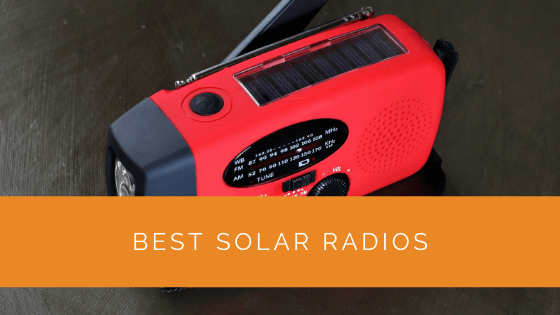
The Solar Hand Crank Radio 5-Way Powered is our top pick for UK buyers who want a genuinely reliable emergency radio. With 8,300 reviews at 4.5 stars and five independent charging methods, it covers every situation from a camping weekend to a winter power cut.
Solar radios have become one of the most popular emergency preparedness purchases in the UK, and the category has improved significantly. The best current models combine large-panel solar charging, hand crank backup, substantial battery banks for phone charging, and in the premium tier, DAB+ digital radio reception for UK listeners. This guide covers eight of the best available on Amazon.co.uk right now, from compact budget models under £25 to feature-rich DAB+ units with Bluetooth and colour displays.
Our Top Picks
| Image | Name | |
|---|---|---|
| Solar Hand Crank Radio 5-Way Powered AM/FM/SW | |
| PRUNUS J-369 Wind Up Radio Solar AM/FM | |
| Mesqool Wind Up Radio with 12000mAh and Large Solar Panel | |
| ROCAM DAB/FM Wind Up Solar Radio with 12000mAh | |
| flysclean Emergency Hand Crank Radio AM/FM 2000mAh | |
| Wind Up Solar Radio 7400mWh Best Seller (Red) | |
| 5000mAh Wind Up Solar Radio (Yellow) | |
| Esky 10000mAh Wind Up Radio AM/FM |
8 Best Solar Radios
1. Solar Hand Crank Radio 5-Way Powered AM/FM/SW
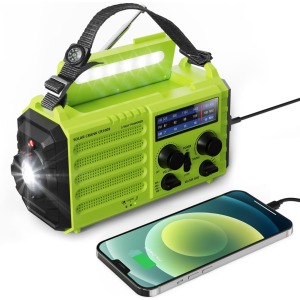
Eight thousand reviews at 4.5 stars is an unusual level of validation for any product category, and it earns the Solar Hand Crank Radio the top position in this roundup by a clear margin. This is not a product you’re buying on faith; it’s a product backed by an exceptionally large body of real-world experience across UK buyers who’ve used it at campsites, during power cuts, in sheds, and on allotments.
The five-way power system is the key specification: solar panel, hand crank dynamo, built-in rechargeable battery, AA batteries, and a USB-C input. That redundancy is exactly what you want in an emergency radio. If the battery runs down and the sun isn’t out, you crank. If you can’t crank, you put in AAs. The 5000mAh battery doubles as a phone charger, which is genuinely useful when the power is out and you need to keep a phone charged. The AM/FM/SW bands cover all UK broadcast frequencies, and shortwave adds global reach for emergency listening.
The flashlight, reading lamp, SOS alarm, and compass fill out the emergency toolkit. The compass is a nice touch that most competitors don’t bother with. Build quality is solid for the price at £24.99. This is the pick for anyone who wants a single radio that covers camping, home emergency, and general outdoor use without spending over £25.
Features
- AM/FM/SW three-band reception
- 5-way power: solar, hand crank, built-in battery, AA, USB-C
- 5000mAh battery with USB phone charging output
- LED flashlight, reading lamp, SOS alarm, compass
- 4.5 stars, 8,300 reviews
- £24.99
- 8,300 reviews at 4.5 stars is the most validated product in this roundup by a wide margin
- 5-way power means you are never left without a charging option
- 5000mAh bank is large enough to meaningfully charge a smartphone
- AM/FM/SW covers all UK frequencies plus global shortwave
- Compass is a useful addition most competitors skip
- FM/AM only, no DAB+ for UK digital radio stations
- Speaker quality is functional rather than impressive
- Solar charging is a supplement, not a primary charging method
2. PRUNUS J-369 Wind Up Radio Solar AM/FM
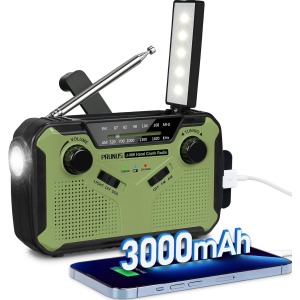
The PRUNUS J-369 is the best compact option in this roundup. At 2,200 reviews with a 4.6-star rating and the #1 Best Seller tag, it hits the price-to-performance sweet spot that makes it the most popular single-unit solar radio in the UK at this price point. It is smaller and lighter than most competitors, which matters if you’re carrying it in a bag for a festival, camping trip, or emergency grab bag.
The 3000mAh power bank output is smaller than the 5-way radio above but adequate for topping up a phone in an emergency. Solar and hand crank charging are both present, with the hand crank being the more reliable quick-charge method in UK overcast conditions. The LED torch, SOS alarm, and USB phone charger complete the emergency feature set. AM/FM reception covers all UK analogue broadcast frequencies.
It comes in a compact green unit that takes up minimal shelf or bag space. For a home emergency kit, a campervan glove box, or a rucksack, the J-369 is the right size. The 4.6-star rating with 2,200 reviews puts it marginally ahead of the 5-way radio on rating if not on review volume.
Features
- AM/FM reception
- Solar and hand crank charging
- 3000mAh power bank with USB output
- LED torch, SOS alarm
- 4.6 stars, 2,200 reviews
- £24.99
- Compact size suits bags, grab kits, and smaller spaces
- 4.6-star rating, highest for a sub-£30 model in this roundup
- 2,200 reviews gives strong confidence in real-world performance
- Hand crank provides reliable quick charging when sun is unavailable
- 3000mAh is on the lower end for extended phone charging
- FM/AM only, no DAB+
- Speaker output is modest for a larger room or garden
3. Mesqool Wind Up Radio with 12000mAh and Large Solar Panel
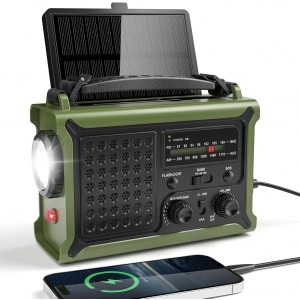
The Mesqool earns the highest rating in this roundup at 4.7 stars and carries the #1 Top-Rated badge. The standout specification is the 8500mm squared solar panel, which is substantially larger than the panels on most competing radios. In practice this means meaningfully faster solar charging, which matters more in UK conditions where you’re relying on weaker, often diffuse light rather than strong direct sun.
The 12000mAh battery capacity is the largest in this price tier and gives this radio a dual role: emergency radio and substantial power bank. A 12000mAh bank will charge a typical smartphone two to three times from empty, which is genuinely useful during extended power cuts. The 5W flashlight is one of the brighter torch outputs in this category. The 120dB SOS alarm is loud enough to be heard at distance outdoors.
At £43.69 it costs around £20 more than the budget picks. That premium buys you a larger solar panel that actually charges faster in UK conditions, a battery that will keep you and your phone running through a serious outage, and a 4.7-star rating with 1,100 reviews confirming that the real-world performance matches the specification. This is the pick for serious outdoor users and anyone who wants a radio that doubles as an extended power bank.
Features
- AM/FM reception
- 8500mm squared large solar panel, fastest solar charging in this roundup
- 12000mAh battery with USB output
- 5W flashlight, 120dB SOS alarm
- 4.7 stars, 1,100 reviews
- £43.69
- 4.7 stars is the highest rating in this roundup
- 8500mm squared panel is the largest solar panel here, charges faster in UK conditions
- 12000mAh battery will charge a phone 2 to 3 times from empty
- 5W torch is the brightest flashlight in this roundup
- FM/AM only, no DAB+ for UK digital stations
- Costs around £20 more than the budget picks
- Larger and heavier than compact models
4. ROCAM DAB/FM Wind Up Solar Radio with 12000mAh
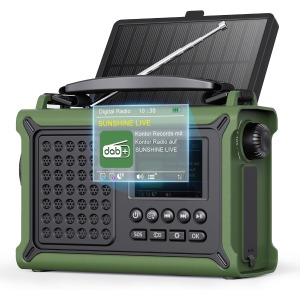
The ROCAM is the only radio in this roundup that includes DAB/FM digital radio, a 2.4 inch colour display, and Bluetooth 5.0. For UK buyers who want to listen to BBC Radio 6, Radio 4 Extra, or any of the UK-only DAB stations, this is the relevant pick. FM/AM analogue radios work, but the UK’s digital radio network via DAB covers far more stations and significantly better audio quality on most content.
The 57mm speaker is notably larger than the speakers in the budget FM-only models, which translates to fuller, louder audio. For kitchen, shed, or garden use where you want to actually hear the radio rather than strain to follow it, the speaker size makes a practical difference. Bluetooth 5.0 lets you use it as a wireless speaker for your phone, adding flexibility for music or podcasts beyond what the radio itself receives.
The 12000mAh battery and 8500mm squared solar panel match the Mesqool on the power storage side. At £55.99 this is the most expensive radio in this roundup. The premium over the FM-only models is justified if DAB+ digital radio, Bluetooth, or a larger speaker are priorities. If you just want an emergency FM radio for the car or rucksack, the cheaper options are perfectly adequate.
Features
- DAB/FM digital and analogue radio reception
- 2.4 inch colour display, Bluetooth 5.0
- 57mm speaker
- 8500mm squared solar panel, 12000mAh battery
- 4.5 stars, 798 reviews
- £55.99
- DAB/FM is the only digital radio option in this roundup
- Bluetooth 5.0 adds wireless speaker functionality
- 57mm speaker delivers noticeably fuller audio than budget models
- Colour display makes navigation easier than single-line LCD screens
- Most expensive radio in this roundup at £55.99
- Fewer reviews than the top picks for long-term durability confidence
- Larger format, not suited to compact carry
5. flysclean Emergency Hand Crank Radio 2000mAh
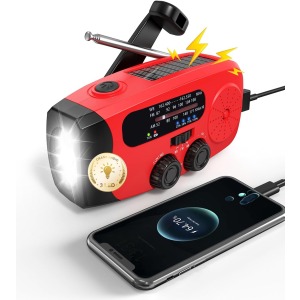
The flysclean sits in the middle of this roundup on both price and specification. At £27.75 with a 4.6-star rating and 1,300 reviews, it is a well-validated mid-range option. The 2000mAh battery is smaller than the Mesqool’s 12000mAh, but it is sufficient for a typical short emergency or camping scenario where you’re topping up rather than fully charging a phone. Solar charging, hand crank, and USB input give three ways to refill the battery.
The AM/FM and NOAA bands are a full specification for the frequency, though NOAA weather band is a US-specific broadcast format with no UK equivalent. UK buyers get the AM/FM coverage; the NOAA feature is effectively unused in Britain. The bright flashlight is highlighted in the product listing and reviews consistently confirm it is genuinely bright rather than the dim LED often found in budget models. This is a solid choice for buyers who want something between the bare-bones budget picks and the premium Mesqool or ROCAM.
Features
- AM/FM/NOAA reception (NOAA is US-only, UK gets AM/FM)
- Solar, hand crank, and USB charging
- 2000mAh battery with phone charging output
- Bright LED flashlight
- 4.6 stars, 1,300 reviews
- £27.75
- 4.6-star rating with 1,300 reviews is strong mid-range validation
- Bright flashlight confirmed across reviews
- Three charging methods give flexibility in varied conditions
- NOAA weather band is irrelevant for UK listeners
- 2000mAh battery is the smallest in this tier
- No DAB+
6. Wind Up Solar Radio 7400mWh Best Seller (Red)
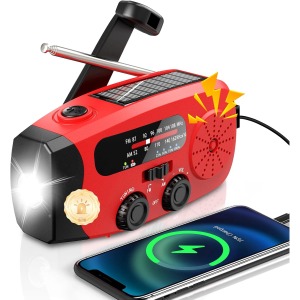
The 7400mWh (approximately 2000mAh equivalent) power bank in this Best Seller model gives it a useful bump in capacity over the entry-level options. At £23.99 it costs less than most of the mid-range picks while offering the standard set of features: solar and hand crank charging, AM/FM reception, LED torch, and SOS alarm. The 4.6-star rating with 759 reviews is a solid foundation for a newer product.
It sits between the two most-reviewed budget picks and the more expensive mid-range options. If you want something with a slightly larger battery than the PRUNUS at a similar price, this is the alternative. The USB phone charger output is present. Build quality and feature set are comparable to the PRUNUS J-369, with the main difference being the battery capacity figure and the red colour option that makes it easier to locate in a dark bag or drawer.
Features
- AM/FM reception
- Solar and hand crank charging
- 7400mWh power bank with USB output
- LED torch, SOS alarm
- 4.6 stars, 759 reviews
- £23.99
- 7400mWh capacity is a step up from entry-level 2000mAh models
- Best Seller badge confirms ongoing UK buyer popularity
- Red colour is practical for locating in dark conditions
- 759 reviews is lower long-term validation than the top two picks
- FM/AM only, no DAB+
- No notable differentiator over the PRUNUS at a similar price
7. 5000mAh Wind Up Solar Radio (Yellow)
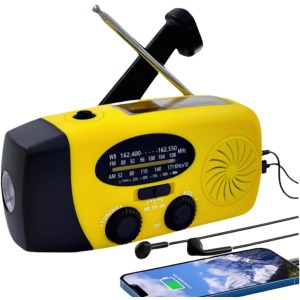
With 7,900 reviews at 4.5 stars, this yellow wind-up radio is the second most reviewed model in this roundup, and at £21.99 with a 15% checkout discount it is the cheapest option that still delivers a 5000mAh power bank. The specification is comparable to the 5-way radio at position one but at a lower price, making this the budget buyer’s first choice. It covers FM/AM, hand crank, solar, and USB charging, and includes the standard flashlight and SOS alarm.
The trade-off is that it has four charging methods rather than five (no AA battery fallback), which reduces the redundancy of the charging setup. For most buyers that won’t matter. For anyone building an emergency kit where every fallback counts, the 5-way radio at the top of this list is the better choice. Otherwise, the review volume and low price make this a very strong entry-level pick.
Features
- FM/AM reception
- Solar, hand crank, USB, and built-in battery charging
- 5000mAh power bank with USB output
- LED flashlight, SOS alarm
- 4.5 stars, 7,900 reviews
- £21.99 (save 15% at checkout)
- Cheapest 5000mAh model in this roundup
- 7,900 reviews at 4.5 stars is exceptional for the price point
- 15% checkout discount reduces the price further
- No AA battery fallback unlike the top pick
- FM/AM only, no DAB+
- No notable differentiator over the #1 pick beyond price
8. Esky 10000mAh Wind Up Radio AM/FM
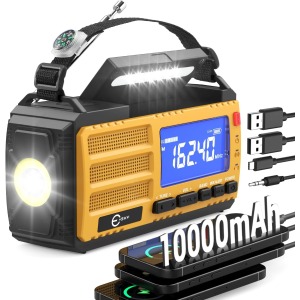
The Esky sits between the budget 5000mAh models and the premium 12000mAh Mesqool. At £29.99 with a 10000mAh battery, it offers more storage capacity than the entry-level picks at a price that doesn’t stretch to the premium tier. Solar, USB, and hand crank charging are all present. The flashlight, reading lamp, SOS alarm, and compass mirror the feature set of the top pick. AM/FM reception covers UK broadcast frequencies.
At 412 reviews with a 4.5-star rating, the Esky has fewer reviews than the other models, which means slightly less confidence in long-term durability. But the current review profile is consistent. For buyers who want a 10000mAh bank without paying for the Mesqool’s additional premium features, this is the middle path.
Features
- AM/FM reception
- Solar, USB, and hand crank charging
- 10000mAh battery with USB output
- Flashlight, reading lamp, SOS alarm, compass
- 4.5 stars, 412 reviews
- £29.99
- 10000mAh battery is substantially larger than budget 2000-5000mAh models
- Compass and reading lamp included at this price
- Sits between the budget and premium tiers in both price and capacity
- 412 reviews is the lowest in this roundup
- FM/AM only, no DAB+
- At £29.99, the Mesqool at £43.69 offers significantly more for a modest premium
Solar Radios Buying Guide
Key Takeaways
- Solar is a top-up charging method, not a primary one. In UK overcast conditions, solar input is often 20 to 40% of rated capacity. Always use hand crank or USB as the primary charging method; solar extends your runtime in good weather.
- DAB+ is the UK’s digital radio standard and unlocks significantly more stations than FM alone. If you want BBC Radio 4 Extra, Radio 6 Music, or commercial DAB-only stations, you need a DAB+ unit. FM-only models miss all of these.
- Battery capacity determines how useful the radio is as a phone charger. 2000mAh provides one partial top-up. 5000mAh charges a phone once or twice. 10000mAh to 12000mAh covers 2 to 3 full charges.
- Speaker size affects how well you can hear the radio across a room or in a garden. Budget models have 30 to 40mm speakers; premium models have 50 to 57mm speakers with noticeably fuller audio.
- Hand crank charging is the most reliable method when sun is unavailable. One minute of cranking typically provides 1 to 3 minutes of radio playback. It is slow but it is always available.
- NOAA weather band is a US broadcast format with no UK equivalent. Models listing NOAA effectively provide AM/FM in the UK; the NOAA listing is not a useful feature for British buyers.
Solar as Top-Up, Not Primary Charging
The most common misunderstanding about solar radios is the role of the solar panel. Marketing often emphasises the solar charging capability, giving the impression that the radio runs primarily on sunlight. In practice, the small solar panels on portable radios are a supplementary charging method, not a standalone one.
On a bright UK summer day with the panel facing directly towards the sun, a typical solar radio panel might contribute 0.5 to 2 watts of charging power. That is enough to extend battery life during outdoor use, or to trickle-charge the battery over several hours. On a typical British overcast day, that figure drops to 20 to 40% of the sunny-day figure. In winter, with weak sun at a low angle and short day length, solar contribution is minimal.
| UK conditions | Solar input as % of rated | Practical use |
|---|---|---|
| Direct summer sun | 80 to 100% | Useful supplementary charging during outdoor use |
| Light cloud / hazy | 40 to 60% | Slow trickle charge over several hours |
| Heavy overcast | 10 to 25% | Minimal contribution, rely on crank or USB |
| UK winter | 5 to 15% | Negligible, hand crank is the primary backup |
This is not a reason to avoid solar radios; it is a reason to understand what you’re buying. The solar panel extends runtime and reduces how often you need to crank or plug in. In genuine emergencies and outdoors use in decent weather, it adds real value. Just don’t expect to power a radio indefinitely from UK winter sun.
DAB+ vs FM vs AM for UK Listeners
The UK’s broadcast landscape in 2026 is predominantly digital. DAB+ (Digital Audio Broadcasting Plus) is the standard that covers the majority of UK listeners and carries stations that FM does not. All BBC national radio stations are available on FM, but many popular stations are DAB-only: BBC Radio 4 Extra, BBC Radio 5 Live Sports Extra, Radio 6 Music, Absolute Radio 80s, and hundreds of local digital stations.
FM is still entirely relevant: all major BBC networks broadcast on FM, and coverage is reliable even in areas where DAB signal can be patchy. For emergency use in a power cut, a good FM radio will pick up BBC Radio 4 (the UK’s primary emergency information broadcaster) reliably. For everyday listening where you want access to the full UK digital radio landscape, DAB+ is the right choice.
AM reception is less relevant for most UK listeners but covers some BBC Radio 5 Live broadcasts and community stations. Shortwave reception (SW), offered by one model in this roundup, adds global reach for international emergency broadcasts. It is of specific interest to preparedness-focused buyers but has no everyday use for the typical UK listener.
Battery Capacity and Phone Charging
Battery capacity is one of the most practically important specifications in a solar radio, particularly for its role as an emergency phone charger. A typical smartphone battery in 2026 ranges from 3000mAh to 5000mAh. This determines how useful the radio’s built-in power bank is in a real emergency.
| Radio battery capacity | Approximate phone charges (full cycle) | Best for |
|---|---|---|
| 2000mAh | Less than 1 full charge | Short-term emergency top-up only |
| 3000mAh | About 1 full charge | Compact emergency kits, light use |
| 5000mAh | 1 to 1.5 full charges | General camping, short-duration power cuts |
| 10000mAh | 2 to 2.5 full charges | Extended outdoor trips, longer power outages |
| 12000mAh | 2.5 to 3 full charges | Serious emergency kit, multi-day outdoor use |
The efficiency loss from battery to output is typically 15 to 25%, so a 5000mAh radio battery does not deliver 5000mAh to your phone; the real-world figure is closer to 3750 to 4250mAh output. Factor this in when choosing between the capacity tiers.
Speaker Size and Audio Quality
Speaker size is a specification that rarely appears in product titles but has a significant effect on listening experience. Budget solar radios typically use 30 to 40mm speakers. At these sizes, audio is functional for close-range listening in quiet environments but becomes thin and tinny at higher volumes or in noisy settings. You can hear speech on Radio 4 clearly in a quiet room; you cannot easily follow commentary in a busy garden.
Premium models in this roundup (specifically the ROCAM) use 57mm speakers, which produce noticeably fuller bass response and clearer audio at higher volumes. For a radio used primarily in a kitchen, shed, or garden, speaker size matters more than it would for a radio tucked in a bag for emergency-only use.
When Not to Buy a Solar Radio
Solar radios are excellent for emergency preparedness, camping, and outdoor use. They are not the best choice in every situation. If you want a quality everyday kitchen or shed radio, a mains-powered DAB+ radio will deliver significantly better sound quality, more reliable reception, and a better user experience than any solar radio in this category. Solar radios involve trade-offs in audio quality and ease of use that are worthwhile when off-grid capability or emergency backup is the priority; they are unnecessary compromises for a fixed-location everyday radio that always has power available.
Similarly, if you’re building a home emergency kit and already have a quality power bank, you may not need the phone-charging capability of a solar radio. A simpler, cheaper AM/FM transistor radio with hand crank only can be a more reliable emergency tool than a feature-heavy solar radio with more components that can fail.
Quick Buyer Checklist
- Do you need DAB+ for UK digital station access? (ROCAM only in this roundup)
- What battery capacity do you need? (2000mAh for emergencies only, 10000mAh+ for extended use)
- Is this for a bag or rucksack? (Choose compact: PRUNUS J-369)
- Do you want the maximum solar panel size for UK outdoor use? (Mesqool or ROCAM)
- Does the radio list NOAA? (Irrelevant for UK, check it also covers AM/FM clearly)
- How many charging methods does it have? (5-way beats 3-way for emergency redundancy)
- Do you need a Bluetooth speaker function as well? (ROCAM only in this roundup)
Case Study: A Retired Couple in Derbyshire Prepare for Winter Power Cuts
Background
A couple in the Peak District had experienced two winter power cuts lasting over six hours in the previous two years. Their primary concern was maintaining communication, being able to charge mobile phones, and having reliable lighting without relying on the grid. They wanted a single device that covered all three needs.
Project Overview
After comparing options, they chose the Solar Hand Crank Radio 5-Way Powered as their primary unit and the ROCAM DAB/FM as an everyday kitchen radio that could switch to emergency mode if needed. The 5-way radio went into their emergency kit alongside candles and a first-aid kit. The ROCAM replaced their existing mains DAB radio on the kitchen worktop.
Implementation
Both radios were kept charged via USB between uses. The 5-way unit was tested quarterly by fully depleting the battery and recharging it via hand crank alone, confirming the crank mechanism stayed functional. The ROCAM’s solar panel was positioned near a south-facing kitchen window to provide supplementary trickle charging during daylight hours, extending the time between USB charges.
Results
During the following winter’s power cut, the 5-way radio provided over four hours of radio listening and charged both their phones from 15% to above 80% before the power was restored. The hand crank extended the session when the battery dropped below 20%. The ROCAM on the kitchen worktop had enough stored battery charge from the trickle solar top-up to function for the full six-hour outage without any active charging. Both radios performed as needed without any technical issues.
Expert Insights From Our Solar Panel Installers About Solar Radios
One of our senior solar panel installers with over 12 years of experience working across UK domestic properties shared this perspective:
“We get asked about solar radios a lot from customers who’ve just had solar panels installed and are thinking more broadly about energy independence. My advice is always the same: the solar panel on a portable radio is a useful top-up, nothing more. In UK conditions, especially in winter, you will rely on the hand crank or USB far more than you will rely on the solar panel. The solar panel is the feature that gets the marketing attention, but the hand crank is the feature that will actually save you in a power cut. Don’t buy a solar radio without a hand crank, and don’t expect UK winter sun to do much for your battery.”
Frequently Asked Questions
Can a solar radio charge in UK cloudy weather?
Yes, but at reduced efficiency. Solar panels generate power from daylight, not just direct sun, so UK overcast weather does not prevent solar charging entirely. On a heavily overcast UK winter day, you might get 10 to 25% of the panel’s sunny-day output. This is enough for a slow trickle charge but not enough to meaningfully charge the battery during heavy cloud cover. Use hand crank or USB charging as the primary method in poor weather and treat solar as a welcome bonus on brighter days.
Do UK solar radios receive DAB stations?
Most solar radios in this price range receive FM and AM only, not DAB or DAB+. Only the ROCAM in this roundup includes DAB/FM digital radio. If you want to listen to BBC Radio 4 Extra, Radio 6 Music, or other UK DAB-only stations, you need a DAB-capable model. FM-only models cover all BBC national networks (Radio 1, 2, 3, 4) and most commercial stations, but miss the digital-only content entirely.
How long does the hand crank charge a solar radio?
Hand crank charging is relatively slow. As a rough guide, one minute of cranking at a moderate pace provides around 1 to 3 minutes of radio playback, depending on the model’s battery efficiency and playback volume. For phone charging via the radio’s power bank output, cranking is impractical as a primary method but works as a top-up in genuine emergencies. The hand crank is most valuable as a fallback when no other charging source is available.
What does NOAA mean on a solar radio, and is it useful in the UK?
NOAA stands for National Oceanic and Atmospheric Administration, a US government agency that broadcasts weather alerts on dedicated frequencies across the United States. The NOAA weather band is a US-specific broadcast format with no UK equivalent. A radio listing NOAA effectively provides AM/FM reception for UK listeners; the NOAA feature goes unused in Britain. The specification does not affect the AM/FM performance, so it is simply a neutral feature rather than a drawback for UK buyers.
How much can a solar radio charge a phone in a power cut?
It depends on the radio’s battery capacity. A 2000mAh model provides less than one full smartphone charge. A 5000mAh model charges a typical smartphone once, accounting for efficiency losses. A 12000mAh model charges a phone two to three times from empty. For a serious power cut where phone communication is critical, choose a model with at least 5000mAh battery capacity. The Mesqool at 12000mAh is the most capable option in this roundup for sustained phone charging.
Are solar radios good for camping in the UK?
Yes, solar radios are well suited to UK camping. The combination of solar top-up charging during daylight hours, hand crank backup, and a built-in power bank for phone charging covers the main needs of a UK camper. The FM reception covers BBC radio networks reliably across most UK campsites. For UK camping specifically, choose a model with at least IP44 splash resistance, a battery of 5000mAh or above, and a hand crank as a reliable backup for the inevitably overcast days.
How long does a solar radio last on a full charge?
Radio playback time on a full battery charge varies significantly by model and volume. Budget models with 2000 to 3000mAh batteries typically provide 8 to 12 hours of radio playback at moderate volume. Models with 10000 to 12000mAh batteries can provide 40 to 60+ hours of radio playback before the battery depletes. In practice, the phone-charging function depletes the battery much faster than radio playback alone, so actual runtime in an emergency where you’re also charging phones will be substantially lower than the radio-only figure.
Can I use a solar radio as an everyday radio in the UK?
You can, but with some caveats. FM-only solar radios miss all DAB digital stations, and audio quality from budget models is modest compared to mains-powered radios. The ROCAM with DAB/FM and Bluetooth is the best option in this roundup for everyday use, offering digital station access and reasonable audio quality. For a kitchen or shed where you want consistent, hands-free listening, a dedicated mains DAB radio will outperform any solar radio on audio quality and user convenience. Solar radios make more sense as emergency-primary, everyday-secondary devices than as pure everyday radios.
Summing Up
The best solar radio for most UK buyers is the Solar Hand Crank Radio 5-Way Powered: 8,300 reviews at 4.5 stars, five charging methods including an AA battery fallback, and a 5000mAh power bank at £24.99 makes it the most comprehensively validated option in this roundup. For DAB+ and Bluetooth, the ROCAM is the only option in this category and well worth the premium for buyers who want full UK digital radio access and a larger speaker for everyday use. The Mesqool sits in between as the premium outdoor choice: the largest solar panel, the highest rating (4.7 stars), and 12000mAh battery capacity for serious camping or emergency use.
Updated