
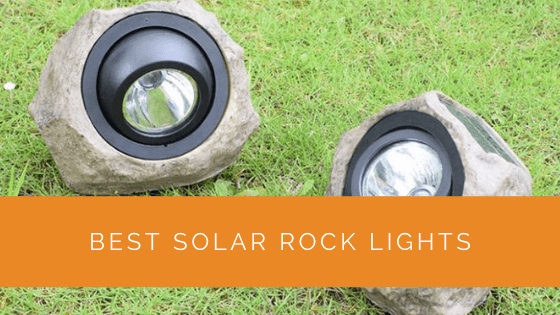
The Candieslife Solar Garden Rock Lights 4 Pack is our top pick for UK buyers wanting a complete garden path lighting solution in one purchase. Four stones at 4.5 stars, 35 lumens each, and IP65 waterproofing deliver genuine coverage without any visible wiring or obvious plastic fixtures interrupting your planting.
Solar rock lights have improved considerably in recent years. The best current models use efficient ABS or resin housings, 1,000mAh batteries, and panels that charge meaningfully through British overcast afternoons. This guide covers six of the best available on Amazon.co.uk right now, with honest notes on where each falls short and what to watch out for before buying.
Our Top Picks
| Image | Name | |
|---|---|---|
| Candieslife Solar Garden Rock Lights 4 Pack | |
| Candieslife Solar Rock Lights 2 Pack | |
| VISFLAIR Solar Rock Lights 2 Pack | |
| GOODFOEVER 2pk Solar Rock Garden Lights | |
| Solar Rock Lights Faux Rock Spotlight | |
| 2 Pack Solar Rock Lights Angle Adjustable |
6 Best Solar Rock Lights
1. Candieslife Solar Garden Rock Lights 4 Pack
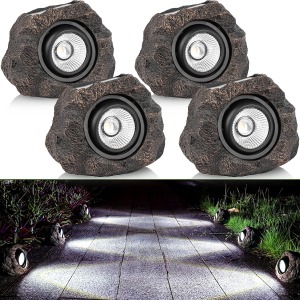
The Candieslife 4-pack earns the top position by solving the problem that stops most solar rock lights from working well in practice: coverage. A single pair of stones lights one short stretch. Four stones along a path, around a patio edge, or flanking a border gives you the continuous ambient glow that makes the concept actually look intentional rather than sparse. At 35 lumens per unit, these are firmly in decorative territory rather than security lighting, but that is exactly the right output for path edging or bed framing where you want warmth rather than a flood.
The ABS construction holds up well in UK conditions. ABS is tougher than the resin used by some competitors, with better resistance to frost cracking, UV yellowing, and the repeated wet-dry cycles that British gardens produce throughout the year. The IP65 rating confirms it handles rain and splashing properly. After a full 4 to 6 hour charge, the claimed all-night runtime has held up in practice according to reviews, which is the more important test than manufacturer spec sheets. A 4.5-star rating from 34 reviews at time of writing suggests buyers are finding it does what it says.
The integrated panel design means each stone sits as a self-contained unit. There are no cables trailing between a remote panel and the light body. This is both a convenience and a constraint: you place each stone where the sun reaches, which means south-facing positions or open garden areas work well, but deep shade under established shrubs will limit charging significantly. The auto on/off dusk-to-dawn sensor handles switching without any intervention, and the on/off switch on the base means you can disable individual stones when you want to move or store them seasonally.
For buyers who want one purchase that transforms a full pathway or patio edge, the 4-pack is the practical choice. Buying two 2-packs separately typically costs more and may give you mismatched stones from different production batches. This way all four match in colour and texture from the start. The per-stone price of around £14.50 is higher than the cheapest options here, but the rating and all-weather ABS build justify it.
Features
- 4 stones per pack, 35 lumens each
- IP65 waterproof ABS construction
- Charges in 4 to 6 hours, designed for all-night runtime
- Auto dusk-to-dawn sensor
- 4.5 stars
- £57.97 (around £14.50 per stone)
- 4-pack covers a full path or border edge in one purchase with matching stones
- 35 lumens delivers proper ambient glow, not just a dim flicker
- ABS housing more frost-resistant than resin alternatives
- IP65 handles British rain and garden conditions year-round
- Integrated panel means stones must be placed where direct sun reaches
- Higher total price than 2-pack alternatives (though better value per stone)
2. Candieslife Solar Rock Lights 2 Pack
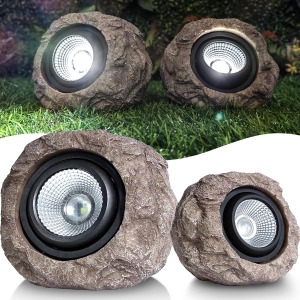
The 2-pack version of the Candieslife carries the same 35-lumen output, ABS construction, and IP65 waterproofing as the 4-pack above. At £40.88 for two stones it works out at around £20.44 per unit, which is actually more expensive per stone than the 4-pack but considerably cheaper as an entry point if you only need to light a doorstep, a single planting pocket, or two positions flanking a gate.
The 4.4-star rating across 123 reviews gives this more real-world validation than the newer 4-pack, which is worth noting if you want the comfort of a larger review dataset before committing. The same auto on/off sensor and ABS shell apply. You get consistent performance from the same product family, just in a smaller quantity. If you later decide you want more stones, buying a second pair or the 4-pack will give you matching units from the same Candieslife line.
This is the sensible starting point for buyers who are not sure how solar rock lights will look in their specific garden. Try two first, see how they perform through a typical UK autumn and winter, and add more next spring if you’re happy. The 2-pack is also worth considering for buyers who just need to flank a specific focal point like a garden statue or a specimen shrub rather than lighting a full path.
Features
- 2 stones per pack, 35 lumens each
- IP65 waterproof ABS construction
- 4 to 6 hour charge, designed for all-night runtime
- Auto dusk-to-dawn sensor
- 4.4 stars, 123 reviews
- £40.88 (around £20.44 per stone)
- More real-world reviews than the 4-pack for greater buyer confidence
- Same ABS and IP65 quality as the top pick
- Good starting point to trial solar rock lights before committing to more
- More expensive per stone than the 4-pack version
- Only two stones may not be enough for a full path or border
- Integrated panel requires good sun access at each placement position
3. VISFLAIR Solar Rock Lights 2 Pack
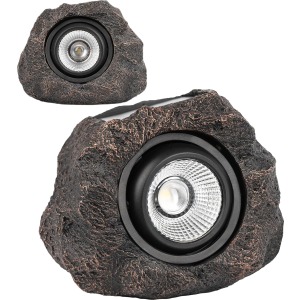
VISFLAIR’s 2-pack distinguishes itself on stone texture. The dark brown finish is moulded to replicate the natural variation of weathered garden rock rather than the uniform surface of a mass-produced ABS shell. In a border with established planting, these blend better than smoother-surfaced competitors. The listing description is upfront about the dusk-to-dawn intelligent sensor, IP65 rating, and the high-efficiency solar panel, which is the right level of specification transparency for a buyer trying to evaluate a product before purchasing.
At £40.74 for two, this is price-competitive with the Candieslife 2-pack. The 4.4-star rating from 110 reviews puts it close to Candieslife in real-world validation. The key differentiator here is the dark brown stone texture, which suits gardens with exposed aggregate paths, slate mulch, or natural stone edging. If your garden uses lighter gravel or buff stone, the lighter-coloured alternatives may blend better. Stone colour matching is genuinely worth thinking about: a dark stone sitting on pale gravel looks less natural than one that roughly matches the surrounding material.
Like the Candieslife, the integrated panel design means sun access at the placement position is the primary constraint. The dusk-to-dawn sensor handles switching automatically. VISFLAIR is a newer brand with fewer long-term reviews than Candieslife, but the current review profile looks genuine and consistent. Worth considering if the dark brown texture suits your garden better than the lighter stone options above.
Features
- Dark brown realistic stone texture
- IP65 waterproof construction
- Intelligent dusk-to-dawn sensor
- High-efficiency solar panel
- 4.4 stars, 110 reviews
- £40.74
- Realistic dark brown stone texture blends well into natural garden settings
- Price-competitive with equivalent Candieslife 2-pack
- IP65 and dusk-to-dawn sensor match best-in-class specs
- Newer brand with fewer long-term reviews than Candieslife
- Dark brown colour may not blend as well with pale gravel or buff stone paths
- Only 2 stones, so a full path still needs multiple packs
4. GOODFOEVER 2pk Solar Rock Garden Lights
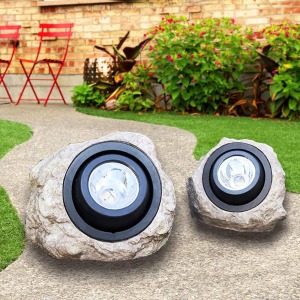
GOODFOEVER’s standout feature is the dual colour temperature option: you can set these to warm white (3000K) or cool white (6000K) depending on whether you want the rocks to cast a soft golden glow or a crisp daylight tone. Most solar rock lights only offer warm white. If you’re planting with silvery foliage or working with modern garden design where cool tones suit the aesthetic better, having the choice is actually useful. The 1,000mAh battery and claimed 8-hour runtime are the strongest capacity figures in this roundup.
At £55.42 for two stones, this is the highest per-stone price in the guide, so the dual colour mode needs to justify the premium. For buyers who care about colour temperature and want the flexibility to switch between warm evening ambience and cooler task-adjacent lighting, it does. For those who just want warm white like everyone else, the Candieslife or VISFLAIR offer better value. The AA-sized 1,000mAh battery is a positive: it suggests a standard replaceable form factor rather than a soldered-in cell, which matters if you want to extend the product’s lifespan beyond the first battery failure.
The product arrives ready to use. No installation or assembly is needed beyond turning the switch on the base to ON. The solar panel at 2.95 x 2.95 inches is among the larger panel sizes in this category, which supports the 8-hour runtime claim. Note that actual runtime in UK winter conditions with limited daily sun will be shorter. Managing expectations on output from October through February is important with any solar garden product.
Features
- Dual colour temperature: warm white (3000K) and cool white (6000K)
- 1,000mAh battery, claimed 8-hour runtime
- 2.95 x 2.95 inch solar panel
- IP65 waterproof
- 4.3 stars, 272 reviews
- £55.42
- Dual warm/cool white mode offers colour temperature flexibility others don’t
- 1,000mAh battery and large panel support genuine all-night runtime
- 272 reviews gives solid real-world validation
- Highest per-stone price in the roundup
- Dual mode is only worth the premium if colour temperature matters to you
- Winter runtime in the UK will fall well short of the 8-hour summer figure
5. Solar Rock Lights Outdoor Faux Rock Landscape Spotlight
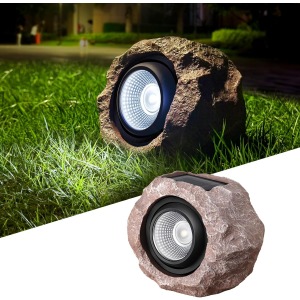
This is the most-reviewed product in the roundup with over 1,000 ratings, and it offers the adjustable angle feature that none of the others match. The light head tilts so you can direct the beam at a plant, a focal point, or a particular section of path rather than just diffusing light in all directions. That makes it a better choice if you want the rock to function as a subtle spotlight rather than pure ambient decoration. At £40.13 for a single unit, it sits at a mid-range price.
One important caveat: the IP rating. The listing title says IP65 but the product description references IP54, which is notably lower. IP54 means splash-resistant from any direction, not protected against sustained rain jets. For a British garden that sees genuine rain rather than occasional drizzle, this is worth factoring in. Most buyers probably won’t notice a difference in normal conditions, but if you’re positioning the stone somewhere exposed that takes driving rain, the lower IP rating of this model compared to the IP65 alternatives is a real consideration. The 4.2-star rating from 1,000+ reviews suggests it’s holding up well enough in practice, but it’s a spec to know about rather than discover later.
The resin construction is durable but slightly less frost-resistant than ABS over multiple UK winters. The adjustable angle is the defining purchase reason here. If you need it, this is the one to buy. If you don’t, the Candieslife or VISFLAIR give better IP ratings for a similar price.
Features
- Adjustable tilt angle for directional spotlighting
- Resin construction
- IP54 (listed as IP65 in title, check spec carefully)
- Auto on/off dusk-to-dawn sensor
- 4.2 stars, 1,000+ reviews
- £40.13
- Adjustable angle for directional use as a subtle spotlight
- 1,000+ reviews gives the most real-world validation in this roundup
- IP54 rather than IP65, despite the title claiming IP65
- Resin less frost-durable than ABS over multiple UK winters
- Single unit, so a full garden setup needs multiple purchases
6. 2 Pack Solar Rock Lights Outdoor Angle Adjustable
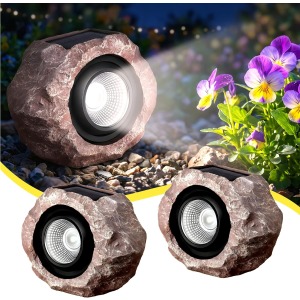
This 2-pack uses monocrystalline silicon in its solar panel, which the listing claims achieves a 25% conversion rate. Whether that specific figure is real-world accurate is debatable, but monocrystalline panels do genuinely outperform the polycrystalline panels used in cheaper solar garden lights, particularly in low-light and overcast conditions. For UK buyers who want the best chance of a meaningful charge on grey September and October days, the panel technology here is a real differentiator over anonymous budget alternatives. At £53.15 for two stones, it sits towards the upper end of the 2-pack price range.
IP65 waterproofing, angle adjustment, and straightforward out-of-the-box use round out the specification. The 4.2-star rating from 521 reviews is solid. This is the pick if you want a properly specified pair of rocks with good panel technology and genuine waterproofing, and you need the tilt angle to direct the output at a plant or feature.
Features
- Monocrystalline silicon solar panel, claimed 25% conversion rate
- Adjustable light angle
- IP65 waterproof
- Auto on/off sensor
- 4.2 stars, 521 reviews
- £53.15
- Monocrystalline panel better suited to UK overcast charging conditions
- IP65 waterproofing confirmed, not just claimed in the title
- Adjustable angle for directional output
- Higher per-stone cost than Candieslife 2-pack for similar review-count confidence
- The conversion rate claims are typical seller marketing and may not be independently verified
- Only 2 stones
Solar Rock Lights Buying Guide
Key Takeaways
- Solar rock lights are decorative ambient lights, not security or task lighting. Expect 5 to 35 lumens per stone.
- The biggest practical issue is integrated panel placement: the stone must sit where direct sun reaches for at least 4 to 6 hours.
- ABS construction is more frost-resistant than resin over multiple UK winters.
- IP65 is the right minimum for UK outdoor use. IP54 is splash-resistant, not rain-resistant.
- Warm white (2700 to 3000K) suits most gardens. Cool white (6000K) suits modern or contemporary designs.
- 4-packs work out cheaper per stone than buying two 2-packs separately for the same brand.
- Adjustable angle models let you direct output at a plant or feature rather than just diffusing ambient light around the stone.
- UK winter performance will be roughly 40 to 60% of summer figures. Size up battery capacity if you want reliable performance from October through February.
What Solar Rock Lights Are Actually Good For
Solar rock lights serve a specific decorative function: they add low-level ambient light to garden paths, borders, and planting areas without trailing cable, visible fixings, or the obvious plastic stakes that most solar garden lights use. The stone disguise is the point. During the day the lights look like rocks. At night they glow.
They are not security lights, pathway safety lights, or feature spotlights in the traditional sense. At 5 to 35 lumens per stone, you won’t see much beyond a gentle ambient glow. That’s enough to add atmosphere to an evening garden, define the edge of a path without blinding anyone, and hint at planting without fully illuminating it. If you need proper pathway safety lighting or security deterrent output, look at dedicated solar path lights or solar flood lights instead.
The products that work best are the ones where the stone genuinely passes for a rock in the garden setting. Good texture, appropriate colour for the surrounding material, and a stone shape that fits the scale of your planting. A large angular brown stone looks wrong next to small pale gravel. A smooth grey pebble looks right next to other smooth grey pebbles. Take the time to match the stone to your garden materials before buying.
The Integrated Panel Problem and How to Work Around It
Every solar rock light in this roundup has its solar panel built into the top or side of the stone body. That is both the design’s great strength (no wires, no separate panels, completely self-contained) and its main practical limitation.
The panel must face the sky with unobstructed sun access to charge properly. That means you cannot tuck these stones under the edge of a dense shrub, in a shaded border, or anywhere that spends most of the day in shadow. A stone sitting in full shade will barely charge at all and won’t give meaningful output at night.
Before buying, walk your garden at midday and identify which positions get at least 4 to 6 hours of direct or near-direct sun. Those are your viable placement spots. If your garden is predominantly shaded, a separate-panel solar spotlight (where the panel sits in the sun but the light body can be placed in shade) will serve you better than integrated-panel rock lights.
ABS vs Resin: Why Material Matters in UK Gardens
Solar rock lights come in two main materials: ABS plastic and resin. Both can be moulded to look like convincing rock textures. But they behave differently over a UK winter.
| Material | Frost resistance | UV stability | Weight | Typical cost |
|---|---|---|---|---|
| ABS plastic | Good (flexible at low temps) | Good with UV stabilisers | Light | Mid to high |
| Resin | Moderate (can crack in hard frosts) | Moderate (yellows over time) | Heavier | Low to mid |
ABS flexes slightly at low temperatures rather than becoming brittle, which means it is less likely to crack when water in micro-fissures freezes and expands during a hard frost. Resin can crack in extended cold snaps, particularly if water has worked into any join around the panel or the base. If you’re buying for a garden that experiences regular winter frosts, ABS is the safer choice. If budget is the primary concern and you’re prepared to bring the lights in during the coldest weeks, resin is fine for milder UK winters.
IP Ratings: What IP65 and IP54 Actually Mean
Most solar rock lights in 2026 claim IP65 waterproofing. The second digit (5) means protection against water jets from any direction. For a British garden, this is the minimum sensible standard: it covers rain, garden hose splash, and the kind of prolonged wet weather the UK sees from October through March.
IP54 (as found on the faux rock spotlight reviewed above) means the product is only protected against splash from any direction, not sustained water jets. In practice this distinction matters less in light rain than it does in heavy downpours or exposed positions that catch wind-driven rain. For a sheltered patio position, IP54 is probably adequate. For a garden border exposed to the prevailing south-westerly wind and rain, IP65 is the minimum.
A common issue across cheaper solar garden lights is that the IP rating applies to the housing but not the seal around the panel junction or the base switch. Check that the sealing is consistent across the whole unit rather than just the outer shell.
How Much Light to Expect
Solar rock lights are ambient garden lights, not task or security lights. The lumen outputs in this category are low by design. Here is what you can expect from typical outputs at various lumen levels:
| Output | Effect | Best use |
|---|---|---|
| 5 to 15 lumens | Very subtle glow, visible as a warm point of light | Purely decorative, defining border edges |
| 15 to 35 lumens | Gentle ambient illumination, lights immediate surroundings | Path edging, planting pockets, patio accent |
| 35 to 60 lumens | Noticeable ambient light, some practical use | Wider path lighting, step edge marking |
The products in this roundup cluster between 25 and 35 lumens, which puts them in the middle tier: enough to define a path edge and create atmosphere, but not enough to light a path for practical walking without other light sources. Setting this expectation before buying avoids disappointment. Solar rock lights are a garden atmosphere product, not a practical lighting solution.
Common Buying Mistakes
- Buying for a shaded position. Integrated panel rocks need sun access. A stone in full shade will barely charge. Check your garden at midday before choosing positions.
- Expecting security light output. At 35 lumens, these are ambient decorative lights. For security deterrence or bright path lighting, you need a different product category entirely.
- Mismatching stone colour to garden materials. A dark brown stone on pale gravel looks wrong. Match the stone colour to your existing garden surfaces.
- Ignoring the IP54 vs IP65 distinction. Some listings claim IP65 in the title but specify IP54 in the description. Check the specification section, not just the title.
- Buying too few stones for the space. One or two rocks in a long border look sparse. Plan your layout first: for a 4-metre path edge, four to six stones spaced at 60 to 80cm intervals gives proper coverage.
- Assuming summer spec performance year-round. 8-hour runtime in a UK December is fantasy. Factor in shorter days and weaker sun: expect 4 to 5 hours of output in midwinter from a well-positioned stone.
Quick Buyer Checklist
- Does the placement position get at least 4 to 6 hours of direct sun?
- Does the stone colour match your garden’s existing surfaces and materials?
- Is the IP rating IP65 or higher (check the spec section, not just the title)?
- Is the housing ABS (frost-preferred) or resin (adequate for mild winters)?
- Do you need adjustable angle for directional output at a plant or feature?
- How many stones do you need for full coverage of your intended space?
- Does the battery capacity (1,000mAh or higher) support winter use in your area?
Case Study: A Garden in West Yorkshire Gets Defined Path Edges
Background
A homeowner in West Yorkshire had recently redesigned their rear garden with a curved gravel path leading from the back door to a seating area and a small raised bed. The path was slate grey gravel with brown sandstone edging. The brief: add evening atmosphere lighting that looked natural during the day and didn’t involve any electrical installation.
Project Overview
The homeowner selected eight solar rock lights across two 4-packs in a mid-brown stone finish to match the sandstone edging. Positions were chosen by marking where each stone would sit in full afternoon sun, confirmed by checking each position with a sun-tracking app during the buying decision. The entire setup took 15 minutes to place with no tools and no drilling.
Implementation
All eight stones were placed with panels facing south-west to catch afternoon sun before the garden wall shaded the area from around 6pm. In summer the stones charged fully by 3pm and provided 6 to 7 hours of ambient output. The colour matched the existing sandstone edging well enough that daytime visitors did not immediately recognise the stones as lights rather than decorative cobbles.
Results
Through the first summer and autumn the stones performed well. Through December and January output dropped to around 4 hours per night and the glow was noticeably dimmer on overcast days following multiple days of cloud. The homeowner brought two of the shadiest-positioned stones indoors during the coldest weeks, leaving six on the path that maintained consistent output. The overall outcome was a defined path edge that required no maintenance beyond the occasional wipe of the panel surface to remove dirt after heavy rain.
Expert Insights From Our Solar Panel Installers About Solar Rock Lights
One of our senior solar panel installers with over 12 years of experience in UK garden and domestic solar installations offered this perspective:
“Solar rock lights are one of the more practical decorative solar products because the expectation is already set correctly. People know they’re ambient, they know they need sun, and they know they won’t replace proper lighting. What catches buyers out is the panel placement issue with integrated designs. I always say: stand in your garden at 1pm on a clear day and see which positions get unobstructed sun. Those are the positions where solar rock lights will perform. Anything else is buying for hope rather than reality. The other thing I flag is winter. UK winter sun is low in the sky and often weak. A stone that gives you 7 hours in August will give you 4 hours in December, and that’s on a good day. It’s not a fault. It’s physics.”
Frequently Asked Questions
How long do solar rock lights last at night in the UK?
In summer, a fully charged solar rock light typically runs for 6 to 8 hours per night. In UK winter, expect 3 to 5 hours on a reasonable day and as little as 1 to 2 hours after a run of overcast weather without meaningful charging. Products with 1,000mAh batteries and larger solar panels hold up better through winter than budget models with smaller batteries. Position matters too: a south-facing stone in full afternoon sun will charge faster and more completely than one in partial shade.
Do solar rock lights work in the shade?
Not well. Integrated-panel solar rock lights rely on direct or near-direct sun access to charge. In full shade, the panel generates almost no charge, and the light will produce minimal output or none at all at night. If you want to place lights in shaded positions, look for products with a separate solar panel on a cable so you can put the panel in the sun while positioning the light body where you want it.
What is the difference between IP54 and IP65 for solar rock lights?
IP54 means the product is protected against splash from any direction. IP65 means it is protected against sustained water jets. For UK outdoor use, IP65 is the safer minimum: it covers heavy rain, driving rain from the side, and garden hose splash. IP54 is adequate for sheltered positions but may let water in during heavy downpours in exposed garden positions. Always check the specification section of the listing rather than just the title, as some products claim IP65 in the headline but specify IP54 in the details.
How many solar rock lights do I need for a garden path?
For a defined path edge, space stones 60 to 80cm apart for continuous visual coverage. A 3-metre path needs approximately 4 to 6 stones per side (8 to 12 total for both edges). A single 2-pack will define a short doorstep or flanking position. A 4-pack is the minimum for a section of path that reads as intentional rather than accidental. For larger gardens, plan to buy multiple packs and choose a consistent stone colour and texture throughout.
Do solar rock lights work in winter in the UK?
Yes, but with reduced performance. UK winter days are short (7 to 8 hours of daylight in December) and sun intensity is low. A stone that performs well in summer will produce roughly 40 to 60% of its summer output in midwinter. Choosing products with larger panels and 1,000mAh or higher battery capacity helps. Positioning stones in open, unobstructed south-facing spots maximises the available winter sun. Some owners bring their stones indoors during the coldest weeks if consistent performance matters.
What colour temperature is best for solar rock lights?
Warm white (2700K to 3000K) suits most UK garden settings. It creates a soft, golden glow that looks natural in planted borders and on stone or gravel paths. Cool white (6000K) is more appropriate for contemporary garden designs with concrete, steel, or modern stone surfaces where a crisper light tone matches the aesthetic. Most solar rock lights only offer warm white. The GOODFOEVER model in this roundup offers both modes, which is useful if you’re undecided.
Are solar rock lights waterproof enough for a UK garden?
The best models in this roundup are IP65 rated, which is adequate for all UK weather conditions including heavy rain and driving rain. Avoid IP44 or IP54 rated models for exposed garden positions. Also check that the sealing runs throughout the unit including the panel junction and the base switch, not just the outer shell. Even IP65 rated products can develop issues if the seal around the panel degrades after several years of UV exposure.
Should I leave solar rock lights out all winter?
ABS-construction models can generally be left out through a UK winter. Resin models are more susceptible to cracking in sustained hard frosts. If your area regularly experiences temperatures below -5°C for extended periods, bringing resin rocks indoors for the coldest weeks extends their lifespan. ABS models are more robust in this regard. Regardless of material, wiping the solar panel surface monthly removes dirt and grime that reduces charging efficiency, which is especially important in winter when every bit of available light counts.
Summing Up
Solar rock lights are one of the more straightforward solar garden products: buy the right ones for your garden’s stone palette and available sun, place them in positions that actually charge, and they’ll deliver consistent ambient atmosphere through the British spring, summer, and autumn. The Candieslife 4-pack is the best overall choice for buyers who want to light a full path or border in one purchase with the best-rated ABS and IP65 construction in the category. The VISFLAIR 2-pack is worth considering if the dark brown stone texture suits your garden better. And the GOODFOEVER pair makes sense for buyers who want dual colour temperature flexibility that none of the other models offer.
For anyone already thinking about more substantial solar installations for your home or property, contact us for a free quote and we’ll assess what’s possible for your situation.
Updated