
Solar spike lights are one of the most versatile additions to a UK garden. Push a spike into the soil next to a tree, shrub, or border feature, point the head at whatever you want to illuminate, and let the sun do the rest. No wiring, no electrician, no running costs. The best models now deliver genuinely impressive brightness, adjustable colour temperatures, and IP66 or IP67 waterproofing that holds up through British winters without complaint.
The key is picking the right one. Output varies enormously between budget models and mid-range spotlights, and features like adjustable colour temperature and remote control make a real difference to how useful the lights are once installed. We’ve reviewed six of the best solar spike lights available on Amazon.co.uk, covering everything from premium remote-controlled sets to solid budget options for path lighting.
Our Top Picks
| Image | Name | |
|---|---|---|
| GreenClick 4in1 Solar Spot Lights | |
| Linkind Solar Spot Lights IP67 | |
| CORESLUX LED Solar Spot Lights | |
| MEIHUA Solar Landscape Spotlights | |
| Linke Solar Spot Lights 3-in-1 Adjustable | |
| T-SUNUS Solar Garden Spot Lights |
6 Best Solar Spike Lights for UK Gardens
1. GreenClick 4in1 Solar Spot Lights, Best Overall
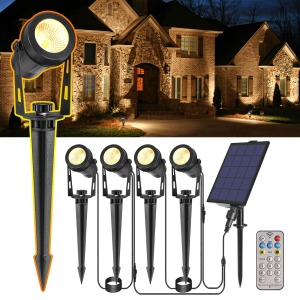
The GreenClick 4-in-1 spotlight earns its place at the top of this list through a combination of features that most competitors charge considerably more for. The remote control is the standout addition, being able to adjust brightness, set a timer, and switch between modes from across the garden is genuinely useful, particularly if your lights are mounted in a border or next to a raised bed where reaching the unit itself is awkward.
IP65 waterproofing is adequate for UK conditions. The 4-in-1 mounting system is a real practical advantage: spike into soil, mount on a wall, clip to a fence, or use the ground plate, one product covers all the situations you might encounter across a garden layout. Auto on/off via light sensor works reliably, and the solar panel charges quickly on a decent day, providing 8-10 hours of output overnight.
At £39.99 it’s not the cheapest spike light on this list, but the remote control and mounting flexibility justify the premium. A strong choice for anyone who wants one set of lights to handle multiple garden positions.
Features
- 4-in-1 mounting: spike, wall, fence, and ground plate
- Remote control for brightness, timer, and mode adjustment
- IP65 waterproof, suited to UK all-weather use
- Auto on/off light sensor with 8-10 hour runtime
- 4.7 stars on Amazon.co.uk
- Remote control is genuinely useful in the garden
- 4-in-1 mounting covers every installation scenario
- Excellent 4.7-star rating from UK buyers
- Good brightness for a solar spotlight
- £39.99 is mid-premium territory
- IP65 rather than IP67, fine for rain, not submersion
2. Linkind Solar Spot Lights IP67, Best for Wet Conditions
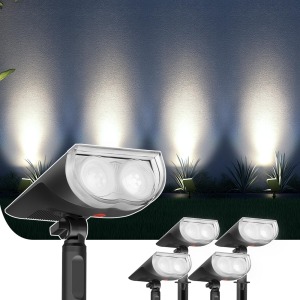
Linkind is a well-established name in solar garden lighting, and this 4-pack of spike spotlights is one of their strongest offerings. The IP67 rating is the headline feature: fully dust-tight and able to withstand temporary submersion in up to 1 metre of water. In practice this means these lights will handle anything a UK winter throws at them, including pooling water after heavy rain.
The compact form factor suits smaller garden areas and plant borders well. Unlike the large spotlights that work better for illuminating trees or walls, the Linkind units are tidy enough to blend into a planting scheme without looking industrial. Both ground spike and wall-mount brackets are included in the pack, giving you flexibility in placement. Cool white light (around 6000K) is crisp and clearly identifies features without the yellow tint that cheaper solar lights often produce.
Four in the pack at £28.78 is reasonable value, and the IP67 rating alone justifies the slight premium over cheaper competitors for UK buyers who want to set and forget without worrying about winter waterlogging.
Features
- IP67 waterproof, highest rating in this roundup
- 4-pack with both ground spike and wall-mount brackets
- Cool white light output, approximately 6000K
- Compact, low-profile design suits planted borders
- 4.5 stars on Amazon.co.uk
- IP67 is the best waterproofing rating here
- Good value as a 4-pack
- Tidy, compact design
- No remote control or colour temperature options
- Cool white only, not everyone’s preference for garden lighting
- Smaller solar panel than some rivals
3. CORESLUX LED Solar Spotlight, Best for Brightness
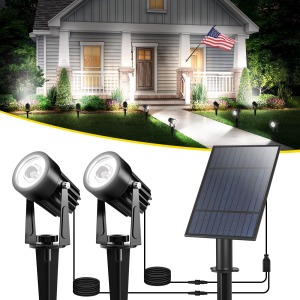
If raw brightness is the priority, the CORESLUX solar spotlight delivers. The 6000K cool white output is notably crisper and brighter than many competitors at a similar price, and the 60-degree adjustable head means you can direct the beam precisely at a wall, tree trunk, or garden ornament without relying on a fixed angle that may not suit your specific layout.
IP65 waterproofing is solid, and the build quality feels more substantial than you’d expect at £21.84. The light has been on Amazon.co.uk for several years and maintains a 4.6-star rating, which is a reliable signal that it performs consistently across different UK garden environments, not just in ideal sunny conditions. Runtime of 6-8 hours after a full day’s charge is typical for this category.
Worth considering if you’re illuminating a specific feature, a mature tree, a garden sculpture, or a house wall, where directed brightness matters more than warm ambience.
Features
- 6000K cool white, high-brightness output
- 60-degree adjustable head for precise aiming
- IP65 waterproof for all UK weather conditions
- Auto on/off sensor with 6-8 hour runtime
- 4.6 stars, well-established on Amazon.co.uk
- Notably bright output for a solar spotlight
- 60-degree adjustable head is very practical
- Excellent 4.6-star rating with substantial review history
- Cool white only, no warm option
- Single unit rather than a pack
4. MEIHUA Solar Landscape Spotlights, Best Warm White
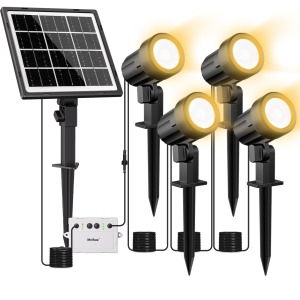
Most solar spotlights default to cool or neutral white, which looks fine on walls and trees but can feel clinical in a garden planting scheme. The MEIHUA 4-in-1 spotlight fills the warm white gap with 2700K output, the same colour temperature as a traditional halogen garden light, which sits more naturally in a planted border in the evening.
The 4-in-1 mounting system covers spike, fence, wall, and ground installation. IP66 waterproofing is one step below IP67 but more than adequate for any UK rainfall scenario. At £21.59, this represents genuinely good value for warm white solar spotlighting, and the 4.4-star rating reflects consistent buyer satisfaction. A sensible pick if you’re going for a warm, atmospheric garden look rather than a security-focused bright white.
Features
- 2700K warm white, closest to traditional halogen garden lighting
- 4-in-1 mounting: spike, fence, wall, ground plate
- IP66 waterproof for UK all-weather use
- Good value at £21.59
- 4.4 stars on Amazon.co.uk
- Warm 2700K suits planted garden schemes well
- 4-in-1 mounting is very flexible
- Good value for warm white performance
- IP66 rather than IP67
- Slightly lower brightness than cool white rivals
- 2-3 cons for a mid-tier product
5. Linke Solar Spot Lights 3-in-1 Adjustable, Best for Flexibility
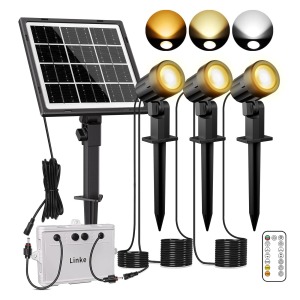
The Linke 3-in-1 spotlight is the most versatile colour option on this list. Three selectable colour temperatures, 2700K warm white, 4000K neutral white, and 6500K cool white, switch physically on the unit, which means you can set the tone to match your garden after dark, or adjust seasonally as the character of the garden changes. Few solar spotlights at this price point offer this flexibility.
IP66 waterproofing and a fully adjustable spike accommodate most garden surfaces and angles. At £26.99 it sits comfortably in the mid-range, and the 4.4-star rating indicates this is a product that meets expectations consistently. The build quality is solid, and the solar panel charges effectively even on overcast days typical of UK autumn and spring.
Features
- Three switchable colour temperatures: 2700K / 4000K / 6500K
- IP66 waterproof, solid UK weather performance
- Fully adjustable spike and spotlight head
- Charges effectively in low UK winter light
- 4.4 stars on Amazon.co.uk
- Three colour temperatures in one unit, unique at this price
- Solid IP66 waterproofing
- Mid-range price for premium-feeling feature set
- Colour switch is physical, not remote-controlled
- Sold as single unit, packs work out cheaper per light
- Slightly bulkier than competing spotlights
6. T-SUNUS Solar Garden Spot Lights, Best Budget
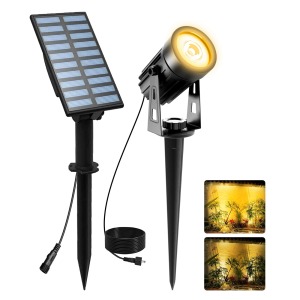
At £14.95, the T-SUNUS is the budget entry on this list, and it’s honest about what it offers. Warm white (3000K) auto on/off lighting for paths, driveways, and border edging, nothing more. What you don’t get is adjustable colour, high-end waterproofing ratings, or mounting flexibility. What you do get is reliable, decent-looking solar pathway lighting at a price that makes it easy to buy four or six units and light an entire garden edge without a significant outlay.
The 4.4-star rating suggests it performs well within its brief, and it’s suitable for the UK’s moderate outdoor lighting demands. For a rental property, a temporary installation, or someone just getting started with solar garden lighting, the T-SUNUS makes more sense than spending four times as much on premium units for the same basic function.
Features
- 3000K warm white auto on/off spotlight
- Waterproof for standard UK outdoor use
- Simple spike installation, no tools needed
- Budget price point, ideal for multi-unit purchases
- 4.4 stars on Amazon.co.uk
- Excellent value, easy to buy multiple units
- Warm white suits garden path lighting well
- Basic spec, no adjustable colour or remote control
- Lower brightness than mid-range rivals
- Not rated to IP65/66/67, less weatherproof than the others
Solar Spike Lights Buying Guide
Key Takeaways
Solar spike lights are straightforward garden lighting, but getting the right ones for your garden means thinking through a few specific decisions: how deep your soil is (soft lawn vs packed ground changes what stake design you need), how bright you want them (5 lumens is a garden accent, 50+ lumens is actual pathway safety), and whether your garden has shade (north-facing borders need separate panel cable designs so the panel can go in the sun). Most UK gardens end up with a mix of sizes — 20-50 lumen lights along borders, brighter 80-150 lumen versions for paths and steps. Winter performance matters: a spike light doing 10 hours in July will do 3-4 hours in December, so don’t expect evening ambiance if your garden faces north. Stainless steel spikes outlast plastic ones through UK frost cycles. IP67 matters if your garden has clay soil or standing water; IP65 is fine for gravel or well-draining borders.
- Spike depth and ground type determine which stake design to choose (soft soil vs packed ground vs gravel)
- Lumen output ranges from 5lm decorative to 150lm+ safety tier — most gardens need a mix
- Solar panel placement (top-mounted vs separate cable) changes where you can install them — separate panels let north-facing gardens actually work
- UK winter cuts output by 70% compared to summer — plan for 3-4 hour December runtime vs 12+ hours in July
- IP67 (waterproof) protects against ground-level pooling in clay soil; IP65 (splash-resistant) works for gravel borders
- Stainless or anodised aluminium stakes survive UK frost cycles; plastic spikes fail after 1-2 winters in heavy frost areas
- Pack buying (6, 8, 10-packs) costs 30-40% less per unit than individual lights
- Warm white LED (2700K) standard for gardens; cool white looks wrong outdoors and drains battery faster
The Spike Depth Problem — Soft Lawn vs Packed Soil
Solar spike lights need to go into the ground deep enough that they do not fall over in wind or when brushed by a garden hose. That sounds simple until you actually try to push a spike into different UK garden soils. Soft lawn (loam, plenty of organic matter) takes a 10-15 cm stake no problem. Packed soil, gravel borders, or clay takes a lot more pushing, and some spike light designs simply cannot take the force without the head snapping off.
This is why cheaper spike lights often fail: the head is glued or lightly screwed to the stake, and forcing them into hard soil breaks the connection. Better designs have the stake moulded as one piece with the head, or use a threaded socket that locks the head mechanically.
Before buying, dig a 15 cm hole in the actual spot where you want to put the lights. See how hard the soil is. Soft? Cheap plastic stakes will work. Hard-packed? You need either a stainless steel spike with a ground-claw anchor, or a design where you can pre-drill a hole with an auger before inserting the light.
UK gardeners in clay-heavy areas (most of the Midlands, parts of the South East, and Northern England) should budget for stainless spikes with anchor claws. Gravel and sandy soil gardens can use aluminium. Deep loam gardens can use plastic.
| Your Soil Type | Stake Material Recommendation | Claw or Anchor Design Needed? | Pre-Drilling Required? | Typical Cost Per Light |
|---|---|---|---|---|
| Soft loam / organic lawn | Plastic, aluminium, or stainless | No | No | £5-8 |
| Mixed soil / gravel borders | Anodised aluminium or stainless | Optional (helpful but not essential) | No | £8-12 |
| Hard-packed clay / shale | Stainless steel with ground claw | Yes (critical) | Recommended | £12-18 |
Lumen Output — When Decorative Becomes Functional
Solar spike lights cover a huge range of brightness, from 5 lumens (barely noticeable evening glow) to 150+ lumens (actually bright enough to light a path safely after dark). Understanding this range before you buy prevents the common mistake of buying six 20-lumen decorative lights thinking they will make a pathway safe, then being disappointed on a dark night.
In UK gardens, brightness tiers break down like this: 5-15 lumens is pure accent — visible only in dusk and early evening, nice for highlighting plants but useless for navigation. 20-50 lumens is the sweet spot for most garden borders, highlighting shapes and adding ambiance without being glaring. 80-150 lumens is genuine pathway lighting — safe to walk by, but noticeable glare if you look directly at it. 150+ lumens is flood or security level, rarely appropriate for a residential garden border.
The trick in UK gardens is mixing levels. Plant 20-30 lumen lights along flower borders for aesthetics, then add 80-100 lumen versions on pathways and steps for actual safety. This gives you 80% ambiance (the border lights) and 20% function (the pathway lights).
One more thing: brightness claims on the box are often optimistic. A light claiming 50 lumens might deliver 40 in the UK (less sun = slower charging = lower voltage output = dimmer LED). If you need safe pathway lighting, buy one tier brighter than you think you need.
Solar Panel Placement — Why Separate Cables Matter for Shaded Gardens
Solar spike lights come in two designs: top-mounted panel (the small solar cell is built into the light head) and separate panel on a cable (the head is just the light, and the solar panel attaches on a 2-3 metre cable). Most budget lights use top-mounted panels because they are simpler to manufacture. But if your garden has any shade, the separate cable design becomes essential.
Here’s the problem: you might want your spike light in a shaded border, but the top-mounted panel does not get sun. So the light does not charge, and it does not work. With a separate cable panel, you route the cable to a sunny spot (fence top, shelf, roof edge) where it gets proper charging, while the light sits where you actually want the ambient glow — under your pergola, in a shaded corner, or north-facing border. This is the difference between lights that work all season and lights that work only in June.
North-facing UK gardens should avoid top-mounted panels altogether. South-facing gardens can use either design. If you have a pergola, trellis, or shade sails in summer, separate panel cables are worth the extra £3-5 per light.
IP Ratings — Waterproofing When Your Spike Light Sits in a Puddle
Solar spike lights sit on the ground, which in UK winters means puddles. Clay soil especially holds water. Some lights are IP65 (splash-resistant but not submersion-proof), and some are IP67 (fully submersible for up to 1 metre). The difference matters more than you might think.
An IP65 light has air vents that let water spray escape. It survives rain and hose spray without issues. But if it sits in standing water for 24 hours (which happens in clay soil after heavy rain), water wicks up into the battery compartment and causes corrosion or short circuits. By January, the light stops working.
An IP67 light is sealed completely — no water gets in unless the light is actually submerged, which does not happen in a garden border. IP67 lights survive clay soil winter without issue.
If your garden drains quickly (gravel, sandy soil, raised borders), IP65 is fine and costs less. If you have clay, boggy soil, or standing water issues, IP67 is non-negotiable. The cost difference is usually just £1-2 per light, and it extends lifespan by 2-3 years.
Battery Chemistry — NiMH vs LiFePO4 for UK Winter
Most budget solar spike lights use NiMH (nickel-metal hydride) batteries. They are cheap, reliable, and work well in summer. But in UK winter, they underperform: a 1000 mAh NiMH battery at 20°C does not hold as much charge as it does at 25°C, and that matters when your light only gets 4 hours of sun in December.
Premium spike lights use LiFePO4 (lithium iron phosphate) batteries. They are more expensive (£15-25 per light instead of £5-10), but they deliver consistent voltage across a wider temperature range. A LiFePO4 battery maintains nearly full capacity at 0°C, so your lights stay bright even in deep winter.
For most UK gardeners, NiMH is fine — it will do 3-4 hours in December and 10+ hours in summer, which is reasonable ambiance. If you live in Scotland, Northern England, or areas with heavy cloud cover (most of the UK, really), and you want reliable performance year-round, LiFePO4 is worth the extra cost. If you swap batteries seasonally (removing them in November for a break), NiMH is adequate.
Stake Material and Frost Durability
UK winters expand and contract soil through freeze-thaw cycles. A plastic spike gets pushed up and out by frost heave over several winters, leaving it loose and unsafe. Stainless steel does not expand, so it stays anchored year after year. This is not a feature that gets advertised, but it shows up in year-three durability: plastic spike lights buried for two winters tend to be loose or fallen over; stainless or anodised aluminium lights stay planted.
Plastic spikes are fine for southern UK (London, South East) where frost is rare or light. They last 2-3 years. Anywhere north of the Midlands, or at altitude, invest in stainless or anodised aluminium. They cost 30-50% more but last 5-8 years without degradation.
Do not buy spike lights with bare steel stakes — they rust within one UK winter. Always look for stainless (marked as 304 or 316 stainless) or anodised aluminium (which has a coloured oxide layer preventing corrosion).
UK Seasonal Performance Table — What to Expect by Month
Battery capacity and solar charging combine to produce very different runtime by season. A 1000 mAh NiMH battery in a spike light gets 3-4 hours of use in January, 6-7 hours in April, 12+ hours in July, then back to 5-6 hours by October. This is why some gardeners say their spike lights “stopped working” in autumn — they did not stop working; they just lost the long evening glow they had in summer.
If you need consistent evening lighting year-round, either size up to 1500+ mAh batteries, add separate panel designs (more sun charging), or use a mix of spike lights and mains-powered alternatives in winter.
| Month | Sun Hours (avg UK) | Charge per Day (Typical 1000mAh) | Runtime Before Dark | Brightness at 10 PM |
|---|---|---|---|---|
| January | 1.5 | 60% charge | 3-4 hours | Dim (useful accent only) |
| April | 4.5 | 90% charge | 6-7 hours | Good (pleasant ambiance) |
| July | 6.5 | 100% charge | 12+ hours | Good (well-lit all evening) |
| October | 3.0 | 75% charge | 5-6 hours | Moderate (readable book level) |
Pack Buying Economics and Installation Patterns
Solar spike lights sell in packs: 4-pack (usually £20-30), 6-pack (£25-40), 8-pack (£35-55), 10-pack (£45-70). The per-unit cost drops significantly in larger packs — a 4-pack at £28 costs £7 per light, but a 10-pack at £65 costs £6.50 per light. So yes, larger packs save 10-20% per unit.
Most UK gardens look best with 6-8 spike lights for a 12-metre border, or 8-10 for a full pathway circuit. That usually means buying one 6-pack and one 4-pack (total 10 lights) rather than two 6-packs (12 lights, which is often one too many for cramped borders).
Do not buy mismatched packs from different brands or years — the colour temperature (warm white 2700K vs cool white 5000K) will be visibly different, and the brightness will not match. Buy all the same product, even if it costs a bit more. Consistency matters more than perfect economy.
Quick Buying Decision Guide
| Your Situation | Best Spike Light Type | Key Check Before Buying | Expected Lifespan | Budget |
|---|---|---|---|---|
| Soft lawn, south-facing, summer use only | Budget plastic spike, 20-30 lm, top-mounted panel, NiMH battery | Check lumen output (ask for 20+ lumens, not the vague “LED” claim) | 1-2 years | £5-8 per light |
| Mixed garden, decent soil, year-round use | Mid-range aluminium spike, 30-50 lm, top or separate panel, NiMH or LiFePO4 | Check IP rating (IP65 minimum for mixed soil); verify anchor design if soil is hard | 3-4 years | £8-12 per light |
| North-facing, shaded, or clay soil garden | Premium stainless spike, 50+ lm, separate panel cable, LiFePO4 battery, IP67 | Measure cable length needed (most are 2-3m — not enough for far-away sunny spot? buy two packs with separate panels) | 5-8 years | £15-22 per light |
| Pathway safety (steps, dark areas) | High-brightness stainless spike, 100+ lm, top-mounted panel, larger battery (1500+ mAh) | Check actual lumens output (not marketing “brightness”); IP67 recommended | 4-6 years | £12-18 per light |
| Budget-conscious, summer garden parties | 4-6 pack of decent 20-30 lm budget spikes, plastic or aluminium stake, NiMH | Check for IP rating (at least IP65); avoid any without a recognised brand | 1-3 years | £24-35 for 4-pack (£6-9 per light) |
Case Study: West Sussex Garden Makeover, Spring 2026
Background
A homeowner in Chichester with a 60-foot rear garden had recently replanted two large specimen beds either side of a central lawn. Three mature Italian cypress trees and a mix of ornamental grasses needed uplighting to look their best after dark. The garden had no external power sockets.
Project Overview
Six CORESLUX solar spotlights were ordered at £21.84 each, along with two Linke 3-in-1 units for the ornamental grass border where warm white was preferred. Total spend: £184.66. The homeowner positioned each unit and adjusted the spotlight heads during a single afternoon.
Implementation
The cypress trees received two spotlights each, angled to light from two sides. The CORESLUX 6000K cool white gave sharp definition to the dark foliage. The ornamental grass border used the Linke 3-in-1 units set to 2700K warm white, which gave the grasses a golden evening glow that blended with the warm tones of the house lighting visible through the windows.
Results
Runtime of 7-9 hours was sufficient from April through September. In January and February, output dropped to around 4 hours, adequate for the early evening but not lasting all night. The homeowner considered this a reasonable trade-off given zero running costs and no wiring. Total installation time: 45 minutes. Total ongoing cost: nil.
Expert Insights From Our Solar Panel Installers About Solar Spike Lights
“Solar spike lights have improved dramatically in the last three years. The IP67-rated units we’d recommend today would have been considered premium products in 2022. The main mistake I see is people positioning them where the solar panel doesn’t get a decent charge, under a pergola, behind a fence, or in deep border shade. You need at least 4-6 hours of sun on the panel for reliable overnight performance. In UK conditions, south or west-facing placement is nearly always better than north or heavily shaded east positions,” says one of our senior solar panel installers with over 11 years of UK residential experience.
Frequently Asked Questions
Do solar spike lights work in the UK?
Yes, solar spike lights work well in UK conditions, though performance drops in winter. From April to September, most quality models deliver 7-10 hours of output after a full charge. From November to February, expect 3-5 hours depending on cloud cover and the panel’s daily charge time. Choosing units with IP65 or higher waterproofing is essential for UK all-weather use.
How bright are solar spike lights?
Output varies considerably. Budget models produce 10-30 lumens, adequate for path marking but not feature illumination. Mid-range spotlights like the CORESLUX or Linkind produce 50-100 lumens, enough to clearly illuminate a small tree or shrub. Premium models with motion sensors can reach 200+ lumens briefly. As a reference, a standard indoor reading lamp is around 400 lumens.
What IP rating do I need for UK outdoor use?
IP65 is the minimum acceptable for year-round UK garden use, it’s fully dust-tight and protected against water jets from any direction. IP66 adds resistance to more powerful water jets, and IP67 means the unit can be submerged in 1 metre of water for 30 minutes. For gardens that flood or have very wet soil near ponds or water features, IP67 is worth seeking out.
How do I get more from solar lights in winter?
Position the solar panel to face south and tilt it towards the low winter sun. Clean the panel monthly during winter as grime builds up faster and reduces charging efficiency. If your lights have a timer, set them to run for fewer hours rather than all night, 3-4 hours at the start of the evening rather than draining all night gives you usable light when people are actually outside or looking out at the garden.
Can solar spike lights be used on patios?
Most solar spike lights come with alternative mounting options, wall brackets, fence clips, or a flat base. The ground spike itself works only in soil, but the light head is often detachable and compatible with the included alternative mounts. Check the product listing before buying if patio or paving use is your primary need, as some models are spike-only.
How long do solar spike lights last?
The solar panel and LED components typically last 5-10 years. The rechargeable battery, which is the most likely failure point, usually needs replacing after 2-4 years depending on charge cycles and winter temperatures. Most quality models use standard AA NiMH or small lithium cells that are replaceable. Check before buying that the battery is accessible, as some cheaper units are sealed.
What colour temperature is best for garden lighting?
Warm white (2700K-3000K) suits most domestic garden settings and plants, giving a golden glow that enhances foliage colours and complements house lighting seen through windows. Cool white (5500K-6500K) is brighter and harsher but works well for security-focused uplighting of walls and fences, or for contemporary garden designs where a crisp white light fits the aesthetic. Neutral white (4000K) is a reasonable compromise for general-purpose use.
Are solar spike lights easy to install?
Yes, they’re among the simplest outdoor lighting options available. Push the spike into the soil, angle the spotlight head at your target, and the light does the rest. Most units arrive partially charged and will operate on their first night without needing a full day’s charge first. No tools, no wiring, and no specialist knowledge are required.
Summing Up
Solar spike lights are one of the best value garden lighting investments available to UK homeowners, no running costs, no electrician, no planning, and they go where you need them without committing to a fixed position. The GreenClick 4in1 is our top overall pick for its remote control and mounting flexibility, while the Linkind IP67 set is the best choice for wet garden positions. For warm white output on a budget, the MEIHUA 4-in-1 is hard to beat at £21.59. Whatever your garden layout, there’s a solar spike light on this list that fits the brief.
Updated