
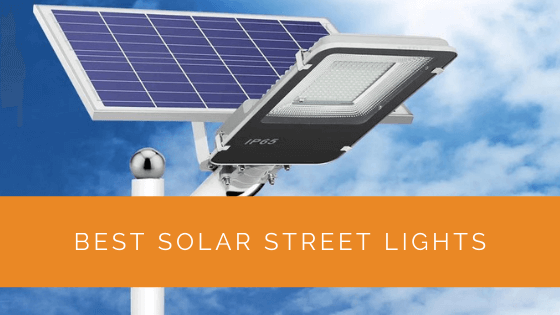
The best solar street light for most UK buyers is the INTELAMP 108 LED Solar Light Fixture, which combines 270-degree wide-angle illumination, a 6000 mAh battery, and IP65 weatherproofing into a single fitting that’s earned nearly 900 reviews at 4.6 stars. It works equally well on domestic garage walls, garden posts, and commercial yard entrances, and the motion sensor handles the switching automatically from dusk to dawn.
Solar street lights have improved considerably in recent years. Where older models struggled in UK winter conditions, the current generation uses high-capacity batteries and efficient monocrystalline panels that store enough charge during shorter days to run reliably through the night. This list covers the best options currently available on Amazon.co.uk, from budget motion sensor lights to commercial-grade floodlights capable of illuminating entire car parks.
Our Top Picks
| Image | Name | |
|---|---|---|
| INTELAMP Solar Light Fixture, 108 LED with Motion Sensor | |
| YACAISI Solar Street Lights Outdoor, 8500K Motion Sensor | |
| INTELAMP Solar Spotlight 4000LM with Remote Control | |
| Ofuray Solar Flood Lights Outdoor, 180 LED 2-Pack | |
| JAYNLT Y-4200W Solar Street Light, Commercial Parking Lot | |
| Ofuray Of-9600W Solar Street Light, 90 Ultra-Bright LEDs |
6 Best Solar Street Lights
1. INTELAMP Solar Light Fixture, 108 LED with Motion Sensor
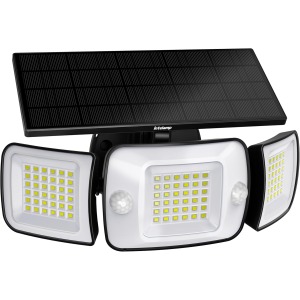
With 895 reviews at 4.6 stars, this is the solar street light that UK buyers are actually choosing and recommending. The 108 LED three-head design produces up to 1,200 lumens across a 270-degree arc, which covers a genuinely wide area rather than focusing a narrow beam at one spot. That wide-angle spread is what makes it practical for gates, driveways, courtyards, and garage walls where you need the whole area lit rather than just a single point.
The 6000 mAh battery is large enough to run through a full UK winter night after a reasonable charging day. The dual PIR sensor gives three operating modes: constant low light, motion-activated bright light, and a pure motion sensor mode that keeps the light off until movement triggers it. For most UK installations the motion sensor mode gives the best combination of battery life and security deterrence.
At £46.90 this is genuinely good value for a three-head fixture with this review volume. IP65 waterproofing handles British weather without any issues, and the black finish suits most wall and post installations. It’s the right starting point for anyone who needs reliable outdoor solar lighting without spending serious money.
Features
- 108 LED beads, 1,200 lumen output
- 270-degree wide-angle three-head design
- 6,000 mAh battery capacity
- Dual PIR sensor, 3 lighting modes
- IP65 waterproof rating
- 895 reviews at 4.6 stars
- 895 reviews, proven real-world track record
- 270-degree coverage illuminates wide areas
- 6,000 mAh handles UK winter nights well
- Competitive price for a three-head fixture
- Black finish only, no colour options
- No remote control for adjustment
2. YACAISI Solar Street Lights Outdoor, 8500K Motion Sensor
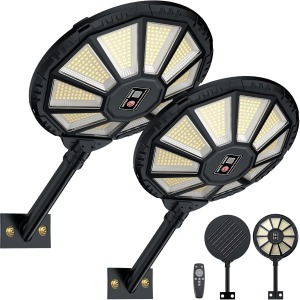
At £30.67 this is the most affordable solar street light on this list, and for basic security lighting on a garden gate, shed, or back wall it does exactly what it needs to. The 8500K colour temperature is notably crisp and bright, producing a cool daylight-white output that shows up clearly on security camera footage and reads as genuinely illuminating rather than the warm yellow of older solar lights.
The dusk-to-dawn automatic operation means there’s nothing to manage after installation. The motion sensor activates on approach and returns to standby between detections, which extends battery life considerably on quiet nights. For buyers who want a simple, affordable solar security light without complicated setup or settings, this delivers without any fuss. The 35 reviews at 4.6 stars are encouraging for a newer product at this price.
Features
- 8500K cool daylight white output
- Motion sensor with dusk-to-dawn operation
- IP65 waterproof outdoor construction
- Wall and post mountable
- 35 reviews at 4.6 stars
- Lowest price on this list at £30.67
- 8500K output is crisp and camera-friendly
- Simple dusk-to-dawn auto operation
- Fewer reviews than the established top picks
- Smaller battery than higher-end models
- No adjustable colour temperature
3. INTELAMP Solar Spotlight 4000LM with Remote Control
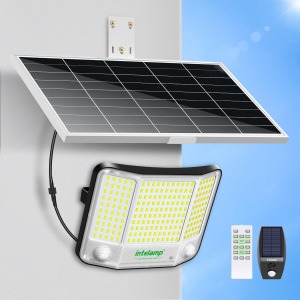
The remote control is what sets this model apart. Most solar street lights are install-and-forget, but being able to adjust sensitivity, brightness, and operating mode without climbing a ladder is a real practical advantage for anyone with a high or awkward installation. The 4,000 lumen output is substantially brighter than typical consumer solar lights, and the 20,000 mAh battery is the largest capacity on this list by some margin.
That battery size directly addresses the biggest concern UK buyers have about solar street lights in winter: will they run all night in December? With 20,000 mAh and a 25% conversion efficiency monocrystalline panel, the answer is yes under normal conditions. The 6500K colour temperature provides the neutral daylight output that works best for security and visibility applications.
At £88.92 it’s a step up in price, but the combination of very high output, remote control, and a large battery means this is the right choice for anyone needing serious illumination from a single fixture rather than multiple smaller lights.
Features
- 4,000 lumen output at 6500K
- Remote control for mode and sensitivity adjustment
- 20,000 mAh battery capacity
- 25% efficiency monocrystalline panel
- Motion sensor with multiple operating modes
- 29 reviews at 4.8 stars
- Remote control is a genuine convenience for high installations
- 4,000 lumens, the brightest single-head on this list
- 20,000 mAh battery handles long UK winter nights
- 4.8 stars from early buyers
- Only 29 reviews, newer product with a limited track record
- Higher price than basic security light options
4. Ofuray Solar Flood Lights Outdoor, 180 LED 2-Pack
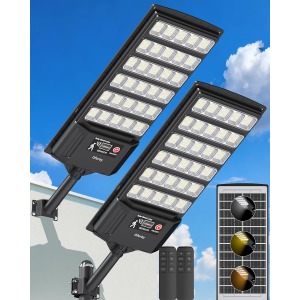
Two lights for £129 changes the value calculation considerably. Each Ofuray fixture has 180 LEDs, IP65 protection, motion sensing, and three selectable colour temperatures: 3000K warm white, 4000K neutral white, and 6500K cool daylight. Buying two fixtures with adjustable colour temperature for the same money as a single premium single-head fixture is a strong deal for anyone needing to cover multiple areas.
That adjustable colour temperature is a feature usually reserved for more expensive fixtures. Being able to dial between warm white for a welcoming entrance, neutral white for a utility area, and cool daylight for maximum visibility gives this model flexibility that fixed-temperature lights can’t offer. The 169 reviews at 4.6 stars confirm these aren’t just impressive on paper.
The main limitation is that each individual light in the pack produces less output than the dedicated single-fixture premium models. If you need maximum illumination at one specific point, the INTELAMP 4000LM or the Ofuray Of-9600W below will outperform it. But for covering two separate zones at a reasonable total cost, this twin pack is the better choice.
Features
- 2 lights included, 180 LEDs per fixture
- 3 selectable colour temperatures: 3000K, 4000K, 6500K
- Motion sensor and dusk-to-dawn operation
- IP65 waterproof rating
- 169 reviews at 4.6 stars
- Two lights included, covers two zones for one outlay
- Adjustable colour temperature is rare at this price
- 169 reviews at 4.6 stars, solid real-world feedback
- Individual output lower than dedicated premium single fixtures
- Not the right choice where maximum single-point illumination is the priority
5. JAYNLT Y-4200W Solar Street Light, Commercial Parking Lot
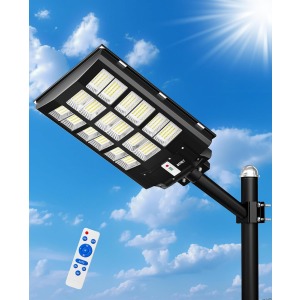
The JAYNLT Y-4200W is built specifically for commercial applications: car parks, loading bays, farm yards, and industrial estates where a domestic security light won’t cut it. The three operating modes give control over light behaviour between detections, with the motion sensor mode keeping the fixture at 20% brightness until movement bumps it to full 100% output. That intelligent dimming extends battery life significantly on quiet nights when full brightness isn’t needed.
At £139.99 with 24 reviews at 4.8 stars, it’s a product with limited but very positive early feedback. The 6500K output and commercial-grade construction make it appropriate for applications where safety and deterrence are the priority. The waterproof rating handles exposed locations, and the motion sensor range is calibrated for larger areas than domestic models target.
Features
- Commercial parking lot and yard specification
- 3 lighting modes including intelligent 20% to 100% dimming
- 6500K daylight white output
- Waterproof construction for exposed outdoor locations
- 24 reviews at 4.8 stars
- Built for commercial applications and large sites
- Intelligent dimming saves battery on quiet nights
- 4.8 stars from early buyers
- Only 24 reviews, limited real-world history
- Higher cost suits commercial use better than typical domestic gardens
6. Ofuray Of-9600W Solar Street Light, 90 Ultra-Bright LEDs
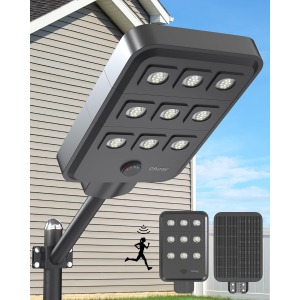
The Ofuray Of-9600W sits at the premium end at £246.99, and it earns that position with specifications that exceed everything else here. The 90 ultra-bright 5054 LED beads carry a rated lifespan of 60,000 hours, and the coverage area of up to 2,500 square feet makes it genuinely appropriate for large farms, commercial yards, and industrial applications where smaller lights would leave dark patches.
The distinctive bionic eagle shape isn’t just styling. The form is engineered to direct light across the widest possible horizontal spread, which is exactly what you need when illuminating a car park or wide open yard rather than a narrow path or doorway. With 126 reviews at 4.8 stars it has the strongest review confidence of any fixture on this list, which is impressive for a product at this price point.
The four smart lighting modes include a schedule function that lets you set different brightness levels for different times of night. That programmability puts it in a different class from everything else here. If you’re spending this much on a solar street light, having proper control over how and when it operates is exactly what the money buys.
Features
- 90 ultra-bright 5054 LED beads (60,000-hour lifespan)
- Coverage up to 2,500 sq.ft per fixture
- 4 smart lighting modes including programmable schedule
- Bionic eagle shape for wide horizontal light spread
- 126 reviews at 4.8 stars
- 126 reviews at 4.8 stars, best review confidence on this list
- 2,500 sq.ft coverage for large sites
- 60,000-hour LED lifespan
- Programmable schedule mode is unique here
- £246.99 is a serious investment
- Overpowered and overpriced for small domestic applications
Solar Street Lights Buying Guide
Key Takeaways
- Solar street lights divide into three genuinely different mounting types: pole-mount lights (freestanding on their own mast, typically 2-5m), wall-bracket lights (fixed to a wall or fence at height), and oversized stake lights (heavy-duty ground stake, 0.5-1.5m); the right choice depends entirely on what you’re trying to illuminate and whether a suitable fixed surface exists nearby
- Lumens output is critical for street lights and most buyers underestimate how much is needed: path edge marking works at 200-500 lumens, a driveway or car park area needs 800-2000 lumens, and a commercial yard or access road requires 2000-5000 lumens; products described as “solar street lights” span this entire range, and a 300-lumen model genuinely cannot do the job of a 1500-lumen model regardless of other specifications
- PIR motion sensor range and sensitivity setting is the most practically important feature after lumens: a sensor that triggers too easily (wind, small animals) drains the battery through the night; one that doesn’t trigger reliably for pedestrians is useless for the stated purpose; adjustable sensitivity with a lockable constant-on mode is the most useful configuration for mixed residential and commercial use
- Solar panel size is the real limiting factor for high-output models: a 30W integrated panel can support much higher battery capacity and brighter LEDs than a 10W panel, but requires a significantly larger panel on the pole head or a separate tilted panel; products that claim very high lumen outputs with very small panel areas are almost always overstating their real-world performance
- Battery capacity needs to match the expected runtime: a 2000-lumen light running dusk-to-dawn in December (7pm to 7am = 12 hours) needs substantial battery storage — 20,000mAh+ at that output level; many budget street lights in this category carry 5000-8000mAh and will dim significantly or cut off after 4-6 hours in UK winter
- IP66 is the practical minimum for pole-mount street lights — the elevated position means the light faces direct rain, wind-driven spray, and temperature extremes not experienced by ground-level lights; IP65 is adequate for wall-mounted and stake designs with overhead protection from eaves
- For residential driveways and paths in the UK, a 1000-1500 lumen output with PIR motion activation and dusk-to-dawn dim mode is the most practical combination: dim ambient light from dusk, full brightness on motion, auto-dim return after motion ends, off at dawn
Mounting Types: Matching the Product to the Location
The most common buying mistake is choosing a product without considering how it will actually be mounted. Each mounting type has genuine advantages and constraints.
Freestanding pole-mount: The light comes with its own mast, typically installed by driving or concreting the base pole into the ground. This is the only option for illuminating areas away from walls or fences — a car park centre, a field gateway, the middle of a driveway. The height (2-5m) provides a wider illumination footprint than ground-level lights. The downside is that installation involves digging and the pole occupies footprint permanently. Best for: driveways, yards, field access, commercial applications.
Wall-bracket mount: The light body attaches to an arm bracketed to a wall, fence, or existing pole. Uses existing structure rather than requiring a new mast. Height is determined by the mounting surface. Works well for: house walls above driveways, garage walls, boundary walls, existing fence posts. Requires a suitably solid wall or post — a thin timber fence panel is not adequate for a heavy-duty solar street light.
Heavy-duty stake: A tall ground spike (typically 80cm-1.5m) supporting a larger-format light head at height. Easier to install than a freestanding pole but not as tall and less stable in soft ground. Adequate for: path edges, garden boundaries, low-traffic domestic positions.
Pole Mount Installation: What It Actually Requires
Freestanding pole-mount street lights look simple in product photos but require more preparation than most buyers expect. Understanding the installation process before you buy avoids choosing a product that’s impractical for your ground conditions.
The basic installation: Most freestanding solar street lights ship with a base pole section (typically 400-600mm) that buries in the ground, plus one or more extension sections reaching 2-5m total height. The standard approach is to dig a hole roughly twice the diameter of the base pole and 300-450mm deep, drop the base section in, backfill with concrete, and leave to cure for 24-48 hours before attaching the upper sections and light head.
Ground type matters: Clay soil can shift seasonally as it absorbs and loses moisture — a concrete collar around the buried base section prevents lean over time. Sandy or loose soils need a deeper hole (450mm minimum) or a concrete pad. Hard-packed gravel or compacted sub-base is ideal for driving the pole directly without concrete in some lighter designs. Check product installation instructions before assuming your ground type will work without concrete.
Semi-permanent commitment: Once the concrete is poured, the pole position is fixed. Spend time checking sight lines, shadow patterns, and whether the solar panel on the pole head will receive unobstructed sun before finalising placement. Moving a pole-mount light after installation means breaking concrete and restarting from scratch.
Wall-bracket installation is simpler: Most wall-bracket solar street lights mount with 4-6 masonry bolts into a brick, block, or stone wall. Timber wall installation requires checking that the timber is thick enough (50mm minimum) and in good condition. The bracket itself handles the bracket-to-wall fixings; the light panel and battery are usually self-contained within the head unit.
Lumens Guide: Matching Output to Application
| Application | Lumens Needed | Typical Battery Required | Panel Size Needed | Realistic Budget |
|---|---|---|---|---|
| Residential path / garden edge marking | 200-500lm | 5,000-10,000mAh | 10-20W panel | £25-60 |
| Domestic driveway lighting | 800-1500lm | 10,000-20,000mAh | 20-40W panel | £45-120 |
| Commercial car park or yard | 2000-4000lm | 30,000-60,000mAh | 40-80W panel | £120-350 |
| Security perimeter lighting | 3000-6000lm | 50,000mAh+ | 60-100W panel | £200-500 |
| Rural track or field gate | 500-1500lm, long-duration | 20,000mAh+ | 30-50W panel | £60-150 |
Be particularly sceptical of budget products claiming very high lumen outputs. A product advertised as “6000 lumens” with a 15W panel and 8000mAh battery physically cannot deliver that output for a meaningful duration. Legitimate high-output solar street lights are physically large and heavy — the panel area and battery pack required to support genuine high-lumen continuous output cannot be miniaturised away.
Colour Temperature: Visibility vs Atmosphere
Colour temperature is often an afterthought in street light buying decisions, but it has a measurable effect on how much useful visibility a given lumen output actually delivers.
Commercial street lighting standards in the UK typically specify 4000-5000K (neutral to cool white) for roads, car parks, and access routes. At cooler colour temperatures, the human eye perceives more contrast and spatial detail — meaning a 1000-lumen light at 5000K appears subjectively brighter and gives better obstacle visibility than a 1000-lumen light at 2700K. For driveways, commercial yards, and anywhere safety or security is the primary aim, neutral white (4000-4500K) is the better choice.
Warm white (2700-3000K) suits domestic path lighting and areas where the visual atmosphere matters as much as pure visibility. A row of warm white pole lights along a garden path creates a welcoming effect; the same lights at 5000K looks clinical. For mixed-use applications — a driveway that needs to be safe but also serves as a garden feature — 4000K is a reasonable middle ground.
Not all products specify colour temperature clearly. If a product description says only “white LED” or “bright white” without a Kelvin figure, it’s likely in the 5000-6500K range, which is fine for functional use but quite cold in appearance.
PIR Sensor Modes and Why They Matter
Most residential solar street lights offer three operational modes, and the choice of mode significantly affects both usability and battery life:
Motion-only mode: Light stays off until PIR triggers, then full brightness for a timed period (typically 30-120 seconds). Maximum battery life. Appropriate for security applications where the light off is the default state. Not suitable for paths that need continuous illumination for safe navigation.
Dim-and-brighten mode (most useful for domestic use): Light runs at reduced output (typically 10-30% brightness) from dusk, jumps to full brightness on PIR trigger, then returns to dim after motion ends. Provides continuous ambient light for navigation while conserving battery for full-brightness bursts. This is the most practical mode for a residential driveway or path that needs to be safe to navigate but doesn’t need full security-level output constantly.
Constant-on mode: Full brightness from dusk to dawn. Maximum battery consumption — only suitable where the battery and panel are sized to support it through the night. Budget models in constant-on mode will dim significantly or cut off in the early hours, particularly in UK winter.
Adjustable PIR sensitivity is important. UK gardens include cats, foxes, rabbits, hedgehogs, and wind-blown vegetation — all of which can trigger a poorly configured motion sensor. The ability to reduce sensitivity or set a minimum trigger distance prevents the battery being repeatedly drained by non-target motion events.
Battery Capacity and UK Winter Performance
UK winter is the performance test for solar street lights. December daylight in the south of England is 7-8 hours at best; in Scotland, 6-7 hours. Output on overcast days — the majority in UK December — may be 20-40% of clear-sky charging.
A rough rule: for reliable dusk-to-midnight operation (5-6 hours) in UK December on average overcast days, you need a battery approximately 3-4x the rated hourly energy consumption of the LED at the target brightness. Higher lumen outputs need proportionately larger batteries. Products that advertise “12 hour runtime” without specifying the testing conditions (full sun charge, reduced brightness mode) are almost certainly not delivering 12 hours of full-brightness output in UK winter.
For residential buyers who mainly need the light operational in the 4pm-10pm evening window (6 hours), requirements are somewhat more manageable. For all-night commercial security lighting through UK winter, budget products are genuinely inadequate — you need a properly specified system.
Quick Buying Decision Guide
| Your Situation | Best Mount Type | Lumens Needed | Key Specification | Expected Lifespan | Budget |
|---|---|---|---|---|---|
| Residential driveway, wall nearby | Wall-bracket mount | 800-1500lm | Dim+brighten mode, adjustable PIR, IP65+ | 4-6 years | £45-100 |
| Residential driveway, no suitable wall | Freestanding pole, 2-3m | 800-1500lm | 20W+ panel, 15,000mAh+, IP66, concrete base | 4-6 years | £70-150 |
| Path or garden edge, domestic | Heavy-duty stake or wall bracket | 300-600lm | Dim+brighten PIR, IP65 | 3-5 years | £30-70 |
| Commercial car park or yard | Freestanding pole, 4-5m | 2000-4000lm | 40W+ panel, 30,000mAh+, IP66, adjustable head, 4000-5000K | 5-8 years | £150-350 |
| Rural track or field gate | Freestanding pole, 2-3m | 800-1500lm | Large panel, 20,000mAh+ for long nights | 4-6 years | £60-130 |
Case Study: Farm Yard Security Lighting Upgrade
Background
A property owner in Lincolnshire with a working farm had three outbuildings and a large yard that needed security lighting. The nearest mains supply was 40 metres from the furthest building, and an electrician’s quote for a cabled installation across the yard came to over £2,400 including trenching and Part P certification.
Project Overview
The goal was to illuminate the main barn entrance, an equipment storage building, and the vehicle access gate at the property boundary. Each point needed wide-area coverage and reliable dusk-to-dawn operation through winter. The motion sensor requirement was secondary to baseline illumination rather than the primary function.
Implementation
The property owner installed three Ofuray Of-9600W fixtures, one at each location, on existing wall brackets previously used for halogen floods. No new cabling was required. All three lights were operational within a single afternoon. Total cost for three fixtures was under £750, compared to the £2,400+ cabled alternative.
Results
All three lights operated reliably through a full winter season. The programmable schedule mode keeps the lights at full brightness from dusk until midnight, then drops to 40% for the early morning hours when the yard is unoccupied. Battery life has not been an issue even through consecutive overcast days. The property owner reported the installation as straightforwardly the most cost-effective upgrade made to the farm that year.
Expert Insights From Our Solar Panel Installers About Solar Street Lights
One of our senior solar panel installers, with over 14 years of experience across domestic and commercial solar installations in the UK, offered this assessment of the current market:
“The quality gap between budget solar street lights and proper commercial fixtures is real, but it’s narrowed significantly in the last couple of years. The INTELAMP and Ofuray products I’ve seen installed on customer sites have impressed me. Battery capacities are now large enough to handle UK winter nights, which was always the weak point of earlier solar lights. What I always tell people is: don’t undersize the battery for your latitude. Someone in Inverness needs a bigger battery reserve than someone in Cornwall, and that should drive your product choice. For genuinely large commercial sites, proper pole-mounted split-system solar street lights are still the professional standard, but for most farms, yards, and driveways, the all-in-one products here do an excellent job.”
Frequently Asked Questions
Do solar street lights work in the UK winter?
Yes, but performance depends heavily on battery size. UK winter days provide 7 to 8 hours of daylight, often overcast, so panels charge at well below their rated capacity. A light with a 6,000 mAh or larger battery will typically run through a full winter night, while smaller-battery models may dim or cut out in the early morning hours. Models with intelligent dimming handle winter conditions better than constant-brightness designs.
What does “9600W” mean on solar street lights?
It’s a marketing figure, not actual power consumption. No consumer solar street light consumes or produces thousands of watts. These numbers typically represent an equivalent brightness comparison to traditional lighting, or a peak power figure under ideal laboratory conditions. When comparing products, focus on actual lumen output, LED count, and battery capacity in mAh rather than wattage claims.
Can solar street lights replace mains-powered street lights?
On private property, yes. For public roads, it depends on local authority requirements and lighting standards. On private land including farms, car parks, private roads, and industrial estates, solar street lights can fully replace mains equivalents at lower total installed cost. For public highways, a council would need to assess whether the light output meets the relevant highway lighting standard for that road classification.
How long do solar street light batteries last?
Lithium iron phosphate batteries typically last 2,000 to 3,000 charge cycles, equating to 5 to 8 years of daily use. Standard lithium-ion batteries in less expensive models last 500 to 1,000 cycles, or roughly 2 to 3 years. Battery degradation is the main failure mode in solar street lights, so checking whether a product uses LiFePO4 chemistry is worth doing if longevity is your priority.
How high should a solar street light be mounted?
For domestic security lighting, 2.5 to 4 metres is the typical range. Higher mounting gives wider coverage but reduces motion sensor ground-level sensitivity. For car parks and larger commercial areas, 5 to 8 metres is standard, and at those heights a proper pole-mounted split-system light is more appropriate than the all-in-one consumer units on this list. Most domestic installations work best between 3 and 3.5 metres.
Do solar street lights need planning permission in the UK?
On private property they generally fall within permitted development rights and don’t require planning permission, provided the property isn’t a listed building or in a protected area. For lights on commercial premises visible from the highway, or any installation that creates light nuisance to neighbours, it’s worth checking with your local planning authority first. Domestic wall or post lights under 3 metres are almost always permitted development.
Summing Up
The INTELAMP 108 LED Solar Light Fixture remains the top recommendation for most UK buyers, combining 895 reviews, 270-degree coverage, a 6,000 mAh battery, and IP65 protection at £46.90. For a budget entry point the YACAISI 8500K at £30.67 delivers reliable dusk-to-dawn security without complications. If you need remote control and maximum winter battery reserve, the INTELAMP 4000LM earns its premium price. The Ofuray 180 LED 2-Pack is the best value for covering two separate zones, while the JAYNLT Y-4200W and Ofuray Of-9600W serve commercial applications where domestic-grade products aren’t sufficient. For larger solar projects including property-scale and commercial installations, contact us for a free quote from our network of MCS-accredited installers.
Updated