
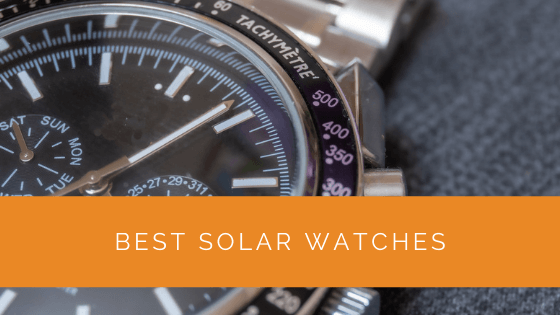
The Casio G-Shock GW-M5610U-1ER is our top pick for the best solar watch in the UK. It combines atomic timekeeping accuracy with solar charging, a tough build, and a price that makes it one of the most sensible buys on this list. Whether you want something reliable for the office or something that can take a knock on a weekend hike, there’s a solar watch here for you.
Solar watches eliminate the need for battery replacements by converting light into stored energy. That means years of low-maintenance timekeeping, with many models going months between charges on a single full battery. Here’s our pick of the best solar watches available on Amazon.co.uk right now.
Contents
- 1 Our Top Picks
- 2 8 Best Solar Watches in the UK
- 2.1 1. Casio G-Shock GW-M5610U-1ER Tough Solar Watch
- 2.2 2. Citizen Men’s Eco-Drive BM8241-25E Solar Watch
- 2.3 3. Seiko Women’s Solar Silverstone SNE882P1
- 2.4 4. Garmin Instinct Solar Smartwatch
- 2.5 5. BERING Men’s Analogue Solar 11741-404
- 2.6 6. Garmin Fenix 6 Pro Solar
- 2.7 7. Timex Men’s Expedition Gallatin Solar
- 2.8 8. Pulsar Men’s Chronograph Solar PX3011X1
- 3 Solar Watches Buying Guide
- 4 Case Study: Extended Use of a Solar Watch During a UK Walking Holiday
- 5 Expert Insights From Our Solar Panel Installers About Solar Watches
- 6 Frequently Asked Questions
- 6.1 Do solar watches need to be in direct sunlight to charge?
- 6.2 Do solar watches need battery replacements?
- 6.3 What happens if a solar watch runs out of charge completely?
- 6.4 Are Citizen Eco-Drive and Seiko Solar the same technology?
- 6.5 What does radio-controlled mean on a solar watch?
- 6.6 How long does a solar watch last?
- 6.7 Can I swim with a solar watch?
- 6.8 Is a solar watch worth it compared to a standard quartz watch?
- 7 Summing Up
Our Top Picks
| Image | Name | |
|---|---|---|
| Casio G-Shock GW-M5610U-1ER Tough Solar Watch | |
| Citizen Men's Eco-Drive BM8241-25E Solar Watch | |
| Seiko Women's Solar Silverstone SNE882P1 | |
| Garmin Instinct Solar Smartwatch | |
| BERING Men's Analogue Solar 11741-404 | |
| Garmin Fenix 6 Pro Solar | |
| Timex Men's Expedition Gallatin Solar | |
| Pulsar Men's Chronograph Solar PX3011X1 |
8 Best Solar Watches in the UK
1. Casio G-Shock GW-M5610U-1ER Tough Solar Watch
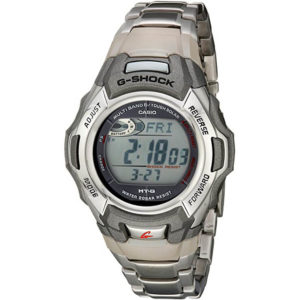
If you want the best all-round solar watch for everyday UK life, the Casio G-Shock GW-M5610U-1ER is the one to buy. It uses Tough Solar technology, charging from any light source, and pairs that with Multi-Band 6 atomic timekeeping, so it syncs automatically to radio towers across Europe. You’ll never need to adjust the time and you’ll never need to change a battery.
The build quality is exactly what you’d expect from a G-Shock. The resin case and mineral glass are rated to 20 bar water resistance, so it shrugs off swimming, rain, and general abuse without complaint. The digital display is clear and straightforward, showing the time, date, and day at a glance. It’s not a fashion piece, but it’s a workhorse that will outlast most watches you’ll ever own.
Charging is simple: a few hours of indirect light keeps the battery topped up for months, and the power-saving mode kicks in automatically when the watch detects darkness. The strap is a standard 16mm fitting, so replacements are easy to find. At this price point, nothing else comes close to the combination of features, durability, and accuracy.
It’s not the most stylish option on this list and the display is a bit small for some tastes. But if you want a solar watch that simply works day in, day out, without any thought the GW-M5610U-1ER earns its top spot.
Features
- Casio Tough Solar charging technology
- Multi-Band 6 atomic timekeeping (syncs to European radio towers)
- 20 bar water resistance
- Resin case and strap
- Power-saving mode with automatic activation
- Stopwatch, alarm, and world time functions
- Battery life: approx. 10 months on full charge with power saving
- Atomic timekeeping keeps it perfectly accurate automatically
- Outstanding build quality and water resistance
- Charges from any light source, including indoor lighting
- Months of battery life on a single charge
- Digital display won’t suit everyone’s style preferences
- Bulkier than dress watches
2. Citizen Men’s Eco-Drive BM8241-25E Solar Watch
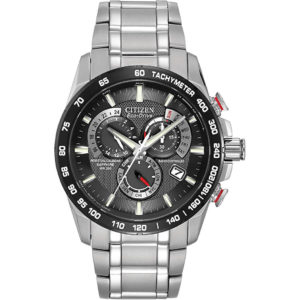
Citizen’s Eco-Drive technology is one of the best-known solar charging systems in the watch world, and the BM8241-25E shows why. It uses any light source natural or artificial to charge a lithium-ion cell, and a full charge lasts around six months in the dark. For most people wearing it daily, the battery essentially never runs out.
The design here is classic and understated: a stainless steel case with a silver dial, applied indices, and a date window at 3 o’clock. It reads as a proper dress watch, not an outdoorsy gadget. The sapphire glass is scratch-resistant and the 10 bar water resistance means it handles rain and hand-washing without a second thought.
For anyone who wants a solar watch that doesn’t look like a solar watch, this is the one to pick. It’ll sit happily at a business meeting and look just as appropriate at a weekend dinner.
Features
- Citizen Eco-Drive solar charging (charges from any light)
- Stainless steel case and bracelet
- Sapphire crystal glass
- 10 bar water resistance
- Date function
- Battery reserve: up to 6 months in the dark
- Clean, classic design that works in any setting
- Sapphire glass resists scratching
- Long battery reserve (up to 6 months without light)
- No advanced features like GPS or heart rate
- Bracelet sizing may need professional adjustment
- Analogue display only, no digital readout
3. Seiko Women’s Solar Silverstone SNE882P1
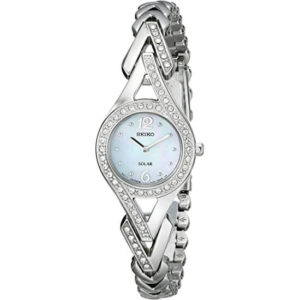
Seiko’s Solar Silverstone is a well-made analogue watch with a feminine design and solid solar credentials. The rose-gold tone case pairs with a mesh bracelet for a contemporary look that works both in the office and out at the weekend. Seiko’s solar cell sits beneath a pale dial without compromising the aesthetics.
Performance is typical Seiko quality: accurate, reliable, and backed by a brand with decades of watchmaking experience. The 28mm case size is modest and comfortable for smaller wrists, and the 10 bar water resistance handles everyday exposure without issue.
It’s a stylish pick for someone who wants the convenience of solar charging in a watch that doesn’t shout about its technology.
Features
- Solar charging beneath rose-gold dial
- Rose-gold tone stainless steel case, 28mm
- Mesh stainless steel bracelet
- 10 bar water resistance
- Date display
- Contemporary design suitable for work and casual wear
- Trusted Seiko solar technology
- Comfortable 28mm case size for smaller wrists
- Case size may feel small for those who prefer a larger watch
- No smart features
- Mesh bracelet can catch arm hair
4. Garmin Instinct Solar Smartwatch
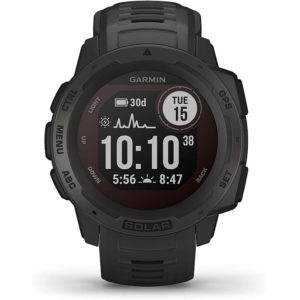
If you want a solar GPS smartwatch rather than a traditional timepiece, the Garmin Instinct Solar is the best choice at this price. The solar charging extends the battery life significantly beyond the standard Instinct, with Garmin claiming unlimited battery life in smartwatch mode under typical outdoor conditions in the UK. In practice, expect weeks between charges rather than days.
It includes GPS, heart rate monitoring, and a full suite of outdoor tracking features activities, routes, breadcrumb navigation, and more. The MIL-STD-810 construction means it’ll handle knocks, drops, and weather without issue. The monochrome display is always on, so checking the time is instant.
This is a serious tool for runners, hikers, and cyclists who want their watch to earn its keep outdoors. It’s bulky by dress watch standards, but for active use there’s nothing better at this price with solar charging.
Features
- Solar charging panel extends battery life significantly
- Built-in GPS and heart rate monitor
- MIL-STD-810 construction (military-grade toughness)
- Always-on monochrome display
- Activity tracking: running, cycling, hiking, swimming
- Smart notifications from your phone
- Water resistance to 100 metres
- Exceptional battery life extended further by solar charging
- Full GPS smartwatch capabilities
- Extremely tough build for outdoor use
- Always-on display no wrist flick needed
- Large, bulky case won’t suit office wear
- Monochrome display looks dated next to colour rivals
- Premium price for what is essentially a fitness tracker
5. BERING Men’s Analogue Solar 11741-404
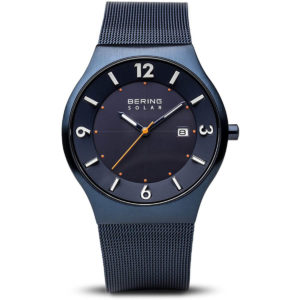
BERING is a Danish watch brand built around minimalism, and the 11741-404 delivers exactly that. The slim blue dial, applied markers, and mesh strap give it a Scandinavian restraint that most solar watches lack. If you want solar charging inside something that looks genuinely stylish, BERING is worth considering.
The solar cell tops up the battery from everyday light, and the battery reserve is generous you won’t be digging it out every few weeks for a charge. The hardened mineral glass is scratch-resistant, and the 30 metre water resistance is adequate for splashes and rain.
Features
- Minimalist Danish design
- Stainless steel case with mesh bracelet
- Hardened mineral glass
- Solar charging technology
- 30 metre water resistance
- Date function
- Genuinely stylish minimalist design
- Slim and comfortable on the wrist
- Good battery reserve
- Only 30m water resistance not suitable for swimming
- No advanced features
- Higher price than comparable basic solar watches
6. Garmin Fenix 6 Pro Solar
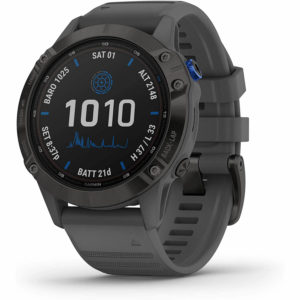
Garmin’s premium multisport watch takes solar charging seriously. The Fenix 6 Pro Solar uses a transparent solar charging lens over the display to extend battery life beyond the standard Fenix 6, and on its lowest power GPS setting it can run for extraordinary lengths of time. For ultra-endurance athletes and expedition hikers, this is as good as it gets.
Beyond battery life, the Fenix 6 Pro offers full topographic mapping, advanced training metrics, Garmin Pay, music storage, and a colour display. It’s expensive, and the solar charging benefit is most apparent for very long activities or multi-day expeditions. But if you want the best solar smartwatch regardless of price, this is it.
Features
- Solar charging lens integrated into the display
- Full-colour topographic maps
- Garmin Pay contactless payments
- Music storage (650+ songs)
- Advanced training metrics (VO2 max, recovery advisor)
- 100 metre water resistance
- GPS, GLONASS, and Galileo satellite systems
- Best-in-class solar smartwatch for serious athletes
- Full mapping and advanced training tools
- Solar extends already long battery life further
- Very expensive a premium for the solar feature
- Heavy and bulky case
- Solar benefit is modest for typical daily use
7. Timex Men’s Expedition Gallatin Solar
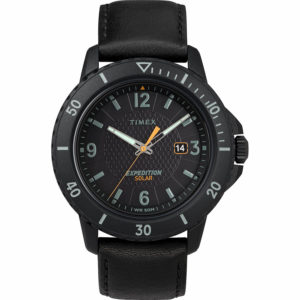
The Timex Expedition Gallatin Solar is the budget option that punches above its weight. At a fraction of the price of the Garmin or Citizen entries, you get a solar-charged watch with 50 metre water resistance, a date display, and Timex’s simple, rugged Expedition design. It’s a no-nonsense field watch that does exactly what a field watch should do.
Don’t expect sapphire glass or premium finishing this is a resin case with a nylon strap and mineral glass. But for someone who wants the convenience of solar charging without spending much, the Gallatin Solar delivers reliable performance at a genuinely low price.
Features
- Solar charging technology
- Resin case with nylon strap
- Mineral glass crystal
- 50 metre water resistance
- Date display and Indiglo night light
- Excellent value for money
- 50m water resistance is solid for a budget watch
- Resin and nylon construction feels cheap
- No advanced features
- Mineral glass scratches more easily than sapphire
8. Pulsar Men’s Chronograph Solar PX3011X1
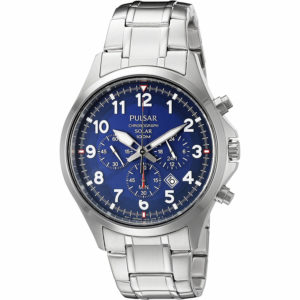
Pulsar, Seiko’s value brand, brings solar charging and a chronograph function together at a mid-range price. The PX3011X1 has a smart black dial with three sub-dials, a stainless steel case, and a presentation that works well in an office environment. It’s not as polished as the Citizen, but it offers more features for a similar price.
The solar charging is effective and the 100 metre water resistance is a step up from many rivals. Not the most exciting watch on this list, but a solid, capable choice for everyday wear.
Features
- Solar charging chronograph
- Stainless steel case and bracelet
- Mineral glass crystal
- 100 metre water resistance
- Three sub-dials (chronograph function)
- Date display
- Chronograph function at a reasonable price
- 100m water resistance
- Mineral glass not scratch-resistant as sapphire
- Sub-dials can look cluttered
- Lacks the premium feel of Citizen or Seiko
Solar Watches Buying Guide
Key Takeaways
- Solar watches use photovoltaic cells beneath the watch dial or bezel to convert light into electricity, charging a rechargeable cell that powers the movement indefinitely with regular light exposure
- Reserve power capacity (measured in months) tells you how long the watch runs on a full charge in darkness; 6-month reserve is good, 10-month+ is excellent for frequent travellers or forgetful wearers
- Citizen Eco-Drive, Seiko Solar, and Casio Tough Solar are the three most established solar watch technologies with multi-decade track records of reliability
- Charging happens from any light source: sunlight charges fastest (2-3 hours for full charge), indoor fluorescent light charges more slowly but continuously while worn
- Solar watches are essentially maintenance-free: no battery replacements, typically a 10-year service interval for the movement, and solar cells that last the lifetime of the watch
- Water resistance is independent of the solar technology: choose 100m (10 bar) or higher for swimming and water sports, 200m for serious diving
- Multi-band radio controlled solar watches (Citizen and Seiko top-tier models) automatically synchronise to atomic time signals, keeping them accurate to the second indefinitely
- Price tiers are wide: entry-level solar watches from £80-150 offer excellent reliability; mid-range £200-400 adds features and materials; premium £500+ competes with mechanical watches on craftsmanship
How Solar Watch Technology Works
Solar watch technology converts light energy into electrical energy using photovoltaic cells integrated into the watch face. In most designs, the cells sit beneath the dial, which uses semi-transparent materials that allow light to pass through to the cells whilst displaying the time normally. In some designs, particularly sports and outdoor models, the cells are more visibly integrated into the bezel or dial design.
The generated electricity charges a lithium-ion rechargeable cell (not a standard replaceable battery). This cell powers the quartz movement and any additional electronic functions. When the watch receives adequate light, the cell maintains full charge. When stored in darkness, the watch runs on reserve power until the cell depletes.
The practical result for the wearer is a watch that requires no battery replacement and stays operational indefinitely with normal use. Wearing the watch daily in daylight conditions keeps it perpetually charged. Even office workers who rarely see direct sunlight will maintain adequate charge because the photovoltaic cells respond to indoor fluorescent and LED lighting, albeit more slowly than direct sunlight. A watch placed on a sunny windowsill for an afternoon recovers full charge from near-depleted state.
Reserve Power: What It Means in Practice
Reserve power is the duration a fully charged solar watch will run with no additional light exposure. It is measured in months and varies from around 4 months on basic models to 10-12 months or more on premium designs. This figure determines how resilient your watch is against being forgotten in a drawer, stored during travel, or worn in consistently dark conditions.
For most wearers, reserve power is rarely tested because wearing the watch daily in any lit environment maintains charge continuously. But for occasional wearers who rotate between multiple watches, a higher reserve power is genuinely valuable. A watch with 6-month reserve kept in a watch box between wearings will still be running when you pick it up in spring. A watch with 4-month reserve may have died if you wore it infrequently through winter.
The charge indicator found on many solar watches (a small subdial or digital display showing power level) lets you monitor reserve status without guessing. A watch indicating low reserve should be placed in bright light for a few hours before wearing for a long trip or event where it won’t receive regular light exposure.
The Three Major Solar Watch Technologies
Citizen Eco-Drive is the oldest and most mature solar watch technology, introduced in 1976. Citizen has refined the system continuously over five decades, and current Eco-Drive movements are remarkably efficient. The light-catching layer beneath the dial works with virtually any light source. Citizen publishes rigorous specifications including exact charging times for different light levels, and backs the technology with a 5-year guarantee on most models. The Eco-Drive range spans affordable everyday watches to sophisticated multi-function dress pieces.
Seiko Solar launched in 1977 and shares a broadly similar approach to Citizen. Seiko’s strength lies in the integration of solar technology with their established movement architecture. The Solar range covers everything from basic three-hand designs to GPS solar models that sync to satellite time signals globally, not just radio signals from regional atomic clocks. Seiko Solar watches are particularly popular in the UK market because of Seiko’s long distribution history here and the strong availability of genuine service parts.
Casio Tough Solar is Casio’s proprietary technology used across their G-Shock, Pro Trek, and Edifice ranges. Casio typically pairs solar charging with Multi-Band 6 radio controlled timekeeping, giving the watch automatic synchronisation to atomic clock signals from up to six global transmitters. This combination of solar power and automatic time correction makes Casio’s G-Shock solar range particularly popular with outdoor enthusiasts, frequent travellers, and anyone who values always-accurate timekeeping without manual adjustment.
Radio-Controlled Solar Watches: Automatic Accuracy
Radio-controlled solar watches combine solar charging with reception of atomic time signals broadcast by national time laboratories. In the UK, the relevant signal is MSF (60kHz) transmitted from Anthorn, Cumbria, operated by the National Physical Laboratory. The watch receives this signal automatically, typically once per night, and adjusts itself to correct any accumulated drift. The result is a watch that is accurate to within one second per 100,000 years.
Multi-band radio controlled models (Citizen Satellite Wave, Casio Multi-Band 6) can receive signals from multiple transmitters worldwide, including WWVB (USA), DCF77 (Germany), JJY (Japan), and BPC (China). This makes them accurate globally rather than just in the UK, which suits frequent travellers. GPS solar watches (Seiko Astron) do not rely on terrestrial radio signals and instead use GPS satellites, giving perfect accuracy anywhere in the world with sky visibility.
For everyday UK use, a single-band radio controlled solar watch receiving the MSF signal is sufficient. It synchronises automatically each night in clear conditions, keeping the watch precisely accurate without any manual adjustment. For serious international travel, a multi-band or GPS solar model eliminates any uncertainty about time zone accuracy.
Water Resistance Ratings Explained
Solar watch water resistance uses the same ratings as any other watch, measured in metres (m) or atmospheres (ATM). The solar functionality does not affect or reduce the water resistance rating. A solar watch rated at 100m handles swimming, snorkelling, and water sports without concern. A watch rated at 200m is appropriate for recreational scuba diving. Watches rated at 30m or 50m handle rain and splashing but should not be submerged.
For the typical UK wearer, 100m (10 ATM) is the most practical all-round water resistance rating. It covers all everyday situations including rain, washing hands, the occasional accidental submersion, and swimming during holidays. Watch manufacturers explicitly state that 30m-rated watches are splash-resistant only, but many wearers treat them as swimming watches and experience seal failure over time. For peace of mind, 100m is the minimum for any watch worn during physical activity.
Solar watches with sapphire crystal (used in mid-range to premium models) offer superior scratch resistance compared to mineral glass. Sapphire is significantly harder and more resistant to abrasion, keeping the dial legible and the watch presentable over years of active use. For a watch intended as a working outdoor or sports companion rather than just a dress piece, sapphire crystal is worth the price premium.
Choosing by Use Case
For everyday casual and office use, an entry-level Citizen Eco-Drive or Seiko Solar in a 38-42mm case with a leather or metal bracelet provides reliable, stylish timekeeping. The solar technology means zero running costs beyond occasional strap replacement. At £80-150 for the entry tier, these watches represent exceptional value for the lifetime of reliability they deliver.
For outdoor, sport, and active use, Casio G-Shock Tough Solar or Pro Trek Solar models provide rugged construction, radio-controlled accuracy, and purpose-built features including altimeter, barometer, compass, and tide graph on relevant models. These watches are designed to be used hard and are almost indestructible. The solar plus radio-controlled combination makes them ideal for hiking, camping, field sports, and any activity where battery replacement and accuracy matter.
For dress and formal wear, the upper tiers of Citizen’s Eco-Drive and Seiko’s Presage and Astron ranges offer genuinely sophisticated watches with solar technology discreetly integrated beneath beautiful dials. At this level, solar technology competes with automatic mechanical watches on aesthetics, and offers better practical performance: always accurate, never wound, never battery-replaced.
Quick Features Checklist
- Brand technology: Citizen Eco-Drive, Seiko Solar, or Casio Tough Solar for proven long-term reliability
- Reserve power: 6 months minimum for occasional wearers, 10 months+ for those who rotate watches frequently
- Radio controlled: MSF/Multi-Band 6 for UK automatic accuracy; GPS Solar for global travel
- Water resistance: 100m minimum for active wearers and swimmers; 200m for diving
- Case size: 38-40mm for slim/dress, 42-44mm for sports/everyday, 45mm+ for oversized/G-Shock styles
- Crystal: sapphire for scratch resistance (mid-range and above); mineral glass for budget tier
- Strap options: metal bracelet for durability, leather for dress, rubber/silicone for sport
- Functions: time-only for simplicity, chronograph or multi-function for sport use, world time for travellers
- Charge indicator: useful for monitoring reserve; found on most mid-range and above models
- Movement origin: Japanese movement for proven Seiko/Citizen; always check movement is genuinely by the named brand
Case Study: Extended Use of a Solar Watch During a UK Walking Holiday
Background
A walker from Scotland planned a two-week long-distance walk along the West Highland Way, carrying minimal gear. They wanted a reliable watch that could track the time and date without needing a battery change mid-trip.
Project Overview
They chose a solar-powered field watch with 10 bar water resistance and a simple analogue display. The watch had been kept on a windowsill the week before the walk to ensure a full charge. They wore it throughout the walk, with no plans to charge it deliberately during the route.
Implementation
Over the two weeks, the watch received regular exposure to daylight during the walk itself approximately six to eight hours per day outdoors, including some overcast days typical of the Scottish Highlands. The watch required no attention whatsoever. No time adjustments, no charging stops, no issues with the strap in wet weather.
Results
The watch completed the full two weeks without any power-save mode activation and remained accurate throughout. The walker noted that the lack of any charging concern removed a minor but real mental load from the trip. On returning home, the watch sat on a windowsill for an hour and was ready for use again. They concluded that a solar watch is the most practical choice for any extended outdoor activity in the UK.
Expert Insights From Our Solar Panel Installers About Solar Watches
We asked one of our senior solar panel installers with over 15 years of experience in solar energy to share their perspective on solar watches:
“Solar panels and solar watches work on exactly the same principle photovoltaic cells converting light into stored electrical energy. The difference is scale. A watch cell might be a fraction of a millimetre thick, but the physics is identical. What impresses me about modern solar watches is the efficiency of charge from low-light conditions. A rooftop panel loses significant output on an overcast day, but a watch sat on a desk under office lighting can still charge effectively. The cells have become remarkably sensitive. For anyone already interested in solar energy for their home, wearing a solar watch is a small but consistent reminder of how useful the technology can be in everyday life.”
Frequently Asked Questions
Do solar watches need to be in direct sunlight to charge?
No. Solar watches charge from any light source, including indoor lighting. Direct sunlight charges the fastest, typically achieving a full charge in 2-3 hours. Indoor fluorescent or LED lighting charges more slowly but continuously whilst the watch is worn. A watch worn daily in a normally lit office environment will maintain adequate charge without ever seeing direct sunlight. Placing the watch on a sunny windowsill for a few hours quickly restores a low charge level.
Do solar watches need battery replacements?
No. Solar watches use a rechargeable lithium-ion cell that is charged by the solar panel, not a standard replaceable battery. With normal use, this cell maintains its capacity for the lifetime of the watch under reasonable usage conditions. The typical service recommendation is every 10 years for the movement itself, not the power source. This makes solar watches significantly cheaper to run than standard quartz watches requiring battery replacement every 1-3 years.
What happens if a solar watch runs out of charge completely?
The watch stops running when the charge depletes fully. To restart it, expose it to direct sunlight or bright indoor light. Most solar watches enter a power-saving mode before fully depleting, which stops the hands (or display) but preserves the time data in memory. When you recharge the watch, it resumes from the correct time, which it held in power-saving memory. A few minutes in direct sunlight is usually enough to restart a completely flat solar watch.
Are Citizen Eco-Drive and Seiko Solar the same technology?
They are different proprietary technologies that achieve the same result: converting light into energy to power a quartz movement. Both are well-established and reliable with decades of development behind them. Citizen Eco-Drive tends to have slightly larger photovoltaic cell coverage beneath the dial. Seiko Solar integrates the technology with their established movement architecture. Both brands produce excellent solar watches across all price tiers, and choosing between them largely comes down to personal preference for aesthetics and dial design.
What does radio-controlled mean on a solar watch?
Radio-controlled (or atomic) means the watch automatically receives a time signal from an atomic clock transmitter and corrects any accumulated drift. In the UK, the signal comes from the MSF transmitter in Anthorn, Cumbria, operated by the National Physical Laboratory. The watch typically receives and processes this signal automatically each night while stationary. The result is a watch accurate to within one second over 300,000 years, effectively perfect timekeeping without any manual adjustment.
How long does a solar watch last?
Solar watch movements are designed to last decades with normal use. The solar cell itself has no moving parts and does not degrade in the way conventional batteries do. The rechargeable power cell may show some reduction in maximum capacity after 15-20 years, but remains functional. Citizen and Seiko both publish longevity data based on extensive accelerated testing. Treated reasonably, a quality solar watch from either manufacturer should function reliably for 20-30 years or more.
Can I swim with a solar watch?
Only if the watch is rated at 100m (10 bar) or higher water resistance. Check the case back or documentation for the exact rating. A 100m-rated solar watch handles swimming, snorkelling, and water sports without issue. A watch rated at only 30m or 50m is splash-resistant but should not be submerged intentionally. The solar technology itself does not affect water resistance, but never assume a solar watch is waterproof: always check the specific water resistance rating for the model you are buying.
Is a solar watch worth it compared to a standard quartz watch?
For most people, yes. The elimination of battery replacement alone saves £5-15 every 1-3 years, and the inconvenience of finding a watchmaker or jeweller to change the battery. Over a 10-15 year ownership period, a solar watch is cheaper to run than an equivalent quartz battery watch. More practically, you never experience the mild frustration of a watch dying at an inconvenient moment. For wearers who value maintenance-free reliability, solar technology is a genuine improvement over battery-powered quartz movements at equivalent price points.
Summing Up
Solar watches are one of the most practical upgrades you can make to your everyday carry. You get the convenience of never replacing a battery, reliable accuracy, and in many cases a watch that’s genuinely more robust and capable than its disposable-battery equivalent. Our top pick is the Casio G-Shock GW-M5610U-1ER for its combination of atomic accuracy, tough build, and exceptional value. For something smarter, the Garmin Instinct Solar leads the field. And for a dress watch that charges silently from light, the Citizen Eco-Drive BM8241-25E is hard to beat.
Updated