
The Citizen CA0690-88E Eco-Drive Chronograph is our top pick for UK buyers who want a solar watch that genuinely earns its place on a wrist rather than just sitting on a shelf. With 3,740 reviews and a chronograph complication that works as well for everyday timing as it does for sport, it covers more use cases than any other watch in this roundup.
Solar watches are a different proposition from solar gadgets. Where a solar power bank tops up by leaving it on a windowsill, a watch charges constantly from whatever light you’re already in. Office fluorescents, kitchen LEDs, overcast daylight: all of it converts to power. The practical result is a watch you charge by wearing, and one you may only need to put in direct sunlight once every few months as a top-up. The technology across the brands reviewed here is mature, reliable, and genuinely useful.
Our Top Picks
| Image | Name | |
|---|---|---|
| Citizen CA0690-88E Eco-Drive Chronograph | |
| Casio G-Shock GW-M5610U-1BER Tough Solar | |
| Citizen Gents Eco-Drive Sport Casual | |
| Citizen Eco-Drive Aviator Nylon Strap | |
| Citizen AW1810-85L Eco-Drive | |
| Citizen Titanium AW1641-81E Eco-Drive | |
| Casio Pro Trek PRG-270-1 Tough Solar | |
| Garmin Instinct 2 Solar GPS Smartwatch |
8 Best Solar Watches
1. Citizen CA0690-88E Eco-Drive Chronograph
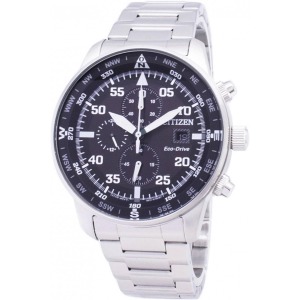
The Citizen CA0690-88E is the most reviewed solar watch in this roundup at 3,740 ratings, which tells you something before you even look at the spec sheet. It’s a versatile chronograph in a 44mm case, with a tachymeter bezel, three sub-dials, and Citizen’s Eco-Drive solar movement. At £169.26, it sits at the mid-to-upper end of the Eco-Drive range but doesn’t ask you to pay a premium for looks alone.
The Eco-Drive technology charges from any light source: sunlight, office lighting, indoor LEDs, even low indoor light levels. A full charge gives a power reserve of around six months in complete darkness, which in practice means you never think about the battery. The chronograph function is accurate and easy to use, with pushers at 2 and 4 o’clock that feel precise despite the quartz movement. The dial layout is uncluttered for a chronograph, which is harder to achieve than it sounds.
For UK buyers specifically, the sapphire crystal is worth noting. It won’t scratch against keys or a metal watchband clasp the way mineral glass does over the years. For a watch that may well last two decades without a battery change, scratch resistance on the crystal matters more than it does on a watch you’ll replace in five years.
The water resistance at 100m covers swimming and snorkelling. The brown leather strap suits business and casual wear, and the dial’s warm silver-white tone photographs well in both indoor and outdoor light. This isn’t a sportswear piece, but it earns its price by working across multiple contexts rather than just one.
Features
- Eco-Drive solar movement, charges from any light source
- 44mm case with chronograph sub-dials and tachymeter bezel
- Sapphire crystal
- 100m water resistance
- Power reserve: approximately 6 months fully charged
- 3,740 customer reviews
- 3,740 reviews gives the strongest real-world validation in this roundup
- Sapphire crystal is genuinely more durable than mineral glass over years of wear
- Chronograph function is well-laid-out and practical for daily use
- Works across business, smart casual, and sport contexts
- £169.26 is a significant step up from the budget options here
- No radio-controlled time syncing
- Leather strap will need replacement over time
2. Casio G-Shock GW-M5610U-1BER Tough Solar Radio Controlled
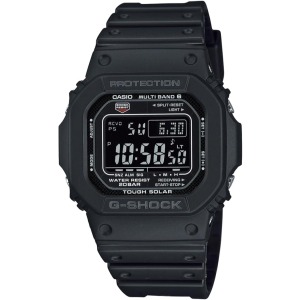
The GW-M5610U is the G-Shock that made the case for solar and radio-controlled timekeeping in a single watch. Tough Solar powers it from any light source; the Multi-Band 6 radio signal syncs to UK MSF atomic time automatically, typically at night, keeping the time accurate to within one second per 100,000 years. In practice, you set it once and it stays correct for the life of the watch.
The 43.2mm resin case is built to MIL-SPEC standards: 200m water resistance, shock resistance, and a negative display with white digits on a dark background that reads clearly in direct sunlight. The stopwatch, countdown timer, and five alarms are all accessible through the four buttons. The display changes daylight saving time automatically when it syncs to the MSF signal, so you genuinely never touch the time-setting function after the initial setup.
The only honest caveat is the display. A digital watch face on a resin G-Shock divides buyers. Some love the utilitarian clarity; others want analogue hands. If a traditional dial matters to you, the Citizen options in this list are better fits. For anyone who wants the most accurate, durable, maintenance-free solar watch available and is comfortable with a digital display, this is the one to buy.
Features
- Tough Solar charging, powers from any light source
- Multi-Band 6 radio control, syncs to UK MSF atomic time signal
- 200m water resistance
- MIL-SPEC shock resistance
- 5 alarms, stopwatch, countdown timer
- 43.2mm resin case and band
- 808 customer reviews
- Radio-controlled time sync means the watch never drifts and handles BST changes automatically
- 200m water resistance is the highest rating in this roundup
- MIL-SPEC durability for genuinely tough conditions
- No battery to replace, ever
- Digital display only, no analogue hands
- Resin G-Shock aesthetic doesn’t suit formal or smart-casual settings
- Interface takes some learning for first-time G-Shock users
3. Citizen Gents Eco-Drive Sport Casual
This is the Citizen Eco-Drive for buyers who want a proper analogue watch without the chronograph sub-dials or the dress-watch formality of the titanium models. The sport-casual format gives you a clean three-hand dial and day-date display at £133.55, with 966 reviews confirming it holds up in daily wear.
The Eco-Drive movement charges from any light source with a power reserve of around five months when fully charged. At 100m water resistance, it handles swimming and daily wet conditions. The case size sits in the mainstream range, readable without being oversized on average wrists. For commuters, weekend walkers, and anyone who wants a reliable everyday watch that doesn’t need a battery change, this is the sensible mid-range choice.
It won’t stand out at a formal occasion the way the chronograph does, and it doesn’t offer radio-controlled accuracy. But as an all-day watch for the full spectrum of UK daily life, the sport-casual Eco-Drive earns its place through consistent, unfussy reliability.
Features
- Eco-Drive solar movement
- Three-hand analogue dial with day-date display
- 100m water resistance
- Power reserve: approximately 5 months fully charged
- 966 customer reviews at 4.4 stars
- 966 reviews confirms strong real-world reliability
- Clean analogue face suits everyday wear across contexts
- Day-date display is genuinely practical for daily use
- No radio time sync or chronograph complication
- Not a standout choice for formal occasions
- £133.55 isn’t a budget price for a sport-casual watch
4. Citizen Eco-Drive Aviator Nylon Strap
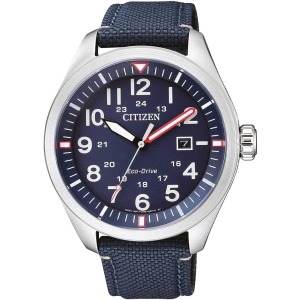
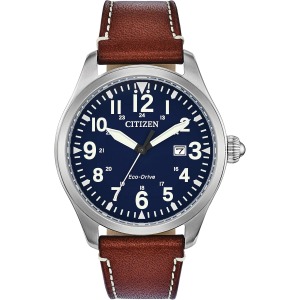
At £99.69 with 425 reviews, this is the entry point into genuine Citizen Eco-Drive quality without paying for features you may not need. The Aviator case styling, large luminous indices, and NATO-style nylon strap give it an outdoorsy character that has aged well as military-inspired watch design has stayed in fashion. It wears larger than the spec sheet suggests and reads clearly at a glance, which is often what you actually want from a watch.
The Eco-Drive solar movement is the same technology as the rest of the Citizen range: charges from any light, holds charge for months. No chronograph, no radio sync, no sapphire crystal at this price. What you get is a well-made solar watch from one of the two brands that invented the technology, at a price that makes Eco-Drive accessible without compromising on the movement itself.
Features
- Eco-Drive solar movement
- Aviator-style case with large luminous indices
- NATO-style nylon strap
- 100m water resistance
- 425 customer reviews
- £99.69, lowest price in this roundup
- Most affordable genuine Eco-Drive in this list at under £100
- Aviator styling works across casual and outdoor contexts
- Large luminous indices for low-light readability
- No chronograph, radio sync, or sapphire crystal
- Nylon strap isn’t suitable for smart or formal settings
- Fewer reviews than the top three picks
5. Citizen AW1810-85L Eco-Drive
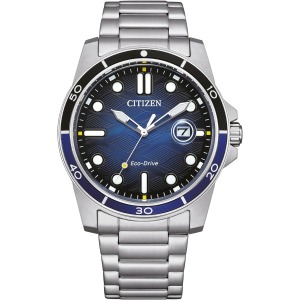
The AW1810-85L is Citizen’s contemporary take on a smart-casual everyday watch. The light blue dial, stainless steel case, and bracelet combination reads dressier than the sport models but without the formal associations of a full dress watch. At £138.78 with 327 reviews, it sits between the budget Aviator and the chronograph and earns that position by looking noticeably more polished than either.
Power reserve runs to approximately five months from a full charge. The Eco-Drive technology means any light source contributes during daily wear. The 100m water resistance covers everything from washing up to summer swimming. If you want a solar watch that passes for a proper office watch but won’t look out of place at a weekend market, this is a strong candidate.
Features
- Eco-Drive solar movement
- Light blue dial with stainless steel case and bracelet
- 100m water resistance
- Power reserve: approximately 5 months
- 327 customer reviews at 4.4 stars
- Dressier aesthetic than the sport-casual options at a reasonable price
- Light blue dial is distinctive without being impractical
- Stainless bracelet reads more formal than nylon or rubber
- Lower review count than the top picks
- No chronograph or radio time sync
- Light blue dial won’t suit everyone’s taste
6. Citizen Titanium AW1641-81E Eco-Drive
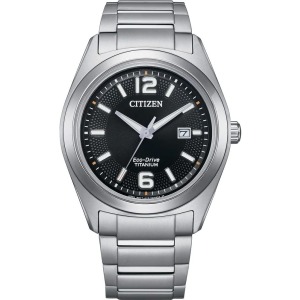
Titanium changes the wear experience. It’s roughly 45% lighter than stainless steel at the same volume, hypoallergenic, and more scratch-resistant than untreated stainless. The AW1641-81E brings those material advantages to the Eco-Drive range at £170.98, with 329 reviews from buyers who knew exactly why they were paying the premium over the stainless models.
The watch wears lighter than anything else in this roundup. For anyone who finds metal watch bracelets uncomfortable over a long working day, or who has a nickel sensitivity that makes untreated stainless a problem, titanium resolves it entirely. The Eco-Drive movement and power reserve are consistent with the rest of the Citizen range. This is a watch you might buy once and never need to replace.
Features
- Titanium case and bracelet
- Eco-Drive solar movement
- Hypoallergenic construction
- 100m water resistance
- Power reserve: approximately 5 months
- 329 customer reviews
- Titanium is lighter, more scratch-resistant, and hypoallergenic vs stainless
- Material quality alone justifies the premium over stainless models
- More comfortable during long wear days than any metal-bracelet alternative here
- At £170.98, the pricier end of non-GPS options here
- No chronograph or radio-controlled time
- Titanium grey aesthetic doesn’t suit everyone
7. Casio Pro Trek PRG-270-1 Tough Solar Triple Sensor
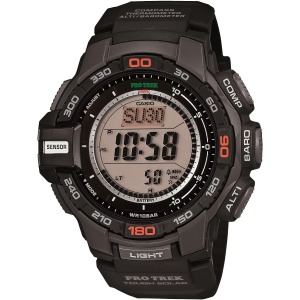
The Pro Trek is the outdoor specialist in this roundup, and it doesn’t try to be anything else. The Triple Sensor refers to the altimeter, barometer, and digital compass built into the 47mm resin case. These aren’t cosmetic: the barometer reads pressure changes that signal incoming weather, the altimeter gives summit height and ascent data, and the compass navigates without needing a phone signal. Combined with Tough Solar charging and Multi-Band 6 radio-controlled time, this is the most functionally complete outdoor watch here.
At £184.19 with 136 reviews, it’s a specialist watch for a narrower audience. The lower review count compared to the Citizen models reflects that audience size rather than inferior quality. If you’re regularly in the hills and want navigation data on your wrist, the Pro Trek earns its price. If you mainly want a solar watch that looks good for everyday wear, any of the Citizen models serve you better at a lower cost.
Features
- Triple Sensor: altimeter, barometer, digital compass
- Tough Solar charging
- Multi-Band 6 radio-controlled time
- 100m water resistance
- 47mm resin case
- 136 customer reviews
- Altimeter, barometer, and compass are genuinely useful hill-walking tools
- Radio-controlled time sync keeps accuracy without any manual input
- 47mm case wears very large on smaller wrists
- Sports and outdoor aesthetic only, unsuitable for formal or office settings
- £184.19 at a price point where GPS watches now offer similar sensor sets
8. Garmin Instinct 2 Solar Rugged GPS Smartwatch
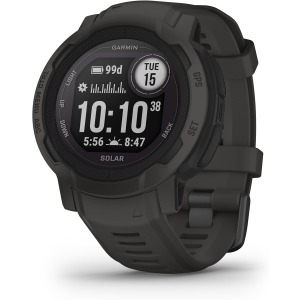
The Garmin Instinct 2 Solar is in a different product category from the rest of this list, and it’s worth being upfront about that. It’s a GPS sports smartwatch with solar charging, not a traditional solar watch. Its 5,952 reviews make it the most reviewed product here by a wide margin. At £199.95, it also costs the most. What you’re getting is GPS tracking, wrist heart rate, sleep monitoring, activity profiles for running, cycling, swimming, and hiking, and phone connectivity, all in a MIL-STD-810 tested case.
The Solar Power feature works differently from Citizen and Casio. In optimal conditions, it can extend battery life considerably. In UK real-world use, with mixed light and active GPS use, the solar meaningfully extends time between charges rather than eliminating charging entirely. It’s a life-extension feature, not a self-sustaining system.
If you’re a Garmin Connect user already, or train seriously and want GPS alongside solar-assisted battery life, the Instinct 2 Solar makes a compelling case at the price. But if your main interest is a quality solar watch that tells the time without a battery change, the Citizen Eco-Drive models above serve that need better and more affordably.
Features
- Solar charging for extended battery life
- Built-in GPS with multi-GNSS support
- Wrist heart rate, SpO2, and stress monitoring
- MIL-STD-810 tested for shock, temperature, and humidity
- 100m water resistance
- 5,952 customer reviews at 4.5 stars
- 5,952 reviews: the most validated product in this roundup by a wide margin
- GPS and health tracking go far beyond what traditional watches offer
- MIL-STD-810 ruggedness for serious outdoor use
- Most expensive option at £199.95
- Solar extends battery life rather than replacing charging entirely
- Smartwatch complexity isn’t what every buyer wants from a watch
Solar Watch Buying Guide
Key Takeaways
- Solar watches charge from any light source, not just direct sunlight. Office LEDs, indoor ambient light, and overcast daylight all contribute
- Citizen Eco-Drive and Casio Tough Solar are the dominant technologies. Both are mature and reliable; choose based on the design and features you want rather than which is “better”
- Power reserve is the most useful spec to check. Look for 4 months minimum; 6 months gives comfortable headroom for UK winters and rotation use
- Radio-controlled time sync, available on some Casio models, syncs the watch to atomic time automatically and handles British Summer Time changes without you touching it
- The Garmin Instinct 2 Solar is a GPS smartwatch, not a traditional solar watch. Evaluate it on smartwatch criteria first
- Titanium is worth the premium if long-day comfort or nickel sensitivity are relevant
- All solar watches in this roundup eliminate battery replacement for the working life of the watch
How Solar Watch Technology Actually Works
The solar cell in a Citizen Eco-Drive or Casio Tough Solar watch is a thin photovoltaic panel positioned beneath a semi-translucent dial. Light passes through the dial, hits the panel, and charges a rechargeable secondary cell. Unlike the primary batteries in conventional quartz watches, these secondary cells are designed to last 10 years or more before needing replacement, if they need replacing at all.
The critical difference from solar gadgets is that the watch charges during normal wear. You don’t need to leave it on a windowsill or think about it. Wearing it in an office with standard LED lighting counts. Wearing it outdoors on an overcast UK day counts. The charging is continuous and passive, which is what makes solar watches a genuinely superior technology for most buyers rather than a novelty.
Garmin’s approach works differently. The Instinct 2 Solar uses a clear solar panel embedded in the lens rather than a watch dial panel. But the purpose is life extension rather than full recharge: the battery in a GPS smartwatch requires substantially more power than a traditional quartz movement, so solar alone can’t sustain it indefinitely.
Solar Watch Technology Compared
| Technology | Brand | Charges From | Power Reserve | Notes |
|---|---|---|---|---|
| Eco-Drive | Citizen | Any light source | 4 to 6 months | Industry pioneer. Consistent performance across the full Citizen range |
| Tough Solar | Casio | Any light source | 5 to 10 months | Often paired with radio-controlled time on G-Shock and Pro Trek models |
| Instinct Solar | Garmin | Any light source | Extends by days to weeks, not months | GPS smartwatch: solar extends rather than replaces charging |
Power Reserve: The Number That Actually Matters
Power reserve tells you how long the watch runs in complete darkness after a full charge. A watch rated at six months means that if you store it fully charged in January, it will still be running when you retrieve it in July. In practice, UK daily wear in normal lighting provides enough ambient light to maintain charge year-round, but the reserve is the safety net for travel, rotation, or forgetting to wear a watch for a few weeks.
Four months is the acceptable minimum. Anything shorter creates inconvenience if you rotate watches or put one away for a season. Six months is comfortable for most UK buyers. Casio Tough Solar models tend to offer longer reserves (up to 10 months on some configurations) because the G-Shock movement is engineered for lower power consumption than a watch with chronograph complications.
How UK Light Conditions Affect Charging
British winters don’t offer much direct sunlight, and this is the question most UK buyers ask first. The answer is reassuring. Both Eco-Drive and Tough Solar handle indoor artificial light well. Standard office LED and fluorescent lighting at normal brightness provides a useful charge rate, enough to maintain the watch during regular wear even when you’re barely seeing daylight.
The practical outcome is this: if you wear the watch daily in a normally-lit environment, the charge maintains regardless of the season. The only scenario where you’d actively need to seek sunlight is if a watch had been stored for an extended period and gone flat. Daily wear in UK conditions, including winter, is sufficient to keep any solar watch in the roundup running normally.
Radio-Controlled Time: The Hidden Game-Changer
Some solar watches, specifically the Casio G-Shock GW-M5610U and Pro Trek PRG-270-1 in this roundup, pair solar charging with radio-controlled timekeeping. In the UK, the MSF signal from the National Physical Laboratory in Anthorn, Cumbria, broadcasts atomic time continuously. A watch with Multi-Band 6 reception syncs to this signal overnight and adjusts to within one second per 100,000 years.
The practical effect is complete ownership simplicity. You never set the time manually. British Summer Time changes happen automatically when the watch syncs overnight. For buyers who find any friction in watch ownership annoying, solar plus radio control removes every reason to interact with the watch other than reading it.
Case Size and Wrist Fit
| Watch | Case Size | Suitable Wrist | Case Material |
|---|---|---|---|
| Citizen CA0690-88E Chrono | 44mm | Medium to large | Stainless steel |
| Casio G-Shock GW-M5610U | 43.2mm | Medium to large | Resin |
| Citizen Eco-Drive Sport | 42 to 44mm | Medium | Stainless steel |
| Citizen Eco-Drive Aviator | 44mm | Medium to large | Stainless steel |
| Citizen AW1810-85L | 42mm | Medium | Stainless steel |
| Citizen Titanium AW1641-81E | 40mm | Small to medium | Titanium |
| Casio Pro Trek PRG-270-1 | 47mm | Large wrists only | Resin |
| Garmin Instinct 2 Solar | 45mm | Medium to large | Fibre-reinforced polymer |
Common Buying Mistakes
- Treating the Garmin Instinct 2 Solar as a traditional solar watch. It’s a GPS smartwatch that happens to have solar charging. Buy it for GPS and activity tracking; evaluate it on smartwatch criteria.
- Ignoring the power reserve spec. This matters more than wattage figures. A long reserve means the watch survives extended storage and low-light seasons without going flat.
- Assuming a solar watch never needs any light. Solar watches need light to maintain charge. Daily wear in normal lighting is sufficient, but a watch stored in a dark drawer will eventually deplete.
- Overlooking water resistance for an active lifestyle. 100m covers swimming. If you dive, you need 200m or more, and the G-Shock is the only option here at that rating.
- Not checking the case size before buying. The 47mm Pro Trek wears very large on a smaller wrist. Check the lug-to-lug dimension against your wrist size before committing.
When a Solar Watch Is Not the Right Buy
If you store watches for long periods without wearing them, solar charging loses its advantage. A conventional quartz battery with a three-to-five year life is simpler for a watch that spends most of its time in a drawer. If you want a dress watch for occasional formal events only, the sporty or aviation styling of most solar models may not suit. And if GPS tracking is your main requirement, the Garmin is the right pick here, but you should assess it as a smartwatch rather than specifically as a solar watch.
Quick Buyer Checklist
- Decide between traditional solar watch (Citizen, Casio) and GPS smartwatch (Garmin) before looking at individual models
- Check power reserve: 4 months minimum, 6 months preferred for comfortable UK use
- Verify case size against your wrist: 40 to 44mm is mainstream, 47mm Pro Trek runs large
- Water resistance: 100m for swimming, 200m for diving
- Radio-controlled time sync: essential if you want zero manual time-setting for life
- Titanium: worth considering for long-day wear comfort or nickel sensitivity
- Chronograph complication: useful daily timing tool or primarily an aesthetic choice for you?
- Review count: 400-plus confirms real-world reliability at scale
Case Study: Replacing a Conventional Watch for a UK Walker
Background
A retired engineer from the Peak District had worn a conventional automatic watch for 20 years. After the movement required a third expensive service, he decided to look for a lower-maintenance alternative. He walked the hills regularly and wanted something durable, accurate, and permanently ready without ongoing servicing costs.
Project Overview
After researching solar watch options, he chose the Casio G-Shock GW-M5610U for its combination of Tough Solar charging, MSF radio control, and MIL-SPEC shock resistance. His specific concern was accuracy without manual correction: he wanted to trust the time on his wrist without checking his phone on moorland walks where signal was unreliable.
Implementation
The transition required a few weeks of adjusting to the digital display. After a month, the interface felt natural and the stopwatch became a regular tool for timing his pace on ascents. The watch synced to the MSF signal automatically overnight and adjusted itself for British Summer Time in March without any input from him.
Results
Three years later, he has never replaced a battery, never adjusted the time manually, and the watch has survived falls on rocky ground and full submersion in a moorland stream. He estimates he has saved considerably on battery changes and servicing costs compared to his previous watch over the same period. His one complaint is that the watch gives him nothing to tinker with.
Expert Insights From Our Solar Panel Installers About Solar Watches
One of our senior solar engineers with over 20 years in the industry is regularly asked about solar watches by homeowners who’ve become interested in solar technology after having panels installed: “The technology in a Citizen Eco-Drive or Casio Tough Solar is some of the most refined solar conversion you’ll find in a consumer product. The efficiency at converting indoor artificial light to stored energy is genuinely impressive, and the power reserve on the better models reflects how low the power consumption of a modern quartz movement actually is. The Garmin is a different proposition entirely. It uses solar to extend battery life on what is fundamentally a smartphone-class device in terms of power draw. Both are useful. But they’re solving different problems, and buyers who confuse the two tend to be disappointed by whichever one they chose for the wrong reasons.”
Frequently Asked Questions
Do solar watches charge in UK winter when there is little sunlight?
Yes. Solar watches charge from artificial light sources as well as natural light. Standard office LED lighting, household bulbs, and indoor ambient light all contribute to charge. If you wear the watch in a normally-lit environment each day, it will maintain its charge through a British winter without needing direct sunlight. The power reserve of 4 to 6 months on Citizen and Casio models provides additional buffer during extended low-light periods.
How long does the battery in a solar watch last?
The rechargeable secondary cell in a solar watch is typically rated for 10 or more years before needing replacement. Citizen and Casio both quote approximately 10 years of service life under normal use conditions. In practice, many solar watches run for 15 to 20 years before any capacity decline becomes noticeable. The comparison with conventional quartz watches is stark: a standard battery needs replacing every 2 to 3 years; a solar watch secondary cell lasts a generation.
What is the difference between Citizen Eco-Drive and Casio Tough Solar?
Both technologies charge from any light source and store energy in a rechargeable secondary cell. The main practical difference is aesthetics and feature pairing. Citizen Eco-Drive appears most often in traditional analogue watch designs with dress and sport-casual styling. Casio Tough Solar is used in G-Shock and Pro Trek models with digital displays, and is frequently paired with radio-controlled time syncing and extended power reserves. Neither technology is superior to the other; choose based on the watch design and features you want.
Can you overcharge a solar watch by leaving it in direct sunlight?
No. Solar watches include charge regulation circuits that prevent overcharging. Once the secondary cell reaches full capacity, the panel effectively stops contributing charge. You can leave a solar watch on a sunny windowsill indefinitely without damaging it. The caveat is prolonged extreme heat: temperatures above 60 degrees Celsius can affect the movement, so avoid leaving the watch in a sealed car on a very hot day.
What happens if a solar watch battery runs flat?
Most solar watches enter a power-saving mode as charge depletes. The hands may stop while the timekeeping circuit continues running, so the watch restarts showing the correct time when recharged. Exposing the face to bright light for a few minutes provides enough charge to restart the movement. A few hours of indirect sunlight, such as a windowsill out of direct sun, typically achieves full recovery. After prolonged storage, a full day of indirect light usually restores normal operation.
Is radio-controlled timekeeping available on all solar watches?
No. Radio control is an additional feature, not standard across all solar models. In this roundup, the Casio G-Shock GW-M5610U and Pro Trek PRG-270-1 include Multi-Band 6 radio control, which receives the UK MSF atomic time signal from Anthorn, Cumbria, and adjusts automatically. The Citizen Eco-Drive models here do not include radio control. Citizen does make radio-controlled Eco-Drive models, but they carry a significant price premium over non-radio variants.
How is the Garmin Instinct 2 Solar different from the other watches here?
The Garmin Instinct 2 Solar is a GPS sports smartwatch with solar charging as a battery life extension feature. It tracks GPS routes, records heart rate, monitors sleep, connects to a smartphone, and runs activity profiles for multiple sports. The solar panel extends battery life beyond what the battery alone provides, but does not provide the self-sustaining, no-charging-required operation that Eco-Drive and Tough Solar deliver for traditional quartz watches. Assess it as a smartwatch first, a solar watch second.
Are solar watches worth the higher price over conventional quartz watches?
For most buyers, yes. A conventional quartz watch costs £5 to £10 per battery change every 2 to 3 years, so roughly £25 to £50 over a decade. The price premium for a solar equivalent over a non-solar version of a similar watch is often similar to or less than that cumulative battery cost. More significantly, solar watches eliminate the inconvenience of a watch stopping mid-day and the need to find a watchmaker. For buyers who keep watches for many years rather than frequently replacing them, solar represents clear practical value.
Summing Up
The Citizen CA0690-88E is the best all-round solar watch for most UK buyers: the most reviewed in this roundup, versatile across contexts, and built with sapphire crystal that justifies the price over the long term. For accuracy and genuinely zero-maintenance ownership, the Casio G-Shock with radio-controlled time is the most complete solution available at any price. The Pro Trek is for outdoor enthusiasts who want navigation tools on their wrist, and the Garmin Instinct 2 Solar is the right pick if GPS tracking and health monitoring are what you’re actually looking for. Just be clear you’re buying a smartwatch, not a traditional solar watch.
Updated