
The **Smart Solar Gemini Wind Spinner** is the best solar wind spinner for UK gardens, combining a proven crackle-glass sphere design with reliable LED lighting that works through British evenings. Solar wind spinners have come a long way from the flimsy plastic pinwheels of a decade ago — in 2026 the best models are weather-resistant garden features that catch the eye by day and glow gently after dark.
There are three distinct design types worth knowing before you buy: the Gemini-style crackle globe spinner (the most popular UK type, with a coloured glass ball that splits into two spinning halves), figurative animal designs (peacock tail fans, hummingbirds), and kinetic metal sculptures (cascading cups, spirals). Each suits a different garden and aesthetic. This guide covers the best across all three.
Our Top Picks
| Image | Name | |
|---|---|---|
| Smart Solar Gemini Solar Wind Spinner | |
| Garden Mile Gemini Solar Wind Spinner | |
| Peacock Crackle Glass Solar Wind Spinner | |
| HDNICEZM Solar Wind Spinner Multi-Colour LED Glass Ball | |
| Solar Wind Spinners Hummingbird | |
| SteadyDoggie Solar Wind Spinner Jewel Cup (75 inch) |
6 Best Solar Wind Spinners
1. Smart Solar Gemini Wind Spinner — Best Overall
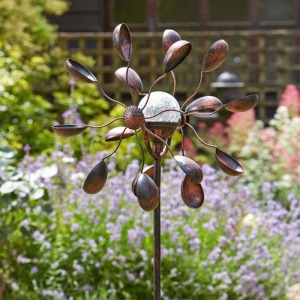
The Smart Solar Gemini has been the benchmark crackle-globe spinner in the UK market for years, and the reason is straightforward: it gets the fundamentals right. The coloured crackle-glass ball splits at the equator into two contra-rotating hemispheres when the wind picks up, creating that distinctive dual-spin effect that catches the eye from across the garden. In direct sun the solar panel on the stake charges a small battery, and after dusk the crackle glass glows with warm LED light that makes it visible well into the evening.
Smart Solar is a UK-based brand, and that matters for a product that needs to survive British weather. The stake, frame and internal mechanism are built to a higher standard than the sub-£15 spinner imports that flood Amazon — the bearing assembly in particular is notably smoother and more sensitive to light breezes than generic equivalents. UK reviewers consistently mention it spinning in conditions where cheaper versions sit still, and that responsiveness is the whole point of a kinetic garden feature.
The height is approximately 90cm, which suits most garden borders and patio containers. Colour options include blue, red, purple and green — the blue crackle glass with warm LEDs is the most popular UK choice and works well with silver birches, lavender borders, or against stone walls. One limitation is that the solar LED runs on a modest battery — it won’t match a dedicated solar light for brightness, but it casts a pleasant ambient glow rather than trying to be a spotlight.
This is the spinner to start with if you’re unsure. It combines the most popular design type in the UK, a well-known brand, a sensible height, and a track record of durability that budget alternatives simply don’t have.
Features
- Contra-rotating crackle glass sphere design
- Built-in solar panel with LED lighting
- Height approximately 90cm including stake
- Ground stake installation
- Multiple colour options (blue, red, purple, green)
- UK brand with UK weather testing
- Smooth, sensitive bearing — spins in light breezes
- UK brand built for British weather conditions
- Warm LED glow after dusk is a genuinely nice evening effect
- Proven long-term durability in UK reviews
- LED glow is subtle — not a bright light source
- Priced above budget imports (but the quality justifies it)
- Single height option
2. Garden Mile Solar Wind Spinner Gemini — Best Value Large
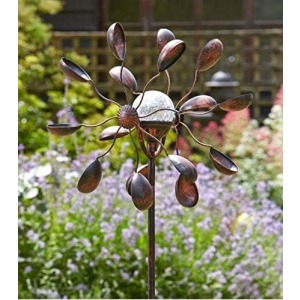
Garden Mile’s Gemini spinner offers a larger crackle-glass sphere than the Smart Solar at a competitive price, making it an appealing option for gardens where you want the spinner to read clearly from a distance — across a lawn, at the end of a long border, or as a focal point in a larger plot. The bigger sphere means more visual presence when spinning and a more substantial glow after dark when the LED illuminates the crackle glass from within.
The construction is solid rather than exceptional. Garden Mile is a UK-based garden brand, and quality control is more consistent here than with unbranded imports, but the bearing isn’t quite as finely tuned as the Smart Solar. In calm UK conditions it may need a slightly stronger gust to start spinning. That said, once it gets going the larger sphere creates more rotational momentum, so it tends to keep going longer once moving. For gardens that get regular afternoon breeze — coastal gardens, exposed northern gardens, anywhere with a clear south-westerly aspect — this won’t be an issue.
Colour options typically include blue, purple and amber. The amber crackle glass with warm LED is particularly effective in autumnal borders or alongside ornamental grasses. The stake height suits mixed borders and pots equally well. UK buyers in particular appreciate that Garden Mile products are available in many UK garden centres as well as online, so returns and customer service are less of a headache than with marketplace imports.
If the Smart Solar is sold out in the colour you want, or you specifically need the larger sphere size, Garden Mile’s Gemini is the natural alternative.
Features
- Large crackle-glass sphere, contra-rotating halves
- Solar panel with LED illumination
- Ground stake included
- Multiple colour options including amber
- UK brand with retail presence in UK garden centres
- Larger sphere than Smart Solar — better presence in bigger gardens
- Good value for size
- UK brand with accessible returns
- Bearing less sensitive than Smart Solar — needs a bit more wind to start
- Colour range varies by season and stock
3. Peacock Solar Wind Spinner with Cracked Glass Ball — Best Figurative Design
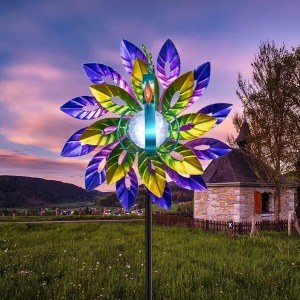
If a spinning globe doesn’t fit your garden’s aesthetic, this peacock design takes a completely different approach. The tail fan is constructed from layered, individually cut metal feathers that rotate in the breeze, creating a rippling effect as the layers move at slightly different speeds. A crackle-glass ball sits at the base, solar-charged and LED-lit, providing the light element without competing with the tail for visual attention. It’s a more structured, ornamental look that suits formal gardens, cottage borders, and anyone who prefers representational garden sculpture over abstract kinetics.
The metal tail construction is more wind-resistant than it looks. The feathers are laser-cut steel rather than stamped, which means cleaner edges, better symmetry, and more resistance to warping over time. UK buyers describe it holding up well through autumn gales when properly staked, though in very exposed positions (coastal cliffs, open moorland) the tail can catch wind in a way that strains the stake fixing — push it in deep if you’re in a windy garden.
The LED ball provides the same ambient evening glow as the globe-style spinners, and the crackle glass effect is the same. What changes is the daytime visual: the peacock tail in full rotation is a genuinely striking garden feature that invites a closer look rather than simply catching peripheral attention. It reads at a medium distance (5-10 metres) where you can appreciate the layered feather structure.
This is a strong choice for gardens with formal borders, rose beds, or cottage planting schemes where you want something figurative and recognisable rather than a spinning sphere.
Features
- Layered laser-cut steel peacock tail fan design
- Crackle glass ball with solar LED at base
- Ground stake installation
- Multi-layer rotation creates rippling movement effect
- Weather-resistant steel construction
- Distinctive figurative design — stands out from generic globe spinners
- Layered tail creates complex movement even in gentle breeze
- Laser-cut steel tail resists warping better than stamped alternatives
- Tail catches more wind in exposed positions — stake firmly
- Design won’t suit every garden style
- LED ball is secondary to the tail visually — low brightness
4. HDNICEZM Solar Wind Spinner Multi-Colour LED Glass Ball — Best LED Display
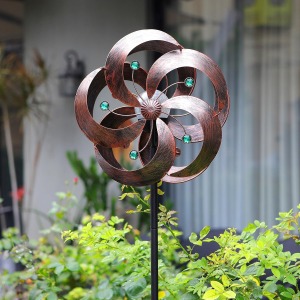
For the evening garden, the HDNICEZM multi-colour LED spinner takes a different approach to lighting than the warm-white glow of the Gemini-style models. The LED inside the crackle glass ball cycles through colours — blue, green, red, purple — casting shifting coloured light through the glass as the ball rotates. The effect in the dark is genuinely striking, particularly when the spinner is moving and the crackle pattern throws the colours across nearby plants and paving.
The trade-off is one that matters for UK summers: colour-cycling LEDs drain the battery faster than a simple warm-white LED, and the UK’s limited summer sun hours mean that by September you’ll often see shorter run times in the evenings than in June and July. If you’re primarily using this as an evening feature, expect strong performance from May through August and progressively shorter LED run times as autumn approaches.
The globe spinner mechanism is functional and the bearing is adequate, though it’s not as finely balanced as the Smart Solar. For the price point it’s a reasonable compromise. Build quality is acceptable for an import — the glass feels solid and the stake is of decent gauge, but don’t expect the same long-term durability as the UK brand alternatives. UK buyers who’ve had it for multiple seasons report mixed experiences; some last five or six years without issue, others replace after two or three. It depends a lot on where you position it and whether you bring it in over winter.
The colour-changing LED effect really is its headline feature, and for evening entertaining or garden parties it creates a noticeably different atmosphere than a warm-white glow. If your focus is the daytime kinetic effect, the Smart Solar will serve you better. If you want something that works as a coloured light feature after sunset, this earns its place.
Features
- Multi-colour cycling LED (blue, green, red, purple)
- Crackle glass sphere contra-rotating design
- Solar panel charging with automatic dusk-to-dawn LED
- Ground stake included
- Colour light throws through crackle glass pattern
- Colour-cycling LED is a genuinely different evening effect
- Crackle glass multiplies the coloured light across surrounding plants
- Competitively priced for the LED feature
- Colour LEDs drain battery faster — shorter run times in autumn/winter
- Build quality varies — less consistent than UK brand alternatives
- Bearing not as sensitive as Smart Solar
5. Solar Wind Spinners Hummingbird — Best Wildlife Design
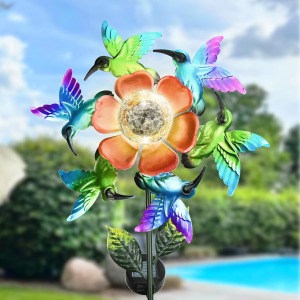
The hummingbird wind spinner takes a different route to movement than the globe or peacock designs. Here the spinning element is a set of hummingbird wings (and sometimes a rotating body) mounted on a shaft above the solar stake — the wings catch the breeze and spin in a way that mimics the rapid hovering motion of the actual bird. It’s a charming effect in a garden that already features other wildlife elements: a bird feeder, a pond, pollinator planting.
The solar LED in this design illuminates the hummingbird body or wings after dark, depending on configuration. The light is warm and quite localised — this is an ornamental feature rather than a lighting solution. What it does well is bring movement and life to a garden spot even when the wind is very light. Hummingbird wings are designed to be aerodynamically sensitive, meaning the bearing and blade geometry allows it to spin in conditions that would leave a heavier globe spinner static.
Construction quality on hummingbird spinners varies considerably across the Amazon marketplace. The specific listing recommended here has maintained solid UK reviews over multiple seasons, but do check the current review date spread — this is a product category where quality varies by batch. The stake is standard gauge and the painted finish holds reasonably well if brought in over winter, though surface rust on the pivot area is the most common complaint reported over two to three seasons of outdoor use.
The hummingbird design naturally suggests placement near flower beds or herb gardens, where the wildlife motif reinforces the planting around it. At lower heights (60-80cm stake) it’s also suitable for patio pots if the container is heavy enough to resist toppling on a windy day.
Features
- Hummingbird wing and body kinetic design
- Solar panel with LED illumination
- Aerodynamically sensitive wings spin in light breezes
- Ground stake installation
- Suits wildlife and cottage garden settings
- Wing design spins in lighter breezes than globe-style spinners
- Wildlife theme works naturally alongside bird feeders and pollinator planting
- Lower price point than UK brand alternatives
- Pivot area prone to surface rust if left out through winter
- Batch quality variation — check recent reviews before buying
- LED illumination is minimal rather than a feature
6. SteadyDoggie Solar Wind Spinner Jewel Cup — Best Statement Piece
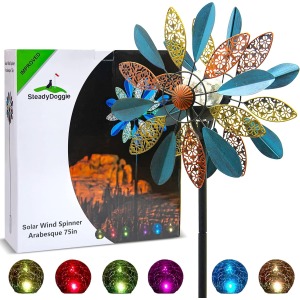
At approximately 190cm (75 inches) tall, the SteadyDoggie Jewel Cup is a completely different category of garden wind spinner. Where the other products in this guide are border accessories, this is a garden sculpture. The cascading cup design — a series of cupped metal rings that catch and redirect wind to create continuous rotation — is the original kinetic garden art form, and at this height it commands serious visual attention from anywhere in the garden.
The construction is stainless steel throughout, which is the key quality distinction over painted or powder-coated alternatives at this scale. Stainless doesn’t rust, doesn’t need an annual coat of paint, and maintains its polish in the same British weather that strips the finish off cheaper materials within a few seasons. SteadyDoggie is an American brand with a long history in kinetic garden art — this isn’t an Amazon impulse product, it’s a considered garden feature with a corresponding price point.
The solar element is modest: a small LED in the base stake provides a low glow at night, enough to mark the position of the spinner after dark but not intended as a lighting feature. At this height, the spinner’s visual impact is entirely in its daytime movement — and in a decent breeze, the cascading cup rotation is genuinely mesmerising to watch, with each tier moving at a slightly different speed. The bearing is precision-engineered and responds to very light air movement.
This suits large gardens, gardens with strong architectural elements, or anyone who wants a focal point feature rather than a border accent. In a small courtyard garden it would simply overwhelm the space. But for the right garden, nothing else in this guide comes close to its presence.
Features
- 190cm (75 inch) total height
- Cascading cup kinetic design with precision bearing
- Stainless steel construction throughout — no rust
- Solar LED base stake lighting
- Responds to very light air movement
- Made by a specialist kinetic garden art brand
- Stainless steel — genuinely long-lasting in UK weather, no painting required
- Precision bearing is notably more sensitive than mass-market alternatives
- A genuine garden sculpture rather than a garden accessory
- Significantly more expensive than other options in this guide
- 190cm height suits large gardens only — overwhelming in small spaces
- LED base lighting is minimal rather than a feature
Solar Wind Spinner Buying Guide
Key Takeaways
- Three distinct design families exist in this guide: Gemini crackle-globe spinners, figurative ornamental designs (hummingbird), and large kinetic cup sculptures — each suits a different garden style and placement
- Bearing quality is the single most important mechanical feature: sealed ball bearings spin in light UK breezes of 2–3mph; cheap sleeve bearings need 8–10mph winds to start moving
- UK-specialist brands like Smart Solar and Garden Mile build specifically for British weather and wind conditions — they’re worth the premium over generic imports for outdoor longevity
- Crackle glass quality varies enormously: genuine crackle glass internal fracture patterns glow beautifully with LEDs; moulded plastic that mimics the look does not
- LED runtime after dark depends entirely on battery size — look for solar panel wattage and battery capacity in the spec, not just whether LEDs are present
- Stake depth matters in the UK: wet soil reduces grip significantly — drive stakes at least 20cm deep and consider a concrete pot insert for exposed positions
- Height and garden scale must match: a 75cm spinner looks lost in a large border; a 40cm spinner can be overwhelming on a small patio
The Three Design Families: Which Type Are You Buying?
Before comparing individual products, it helps to understand that solar wind spinners break into clearly distinct design families — and the buying decisions for each are different. Picking the wrong type for your garden style is the most common mistake buyers make.
Gemini crackle-globe spinners (the Smart Solar and Garden Mile Gemini models in this guide) are the classic UK garden spinner design. They feature cupped wind-catcher vanes that spin on a vertical axis, with a crackle glass solar globe at the centre that illuminates after dark. The design is relatively understated and works well in traditional British cottage gardens, mixed borders, and alongside stone or brick features. The crackle globe provides warm ambient light rather than bright LED display, which many gardeners prefer. These are practical, well-engineered products from established UK brands.
Figurative ornamental spinners (the Peacock Crackle Glass and Hummingbird models) combine a decorative sculptural element with kinetic spinning. The peacock features a fan of coloured crackle glass panels that rotate, while hummingbird designs typically feature kinetic wings and bodies on pivot points that sway and turn in the breeze. These work best as focal points in a border or beside a garden seat where they’re seen up close. They suit cottage gardens, wildlife-themed spaces, and anyone who wants a garden feature with more personality than a geometric spinner.
Large kinetic cup sculptures (the SteadyDoggie Jewel Cup 75-inch model) are a different proposition entirely — tall statement pieces that create movement and light at height, visible from across a garden. These are designed to be seen rather than examined closely. They work in larger gardens as border anchors or standalone lawn features, and the height means the spinning motion is dramatic in even light breezes. Not suited to small patios or compact gardens where the scale would overwhelm.
Bearing Quality: The Feature That Decides Whether It Actually Spins
This is the specification most buyers overlook and most manufacturers downplay. The bearing is the mechanical heart of any wind spinner — it’s what allows the spinning element to rotate freely. Get this wrong and you end up with an ornament that only moves in a gale.
UK wind conditions vary considerably. A garden in the Pennines or the Scottish Highlands sees regular 15–20mph gusts that will spin almost anything. But a sheltered suburban garden in the Midlands or a south-facing London courtyard might see average wind speeds of only 3–5mph during summer afternoons. For those gentler conditions, bearing quality is critical.
Sealed ball bearings — the type used in the Smart Solar and Garden Mile models — require very little force to start rotating and maintain smooth spin at low wind speeds. The balls are enclosed and pre-lubricated, meaning they don’t corrode or seize in wet UK weather. Cheap sleeve bearings (a simple tube around an axle) require significantly more wind force to start moving and develop friction over time as they corrode. You cannot tell which type a product uses from the product images alone — check the description for “sealed bearings” or “ball bearings” specifically. If it doesn’t mention bearings at all, assume they’re the cheaper type.
The SteadyDoggie model uses a dual-direction bearing design that deserves special mention: the spinner can rotate both clockwise and anticlockwise, which prevents the wind-induced torque from tightening or loosening the stem over time. This extends mechanical life considerably.
Crackle Glass Quality: What Makes the Difference at Night
Several spinners in this guide feature crackle glass globes or panels, and the quality range is wide. Genuine crackle glass is made by briefly submerging red-hot molten glass in cold water, creating an internal network of fine fracture lines throughout the body of the glass. When an LED shines through it, the fractures scatter and refract the light in all directions, creating a warm, complex, jewel-like glow that changes as the spinner rotates.
The cheaper alternative is a moulded plastic component that has surface texture designed to look like crackle glass in product photographs. In daylight and in photographs it can look similar. At night with an LED behind it, the difference is immediately apparent — the plastic version glows flatly without the internal fracture refractions, giving a much less impressive visual effect.
Both Smart Solar and Garden Mile use genuine crackle glass in their Gemini models, which is a key reason these products have remained popular with UK gardeners for years. The Peacock model also uses real crackle glass panels in the tail fan. Genuine glass is heavier and more fragile than plastic alternatives, but the visual effect at night justifies the handling care required during setup.
Height and Garden Scale: Sizing Your Spinner Correctly
Height matching is crucial and easy to get wrong when buying online. A product described as “75 inches” (190cm) is a significant garden feature — roughly the height of a tall person. The SteadyDoggie Jewel Cup is this size. In a large herbaceous border or as a focal point on a sweep of lawn, it’s striking. On a 3m x 4m patio with other furniture, it’s overwhelming.
The Gemini-style spinners (Smart Solar and Garden Mile) stand at approximately 80–90cm including their ground stake. This is the most versatile height for UK gardens — visible above border plants, appropriate for both small and medium gardens, and comfortable as a secondary accent feature rather than a dominant focal point. The Peacock and Hummingbird designs typically fall in the 60–80cm range, which works well close to a seating area or along a path edge where they’re seen at close range.
A useful practical guideline: measure the height of the tallest plants in the border where you plan to position the spinner. For a spinner to be seen and appreciated, it should stand at least 30cm taller than surrounding plants at their mature height. In a border with 60cm perennials, a 90cm spinner clears them comfortably. In a border with 1.2m grasses or tall dahlias, you’d want the SteadyDoggie’s greater height.
| Spinner Height | Best Garden Setting |
|---|---|
| 40–60cm | Small patio, raised bed, pots |
| 60–90cm (Gemini, Peacock, Hummingbird) | Standard UK mixed border, small-medium gardens |
| 90–120cm | Larger borders, lawn focal point |
| 120cm+ (SteadyDoggie 75in) | Large gardens, wide open lawn areas |
LED Technology: Runtime, Colour Modes, and UK Evening Performance
Solar wind spinners with LEDs face a specific challenge in the UK: summer evenings with late sunset (9–10pm in June in Scotland) mean the battery has been charging all day and runs well into the evening. But spring and autumn evenings are shorter and solar charge may be limited on overcast days — exactly when you most want the garden feature to be working.
The crackle globe models (Smart Solar Gemini, Garden Mile Gemini) use a single warm white or colour-changing LED that illuminates the globe. These consume very low power and typically run for 4–6 hours after the panel stops charging. The visual effect is subtle and warm — appropriate for a cottage garden aesthetic.
The HDNICEZM multi-colour LED model takes a different approach: RGB LEDs with multiple colour modes mean you can set it to cycle through colours, hold a specific colour, or flash. The effect is much more vibrant and modern-looking. The trade-off is higher power consumption, which means shorter runtime on cloudy days and earlier cut-off in the evening. If you want a bright, colourful display, this is the model to choose. If you prefer a gentle ambient glow that runs reliably through a full UK autumn evening, the crackle globe designs are more consistent.
The SteadyDoggie Jewel Cup includes colour-changing crackle glass globes that respond particularly well to LED illumination at height — the motion of the spinning cups combined with the changing light creates a genuinely striking evening display in a large garden.
Stake Depth and Wind Stability in UK Conditions
UK weather presents a specific challenge for garden stake-mounted features: we get substantial rain that softens soil considerably, combined with unpredictable wind gusts that are stronger than the average might suggest. A spinner that’s perfectly stable on a dry June day can lean, tip, or be blown out entirely after a wet autumn week when the ground has softened.
The standard supplied stakes on most wind spinners are designed for average conditions in manufacturer testing. For UK gardens, especially those with clay-heavy soil (common across much of England and Wales), you should drive stakes deeper than the minimum the product suggests. A general rule: for any spinner over 60cm, drive the stake at least 20cm into the ground. For the SteadyDoggie at 75 inches, aim for 25–30cm of stake depth.
In particularly exposed positions (a gap in a fence line, the corner of a garden where two wind directions converge, an elevated plot), consider sinking the stake into a heavy pot filled with concrete or gravel and using that as the base rather than ground-mounting directly. This both anchors the spinner and allows you to move it indoors over winter without disturbing your soil. The Smart Solar and Garden Mile spinners have robust stake designs suited to UK conditions, whereas some lighter imported models use thin single-spike stakes that will lean progressively as wet soil loses grip.
Materials Durability: What Survives UK Weather Long-Term
The UK climate is demanding on outdoor decorative products. The combination of UV exposure (weaker than southern Europe but still significant over multiple seasons), persistent moisture, and temperature cycling from frost to summer heat challenges most finishes within two to three years if the materials aren’t specified correctly.
Powder-coated steel is the most durable finish for the metal vane elements of wind spinners. The coating bonds chemically to the metal substrate and resists chipping, UV fading, and moisture penetration significantly better than painted finishes. Smart Solar uses powder-coated steel on the Gemini model, which is why the finish holds up well through multiple UK winters. Painted steel by contrast can begin to show rust at chip or scratch points within the first year in a garden exposed to winter rain.
Stainless steel components (used on stakes and fixings in quality spinners) don’t rust regardless of moisture exposure, which matters particularly in coastal gardens or anywhere that gets heavy dew. The stake is the most failure-prone point on any garden spinner, and a cheap mild steel stake will rust through within two to three seasons in wet UK soil.
The crackle glass globes require careful storage through winter rather than leaving them exposed to frost — glass subjected to repeated freeze-thaw cycles can crack along the internal fracture lines. Remove crackle glass components in November and store inside. The metal vane elements of the Gemini models can typically stay outdoors year-round.
Where to Position Your Solar Wind Spinner
Getting placement right makes a significant difference to both the visual impact and the operational performance. For the solar panel to charge effectively, the spinner needs access to open sky — not necessarily direct south-facing sun all day, but no significant overhead canopy blocking the light. A position that receives direct sunlight for at least 4–5 hours daily will provide adequate charging for an evening’s LED operation.
Visually, wind spinners work best when seen against a contrasting background. A metallic spinner set against a dark yew hedge or a brick wall shows the movement and the gleam of the materials much more clearly than one set against a bright sky or a white fence. Position crackle globe spinners where you’ll be sitting in the evening — the right viewing angle for the illuminated globe is from the side rather than directly above, so a seating area looking toward the border where the spinner is placed gives the best result.
Avoid positions directly under or beside tall trees that drop leaves or create dense shade. Leaf debris on the solar panel reduces charging efficiency dramatically, and the constant shadow-and-light pattern of a moving tree canopy above can confuse the dusk sensor that triggers the LEDs. Clear sky access directly above the panel is more important than compass orientation for spinners with hemispherical or omnidirectional solar panel designs like the Gemini crackle globe.
Buying Checklist
- Design family matches your garden style? (Gemini for classic UK gardens; ornamental for wildlife/cottage themes; tall kinetic for large gardens)
- Sealed ball bearings confirmed in product spec?
- Stake height appropriate for border plant heights?
- Real crackle glass or plastic substitute? (check product description carefully)
- LED type: single warm-white for subtle glow or RGB for vibrant colour?
- Battery capacity and expected runtime mentioned in spec?
- Stake depth: at least 20cm planned for UK soil conditions?
- Winter storage plan for crackle glass components?
- Position offers 4–5 hours of clear sky access for the solar panel?
Case Study: A North Yorkshire Cottage Garden
Background
A homeowner in Harrogate with a north-facing cottage garden had been struggling to find solar garden features that actually worked. The garden’s aspect meant direct sun was limited to a few hours around midday in summer, and the wind — typical of exposed Yorkshire positions — was more reliable than the sun. Previous solar lights had given minimal performance from September onwards. What they wanted was something that looked good by day and had at least some evening presence.
Project Overview
The garden was a 12m x 9m plot with a mixture of exposed borders and a sheltered corner near the house wall. The sheltered corner was reserved for patio furniture; the main border faced south-west and got decent midday sun despite the north-facing aspect. The homeowner wanted two spinner installations: one as a border feature in the main planting scheme, one as a focal point at the end of the garden near an old stone wall.
Implementation
The Smart Solar Gemini in deep blue was installed in the main border amongst silver-leaved plants — lavender, Stachys byzantina, and some silvery-blue hostas. The blue glass echoed the cool tones in the planting, and the position near the south-west corner of the border gave it adequate afternoon sun for LED charging. For the end-of-garden position near the stone wall, the peacock spinner was chosen because the wall provided enough backdrop contrast for the tail fan to read clearly and the more formal design suited the established cottage-garden planting scheme around it.
Results
Both spinners performed well through the summer. The Gemini’s bearing was sensitive enough to spin in the moderate Yorkshire breezes without needing a full wind, and the blue LED glow in the evenings extended into September reliably. The peacock spinner needed its stake hammered particularly firmly after October gales in the first year — the tail acts as a considerable sail in a strong wind — but remained undamaged. Both were brought under cover in November and reinstalled in March, which the homeowner confirmed is simply the practical approach for painted steel garden metalwork in Yorkshire’s damp winters.
Expert Insights From Our Solar Panel Installers About Solar Wind Spinners
One of our senior solar panel installers with over 15 years of experience working in UK gardens offered this: “The most common issue I see with solar wind spinners is positioning them where they look right rather than where the solar panel faces. The best spinner in the world won’t charge its battery if it’s in full shade all afternoon. Even a crackle-globe Gemini needs three to four hours of unobstructed afternoon sun to give you a decent evening glow. If your ideal position is shaded, look for a model with a separate solar panel on a longer cable that you can position independently — some versions of the SZMP fountain pump range, for instance, have this. For spinners specifically, it’s trickier, because the panel is usually integrated into the stake. Position it where it gets sun first, then think about aesthetics second.”
Frequently Asked Questions
Do solar wind spinners work in the UK?
Yes — the kinetic spinning element works in any garden with reasonable air movement, and the UK’s Atlantic climate provides plenty of breeze. The solar LED component depends on sunlight to charge, so LED run times are longer in summer (May-August) and shorter in autumn and winter. The spinning itself is not solar-powered and works regardless of sun or cloud.
Do solar wind spinners need direct sunlight to charge?
Direct sunlight charges the battery fastest and gives the longest LED run times. But most solar wind spinner panels will charge in diffuse light — overcast bright days still provide useful charge. The issue in the UK is more about shading from fences, trees, or buildings than cloud cover. Position the stake where it gets unobstructed sky, even if not direct sun, for best results.
How long do solar wind spinners last?
UK brand stainless steel spinners (like the SteadyDoggie) will last 10 years or more with basic maintenance. Powder-coated steel spinners from UK brands like Smart Solar typically last 4-7 seasons with care. Budget import spinners often show surface rust within 2-3 seasons, particularly around pivot points and stake tips. Bringing any painted steel spinner under cover from November to March significantly extends its lifespan.
Can I leave a solar wind spinner out in winter?
You can, but painted steel finishes will degrade faster through sustained damp and frost-thaw cycles. The glass elements are frost-resistant and will be fine. The bearing is usually sealed and handles UK winters, though a light oil application in spring helps. If your spinner is a budget import with a painted finish, bringing it in from November to March will meaningfully extend its usable life. Stainless steel models can safely stay out year-round.
What wind speed do solar wind spinners need to spin?
A quality spinner with a good bearing will rotate in breezes of just 2-4mph — barely perceptible on the skin. Budget spinners with lower-quality bearings may need 8-10mph before they start moving. Figurative designs like peacock tail fans often have good sensitivity due to the large surface area of the tail. If your garden is sheltered, invest in a UK brand spinner with a quality bearing rather than a budget import.
Are solar wind spinners noisy?
A well-maintained spinner with a quality bearing runs silently. Any noise — squeaking, grinding, rattling — indicates either a worn bearing that needs lubrication, debris caught in the mechanism, or a loose fitting that needs tightening. A single drop of light oil on the pivot point usually eliminates bearing noise completely. Cup-style kinetic spinners are genuinely silent even in strong winds.
How do I stop my solar wind spinner from rusting?
For stainless steel: no action needed, it won’t rust. For powder-coated steel: inspect annually for chips and paint bare areas immediately with rust-resistant metal paint, focusing on the stake tip and any screw heads. Bring indoors from November to March if possible. Avoid leaving the stake embedded in wet soil over winter — pull it out and store it dry. Clean off bird droppings promptly as they are mildly acidic and can accelerate paint breakdown.
How bright is the solar LED on a wind spinner?
Not very — and that’s worth being clear about before you buy. Solar wind spinner LEDs are designed to create an ambient glow through the crackle glass rather than illuminate the garden. Think of it as similar to a solar path light on its lowest setting: pleasant, visible, atmospheric, but not functional lighting. If you need meaningful solar lighting, buy a dedicated solar garden light separately. The spinner’s LED is an evening bonus, not its primary function.
Summing Up
Solar wind spinners bring something to a garden that static ornaments can’t — constant, responsive movement that changes with every shift in the breeze. The Smart Solar Gemini remains the best all-round choice for UK gardens: it’s built by a UK brand with UK weather in mind, the bearing is genuinely sensitive, and the crackle-glass LED glow adds real value to summer evenings. For larger gardens needing a focal point, the SteadyDoggie justifies its price with stainless steel construction and a precision bearing that will outlast any coated-steel alternative. For the figurative garden, the peacock design brings a different kind of beauty — layered, structured, and best appreciated up close.
Whatever you choose, position the solar stake where it gets unobstructed afternoon light, apply a drop of oil to the bearing each spring, and bring painted steel models in over winter. A well-maintained spinner should reward you with years of quiet, easy movement.
Updated