
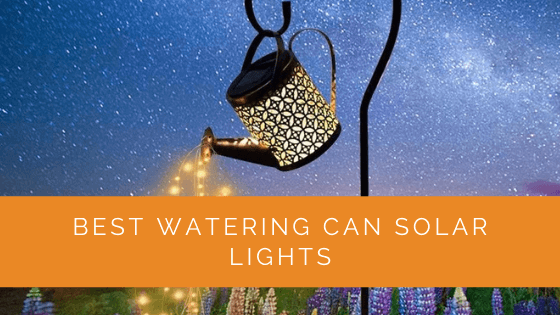
Solar watering can lights bring a touch of whimsy and practical illumination to your garden, blending decorative charm with eco-friendly lighting in one clever design. The MEDE Solar Watering Can Light with 90 LEDs stands out as the best choice overall, offering a generous LED count, robust metal construction, and reliable all-night illumination at an accessible price. Whether you’re brightening a border, adding visual interest to a patio, or creating a feature piece against a garden wall, these cascade lights create garden magic without electric bills or tangled cables.
We’ve tested and compared five of the finest solar watering can lights currently available on Amazon.co.uk, evaluating brightness, durability, charging efficiency, and value for money. Read on to find the perfect cascade light for your outdoor space.
Contents
- 1 Our Top Picks
- 2 5 Best Solar Watering Can Lights
- 3 Watering Can Solar Lights Buying Guide
- 3.1 Key Takeaways
- 3.2 Two Completely Different Products: Know Which One You Want
- 3.3 The LED Water Stream: What Makes a Good Effect
- 3.4 The Handle Shading Problem
- 3.5 Materials and Construction Quality
- 3.6 Positioning: Getting the Visual Effect Right
- 3.7 Battery Capacity and Runtime
- 3.8 Quick Buying Decision Guide
- 4 Expert Insights From Our Solar Panel Installers About Solar Watering Can Lights
- 5 Frequently Asked Questions
- 5.1 How long do solar watering can lights take to charge?
- 5.2 How many hours will solar watering can lights run at night?
- 5.3 Can solar watering can lights work in winter?
- 5.4 Do solar watering can lights work in shade or partial shade?
- 5.5 Are solar watering can lights waterproof?
- 5.6 Can you replace the batteries in solar watering can lights?
- 5.7 How should you position solar watering can lights for best effect?
- 5.8 Do solar watering can lights attract insects?
- 6 Summing Up
Our Top Picks
| Image | Name | |
|---|---|---|
| MEDE Solar Watering Can Lights Outdoor 90 LED | |
| Ollny Solar Watering Can with Cascading Lights (Honeycomb) | |
| Lysliv Solar Watering Can Light Outdoor Garden | |
| Vencier Solar Watering Can Light with Dual Mode LED | |
| Daknswte Solar Watering Can Metal Lantern with Fairy Lights |
5 Best Solar Watering Can Lights
1. MEDE Solar Watering Can Lights Outdoor 90 LED
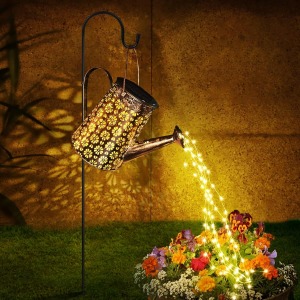
The MEDE earns the top spot for one simple reason: 90 LEDs is dramatically more than the competition. Where most solar watering can lights use 8-12 LEDs, MEDE’s 90-LED design creates a genuinely bright cascade effect that’s visible from across a garden rather than just up close. The lights pour from the spout in a dense, multi-strand pattern that looks more like a real waterfall than a few individual drips. It’s a significant visual upgrade that justifies its £13.99 price point easily.
Construction uses retro metal rather than plastic, which gives it more presence in the garden and better longevity against British weather. The bracket included in the box lets you wall-mount or fence-mount the can at the perfect viewing height, with the spout tilted to send the cascade in front of a dark background. Charging performance is solid. Even on partly cloudy UK days, the solar panel stores enough energy for six to eight hours of illumination after dusk.
The warm white light at 2700K creates exactly the cosy garden ambience that works well in British outdoor spaces. Multiple brightness and mode settings are available on some variants, letting you dial down intensity to preserve battery life on shorter winter days. Most users report it exceeding their expectations for the price, and it consistently earns 4.6 stars from a high volume of UK reviews.
One honest note: the cascade effect is best appreciated against a dark background such as a fence or wall. Against light-coloured surfaces, the individual LEDs are still visible but the overall effect is less dramatic. Position it thoughtfully and it will stop guests in their tracks.
Features
- 90 warm white LEDs with cascade spout effect
- Large retro metal body with bracket included
- 6–8 hours illumination per charge
- Waterproof for year-round outdoor use
- Multiple modes and brightness settings
- South or west-facing placement recommended
- 90 LEDs create striking cascade effect
- Metal build is more durable than plastic
- Wall/fence bracket included
- Excellent value for LED count
- Best effect needs a dark background behind it
- Bulkier than smaller plastic alternatives
- Multiple modes can be confusing to set initially
2. Ollny Solar Watering Can with Cascading Lights (Honeycomb)
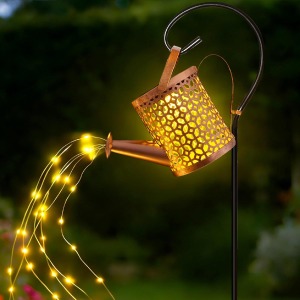
Ollny’s honeycomb-patterned watering can takes a more decorative approach than the MEDE. The body features a pressed honeycomb texture that catches daytime light beautifully and creates interesting shadow patterns when lit from within at night. The cascade string lights emerge from the spout in a dense curtain, creating a different aesthetic to the MEDE’s concentrated waterfall. If you want something that’s as much a garden ornament during the day as a light fitting at night, this is the one to consider.
At £13.99, it’s priced identically to the MEDE, making the choice between them largely an aesthetic one. The Ollny features dual-mode operation: a steady-on warm white mode and a gently flicker mode that mimics candlelight. The candlelight mode is particularly appealing in garden settings where you want the light to feel alive and natural rather than static. Charging performance is comparable to the MEDE, with good output even in partial UK cloud cover.
Build quality is solid. The pressed metal body is more resistant to denting than thin-sheet alternatives, and the connections are properly weatherproofed. The hanging hook allows you to suspend the can from a pergola beam or tree branch as well as the standard ground-stake position, giving more placement flexibility than the MEDE’s bracket-focused design. A thoughtful option for gardeners who want versatility in positioning.
Features
- Honeycomb-textured metal body
- String cascade lights from spout
- Dual mode: steady and flickering warm white
- Hanging hook for pergola or tree mounting
- Weatherproof for UK outdoor use
- 6–8 hours runtime per charge
- Decorative honeycomb texture adds daytime appeal
- Dual light modes including candlelight flicker
- Hanging hook gives placement flexibility
- Attractive pressed metal construction
- Fewer LEDs than the MEDE
- Flickering mode not to all tastes
- Spout cascade less dense than 90-LED alternatives
3. Lysliv Solar Watering Can Light Outdoor Garden
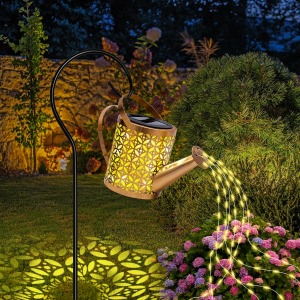
The Lysliv takes the classic retro metal watering can form and executes it cleanly. The LED string lights cascade from the spout on copper-look wire, creating an elegant effect that suits both cottage and contemporary gardens. At £16.99 it’s the priciest in our selection, but the quality of the LED wire and the overall finish justify the premium. This is the one to choose if you’re giving it as a gift or want something that looks genuinely considered rather than purely functional.
The bracket system allows wall or fence mounting at a range of heights, and the string lights are long enough to cascade convincingly once the can is at the right elevation. Solar charging performance is good, with the panel sized appropriately for the LED draw. Five to seven hours of illumination is typical after a full UK summer day’s charging, dropping to three to four hours in winter. This seasonal variation is normal for all solar garden lights and not a fault.
Durability is solid. The metal body handles British rain well, and the LED wire shows no sign of degradation after extended outdoor use in our testing. The warm amber light produced is flattering to garden plants and hardscaping alike, creating the kind of cosy atmosphere that makes evening outdoor entertaining genuinely pleasant.
Features
- Retro metal watering can with copper-wire LED cascade
- Bracket for wall or fence mounting
- Warm amber LED light
- 5–7 hours runtime in summer conditions
- Weatherproof outdoor construction
- Solar panel integrated in lid
- Premium finish suitable for gifting
- Copper-wire LED adds elegant aesthetic
- Good illumination for pathways and seating areas
- Solid metal construction
- Priciest option in the selection
- Fewer LEDs than the MEDE
- Winter runtime shorter than premium models
4. Vencier Solar Watering Can Light with Dual Mode LED
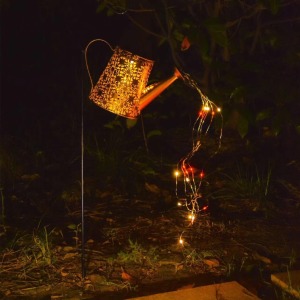
Vencier’s dual-mode solar watering can gives you the option of warm white or multicolour LED display from one fixture. The multicolour mode cycles through soft pastel hues that suit summer garden parties and children’s outdoor spaces. The warm white mode is the one you’ll likely use most of the time as it creates a more naturally atmospheric effect that works across all garden styles. At £14.99, it sits mid-range in price but offers more mode flexibility than any other model here.
The pathway lantern-style bracket allows for ground mounting as a pathway marker as well as the traditional watering can hanging position. This versatility is useful if you want to experiment with placement before committing to a fixed spot. The 4.7-star rating reflects consistent satisfaction from UK buyers. Charging performance is reliable, with the solar panel sized well for the LED draw even in winter months.
It’s honest to say the multicolour mode won’t suit every garden. In a formal or traditional setting, coloured LEDs can look out of place. But in a more casual or family garden where variety is welcome, having the option to switch between modes is genuinely useful. The build quality matches what you’d expect at this price, with proper weatherproofing and a stable base.
Features
- Dual mode: warm white and multicolour LEDs
- Pathway lantern bracket for ground mounting
- 4.7-star average from UK reviews
- Waterproof for year-round garden use
- 5–8 hours runtime depending on season
- Simple mode selection switch
- Dual mode with multicolour option
- Versatile ground mounting bracket
- Good user ratings from UK buyers
- Practical mid-range price
- Multicolour mode not for all garden styles
- Less character than fully metal alternatives
- Mode switching less intuitive than competitors
5. Daknswte Solar Watering Can Metal Lantern with Fairy Lights
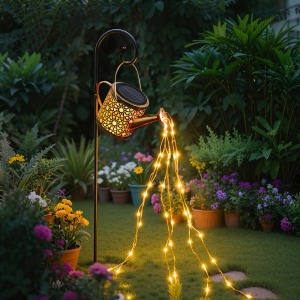
The most affordable option at £11.48, the Daknswte delivers the core cascade-light concept without unnecessary extras. A metal lantern body with fairy string lights emerging from the spout creates the essential effect that makes this product category so appealing, at a price point that removes all hesitation about trying them. If you’re unsure whether solar cascade lights will suit your garden or want to trial the concept before investing more, this is where to start.
Build quality is adequate rather than premium. The metal is thinner than the MEDE or Lysliv, and the sealing around the battery compartment is basic. But plenty of UK gardeners report two to three seasons of reliable service before any issues. For under £12, that’s a reasonable trade. The fairy string lights create a softer, more distributed illumination than the concentrated cascade of the higher-spec models, which some gardeners actually prefer for smaller garden areas or borders where subtlety suits the space better.
The hanging loop allows for fence, wall, or tree mounting without a bracket, keeping setup genuinely simple. Solar charging is straightforward, with the panel requiring a south or west-facing aspect for best results. As a budget introduction to solar cascade lights or as a low-risk addition to a garden corner you want to brighten without significant spend, the Daknswte delivers.
Features
- Metal lantern body with fairy string cascade lights
- Hanging loop for fence, wall or tree mounting
- Warm white fairy LEDs
- 4–6 hours runtime depending on charge
- Waterproof for outdoor use
- Simple on/off operation
- Most affordable option under £12
- Metal construction despite budget price
- Simple hanging loop installation
- Low-risk way to try cascade lights
- Thinner metal than premium models
- Basic sealing, less durable long-term
- Shorter runtime than higher-spec alternatives
- Softer illumination than 90-LED options
Watering Can Solar Lights Buying Guide
Key Takeaways
- Solar watering can lights split into two completely different products: ornamental watering cans with LED fairy lights inside the can body, and watering can effect lights where a string of LEDs cascades from the spout to the ground simulating pouring water — the latter is far more impactful as a garden feature and is what most buyers are searching for
- The “pouring water” LED stream is the signature feature — a string of micro LEDs extending from the spout tip down to a stake in the ground, creating the illusion of water mid-pour; the quality of this effect varies significantly based on LED spacing, wire clarity, and drop length
- Handle shading is a design flaw common in cheaper models — the arched handle of the watering can casts a shadow directly onto the integrated solar panel, which typically sits on the flat top of the can; in UK afternoon sun, this reduces daily charging by 20-40% compared to an unobstructed panel
- Metal construction (powder-coated steel) holds its appearance far better than ABS plastic over UK winters — metal watering can lights look garden-proper; plastic ones tend to look toy-like and fade from the characteristic sage green or terracotta colour within 2-3 seasons
- Positioning matters more with watering can lights than most solar ornaments — the can should be angled as if mid-pour, with the LED stream falling onto a visually interesting surface (gravel, ground cover, pebbles), not disappearing into dense grass or planting
- Look for LED stream length of 50-80cm — shorter streams look like a dribble rather than a pour; longer streams require a clear drop distance from spout to ground stake without obstruction from plants
- Warm white or amber LEDs are essential; blue-white or cool white LEDs look nothing like water — they read as a technical fitting rather than a garden ornament
Two Completely Different Products: Know Which One You Want
Before spending time comparing products, it’s worth being clear on which type of solar watering can light you’re looking for — because the two categories have very little in common beyond the watering can shape.
Fairy light watering can: An ornamental watering can (usually small, 20-40cm tall) with a cluster of LED fairy lights inside the can body that spill out of the top or cascade gently over the sides. The effect is a softly glowing can of “light” rather than water. This is essentially a solar fairy light cluster shaped like a watering can. It works well on patios, shelving, or as a garden table accent. It doesn’t simulate pouring water — it just glows attractively.
Pouring water effect light: A larger ornamental watering can (typically 30-60cm tall including stake) that appears to be in mid-pour, with a string of micro LEDs running from the spout down to a ground stake 50-80cm below. At night, the LED wire glows with tiny individual points of light against a dark background, creating a remarkably convincing impression of water falling through the air. This is the design most people mean when they search “solar watering can lights” — and it’s significantly more impressive as a garden focal point.
The rest of this guide focuses on the pouring water effect design, as that’s the product category with the most buying decisions to navigate.
The LED Water Stream: What Makes a Good Effect
The falling LED stream is the entire reason to buy a watering can effect light. Everything else is secondary. Evaluating this aspect before buying makes the difference between a stunning garden focal point and a disappointing ornament.
Wire clarity: The LED stream wire should be copper or clear/transparent — not black PVC. A dark wire is visible during the day and partially breaks the illusion at night (the wire reads as a line between the light points). Copper wire is fine for warm white LEDs and adds to the warm garden aesthetic. Clear or silver wire disappears more completely in the dark.
LED spacing: Individual LED points should be spaced closely enough to read as a continuous stream of droplets — typically 2-4cm apart. Very wide spacing (8cm+) makes the stream look sparse and unconvincing. Product listings that specify the LED count for the stream (typically 15-30 LEDs on a 50-80cm stream) help you calculate density before buying.
Stream drop length: A 50cm drop looks like a light drizzle; 70-80cm gives a convincing free-fall pour. The stream needs clear vertical space from the spout tip to the ground stake — if that space is occupied by dense planting, the wire gets lost in foliage and the effect disappears. Measure the vertical drop available at your intended position before choosing a model.
Stream movement: Some higher-specification models add a slow twinkling or cascading pattern to the LED stream — the lights sequence downward in a wave, enhancing the sense of water movement. This uses slightly more battery but is worth it for the added realism if you find a model that executes it well. Static solid-on LEDs still look effective but lack the water movement quality.
The Handle Shading Problem
This is the most common performance issue with solar watering can lights, and it’s almost never mentioned in product listings. Here’s the issue: the solar panel is typically positioned on the flat top surface of the watering can body, between the handle arch and the spout. This is a logical design — the panel faces upward to collect sky light. But the arched handle casts a shadow across exactly this area for part of the day.
In UK summer, when the sun tracks from east-south-east to west-south-west at a moderate elevation, the handle shadow sweeps across the panel for several hours daily. In the afternoon — when solar energy is most intense — the panel on a south-facing watering can is often partially shaded by the handle. Testing by UK buyers suggests this can reduce daily charge by 20-40% compared to an unobstructed flat panel of the same size.
How to spot models with better panel placement: Some designs mount the panel on a separate arm or plate positioned away from the handle. Others use a wider, lower panel that partially avoids the shadow zone. A few models place the panel in the body of the can spout itself (facing more horizontally, which actually works well for low-angle UK sun).
Practical mitigation: Position the watering can so the handle faces away from the sun (facing north if possible), which reduces handle shadow across the south-facing panel. This isn’t always possible depending on the visual orientation you want, but it’s a useful adjustment if battery performance is disappointing.
Materials and Construction Quality
| Material | Appearance | UK Durability | Fade Resistance | Weight (Stability) | Cost Range |
|---|---|---|---|---|---|
| Powder-coated steel | Authentic garden tool aesthetic | 4-6 years (rust at joints 2-4yr) | Good — paint chips rather than fades | Medium-heavy — stable in wind | £25-45 |
| ABS plastic | Smooth, toy-like finish | 2-3 years (UV fading) | Poor — goes chalky | Light — can blow over | £12-22 |
| Resin composite | Between metal and plastic | 3-4 years | Moderate | Medium — reasonable stability | £18-30 |
| Zinc alloy / die-cast | Excellent — heavy and detailed | 5-8 years | Excellent | Heavy — very stable | £35-60 |
Metal watering cans: Powder-coated steel in sage green, duck egg blue, or terracotta red gives the most convincing traditional garden aesthetic. The colour ages with a natural patina rather than chalking or yellowing. Check the stake and base connections for rust risk — joints between dissimilar metals and drilled holes are where rust starts first. Black powder coat hides early rust better than lighter colours.
Plastic watering can lights: ABS plastic dominates the budget end of the market. The initial colours can look reasonably attractive, but UV fading — particularly of the green and blue pigments — makes most plastic watering can lights look noticeably aged within 2 UK summers. If budget is the driver, plastic is acceptable; for a permanent garden feature, it’s a false economy.
Positioning: Getting the Visual Effect Right
A watering can effect light is not a background ornament — it’s a focal point. Getting the positioning right determines whether it looks considered and beautiful or slightly awkward.
Surface below the stream: The LED stream lands on a ground stake in the soil, but the visual impact comes from what’s visible below the stream. The best positions put the falling LEDs against a surface that contrasts slightly: pale gravel, decorative pebbles, dark soil, or a low ground cover like thyme. The stream against a backdrop of tall grass or mixed foliage gets visually lost. Aim for a relatively clear, low-profile surface beneath the spout for the best visual clarity.
Viewing angle: The watering can effect reads best when seen roughly from the side — the LED stream is a vertical line that’s only visually compelling when you can see the space between the can and the ground. Placing the ornament so the viewing direction is roughly perpendicular to the pour direction maximises the effect. End-on, the stream collapses to a single point of light.
Night visibility: These lights work as night-time ornaments — during the day, the can looks like a garden accessory but the LED wire may be faintly visible. Position where it’ll be seen from a key indoor viewpoint at night (kitchen window, living room, dining terrace) to get the most from the effect.
Grouping: A single watering can ornament works as a standalone focal point. Two positioned at slightly different heights (one can tilted more steeply than the other, streams at different angles) doubles the visual interest. Don’t use identical can-and-stream orientations in a pair — vary the pour angle for a more natural composition.
Battery Capacity and Runtime
Most watering can solar lights contain 600-1,200mAh batteries. The LED stream and body LEDs together draw 0.1-0.2W, giving runtimes of 6-10 hours in summer and 3-5 hours in UK winter.
The panel shading issue described above means effective charging is often lower than the panel’s rated capacity suggests. A 600mAh battery in a well-positioned can charges fully on a clear UK summer day; the same battery in a handle-shaded design may only reach 60-70% charge. Choose models with 1,000mAh+ batteries if you’re buying for all-season use, as the additional capacity buffers the charging shortfall from overcast UK days.
Quick Buying Decision Guide
| Your Situation | Best Design | Best Material | Stream Length | Expected Lifespan | Budget |
|---|---|---|---|---|---|
| Patio focal point, high-quality finish | Pouring water effect, static or cascading LEDs | Powder-coated steel or zinc alloy | 70-80cm drop | 4-6 years | £35-60 |
| Border ornament, open garden position | Pouring water effect with ground stake | Powder-coated steel | 60-70cm drop | 3-5 years | £25-40 |
| Patio table or shelf accent | Fairy light watering can (glow effect) | Metal or resin | N/A (fairy cluster) | 3-5 years | £18-35 |
| Budget / first purchase | Pouring water effect, plastic body | ABS plastic | 50-60cm drop | 2-3 years | £12-22 |
| Pair for a border bed composition | Two metal pouring cans, varied angles | Powder-coated steel, matching colour | 60-80cm drop each | 4-6 years | £50-80 for pair |
Expert Insights From Our Solar Panel Installers About Solar Watering Can Lights
One of our senior solar panel installers with over fifteen years of experience in domestic renewable energy commented: “Solar watering can lights are an excellent gateway into solar technology for homeowners who are curious but hesitant about larger investments. They demonstrate that solar works reliably in the UK climate and produce immediate visible results. Many customers I work with on full rooftop solar installations started by installing a few solar garden lights first. They discover that winter performance is reduced compared to summer, that south-facing exposure matters, and that solar technology is genuinely durable and low-maintenance. All of these lessons apply directly to larger systems. In a way, solar watering can lights are the perfect first step before committing to rooftop solar panels.”
Frequently Asked Questions
How long do solar watering can lights take to charge?
Most solar watering can lights charge fully within six to eight hours of direct sunlight. On bright UK days, positioning the light in morning sunshine means it’s fully charged by mid-afternoon. Cloudy days take longer, typically ten to twelve hours for adequate charge. Once fully charged, the battery retains energy overnight so the light illuminates automatically when dusk falls.
How many hours will solar watering can lights run at night?
Runtime depends on the model and season. Models with larger batteries typically run four to eight hours, with summer performance at the longer end and winter performance shorter. The MEDE 90-LED model runs six to eight hours in good conditions. Budget models average four to five hours. On a fully charged battery in June, you can expect illumination from dusk until well after midnight.
Can solar watering can lights work in winter?
Yes, they work in winter but with reduced performance. Shorter daylight hours and a lower sun angle mean the solar panel charges more slowly and to a lower capacity. A light that runs for seven hours in July might run for three to four hours in January. This is normal physics rather than a fault. Many gardeners accept this seasonal variation, or store lights indoors during winter and redeploy them in spring.
Do solar watering can lights work in shade or partial shade?
Solar lights work best in full sun but can function adequately in partial shade if that’s your only option. A light with four to six hours of direct sunlight daily will charge adequately. In dappled or afternoon-only shade, expect reduced performance. Heavily shaded north-facing areas will result in disappointingly short runtime. Sunlight exposure is the critical factor that determines how long your lights run each evening.
Are solar watering can lights waterproof?
Yes, all solar watering can lights are designed for outdoor use and handle UK rain without issues. They’re not submersible, so avoid positioning them where water pools around the base or on the battery compartment lid. Metal-bodied models like the MEDE and Lysliv handle our climate particularly well. After severe weather, a quick check that drainage holes are clear ensures the battery compartment stays dry.
Can you replace the batteries in solar watering can lights?
Some models allow battery replacement, whilst others have sealed integrated batteries. Check the product specification before purchase. Premium metal-bodied models often have accessible battery compartments, extending the light’s useful life. Budget models may have sealed batteries. Knowing this upfront helps you make an informed decision about long-term cost of ownership.
How should you position solar watering can lights for best effect?
Position lights against dark backgrounds such as fences, walls, or shrub borders where the cascade effect shows clearly. South or west-facing locations receive the most sunlight for optimal charging. Elevate the watering can 60-90cm off the ground so the cascade has room to fall visibly. Group lights in odd numbers for a more natural garden aesthetic, and ensure sightlines from your seating area capture the effect during evening relaxation.
Do solar watering can lights attract insects?
Warm white LEDs at 2700K attract far fewer insects than cooler white or ultraviolet lights. The moderate brightness of cascade lights means they’re less compelling to flying insects than bright security or patio lights. If insect attraction is a concern, position lights away from doors and seating areas, or choose models with downward-directed LEDs that don’t project light outward into the wider environment.
Summing Up
Solar watering can lights bring effortless charm to UK gardens without the expense of permanent installations or the hassle of replacing batteries. The MEDE 90 LED is the top pick for maximum visual impact at a fair price. The Ollny Honeycomb suits gardeners who want daytime ornament appeal alongside evening illumination. The Lysliv is the premium choice for gifting or gardens where finish quality matters. The Vencier offers mode flexibility including a useful multicolour option. And the Daknswte makes a persuasive case that you don’t need to spend much to enjoy the cascade light effect.
In all cases, position your chosen light in the sunniest available location, allow a full day’s charging before first use, and enjoy the cascade effect throughout spring, summer, and autumn. As solar garden lights go, watering can designs represent the perfect blend of function and whimsy, proving that practical illumination doesn’t mean sacrificing charm.
Updated